


In Preparation For or In Preparation Of: Which Phrase Is Correct? This question matters when choosing the right words for everyday and professional writing.
Small words like for and of can change the overall meaning of a sentence. When writing an email, preparing a report, or creating professional documents, you should understand their different grammatical roles.
These prepositions in English may appear in similar phrases, but their usage is not always the same. Choosing the right expression improves English grammar, grammatical accuracy, and formal writing. It also helps your message sound natural and clear.
This language distinction is useful in business communication, workplace communication, project management, meetings, scheduling, and time management. You may need the correct phrase while organizing an online booking, preparing a presentation, or creating content for broadcasting.
Understanding the exact difference through definitions, practical examples, and common usage makes phrase selection easier. This guide also explains common mistakes, correct phrasing, and helpful usage tips. With better word choice, you can communicate clearly and professionally, maintain consistency, and build greater writing confidence and accuracy.
Quick Answer
“In preparation for” is the standard and natural expression when you describe actions taken to get ready for an upcoming event, activity, or situation.
For example:
- The students studied every evening in preparation for their final examinations.
- The company hired additional employees in preparation for its expansion.
- She organized her documents in preparation for the interview.
By contrast, “in preparation of” generally sounds unnatural when you want to communicate the same meaning. English speakers normally use “the preparation of” when discussing the process of creating, making, or organizing something.
For example:
- The preparation of the annual report took several weeks.
- The preparation of the meal required fresh ingredients.
- The preparation of the presentation involved extensive research.
Here’s a quick comparison:
| Expression | Meaning | Example |
| In preparation for | Getting ready for an event or situation | We practiced in preparation for the competition. |
| In preparation of | Generally not the preferred construction for this meaning | We practiced in preparation of the competition. |
| The preparation of | The process of making or organizing something | The preparation of the report took two days. |
| Prepared for | Ready for something | The employees were prepared for the inspection. |
| To prepare for | Taking action to get ready | She studied to prepare for the examination. |
The easiest rule to remember: Use in preparation for when getting ready for something. Use the preparation of when describing the process of making something.

What Does “In Preparation For” Mean?
The expression “in preparation for” means doing something beforehand to get ready for an expected event, activity, responsibility, or situation.
It connects an action with something that will happen later. That action might involve studying, planning, organizing, practicing, purchasing supplies, or making arrangements.
For example, imagine a university organizing an annual graduation ceremony. Before the event, staff members arrange seating, prepare certificates, test microphones, and coordinate schedules.
You could describe these activities by saying:
“The university arranged the auditorium in preparation for the graduation ceremony.”
Here, the phrase explains why the university arranged the auditorium. The staff wanted everything ready before the ceremony began.
Similarly, consider someone preparing for a job interview. They might research the company, practice answers, and organize their resume.
You could write:
“Daniel reviewed common interview questions in preparation for his job interview.”
The phrase establishes a clear relationship between Daniel’s preparation and the upcoming interview.
Understanding the Grammar of “In Preparation For”
The expression follows a straightforward grammatical pattern:
In preparation for + noun or noun phrase
The preposition for introduces the event, activity, or situation that someone wants to prepare for.
Consider these examples:
- In preparation for the examination
- In preparation for the wedding
- In preparation for the conference
- In preparation for the upcoming inspection
- In preparation for the new academic year
You can also use a gerund phrase after for because this preposition accepts an -ing form.
For example:
- The athletes trained regularly in preparation for competing internationally.
- She practiced speaking in preparation for presenting her research.
- The team conducted several tests in preparation for launching the product.
Notice that competing, presenting, and launching function as gerunds after the preposition.
The complete expression can appear at the beginning or end of a sentence.
At the beginning:
“In preparation for the winter season, the hotel repaired its heating system.”
At the end:
“The hotel repaired its heating system in preparation for the winter season.”
Both constructions are grammatically correct. The difference concerns sentence emphasis rather than meaning.
When to Use “In Preparation For”
You can use this expression whenever an action happens beforehand to make a future situation easier, safer, or more successful.
Several common situations make its meaning particularly clear.
Before examinations and academic activities
Students and teachers frequently use the expression when discussing academic preparation.
Examples:
- The students attended extra classes in preparation for their final examinations.
- She completed several practice tests in preparation for the entrance examination.
- The professor revised the lecture materials in preparation for the new semester.
Before business meetings and professional events
Businesses often take advance measures before important meetings, inspections, presentations, and product launches.
Examples:
- The manager reviewed the financial statements in preparation for the board meeting.
- Employees received additional training in preparation for the new software launch.
- The marketing department finalized its campaign in preparation for the product release.
Before personal events and celebrations
The phrase also works naturally in everyday situations involving weddings, birthdays, holidays, and family gatherings.
Examples:
- They decorated their home in preparation for the wedding.
- She purchased new clothes in preparation for the family celebration.
- We cleaned the house in preparation for the holiday season.
Before difficult situations or unexpected challenges
Preparation isn’t limited to planned celebrations or professional activities. You can also use the expression when describing measures taken against possible difficulties.
Examples:
- Residents stored emergency supplies in preparation for severe weather.
- The hospital arranged additional staff in preparation for a possible emergency.
- The government reviewed its response plans in preparation for potential flooding.
In each example, the expression connects an earlier action with an anticipated situation.
“In Preparation For” in Example Sentences
The following examples demonstrate how naturally this expression works across different contexts.
| Example sentence | Context |
| She studied for three hours in preparation for the examination. | Education |
| The company renovated its offices in preparation for expansion. | Business |
| We booked our accommodation in preparation for the trip. | Travel |
| The players practiced daily in preparation for the tournament. | Sports |
| The hospital purchased additional equipment in preparation for the inspection. | Healthcare |
| He rehearsed his speech in preparation for the conference. | Public speaking |
| The family arranged extra seating in preparation for the celebration. | Personal events |
| The engineers tested the system in preparation for its launch. | Technology |
These examples share one important feature: each sentence describes an action taken beforehand.
The upcoming event doesn’t necessarily need to happen immediately. Someone might prepare weeks or months in advance. The expression still works because it establishes the purpose behind that preparation.
Read more: 5 Good Synonyms for Willful Ignorance And What It Means
What Does “In Preparation Of” Mean?
The expression “in preparation of” is generally not the natural choice when you mean getting ready for an upcoming event.
Many writers use it because they recognize another common construction: “the preparation of.” However, these expressions don’t have identical grammatical functions.
For example:
- The preparation of the report took three days.
- The team worked in preparation for the conference.
The first sentence describes the process of producing a report. The second explains why the team performed certain activities.
The preposition of commonly introduces the thing being prepared, produced, or organized. Meanwhile, for introduces the event or purpose that someone is preparing to face.
This distinction matters because changing one preposition can make an otherwise understandable sentence sound unnatural.
Is “In Preparation Of” Ever Correct?
The answer requires a little nuance.
“In preparation of” isn’t the standard expression for getting ready for an event. In ordinary contemporary English, writers should generally choose “in preparation for” instead.
However, that doesn’t mean the word of is incorrect after preparation in every situation.
Consider these sentences:
- The preparation of the documents took several hours.
- The preparation of the food began early.
- The preparation of the research paper required careful planning.
All three sentences use preparation of correctly.
The important distinction is that these examples use the noun phrase “the preparation of” rather than the complete expression “in preparation of.”
Compare the following:
Awkward in standard usage:
“The employees attended training in preparation of the new system.”
Natural and correct:
“The employees attended training in preparation for the new system.”
The second sentence communicates that the training helped employees get ready for the system.
There may be specialized, regional, or historical contexts where writers use in preparation of. Nevertheless, it isn’t the recommended choice for general-purpose American English.
If you’re writing an essay, business email, article, or professional report, “in preparation for” is the safer and more natural option when referring to an upcoming event.
The Difference Between “Preparation Of” and “Preparation For”
Understanding these two constructions makes the entire issue much easier.
Preparation of identifies the thing someone is making, arranging, or producing.
For example:
“The preparation of the financial report required accurate data.”
This sentence focuses on producing the report.
Preparation for identifies the event, activity, or situation someone wants to get ready for.
For example:
“The accountant gathered financial records in preparation for the annual audit.”
This sentence focuses on getting ready for the audit.
Here are additional comparisons:
| Preparation of | Preparation for |
| The preparation of the meal took an hour. | We bought groceries in preparation for the dinner party. |
| The preparation of the presentation required research. | She practiced in preparation for the presentation. |
| The preparation of the documents took several days. | The staff organized the files in preparation for the inspection. |
| The preparation of the report involved several departments. | The department held meetings in preparation for the annual review. |
Both constructions are useful. You simply need to identify what your sentence intends to communicate.
Better Alternatives to “In Preparation Of”
If you’ve written in preparation of and the sentence sounds awkward, several alternatives can express your intended meaning more naturally.
1. In Preparation For
Use this expression when describing actions taken before an upcoming event.
Example:
“The company hired additional workers in preparation for the busy season.”
2. The Preparation Of
Use this construction when discussing the process of making or organizing something.
Example:
“The preparation of the contract required legal review.”
3. As Preparation For
This expression identifies an action as a way of getting ready for something.
Example:
“The students completed several assignments as preparation for their final examination.”
4. Ahead Of
Use ahead of when emphasizing that something happens before an expected event.
Example:
“The company announced its new policies ahead of the annual meeting.”
5. To Prepare For
This is a straightforward alternative that works particularly well in everyday writing.
Example:
“She attended additional classes to prepare for the entrance examination.”
6. In Anticipation Of
Use this expression when someone takes action because they expect something to happen.
Example:
“The residents purchased emergency supplies in anticipation of the approaching storm.”
Although these alternatives share related meanings, they aren’t interchangeable in every sentence. Choose the expression that accurately reflects the relationship between the action and its purpose.
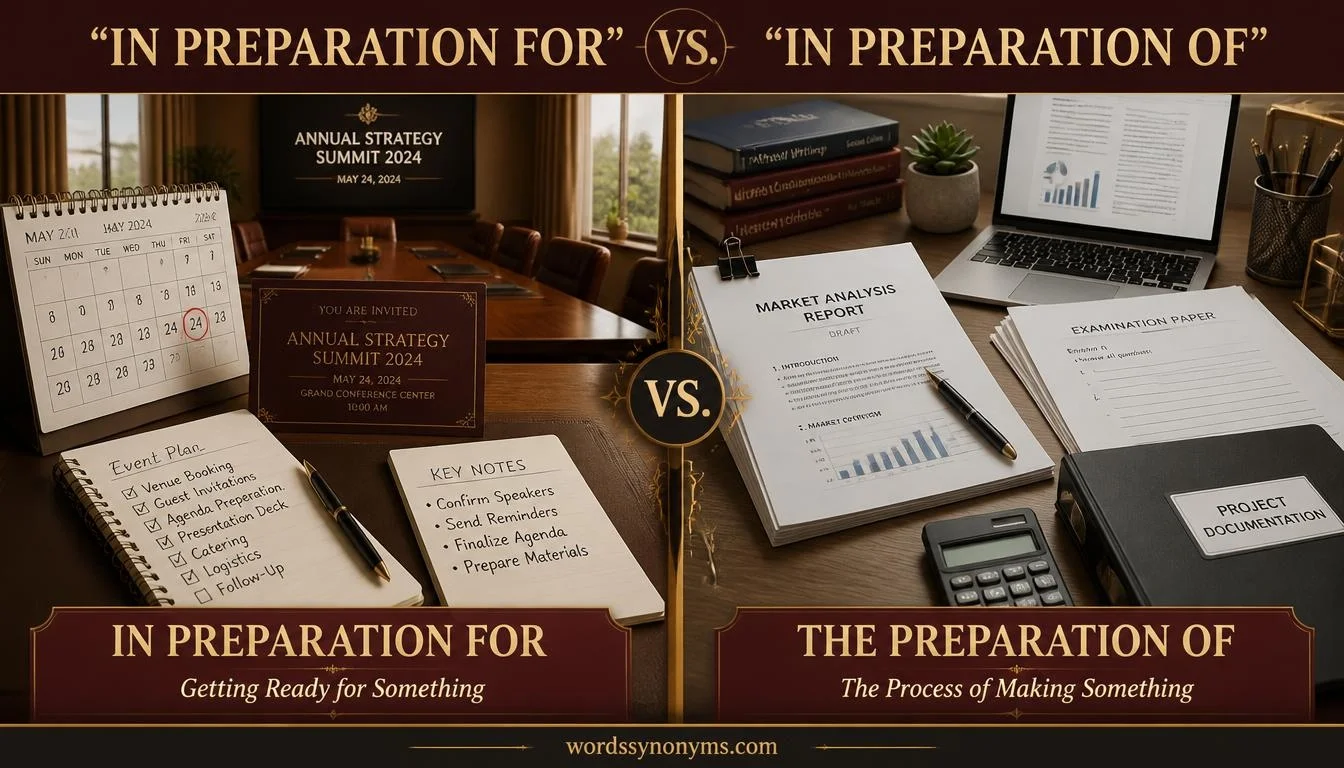
“In Preparation For” vs. “In Preparation Of”: Key Differences
The main difference concerns how each preposition connects the word preparation with the rest of a sentence.
For generally introduces the event or situation someone wants to become ready for. Of commonly introduces the thing being made or organized when used in the construction the preparation of.
Let’s examine the differences more closely.
Meaning and Purpose
The expression “in preparation for” describes advance action.
For example:
“The school organized additional classes in preparation for the entrance examinations.”
The additional classes helped students get ready for their examinations.
On the other hand, “the preparation of” describes a process.
For example:
“The preparation of the examination papers took several days.”
Here, the sentence discusses creating the examination papers rather than preparing for an examination.
Grammatical Structure
The two constructions also differ in their sentence patterns.
In preparation for:
- In preparation for + noun
- In preparation for + noun phrase
- In preparation for + gerund phrase
Examples:
- In preparation for the meeting
- In preparation for the annual conference
- In preparation for presenting the proposal
The preparation of:
- The preparation of + noun
- The preparation of + noun phrase
Examples:
- The preparation of the report
- The preparation of the annual budget
- The preparation of the conference materials
These patterns help you recognize which construction fits your sentence.
Naturalness in Everyday English
Native English speakers commonly use “in preparation for” when describing advance planning.
For example:
“We cleaned the house in preparation for the guests.”
This sounds natural and clearly communicates the purpose of cleaning.
However, the following version sounds awkward:
“We cleaned the house in preparation of the guests.”
The problem isn’t the meaning of the sentence. Readers can probably understand the intention. The problem is the preposition.
A simple correction makes the sentence natural again.
Comparison of Common Expressions
| Expression | Function | Correct example |
| In preparation for | Preparing for an event | We practiced in preparation for the show. |
| The preparation of | Creating or organizing something | The preparation of the show took weeks. |
| Prepared for | Being ready for something | The performers were prepared for the show. |
| In advance of | Before an upcoming event | The invitations arrived in advance of the show. |
| To prepare for | Getting ready for something | We practiced to prepare for the show. |
| In anticipation of | Acting because something is expected | We decorated the venue in anticipation of the show. |
Notice how each expression has a slightly different purpose. Understanding those differences helps you avoid awkward sentences.
Why Do People Confuse “In Preparation For” and “In Preparation Of”?
The confusion usually comes from the fact that English uses both for and of after the noun preparation.
Both prepositions are grammatically useful. However, their meanings depend on the construction in which they appear.
There are several reasons writers mix them up.
The Word “Preparation” Works in Different Structures
The noun preparation can describe the process of getting ready or making something.
Consider these examples:
- Preparation for the examination
- Preparation of the examination papers
Both expressions are correct, but they communicate different ideas.
In the first example, students are getting ready to take an examination.
In the second example, teachers are creating the examination papers.
Because both constructions use the same noun, writers sometimes assume they can combine them freely. That’s where the confusion begins.
The Prepositions “For” and “Of” Have Different Functions
English prepositions often establish relationships between different parts of a sentence.
The word for frequently expresses purpose, intended use, or the object of preparation.
For example:
- A plan for the future
- Training for the competition
- Preparation for the interview
The word of frequently identifies something connected with a noun or the thing being created.
For example:
- The design of the building
- The preparation of the meal
- The organization of the event
These examples show why choosing a preposition based on meaning matters more than choosing one simply because it sounds familiar.
Direct Translation Can Create Confusion
People who learn English as an additional language sometimes translate expressions directly from their native languages.
Unfortunately, prepositions rarely match perfectly across languages. A construction that sounds natural in one language might sound awkward in English.
For instance, someone might understand the general meaning of preparation of an examination and assume that in preparation of an examination follows the same pattern.
However, English grammar depends on the complete construction.
Learning expressions as complete phrases helps prevent these mistakes.
Familiar Expressions Can Influence Word Choice
Writers frequently encounter expressions such as:
- In need of
- In charge of
- In favor of
- In preparation for
Because these phrases share a similar structure, someone might mistakenly replace for with of.
However, English doesn’t follow a single preposition rule for every expression beginning with in.
The best approach is to learn which preposition naturally follows each expression.
Read more: 5 Words to Describe Someone Who Helps Others Selflessly
Common Mistakes to Avoid
Even experienced writers sometimes choose the wrong preposition when discussing preparation.
Fortunately, most mistakes are easy to correct once you understand the intended meaning.
Using “In Preparation Of” Before an Upcoming Event
This is one of the most common mistakes.
Awkward:
“The employees attended a training session in preparation of the inspection.”
Correct:
“The employees attended a training session in preparation for the inspection.”
The training session helped employees get ready for the inspection. Therefore, for is the appropriate preposition.
Confusing “Preparation Of” With “Preparation For”
These constructions aren’t interchangeable.
Incorrect for the intended meaning:
“The preparation of the examination, the students studied every night.”
Correct:
“The students studied every night in preparation for the examination.”
However, if you’re describing the creation of examination materials, preparation of works correctly.
For example:
“The preparation of the examination papers took two days.”
Using “For” When “Of” Is Needed
The opposite mistake can also happen.
Consider this sentence:
“The preparation for the annual report took several weeks.”
This sentence can be grammatical if it describes preparations made before producing or presenting the report.
However, if the intended meaning concerns actually creating the report, a more precise version is:
“The preparation of the annual report took several weeks.”
The distinction depends on what the writer wants to emphasize.
Choosing Formal Expressions When Simpler Words Work Better
Sometimes, writers use unnecessarily complicated phrases because they believe formal language sounds more professional.
For example:
“The department conducted several meetings in preparation for the implementation of the new policy.”
This is grammatically correct.
However, another version may communicate the same idea more directly:
“The department held several meetings to prepare for the new policy.”
Both sentences work. The second simply uses fewer words.
Assuming Every Published Expression Is Correct
You might encounter in preparation of in an online article, document, or advertisement.
That doesn’t automatically make it the preferred construction in standard English.
Published writing can contain regional variations, unusual phrasing, editing mistakes, or specialized terminology.
When you’re unsure, examine the meaning and sentence structure instead of copying an expression without checking it.

“In Preparation For” vs. “In Preparation Of” in Formal and Academic Writing
Choosing the correct expression becomes particularly important in professional and academic writing.
A small preposition mistake can make an otherwise polished sentence sound awkward. Fortunately, “in preparation for” works comfortably in formal reports, research papers, business correspondence, and academic assignments.
In Academic Writing
Students frequently use the expression when discussing examinations, research projects, presentations, and academic events.
Examples:
- The researchers collected preliminary data in preparation for the main study.
- Students attended additional lectures in preparation for their final assessments.
- The university revised its academic policies in preparation for the new semester.
When discussing the creation of academic materials, use the preparation of instead.
Examples:
- The preparation of the questionnaire required careful consideration.
- The preparation of the research proposal involved several revisions.
- The preparation of the examination materials took two weeks.
These examples demonstrate how the intended meaning determines the correct construction.
In Business Writing
Professional communication often involves describing activities completed before important business events.
Examples:
- The management team reviewed its objectives in preparation for the annual meeting.
- The company updated its website in preparation for the product launch.
- Employees received safety training in preparation for the inspection.
When describing the production of business materials, use the preparation of.
Examples:
- The preparation of the annual budget required input from several departments.
- The preparation of the contract involved legal and financial reviews.
- The preparation of the presentation took approximately four days.
Both expressions are appropriate in professional writing when used in their correct grammatical structures.
In Emails and Workplace Communication
You can also use in preparation for in professional emails without sounding overly formal.
For example:
“Please review the attached documents in preparation for tomorrow’s meeting.”
Another example:
“The team will conduct a short training session in preparation for the software update.”
These sentences are direct, polite, and easy to understand.
If you want a simpler alternative, try before, to prepare for, or ahead of.
For example:
“Please review the attached documents before tomorrow’s meeting.”
The best choice depends on the tone and information you want to communicate.
Read more: Bit or Bitten: Which Is Correct? Understanding the Difference
Practical Case Studies: Choosing the Correct Expression
Sometimes, the easiest way to understand grammar is to see how it works in realistic situations.
The following examples show how small changes in wording can affect meaning.
Case Study: Preparing for a University Examination
Imagine a student preparing for an important university examination.
She creates a study schedule, reviews lecture notes, and completes practice questions. These activities happen before the examination.
Correct sentence:
“She completed several practice tests in preparation for her university examination.”
Why does this work?
The practice tests help her become ready for an upcoming event. The examination is the purpose of her preparation.
Now consider a different situation.
A university department creates examination papers for its students.
Correct sentence:
“The preparation of the university examination papers took several days.”
Here, the sentence describes creating the examination materials rather than getting ready to take the examination.
Case Study: Preparing for a Business Conference
Imagine a company organizing a large business conference.
Employees arrange the venue, prepare presentation slides, and contact invited speakers.
Correct sentence:
“The employees coordinated their schedules in preparation for the business conference.”
The phrase explains why they coordinated their schedules.
However, suppose the marketing department creates the conference brochure.
Correct sentence:
“The preparation of the conference brochure required several revisions.”
The sentence focuses on producing the brochure.
These examples show why preparation for and preparation of serve different purposes.
Case Study: Preparing for a Wedding
Consider a family organizing a wedding ceremony.
They purchase decorations, arrange transportation, and prepare the guest list.
Correct sentence:
“The family decorated the house in preparation for the wedding.”
Now imagine someone describing the process of creating the wedding menu.
Correct sentence:
“The preparation of the wedding menu involved several family discussions.”
Both sentences discuss wedding-related activities. However, their grammatical structures reflect different meanings.
FAQs
1. Is “in preparation for” grammatically correct?
Yes, “in preparation for” is grammatically correct and widely used in English. It describes getting ready for an upcoming event, activity, or situation. For example, “She studied every evening in preparation for her final exams.”
2. Is “in preparation of” correct English?
“In preparation of” is generally not the standard choice when referring to getting ready for something. English speakers normally use “in preparation for” instead. However, “preparation of” is correct in other sentence structures, such as “The preparation of the report took two days.”
3. What is the difference between “in preparation for” and “in preparation of”?
The main difference lies in how each expression connects ideas. “In preparation for” introduces an upcoming event or purpose. Meanwhile, “preparation of” usually refers to creating or producing something. Their meanings depend on sentence structure.
4. Can I use “in preparation for” in formal writing?
Absolutely! “In preparation for” works well in formal emails, business reports, academic assignments, and professional documents. It’s clear, natural, and grammatically accepted.
5. What are some alternatives to “in preparation for”?
Depending on your sentence, you can use “ahead of,” “in anticipation of,” “as preparation for,” or “to prepare for.” Each alternative has a slightly different tone, so choose one that fits your meaning.
6. Why is choosing the correct preposition important?
Prepositions connect words and explain relationships between ideas. Using the wrong one can make a sentence confusing or unnatural. Choosing the correct preposition improves clarity, strengthens your grammar, and helps your writing sound more professional.
Conclusion
Choosing between “in preparation for” or “in preparation of” becomes easier once you understand how prepositions work. Although these expressions look similar, they don’t always fit the same situations. In everyday English, “in preparation for” is the more natural and widely accepted phrase when talking about getting ready for an upcoming event, task, or situation. Paying attention to this small difference can make your emails, reports, and other written messages clearer.
Before using either expression, consider what you’re trying to communicate. Read your sentence aloud and check whether the preposition connects your idea naturally. Don’t let small words undermine an otherwise well-written message. With a little practice and attention to context, you’ll make better grammar choices and feel more confident in both personal and professional communication.

Franklin Hayes is a writer and editor at WordsConfusing.com, focused on making English vocabulary, grammar, and commonly confused words easy to understand. He writes clear, practical articles with simple explanations and useful examples to help readers improve their English with confidence.
His goal is simple: Making Confusing Words Simple.