
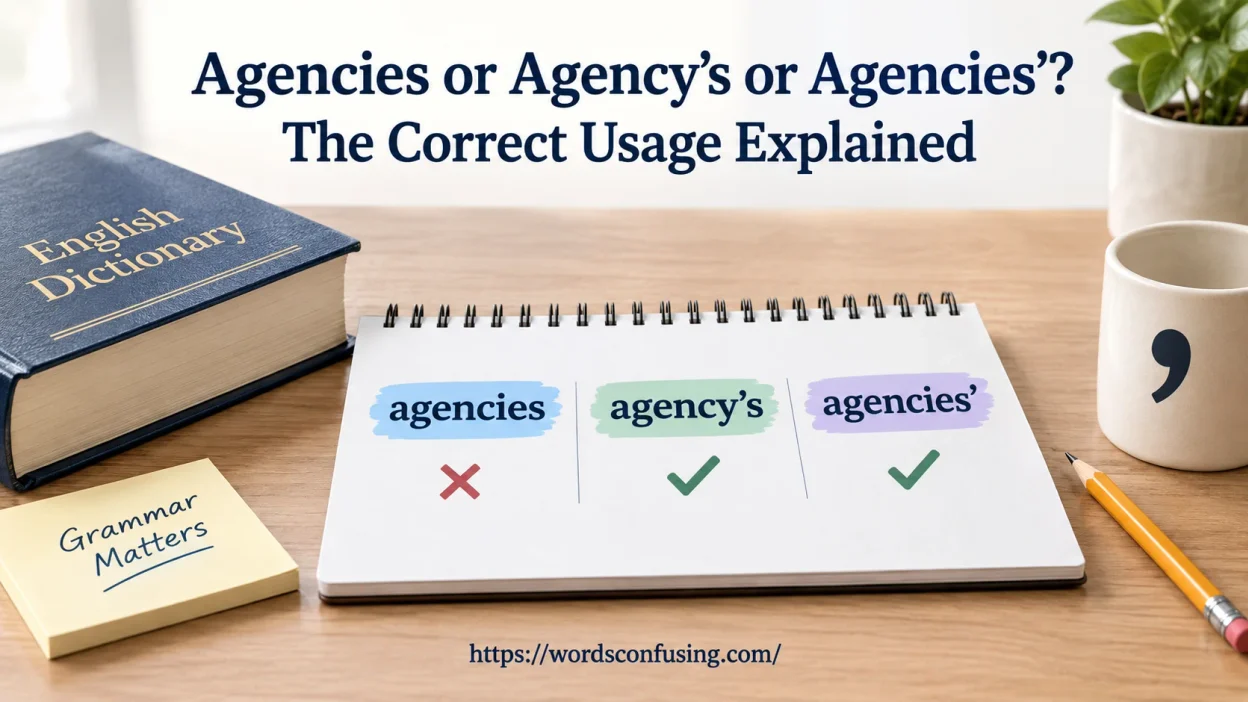
Agencies or Agency’s or Agencies’? The Correct Usage Explained makes the difference between these forms easier to understand.
In writing, business communication, and formal writing, agencies, agency’s, and agencies’ have different meaning and grammatical roles. Agencies works as the plural form, while agency’s shows the singular possessive form.
Meanwhile, agencies’ is the plural possessive form. The single apostrophe in agency’s shows that one agency owns or relates to something, whereas agencies’ shows possession involving multiple agencies.
This distinction matters in professional documents, where one small punctuation mark can affect clarity, correct usage, and professionalism. You may notice this in reports, emails, contracts, and client-facing content, especially when precise wording matters.
A practical guide should help you understand the correct possessive forms and apply the rules naturally. These forms can appear in real-world contexts such as project management, scheduling, meetings, a calendar, online booking systems, broadcasting, time management, and workplace communication.
Start by identifying whether you mean one agency, several agencies, or something connected to ownership. That quick check makes correct grammar easier and supports clear communication and accurate communication.
This article can explain the cases through simple explanations and practical examples, so you can recognize the correct form, avoid the wrong version, and reduce common punctuation mistakes in modern English.
Quick Answer
The correct form depends on whether you mean plural, singular possession, or plural possession.
| Form | What it means | Correct use | Example |
| agencies | More than one agency | Plural noun | Several agencies provide this service. |
| agency’s | Something belonging to one agency | Singular possessive | The agency’s website looks modern. |
| agencies’ | Something belonging to multiple agencies | Plural possessive | The agencies’ websites look modern. |
Here’s the easiest way to remember it:
Agencies = many agencies. Agency’s = one agency owns or has something. Agencies’ = several agencies own or have something.
Notice how the apostrophe has nothing to do with making agency plural. The apostrophe shows possession or association.
Agencies: The Correct Plural Form
Agencies is the standard plural of agency.
When you’re talking about two or more agencies, use agencies without an apostrophe.
For example:
- Several agencies submitted proposals.
- Marketing agencies often work with multiple clients.
- Government agencies released new guidelines.
- Travel agencies offer different vacation packages.
- Three agencies competed for the contract.
The word agencies simply tells readers that more than one agency exists or participates in the action.
Why Does Agency Become Agencies?
The spelling follows a common English pluralization pattern.
When a singular noun ends in a consonant followed by y, the y usually changes to i before adding -es.
So:
- agency → agencies
- company → companies
- family → families
- country → countries
- policy → policies
- university → universities
The important detail is the letter immediately before y.
In agency, the letter before y is c, which is a consonant. Therefore, the plural becomes agencies, not agencys.
Agencies Does Not Need an Apostrophe
One of the most common mistakes involves adding an apostrophe to an ordinary plural.
For example:
Several agency’s attended the conference.
That sentence is incorrect if the writer means several agencies.
The correct version is:
Several agencies attended the conference.
Why? The word agencies is simply plural. Nothing belongs to anything in that sentence.
An apostrophe isn’t needed merely because the word ends in s or because the spelling changes from y to ies.
Agencies in Everyday Writing
You’ll often see agencies in business, government, advertising, employment, travel, and public-service contexts.
Consider these examples:
- Advertising agencies create campaigns for brands.
- Recruitment agencies connect employers with job candidates.
- Government agencies administer public programs.
- Insurance agencies help customers compare policies.
- News agencies distribute information to media organizations.
In every example, agencies means more than one agency.
Agency’s: The Singular Possessive Form
Agency’s is the singular possessive form of agency.
Use it when one agency possesses, controls, operates, produces, or is associated with something.
The basic pattern looks like this:
one agency + ’s + something
For example:
The agency’s website needs an update.
The sentence refers to one particular agency. The website belongs to, represents, or is associated with that agency.
More examples include:
- The agency’s director approved the proposal.
- The agency’s office closes at five.
- The agency’s employees attended the meeting.
- The agency’s contract expires in June.
- The agency’s policy changed recently.
- The agency’s clients received an email.
In each case, agency’s refers to something connected with one agency.
Why Does Agency’s Have an Apostrophe?
The apostrophe signals a possessive relationship.
English commonly forms the singular possessive by adding ’s to the noun.
For example:
- company → company’s
- organization → organization’s
- agency → agency’s
- manager → manager’s
- school → school’s
The spelling of the base noun doesn’t change before the possessive ending.
Therefore:
agency + ’s = agency’s
The plural form works differently because agencies already ends in s.
Agency’s Doesn’t Mean More Than One Agency
This distinction matters.
If you write:
The agency’s offices are crowded.
You normally mean that the offices belong to one agency.
If you mean that several agencies have offices, write:
The agencies’ offices are crowded.
That single apostrophe position changes the number of agencies involved.
Read more: Forbade or Forbidden: Which Is the Past Tense of Forbid?
Agencies’: The Plural Possessive Form
Agencies’ is the plural possessive form of agency.
Use it when multiple agencies possess, control, operate, or have a connection with something.
The structure is:
agencies + apostrophe = agencies’
For example:
The agencies’ reports were released yesterday.
The sentence indicates that multiple agencies produced or owned the reports.
Other examples include:
- The agencies’ offices are located downtown.
- Several agencies’ websites use similar designs.
- The agencies’ policies differ considerably.
- The agencies’ representatives attended the meeting.
- The agencies’ contracts expire at different times.
Why Does the Apostrophe Come After the S?
The plural noun agencies already ends in s.
For regular plural nouns ending in s, English generally forms the possessive by adding an apostrophe after the final s.
For example:
- companies → companies’
- schools → schools’
- organizations → organizations’
- agencies → agencies’
You don’t normally add another s after the apostrophe.
Therefore:
agencies + ’ = agencies’
Not:
agencies’s
Agencies’ Does Not Mean One Agency
Consider these two sentences:
The agency’s employees attended the event.
The agencies’ employees attended the event.
The first sentence points to employees associated with one agency.
The second points to employees associated with multiple agencies.
The difference is small visually but significant grammatically.
Agencies vs. Agency’s vs. Agencies’ in a Simple Table
The three forms become easier to understand when you place them side by side.
| Form | Number | Possessive? | Example | Meaning |
| agency | One | No | The agency opened today. | One agency |
| agencies | More than one | No | Several agencies opened today. | Multiple agencies |
| agency’s | One | Yes | The agency’s office opened today. | Office belonging to one agency |
| agencies’ | More than one | Yes | The agencies’ offices opened today. | Offices belonging to multiple agencies |
This four-part comparison adds an important detail: agency itself is also a valid form.
The singular noun means one agency. Its plural becomes agencies. The singular possessive becomes agency’s, while the plural possessive becomes agencies’.
How to Tell Which Form You Need
A quick meaning test can solve most cases.
Before writing the word, ask two questions:
- Am I talking about one agency or multiple agencies?
- Am I showing possession or simply naming the agencies?
Your answers lead directly to the correct form.
Use Agencies for Multiple Agencies
Choose agencies when the word simply refers to more than one agency.
For example:
Several agencies offer emergency services.
There’s no possession here. The sentence simply identifies several agencies.
Another example:
Advertising agencies compete for major accounts.
Again, agencies is just the plural noun.
Use Agency’s for One Agency’s Possession
Choose agency’s when one agency has something associated with it.
For example:
The agency’s new campaign attracted attention.
The campaign belongs to or comes from one agency.
Try replacing agency’s with the agency has.
If the meaning still works, you probably need the singular possessive.
For instance:
The agency’s employees received training.
You could think of it as:
The agency has those employees.
The exact relationship isn’t always literal ownership. Possession in grammar can also describe association, responsibility, origin, or connection.
Use Agencies’ for Multiple Agencies’ Possession
Choose agencies’ when multiple agencies have something.
For example:
The agencies’ representatives met yesterday.
Multiple agencies have representatives. Therefore, the plural possessive form makes sense.
A useful mental rewrite is:
The representatives of the agencies met yesterday.
That longer version reveals why agencies’ works.
A Simple Possession Test
Here’s a practical trick you can use when proofreading.
Step One: Identify the Number
Ask:
Is there one agency or more than one?
- One → agency
- More than one → agencies
Step Two: Look for Possession
Ask:
Does something belong to or connect with the agency?
If no:
- agency
- agencies
If yes:
- agency’s
- agencies’
Step Three: Check the Apostrophe
If you’re referring to one agency:
agency’s
If you’re referring to several agencies:
agencies’
This three-step method works quickly because it separates number from possession.
Common Mistakes With Agencies
Certain errors appear repeatedly because the three forms look so similar.
Mistake: Writing Agency’s for the Plural
Incorrect:
Five agency’s participated in the project.
Correct:
Five agencies participated in the project.
The sentence doesn’t show possession. It simply refers to five agencies.
Mistake: Writing Agencies’ Without Possession
Incorrect:
Several agencies’ provide this service.
Correct:
Several agencies provide this service.
The apostrophe doesn’t belong because the agencies aren’t possessing anything.
Apostrophes don’t make ordinary nouns plural.
Mistake: Writing Agencies’s
Incorrect:
The agencies’s policies were different.
Correct:
The agencies’ policies were different.
The plural agencies already ends in s. Add only an apostrophe to form the possessive.
Mistake: Writing Agencys
Incorrect:
Several agencys submitted applications.
Correct:
Several agencies submitted applications.
Because agency ends with consonant + y, the plural changes y to ies.
Agencies or Agencies’ in a Sentence?
The word that follows the noun can often reveal which form you need.
Compare:
Agencies provide different services.
Here, agencies performs the role of the plural subject.
Now compare:
Agencies’ services vary widely.
Here, services are associated with multiple agencies. Therefore, agencies’ functions as a plural possessive.
Another pair makes the distinction even clearer:
Several agencies hired consultants.
Several agencies’ consultants attended the conference.
In the first sentence, agencies perform the action.
In the second, the consultants are associated with the agencies.
Agency or Agencies?
Although the main question involves apostrophes, understanding agency and agencies provides the foundation.
Agency is singular.
The agency opened a new branch.
Agencies is plural.
Several agencies opened new branches.
The spelling changes because of the standard consonant-plus-y plural rule.
Similar Singular and Plural Patterns
| Singular | Plural |
| agency | agencies |
| company | companies |
| family | families |
| policy | policies |
| industry | industries |
| university | universities |
| party | parties |
This pattern isn’t universal for every noun ending in y. If a noun ends in a vowel followed by y, it typically keeps the y and adds s.
For example:
- boy → boys
- day → days
- key → keys
- toy → toys
The distinction depends on the letter before the final y.
Agencies’ vs. Agencies’s: Which Is Correct?
The standard plural possessive form is agencies’.
For example:
The agencies’ decisions affected several businesses.
Not:
The agencies’s decisions affected several businesses.
The reason is straightforward. Agencies is already the plural form and ends in s.
Regular plural nouns ending in s generally take an apostrophe after that final s when they become possessive.
Compare:
- students → students’
- teachers → teachers’
- companies → companies’
- agencies → agencies’
This pattern keeps the spelling compact and makes the grammatical relationship clear.
Case Study: Comparing Three Nearly Identical Sentences
Consider these three sentences:
The agency hired a consultant.
The agency’s consultant attended the meeting.
Several agencies’ consultants attended the meeting.
Each sentence tells a different story.
In the first sentence, agency is simply a singular noun. One agency performs the hiring.
In the second, agency’s shows that the consultant is connected with one agency.
In the third, agencies’ shows that consultants from multiple agencies attended.
Now add the plural without possession:
Several agencies hired consultants.
This gives you all four essential forms:
| Form | Example |
| agency | The agency hired a consultant. |
| agency’s | The agency’s consultant attended. |
| agencies | Several agencies hired consultants. |
| agencies’ | The agencies’ consultants attended. |
Once you can distinguish these four forms, most related questions become straightforward.
Examples With Common Types of Agencies
The same rules apply regardless of the type of agency.
Advertising Agencies
- Several advertising agencies submitted proposals.
- The advertising agency’s campaign performed well.
- The advertising agencies’ campaigns used different strategies.
Government Agencies
- Federal agencies published new reports.
- The agency’s director issued a statement.
- The agencies’ reports covered different subjects.
Travel Agencies
- Local travel agencies offer vacation packages.
- The travel agency’s office closes at six.
- Several travel agencies’ websites list similar destinations.
Recruitment Agencies
- Recruitment agencies help employers find candidates.
- The agency’s recruiters contacted several applicants.
- The agencies’ recruiters attended the career fair.
The grammatical rule doesn’t change based on the industry.
What Does the Apostrophe Actually Do?
Understanding apostrophes generally makes agency’s and agencies’ much easier.
An apostrophe can serve several grammatical purposes in English. In possessive nouns, it helps show a relationship between one noun and another.
For example:
Sarah’s book
The book belongs to or is associated with Sarah.
Likewise:
the agency’s book
The book belongs to or is associated with one agency.
With a plural ending in s, the apostrophe usually follows the s:
the agencies’ books
That construction indicates that multiple agencies have a relationship with the books.
Apostrophes Don’t Automatically Mean Plural
This point deserves emphasis.
An apostrophe does not normally make a noun plural.
These are different:
- agency = one
- agencies = multiple
- agency’s = one agency’s possession
- agencies’ = multiple agencies’ possession
If you remember only one rule, remember this:
Plurality comes from the noun form. Possession comes from the apostrophe.
That distinction eliminates many common errors.
How Context Changes the Correct Form
Sometimes you can’t identify the correct form by looking at the word alone. You need to consider the entire sentence.
For example:
The agencies submitted their reports.
Here, agencies is plural. No apostrophe is necessary.
Now consider:
The agencies’ reports contained different information.
The reports are associated with multiple agencies. The apostrophe becomes necessary.
Compare one more pair:
The agency changed its policy.
The agency’s policy changed.
Both sentences refer to one agency. However, the first uses agency as a noun performing an action, while the second uses agency’s to connect the agency with its policy.
A Quick Editing Checklist
When proofreading agencies, agency’s, or agencies’, run through this checklist:
- Does the word mean more than one agency? Use agencies.
- Does one agency possess or have something? Use agency’s.
- Do multiple agencies possess or have something? Use agencies’.
- Are you using an apostrophe only to make a plural? Remove it.
- Did you write “agencys”? Change it to agencies.
- Did you write “agencies’s”? Usually change it to agencies’.
- Does the surrounding sentence clearly show the intended meaning? Check the entire construction.
FAQs
Is “agencies” the plural form of “agency”?
Yes. Agencies is the plural form of agency. Use it when referring to two or more agencies without showing ownership.
When should I use “agency’s”?
Use agency’s when one agency owns something or when something belongs to one agency. For example, “The agency’s office is downtown.”
What does “agencies’” mean?
Agencies’ is the plural possessive form. It shows that something belongs to or relates to multiple agencies, such as “The agencies’ policies differ.”
Is “agency’s” the same as “agencies’”?
No. Agency’s refers to possession by one agency, while agencies’ indicates possession by multiple agencies. The apostrophe placement changes the meaning.
How can I quickly remember the difference?
Think about the number of agencies first. One agency uses agency’s for possession, while several agencies use agencies’. If you simply mean more than one agency, use agencies.
Why does apostrophe placement matter in “agencies’”?
Apostrophe placement helps readers understand ownership. In agencies’, the apostrophe comes after the s because the word already represents multiple agencies.
Conclusion
Choosing between agencies, agency’s, and agencies’ becomes much easier once you focus on meaning first. Use agencies when you simply mean more than one agency, agency’s when one agency owns or relates to something, and agencies’ when several agencies share ownership or connection. The apostrophe may look like a tiny detail, but it can change the relationship your sentence describes.
When you’re writing an email, report, contract, or professional document, take a second to check the form you’ve chosen. This small habit can prevent confusing punctuation mistakes and make your writing clearer. Once you recognize whether the noun is singular, plural, or possessive, choosing the right form becomes almost automatic.

Franklin Hayes is a writer and editor at WordsConfusing.com, focused on making English vocabulary, grammar, and commonly confused words easy to understand. He writes clear, practical articles with simple explanations and useful examples to help readers improve their English with confidence.
His goal is simple: Making Confusing Words Simple.