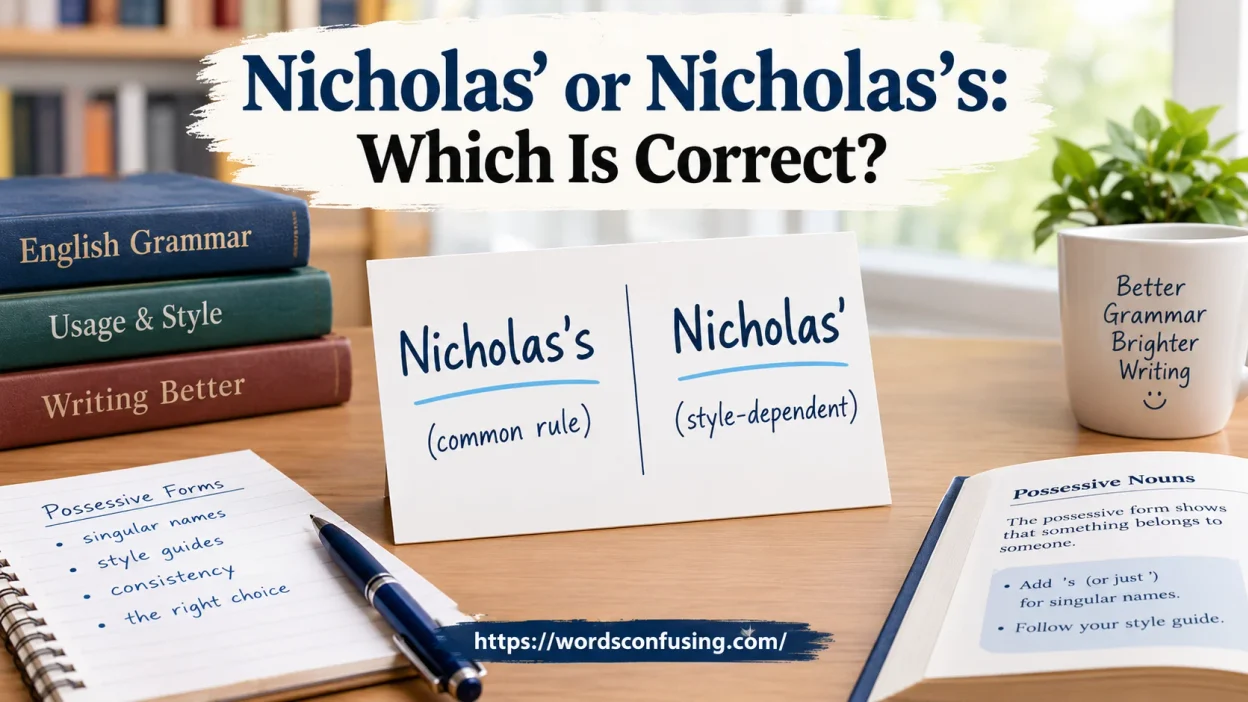
Nicholas’ or Nicholas’s: Which Is Correct? is a common grammar question about the possessive form of a proper noun.
Nicholas’ and Nicholas’s can both appear in English, depending on the style guides or stylebook you follow. Because names ending in S have special rules, forming the possessive requires attention to the apostrophe, apostrophe-s, spelling, and punctuation. In formal writing, consistency matters, so choose one accepted structure and use it consistently.
For clear writing, accurate writing, and professional writing, context also matters. The possessive forms of Nicholas can appear in emails, reports, business communication, academic communication, or everyday correspondence.
Modern style guides may differ, but their grammatical rules help you make the correct choice. When you compare Nicholas’ and Nicholas’s through practical examples, the difference becomes easier to understand.
Knowing these possessive rules gives writers more confidence when handling professional communication, documents, and other forms of English usage.
Quick Answer
Nicholas’s is generally the preferred possessive form when referring to one person named Nicholas. For example, “Nicholas’s car is outside.” However, Nicholas’ is also used by some style guides and publications. Both forms can show possession, so follow the style guide required for your writing and stay consistent.
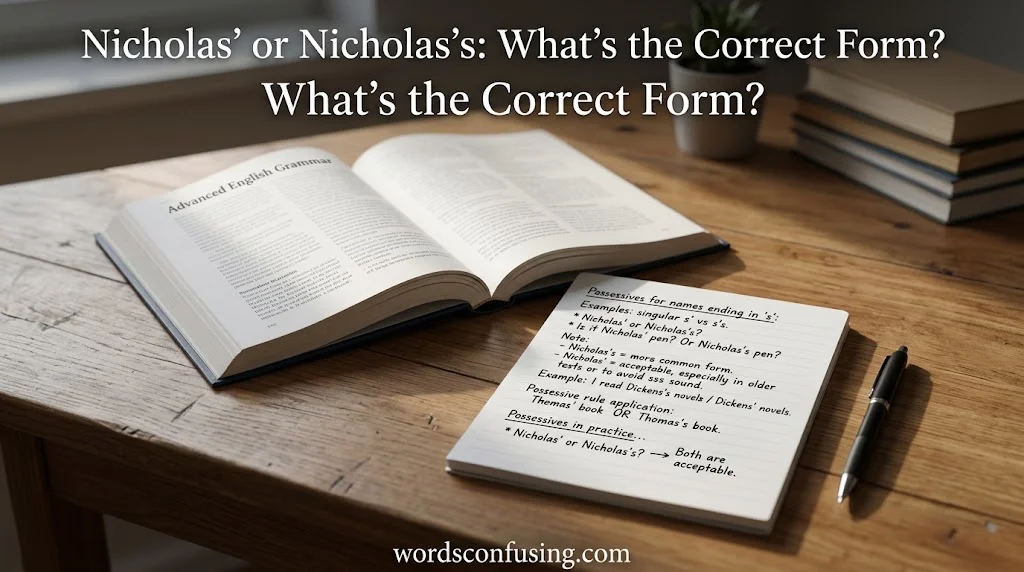
Nicholas’ or Nicholas’s: What’s the Correct Form?
The safest general answer is Nicholas’s.
When a singular name ends in s, the standard possessive pattern adds ’s:
- Nicholas → Nicholas’s
- James → James’s
- Lucas → Lucas’s
- Chris → Chris’s
- Iris → Iris’s
So if Nicholas owns a book, you can write:
Nicholas’s book is on the desk.
The apostrophe shows possession, while the additional s forms the conventional singular possessive.
That rule may look strange at first. After all, Nicholas already ends in s. Why add another one?
Because the final s in Nicholas belongs to the name itself. The added ’s marks the possessive relationship. In other words, the two s letters have different grammatical jobs.
Nicholas’s and Nicholas’: Quick Comparison
| Form | Meaning | Example | General use |
| Nicholas’s | Something belongs to one Nicholas | Nicholas’s car | Preferred by many major style systems |
| Nicholas’ | Something belongs to one Nicholas | Nicholas’ car | Used by some style conventions |
| Nicholases | More than one person named Nicholas | Two Nicholases attended | Plural |
| Nicholases’ | Something belongs to multiple people named Nicholas | The Nicholases’ homes | Plural possessive |
Notice an important distinction: Nicholas’ does not normally mean that several people named Nicholas own something.
That’s a common source of confusion.
If two people named Nicholas jointly own a business, the plural possessive would generally require a plural form first. Depending on the naming context, that can become the Nicholases’ business.
Why Is Nicholas’s Usually Considered Correct?
The basic grammar becomes much easier once you separate singular possession from plural possession.
A singular noun usually forms its possessive by adding ’s. That remains true when the singular noun already ends in s.
For example:
- the class → the class’s schedule
- the bus → the bus’s driver
- the witness → the witness’s statement
- Nicholas → Nicholas’s statement
The same principle applies to proper names.
So:
Nicholas’s phone is ringing.
means the phone belongs to Nicholas.
The possessive ending doesn’t turn Nicholas into a plural. It simply tells the reader who has the relationship with the following noun.
The Singular Rule Behind Nicholas’s
Think of the construction in two stages:
Nicholas + ’s = Nicholas’s
The original spelling stays intact. The possessive marker attaches to the complete singular name.
That gives you:
- Nicholas’s apartment
- Nicholas’s mother
- Nicholas’s computer
- Nicholas’s jacket
- Nicholas’s answer
- Nicholas’s birthday
- Nicholas’s opinion
This approach also matches the current Chicago style recommendation. The Chicago Manual of Style, including its 18th edition, recommends adding ’s to singular proper names ending in s. It gives examples such as James’s and Iris’s.
Is Nicholas’ Grammatically Correct?
Yes, Nicholas’ can be acceptable, depending on the style convention you’re following.
That’s the part that often gets lost in quick grammar explanations. Writers sometimes claim that Nicholas’ is simply wrong, but the situation is more nuanced.
Some editorial systems allow singular proper names ending in s to take only an apostrophe:
Nicholas’ car
Under that convention, the sentence is understood exactly the same way as:
Nicholas’s car
The difference is primarily style, not meaning.
This distinction matters when you’re writing for a school, publication, employer, or client. If the organization follows a particular style guide, that guide may determine which form editors expect.
Why Do Writers Use Nicholas’?
The apostrophe-only form has a long history in English publishing. It can also look cleaner because it avoids the visually awkward s’s sequence.
Compare:
- Nicholas’s decision
- Nicholas’ decision
Some readers find the second version visually smoother. Others prefer the first because it makes the grammatical structure more obvious.
Neither reaction changes the underlying meaning.
However, different style guides and publishers may make different choices. That’s why a good editor doesn’t automatically treat every Nicholas’ as a spelling error.
Nicholas’s vs. Nicholas’: What Is the Difference?
In ordinary meaning, there is usually no difference in possession between the two forms.
Both can mean:
something belonging to Nicholas
For example:
Nicholas’s car is parked outside.
and
Nicholas’ car is parked outside.
Both sentences identify Nicholas as the owner.
The difference comes from the possessive convention being used.
| Question | Nicholas’s | Nicholas’ |
| Refers to one Nicholas? | Yes | Yes |
| Shows possession? | Yes | Yes |
| Uses an apostrophe? | Yes | Yes |
| Adds another s? | Yes | No |
| Accepted in some style systems? | Yes | Yes |
| Broad general choice? | Yes | Style-dependent |
So if you’re writing without a required house style, Nicholas’s is usually the straightforward choice.
How to Make Nicholas Possessive in a Sentence
Once you know the rule, forming the possessive becomes mechanical.
Start with the singular name:
Nicholas
Then add the possessive ending:
Nicholas’s
Finally, place the possessive form before the noun it modifies.
Nicholas’s notebook is missing.
The notebook belongs to Nicholas.
Nicholas’s brother called this morning.
The brother has a family relationship with Nicholas.
Nicholas’s apartment overlooks the park.
The apartment belongs to or is associated with Nicholas.
Nicholas’s explanation made the problem easier.
The explanation came from Nicholas.
These examples all use Nicholas’s as a singular possessive.
Nicholas’s Before a Singular Noun
The pattern works naturally before singular nouns:
- Nicholas’s car
- Nicholas’s desk
- Nicholas’s book
- Nicholas’s phone
- Nicholas’s idea
- Nicholas’s office
For example:
Nicholas’s desk is next to the window.
Here, desk is singular. The possessive construction clearly identifies Nicholas as the person associated with it.
Nicholas’s Before a Plural Noun
A plural noun after the possessive doesn’t change the possessive form.
You still write Nicholas’s:
- Nicholas’s friends
- Nicholas’s parents
- Nicholas’s children
- Nicholas’s projects
- Nicholas’s neighbors
For example:
Nicholas’s friends arrived before dinner.
The word friends is plural, but the owner remains one person: Nicholas.
That distinction is worth remembering because writers sometimes assume a plural noun requires a different apostrophe. It doesn’t.
The number of the possessor determines the possessive form.
Nicholas’s or Nicholas’: The Pronunciation Question
Pronunciation creates another layer of confusion.
When people see Nicholas’s, they may wonder whether they should pronounce both s sounds separately. In ordinary speech, the possessive ending typically adds a sound rather than simply appearing silently on the page.
For many speakers, Nicholas’s sounds approximately like “Nicholas-iz.”
That’s similar to possessives such as:
- class’s
- bus’s
- witness’s
- actress’s
The spelling may look crowded, but the pronunciation follows a recognizable possessive pattern.
For example:
The bus’s engine is loud.
The possessive ending adds a syllable.
Likewise:
Nicholas’s answer surprised everyone.
The possessive ending can be heard rather than merely seen.
This pronunciation is one reason some writers prefer Nicholas’s. The written form reflects the spoken possessive more clearly.
When Is Nicholas’ Correct?
Nicholas’ becomes appropriate when the writing follows a convention that forms certain singular possessives with an apostrophe alone.
That means you shouldn’t automatically “correct” every instance of Nicholas’ to Nicholas’s without checking the required style.
For example, suppose a publication consistently uses:
- James’ book
- Charles’ house
- Nicholas’ car
- Harris’ speech
Changing only one of those to Nicholas’s could create an inconsistency.
A professional editor considers the publication’s style as a whole.
Nicholas’ Doesn’t Mean Plural
One of the biggest misconceptions involves the final apostrophe.
Some readers see:
Nicholas’
and assume it must refer to multiple Nicholases.
That’s not necessarily true.
A singular possessive can use an apostrophe alone under certain conventions. The apostrophe doesn’t automatically indicate plurality.
Compare:
Nicholas’ car
with:
the students’ cars
The first can refer to one Nicholas under an apostrophe-only style. The second refers to multiple students because students is plural.
Context does the heavy lifting.
Nicholas’ or Nicholas’s in Different Style Guides
Style guides are one reason grammar discussions about names ending in s can become surprisingly complicated.
It’s tempting to search for one universal rule. However, professional writing often operates under specific editorial systems.
Chicago Style
Current Chicago style favors Nicholas’s.
The Chicago Manual of Style says singular proper names ending in s generally form the possessive by adding an apostrophe and s. Its examples include James’s and Iris’s.
Chicago also explains that the apostrophe-only practice exists, but it does not recommend that approach for ordinary singular names.
That gives you a clear Chicago-style answer:
Nicholas’s
The distinction becomes even more interesting historically. Chicago notes that its treatment has changed over time. Earlier editions used different rules for certain names, including distinctions based on syllables and historical forms. Modern Chicago has moved toward a consistent ’s approach for personal names.
So an older book may use a form that doesn’t match today’s Chicago recommendation.
MLA Style and Family Names
MLA’s published guidance clearly distinguishes plural family names from possessive forms.
For family names ending in s, MLA gives plural forms such as:
- Myerses
- Danielses
- Forlineses
- Collinses
The plural possessive then adds an apostrophe:
- the Myerses’
- the Danielses’
- the Forlineses’
- the Collinses’
This matters because Nicholas’s and Nicholas’ concern a singular possessive, while Nicholases’ concerns a plural possessive.
Don’t mix those categories.
AP Style
AP style has its own possessive conventions, so writers working in journalism or news publishing should follow the current AP Stylebook rather than applying a general rule blindly.
This is especially important because AP style also distinguishes possessive constructions from descriptive uses of nouns ending in s.
If you’re writing for a publication that follows AP, use that publication’s current house rules or Stylebook guidance.
The Practical Rule
You don’t need to memorize every editorial manual.
Instead, use this hierarchy:
- Follow your employer’s or publication’s house style.
- If required, follow the assigned style guide.
- If no style guide applies, Nicholas’s is a clear general choice.
- Stay consistent throughout the same document.
That approach prevents most possessive-name problems.
Nicholas’s vs. Nicholas’ Side-by-Side Examples
Seeing the forms in real sentences makes the distinction easier.
| Nicholas’s | Nicholas’ |
| Nicholas’s car needs repairs. | Nicholas’ car needs repairs. |
| I borrowed Nicholas’s book. | I borrowed Nicholas’ book. |
| Nicholas’s office is upstairs. | Nicholas’ office is upstairs. |
| We visited Nicholas’s house. | We visited Nicholas’ house. |
| Nicholas’s idea solved the problem. | Nicholas’ idea solved the problem. |
| The teacher praised Nicholas’s work. | The teacher praised Nicholas’ work. |
In each pair, the basic meaning remains the same.
The variation lies in the spelling convention, not in who owns the object.
Nicholas’s or Nicholas’: Common Real-World Examples
1. Nicholas’s Car
2. Nicholas’s car is parked outside.
This means the car belongs to Nicholas.
The name is singular, so Nicholas’s follows the standard singular possessive pattern.
Nicholas’s Phone
Nicholas’s phone keeps vibrating.
Again, the phone belongs to one person named Nicholas.
Nicholas’s Parents
Nicholas’s parents are visiting this weekend.
Although parents is plural, the possessor is still one Nicholas.
Nicholas’s Friends
Nicholas’s friends organized the surprise party.
The friends belong to Nicholas in the broad relational sense. The plural noun doesn’t change the possessive spelling.
Nicholas’s Opinion
Nicholas’s opinion differed from the committee’s.
Here, the possessive identifies the source of an opinion rather than literal ownership.
That’s a useful reminder: possessive constructions don’t always express physical ownership.
They can show relationships, association, origin, authorship, or responsibility.
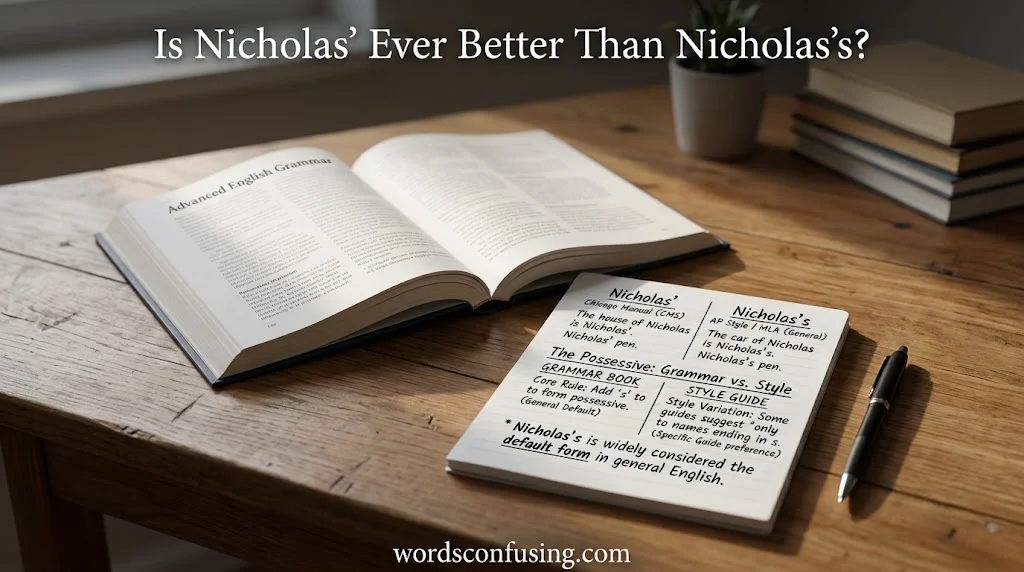
Is Nicholas’ Ever Better Than Nicholas’s?
There isn’t one universal answer.
If your style guide prefers Nicholas’, then it may be the better choice for that particular document. If your style guide recommends Nicholas’s, then the longer form is preferable.
Without a style requirement, however, Nicholas’s has a strong advantage: its grammatical structure is immediately recognizable.
It follows the familiar singular possessive pattern:
singular noun + ’s
That makes it a useful default for general American English writing.
Still, the apostrophe-only form isn’t something that needs to be treated as a catastrophic grammatical error.
The better approach is to distinguish grammar from editorial preference.
Grammar vs. Style
Grammar tells you what relationship you’re expressing.
Style tells you how your publication wants that relationship written.
That’s why two professionally edited publications can display different forms without either one being careless.
Think of it like spelling preferences such as color and colour, except the situation here involves possessive conventions rather than American and British spelling.
The underlying meaning stays intact.
Read more: Starting a Sentence With “During” Comma Rules Explained
Nicholas’ or Nicholas’s: Common Mistakes
Mistake 1: Writing Nicholass’s
A common typo is:
❌ Nicholass’s car
That’s incorrect.
The name is already spelled Nicholas. You don’t add another ordinary s before the apostrophe.
Correct:
Nicholas’s car
Mistake 2: Writing Nichola’s
Another mistake removes the final s:
❌ Nichola’s car
Unless Nichola is actually the person’s name, this changes the name itself.
Correct:
Nicholas’s car
The possessive ending doesn’t remove letters from the original name.
Mistake 3: Using Nicholas’s to Make a Plural
Don’t use an apostrophe to make multiple Nicholases.
❌ Three Nicholas’s attended the event.
That construction incorrectly treats the apostrophe as a plural marker.
A plural family-name pattern can use -es when the name ends in s:
Three Nicholases attended the event.
The apostrophe belongs to the possessive form, not the ordinary plural.
Mistake 4: Confusing Plural and Possessive Forms
Consider these four forms:
| Form | What it means |
| Nicholas | One person |
| Nicholas’s | Something belonging to one Nicholas |
| Nicholases | Multiple people named Nicholas |
| Nicholases’ | Something belonging to multiple Nicholases |
This table solves most of the confusion.
The trick is to ask two questions:
How many people named Nicholas are there?
Then:
Does the sentence show possession or association?
Once you answer those questions, the apostrophe becomes much easier to place.
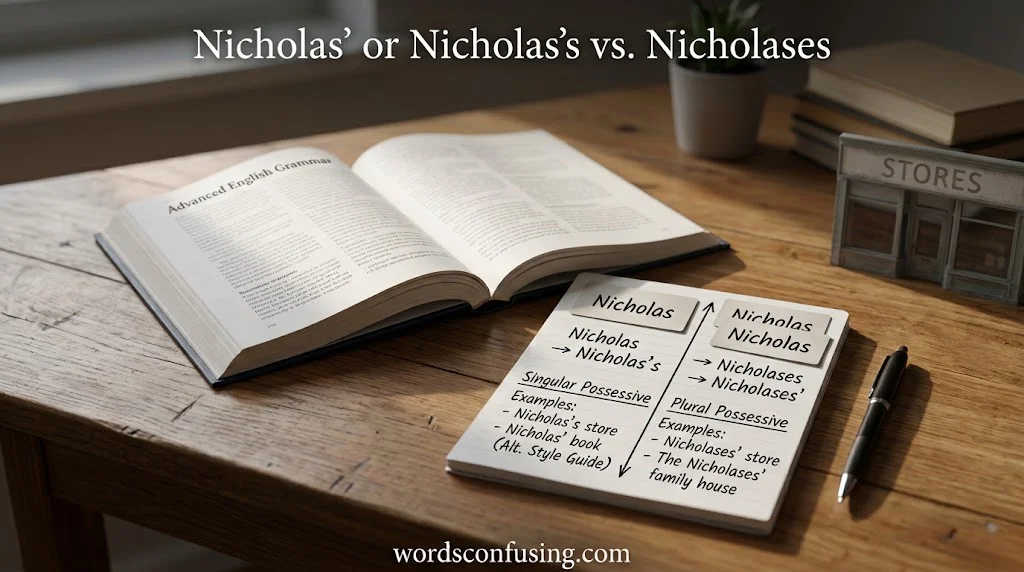
Nicholas’ or Nicholas’s vs. Nicholases
The plural form deserves special attention because names ending in s can look deceptively plural.
Suppose a classroom has two students named Nicholas.
You might write:
Two Nicholases joined the discussion.
Now suppose those two people jointly own a store:
The Nicholases’ store opened last year.
Here, Nicholases is plural. The apostrophe goes after the final s because the plural form already ends in s.
Compare that with one Nicholas:
Nicholas’s store opened last year.
The distinction is:
One Nicholas → Nicholas’s
Several Nicholases → Nicholases’
That difference is grammatical rather than merely stylistic.
MLA’s guidance for family names ending in s similarly uses -es for the plural and an apostrophe after that plural ending for the plural possessive.
Can You Use Nicholas’ in Academic Writing?
Yes, but your academic style guide matters.
If an instructor, university, journal, or publisher requires a specific style, follow it consistently.
For example, a paper following a style system that favors Nicholas’s should use that form throughout. A publication with an apostrophe-only house convention may use Nicholas’ instead.
Don’t switch forms simply because one version appears shorter.
Academic writing values consistency because inconsistent punctuation can make an otherwise polished paper look unfinished.
A Simple Academic Example
Nicholas’s argument focuses on language change.
That’s clear and conventional.
If your required style uses the apostrophe-only convention:
Nicholas’ argument focuses on language change.
The sentence still has the same meaning.
The important factor is whether the selected style permits that construction.
Can You Use Nicholas’s for a Name Pronounced With an S Sound?
Yes.
The name’s pronunciation doesn’t automatically prevent you from adding ’s.
That’s why forms such as these are possible:
- James’s
- Chris’s
- Nicholas’s
- Iris’s
- Lucas’s
The spelling may look unusual, but English already has many possessives that create a repeated s pattern.
The visual awkwardness isn’t enough to make the construction grammatically impossible.
What About Nicholas’ in Older Books?
Older books can complicate the picture.
English punctuation conventions have changed over time. A form that appears frequently in older literature isn’t necessarily the form a current style guide would recommend today.
Chicago’s historical discussion is a good example. Its early editions used a more complicated system that sometimes treated longer names ending in a sibilant differently. Chicago later moved away from those distinctions.
So if you encounter:
Nicholas’
in an older text, don’t assume the writer made a mistake.
The publication may reflect an older editorial convention.
This is particularly important when proofreading historical documents. Modernizing every apostrophe automatically can alter the original style.
Read more: Buses or Bus’s or Bus’: Which Is Correct?
How to Choose Nicholas’s or Nicholas’
When you’re writing a sentence right now, use a simple decision process.
Step 1: Is Nicholas singular?
If you’re talking about one person named Nicholas, you’re dealing with a singular possessive.
Step 2: Are you showing possession or association?
If something belongs to, comes from, or relates to Nicholas, you need a possessive construction.
For example:
Nicholas’s notebook
Step 3: Does your style guide specify the form?
If yes, follow it.
This takes priority over personal preference.
Step 4: If no style guide applies, choose a consistent default
For general American English, Nicholas’s is a strong default.
Step 5: Don’t switch forms randomly
If you use Nicholas’s in one paragraph, don’t suddenly write Nicholas’ in another unless a specific reason exists.
Consistency makes the writing easier to trust.
Quick Rule for Nicholas’ or Nicholas’s
Here’s the shortest useful rule:
Use Nicholas’s as the general singular possessive form. Use Nicholas’ when the required style convention permits or prefers the apostrophe-only form.
For everyday writing, these examples are straightforward:
- Nicholas’s car
- Nicholas’s house
- Nicholas’s idea
- Nicholas’s brother
- Nicholas’s phone
If a publication specifically uses the apostrophe-only convention, you may see:
- Nicholas’ car
- Nicholas’ house
- Nicholas’ idea
- Nicholas’ brother
- Nicholas’ phone
Both versions identify one Nicholas.
The style determines the spelling.
A Practical Cheat Sheet
| Situation | Recommended form |
| One Nicholas owns a car | Nicholas’s car |
| One Nicholas wrote an essay | Nicholas’s essay |
| One Nicholas has several friends | Nicholas’s friends |
| General American English with no house style | Nicholas’s |
| Style guide allows apostrophe-only possessives | Nicholas’ |
| Several people named Nicholas | Nicholases |
| Something belongs to several Nicholases | Nicholases’ |
Keep this distinction handy whenever a name ending in s appears in your writing.
Nicholas’ or Nicholas’s: Which One Should You Use?
For most general-purpose American English writing, Nicholas’s is the safest choice.
It clearly marks Nicholas as a singular possessor and follows the familiar singular noun + ’s pattern. Current Chicago guidance specifically recommends the ’s form for singular personal names ending in s.
However, Nicholas’ isn’t automatically an error.
Some editorial conventions use an apostrophe alone with singular proper names ending in s. That’s why you’ll encounter both forms in real-world writing.
The key is to avoid treating a style preference as a universal grammar law.
1. If you’re writing a school assignment, check the required style.
2. If you’re preparing professional copy, follow the organization’s house style.
3. If you’re writing casually with no prescribed system, Nicholas’s offers a clear and widely understood choice.
Most importantly, keep the convention consistent.
FAQs
Is Nicholas’ grammatically correct?
Yes. Nicholas’ is an accepted possessive form in some style guides. It uses an apostrophe after the final s.
Is Nicholas’s also correct?
Yes. Nicholas’s is also widely accepted. Many style guides recommend adding ’s to singular names, even when the name ends in s.
Which form should I use in formal writing?
Follow the style guide required by your school, workplace, publisher, or organization. The most important point is consistency throughout your writing.
Does the pronunciation change between Nicholas’ and Nicholas’s?
Usually, the pronunciation does not change in a meaningful way. The difference mainly involves the written possessive form and the style convention being followed.
Should I use Nicholas’ or Nicholas’s in academic writing?
Check your institution or instructor’s preferred style guide. Different systems can recommend different possessive conventions, so following the required standard is safest.
What does the possessive form of Nicholas mean?
It shows that something belongs to or is associated with Nicholas. For example, Nicholas’s book means the book belongs to Nicholas.
Conclusion
Choosing between Nicholas’ and Nicholas’s can feel surprisingly tricky, but the answer becomes clearer once you know the style you’re following. Both forms appear in established English writing, so the key is to follow the rules of your chosen style guide and stay consistent.
In casual writing, either may be understood easily, while formal or academic work may require one specific convention. When in doubt, check the style guide your school, workplace, or publication uses. Once you settle on that standard, writing the possessive form of Nicholas becomes a simple matter of consistency rather than guesswork.

Franklin Hayes is a writer and editor at WordsConfusing.com, focused on making English vocabulary, grammar, and commonly confused words easy to understand. He writes clear, practical articles with simple explanations and useful examples to help readers improve their English with confidence.
His goal is simple: Making Confusing Words Simple.