
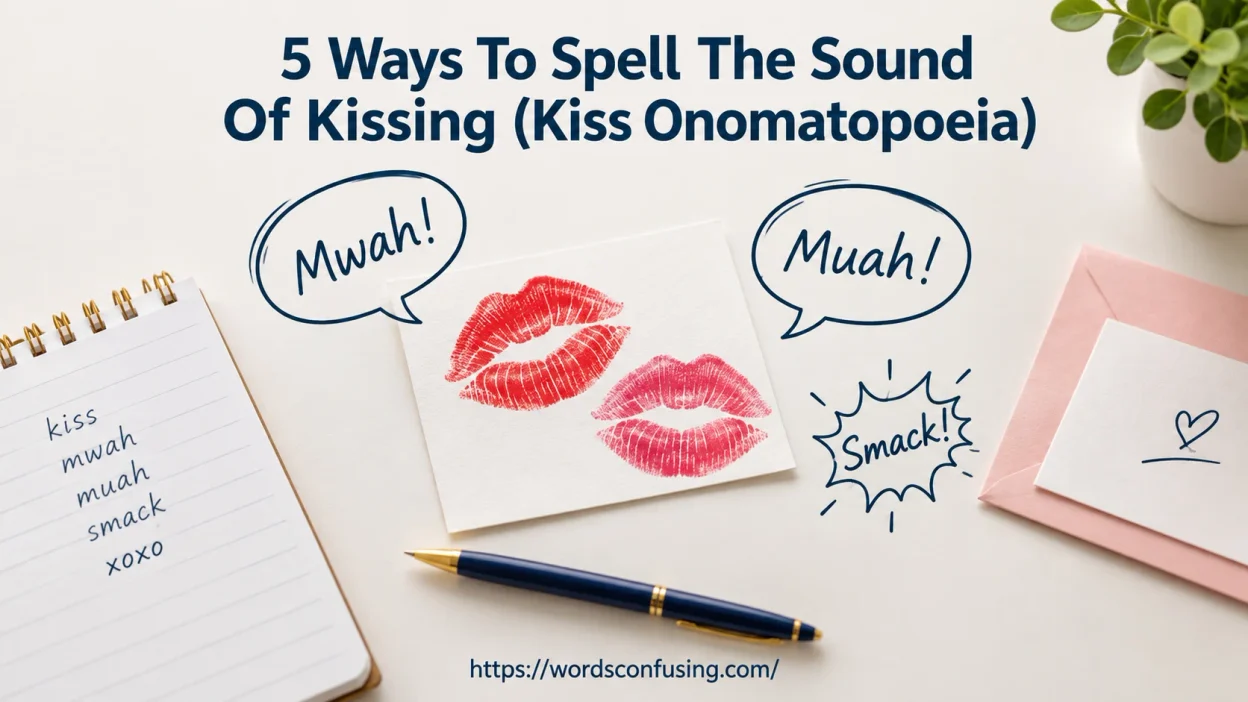
5 Ways To Spell The Sound Of Kissing helps writers use Onomatopoeia to represent the sound of a kiss naturally in English.
Instead of using a mass of words to describe it, you can spell the sound through common spellings that suggest an affectionate sound. Choosing the right form can improve clarity, readability, and natural expression. Editors and storytellers also consider the tone and context before deciding which kiss onomatopoeia works best.
From my experience with practical writing, the right spelling makes the scene easier for the reader to understand without adding unnecessary detail.
These common ways can appear in fiction, comics, subtitles, social media content, and broadcasting, although variations may influence consistency and authenticity. Strong usage depends on an understanding of grammar, style, and usage conventions, while your audience and writing purpose should guide the final choice.
A sound representation can suit casual content, yet formal writing and business communication usually need greater precision. Even meetings, project management, scheduling, time management, online booking, and calendar organization show why clear communication matters. The right spelling can improve the overall quality of your text and build confidence.
This article will explain which forms work best and explore their subtle differences.
Quick Answer
The most common ways to represent a kissing sound in informal English include:
- Mwah — a playful written kiss sound, especially for an air kiss or blown kiss.
- Muah — a common spelling variant of mwah with a softer visual appearance.
- Smack — a word that represents the sharp, audible sound of lips meeting.
- X-X-X — a symbolic way to represent multiple kisses rather than their actual sound.
- Umma — a kiss expression associated with particular linguistic and cultural contexts rather than standard American English.
For most everyday English writing, “mwah” is the safest and most recognizable choice when you want to represent a playful kissing sound.
If you want to describe a clearly audible kiss, “smack” may work better. If you’re simply signing off with kisses in a message, X-X-X can communicate the idea without pretending to reproduce the sound.
What Is Kiss Onomatopoeia?
Onomatopoeia refers to words or expressions that imitate or suggest sounds. Common examples include buzz, hiss, clang, bang, and tick-tock.
Kissing sounds are more complicated.
A kiss doesn’t produce one universal noise. The sound changes depending on how someone kisses, where the kiss lands, how much pressure the lips create, and whether the kiss happens in the air or against another surface.
That’s why English uses several informal spellings.
“Mwah” tries to capture the recognizable sound associated with an exaggerated kiss. “Smack” describes a sharper sound that can happen when lips meet firmly. “X-X-X”, on the other hand, isn’t really onomatopoeia because it represents kisses symbolically.
Think of it like drawing a sound with letters. The spelling doesn’t need to reproduce the exact acoustics. It simply needs to make the reader recognize the intended noise or action.
Sound imitation vs. symbolic representation
These categories are worth separating:
| Expression | What it represents | True sound imitation? |
| Mwah | A playful kiss or air-kiss sound | Generally yes |
| Muah | A variant of a kiss sound | Generally yes |
| Smack | A sharp kissing noise | Yes |
| X-X-X | Multiple kisses | No |
| Umma | A culturally or linguistically specific kiss expression | Depends on context |
This distinction matters because people often call every written kiss expression kiss onomatopoeia. Technically, that’s too broad.
Some expressions imitate sound. Others simply tell the reader, “This means kisses.”
Mwah — The Most Recognizable Kiss Sound
When people ask how to spell the sound of a kiss, mwah usually comes to mind first.
The spelling looks playful and sounds expressive. It commonly represents an exaggerated kiss, especially an air kiss or blown kiss. You’ll often see it in text messages, social media posts, fictional dialogue, comic-style writing, and playful conversations.
The word isn’t formal English. You wouldn’t normally use mwah in an academic paper or professional report. Its strength comes from its casual personality.
What does “mwah” mean?
Mwah represents the sound or gesture of giving a kiss. The writer uses the word to help the reader imagine pursed lips followed by a small kissing sound.
For example:
“Goodnight, sweetheart. Mwah!”
The word instantly creates a different feeling from:
“Goodnight, sweetheart.”
The second sentence communicates affection through the words alone. The first adds a little audible personality.
When should you use “mwah”?
Mwah works especially well when the kiss feels:
- Playful
- Affectionate
- Lighthearted
- Exaggerated
- Flirtatious
- Friendly
- Theatrical
- Suitable for casual texting
It also works beautifully in fictional dialogue when you want a character’s personality to come through.
Examples of “mwah”
“See you tomorrow. Mwah!”
She blew him a kiss. “Mwah!”
“Thanks for the flowers. Mwah!”
“Good luck today, darling. Mwah!”
Notice how the context does most of the heavy lifting. The same sound can feel romantic, friendly, silly, or deliberately dramatic depending on who says it.
Why does “mwah” look like a kiss?
The spelling has a visual quality that resembles the exaggerated movement of the mouth. The m sound begins the expression while the ending creates a rounded, open feel.
It isn’t a scientific transcription of what happens inside your mouth. It’s a creative English approximation.
That’s the important point.
Mwah isn’t supposed to be acoustically perfect. It’s supposed to be immediately understandable.
Muah — A Common Variant of Mwah
If mwah is the familiar classic, muah is its close cousin.
You’ll see both spellings in informal communication. Many writers use muah because the spelling feels softer or more natural to them. Others prefer mwah because it more strongly resembles the sound they have in mind.
There isn’t a universal grammar rule declaring one spelling correct and the other wrong.
What does “muah” mean?
Muah generally represents a kiss sound or affectionate kiss expression. It often appears in casual messages, romantic conversations, captions, and playful dialogue.
For example:
“Sleep well. Muah!”
Or:
“Thank you for everything. Muah!”
The intended meaning is usually obvious from context.
Mwah vs. Muah
The difference is mainly stylistic rather than semantic.
| Feature | Mwah | Muah |
| Basic meaning | Kiss sound | Kiss sound |
| Tone | Playful and expressive | Soft and affectionate |
| Common use | Texting and dialogue | Texting and dialogue |
| Formal? | No | No |
| Standardized spelling? | No | No |
| Major meaning difference | None | None |
If you’re writing for a broad English-speaking audience, mwah may feel slightly more immediately recognizable as a sound effect.
Still, muah is perfectly understandable in casual contexts.
When should you use “muah”?
Choose muah when the expression needs a softer or more affectionate feel.
It can work particularly well in:
- Romantic text messages
- Friendly chats
- Social media captions
- Playful dialogue
- Informal notes
- Character dialogue
For example:
“Okay, I’m heading to bed now. Muah!”
The spelling feels less like a comic-book sound effect and more like an affectionate sign-off.
Read more: 7 Ways to Spell the Sound of a Fart with Tone and Use
Smack — The Sound of a More Audible Kiss
Now comes a word with a slightly different job.
Smack can describe the actual sound produced by a kiss. Unlike mwah, which often represents an exaggerated or blown kiss, smack can make the physical noise feel sharper.
Imagine someone planting a loud kiss on another person’s cheek.
Smack!
You can almost hear it.
That’s why smack works especially well in fiction and descriptive writing.
What does “smack” mean?
As a sound word, smack can represent a sharp noise created when something strikes or contacts something else. In the context of kissing, it can describe an audible kiss.
For example:
She kissed his cheek. Smack!
The sound effect emphasizes the physical action.
Compare that with:
“Mwah!”
The first example sounds more like a real, audible kiss. The second sounds more playful and performative.
When should you use “smack”?
Use smack when the kiss has noticeable sound or impact.
It fits:
- Loud cheek kisses
- Comedic scenes
- Dramatic writing
- Children’s stories
- Cartoon-style dialogue
- Physical descriptions
- Playful storytelling
It can also work when a writer wants to emphasize an action rather than simply indicate affection.
Smack vs. Mwah
The distinction becomes clearer with an example.
Mwah:
“Bye! Mwah!”
This sounds like an affectionate goodbye or blown kiss.
Smack:
She kissed him loudly on the cheek. Smack!
This sounds like a physical kiss that makes an audible noise.
The two expressions overlap, but they don’t create exactly the same mental image.
Mwah feels expressive. Smack feels physical.
X-X-X — A Symbolic Way to Represent Kisses
Not every kiss expression needs to imitate a sound.
X-X-X represents kisses symbolically. You’ll commonly find this style in informal letters, notes, messages, and other casual communication.
Unlike mwah or smack, the letters aren’t intended to reproduce the noise made by kissing.
Instead, the symbols communicate the idea of kisses.
Is X-X-X kiss onomatopoeia?
Strictly speaking, no.
That’s an important distinction.
If someone writes:
“Mwah!”
they’re attempting to represent a sound.
If someone writes:
“X-X-X”
they’re using a conventional symbol to communicate kisses.
The result may communicate the same basic affection, but the mechanism differs.
Where can you use X-X-X?
This expression works best in informal settings such as:
- Personal notes
- Casual letters
- Text messages
- Online conversations
- Informal character dialogue
- Affectionate sign-offs
For example:
“Thanks for checking on me. X-X-X”
Or:
“See you soon! X-X-X”
You generally wouldn’t use this style in formal professional communication. It can look overly familiar or out of place.
X-X-X vs. XOXO
These expressions belong to the same broad world of informal affection, but they aren’t identical in every context.
X is commonly associated with a kiss in informal written communication. O can represent a hug.
Therefore, XOXO commonly communicates “hugs and kisses.”
The important takeaway is simple: these are symbols, not literal kissing noises.
Umma — A Kiss Expression With Cultural Context
Umma requires more caution than the other entries.
Unlike mwah, muah, and smack, it shouldn’t automatically be presented as a standard American-English spelling for a kissing sound.
Sound expressions often travel between languages. When they do, their meaning, pronunciation, spelling, and cultural associations can change.
That’s why context matters.
Why “umma” needs context
A reader might encounter umma in translated material, multilingual dialogue, online conversations, or writing influenced by another language.
Using it accurately requires attention to the language and cultural setting involved.
For English-language writing aimed at a general American audience, mwah is usually the clearer choice when the goal is simply to represent a kiss sound.
When might “umma” appear?
You might encounter an expression such as umma in:
- Multilingual dialogue
- Translated writing
- Cultural references
- Language-learning material
- Informal online communication influenced by another language
The safest approach is to avoid treating every kiss expression as a universal English equivalent.
Languages don’t divide sounds and emotions into identical little boxes. Each language develops its own conventions.
5 Ways To Spell The Sound Of Kissing Compared
Once the differences are clear, choosing the right expression becomes much easier.
| Kiss expression | Main purpose | Sound or symbol? | Tone | Best context |
| Mwah | Represents a kiss sound | Sound-based | Playful | Texts, dialogue, captions |
| Muah | Variant of mwah | Sound-based | Soft, affectionate | Casual messages |
| Smack | Represents an audible kiss | Sound-based | Strong, physical | Stories, comedy, dialogue |
| X-X-X | Represents kisses | Symbolic | Affectionate | Notes, texts, sign-offs |
| Umma | Language-specific expression | Context-dependent | Cultural | Multilingual contexts |
The table reveals something useful: there isn’t one “correct” kiss sound for every situation.
Instead, the best choice depends on what you want your reader to hear or understand.
How To Choose the Right Kiss Sound
Choosing a kiss sound becomes simple when you start with the scene rather than the spelling.
Ask yourself one question:
What should the reader imagine?
For a blown kiss
Choose mwah.
“See you later! Mwah!”
This works because mwah has a playful, airy quality.
For a soft affectionate message
Try muah.
“Goodnight, muah.”
The expression feels casual and intimate.
For a loud physical kiss
Use smack.
She planted a kiss on his cheek. Smack!
The reader gets a stronger sense of physical impact.
For several kisses
You can repeat a sound expression.
“1Mwah! 2Mwah!3Mwah!”
Repetition creates emphasis. It can also make the scene feel deliberately playful.
Don’t overdo it, though. Three kisses might feel cute. Twenty could feel like a punctuation avalanche.
For a symbolic sign-off
Use X-X-X.
“Take care until next time. X-X-X”
This communicates affection without pretending to reproduce an actual sound.
How To Write a Kiss Sound in Dialogue
Sound effects can add life to dialogue when you place them naturally.
The biggest mistake is using a sound simply because the scene contains a kiss. Good writing considers tone, character, pacing, and context.
Put the sound after an action
This is often the clearest structure:
She leaned over and kissed his cheek. “Smack!”
The action establishes what happened. The sound reinforces it.
Use the sound as dialogue
A character can also say:
“Mwah! Don’t forget me.”
Here, the expression behaves more like a playful verbal gesture.
Use punctuation deliberately
Punctuation changes the energy.
Mwah.
Quiet and understated.
Mwah!
Playful and energetic.
Mwah…
Soft, lingering, or teasing.
SMACK!
Very loud and dramatic.
You don’t need excessive punctuation to make a kiss noticeable. One well-placed exclamation point can do the job.
Kiss Sound Examples in Different Contexts
The same expression can feel completely different depending on the surrounding scene.
Romantic example
“Goodnight,” she whispered. “Mwah.”
The short sentence keeps the moment gentle.
Friendly example
“Thanks for helping me today. Mwah!”
Here, the expression can sound humorous and affectionate rather than romantic.
Comedic example
She grabbed his cheeks and planted an enormous kiss. SMACK!
The capitalized sound creates comic exaggeration.
Children’s fiction example
“Goodnight, little bear. Mwah!”
A simple sound can make the scene warmer and more animated.
Text-message example
Made it home safely. Mwah ❤️
The expression works naturally because texting often welcomes informal language.
Dramatic fiction example
She paused at the doorway, turned around, and blew him a kiss. “Mwah.”
Here, the sound becomes part of the character’s final gesture.
Is “Mwah” Technically Onomatopoeia?
This question deserves a careful answer.
Mwah is commonly treated as an onomatopoeic or sound-symbolic expression because it represents a kissing sound. However, it doesn’t reproduce the sound with the precision of a scientific phonetic transcription.
That’s normal.
English sound words often approximate noises rather than reproduce them perfectly.
Consider “boom.” A real explosion doesn’t literally pronounce boom. The word simply gives the reader a recognizable representation of the noise.
The same principle applies to mwah.
The spelling gives your brain enough information to construct the intended sound.
Why “smack” is different
Smack has a broader lexical history. It can describe various kinds of sharp impacts or sounds, not just kissing.
In a kissing context, the surrounding words tell the reader which meaning applies.
For example:
She kissed him. Smack!
The reader understands the sound as a kiss because the previous sentence provides the context.
Without that context, smack could describe something completely different.
Why Is It Difficult To Spell a Kiss Sound?
A kiss doesn’t behave like a bell or a clock.
There isn’t one fixed acoustic signature that every kiss produces.
Consider these situations:
- A gentle kiss may make almost no noise.
- A cheek kiss may produce a small popping sound.
- A firm kiss may create a noticeable smack.
- An exaggerated air kiss can produce a distinct playful sound.
- Multiple kisses create a rhythm rather than one isolated noise.
- A comic or theatrical kiss may be intentionally exaggerated.
That variation explains why writers use several spellings.
Writing isn’t a laboratory recording. It is a form of interpretation.
When you write “Mwah!”, you’re not claiming that every kiss sounds exactly that way. You’re giving the reader a quick auditory cue.
A Simple Case Study: One Scene, Five Different Choices
Imagine the same character saying goodbye to a friend.
The wording changes the emotional effect depending on the kiss expression.
Version A: Mwah
“See you tomorrow. Mwah!”
Effect: Playful and affectionate.
Version B: Muah
“See you tomorrow. Muah!”
Effect: Soft and casual.
Version C: Smack
She kissed him on the cheek. “Smack!”
Effect: Audible and physical.
Version D: X-X-X
“See you tomorrow. X-X-X”
Effect: Symbolic and informal.
Version E: No sound effect
She smiled and kissed him goodbye.
Effect: More natural and descriptive.
That final example matters.
You don’t always need a sound word.
Sometimes describing the action creates a stronger scene. A sound effect should add something rather than simply announce what the reader already knows.
Common Mistakes When Writing Kiss Sounds
Even simple expressions can look awkward when you use them in the wrong setting.
Treating informal spellings as formal vocabulary
Mwah and muah belong primarily to casual communication.
Avoid using them in formal reports, academic assignments, professional correspondence, or serious business writing.
Assuming every kiss sounds the same
A gentle forehead kiss doesn’t necessarily sound like a loud cheek kiss.
Choose the expression based on the physical action.
Calling X-X-X a literal sound effect
X-X-X represents kisses symbolically.
It doesn’t reproduce the sound of lips meeting.
Using “smack” for every kiss
Smack implies an audible quality. If the scene describes a barely perceptible kiss, it may feel too loud.
Overusing punctuation
“MWAH!!! ❤️❤️❤️”
Sometimes that works in an intentionally dramatic text. In normal prose, however, it can quickly become distracting.
Repeating sound effects too often
One well-placed mwah can work beautifully.
Five repetitions in every paragraph will probably feel forced.
Ignoring cultural context
Expressions that originate from or belong to another language shouldn’t automatically become interchangeable with standard American-English sound words.
Context keeps the writing accurate.
Mwah vs. Muah: Which Spelling Should You Use?
If you’re writing a general English article, story, text, or caption, mwah is an excellent default.
It’s short, recognizable, and strongly associated with an exaggerated kissing sound.
Muah also works in casual writing. The choice often comes down to personal style and the mood you’re trying to create.
Here’s a quick guide:
- Choose mwah for a recognizable kiss sound.
- Choose muah for a softer informal variant.
- Choose smack for a sharper audible kiss.
- Choose X-X-X for symbolic kisses.
- Use culturally specific expressions only when the surrounding language or context supports them.
Neither mwah nor muah should be treated as a formal spelling rule. They’re informal written representations.
Can You Spell a Kiss Sound in Different Ways?
Absolutely.
That’s one of the interesting features of informal English.
People often invent, shorten, stretch, and modify sound words to match emotion. You might see playful variations such as:
- Mwah!
- Muah!
- Mwaah!
- Mwahhh!
- Smack!
These variations aren’t standardized dictionary forms. Writers use them to change emphasis.
For instance:
“Mwah!”
feels quick and energetic.
Meanwhile:
“Mwaahhh…”
can suggest a deliberately exaggerated or drawn-out expression.
The extra letters don’t create a new grammatical category. They simply change the visual and emotional effect.
When Should You Avoid Kiss Onomatopoeia?
Sometimes silence is stronger.
If you’re writing serious literary fiction, formal prose, or a subtle romantic scene, “mwah” might break the mood.
Instead, describe the physical action:
She kissed his forehead before leaving.
Or:
Their lips met for only a moment.
Descriptive prose can create intimacy without spelling out the sound.
The same principle applies to professional communication. If you’re writing an email to a colleague, “Mwah!” probably isn’t the sign-off you’re looking for.
Unless, of course, the office has become extraordinarily informal.
FAQs
What is the onomatopoeia for a kissing sound?
Common kissing onomatopoeia includes spellings such as “muah,” “smack,” and “mwah.” The best choice depends on the tone and context of your writing.
How do you spell the sound of a kiss in writing?
You can spell a kiss as “muah,” “mwah,” or “smack.” Each spelling creates a slightly different feeling, so choose the one that fits your scene.
Is “muah” a real kissing sound?
Yes. “Muah” is a common informal spelling used to represent the sound of a kiss. You’ll often see it in dialogue, messages, comics, and social media.
What is the difference between “muah” and “mwah”?
Both “muah” and “mwah” represent a kissing sound. “Mwah” often feels more playful or exaggerated, while “muah” can look more like a simple written kiss.
Can I use “smack” for the sound of kissing?
Yes, “smack” can represent a kiss, especially when you want to suggest a noticeable or slightly loud kissing sound. It works well in fiction and comic-style writing.
Which kissing sound spelling is best for writing?
There isn’t one universal best spelling. “Muah” and “mwah” work well for playful dialogue, while “smack” can emphasize the actual sound of a kiss.
Conclusion
Finding the right way to spell the sound of a kiss can make your writing feel more natural and lively. Whether you choose a simple onomatopoeia for dialogue, fiction, comics, or social media content, the best choice depends on the scene and its tone.
A small sound can add personality, emotion, and realism when you use it at the right moment. So, instead of overthinking every spelling, consider your audience and the feeling you want the reader to experience. Choose the form that fits your writing naturally, and let the kiss speak for itself.