
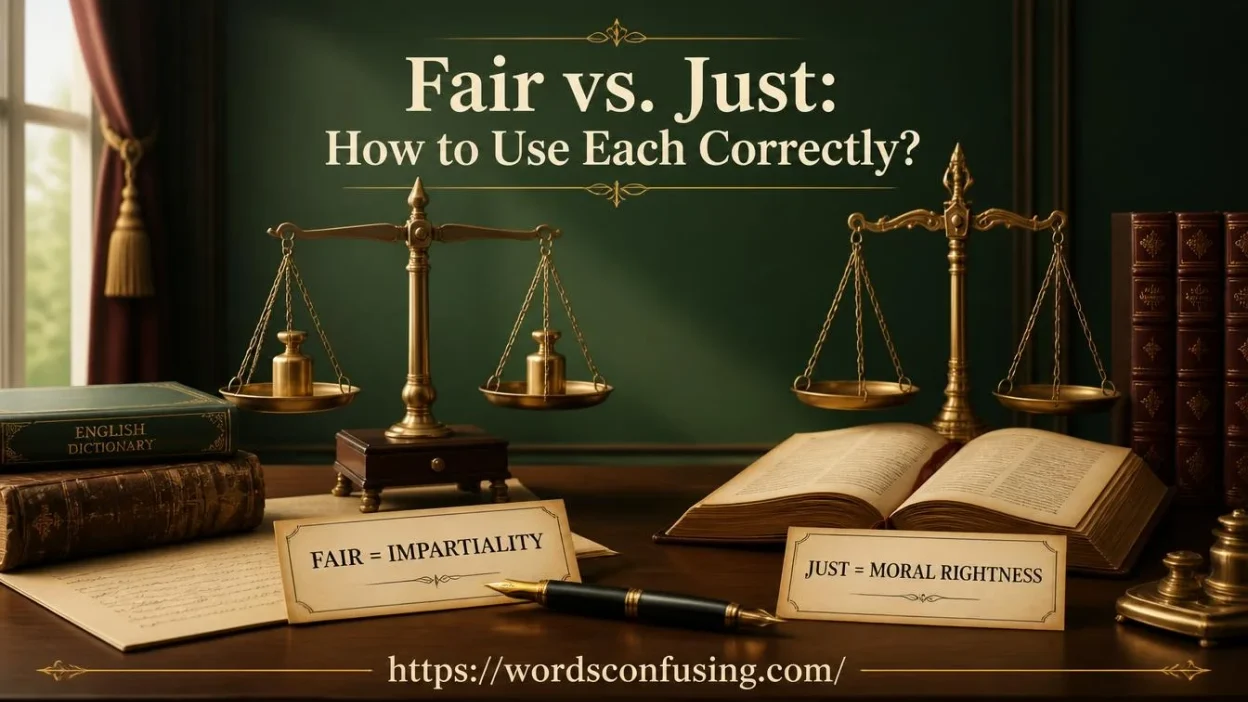
The guide Fair vs. Just: How to Use Each Correctly? explains how fairness and justice shape everyday decisions. Although fair and just seem interchangeable, they express different ideas.
Fairness focuses on equality, equal treatment, same rules, and equal opportunity. It aims for balanced outcomes through reasonable decisions. Justice considers morality, laws, principles, and what people have deserved. A just decision may account for individual circumstances, individual needs, abilities, and different needs.
For example, a teacher may make a fair decision by applying classroom rules consistently. A just response may consider a student’s unique situation and provide appropriate support. These differences matter in relationships, school, work, and daily conversations. A fair price should seem reasonable, while a just law should reflect legal standards and moral principles.
Understanding context helps English learners choose the right word, avoid common mistakes, and improve grammar, vocabulary, writing skills, and effective communication. Practical examples make formal writing, business communication, and real conversations clearer and more natural.
Quick Answer
Fair means treating people impartially and giving them equal opportunities, while just means doing what is morally right and giving people what they deserve. In simple terms, fair focuses on reasonable treatment, whereas just focuses on justice, rights, and accountability.

What Does Fair Mean?
The word fair describes something impartial, reasonable, and free from favoritism or unfair advantage. When someone treats people fairly, they consider everyone’s interests without allowing personal preferences to influence their decisions.
Fairness often involves applying consistent standards and giving people reasonable opportunities. It also means listening to different perspectives before reaching a conclusion.
For example, imagine a manager choosing an employee for promotion. Instead of selecting a close friend, the manager evaluates each applicant’s experience, performance, and qualifications. This approach demonstrates fairness because the manager considers relevant information rather than personal relationships.
However, fairness doesn’t always require identical treatment. Different people sometimes need different forms of support to receive genuinely equal opportunities.
Consider these everyday examples:
- In education: A teacher gives every student an opportunity to participate in classroom discussions.
- At work: A manager evaluates employees using consistent performance standards.
- In relationships: Two siblings receive an opportunity to explain their sides during an argument.
- In sports: A referee applies the same rules to both competing teams.
- In business: A company offers customers transparent prices without hidden charges or favoritism.
What Are the Main Characteristics of Fairness?
Several characteristics help explain what fairness looks like in practice.
Impartiality: Fair decisions don’t favor someone simply because of personal relationships, popularity, or social position.
Consistency: People should follow the same relevant standards when circumstances are comparable.
Equal opportunity: Everyone should receive a reasonable chance to participate, compete, or succeed.
Transparency: Fair decisions involve clear expectations and understandable reasons.
Reasonableness: Fair treatment considers the circumstances rather than following rules blindly.
These characteristics work together. A decision might appear consistent but still produce an unreasonable result when important differences exist.
For instance, requiring every employee to work identical hours might seem equal. However, flexible scheduling could provide fairer opportunities for employees with different responsibilities.
Synonyms and Related Words for Fair
Several English words express ideas similar to fairness. However, each carries slightly different shades of meaning.
| Synonym | Meaning |
| Equitable | Fair and appropriate according to individual circumstances |
| Impartial | Not favoring one person or side |
| Unbiased | Free from personal prejudice or favoritism |
| Evenhanded | Treating different people or sides consistently |
| Objective | Based on facts rather than personal feelings |
| Reasonable | Sensible and appropriate under the circumstances |
| Equal | Having the same status, rights, or opportunities |
For example, impartial emphasizes freedom from favoritism, while equitable considers what different people need.
You can use these words when discussing fair treatment, balanced decisions, and equal opportunities.
Read more: Can You Start a Sentence With “For”? Grammar Rules and Examples
What Does Just Mean?
The word just describes something morally right, deserved, or consistent with principles of justice. It often relates to fairness, ethical behavior, individual rights, and appropriate consequences.
A just decision considers more than whether everyone receives identical treatment. It examines whether people receive what they deserve according to relevant moral principles, responsibilities, and established rules.
For example, imagine an employee discovers that a company hasn’t paid workers for overtime. Requiring the company to provide the missing wages represents a just outcome because employees deserve compensation for their work.
Similarly, a court may impose different penalties on two defendants because their actions and circumstances differ. If those differences justify the outcomes under applicable law, different sentences can reflect justice rather than favoritism.
Here are several practical examples:
- In law: A court considers evidence and applies relevant legal principles before reaching a verdict.
- At work: An employee receives payment for completed work and approved overtime.
- In relationships: Someone takes responsibility after causing harm and makes a reasonable effort to repair the damage.
- In education: A student receives an appropriate consequence after violating established academic rules.
- In society: People receive protection for their legal rights regardless of their background.
What Are the Main Characteristics of Justice?
Justice involves several important principles that guide moral and legal decisions.
Moral correctness: A just action aligns with ethical principles and considers what is right.
Rights and responsibilities: Justice recognizes that people have rights and corresponding obligations.
Accountability: People should take responsibility for their actions and their consequences.
Proportionality: Consequences should reflect the seriousness of an action and relevant circumstances.
Equality under the law: Legal systems should apply established protections and obligations without improper discrimination.
Deserved outcomes: People should receive what they are entitled to or what their actions reasonably warrant.
Justice doesn’t always mean giving everyone the same thing. Sometimes, different circumstances require different responses to protect people’s rights and interests.
For example, a student who accidentally breaks a classroom window may deserve a different consequence from someone who deliberately damages school property. Treating both situations identically would ignore an important distinction.
Synonyms and Related Words for Just
The word just has several synonyms, depending on the context.
| Synonym | Meaning |
| Righteous | Morally good or ethically correct |
| Ethical | Consistent with accepted moral principles |
| Moral | Related to principles of right and wrong |
| Deserved | Earned or appropriately received |
| Principled | Guided by strong moral beliefs |
| Lawful | Permitted or recognized by law |
| Upright | Honest and morally responsible |
| Equitable | Fair according to relevant circumstances |
These words aren’t interchangeable in every sentence. For instance, lawful describes something permitted by law, while righteous emphasizes moral goodness.
Likewise, a decision can be lawful without necessarily resolving every moral concern.
Fair vs. Just: What Are the Key Differences?
The main difference between fair and just concerns what each concept emphasizes.
Fairness focuses on impartiality, reasonable treatment, and equal opportunities. Justice focuses on moral principles, individual rights, responsibilities, and deserved outcomes.
Although these ideas overlap, they answer slightly different questions.
- Fairness asks: Are people receiving impartial and reasonable treatment?
- Justice asks: Is this decision morally right, and are people’s rights and responsibilities respected?
Consider a workplace where every employee receives the same annual bonus. The company follows one consistent policy, which might appear fair.
However, employees who contributed significantly more may reasonably question whether identical bonuses reflect their contributions. A compensation system that considers agreed performance standards could better address what employees deserve.
Neither identical treatment nor different treatment automatically guarantees fairness or justice. The circumstances matter.
Fairness Focuses on Equal and Impartial Treatment
Fairness generally examines how people experience a decision or process.
It asks whether everyone receives a reasonable opportunity and whether personal bias influences the outcome.
For example, imagine two students applying for the same scholarship. The school evaluates both applicants using identical academic requirements and financial eligibility criteria.
If the school follows those requirements consistently, it demonstrates procedural fairness.
However, fairness also requires attention to relevant differences. A student facing financial hardship may qualify for additional assistance under an established scholarship policy.
This doesn’t necessarily violate fairness. Instead, it can help address different circumstances through reasonable standards.
Fairness commonly appears in situations involving:
- Equal opportunities.
- Consistent rules.
- Unbiased evaluations.
- Honest communication.
- Reasonable expectations.
- Balanced treatment.
- Freedom from favoritism.
The central idea is simple: Fairness means treating people impartially while considering circumstances that genuinely matter.
Justice Focuses on What Is Right and Deserved
Justice looks beyond the immediate appearance of equal treatment.
It considers whether a decision respects people’s rights, recognizes their responsibilities, and addresses wrongdoing appropriately.
For example, suppose an employer refuses to pay an employee for completed overtime hours. The employee has performed additional work and deserves the compensation required by the applicable agreement and law.
Requiring the employer to provide that payment addresses the underlying injustice.
Justice commonly involves:
- Protecting individual rights.
- Recognizing responsibilities.
- Addressing wrongdoing.
- Providing appropriate remedies.
- Applying legal and moral principles.
- Holding people accountable.
- Considering what individuals deserve.
The central idea is that justice means upholding what is morally or legally right under the relevant circumstances.
Can Something Be Fair but Not Just?
Yes. A decision can appear fair because everyone receives identical treatment, yet still produce an unjust outcome.
This usually happens when a decision-maker ignores important differences between people’s circumstances.
Consider a school that requires every student to complete an examination within one hour. The rule applies equally to everyone.
However, a student with an approved disability accommodation may need additional time. Refusing that accommodation simply because everyone must follow identical conditions could create an unjust disadvantage.
Another example involves workplace compensation.
Imagine a company gives every employee the same salary regardless of job responsibilities, qualifications, or agreed working conditions. The policy treats everyone identically, but it might fail to recognize legitimate differences in their work.
These examples illustrate an important point:
Equal treatment doesn’t automatically guarantee an equitable or just result.
Can Something Be Just but Not Fair?
This question requires careful attention because justice and fairness overlap considerably.
A decision can follow legitimate moral or legal principles while still appearing harsh, unequal, or unreasonable to someone affected.
For example, imagine two people commit the same offense under comparable circumstances. A court applies the same appropriate legal penalty to both defendants.
One defendant may feel the punishment is unfair because of personal difficulties. However, those feelings alone don’t establish that the decision lacks justice.
Another example involves workplace accountability.
An employer investigates misconduct and dismisses an employee after following established procedures. The decision might be justified by the evidence and relevant employment rules, even if the employee considers the outcome unfair.
However, justice doesn’t excuse arbitrary decisions or disregard for individual circumstances. A genuinely just process should consider relevant evidence, rights, and appropriate procedures.
Fair vs. Just: Comparison Table
The following table summarizes the most important differences between these two words.
| Comparison | Fair | Just |
| Basic meaning | Impartial and reasonable | Morally right or deserved |
| Main focus | Treatment and opportunities | Rights and moral principles |
| Central concern | Avoiding favoritism | Upholding justice |
| Common emphasis | Equality and impartiality | Accountability and responsibility |
| Decision-making | Consistent and unbiased standards | Ethical and legal principles |
| Typical contexts | Relationships, education, workplaces | Law, ethics, society |
| Related noun | Fairness | Justice |
| Opposite | Unfair | Unjust |
Remember that these distinctions describe common patterns rather than absolute rules. Fairness and justice often work together, especially when decisions affect people’s rights and opportunities.
Equality vs. Equity: How They Relate to Fairness and Justice
Understanding equality and equity makes the difference between fair and just even clearer.
Although people sometimes use these terms interchangeably, they describe different approaches to treatment and opportunity.
Equality means giving people the same resources, rights, or opportunities.
Equity means considering different circumstances and providing appropriate support to address relevant disadvantages.
Consider a classroom where three students have different learning needs.
An equality-based approach might provide every student with identical learning materials and the same amount of assistance.
An equity-based approach might provide additional tutoring or accessible materials to students who need them.
<blockquote> Equality gives everyone the same resources. Equity considers what different people need to access comparable opportunities. </blockquote>
Neither approach automatically guarantees justice. The decision must still respect individual rights, relevant responsibilities, and reasonable standards.
A Practical Example of Equality and Equity
Imagine three employees working for the same company.
- Employee A has extensive experience and works independently.
- Employee B is new and needs additional training.
- Employee C has a disability and requires reasonable workplace accommodations.
Giving everyone identical training and workplace arrangements might appear equal.
However, providing different support based on legitimate needs could create more equitable working conditions.
This distinction helps explain why fairness doesn’t always mean treating everyone exactly alike.
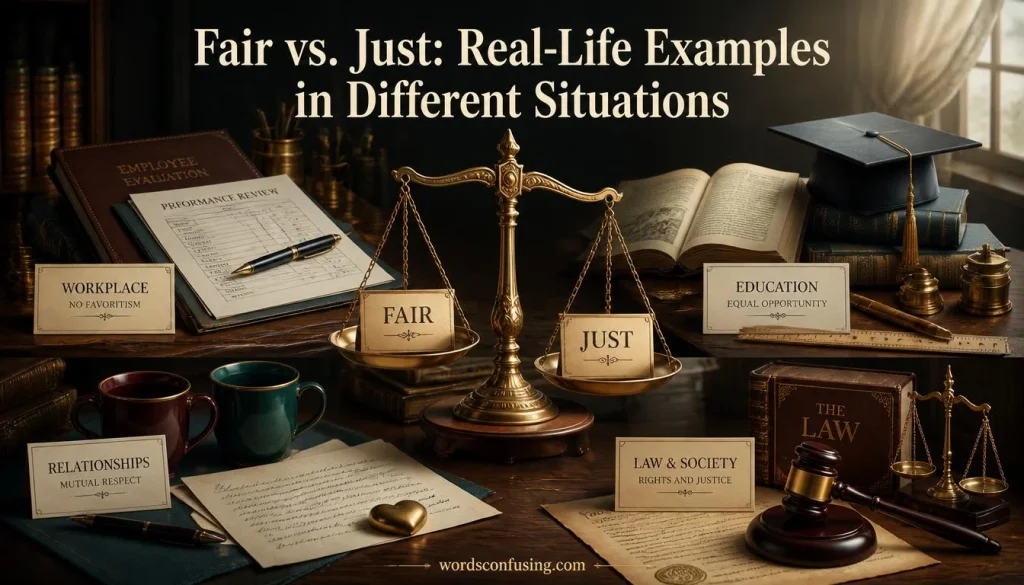
Fair vs. Just: Real-Life Examples in Different Situations
The difference becomes easier to understand when you examine ordinary situations. Fairness and justice influence decisions at work, school, home, and throughout society.
Fair vs. Just in the Workplace
Workplaces regularly involve decisions about promotions, salaries, responsibilities, and employee conduct.
Fairness requires employers to use consistent standards and avoid favoritism. Justice requires them to respect employees’ rights and address workplace wrongdoing appropriately.
Consider these examples:
Example 1: Employee promotions
A manager evaluates every applicant using the same qualifications and performance criteria. This demonstrates fairness because the manager avoids personal favoritism.
Example 2: Unpaid overtime
An employee works additional approved hours but receives no overtime compensation. Requiring the employer to provide the payment legally or contractually owed addresses justice.
Example 3: Workplace misconduct
Two employees violate different workplace policies. Their manager investigates both incidents and considers their seriousness before deciding appropriate consequences.
Applying identical penalties without considering the differences might not produce a just result.
Example 4: Equal opportunities
A company advertises an internal promotion and allows every qualified employee to apply. This supports fairness by providing an impartial opportunity.
Fair vs. Just in Education
Schools and universities must balance consistent academic standards with individual learning needs.
Fairness means students should receive unbiased treatment and reasonable opportunities to demonstrate their abilities.
Justice means schools should respect students’ rights, enforce appropriate academic standards, and address misconduct responsibly.
Consider these situations:
- A teacher gives every student the same examination instructions.
- A school provides approved accommodations for students with disabilities.
- A university investigates plagiarism before imposing academic penalties.
- A teacher grades assignments according to clearly explained assessment criteria.
- A school provides additional learning support to students who need it.
A useful distinction appears when comparing identical examinations with reasonable accommodations.
Students should demonstrate the required knowledge and skills. However, some students may need different arrangements to demonstrate those abilities effectively.
Fair vs. Just in Relationships
Personal relationships depend on trust, mutual respect, and reasonable expectations.
Fairness means listening to different perspectives rather than automatically supporting your closest friend or family member.
Justice involves recognizing responsibility and addressing harm when someone behaves dishonestly or causes damage.
Imagine two siblings arguing about a broken household item.
A parent who listens to both children before deciding what happened demonstrates fairness. If one sibling deliberately caused the damage, requiring that child to take responsibility addresses justice.
Other examples include:
- Dividing household responsibilities according to reasonable expectations.
- Listening to both partners during disagreements.
- Respecting personal boundaries.
- Apologizing after causing emotional harm.
- Sharing expenses according to agreed arrangements.
- Avoiding favoritism when resolving family disagreements.
Fairness helps maintain balanced relationships. Justice helps ensure that people respect each other’s rights and responsibilities.
Fair vs. Just in Law and Society
Legal systems provide particularly useful examples because fairness and justice influence different aspects of legal decision-making.
Fairness in law involves impartial procedures, equal legal protections, and consistent treatment under established rules.
Justice in law involves protecting rights, addressing wrongdoing, and providing appropriate legal remedies.
For example, a defendant should receive a meaningful opportunity to present a defense. This reflects procedural fairness.
If the evidence establishes wrongdoing, an appropriate legal consequence may serve justice.
However, legal decisions and moral judgments aren’t always identical. A law may be valid and enforceable while still raising broader ethical questions.
That distinction explains why discussions about social justice often extend beyond whether someone has technically followed existing rules.
Case Studies: Understanding Fairness and Justice Through Practical Situations
The following fictional case studies illustrate how these concepts work in realistic circumstances.
Case Study: Equal Pay vs. Appropriate Compensation
Imagine a company with two employees working in different positions.
Both employees receive identical monthly salaries despite having different responsibilities and agreed compensation arrangements.
The company argues that equal salaries demonstrate fairness because neither employee receives preferential treatment.
However, the employees question whether the arrangement reflects their actual responsibilities and contractual entitlements.
Fairness perspective: The company applies the same salary policy to both employees.
Justice perspective: The company should honor applicable agreements and consider legitimate differences in responsibilities and compensation entitlements.
The lesson is that identical payments don’t automatically establish fair or just compensation.
Case Study: Classroom Rules and Disability Accommodations
A teacher announces that every student must complete an examination within 60 minutes.
One student has an approved accommodation allowing additional examination time.
Another student argues that providing extra time gives the first student an unfair advantage.
However, the accommodation addresses a documented need and supports access to the same academic assessment.
Fairness perspective: Students should follow consistent academic standards.
Justice perspective: Students should receive appropriate accommodations that protect their access to education.
The lesson is that reasonable differences in treatment can support fairness rather than undermine it.
Case Study: Punishment for Different Actions
Imagine two employees accidentally damage company equipment.
The first employee immediately reports the accident and explains what happened. The second employee knowingly hides the damage and provides misleading information during the investigation.
A manager who considers both situations carefully may recommend different consequences.
Fairness perspective: Both employees receive an opportunity to explain their actions.
Justice perspective: The consequences reflect the differences between an honest mistake and deliberate dishonesty.
The lesson is that identical penalties aren’t always appropriate when the circumstances differ.
Common Expressions and Phrases Using Fair and Just
Both words appear in everyday expressions, professional communication, and formal writing. Understanding these combinations helps you use them naturally.
Common Expressions With Fair
| Expression | Meaning | Example |
| Fair treatment | Impartial and reasonable treatment | Every employee deserves fair treatment. |
| Fair decision | A reasonable and unbiased decision | The manager made a fair decision. |
| Fair chance | A reasonable opportunity | Give everyone a fair chance. |
| Fair share | An appropriate portion | Everyone contributed their fair share. |
| Fair play | Following rules honestly | Fair play matters in every competition. |
| Fair competition | Competition without improper advantages | The organization promotes fair competition. |
| Fair price | A reasonable price | The seller offered a fair price. |
| Fair judgment | An impartial assessment | The teacher provided a fair judgment. |
These expressions frequently appear in discussions about relationships, business, education, and sports.
Common Expressions With Just
| Expression | Meaning | Example |
| Just decision | A morally or legally appropriate decision | The judge reached a just decision. |
| Just punishment | An appropriate consequence | The penalty reflected a just punishment. |
| Just cause | A legitimate reason or justification | The employee challenged the dismissal without just cause. |
| Just society | A society guided by justice | Equal rights help build a just society. |
| Social justice | Fair treatment and protection of rights across society | Social justice includes addressing discrimination. |
| Just reward | Something appropriately earned or deserved | Her promotion was a just reward for her efforts. |
| Just treatment | Treatment consistent with justice | Every person deserves just treatment. |
| Just outcome | An outcome consistent with moral or legal principles | The investigation produced a just outcome. |
One additional distinction matters: just can also function as an adverb meaning simply, exactly, or only.
For example:
- I just finished my homework.
- That’s just what I needed.
- She arrived just before noon.
These sentences don’t use just in the sense of moral justice.
Fair vs. Just: Example Sentences
Examples help you recognize how each word works in natural English. The following sentences demonstrate common uses in different contexts.
Examples of Fair in Sentences
- The teacher gave every student a fair opportunity to participate.
- Everyone deserves fair treatment regardless of personal background.
- The manager made a fair decision after reviewing the applications.
- We agreed to divide the expenses into fair shares.
- The referee ensured fair play throughout the match.
- Customers expect fair prices and honest business practices.
- She wanted a fair chance to explain her actions.
- The company introduced fair policies for all employees.
- Both teams received a fair opportunity to compete.
- His parents tried to be fair when resolving the disagreement.
Examples of Just in Sentences
- The judge delivered a just verdict after reviewing the evidence.
- Every employee deserves a just reward for their contributions.
- The organization works toward creating a just society.
- She believed the punishment was just and appropriate.
- A just decision should respect everyone’s legal rights.
- The employee requested compensation for unpaid work.
- Accountability is essential to maintaining a just system.
- The court considered whether the sentence was proportionate.
- He wanted to make things right after causing harm.
- A just society protects people from discrimination.
Contrasting Sentences Using Fair and Just
These sentence pairs highlight the difference more directly.
| Fair | Just |
| The teacher gave everyone a fair opportunity. | The school provided appropriate accommodations. |
| The manager used fair hiring practices. | The company respected employees’ legal rights. |
| Both students received fair treatment. | The school addressed the misconduct appropriately. |
| The referee applied the rules fairly. | The competition protected every participant’s rights. |
| Everyone received a fair share. | Each person received what they were entitled to. |
Notice how the first column emphasizes treatment and opportunities. The second emphasizes rights, responsibilities, and appropriate outcomes.
Common Mistakes When Using Fair and Just
Although these words share similar meanings, several common mistakes can create confusion.
Assuming Fair and Just Always Mean the Same Thing
The most common mistake involves treating both words as exact synonyms.
Although fairness and justice overlap, they emphasize different ideas.
For example, a teacher may apply identical examination rules to everyone. That approach can demonstrate procedural fairness.
However, a student with an approved accommodation may need additional time. Recognizing that need can support a more equitable and just educational arrangement.
Using Fair When You Mean Morally Right
Sometimes, just communicates the intended meaning more accurately.
Consider these sentences:
- The punishment was fair.
- The punishment was just.
The first sentence suggests that the punishment was reasonable and impartial.
The second emphasizes that the punishment was deserved or morally appropriate.
Both sentences can work, but their emphasis differs.
Using Just When You Mean Impartial
The opposite mistake happens when someone uses just to describe a situation involving impartial treatment.
For example:
- The manager made a fair decision.
- The manager made a just decision.
Both are grammatically correct. However, fair decision emphasizes impartial judgment, while just decision emphasizes moral or legal correctness.
Choose the expression that communicates your intended meaning.
Confusing Equality With Equity
Equality and equity are related but different concepts.
Equality focuses on providing the same treatment or resources. Equity considers relevant differences and individual circumstances.
For example, giving every student identical learning materials demonstrates equal treatment. Providing accessible materials to a student with a disability addresses a specific educational need.
Understanding this difference prevents the mistaken assumption that fairness always requires identical treatment.
Assuming Legality and Justice Are Interchangeable
Something can comply with existing laws without resolving every moral concern.
For example, a company may follow its local employment laws while still maintaining workplace policies that employees consider ethically questionable.
Likewise, a morally appealing decision may conflict with an existing legal requirement.
Therefore, lawfulness and justice are connected but not identical concepts.
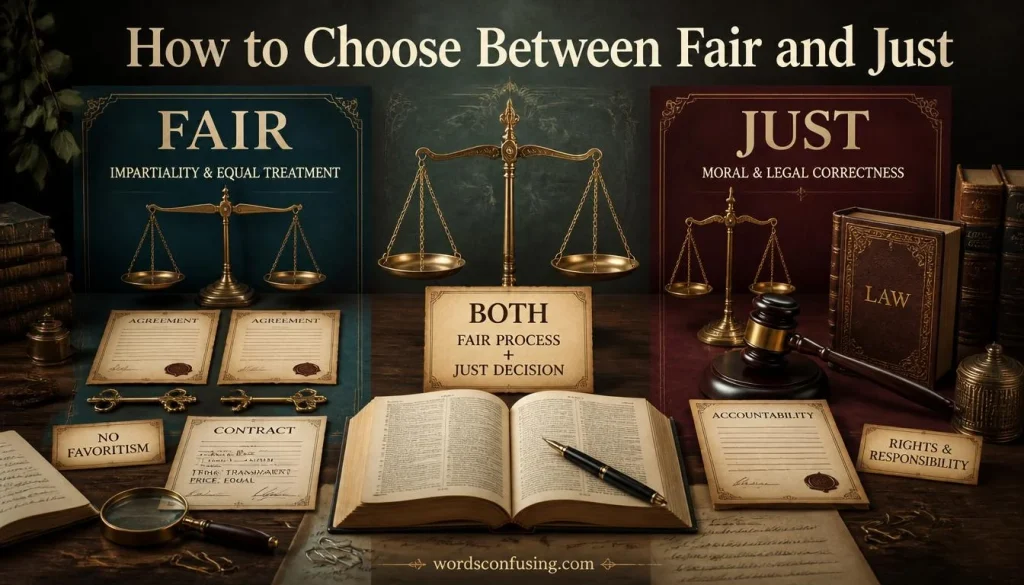
How to Choose Between Fair and Just
Choosing the correct word becomes easier when you identify the main idea behind your sentence.
Ask yourself whether you’re discussing impartial treatment or moral correctness.
Choose Fair When Discussing Impartiality
Use fair when your sentence focuses on:
- Equal opportunities.
- Unbiased decisions.
- Consistent treatment.
- Reasonable prices.
- Honest competition.
- Balanced arrangements.
- Freedom from favoritism.
Examples:
- Every employee deserves a fair opportunity for promotion.
- The teacher gave both students a fair hearing.
- We agreed on a fair price for the furniture.
- The referee ensured fair competition.
Choose Just When Discussing Moral or Legal Correctness
Use just when your sentence focuses on:
- Moral principles.
- Legal rights.
- Accountability.
- Deserved consequences.
- Ethical responsibilities.
- Appropriate punishment.
- Justice within society.
Examples:
- The court delivered a just verdict.
- Workers deserve a just reward for their efforts.
- A just society protects everyone’s basic rights.
- The punishment reflected the seriousness of the offense.
Use Both Words When the Context Requires Them
Sometimes, fairness and justice work together.
For example:
“The school established fair procedures and made a just decision after investigating the incident.”
Here, fair describes the process, while just describes the decision’s moral appropriateness.
This combination communicates both ideas without treating them as identical.
Read more: “Here Is” or “Here Are”: Which One Is Correct?
FAQs
1. Are fair and just the same in meaning?
Not exactly. Fair usually means treating people equally and following consistent rules. Just focuses on what is morally right, reasonable, or deserved. Both words express positive ideas, but they apply to different situations.
2. Can a decision be fair but not just?
Yes. A decision may follow the same rules for everyone but still ignore individual needs. For example, giving every student the same deadline seems fair. However, allowing extra time to a student facing an unusual difficulty may be more just.
3. When should you use fair instead of just?
Use fair when discussing equal treatment, reasonable prices, balanced opportunities, or consistent rules. For example, “The manager made a fair decision.” Here, fair describes a decision that treats everyone reasonably.
4. When is just the better word to use?
Use just when discussing morality, laws, rights, and deserved treatment. For example, “Everyone deserves to live in a just society.” The word just emphasizes moral principles and justice rather than simple equality.
5. Can fair and just be used interchangeably?
Sometimes, yes. Both words can describe something right or reasonable. However, their meanings aren’t always identical. A fair price focuses on reasonable value, while a just law focuses on moral and legal principles.
6. How can English learners remember the difference between fair and just?
Think of fair as equal or reasonable treatment and just as morally right or deserved treatment. Remembering this simple distinction makes word choices easier. Reading examples and noticing how native speakers use both words can also improve your English.
Conclusion
Understanding the difference between fair and just helps you choose words that express your thoughts more accurately. Although both describe something right or reasonable, they don’t always mean the same thing. Fairness focuses on equal treatment, consistent rules, and balanced opportunities. Justice goes further by considering individual needs, moral values, and what someone truly deserves. Sometimes, giving everyone the same thing seems fair, but recognizing different circumstances leads to a more just outcome.
As you improve your English, pay attention to how these words appear in everyday conversations, professional writing, and real-life situations. Use fair when discussing reasonable treatment or equal opportunities. Choose just when referring to moral principles, rights, laws, or deserved outcomes. A little attention to context can prevent common vocabulary mistakes and make your sentences sound more natural.

Shafiq Ur Rehman is a writer and content contributor at WordsConfusing.com. He enjoys exploring the English language, common word confusions, vocabulary, and practical writing tips. His goal is to make English easier to understand through clear, simple, and useful articles.