The guide to Maximal vs. Maximum: What’s the Difference? explains why these similar terms carry distinct meanings in mathematics and everyday use.
Maximum clearly names the highest value, amount, or limit. Maximal describes an element or result that cannot be extended under given conditions. In a set, a greatest element equals or exceeds every other element, while a maximal element has no larger comparable element. This distinction matters in partially ordered sets, optimization, graph theory, computer science, and abstract algebra.
In everyday speech, the difference may seem minor, but precise word choice matters in academic writing and technical explanations. A maximum speed is the highest permitted speed; a maximal result is the greatest outcome within specific constraints. Check the context, intended meaning, and grammatical role before choosing either term.
Maximum can function as a noun or adjective, whereas maximal is usually an adjective. These checks help learners and writers avoid confusion, improve clarity, and communicate with accuracy in scientific and everyday settings.
Quick Answer
- Maximum refers to the greatest amount, number, value, or permitted limit. It works as both a noun and an adjective.
- Maximal means reaching or representing the greatest possible degree or extent. It functions as an adjective.
- Example: “The maximum capacity is 100 people” uses maximum as a noun modifier. “The treatment produced a maximal response” uses maximal as an adjective.
In short, use maximum when referring to an upper limit or highest value. Use maximal when describing the greatest possible degree or extent, particularly in technical contexts.

What Does Maximum Mean?
The word maximum refers to the greatest amount, number, degree, or value that something can reach or allow. It identifies an upper boundary that something cannot exceed within a particular situation.
You encounter this word in everyday life more often than you might realize. Speed limits, examination scores, room capacities, and spending limits all involve maximum values.
For example, a parking garage might allow vehicles up to 6 feet tall. That measurement represents its maximum height limit. Similarly, if an examination offers 100 points, 100 is the maximum possible score.
The word maximum has two main grammatical functions. It can work as a noun or an adjective depending on its position and purpose.
Maximum as a Noun
As a noun, maximum identifies the highest possible amount, level, or limit. It can stand independently in a sentence because it names the upper boundary itself.
Consider a school that allows 30 students in each classroom. The number 30 represents the maximum enrollment for that room.
Here are some additional examples:
- The maximum for this examination is 100 points.
- The room has a maximum of 50 occupants.
- The temperature reached a maximum of 95 degrees.
- You can withdraw a maximum of $500 daily.
- The company recorded a maximum of 2,000 sales in one month.
Notice how maximum names a specific limit in each sentence. You don’t need another noun immediately after it to complete its basic meaning.
Maximum also has two accepted plural forms:
- Maximums: Commonly used in everyday English, especially when discussing separate limits or measurements.
- Maxima: The traditional Latin-derived plural, frequently used in mathematics and scientific writing.
For example:
- The maximums for these three machines are different.
- The graph contains two local maxima.
Both forms are correct, but their preferred contexts differ.
Maximum as an Adjective
As an adjective, maximum describes the greatest amount, highest level, or largest permitted capacity of something. It usually appears before a noun that it modifies.
For instance, a highway sign might display a maximum speed of 65 miles per hour. Here, maximum describes the speed limit rather than naming the limit independently.
Consider these examples:
- The maximum speed on this road is 65 mph.
- Our team needs maximum efficiency during production.
- The building has a maximum capacity of 200 people.
- She received the maximum possible score.
- The machine operates at maximum power.
In each example, maximum gives information about another noun. It identifies the highest permitted or possible amount associated with that noun.
A useful tip: If you can replace maximum with “highest allowed” or “greatest possible” before a noun, you’re probably using its adjective form correctly.
What Does Maximal Mean?
Maximal is an adjective that describes something as reaching or representing the greatest possible degree, extent, or intensity. It emphasizes the highest level that a particular condition or situation can attain.
Although its meaning closely resembles maximum, its grammatical function differs. You cannot normally use maximal as a noun to identify an upper limit.
The word appears frequently in scientific, mathematical, medical, and technical discussions. Writers use it when describing the greatest possible response, intensity, performance, or extent.
For example, an athlete might reach a maximal heart rate during an exercise test. This describes a very high physiological response under the conditions of the test.
Other examples include:
- The experiment required maximal precision.
- Researchers aimed for maximal efficiency.
- The treatment produced a maximal response.
- The athlete demonstrated maximal effort during training.
- The machine operated under maximal pressure.
In these sentences, maximal describes the degree or extent of a particular quality. It doesn’t independently identify a numerical upper limit.
Maximal as an Adjective
The word maximal functions as an adjective in standard English. It modifies nouns by describing their greatest possible degree or extent.
You can place it directly before a noun or use it after a linking verb in an appropriate sentence.
For example:
- The researchers achieved maximal accuracy.
- The patient’s response was maximal under the tested conditions.
- The system was designed for maximal efficiency.
- The athlete maintained maximal effort throughout the exercise.
These examples show how maximal adds information about a quality, condition, or performance level.
However, context matters. A maximal result doesn’t necessarily mean an absolute maximum under every imaginable condition. It may represent the greatest result possible within a particular experiment, system, or set of restrictions.
Where Is Maximal Commonly Used?
Although maximal appears in general English, specialized subjects use it more frequently. Its meaning often relates to a defined condition or measurable degree.
Here are some common areas where you’ll encounter it.
Science and research
Scientific writing uses maximal to describe the greatest response or intensity observed under specific experimental conditions.
Examples:
- Maximal response
- Maximal concentration
- Maximal efficiency
- Maximal absorption
Medicine and exercise physiology
Medical and sports science discussions use the word when describing physiological limits or intense responses.
Examples:
- Maximal heart rate
- Maximal oxygen uptake
- Maximal muscle contraction
- Maximal exercise capacity
Mathematics
Mathematics uses maximal in specific technical expressions. For example, a maximal element in an ordered set is an element that has no strictly greater element within that set.
A maximal element isn’t necessarily the greatest element. This distinction matters in mathematical terminology.
Technology and engineering
Technical descriptions may use maximal to explain the greatest degree of performance or response within a defined system.
Examples:
- Maximal operating efficiency
- Maximal load capacity
- Maximal system response
The important point is that maximal describes a degree or extent. Its specialized uses may carry precise meanings beyond ordinary conversational language.

Maximal vs. Maximum: Key Differences
Now that both words have clear definitions, comparing them side by side makes their differences easier to remember.
The main distinction involves grammatical function. Maximum can identify an upper limit or describe the highest possible amount. Maximal describes something that reaches the greatest possible degree or extent.
Their meanings overlap considerably. However, you cannot always replace one with the other without changing the sentence’s grammatical structure or intended meaning.
| Feature | Maximal | Maximum |
| Part of speech | Adjective | Noun and adjective |
| Basic meaning | Greatest possible degree or extent | Greatest possible amount, value, or limit |
| Everyday usage | Less common | More common |
| Technical usage | Common | Common |
| Can stand alone as a noun? | No | Yes |
| Example | Maximal performance | Maximum performance |
Let’s examine the differences more closely.
Difference in Meaning: Maximal vs. Maximum
Both words connect to the idea of reaching the highest possible level. However, they emphasize slightly different aspects of that idea.
Maximum often identifies the highest value, amount, or boundary within a particular situation. It can refer to a measurable limit or the greatest permitted quantity.
For example:
- The maximum temperature today will reach 100 degrees.
- The maximum number of participants is 40.
- The maximum score for this test is 150 points.
In these examples, maximum identifies a specific upper limit.
Maximal, on the other hand, describes something at its greatest possible degree or extent. It emphasizes the intensity, extent, or level of a particular quality.
For example:
- The athlete demonstrated maximal strength during testing.
- The researchers aimed for maximal accuracy.
- The treatment produced a maximal response.
The distinction becomes clearer when you consider what each word describes. Maximum can name the limit itself, while maximal characterizes something as reaching the greatest possible degree.
Difference in Grammatical Usage
Grammar provides the clearest way to distinguish these words. Even when their meanings overlap, their parts of speech determine where they belong.
Maximum can function as either a noun or an adjective.
As a noun:
- The maximum is 100.
- We reached the maximum.
- The maximum was recorded yesterday.
As an adjective:
- The maximum speed is 80 mph.
- The maximum weight is 200 pounds.
- The machine reached maximum capacity.
Maximal functions as an adjective.
Examples:
- The researchers observed maximal growth.
- The athlete achieved maximal performance.
- The system delivered maximal efficiency.
You cannot normally use maximal independently as a noun.
Compare these sentences:
| Incorrect or correct? | Sentence | Explanation |
| Incorrect | The maximal is 100. | Maximal cannot function as a noun here. |
| Correct | The maximum is 100. | Maximum identifies the upper limit. |
| Correct | The maximal value was recorded. | Maximal modifies the noun value. |
| Correct | The maximum value was recorded. | Maximum also modifies the noun value. |
Remember this simple rule: Maximum can stand alone as a noun, but maximal needs a noun or another appropriate grammatical structure.
Difference in Everyday and Technical Usage
Another noticeable difference involves where people commonly use these words.
Maximum appears in everyday conversations, workplace instructions, advertisements, educational materials, and technical documents.
For example, you might hear:
- The maximum speed is 60 miles per hour.
- You can bring a maximum of two bags.
- This phone offers maximum storage capacity.
- The restaurant accepts a maximum of 20 reservations.
These expressions sound natural because maximum clearly communicates a limit or highest amount.
Maximal appears more often in specialized descriptions. Scientists, researchers, medical professionals, and mathematicians use it when discussing the greatest possible degree of something.
For example:
- The patient achieved maximal oxygen uptake.
- Researchers measured maximal muscle contraction.
- The algorithm identifies a maximal independent set.
Using maximal in everyday writing isn’t grammatically wrong. However, it can sound unnecessarily technical when a simpler word communicates the same idea.
Read more: Comma Before or After “Instead”? Complete Grammar Guide
When to Use Maximum vs. Maximal
Choosing between maximum and maximal becomes easier when you consider the sentence’s purpose.
Ask yourself whether you’re identifying an upper limit or describing the greatest possible degree. Then check whether your sentence needs a noun or an adjective.
When to Use Maximum
Choose maximum when referring to the highest amount, number, value, or permitted limit.
It works particularly well in situations involving measurable quantities, restrictions, and boundaries.
Use maximum when:
- You need a noun to identify an upper limit.
- You’re describing the highest permitted amount.
- You’re discussing a measurement or numerical value.
- You’re explaining a capacity, speed, weight, or score.
- You want natural wording for everyday communication.
Consider these examples:
Example 1: Maximum capacity
The conference hall has a maximum capacity of 500 people.
Here, maximum describes the highest number of people the hall can accommodate.
Example 2: Maximum speed
The maximum speed on this highway is 70 miles per hour.
The word identifies the highest permitted speed.
Example 3: Maximum score
She received the maximum score in her mathematics examination.
Here, maximum functions as a noun because it identifies the highest possible score.
Example 4: Maximum efficiency
The company wants to achieve maximum efficiency without increasing production costs.
In this sentence, maximum modifies the noun efficiency.
Example 5: Maximum weight
This elevator has a maximum weight limit of 1,000 kilograms.
The word describes the highest permitted load.
When to Use Maximal
Choose maximal when describing something that reaches the greatest possible degree or extent.
It works particularly well in scientific, medical, mathematical, and technical contexts.
Use maximal when:
- You’re describing the greatest possible intensity.
- You’re discussing a physiological or scientific response.
- You’re writing about mathematical concepts involving maximal properties.
- You’re describing performance or effectiveness within defined conditions.
- The established technical expression uses maximal.
Consider these examples:
Example 1: Maximal heart rate
The athlete reached maximal heart rate during the final stage of the exercise test.
Here, maximal describes the highest heart rate reached under the testing conditions.
Example 2: Maximal precision
The laboratory equipment requires maximal precision to produce reliable measurements.
The adjective describes the highest degree of precision required.
Example 3: Maximal response
Researchers observed a maximal response after adjusting the experimental conditions.
The word describes the greatest response achieved during the experiment.
Example 4: Maximal effort
The players demonstrated maximal effort during the championship match.
Here, maximal emphasizes the greatest possible level of effort.
Example 5: Maximal oxygen uptake
The exercise specialist measured the athlete’s maximal oxygen uptake during a fitness assessment.
This expression refers to the highest rate of oxygen consumption an individual can achieve during intense exercise.
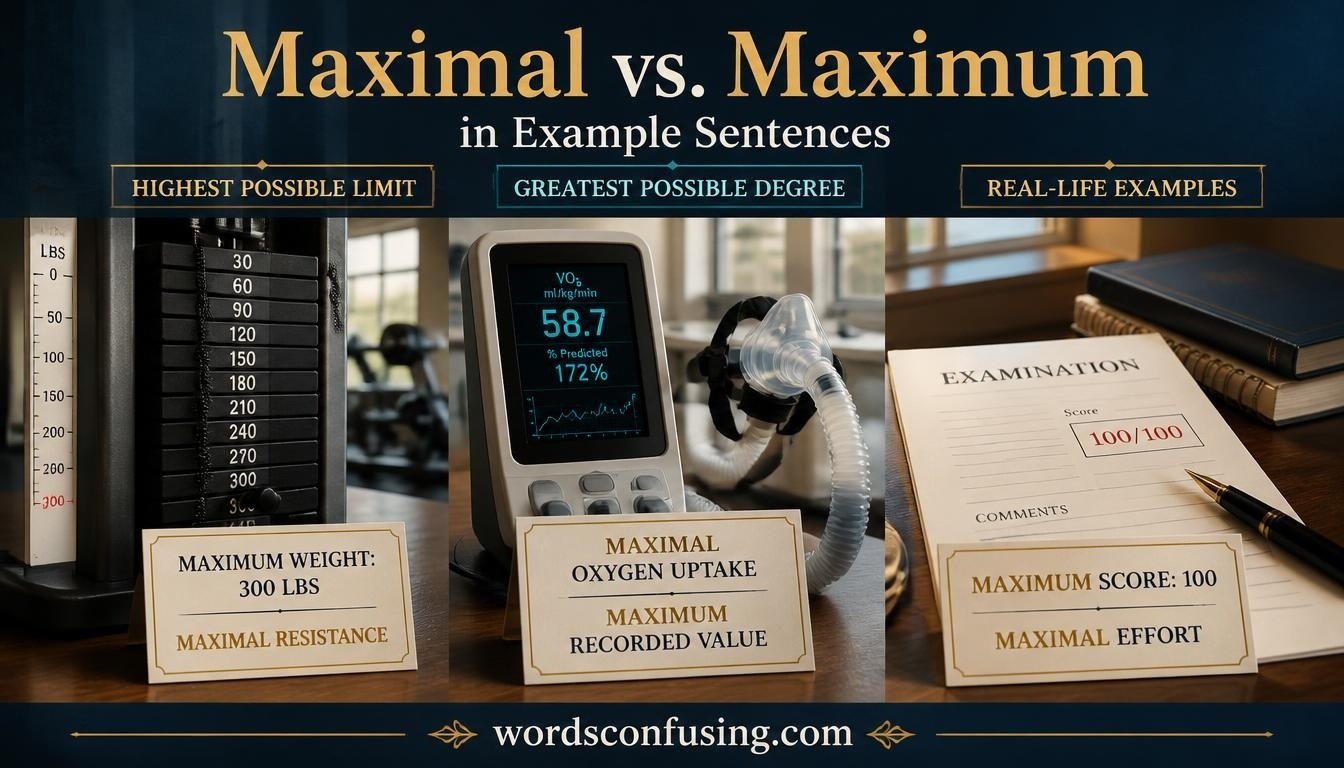
Maximal vs. Maximum in Example Sentences
Sometimes, the best way to understand two similar words is to see them in actual sentences.
The following examples show how both words work in different situations.
| Maximum | Maximal |
| The maximum speed is 100 mph. | The engine reached maximal performance. |
| The maximum temperature is 40°C. | The material demonstrated maximal resistance. |
| The maximum capacity is 50 people. | The treatment produced a maximal response. |
| We reached the maximum possible score. | The team demonstrated maximal effort. |
| The maximum pressure is 200 psi. | The experiment required maximal precision. |
| The maximum output was recorded yesterday. | The researchers measured maximal output. |
| The maximum number of participants is 25. | The study examined maximal participation. |
Notice that some examples allow both words to modify the same noun. However, their suitability depends on context and established terminology.
For instance, maximum output commonly identifies the highest output value. Meanwhile, maximal output can emphasize output at the greatest possible level under particular conditions.
Neither word automatically makes a sentence more accurate. The intended meaning should determine your choice.
Real-Life Usage Examples
Let’s look at a few practical situations where the distinction becomes especially useful.
Case study: A gym’s weight limit
Imagine a gym installs a new exercise machine with a weight limit of 300 pounds.
You could write:
- The maximum weight allowed on this machine is 300 pounds.
- The machine must support maximal resistance during testing.
The first sentence identifies a specific safety limit. The second describes the greatest resistance involved in a testing process.
Case study: A medical exercise assessment
Suppose a sports scientist evaluates an athlete’s cardiovascular fitness.
You might write:
- The athlete reached maximal oxygen uptake during the test.
- The maximum recorded oxygen uptake was 55 milliliters per kilogram per minute.
The first sentence describes the athlete’s highest physiological effort. The second identifies the recorded numerical value.
Case study: A university examination
Imagine a university examination carries 100 possible points.
You could say:
- The maximum score is 100 points.
- Students should make maximal efforts to answer every question.
The first sentence identifies a scoring limit. The second describes the greatest possible effort students should make.
These examples show why context matters more than superficial similarities between words.
Common Mistakes When Using Maximal and Maximum
Although these words share similar meanings, certain mistakes can make your writing confusing or grammatically incorrect. Understanding these errors helps you choose the right expression without second-guessing every sentence.
Using Maximal as a Noun
One of the most common mistakes involves treating maximal as a noun.
Remember that maximal functions as an adjective. It describes a noun rather than independently naming the highest amount or limit.
Consider these examples:
- Incorrect: The maximal of the machine is 500 watts.
- Correct: The maximum of the machine is 500 watts.
- Correct: The machine operates at maximal power.
The first sentence incorrectly uses maximal as a noun. The second identifies the upper limit, while the third uses maximal to describe power.
Assuming Maximal and Maximum Are Always Interchangeable
Their meanings overlap, but that doesn’t make them interchangeable in every sentence.
For example:
- Correct: The maximum number of visitors is 100.
- Incorrect: The maximal number of visitors is 100.
The second sentence is not necessarily ungrammatical because maximal can modify a noun. However, maximum number is the conventional and more natural expression when stating a permitted numerical limit.
Now consider another example:
- The athlete achieved maximal muscle contraction.
- The athlete achieved maximum muscle contraction.
Both constructions can work, depending on the intended meaning and technical context. The first is particularly familiar in physiological discussions.
The takeaway: Don’t replace one word with the other simply because their definitions look similar. Consider established expressions and the meaning you want to communicate.
Choosing Maximal When Maximum Sounds More Natural
Sometimes, writers choose maximal because it sounds more formal or sophisticated. However, complicated wording doesn’t automatically improve your writing.
Consider these examples:
| Less natural wording | More natural wording |
| The maximal number of guests is 30. | The maximum number of guests is 30. |
| The maximal weight allowed is 50 pounds. | The maximum weight allowed is 50 pounds. |
| The maximal speed is 60 mph. | The maximum speed is 60 mph. |
| The maximal capacity is 200 people. | The maximum capacity is 200 people. |
The expressions in the second column communicate permitted limits more naturally.
When writing instructions, policies, or everyday explanations, maximum usually provides the clearest choice.
Confusing Maximum With Maximize
Another common mistake involves confusing maximum, maximal, and maximize.
Although these words share a linguistic connection, they serve different grammatical purposes.
| Word | Part of speech | Meaning | Example |
| Maximum | Noun/adjective | Greatest amount or upper limit | The maximum score is 100. |
| Maximal | Adjective | Greatest possible degree or extent | The athlete reached maximal strength. |
| Maximize | Verb | To increase something as much as possible | We want to maximize productivity. |
Consider these additional examples:
- Maximum: The machine has a maximum operating capacity.
- Maximal: The researchers achieved maximal accuracy.
- Maximize: The company wants to maximize its annual production.
A simple way to remember the difference is that maximum identifies a limit, maximal describes a degree, and maximize expresses an action.

Synonyms of Maximal and Maximum
Both words have several related alternatives. However, their synonyms don’t always carry precisely the same meaning.
Choosing the right replacement depends on the sentence, grammatical structure, and context.
Synonyms of Maximum
The following words can replace maximum in certain situations:
| Synonym | Meaning | Example |
| Highest | At the greatest level | The highest temperature reached 100 degrees. |
| Greatest | Larger or more important than others | She achieved the greatest score. |
| Largest | Greatest in size or quantity | This is the largest available container. |
| Utmost | Greatest possible degree | We exercised the utmost caution. |
| Peak | Highest point or level | Sales reached their peak in December. |
| Upper limit | Highest permitted boundary | The upper limit is 500 pounds. |
For example, you can replace “maximum speed” with “highest speed” in many ordinary sentences.
However, peak may describe the highest point reached rather than a permitted limit. Likewise, utmost often emphasizes intensity or importance instead of numerical quantity.
Synonyms of Maximal
Here are some alternatives to maximal:
| Synonym | Meaning | Example |
| Greatest | Highest in degree or extent | The greatest possible effort |
| Highest | At the top level | The highest achievable standard |
| Largest | Greatest in size or quantity | The largest available sample |
| Utmost | To the greatest possible degree | Utmost concentration |
| Most extensive | Covering the greatest extent | The most extensive investigation |
For example, greatest can replace maximal in certain descriptions without changing the central idea.
However, technical expressions sometimes require their established terminology. In scientific writing, replacing maximal oxygen uptake with another phrase may reduce precision.
Maximal vs. Maximum: Related Opposites
Understanding the opposite words also makes the distinction easier to remember.
The two main pairs are:
- Maximal vs. Minimal
- Maximum vs. Minimum
Although these words belong to related vocabulary groups, their grammatical functions still matter.
Maximal vs. Minimal
Maximal describes the greatest possible degree or extent. Its opposite, minimal, describes the smallest possible degree or amount.
Examples:
- Maximal effort vs. minimal effort
- Maximal impact vs. minimal impact
- Maximal involvement vs. minimal involvement
- Maximal resistance vs. minimal resistance
For example:
“The athlete demonstrated maximal effort during training.”
“The injured player performed only minimal movements.”
Both adjectives describe different levels of intensity or extent.
Maximum vs. Minimum
Maximum identifies the highest possible amount or limit. Its opposite, minimum, identifies the lowest required or permitted amount.
Examples:
- Maximum temperature vs. minimum temperature
- Maximum speed vs. minimum speed
- Maximum age vs. minimum age
- Maximum payment vs. minimum payment
For example:
“The maximum age for registration is 35 years.”
“The minimum age for registration is 18 years.”
These expressions identify opposite boundaries within the same set of rules.
Read more: Take a Decision vs. Make a Decision: Which Is Correct?
FAQs
1. Is maximal the same as maximum?
No, maximal and maximum have different meanings. Maximum refers to the highest possible value, while maximal describes something that cannot be increased or extended under specific conditions.
2. How do you use maximum in a sentence?
You use maximum when referring to the highest amount, level, or limit. For example, “The classroom has a maximum capacity of 40 students.”
3. What does maximal mean in mathematics?
In mathematics, maximal describes an element that has no greater comparable element within a particular set. It doesn’t necessarily mean that the element is the greatest overall.
4. Can maximum be used as both a noun and an adjective?
Yes, maximum works as both. You can say, “The maximum is 100” (noun) or “The maximum speed is 60 mph” (adjective).
5. What is the difference between a maximal element and a greatest element?
A greatest element is equal to or greater than every other element in a set. A maximal element has no element greater than it within the set’s ordering, but other incomparable elements may exist.
6. When should you use maximal instead of maximum?
Use maximal when describing something that cannot be extended further under given conditions. Choose maximum when discussing the highest measurable value, amount, or permitted limit.
Conclusion
Understanding maximal vs. maximum becomes easier once you focus on what each word describes. Maximum refers to the highest possible value, amount, or limit, while maximal describes something that cannot be extended further under specific conditions. Although these terms share a connection with greatness, their meanings aren’t interchangeable. The distinction matters even more in mathematics, science, academic writing, and everyday communication, where one incorrect word can change an entire statement.
Before choosing either term, consider the context and the idea you want to express. Use maximum for an absolute upper limit and maximal for an element that cannot grow further within given constraints. With regular practice and a little attention to word choice, you’ll avoid common mistakes and communicate more confidently. After all, understanding small differences in English can make a big difference in how clearly you express yourself.

Shafiq Ur Rehman is a writer and content contributor at WordsConfusing.com. He enjoys exploring the English language, common word confusions, vocabulary, and practical writing tips. His goal is to make English easier to understand through clear, simple, and useful articles.