Bosses or Boss’s or Boss’: What’s the Difference? Learn how plural forms, apostrophes, and possession change meaning in everyday workplace writing.
In English grammar, bosses, boss’s, and bosses’ follow different grammatical rules despite their similar appearance. This common writing confusion affects English learners, students, and native speakers because a tiny punctuation mark can change a word’s meaning. Boss is a singular noun referring to one person, while bosses is a plural noun referring to more than one boss. The singular form and plural form indicate number, whereas possession expresses ownership or a relationship.
For example, my boss’s decision refers to a decision associated with a single boss. However, my bosses refers to multiple bosses, while my bosses’ meeting indicates a meeting associated with several bosses. These confusing words have different grammatical meanings, grammatical purposes, and sentence meanings. Understanding this distinction improves workplace writing, workplace communication, and your writing skills.
This correct usage helps you avoid common grammar mistakes. When checking a sentence, identify whether you mean a single person or multiple people, then determine whether ownership matters. A useful grammar guide should provide practical examples, clear rules, and helpful explanations of apostrophe usage.
Here are two easy tricks: add an apostrophe and s to indicate singular possession, or leave the apostrophe out when using the plural without ownership. These simple steps reduce apostrophe confusion, help you distinguish between words, and make writing correctly more straightforward.
With practice, you can improve your understanding of punctuation, punctuation rules, and the English language, making this grammar puzzle easier to solve and helping you select the right form.
Quick Answer
The simplest way to distinguish these forms is to look at their meaning and punctuation. The following table summarizes the main differences.
| Word | Grammatical function | Meaning | Example |
| Bosses | Plural noun | More than one boss | The bosses approved the plan. |
| Boss’s | Singular possessive noun | Something belonging to one boss | My boss’s desk is tidy. |
| Boss’ | Alternative singular possessive | Something belonging to one boss | My boss’ desk is tidy. |
| Bosses’ | Plural possessive noun | Something belonging to multiple bosses | The bosses’ offices are upstairs. |
Notice that bosses does not contain an apostrophe. It simply makes the singular noun boss plural.
By contrast, boss’s and boss’ can both indicate singular possession, depending on the writing convention. The form bosses’ indicates possession by more than one boss.
Here’s a quick rule to remember:
- Multiple bosses? Write bosses.
- Something belongs to one boss? Write boss’s by default in American English.
- Your required style guide allows the shorter possessive? You may use boss’.
- Something belongs to several bosses? Write bosses’.
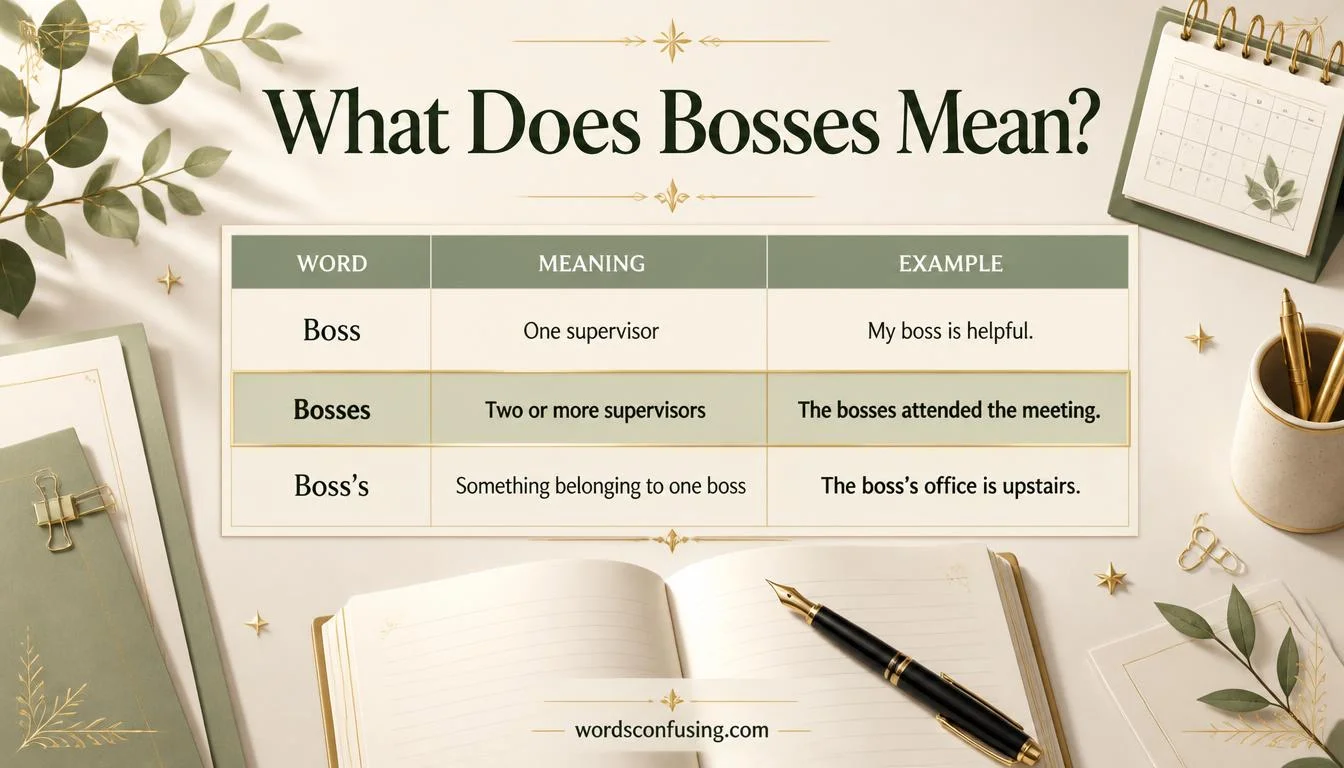
What Does Bosses Mean?
Bosses is the plural form of the noun boss. It refers to two or more people who supervise workers, manage teams, or hold positions of authority.
You don’t need an apostrophe to make boss plural. In ordinary English, most nouns form their plurals by adding s or es. Because boss ends in ss, the standard plural spelling adds es.
For example:
- One boss manages the department.
- Two bosses manage separate departments.
- Several bosses attended the company meeting.
- The employees spoke with their bosses about their schedules.
In each sentence, bosses refers to multiple people. None of these examples expresses ownership.
When to Use Bosses in a Sentence
Use bosses whenever you need to refer to more than one supervisor or person in charge.
The word can function as the subject or object of a sentence. It can also appear after prepositions such as with, for, and about.
Consider these examples:
- As the subject: The bosses discussed the new policy.
- As the object: The employees thanked their bosses.
- After a preposition: She prepared reports for her bosses.
- In a general statement: Good bosses communicate clearly with their teams.
Each sentence refers to multiple bosses without showing that anything belongs to them.
A common mistake is writing boss’s when the sentence simply refers to several supervisors.
Incorrect: The boss’s attended the conference.
Correct: The bosses attended the conference.
The apostrophe in the incorrect version suggests possession, but the sentence doesn’t identify anything owned by the bosses. Removing it fixes the grammatical problem.
Bosses Examples in Sentences
These examples show how to use bosses in different situations.
- The bosses agreed to extend the project deadline.
- Both bosses congratulated the team on its success.
- Her former bosses recommended her for the position.
- The bosses reviewed the employees’ performance reports.
- Many bosses prefer clear communication over unnecessary meetings.
- The new employees introduced themselves to their bosses.
- Several bosses attended the annual leadership conference.
In every example, bosses refers to more than one person. The word doesn’t show possession, so an apostrophe isn’t necessary.
Remember this distinction: plural means more than one; possessive means ownership or association. A word can be plural without being possessive.
Read more: Ones or One’s or Ones’: What’s the Difference?
What Does Boss’s Mean?
Boss’s is the singular possessive form of boss. It indicates that something belongs to, comes from, or is associated with one boss.
In standard American English, the usual rule for singular possessives is straightforward: add an apostrophe followed by s. This rule generally applies even when the singular noun already ends in the letter s.
For example:
- The boss’s office needs new furniture.
- My boss’s instructions were easy to follow.
- The boss’s decision surprised the entire team.
- I borrowed my boss’s laptop for the presentation.
- The boss’s schedule changed unexpectedly.
Each example refers to one boss. The apostrophe and additional s establish a possessive relationship between that person and something else.
Possession doesn’t always mean legal ownership. The expression the boss’s decision, for instance, identifies the person who made the decision rather than something the person physically owns.
When to Use Boss’s in a Sentence
Use boss’s when you want to show that something belongs to or relates to one particular boss.
The possessive form can describe objects, responsibilities, opinions, relationships, and decisions. Context determines the exact relationship.
Consider these common situations.
1. Showing ownership of an object
- The boss’s car is parked outside.
- I left the report on the boss’s desk.
- The boss’s phone rang during lunch.
2. Showing responsibility or authority
- The boss’s approval is required before publication.
- The boss’s instructions determine the next steps.
- The boss’s signature appears on the contract.
3. Showing an opinion or decision
- The boss’s decision ended the discussion.
- Everyone respected the boss’s judgment.
- The boss’s explanation cleared up the confusion.
4. Showing a relationship
- The boss’s assistant scheduled the appointment.
- We attended the boss’s retirement party.
- The boss’s daughter joined the company last year.
These examples demonstrate why the singular possessive form matters. It tells readers which person the sentence connects to the object, action, or relationship.
Boss’s Examples in Sentences
The following examples show how boss’s works in everyday communication, workplace emails, and professional writing.
| Example sentence | What it means |
| My boss’s office is upstairs. | The office is associated with one boss. |
| The boss’s report contains several errors. | One boss prepared or is responsible for the report. |
| I followed my boss’s advice. | One boss gave the advice. |
| The boss’s meeting starts at noon. | The meeting is associated with one boss. |
| We discussed the boss’s proposal. | One boss made or presented the proposal. |
| The boss’s expectations were reasonable. | The expectations belong to or come from one boss. |
One useful detail: possession can sometimes describe an association rather than ownership. In the boss’s meeting, for instance, the boss might organize, lead, or attend the meeting.
Is Boss’s Grammatically Correct?
Yes. Boss’s is a standard and widely accepted singular possessive form in American English.
The general rule adds ’s to a singular noun to make it possessive. This includes many singular nouns that already end in s.
Examples include:
- Boss → boss’s
- Class → class’s
- Dress → dress’s
- Business → business’s
The same general pattern applies to many other singular nouns, although some words and editorial conventions require special consideration.
For ordinary writing, my boss’s office is a reliable choice. It follows the familiar singular possessive pattern and clearly identifies one boss.
What Does Boss’ Mean?
Boss’ is a spelling sometimes used for the singular possessive form of boss. It expresses the same basic relationship as boss’s: something belongs to or is associated with one boss.
For example:
- The boss’ office is upstairs.
- I followed the boss’ instructions.
- The boss’ decision surprised the team.
- We discussed the boss’ schedule.
These sentences communicate the same basic meanings as their versions with boss’s.
However, the shorter form isn’t equally preferred by every style guide. Some editorial conventions omit the additional s after the apostrophe in certain possessive forms, while others favor adding it.
For everyday American English writing, boss’s is the safer default. Use boss’ when a required publication style or established editorial preference calls for it.
When to Use Boss’ in a Sentence
The form boss’ may appear in publications or documents that follow a convention permitting a final apostrophe for singular nouns ending in s.
For example, an organization might maintain a house style that consistently uses shorter possessive spellings. If its rules specifically require boss’, follow that convention.
The important point is consistency. Don’t alternate between boss’s and boss’ without a clear reason in the same piece of writing.
Compare these examples:
- The boss’ office is near reception.
- The boss’ instructions were clear.
- The boss’ decision affected the schedule.
Each sentence uses the shorter possessive spelling consistently. Nevertheless, if no particular style guide applies, boss’s is the more dependable choice for general American English prose.
Boss’ Examples in Sentences
Here are several examples showing how the shorter possessive form works.
| Sentence using boss’ | Equivalent using boss’s |
| The boss’ office is closed. | The boss’s office is closed. |
| I reviewed the boss’ report. | I reviewed the boss’s report. |
| The boss’ schedule changed. | The boss’s schedule changed. |
| We accepted the boss’ recommendation. | We accepted the boss’s recommendation. |
| The boss’ car needs repairs. | The boss’s car needs repairs. |
The meaning remains essentially unchanged. The difference lies in the spelling convention rather than the number of bosses involved.
Is Boss’ Grammatically Correct?
Boss’ can be acceptable under certain style conventions, but boss’s is the safer general recommendation.
One important distinction helps clear up the confusion. The Associated Press Stylebook uses an apostrophe alone for many singular proper names ending in s, but the common noun boss follows the regular possessive pattern. The U.S. Government Publishing Office Style Manual, by contrast, uses a broader rule that permits a final apostrophe for nouns ending in s, including boss’.
This means writers should distinguish between a general grammar rule and a publication’s specific house style. A form may be accepted by one convention without being the preferred choice everywhere.
If you’re writing an email, school assignment, business report, or general-interest article, choose boss’s unless your instructions specify otherwise.
Read more: 23 Best Replies to “It Is What It Is” Witty and Funny
Bosses vs. Boss’s vs. Boss’: Key Differences
The main difference between these spellings comes down to number, possession, and the placement of the apostrophe.
Although the words look similar, they don’t perform the same grammatical job.
| Form | Number | Possessive? | Example |
| Boss | Singular | No | My boss is helpful. |
| Bosses | Plural | No | My bosses are helpful. |
| Boss’s | Singular | Yes | My boss’s advice helped me. |
| Boss’ | Singular | Yes, under certain conventions | My boss’ advice helped me. |
| Bosses’ | Plural | Yes | My bosses’ advice helped me. |
The easiest way to understand the difference is to examine what each sentence communicates.
Bosses: The bosses attended the conference.
This sentence tells you that multiple bosses attended. It doesn’t show possession.
Boss’s: The boss’s presentation impressed everyone.
This sentence connects the presentation to one boss.
Boss’: The boss’ presentation impressed everyone.
This expresses the same basic meaning as boss’s, using an alternative possessive spelling.
Bosses’: The bosses’ presentations impressed everyone.
This sentence connects the presentations to multiple bosses.
Why the Apostrophe’s Position Matters
An apostrophe can change the meaning of a sentence even when the surrounding words stay the same.
Consider the following examples:
- The boss’s office was renovated.
- The bosses’ offices were renovated.
In the first sentence, the possessive refers to one boss. In the second, it refers to multiple bosses.
Notice another difference: the second sentence uses offices because several offices are being discussed. However, plural possession doesn’t always require a plural object.
For example, the bosses’ meeting can refer to one meeting attended by several bosses. The possessive form identifies the people associated with the meeting, not the number of meetings.
This distinction helps prevent mistakes in professional writing.

Bosses’ vs. Boss’s: What’s the Difference?
Bosses’ is the plural possessive form of boss. It indicates that something belongs to or is associated with two or more bosses.
By comparison, boss’s indicates possession by one boss.
The spelling difference is small, but the meaning can change significantly.
- The boss’s office: An office associated with one boss.
- The bosses’ office: An office associated with multiple bosses.
- The boss’s meeting: A meeting associated with one boss.
- The bosses’ meeting: A meeting associated with multiple bosses.
The plural possessive follows a simple rule: form the plural first, then add an apostrophe.
Boss → bosses → bosses’
Because bosses already ends in s, you generally place the apostrophe after that final letter when forming the plural possessive.
Bosses’ Examples in Sentences
Here are several examples of bosses’ used correctly.
- The bosses’ offices are located on different floors.
- We reviewed the bosses’ recommendations before making a decision.
- The bosses’ meeting lasted nearly two hours.
- All the bosses’ signatures appeared on the final document.
- The employees discussed their bosses’ expectations during training.
- The bosses’ schedules changed after the announcement.
Each example involves more than one boss. The apostrophe follows the plural ending to show possession or association.
Boss’s vs. Bosses’: A Practical Comparison
Imagine that a company has one department manager or several department managers. The sentences below illustrate how the possessive forms change.
| Singular possessive | Plural possessive |
| The boss’s desk is clean. | The bosses’ desks are clean. |
| The boss’s decision was final. | The bosses’ decisions were final. |
| The boss’s office is locked. | The bosses’ offices are locked. |
| The boss’s assistant arrived early. | The bosses’ assistants arrived early. |
These pairs make the distinction easy to spot. The singular form uses boss’s, while the plural possessive uses bosses’.
Keep in mind that the number of objects depends on the sentence’s meaning. Several bosses can share one office or one meeting, so a plural possessive doesn’t automatically require a plural noun afterward.
Common Mistakes to Avoid With Bosses, Boss’s, and Boss’
Even experienced writers sometimes place apostrophes incorrectly. The good news is that most errors disappear when you identify the intended meaning before choosing a spelling.
Using Boss’s When You Mean Multiple Bosses
The form boss’s indicates singular possession, not ordinary plurality.
Incorrect: The boss’s attended the annual meeting.
Correct: The bosses attended the annual meeting.
The corrected sentence refers to several bosses. Because it doesn’t show possession, the word needs no apostrophe.
Writing Bosses When You Mean Singular Possession
The plural noun bosses doesn’t show ownership.
Incorrect: I left my report on my bosses desk.
Correct: I left my report on my boss’s desk.
The corrected sentence refers to one boss and the desk associated with that person.
If several bosses share responsibility for the desk, the plural possessive may be appropriate instead. Context determines the correct form.
Confusing Boss’ With the Plural Form
The spelling boss’ doesn’t mean multiple bosses. It’s an alternative singular possessive spelling under certain conventions.
Compare these examples:
- The bosses arrived early. Multiple bosses arrived.
- The boss’s car arrived early. One boss owns or uses the car.
- The boss’ car arrived early. The same basic possessive meaning as the previous sentence under an alternative convention.
Don’t use boss’ simply because you want to make boss plural.
Using Bosses’ for One Boss
The apostrophe in bosses’ follows the plural noun. It therefore indicates possession by multiple bosses.
Incorrect: My bosses’ office is next door. (If you mean one boss.)
Correct: My boss’s office is next door.
However, my bosses’ office could be correct if multiple bosses share that office. The number of people involved determines the appropriate form.
Switching Between Boss’s and Boss’ Without a Reason
Inconsistent spelling can distract readers and make an article or report look poorly edited.
For example, a document might use the boss’s office in one paragraph and the boss’ instructions in the next. Both forms may be acceptable under different conventions, but switching between them without a reason creates unnecessary inconsistency.
Choose a convention at the beginning and apply it throughout your writing.
For general American English, boss’s is the straightforward choice.
Forgetting the Plural Possessive Rule
Another common error is adding an extra s after the apostrophe in bosses’.
Incorrect: The bosses’s offices are upstairs.
Correct: The bosses’ offices are upstairs.
The plural noun already ends in s. Add only the apostrophe to form its possessive version.
How to Choose the Correct Form of Boss
You don’t need to memorize a long list of grammar rules. Instead, ask two questions: How many bosses are involved, and are you showing possession?
Use this simple process whenever you’re unsure.
Step 1: Identify the number of bosses.
If you’re talking about one supervisor, use boss. If you’re talking about several supervisors, use bosses.
Step 2: Decide whether the sentence shows possession.
If the sentence simply identifies multiple supervisors, write bosses. If something belongs to or is associated with one boss, use a singular possessive form.
Step 3: Choose the correct possessive spelling.
Use boss’s for ordinary singular possession in standard American English. If an applicable style guide explicitly requires boss’, follow that convention.
Step 4: Check whether the possessive is singular or plural.
If multiple bosses share ownership or responsibility, use bosses’.
Here’s the complete decision table:
| What you want to express | Correct form | Example |
| One supervisor | Boss | My boss is helpful. |
| Multiple supervisors | Bosses | My bosses are helpful. |
| Possession by one boss | Boss’s | My boss’s office is clean. |
| Alternative singular possessive spelling | Boss’ | My boss’ office is clean. |
| Possession by multiple bosses | Bosses’ | My bosses’ offices are clean. |
A Quick Memory Trick
Remember these four basic forms:
- Boss: One person.
- Bosses: Multiple people.
- Boss’s: Something associated with one person.
- Bosses’: Something associated with multiple people.
The apostrophe acts like a small signpost. It tells readers that the sentence expresses possession rather than merely counting people.
For instance, if you write the bosses arrived, you’re describing several people. If you write the bosses’ reports arrived, you’re describing reports associated with those people.
Once you recognize that difference, the spelling becomes much easier to choose.

Bosses or Boss’s or Boss’: Which Spelling Should You Use in American English?
For most American English writing, the right choice depends on the sentence’s meaning rather than a preference for one spelling.
It is use bosses for the ordinary plural.
Use boss’s for singular possession.
Use bosses’ for plural possession. Reserve boss’ for situations in which the applicable style convention supports that spelling.
This recommendation works well for everyday communication, workplace documents, school assignments, and general online publishing.
What About Formal and Academic Writing?
Formal writing benefits from consistent punctuation. When preparing an assignment, report, or professional article, check whether your institution or publisher requires a specific style guide.
If no guide applies, boss’s is the reliable default for singular possession.
For example:
- The boss’s recommendation influenced the final decision.
- The bosses attended the review meeting.
- The bosses’ recommendations influenced the final decision.
These sentences follow a clear pattern. Each spelling matches the number of bosses and the intended meaning.
Does American English Always Require Boss’s?
The distinction requires a little care. Although boss’s is the safest general recommendation, some editorial conventions use a shorter apostrophe-only form for certain nouns ending in s.
For example, the U.S. Government Publishing Office’s 2008 style manual lists boss’ among its possessive examples. Other major editorial conventions use different rules for particular categories of words.
Therefore, it’s inaccurate to claim that every American publication follows precisely the same possessive rule.
For everyday writing, however, you can confidently use boss’s unless a specific style guide tells you otherwise.
FAQs
1. What is the difference between bosses and boss’s?
Bosses is the plural form of boss, meaning more than one person. Boss’s is the singular possessive form, showing that something belongs to one boss. For example, “The bosses attended the meeting” refers to several people, while “My boss’s office is upstairs” shows possession.
2. Is bosses’ grammatically correct?
Yes, bosses’ is grammatically correct. It is the plural possessive form used when something belongs to or relates to multiple bosses. For example, “The bosses’ decisions affected the entire team” indicates that several bosses made the decisions.
3. Should I write my boss’s decision or my bosses’ decision?
Use my boss’s decision when referring to one boss’s decision. Use my bosses’ decision when referring to a decision associated with multiple bosses. The correct choice depends on how many bosses you mean, not how many decisions they made.
4. Is bosses’s ever correct?
No, bosses’s is not the standard form for showing possession by multiple bosses. Write boss’s for one boss and bosses’ for more than one boss. The apostrophe placement changes according to whether the noun is singular or plural.
5. How do I remember when to use bosses, boss’s, and bosses’?
Use this simple trick:
- Bosses: More than one boss, without showing possession.
- Boss’s: Something belongs to one boss.
- Bosses’: Something belongs to multiple bosses.
Remember that the plural bosses already ends in s, so you add only an apostrophe to show plural possession.
6. Which form should I use in professional or workplace writing?
Choose the form that matches your intended meaning. For example, write “The boss’s instructions were clear” when referring to one boss. Write “The bosses’ instructions were clear” when referring to multiple bosses. Use “The bosses attended the meeting” when you simply mean several people attended. Correct apostrophe usage makes professional writing clearer and prevents misunderstandings.
Conclusion
Choosing between bosses, boss’s, and bosses’ becomes easier when you understand what each form means. Use bosses when talking about more than one boss, boss’s when showing something belongs to one boss, and bosses’ when showing possession by multiple bosses. Before adding an apostrophe, consider whether your sentence describes one person, several people, or ownership.
This small punctuation detail can make a big difference in your writing. With a little practice, you’ll avoid common grammar mistakes and use all three forms confidently in emails, workplace documents, and everyday conversations.

Franklin Hayes is a writer and editor at WordsConfusing.com, focused on making English vocabulary, grammar, and commonly confused words easy to understand. He writes clear, practical articles with simple explanations and useful examples to help readers improve their English with confidence.
His goal is simple: Making Confusing Words Simple.