
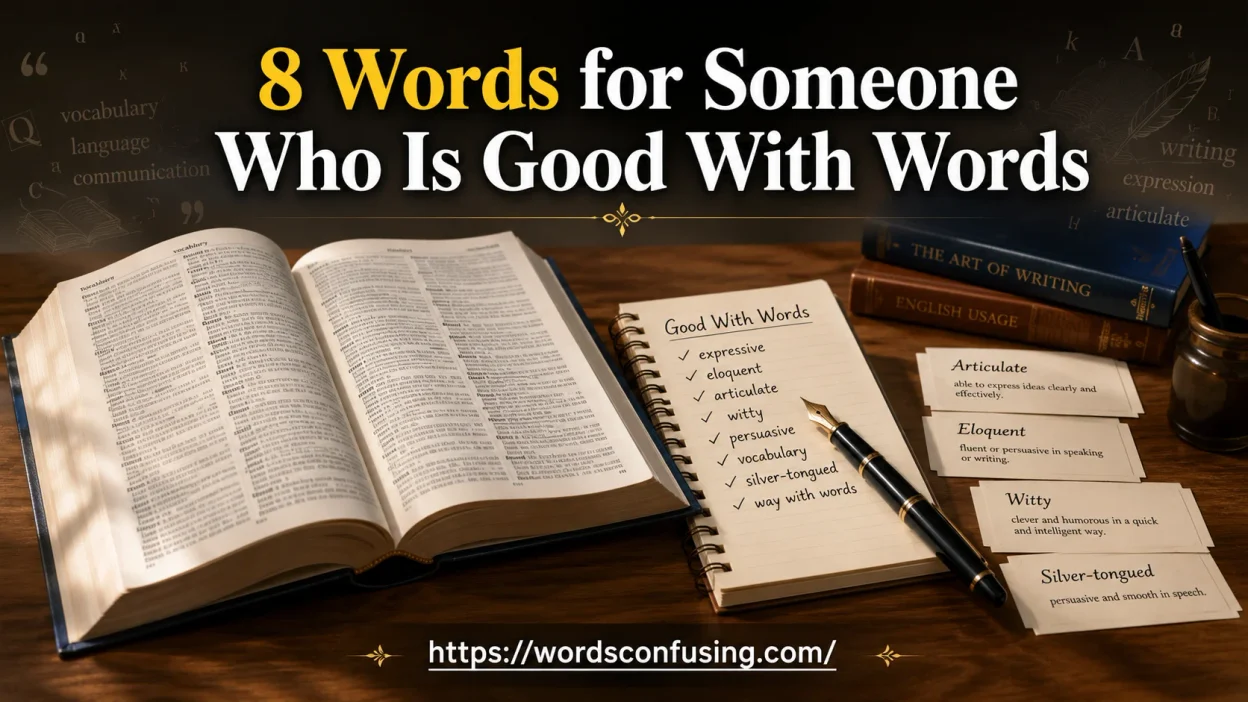
8 Words for Someone Who Is Good With Words can help you describe someone with a good vocabulary who can use the right words to express ideas.
A Wordsmith enjoys choosing the right word and can explain ideas clearly, while an Eloquent speaker uses eloquence to make communication easier.
An Articulate person can share thoughts accurately, and an Expressive person adds feeling through expression and expressiveness. In my experience, a Communicative person has useful communication skills and shares ideas openly.
A Logophile has a natural interest in language, while someone Well-spoken shows strong verbal ability. A Fluent person demonstrates fluency, and these qualities can appear in everyday conversation, writing, and presentations.
If you’re looking for the best people to ask, you may need to know the best words for a particular situation. They’re often the right people to help you understand the case, and this article can help you with that too.
Quick Answer
The best word for someone who is good with words is wordsmith. It describes a person who uses language skillfully, especially when writing. Depending on the situation, articulate, eloquent, expressive, well-spoken, fluent, communicative, or logophile may fit better.
What Do You Call Someone Who Is Good With Words?
The most broadly useful word is wordsmith. A wordsmith is someone who works skillfully with words, especially a skilled writer. Merriam-Webster defines wordsmith as “a person who works with words,” particularly a skillful writer.
However, wordsmith isn’t the only choice.
Depending on the person’s particular strength, you could describe them as eloquent, articulate, expressive, communicative, logophile, well-spoken, or fluent.
Here’s the quick distinction:
| Word | Main Meaning | Best Used For |
| Wordsmith | Skilled at crafting words | Writers and language creators |
| Eloquent | Powerful and graceful in expression | Speeches and polished writing |
| Articulate | Clear and effective at expressing ideas | Explanations and conversation |
| Expressive | Good at conveying feelings or meaning | Emotional or vivid communication |
| Communicative | Willing and able to communicate | Everyday or workplace communication |
| Logophile | Loves words and language | Language enthusiasts |
| Well-spoken | Speaks clearly and appropriately | Conversation and formal speech |
| Fluent | Uses language smoothly and easily | Language proficiency |
The important point is that these aren’t perfect synonyms. They overlap, but each one puts the spotlight somewhere different.
8 Words for Someone Who Is Good With Words
1. Wordsmith
Wordsmith is probably the best all-purpose noun when you want to praise someone’s skill with language.
The word usually suggests deliberate craftsmanship. A good wordsmith doesn’t merely know many words. They know which words to use, where to place them, and how to make them work together.
That makes wordsmith particularly appropriate for writers, editors, journalists, novelists, poets, copywriters, and other people who regularly shape language.
Merriam-Webster identifies wordsmith as a noun for someone who works with words, especially a skillful writer. The dictionary records its first known use in 1873.
Consider these examples:
- She’s a talented wordsmith who can make technical subjects interesting.
- The novelist is a remarkable wordsmith.
- His essays reveal the precision of a seasoned wordsmith.
- Our copywriter is an excellent wordsmith who knows how to make every sentence count.
The word has a useful metaphor hidden inside it. A blacksmith shapes metal with care and precision. A wordsmith shapes language in much the same way.
That’s why wordsmith often sounds warmer and more creative than simply saying someone has a large vocabulary.
When should you use “wordsmith”?
Use wordsmith when the person’s strength lies in crafting language.
It works especially well when you’re praising someone’s writing:
“She’s a gifted wordsmith.”
That’s stronger than saying:
“She’s good with words.”
The first sentence suggests skill, control, creativity, and careful word choice.
2. Eloquent
Eloquent describes someone who expresses ideas in a powerful, fluent, and effective way.
Merriam-Webster defines eloquent as being marked by forceful and fluent expression. It can also describe something that vividly or movingly communicates an idea or feeling.
For example:
- She gave an eloquent speech about education.
- His letter was surprisingly eloquent.
- The lawyer made an eloquent argument.
- She found an eloquent way to describe her experience.
Unlike wordsmith, eloquent doesn’t necessarily imply that someone is a professional writer. A person can be eloquent during a conversation, interview, presentation, debate, or public speech.
The word also carries a sense of impact.
Someone articulate can make an idea easy to understand. Someone eloquent can make that idea memorable.
That distinction is subtle but useful.
Eloquent vs. wordsmith
Think of the difference this way:
- Wordsmith = skilled at crafting words.
- Eloquent = skilled at expressing ideas with force and grace.
A novelist may be a wordsmith. A powerful public speaker may be eloquent. One person can easily be both.
3. Articulate
If you want a word for someone who explains ideas clearly, choose articulate.
Merriam-Webster defines the adjective articulate as expressing oneself readily, clearly, and effectively. It can also describe an argument or idea expressed in that way.
Here are some natural examples:
- She’s incredibly articulate when discussing complex issues.
- He gave an articulate explanation of the problem.
- The candidate was calm and articulate during the interview.
- She’s articulate enough to explain technical concepts to beginners.
Notice what’s missing from the definition: fancy vocabulary isn’t required.
An articulate person might use ordinary words. What matters is clarity, organization, and effectiveness.
Imagine a scientist explaining a complicated theory to a room full of people who aren’t scientists. If that scientist breaks the concept into understandable pieces without losing its meaning, articulate fits perfectly.
Articulate vs. eloquent
These words overlap, but they aren’t identical.
Articulate focuses on clarity and effective expression.
Eloquent often adds force, elegance, fluency, or emotional impact.
For example:
“He was articulate during the presentation.”
This tells you that he communicated his ideas clearly.
“He was eloquent during the presentation.”
This suggests that his delivery had unusual power, grace, or persuasive quality.
A person doesn’t need poetic language to be articulate. In fact, plain language often produces the clearest communication.
4. Expressive
Expressive is a strong choice when someone can communicate feelings, ideas, or meaning vividly.
Merriam-Webster defines expressive as serving to express or effectively conveying meaning or feeling.
Examples include:
- She’s an expressive writer who captures emotion beautifully.
- His stories are incredibly expressive.
- The poet uses simple language in an expressive way.
- She’s expressive when describing personal experiences.
This word works especially well when emotional communication matters.
Suppose two people describe the same sunset. One says:
“The sunset was beautiful.”
The other describes the fading orange light, the cool evening air, and the way the last rays disappeared behind the hills.
The second description may be more expressive because it creates a stronger sense of the experience.
Expressiveness isn’t necessarily about using complicated vocabulary. Sometimes the simplest sentence carries the most feeling.
When should you call someone expressive?
Choose expressive when the person has a strong ability to communicate:
- Emotions
- Impressions
- Personal experiences
- Imagery
- Subtle ideas
- Mood
- Meaning
It’s particularly useful for writers, poets, storytellers, performers, and emotionally perceptive communicators.
5. Communicative
Communicative is slightly different from the other words on this list.
Merriam-Webster defines communicative as tending to communicate or being related to communication.
That means the word doesn’t necessarily suggest exceptional writing or beautiful speech.
Instead, it describes someone who communicates readily and openly.
For example:
- She’s very communicative about what she needs.
- He’s a communicative manager who keeps everyone informed.
- The team became more communicative after the weekly meetings began.
- She’s communicative and easy to talk to.
This distinction is important.
Someone can be highly communicative without being eloquent. They may speak openly, answer questions, share information, and keep conversations moving without having an especially sophisticated vocabulary.
Think of communicative as a broader term. It describes a person’s approach to communication rather than their literary craftsmanship.
Communicative vs. articulate
An articulate person expresses ideas clearly.
A communicative person tends to communicate openly or readily.
One describes how effectively someone expresses an idea. The other focuses more on their tendency to communicate.
6. Logophile
If someone loves words and language, the word you want is logophile.
Cambridge Dictionary defines logophile as “a person who loves words and language.”
This is where many synonym lists become misleading.
A logophile isn’t necessarily an excellent writer or speaker.
The word describes enthusiasm rather than mastery.
A logophile might enjoy:
- Learning unusual vocabulary
- Reading dictionaries
- Studying word origins
- Collecting interesting expressions
- Solving word puzzles
- Learning languages
- Exploring etymology
- Discussing grammar and usage
For example:
She’s a lifelong logophile who keeps a notebook of unusual words.
Or:
As a logophile, he enjoys discovering where everyday expressions came from.
That’s quite different from saying:
He’s a skilled wordsmith.
The first tells you that the person loves language. The second tells you that the person uses language skillfully.
7. Well-Spoken
Well-spoken is a natural choice for someone who speaks clearly, appropriately, and courteously.
Merriam-Webster defines well-spoken as speaking well, suitably, or courteously and also as being spoken with propriety.
Examples:
- She’s intelligent, confident, and well-spoken.
- He was well-spoken during the interview.
- The student gave a thoughtful and well-spoken response.
- She’s known as a well-spoken advocate.
The word is particularly useful when the focus is speech rather than writing.
Someone well-spoken may choose appropriate words, construct clear sentences, maintain a respectful tone, and communicate confidently.
However, being well-spoken doesn’t necessarily mean being poetic.
That’s an important distinction.
A person can be well-spoken because they communicate clearly and appropriately without delivering an especially dramatic or beautiful performance.
A useful distinction
- Well-spoken → speaks appropriately and clearly.
- Articulate → expresses ideas clearly and effectively.
- Eloquent → expresses ideas with unusual force, grace, or impact.
Those three terms can describe the same person. Their emphasis simply changes.
8. Fluent
Fluent works when someone uses a language smoothly, easily, and accurately.
Merriam-Webster defines fluent as capable of using a language easily and accurately. It can also describe something that is smooth and flowing or someone who has mastery of a subject or skill.
Examples:
- She’s fluent in Spanish and English.
- He’s fluent in three languages.
- She speaks fluent English.
- His writing is fluent and natural.
The word is especially useful when discussing language proficiency.
However, don’t confuse fluency with eloquence.
Someone can speak English fluently without being an exceptional writer. Likewise, a person can write eloquently in a language without speaking it fluently in spontaneous conversation.
Fluency is about smooth command and ease of use.
Which Word Is Best for Someone Who Is Good With Words?
There’s no universal winner because “good with words” can describe several different abilities.
Use this guide when you need a quick answer:
| If Someone Is Good At… | Best Word |
| Crafting sentences and choosing words | Wordsmith |
| Speaking or writing with power and grace | Eloquent |
| Explaining ideas clearly | Articulate |
| Conveying emotion or vivid meaning | Expressive |
| Communicating openly | Communicative |
| Loving words and language | Logophile |
| Speaking clearly and appropriately | Well-spoken |
| Using a language smoothly | Fluent |
If you don’t have any additional context, wordsmith is usually the most direct noun for someone skilled with words.
The choice changes once you know what kind of language skill you’re praising.
Wordsmith vs. Eloquent vs. Articulate
These three words cause the most confusion because they frequently describe similar people.
Yet their meanings have different centers of gravity.
| Feature | Wordsmith | Eloquent | Articulate |
| Main focus | Craftsmanship | Impact and expression | Clarity |
| Commonly describes writers | Yes | Yes | Sometimes |
| Commonly describes speakers | Sometimes | Yes | Yes |
| Requires sophisticated vocabulary | No | No | No |
| Emphasizes emotional impact | Sometimes | Often | Not necessarily |
| Emphasizes clear explanation | Sometimes | Sometimes | Strongly |
| Suggests deliberate word choice | Strongly | Often | Moderately |
Consider three people giving presentations.
Person A chooses vivid metaphors and carefully constructed sentences. That person is a wordsmith.
Person B delivers a moving speech that stays with the audience long after it ends. That person is eloquent.
Person C explains a complicated subject so clearly that everyone understands it. That person is articulate.
Of course, one speaker could be all three.
Words for Someone Who Is Good at Speaking
If your focus is spoken communication, several terms become especially useful.
Articulate
Choose articulate when the speaker communicates ideas clearly.
“She was articulate and persuasive during the debate.”
Eloquent
Choose eloquent when the speaker combines clarity with force, elegance, or emotional impact.
“His eloquent speech moved the entire audience.”
Well-spoken
Choose well-spoken when you want to emphasize polished, appropriate, or courteous speech.
“She’s a confident and well-spoken presenter.”
Fluent
Choose fluent when you’re talking about smooth command of a language.
“He’s fluent in French and English.”
Silver-tongued
Silver-tongued describes someone who speaks persuasively or charmingly.
The expression can sound complimentary, but context matters. It may also suggest that someone’s persuasive speech is more impressive than trustworthy.
For example:
The silver-tongued salesman convinced everyone to reconsider the offer.
That sentence doesn’t necessarily praise the salesperson’s honesty. It highlights the person’s persuasive verbal ability.
Read more: 5 Words for a Person Who Finds Fault in Everything
Words for Someone Who Is Good at Writing
Writing requires a slightly different vocabulary.
If someone consistently produces polished, engaging language, wordsmith is often the strongest choice.
Other possibilities include:
- Eloquent — when the writing has force and grace.
- Expressive — when the writing conveys emotion or meaning vividly.
- Articulate — when the writing communicates ideas clearly.
- Fluent — when the writing flows naturally.
- Lyrical — when the writing has a musical, poetic quality.
Consider the difference:
She’s a skilled wordsmith.
This praises her craftsmanship.
Her prose is eloquent.
This praises the power and quality of her expression.
She’s an articulate writer.
This emphasizes clarity.
Her writing is expressive.
This highlights her ability to communicate feeling or meaning.
The best word depends on the exact quality you want to spotlight.
What Does “Has a Way With Words” Mean?
The phrase “has a way with words” describes someone who naturally uses language effectively.
It can refer to writing, conversation, storytelling, humor, romance, or persuasion.
For example:
He has a way with words that makes even ordinary stories fascinating.
The expression is flexible because it doesn’t lock you into one specific skill.
Someone who “has a way with words” might:
- Tell captivating stories
- Explain difficult ideas
- Write memorable messages
- Make people laugh
- Persuade others
- Express emotions beautifully
- Choose unusually effective wording
That’s why the phrase remains useful when no single synonym feels quite right.
Examples of How to Describe Someone Who Is Good With Words
Sometimes you don’t need a dictionary definition. You need a sentence you can actually use.
Here are several natural examples.
For a talented writer
She’s a gifted wordsmith who can turn complicated ideas into engaging prose.
For a powerful speaker
He’s an eloquent speaker who knows how to connect with an audience.
For a clear communicator
She’s remarkably articulate when explaining difficult concepts.
For an emotional storyteller
He’s an expressive writer with a talent for capturing subtle emotions.
For a language enthusiast
She’s a true logophile who enjoys discovering unusual words and their origins.
For a polished speaker
He’s thoughtful, confident, and well-spoken.
For someone who communicates openly
She’s highly communicative and always makes her expectations clear.
For a multilingual speaker
He’s fluent in several languages and moves naturally between them.
Case Studies: Which Word Fits Best?
The easiest way to understand these distinctions is to see them in realistic situations.
Case Study: The Technical Writer
Imagine a software writer who takes complicated instructions and turns them into clean, engaging documentation.
The writer doesn’t necessarily use elaborate vocabulary. Instead, every sentence feels deliberate. Technical terms appear exactly where needed, explanations flow logically, and confusing concepts become approachable.
Best word: wordsmith
Why? The person’s strength lies in crafting language with precision.
You could also call the writer articulate. However, wordsmith better captures the craftsmanship involved in writing.
Case Study: The Public Speaker
Now imagine a speaker addressing a large audience about a difficult personal experience.
The speech has strong rhythm, memorable phrasing, and emotional weight. People understand the message, but more importantly, they feel it.
Best word: eloquent
The speaker isn’t merely clear. The language carries force and emotional impact.
Case Study: The Great Explainer
Consider a teacher who can explain advanced mathematics to students who initially feel lost.
Instead of drowning them in terminology, the teacher uses simple examples, logical steps, and familiar comparisons.
Best word: articulate
The defining quality here is clarity.
The teacher might also be eloquent. Yet articulate describes the specific ability that makes the explanation effective.
Case Study: The Language Lover
Finally, picture someone who gets excited whenever they discover an unusual word.
They enjoy dictionaries, etymology, word puzzles, historical expressions, and obscure vocabulary. They may know fascinating facts about language even if they aren’t a professional writer.
Best word: logophile
The defining quality isn’t necessarily writing ability. It’s love of words and language.
Is “Good With Words” the Same as Having a Large Vocabulary?
Not necessarily.
A large vocabulary can help someone communicate, but knowing more words doesn’t automatically make someone a better communicator.
Imagine having a toolbox containing 5,000 tools. That doesn’t mean you can build a good table.
Language works similarly.
A strong communicator knows how to select the right word for the situation. Sometimes that means using a sophisticated term. Other times, the best choice is an ordinary word that everyone understands.
For example:
“Commence the procedure.”
sounds more formal than:
“Start the process.”
Neither sentence is automatically better.
If you’re writing a legal document, the first might fit the context. If you’re explaining something to a beginner, the second may work much better.
Good word choice isn’t about making every sentence sound impressive. It’s about making every sentence fit its purpose.
Why Context Matters When Choosing a Word
Words carry more than dictionary definitions.
They also carry tone, implication, formality, and emotional weight.
Calling someone articulate usually sounds like straightforward praise. Describing someone as eloquent can feel more elevated. Referring to someone as a wordsmith may suggest a creative or literary talent.
Meanwhile, silver-tongued can contain a hint of skepticism.
Consider these descriptions:
He’s articulate.
Professional and positive.
He’s eloquent.
More expressive and complimentary.
He’s a wordsmith.
Creative and language-focused.
He’s silver-tongued.
Persuasive, charming, and potentially a little suspicious.
The person hasn’t changed. The angle of the description has.
Common Mistakes When Choosing Words for Someone Good With Words
Using “Fluent” When You Mean “Eloquent”
Fluent usually refers to smooth and easy language use.
Eloquent refers to powerful or graceful expression.
Someone can be fluent without being eloquent.
Calling Every Good Speaker a “Wordsmith”
A wordsmith is specifically associated with working skillfully with words. The term is particularly natural for writers.
If someone gives a clear presentation but doesn’t craft written language, articulate may be more precise.
Treating “Articulate” and “Eloquent” as Exact Synonyms
These words overlap, but their emphasis differs.
Use articulate when clarity is the main point. Use eloquent when the expression has unusual force, fluency, or grace.
Assuming “Communicative” Means “Well-Spoken”
A communicative person tends to communicate readily.
A well-spoken person speaks in a clear, fitting, or courteous manner.
Someone can be communicative while still struggling to express ideas clearly.
Using “Logophile” to Mean “Excellent Speaker”
A logophile loves words.
That doesn’t necessarily mean the person speaks beautifully, writes professionally, or communicates persuasively.
It’s a word about enthusiasm rather than demonstrated language skill.
What Is the Best Word for Someone Who Is Good With Words?
For a general compliment, wordsmith is one of the strongest choices.
It directly connects the person with skillful use of language and is especially suitable for writers. Merriam-Webster’s definition specifically identifies a wordsmith as someone who works with words, particularly a skillful writer.
However, don’t force the word into every situation.
Use eloquent when the person’s expression is powerful or graceful.
Choose articulate when clarity is their greatest strength.
Use expressive when they communicate feelings and meaning vividly.
Choose communicative when they readily share information and ideas.
Use logophile when they genuinely love words and language.
Choose well-spoken when polished speech is the main quality.
Use fluent when someone handles a language smoothly and easily.
FAQs
1. What do you call someone who is good with words?
A Wordsmith is a common word for someone who uses words skillfully. You can also call them eloquent, articulate, or well-spoken.
2. What is a person with a good vocabulary called?
A person with a strong vocabulary may be described as articulate, eloquent, or well-spoken. They can usually express their thoughts clearly and choose words carefully.
3. Is “Wordsmith” a compliment?
Yes. Calling someone a Wordsmith is usually a compliment. It suggests that they have a strong command of language and know how to use words effectively.
4. What is the difference between eloquent and articulate?
Eloquent describes someone who speaks or writes in a powerful and impressive way. Articulate means someone can express ideas clearly and understandably.
5. What do you call someone who loves words?
A Logophile is someone who has a strong interest in and enjoyment of words and language. They often enjoy learning new words and exploring their meanings.
6. Can someone be good with words without having a large vocabulary?
Absolutely. Being good with words isn’t only about knowing thousands of words. Communication skills, clarity, confidence, and knowing how to express an idea also matter.
Conclusion
Being good with words is about more than simply knowing a lot of vocabulary. The right person knows how to choose words that fit the moment, explain ideas clearly, and make others feel understood. Whether you describe them as a Wordsmith, Eloquent, Articulate, Expressive, or Well-spoken, each term highlights a slightly different strength.
If you’re trying to describe someone who always seems to find the perfect thing to say, think about how they communicate. Their fluency, verbal ability, and natural way of expressing thoughts can tell you which word fits best. Sometimes, the simplest description is the most accurate one.

Shafiq Ur Rehman is a writer and content contributor at WordsConfusing.com. He enjoys exploring the English language, common word confusions, vocabulary, and practical writing tips. His goal is to make English easier to understand through clear, simple, and useful articles.