
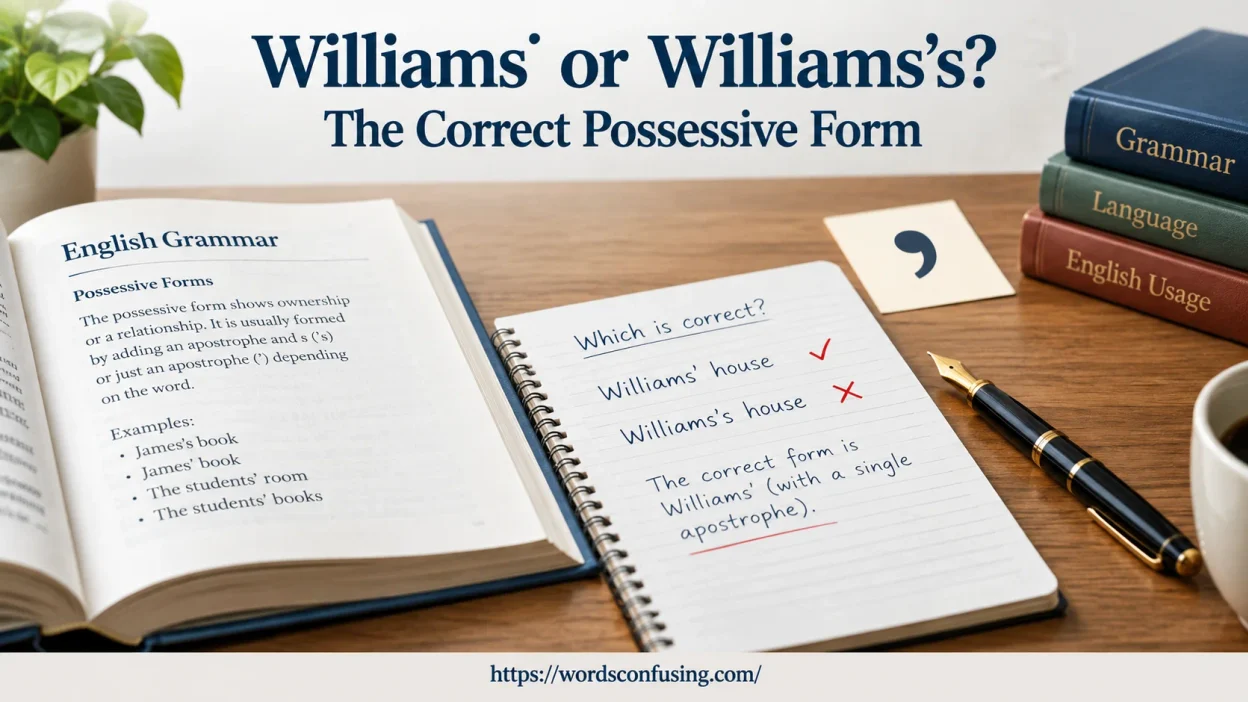
The phrase Williams’ or Williams’s? The Correct Possessive Form helps explain how English possessives work with surnames ending in s clearly.
For any language enthusiast, Williams is a useful example for understanding possessive forms in English. If you want to sharpen linguistic skills, learning these intricacies makes possessives easier to handle. The question may seem tricky, yet the basic rules are straightforward.
When showing possession, you may use an apostrophe + s, ‘s, or just an apostrophe, ‘, depending on the style. In the fascinating world of grammar, the possessive form of Williams may appear as Williams’s or Williams’. Both styles can be correct for a singular possessive, depending on writer’s preference.
As an experienced writer, I find this simple question useful because it connects grammar techniques with everyday language. To form possessives, first determine whether the name refers to one person or multiple people.
A singular possessive generally takes Williams’s, while Williams’ can represent a plural possessive when several people share the surname. These plural forms, singular, plural, ending, and S distinctions make the pattern easier to understand.
This guide will simplify the process and indicate how each form expresses possession. A table can also clarify the different forms and uses.
Quick Answer
Williams’s is the standard singular possessive form when one person named Williams owns something. However, some style guides use Williams’ instead. For multiple people named Williams, use Williamses, while their possessive form is Williamses’.
| Form | Use | Example |
| Williams | One person’s surname | Williams arrived early. |
| Williams’s | Singular possessive | Williams’s car is outside. |
| Williams’ | Singular possessive in some style guides | Williams’ car is outside. |
| Williamses | More than one person | The Williamses arrived. |
| Williamses’ | Plural possessive | The Williamses’ house is nearby. |
Williams’ or Williams’s: Which Is Correct?
Both Williams’ and Williams’s can be correct, but they don’t always mean the same thing.
When Williams refers to one person, you need a singular possessive form if that person owns something or has a relationship with something.
For example:
- Williams’s car is outside.
- Williams’s office is upstairs.
- Williams’s brother called yesterday.
Under the common rule for singular possessive nouns, you add ’s, even when the singular name ends in s.
However, some editorial styles shorten the possessive to Williams’:
- Williams’ car is outside.
- Williams’ office is upstairs.
- Williams’ brother called yesterday.
The important point is that Williams’ doesn’t automatically mean plural. In some style systems, it represents the possessive form of one person named Williams.
Things become different when Williams refers to multiple people.
The plural of the surname is normally Williamses:
The Williamses attended the reunion.
To show that those multiple people possess something, add the apostrophe after the plural ending:
The Williamses’ house is on Oak Street.
So, the basic distinction looks like this:
| Form | Meaning | Example |
| Williams | One person named Williams | Williams arrived early. |
| Williams’s | Possession by one Williams | Williams’s car is new. |
| Williams’ | Singular possessive under some style conventions | Williams’ car is new. |
| Williamses | More than one person named Williams | The Williamses arrived early. |
| Williamses’ | Possession by multiple Williamses | The Williamses’ car is new. |
Once you identify how many people the name refers to, the apostrophe becomes much easier to handle.
When to Use Williams’s
Use Williams’s when one person named Williams possesses something or has a connection to something.
This follows the general rule that a singular noun forms its possessive with ’s.
Consider these examples:
- Williams’s jacket was hanging by the door.
- Williams’s presentation impressed the committee.
- Williams’s daughter starts school next week.
- Williams’s restaurant opens at noon.
- Williams’s decision changed the schedule.
In each sentence, Williams refers to one person.
The apostrophe comes before the final s, followed by another s:
Williams + ’s = Williams’s
This spelling can look unusual because the name already ends in s. Nevertheless, the construction follows the standard singular possessive pattern used in many forms of formal writing.
Why Does Williams’s Have Two S Sounds?
The spelling Williams’s contains the original s in the surname plus the possessive ’s ending.
That doesn’t mean the word is misspelled.
Think of the structure this way:
Williams + ’s → Williams’s
The pronunciation usually reflects the additional possessive syllable:
Williams’s → approximately WILL-yum-ziz
The exact pronunciation can vary slightly depending on accent and speech pattern.
This matters because pronunciation often explains why Williams’s may feel more natural in some sentences. The possessive ending isn’t merely decorative punctuation. It represents a grammatical ending.
Examples of Williams’s in Context
Here are several examples showing how Williams’s works naturally:
Williams’s notebook was left on the conference table.
The notebook belongs to one person named Williams.
The manager reviewed Williams’s application.
The application belongs to one Williams.
Williams’s opinion differed from everyone else’s.
The opinion belongs to one Williams.
We visited Williams’s apartment after work.
The apartment belongs to one Williams.
The pattern stays consistent. One Williams + possession = Williams’s under this convention.
When to Use Williams’
The form Williams’ has two important uses.
First, some style conventions use Williams’ as the possessive form of a singular proper name ending in s.
Second, an apostrophe after the final s can indicate possession by a plural noun ending in s. However, the normal plural of the surname Williams is Williamses, not simply Williams.
That distinction prevents a common mistake.
If one person named Williams owns a car, you may encounter:
Williams’ car
or:
Williams’s car
The choice depends on the style convention being followed.
But if several people named Williams own the car, the standard plural possessive form is:
The Williamses’ car
Why Williams’ Can Be Confusing
The form Williams’ looks identical whether you’re casually interpreting the name or reading a style-specific singular possessive.
That’s why context matters.
Compare:
- Williams’ book is on the desk.
- The Williamses’ books are on the desk.
The first sentence can describe one Williams under a convention that uses Williams’ for singular possession.
The second clearly describes multiple people because Williamses’ contains the plural ending before the apostrophe.
Williams’s vs. Williams’: Singular Possessive
When Williams refers to one person, both forms may appear in edited writing:
Williams’s
and
Williams’
The difference often comes from the style guide used by the publication, organization, school, or writer.
A general grammar approach commonly teaches this pattern:
Singular name ending in s → add ’s
That produces:
- Williams’s
- James’s
- Chris’s
- Lucas’s
- Charles’s
However, some editorial systems simplify singular proper names ending in s by adding only an apostrophe:
- Williams’
- James’
- Chris’
- Lucas’
- Charles’
Neither spelling should be treated as an automatic typo without considering the intended style.
The Most Important Rule: Be Consistent
If a publication uses Williams’ for singular possessives, don’t switch randomly to Williams’s in the same piece.
Consistency matters because readers shouldn’t have to wonder whether a spelling change signals a difference in meaning.
For example, a document that uses:
Williams’ report
should generally maintain that convention rather than suddenly using:
Williams’s report
unless there’s a specific reason for the change.
In professional writing, consistency is often more useful than personal preference.
What Major Style Guides Say
Different style guides handle singular proper names ending in s differently.
That explains why you may see both Williams’ and Williams’s in reputable publications.
Chicago Style
The Chicago Manual of Style generally follows the rule that singular nouns and singular proper names form possessives with ’s, including names ending in s.
That gives you:
Williams’s
The same principle applies to many other singular names ending in s.
For example:
- James’s house
- Chris’s phone
- Lucas’s car
- Williams’s office
This approach makes the grammatical structure visually consistent.
AP Style
Associated Press style traditionally handles many singular proper names ending in s differently.
Under this approach, a singular name ending in s can take only an apostrophe:
Williams’
You may therefore encounter:
Williams’ statement
instead of:
Williams’s statement
This difference explains why two professionally edited articles can use different forms without one necessarily containing a grammatical error.
What Should You Choose?
Choose the convention required by your publication, school, employer, or editorial system.
If no specific style guide applies, Williams’s is a clear and widely accepted choice for the singular possessive under the general rule of adding ’s.
The key isn’t to treat punctuation as a popularity contest. Identify the style requirement first.
Williams’ or Williams’s? Examples in Sentences
Examples make this distinction much easier to see.
Singular Williams
Williams’s car needs new tires.
One Williams owns the car.
Under a style convention that omits the extra s, you may see:
Williams’ car needs new tires.
Again, the sentence refers to one person.
Another Singular Example
Williams’s office is on the third floor.
The office belongs to one Williams.
Alternative style:
Williams’ office is on the third floor.
The meaning remains the same. The spelling reflects a different editorial convention.
Multiple Williamses
Now consider a family containing several people named Williams:
The Williamses attended the ceremony.
Here, Williamses is plural.
To show possession:
The Williamses’ home was decorated for the celebration.
The apostrophe follows the plural ending because the possession belongs to multiple Williamses.
A Useful Comparison
| Sentence | What it means |
| Williams arrived early. | One person named Williams arrived. |
| Williams’s coat is blue. | One Williams owns the coat. |
| Williams’ coat is blue. | One Williams owns the coat under that style convention. |
| The Williamses arrived early. | Multiple people named Williams arrived. |
| The Williamses’ coats are blue. | Multiple Williamses own the coats. |
This is the simplest way to keep the forms straight.
Is Williams’ Grammatically Correct?
Yes, Williams’ can be grammatically correct.
Its correctness depends on the context and the convention you’re following.
When one person named Williams possesses something, some style systems use Williams’ instead of Williams’s.
For example:
Williams’ performance received praise.
Here, the sentence refers to one person named Williams.
However, Williams’ isn’t normally the plural form of the surname.
You shouldn’t write:
The Williams’ attended dinner.
if you mean several people whose surname is Williams.
The plural should normally be:
The Williamses attended dinner.
And the plural possessive becomes:
The Williamses’ dinner was held at six.
That distinction is crucial.
Williams’ Doesn’t Always Mean Multiple People
A common misconception says that an apostrophe after s always indicates a plural possessive.
That’s not true.
Compare:
Williams’ book
with:
Williamses’ books
The first can refer to one Williams under a particular style convention.
The second clearly refers to multiple Williamses.
The surrounding words and context tell you which meaning applies.
Is Williams’s Grammatically Correct?
Yes. Williams’s is a standard singular possessive form.
When one person named Williams owns something, Williams’s follows the common rule for forming the possessive of singular nouns.
Examples include:
- Williams’s house
- Williams’s car
- Williams’s phone
- Williams’s idea
- Williams’s team
- Williams’s daughter
- Williams’s book
The construction remains the same regardless of the thing being possessed.
A Simple Formula
You can remember it like this:
One Williams + possession = Williams’s
For example:
Williams + ’s + car
becomes:
Williams’s car
That formula works under the convention that uses ’s with singular names ending in s.
Read more: Coaches or Coach’s or Coaches’: Which Is Correct?
Williams or Williams’s? Don’t Confuse the Plural With the Possessive
The surname Williams can create confusion because its spelling already ends in s.
The important distinction is between plurality and possession.
Plurality answers:
How many Williamses are there?
Possession answers:
Who owns or is connected to something?
Those are different grammatical jobs.
Williams
Williams is the surname itself.
Example:
Williams is waiting outside.
One person has that surname.
Williamses
Williamses refers to multiple people with the surname Williams.
Example:
The Williamses moved to Texas.
Several people share the surname.
Williams’s
Williams’s shows possession by one Williams under the ’s convention.
Example:
Williams’s car is parked outside.
Williams’
Williams’ can show possession by one Williams under a convention that uses only an apostrophe.
Example:
Williams’ car is parked outside.
Williamses’
Williamses’ shows possession by multiple Williamses.
Example:
The Williamses’ car is parked outside.
These five forms may look similar, but they perform different grammatical functions.
How Do You Make Williams Plural?
To refer to more than one person named Williams, add -es.
The result is:
Williamses
For example:
The Williamses attended the wedding.
This follows the same general pattern used with many names ending in s.
Consider these examples:
- One Williams → two Williamses
- One Jones → two Joneses
- One class → two classes
- One bus → two buses
The spelling makes the plural clear.
How Do You Make Williams Plural and Possessive?
When multiple Williamses possess something, place the apostrophe after the plural ending:
Williamses’
For example:
The Williamses’ house is enormous.
The structure is:
Williams + es + ’
That gives:
Williamses’
Notice that the apostrophe doesn’t appear before the plural ending.
This is different from the singular possessive:
Williams’s
The distinction is small visually but significant grammatically.
Common Mistakes With Williams’ and Williams’s
Several errors appear repeatedly when writers handle surnames ending in s.
Using Williams’ as the Plural
Incorrect when referring to several people:
The Williams’ went shopping.
Correct:
The Williamses went shopping.
The apostrophe isn’t needed because the sentence doesn’t express possession.
Using Williams’s for Multiple People
This form generally refers to one Williams under the standard singular possessive convention.
For multiple people, use:
The Williamses’
Example:
The Williamses’ house was renovated last year.
Adding an Apostrophe to Every Plural Name
Not every plural requires an apostrophe.
For example:
The Williamses arrived.
There is no possession here. Therefore, there is no apostrophe.
Add one only when you need to show ownership or another possessive relationship:
The Williamses’ house was renovated.
Mixing Style Conventions
A document may use either Williams’ or Williams’s for singular possession depending on its chosen style.
The real problem occurs when a writer switches between conventions without a reason.
Pick the required style and apply it consistently.
A Practical Decision Guide for Williams’ or Williams’s
When you’re unsure which form to use, walk through these questions.
Is Williams one person?
If yes, you’re dealing with a singular possessive when ownership is involved.
Depending on the style:
- Williams’s
- Williams’
Are you talking about several people named Williams?
Use:
Williamses
Example:
The Williamses arrived late.
Do several Williamses own something?
Use:
Williamses’
Example:
The Williamses’ restaurant opened in May.
Does your organization follow a style guide?
If yes, follow that guide.
For example, a publication may require Williams’ while another may require Williams’s.
Is there no specific style requirement?
For general writing, Williams’s provides a straightforward singular possessive form.
The most important thing is to preserve the intended meaning and remain consistent.
Williams’ or Williams’s: A Quick Reference Table
| Situation | Correct form | Example |
| One person, no possession | Williams | Williams arrived. |
| One person, singular possessive | Williams’s | Williams’s car is red. |
| One person, singular possessive under some style conventions | Williams’ | Williams’ car is red. |
| Multiple people | Williamses | The Williamses arrived. |
| Multiple people, possessive | Williamses’ | The Williamses’ car is red. |
Keep this table nearby when you’re editing a sentence. It resolves most Williams possessive questions in seconds.
Why Context Matters More Than the Apostrophe Alone
An apostrophe can’t always tell you everything by itself.
Consider:
Williams’
Without context, you don’t know whether the writer means one Williams under a particular style convention or something else.
Now add a noun:
Williams’ report was published yesterday.
The phrase clearly suggests possession.
Add the article and plural ending:
The Williamses’ report was published yesterday.
Now you know that multiple Williamses own or are associated with the report.
Context fills in the missing information.
That’s why possessive punctuation works best when you examine the entire noun phrase, not just the apostrophe.
Case Study: The Williams Family
Imagine a family with the surname Williams. The parents and children all share that surname.
You could write:
The Williamses gathered for dinner.
This tells readers that multiple members of the family gathered.
Now suppose the family owns a house:
The Williamses’ house has a red front door.
The apostrophe comes after Williamses because several people possess the house.
Now imagine one family member named Jordan Williams owns a separate apartment:
Jordan Williams’s apartment is downtown.
Here, only one person possesses the apartment.
If a publication follows a style convention that uses only an apostrophe for singular proper names ending in s, you might instead see:
Jordan Williams’ apartment is downtown.
The meaning hasn’t changed. The editorial convention has.
This example shows why number and style both matter.
What About First Names Ending in S?
The same underlying issue appears with first names.
Consider James.
Under the singular ’s approach:
James’s bicycle is new.
Under a convention that uses only an apostrophe for certain singular names ending in s:
James’ bicycle is new.
The surname Williams follows the same general grammatical question.
This isn’t a special rule created just for Williams. It’s part of the broader question of how to form possessives from singular proper names ending in s.
How Pronunciation Can Help
Pronunciation provides another clue.
With Williams’s, the possessive ending is typically pronounced with an additional syllable:
Williams’s
The ending sounds similar to the final syllable in words such as buses or wishes.
That can make Williams’s sound slightly more noticeable when spoken.
With the written form Williams’, the pronunciation can vary according to the style and speaker. In ordinary speech, the possessive relationship still needs to be expressed naturally.
Don’t choose a spelling solely because it looks easier to pronounce. Follow the grammatical context and the required editorial convention first.
Quick Rule for Williams’ vs. Williams’s
If you need the answer quickly, remember these four patterns:
- Williams = one person named Williams.
- Williams’s = one Williams possesses something under the ’s convention.
- Williams’ = singular possessive under styles that omit the additional s.
- Williamses’ = multiple Williamses possess something.
The biggest trap is treating Williams’ as the normal plural.
It isn’t.
For multiple people, write Williamses. For multiple people who possess something, write Williamses’.
FAQs
Is Williams’s grammatically correct?
Yes. Williams’s is correct when you’re showing possession for one person named Williams. Many style guides use this form for singular names ending in s.
Is Williams’ also correct?
Yes, Williams’ can also be correct. Some style guides prefer only an apostrophe for singular proper names ending in s. Your choice depends on the style guide you follow.
What is the possessive form of Williams?
For one person, you can write Williams’s or Williams’, depending on your chosen style. For example, “Williams’s car” and “Williams’ car” can both be acceptable.
What is the difference between Williams’ and Williams’s?
The main difference is style, not meaning. Both can show that something belongs to one person named Williams. Williams’s makes the possessive ending more explicit.
How do you make Williams plural?
If you mean more than one person with the surname Williams, write Williamses. For example, “The Williamses attended the reunion.” This avoids confusing the plural form with the possessive form.
Should I use Williams’ or Williams’s in formal writing?
Follow the style guide required for your writing. Williams’s is common in many modern style systems, while some publications prefer Williams’. Consistency matters more than switching between the two.
Conclusion
Choosing between Williams’ or Williams’s doesn’t have to feel complicated. When the surname belongs to one person, both forms can be used depending on the style guide you follow. Williams’s clearly marks the singular possessive, while Williams’ follows a style that drops the extra s.
The key is to understand what you mean before adding the apostrophe. If you’re writing for school, work, or publication, check the required style guide and stay consistent. Once you understand the difference between singular, plural, and possessive forms, this small grammar question becomes much easier.

Shafiq Ur Rehman is a writer and content contributor at WordsConfusing.com. He enjoys exploring the English language, common word confusions, vocabulary, and practical writing tips. His goal is to make English easier to understand through clear, simple, and useful articles.