
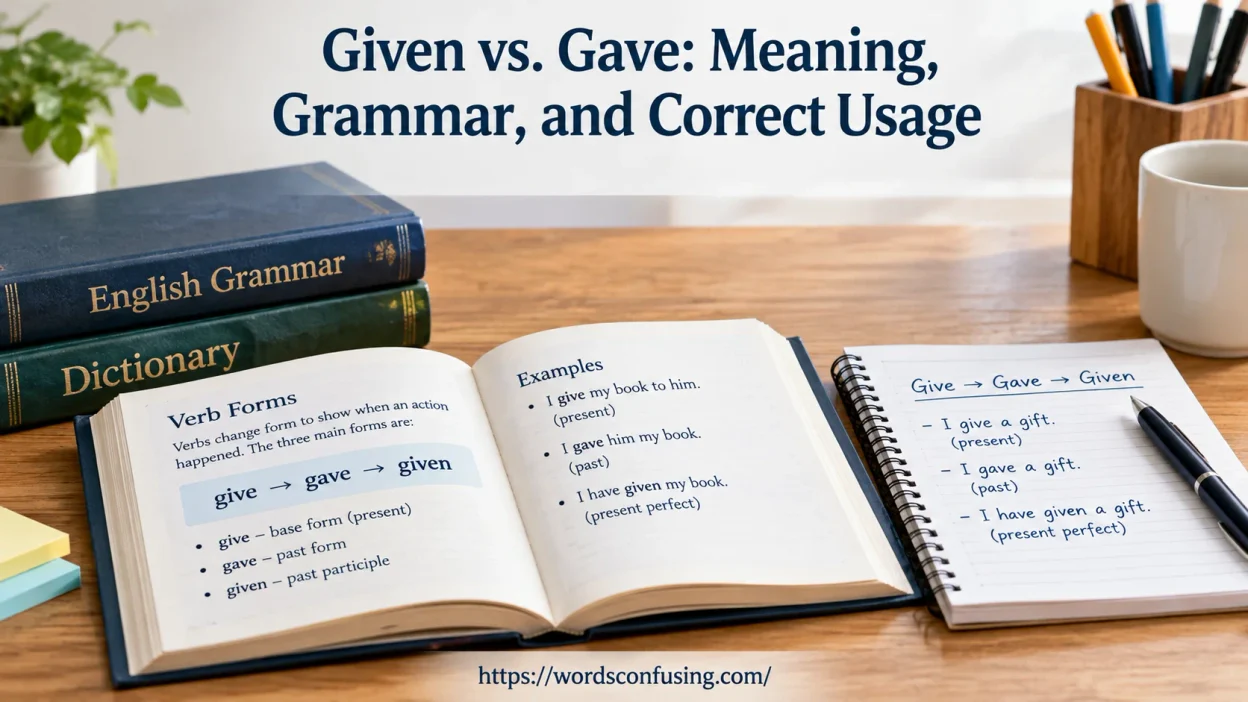
In Given vs. Gave: Meaning, Grammar and Correct Usage, English learners can see why these two verb forms create common mistakes so often.
The difference becomes simple when you understand that gave is the simple past tense of give, while given is the past participle. Both words connect to past actions, but they don’t work in the same sentence structure. Using the wrong form can produce phrases such as “I have gave” or “She given me a gift yesterday.”
The good news is that this pair follows clear grammar patterns. Because give is an irregular verb, its forms don’t follow every usual pattern. Learning these rules helps you speak confidently and avoid unnecessary grammar mistakes.
On the surface, gave and given look like two tiny words, so hesitation is common in emails, essays, and conversations. Even fluent speakers may pause before choosing the right form because both sound familiar and can seem interchangeable.
However, given usually works with helping verbs as a past participle, while gave directly shows a completed past action. Meanwhile, giving describes an action that is unfolding or happening right now. This practical guide uses clear explanations, examples, and memory tricks to make the choice feel natural, quick, and effortless.
The key is to focus on these two forms, their sentence rules, and their past tense forms. That approach can reduce doubt, strengthen writing, build confidence, and help you recognize the correct form more easily.
Quick Answer
Gave is the simple past tense of give. Use it when you describe a completed action in the past.
James gave me his phone number yesterday.
Given is the past participle of give. It usually appears with an auxiliary verb such as has, have, had, or a form of be.
James has given me his phone number.
The basic distinction looks like this:
| Word | Grammatical form | Main use | Example |
| give | Base form | Present tense, infinitive, commands | I give him advice. |
| gave | Simple past | Completed past action | I gave him advice yesterday. |
| given | Past participle | Perfect tenses and passive voice | I have given him advice. |
| giving | Present participle | Continuous forms | I am giving him advice. |
A useful rule is simple:
Gave stands alone as the past-tense verb. Given usually works with another helping verb.
What Does “Gave” Mean?
Gave is the simple past form of give. It tells you that someone performed the action at an earlier time.
The action may involve an object, information, permission, advice, money, assistance, or something less tangible.
For example:
- Maria gave me a present.
- The teacher gave us extra homework.
- He gave his friend some useful advice.
- They gave the charity $500.
- She gave me permission to leave.
In each sentence, gave refers to something that happened in the past.
The verb doesn’t need has, have, or had before it.
When to Use “Gave”
Use gave when the sentence uses the simple past tense.
This often happens when you mention a finished time or past event.
For example:
I gave him the documents yesterday.
She gave me a call last night.
They gave us directions two hours ago.
He gave his teacher the assignment on Monday.
Words such as yesterday, last night, last week, two days ago, and in 2024 can point toward a completed past action. They don’t automatically require gave, but they often appear with the simple past.
Consider the difference:
She gave me the keys yesterday.
The sentence places the action at a specific completed point in the past.
Now compare it with:
She has given me the keys.
Here, the sentence uses the present perfect. It focuses on the completed action and its relevance to the present rather than simply locating the action at a finished past time.
What Does “Given” Mean?
Given is the past participle of give. Unlike gave, it generally doesn’t function as the ordinary simple past form.
Instead, given appears in several grammatical structures.
The most common include:
- has given
- have given
- had given
- has been given
- have been given
- had been given
- was given
- were given
- should have given
- could have given
- would have given
For example:
She has given me excellent advice.
They had given us enough time.
The students were given extra instructions.
The word given can also function as an adjective or preposition in certain contexts. Those uses have different meanings and shouldn’t be confused with its role as the past participle of give.
Give, Gave, and Given: The Three Main Forms
The verb give is irregular. Its forms don’t follow the regular -ed pattern used by verbs such as walk and walked.
Instead, you need to remember these forms:
| Form | Verb | Example |
| Base form | give | I give him my support. |
| Simple past | gave | I gave him my support. |
| Past participle | given | I have given him my support. |
| Present participle | giving | I am giving him my support. |
This distinction becomes especially important in perfect tenses.
You wouldn’t say:
I have gave him my support.
The correct sentence is:
I have given him my support.
Likewise, you wouldn’t normally say:
I had gave her the information.
The correct version is:
I had given her the information.
Think of gave and given as two different tools in the same toolbox. They come from the same verb, but each one has its own grammatical purpose.
Given vs. Gave in Simple Past Sentences
The simple past is where gave belongs.
When the action happened and finished in the past, gave can describe it directly.
Examples With “Gave”
- Tom gave me his old laptop.
- She gave her brother a birthday card.
- The company gave employees a bonus.
- He gave the waiter a generous tip.
- My teacher gave me helpful feedback.
- They gave us three options.
- Sarah gave her friend a ride home.
- The doctor gave him some basic instructions.
Notice something important: gave doesn’t require a helping verb.
The sentence can simply contain:
Subject + gave + object
For example:
Daniel gave Sarah the keys.
You can also add indirect objects, time expressions, locations, and other details:
Daniel gave Sarah the keys after the meeting.
The core verb remains gave because the sentence describes a completed past action.
Read more: United States’ vs. United States’s: Which Possessive Is Correct?
“Gave” With Specific Past-Time Expressions
Specific past-time expressions commonly work with the simple past.
For example:
- yesterday
- last night
- last month
- two weeks ago
- in 2022
- when I was younger
- during the meeting
- after lunch
Consider these sentences:
She gave me the answer yesterday.
He gave his presentation last Friday.
They gave us the information two days ago.
The completed time frame makes the simple past a natural choice.
However, don’t treat these expressions as an absolute formula. Context still determines the correct tense.
Given With Has, Have, and Had
One of the most important rules for given vs. gave involves auxiliary verbs.
The past participle given commonly follows:
- has
- have
- had
These combinations create perfect tenses.
Present Perfect: Has Given and Have Given
Use has given with a singular third-person subject such as he, she, it, or a singular noun.
She has given me permission.
The manager has given us new instructions.
Use have given with I, you, we, they, and plural subjects.
I have given him the documents.
They have given us enough information.
We have given the project careful attention.
The important pattern is:
has/have + given
Not:
has/have + gave
Past Perfect: Had Given
Use had given when you need the past perfect tense.
She had given me the address before I left.
They had given him several warnings before the incident.
We had given the matter enough consideration.
The structure is:
had + given
That’s why “had gave” is incorrect.
“I Have Gave” vs. “I Have Given”
This is one of the most common mistakes involving gave and given.
❌ I have gave him the money.
✅ I have given him the money.
Why?
Because have requires the past participle in the present perfect tense.
The verb sequence works like this:
give → gave → given
So:
- I give
- I gave
- I have given
The same principle applies to other subjects:
- She has given
- He has given
- We have given
- They have given
- You have given
A quick memory trick helps:
Have/has/had + given
If you see have, has, or had, given is usually the form you need when using this verb in a perfect construction.
“I Gave” vs. “I Have Given”
Both sentences can be correct, but they don’t communicate exactly the same grammatical idea.
Compare:
I gave him the money yesterday.
I have given him the money.
The first sentence uses the simple past. It presents the action as a completed event in the past.
The second uses the present perfect. It connects the completed action with the present situation.
For example, imagine someone asks whether you’ve paid your friend.
Have you given Mark the money?
A natural response is:
Yes, I have given him the money.
If you’re simply telling someone what happened yesterday, you might say:
I gave Mark the money yesterday.
The choice depends on the time frame and what you want the sentence to emphasize.
“Did You Gave” vs. “Did You Give”
Another frequent mistake occurs in questions.
❌ Did you gave him the book?
✅ Did you give him the book?
Why does gave change to give?
Because did already marks the sentence as past tense. The main verb therefore returns to its base form.
The structure is:
Did + subject + base verb
So:
Did you give her the message?
Not:
Did you gave her the message?
The same rule applies to other verbs:
- Did you go?
- Did she eat?
- Did they see him?
- Did he take it?
- Did you give her the keys?
You don’t use the simple past form after did.
“Didn’t Give” vs. “Didn’t Gave”
The same rule applies to negative sentences.
❌ She didn’t gave me the answer.
✅ She didn’t give me the answer.
Here, didn’t already carries the past-tense meaning.
Therefore, the main verb uses its base form:
didn’t + give
Examples include:
He didn’t give me enough time.
They didn’t give us any warning.
Sarah didn’t give him the address.
We didn’t give the problem much thought.
This pattern is worth memorizing because it applies consistently to ordinary simple-past questions and negatives.
“Had Gave” vs. “Had Given”
The past perfect requires the past participle.
❌ She had gave me the information.
✅ She had given me the information.
The structure is:
had + past participle
Since given is the past participle of give, the correct construction is:
She had given me the information before the meeting started.
Another example:
By the time we arrived, they had given the tickets to someone else.
The past perfect helps show that one past event happened before another past event.
Given in Passive Voice
Given also appears frequently in passive constructions.
Compare:
The teacher gave the students extra time.
with:
The students were given extra time.
The first sentence uses gave because the subject performs the action.
The second sentence uses given because the sentence focuses on the people receiving the action.
More examples include:
- He was given another opportunity.
- She was given clear instructions.
- The employees were given additional training.
- We were given permission to leave.
- The patient was given medication.
- The team was given more time.
The basic passive structure is:
be + given
The form of be changes according to the tense.
| Tense | Passive construction | Example |
| Present | is/are given | Students are given instructions. |
| Past | was/were given | Students were given instructions. |
| Present perfect | has/have been given | Students have been given instructions. |
| Past perfect | had been given | Students had been given instructions. |
| Future | will be given | Students will be given instructions. |
This is why given appears so often in formal writing, instructions, reports, and academic contexts.
Given With Modal Verbs
The past participle given also appears after modal constructions involving have.
Common patterns include:
- should have given
- could have given
- would have given
- might have given
- may have given
- must have given
Examples:
You should have given him more time.
She could have given us better directions.
They might have given the wrong address.
He would have given you the information if you had asked.
The structure is:
modal + have + past participle
Since given is the past participle, it follows have in these constructions.
“Given” as an Adjective
Not every occurrence of given functions as a verb form.
Sometimes given works as an adjective.
For example:
Under the given circumstances, we decided to leave.
Here, given describes the circumstances.
You can also see expressions such as:
- a given situation
- a given amount
- a given time
- a given condition
- a given set of circumstances
In these expressions, given often means something like specified, particular, or already established.
For example:
The machine can process a given amount of data within seconds.
Here, given means a particular amount that has been specified.
“Given” as a Preposition
Given can also introduce a condition or fact that you take into consideration.
In this use, it can mean considering or taking into account.
For example:
Given the weather, the event was canceled.
This means the weather was a relevant factor in the decision.
Another example:
Given his experience, he handled the situation well.
Here, the speaker considers his experience when explaining the outcome.
This use has nothing to do with choosing gave for a past action.
You wouldn’t replace given with gave in these expressions.
❌ Gave the circumstances, we left early.
✅ Given the circumstances, we left early.
Given vs. Gave: A Side-by-Side Comparison
The following table makes the distinction easier to see.
| Sentence | Correct? | Explanation |
| She gave me the book. | ✅ | Simple past |
| She has given me the book. | ✅ | Present perfect |
| She had given me the book. | ✅ | Past perfect |
| She was given the book. | ✅ | Passive voice |
| She has gave me the book. | ❌ | Use past participle after “has” |
| She had gave me the book. | ❌ | Use past participle after “had” |
| Did she gave you the book? | ❌ | Use base form after “did” |
| Did she give you the book? | ✅ | Correct question structure |
| She didn’t gave me the book. | ❌ | Use base form after “didn’t” |
| She didn’t give me the book. | ✅ | Correct negative structure |
Common Mistakes With Given and Gave
Understanding the most common errors can make the rule stick faster.
Mistake: Using “Gave” After “Have”
❌ I have gave him the details.
Correct:
✅ I have given him the details.
The word have requires the past participle here.
Mistake: Using “Gave” After “Had”
❌ They had gave us permission.
Correct:
✅ They had given us permission.
The past perfect uses had + past participle.
Mistake: Using “Gave” After “Did”
❌ Did you gave her the money?
Correct:
✅ Did you give her the money?
Did already marks the past tense.
Mistake: Using “Given” as Simple Past
❌ She given me the keys yesterday.
Correct:
✅ She gave me the keys yesterday.
The simple past requires gave.
Mistake: Forgetting the Auxiliary Verb With “Given”
❌ He given me some advice.
Correct:
✅ He gave me some advice.
Or:
✅ He has given me some advice.
The correct choice depends on the intended tense.
A Practical Way to Remember Given vs. Gave
If you’re unsure which word to use, identify the grammatical structure first.
Ask yourself a few quick questions:
Is the sentence describing a completed past action?
Use gave.
She gave me the answer yesterday.
Does the sentence contain has, have, or had?
Use given.
She has given me the answer.
Does the sentence use a passive structure?
Use given.
She was given the answer.
Does the sentence use did or didn’t?
Use give, not gave or given.
Did she give you the answer?
This approach works better than trying to memorize dozens of isolated examples.
Given vs. Gave in Everyday Examples
Here are several natural examples that show how the forms work.
Examples With “Gave”
My brother gave me his old headphones.
The waiter gave us the menu.
She gave her friend a thoughtful gift.
The teacher gave everyone five extra minutes.
He gave me a useful suggestion.
They gave the team another chance.
Examples With “Given”
My brother has given me his old headphones.
The waiter has given us the menu.
She has given her friend a thoughtful gift.
The teacher had given everyone five extra minutes.
He has given me a useful suggestion.
They were given another chance.
The meaning of the individual verb remains related to give, but the grammatical structure changes.
A Mini Case Study: Choosing the Correct Form
Imagine this short situation.
Emma visited a bookstore yesterday. She bought a novel for her brother and handed it to him that evening.
You could write:
Emma gave her brother the novel yesterday.
That sentence uses the simple past because the action happened at a definite completed time.
Now suppose someone asks whether Emma has already given the novel to her brother.
You could answer:
Emma has given her brother the novel.
The present perfect connects the completed action to the current situation.
Now imagine the story contains another earlier event:
Emma had given her brother the novel before he left for work.
The past perfect shows that the giving happened before another past event.
Finally, change the focus:
Emma’s brother was given the novel before he left for work.
Now the sentence uses passive voice.
The basic event hasn’t changed. The grammatical perspective has.
Another Case Study: “Gave” and “Given” in Context
Consider these four sentences:
The manager gave the employee a warning.
She has given the employee a warning.
Earlier, the manager had given the employee a warning.
The employee was given a warning.
All four sentences involve the same basic action. Yet each sentence uses a different structure.
Gave presents the action as simple past.
Has given uses the present perfect.
Had given uses the past perfect.
Was given uses passive voice.
This comparison shows why memorizing a single translation or definition isn’t enough. Grammar determines which form belongs in the sentence.
When “Gave” Is Correct
Use gave when:
- The action happened in the past.
- The sentence uses simple past.
- You don’t have an auxiliary verb requiring a past participle.
- You’re describing a completed past event.
Examples:
- She gave me a gift.
- He gave us directions.
- They gave him a chance.
- I gave her the documents yesterday.
When “Given” Is Correct
Use given when:
- It follows has.
- It follows have.
- It follows had.
- It appears in a passive construction.
- It follows have after a modal verb.
- It functions as an adjective.
- It introduces a consideration or condition in expressions such as given the circumstances.
Examples:
- She has given me permission.
- They had given us enough time.
- He was given a second chance.
- You should have given her more information.
- Given the circumstances, we left early.
Quick Grammar Test
Choose gave, given, or give in each sentence.
- She ___ me the book yesterday.
- He has ___ me the answer.
- Did you ___ her the message?
- They had ___ us enough time.
- We were ___ clear instructions.
- She didn’t ___ him permission.
- The teacher ___ us extra homework last week.
- He should have ___ you a warning.
Answers
- gave
- given
- give
- given
- given
- give
- gave
- given
The pattern becomes clear once you identify the helping verb.
Given vs. Gave: The Essential Rule
The entire distinction can be reduced to three verb forms:
Give → Gave → Given
Use give as the base form:
I give him advice.
Use gave as the simple past:
I gave him advice yesterday.
Use given as the past participle:
I have given him advice.
And remember what happens after did:
Did you give him advice?
Not:
❌ Did you gave him advice?
That one rule eliminates a surprisingly large number of common mistakes.
FAQs
Is “gave” the past tense of “give”?
Yes. Gave is the simple past tense of give. You use it for an action that happened and finished in the past. For example, “She gave me a book yesterday.” You don’t normally use gave after helping verbs such as have or has.
When should you use “given” instead of “gave”?
Use given when the sentence needs the past participle of give. It commonly appears with have, has, had, or forms of be. For example, “They have given us enough time.” Using given correctly depends on the sentence structure, not simply on when the action happened.
Is “I have gave” grammatically correct?
No. The correct form is “I have given.” After have or has, you need the past participle given, not the simple past gave. This is one of the most common mistakes English learners make with this irregular verb.
Can “given” appear without a helping verb?
Yes, but its role changes depending on the sentence. Given can also function as an adjective or appear in other grammatical structures. For example, “Given the circumstances, we decided to leave.” Here, given does not mean the simple past action expressed by gave.
What is the difference between “gave” and “given” in a sentence?
Gave directly expresses a completed past action, while given is the past participle. Compare these examples: “He gave me a warning” and “He has given me a warning.” The first uses simple past, while the second uses the present perfect structure.
What is the easiest way to remember “gave” vs. “given”?
Think of the pattern give → gave → given. Use gave for simple past sentences, such as “I gave her a gift.” Use given after have, has, or had, as in “I had given her a gift.” This quick pattern makes the difference easier to remember.
Conclusion
Choosing between gave vs given becomes much easier once you understand their roles. Gave is the simple past form of give, while given is the past participle. So, you can say, “She gave me a present yesterday,” but “She has given me a present.” The helping verb makes all the difference.
When you’re unsure, pause and look at the sentence structure. If you need the simple past, gave is usually your answer. If the sentence contains have, has, or had, given is the form to remember. Once this pattern becomes familiar, these two small words stop causing big grammar headaches.