
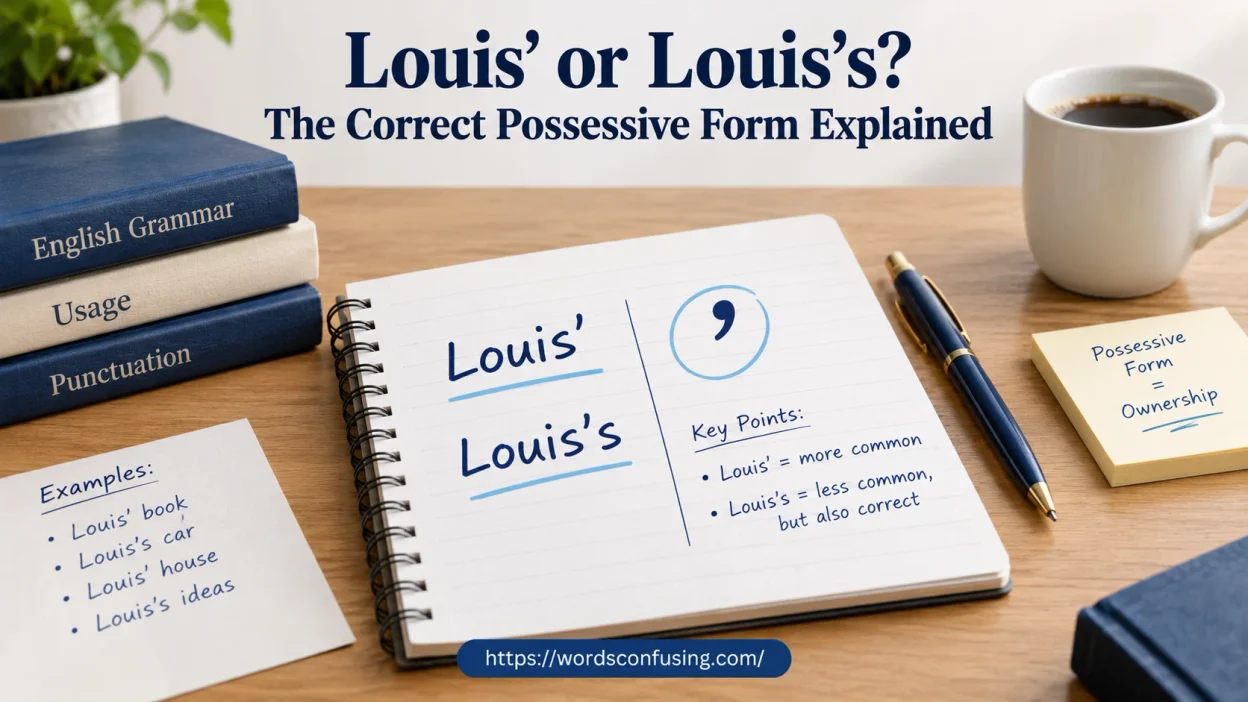
Louis’ or Louis’s? The Correct Possessive Form Explained tackles a tricky puzzle. Even experienced writers can second-guess their writing when they face this choice. When a sentence contains a name ending in “s,” you may wonder what to do. Should you keep the apostrophe? Or should you add an extra “s”? This small choice can create confusion.
The correct possessive form depends on English usage and grammar rules. Your style guide, context, and audience also matter. Different authorities follow different grammar conventions.
Therefore, Louis’ and Louis’s can appear in certain situations. Knowing these possessive forms improves accuracy, confidence, and consistency. It also helps native speakers and people learning English as a second language.
The Louis’ vs. Louis’s debate becomes easier with clear practical examples. This guide explains the mystery behind each form. It also shows how to use possessives correctly. You can sharpen your writing and avoid common grammatical mistakes involving apostrophes, grammar, grammatical usage, rules, spelling, and punctuation.
These principles apply to emails, reports, academic work, everyday communication, business communication, documents, and meetings. They also matter for professional content, project management, calendar entries, scheduling, time management, online booking, and broadcasting.
In these settings, clear language keeps communication precise. It reduces misunderstandings, strengthens writing credibility, and limits uncertainty.
Quick Answer
When Louis refers to one person and you need the possessive form, Louis’s is generally the preferred form in modern American English.
| Form | Use | Example |
| Louis | Singular name | Louis arrived early. |
| Louis’s | Singular possessive | Louis’s car is blue. |
| Louis’ | Alternative possessive style | Louis’ car is blue. |
| Louises | Plural of Louis | Two Louises attended. |
| Louises’ | Plural possessive | The Louises’ cars were parked outside. |
The distinction matters because an apostrophe doesn’t automatically make a word plural. Instead, apostrophes commonly indicate possession or another relationship between words.
Therefore:
Louis’s is the preferred form for standard American English when following Chicago style.
That doesn’t mean every publication will use it. Style conventions can differ.
Louis’ vs. Louis’s: What’s the Difference?
The difference is simply the placement of the possessive ending.
Louis’s adds an apostrophe and s:
1 Louis + ’s = Louis’s
2 Louis’ adds only an apostrophe:
3 Louis + ’ = Louis’
Both forms can appear when writers want to show that something belongs to Louis.
Consider these sentences:
- Louis’s bicycle needs repair.
- Louis’ bicycle needs repair.
The intended meaning is essentially the same: the bicycle belongs to Louis.
The difference comes from editorial convention, not from a completely different grammatical meaning.
This distinction becomes important because many readers assume the extra s must be wrong. It isn’t. In fact, major modern style guidance specifically supports Louis’s.
Why Do Both Forms Exist?
English has accumulated several possessive conventions over time.
Older editorial traditions sometimes treated names ending in s differently. Writers would add only an apostrophe:
- Moses’
- James’
- Dickens’
- Louis’
Other conventions added ’s:
- Moses’s
- James’s
- Dickens’s
- Louis’s
Over time, many modern style systems moved toward the simpler rule of treating singular names like other singular nouns.
That produces:
- James’s book
- Harris’s office
- Louis’s car
Is Louis’ Grammatically Correct?
Yes, Louis’ can be found as a possessive form, especially in writing that follows a style allowing an apostrophe without an additional s.
However, that doesn’t make it the preferred form in every context.
For example:
Louis’ jacket was hanging by the door.
A reader will understand the sentence immediately. The apostrophe tells the reader that the jacket belongs to Louis.
You’ll also encounter:
Louis’ decision surprised everyone.
Again, the intended relationship is clear.
The important point is that Louis’ isn’t a plural form simply because it ends with an apostrophe.
Instead, it can represent a singular possessive under a particular editorial convention.
Some style systems have historically preferred this construction for names ending in s. That’s one reason older books, newspapers, websites, and institutional publications may use Louis’.
If you’re following a specific publication’s house style, use that system consistently.
If no style guide has been specified and you’re writing standard American English, Louis’s is generally the clearer choice.
Is Louis’s Grammatically Correct?
Absolutely.
In fact, Louis’s is the preferred possessive form under current Chicago style.
The same principle applies to many singular names ending in s:
- James’s car
- Chris’s phone
- Harris’s office
- Lucas’s book
- Louis’s jacket
The underlying idea is straightforward. Louis is one person. Add ’s to form the singular possessive.
Examples of Louis’s
Here are several natural examples:
- Louis’s phone rang during the meeting.
- I found Louis’s wallet on the table.
- Louis’s parents arrived yesterday.
- The teacher praised Louis’s project.
- We visited Louis’s apartment last weekend.
- Louis’s answer solved the problem.
- The dog followed Louis’s car home.
In each sentence, Louis’s identifies a relationship between Louis and another noun.
That relationship doesn’t always mean literal ownership.
For example:
Louis’s mother called this morning.
Louis doesn’t own his mother. The possessive form simply establishes a relationship between the two nouns.
That’s an important point. In grammar, possessive often means more than physical ownership.
Louis’ or Louis’s in American English
For American English, Louis’s is generally the better default when you’re referring to one person named Louis.
So you would write:
- Louis’s house
- Louis’s opinion
- Louis’s friend
- Louis’s company
- Louis’s book
However, American English doesn’t operate under one universal editorial rulebook.
Different publications can adopt different house styles. A newspaper might use one convention while a university publisher uses another. A company style guide may also specify its own treatment.
That’s why you’ll occasionally see Louis’ even in polished professional writing.
A Practical Rule for American Writers
If you’re unsure which form to choose, use this simple approach:
One Louis + possession = Louis’s
For example:
Louis’s laptop is on the desk.
Then check the style guide if you’re writing for a specific publication, organization, academic program, or client.
Consistency matters.
Switching between Louis’ and Louis’s within the same document can make your writing look careless even when both forms are understandable.
Read more: Agencies or Agency’s or Agencies’? The Correct Usage Explained
Why Louis’s Usually Makes More Sense
There is a practical reason many writers prefer Louis’s.
The spelling makes the grammatical structure visible.
Look at:
Louis’s notebook
The reader can immediately see the possessive ending.
Compare:
Louis’ notebook
This version also communicates possession, but the ending can visually resemble the plural possessive pattern.
That distinction becomes particularly useful when names already look plural.
Consider Wilkens.
A person named George Wilkens has:
George Wilkens’s house
But a family called the Wilkenses has:
the Wilkenses’ house
The extra s therefore isn’t decorative. It can help readers understand the grammatical structure.
Louis’ vs. Louis’s Examples
Seeing the forms side by side makes the distinction easier.
| Sentence | Form | Meaning |
| Louis arrived early. | Louis | Singular name |
| Louis’s car is outside. | Louis’s | Car belongs to Louis |
| Louis’ car is outside. | Louis’ | Alternative possessive style |
| I borrowed Louis’s book. | Louis’s | Book belongs to Louis |
| I borrowed Louis’ book. | Louis’ | Alternative possessive style |
| Louis’s sister called. | Louis’s | Relationship to Louis |
| Louis’ sister called. | Louis’ | Alternative possessive style |
| Two Louises arrived. | Louises | More than one Louis |
| The Louises’ coats were wet. | Louises’ | Coats belong to multiple Louises |
Notice something important: Louis’s and Louis’ don’t normally change the underlying meaning.
The main difference lies in the style used to form the possessive.
When to Use Louis’s
Choose Louis’s when you’re following a style that forms singular possessives with ’s, including modern Chicago style.
This is especially useful when you’re writing:
- Blog posts
- General web content
- Business material
- School assignments
- Personal writing
- Articles
- Informational guides
- General American English
For example:
Louis’s presentation begins at nine.
Or:
The manager reviewed Louis’s report.
The form is easy to understand and follows the standard singular possessive pattern.
Louis’s With Different Relationships
Possessive constructions can describe several kinds of relationships.
Ownership:
Louis’s car needs gas.
Family relationship:
Louis’s daughter starts school tomorrow.
Authorship:
Louis’s article appeared online yesterday.
Responsibility:
Louis’s decision changed the schedule.
Association:
Louis’s hometown is famous for its historic buildings.
In every example, Louis’s connects Louis with the noun that follows.
When to Use Louis’
Use Louis’ when a publication, institution, or style guide specifically calls for the apostrophe-only convention.
You may also encounter it in established names, quotations, older publications, or content that follows a particular editorial tradition.
For example:
Louis’ restaurant opened downtown.
Or:
The editor discussed Louis’ manuscript.
The construction remains understandable because the apostrophe signals the possessive relationship.
However, don’t randomly alternate between Louis’ and Louis’s.
If your document uses Louis’s in one paragraph, don’t switch to Louis’ later without a reason.
Consistency creates a cleaner reading experience.
How Do You Pronounce Louis’s?
The pronunciation of Louis’s can be confusing because the name Louis itself has more than one established pronunciation.
Depending on the person, region, or naming tradition, Louis may be pronounced differently.
The possessive ending doesn’t erase those differences.
For many speakers, the possessive ending adds an audible s or z sound. In other contexts, pronunciation may vary according to the underlying pronunciation of the name.
The important writing lesson is this:
Don’t choose the spelling solely by guessing how the possessive sounds.
Instead, identify the grammatical form first.
If Louis is singular and you need a possessive under a ’s style, write:
Louis’s
This same principle applies to names such as:
- James’s
- Chris’s
- Lucas’s
- Harris’s
Spelling and pronunciation don’t always line up perfectly in English. That’s hardly unusual.
Louis vs. Louis’ vs. Louis’s vs. Louises’
These forms look deceptively similar, but they perform different jobs.
| Form | Grammatical role | Example |
| Louis | Singular name | Louis called me. |
| Louis’s | Singular possessive | Louis’s phone rang. |
| Louis’ | Alternative singular possessive | Louis’ phone rang. |
| Louises | Plural name | Two Louises called me. |
| Louises’ | Plural possessive | The Louises’ phones rang. |
This table reveals the key idea: plurality and possession are separate concepts.
A plural tells you there is more than one person.
A possessive tells you that one noun has a relationship with another.
The apostrophe helps mark possession, while the spelling of the name helps establish whether you’re dealing with one or multiple people.
What Is the Plural of Louis?
The plural of Louis is Louises when you’re referring to multiple people who share that name.
For example:
Two Louises joined the class this year.
Another example:
The restaurant had three customers named Louis.
If you’re writing about several people named Louis, don’t use an apostrophe to make the name plural.
Incorrect:
Louis’s attended the event.
Correct:
Louises attended the event.
The apostrophe isn’t needed because you’re simply forming a plural.
What Is the Plural Possessive of Louis?
Once you have more than one Louis, the possessive form becomes Louises’.
For example:
The Louises’ cars were parked outside.
Here, Louises means more than one person named Louis.
The final apostrophe indicates that something belongs to those multiple people.
Compare these sentences:
Louis’s car was outside.
One Louis owns or is associated with the car.
The Louises’ cars were outside.
Multiple people named Louis own or are associated with the cars.
This is a crucial distinction.
The Pattern
The structure works like this:
One Louis:
Louis → Louis’s
Multiple Louises:
Louises → Louises’
The extra s in Louis’s belongs to the singular possessive construction.
The apostrophe in Louises’ follows the plural form.
Common Mistakes With Louis’ and Louis’s
A few mistakes appear repeatedly when writers deal with names ending in s.
Mistake 1: Treating Louis’ as a Plural
Some writers assume that Louis’ means multiple people named Louis.
It doesn’t.
The apostrophe marks possession in this construction.
If you mean several people named Louis, write:
Louises
If those people collectively possess something, write:
Louises’
Mistake 2: Assuming Louis’s Is Incorrect
The extra s may look strange at first.
So this sentence is perfectly valid:
Louis’s car needs a new tire.
Mistake 3: Adding an Apostrophe to Make Louis Plural
Don’t write:
The Louis’ arrived at noon.
That construction incorrectly uses the apostrophe as a plural marker.
Write:
The Louises arrived at noon.
The apostrophe belongs to possessive constructions, not ordinary plural names.
Mistake 4: Mixing Styles
A document might contain:
Louis’s office was closed.
Later, the same document says:
Louis’ office reopened.
That inconsistency isn’t necessarily a grammar disaster, but it creates an unnecessary style mismatch.
Pick one convention and stick with it.
Mistake 5: Confusing a Name With a Family Name
The plural possessive becomes especially tricky with surnames.
Suppose a family has the surname Louis.
You may need to distinguish between the family’s plural form and its possessive form according to the intended construction.
Don’t assume that every name ending in s behaves identically without considering whether you’re talking about one person, multiple people, or a family name.
A Simple Decision Guide for Louis’ or Louis’s
When you’re stuck, follow these steps.
Step 1: Are You Talking About One Louis?
If yes, continue.
If you’re talking about multiple people named Louis, use Louises.
Step 2: Are You Showing Possession or Association?
If no, simply use Louis.
Louis arrived early.
If yes, you need a possessive form.
Step 3: Follow Your Style Guide
For modern Chicago style, use:
Louis’s
If your publication uses an apostrophe-only convention, you may see:
Louis’
Step 4: Stay Consistent
Don’t switch forms randomly.
A consistent style is easier to read and easier to edit.
Style Guide Differences Matter
One reason the Louis’ vs. Louis’s debate persists is that English style isn’t governed by a single worldwide authority.
Different style guides can establish different preferences.
Modern Chicago style uses ’s for singular personal names ending in s.
The Australian Government Style Manual also uses ’s for singular personal names ending in s, giving examples such as James’s and Louis’s.
This doesn’t mean every publisher must follow the same convention.
Instead, it explains why two forms can appear in real-world writing.
Why Style Guides Exist
A style guide creates consistency.
Imagine a 200-page book where one editor writes:
James’s
another writes:
James’
and a third writes:
James’s
The reader may understand every sentence. The publication would still look inconsistent.
Style guides prevent that patchwork effect.
They answer questions about:
- Apostrophes
- Capitalization
- Hyphenation
- Numbers
- Quotations
- Spelling
- Names
- Titles
- Abbreviations
For possessive names, the guide tells writers which convention to follow.
Case Study: One Louis vs. Several Louises
Consider a fictional school with three students named Louis.
One student owns a backpack.
You could write:
Louis’s backpack was under the desk.
Now imagine all three students own backpacks.
You could write:
The Louises’ backpacks were under the desk.
The grammar changes because the number of people changes.
| Situation | Correct form |
| One person named Louis | Louis |
| One Louis owns something | Louis’s |
| Multiple people named Louis | Louises |
| Multiple Louises possess something | Louises’ |
This example also shows why Louis’s and Louises’ shouldn’t be treated as interchangeable.
They represent different grammatical structures.
Does Louis’s Mean Louis Is?
No.
This is another common misunderstanding involving apostrophes.
In Louis’s, the apostrophe and s indicate possession.
For example:
Louis’s book is on the desk.
Here, Louis’s means the book belongs to or is associated with Louis.
However, ’s can also form a contraction in other contexts.
For example:
Louis’s coming later.
Depending on context, this can represent:
Louis is coming later.
That’s completely different from:
Louis’s car is outside.
In the second sentence, Louis’s is possessive.
Context tells you which grammatical function applies.
Compare the Two
Possessive:
Louis’s jacket is wet.
Meaning: The jacket belongs to or is associated with Louis.
Contraction:
Louis’s waiting outside.
Meaning: Louis is waiting outside.
The spelling looks identical. The grammatical role differs.
Does the Apostrophe Always Mean Ownership?
Not necessarily.
English possessives often express relationships rather than literal ownership.
Consider:
Louis’s mother
Louis doesn’t possess his mother.
The construction identifies a family relationship.
Similarly:
Louis’s hometown
A person doesn’t own a town.
The possessive simply creates a close relationship between Louis and hometown.
Other examples include:
- Louis’s birthday
- Louis’s opinion
- Louis’s career
- Louis’s childhood
- Louis’s team
- Louis’s favorite song
In each case, the relationship is clear from context.
That’s why linguists often describe these constructions more broadly than simple ownership.
Why You Shouldn’t Rely Only on Pronunciation
Some writers choose between Louis’ and Louis’s by saying the sentence aloud.
That approach can help occasionally, but it isn’t a reliable grammar rule.
Names can have different pronunciations. Speakers also vary in how strongly they pronounce possessive endings.
Writing needs a consistent orthographic system.
For that reason, grammatical number and style convention should guide the spelling.
If one person named Louis has a car and you’re following Chicago style, write:
Louis’s car
You don’t need to solve the pronunciation puzzle first.
Louis’ or Louis’s in Formal Writing
For formal American writing, Louis’s provides a straightforward default.
It works naturally in:
- Academic assignments
- Business reports
- Articles
- Essays
- Professional correspondence
- Website content
- Technical writing
For example:
Louis’s research influenced the final recommendation.
Or:
The committee reviewed Louis’s proposal before the meeting.
If your institution has a required style guide, however, follow that guide first.
That’s especially important for academic and professional publishing.
Quick Comparison: Which Form Should You Choose?
| Question | Answer |
| Is Louis one person? | Use Louis |
| Does one Louis possess something? | Usually Louis’s |
| Does a house style require apostrophe only? | Louis’ may be appropriate |
| Are several people named Louis? | Louises |
| Do several Louises possess something? | Louises’ |
| Is Louis’ automatically wrong? | No |
| Is Louis’s grammatically correct? | Yes |
| What does modern Chicago style prefer? | Louis’s |
FAQs
Is Louis’ grammatically correct?
Yes, Louis’ can be correct when a style guide uses only an apostrophe for singular names ending in s. The preferred form depends on the writing standard you follow.
Is Louis’s also correct?
Yes, Louis’s is also a recognized possessive form. Many writers use it to show that the name is singular and possessive. It can make the intended pronunciation clearer.
Which is more common, Louis’ or Louis’s?
Usage varies by style guide and publication. Some prefer Louis’s, while others use Louis’ for names ending in s. Consistency matters more than switching between styles.
How do you pronounce Louis’s?
The pronunciation depends on how Louis is pronounced in the name. Adding ’s represents possession, but the spoken form follows the name’s established pronunciation.
Should I use Louis’ or Louis’s in formal writing?
Check the relevant style guide first. Academic institutions, publishers, and organizations may follow different conventions. Once you choose one, use it consistently throughout your document.
What is the possessive form of the name Louis?
Both Louis’ and Louis’s can function as the possessive form. The choice depends on the applicable grammar convention, style guide, and context.
Conclusion
Choosing between Louis’ and Louis’s doesn’t have to feel like a grammar guessing game. Both forms appear in English, but your style guide, context, and audience can determine which one fits your writing. Once you understand the underlying possessive rules, that confusing apostrophe becomes much easier to handle.
The key is consistency. Pick the form that matches your chosen convention, then use it throughout your emails, reports, academic work, or professional content. A tiny apostrophe may seem unimportant, but getting it right can make your writing look more polished, precise, and confident.

Franklin Hayes is a writer and editor at WordsConfusing.com, focused on making English vocabulary, grammar, and commonly confused words easy to understand. He writes clear, practical articles with simple explanations and useful examples to help readers improve their English with confidence.
His goal is simple: Making Confusing Words Simple.