

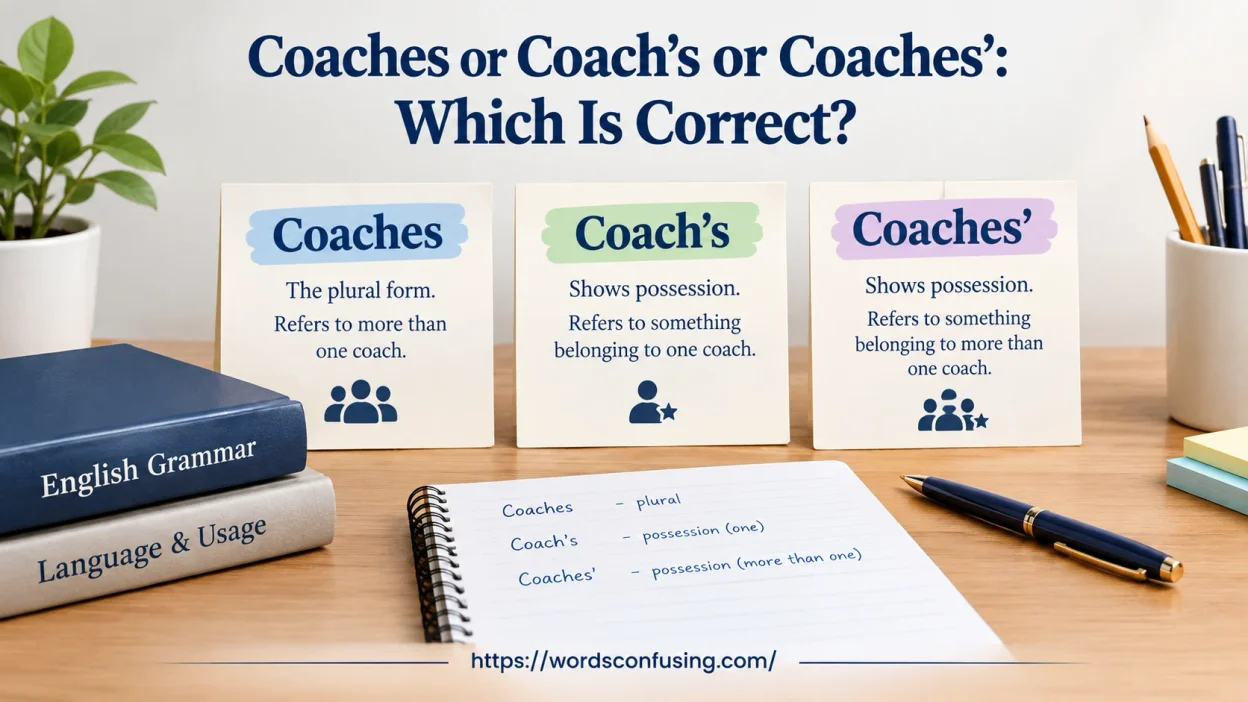
When asking Coaches or Coach’s or Coaches’: Which Is Correct?, the answer depends on whether you mean one coach, several coaches, or possession.
Coaches is the plural form of coach, while Coach’s shows that something belongs to one coach. Coaches’ shows possession involving multiple coaches. A tiny apostrophe can change the meaning of a sentence, so writers, students, and English learners should check the form carefully.
For example, “The coaches met after practice” means more than one coach, while “The coach’s office is upstairs” identifies something belonging to one coach.
The incorrect coachs often causes confusion, especially when people search Google for a quick answer. The basic grammar rule is simple: use Coaches for the plural, Coach’s for singular possession, and Coaches’ for plural possession.
This difference helps you write correctly in real-life writing. English plurals can seem tricky, but these standard rules provide clarity and prevent common mistakes.
Quick Answer
Use coaches when you mean more than one coach or when coaches functions as a verb.
The coaches discussed the new training plan.
Use coach’s when something belongs to one coach. It can also work as a contraction for coach is or coach has.
The coach’s whistle is on the bench.
Use coaches’ when something belongs to two or more coaches.
The coaches’ meeting begins at three o’clock.
A useful memory trick is simple:
- Coaches = more than one coach or the verb coaches
- Coach’s = one coach owns something
- Coaches’ = multiple coaches own something
That tiny apostrophe carries a surprising amount of grammatical weight.
Coaches: The Plural Form of Coach
The word coaches is the standard plural form of coach.
When you talk about one person, you use coach. When you talk about two or more people, you use coaches.
Examples of Coaches as a Plural Noun
- The coaches met after the game.
- Three coaches attended the tournament.
- The coaches reviewed the players’ performance.
- Several coaches helped organize the event.
- The coaches agreed on the practice schedule.
Notice something important in each example: coaches doesn’t have an apostrophe.
That’s because the word simply identifies more than one coach. It doesn’t show ownership.
Why You Don’t Write “Coach’s” for the Plural
A common mistake involves adding an apostrophe whenever a noun becomes plural.
That isn’t how English normally forms plurals.
For most nouns, you simply add -s or -es:
- coach → coaches
- player → players
- teacher → teachers
- class → classes
- student → students
An apostrophe generally doesn’t create a plural.
Therefore:
Correct: The coaches arrived.
Incorrect: The coach’s arrived.
The second version suggests possession or a contraction rather than a straightforward plural noun.
Why Coach Becomes Coaches
The spelling changes from coach to coaches because the word ends in -ch.
Many nouns ending in sounds such as ch, sh, s, x, or z form their plurals with -es.
For example:
- coach → coaches
- church → churches
- brush → brushes
- box → boxes
- bus → buses
This spelling pattern makes coaches completely normal as the plural of coach.
You don’t need an apostrophe to make the plural.
Coaches Can Also Be a Verb
The word coaches has another important function. It can serve as a verb.
In this use, coaches means that someone trains, guides, teaches, or prepares another person or group.
For example:
Maria coaches the school soccer team.
Here, coaches doesn’t mean multiple coaches. It describes an action performed by Maria.
Compare these sentences:
- The coaches arrived early.
- Maria coaches the team.
In the first sentence, coaches is a plural noun.
In the second sentence, coaches is a verb.
The surrounding sentence tells you which meaning applies.
Coaches as a Third-Person Singular Verb
The verb coach changes to coaches when the subject is third-person singular in the present tense.
Compare:
| Subject | Verb |
| I | coach |
| You | coach |
| We | coach |
| They | coach |
| He | coaches |
| She | coaches |
| It | coaches |
Examples make the pattern clearer:
- I coach basketball.
- You coach the junior team.
- They coach at the local school.
- She coaches volleyball.
- He coaches young athletes.
- The instructor coaches new players.
This distinction matters because coaches isn’t always a plural noun.
Sometimes it’s simply the correct present-tense form of the verb coach.
Coach’s: The Singular Possessive Form
Now the apostrophe enters the picture.
Coach’s is the singular possessive form of coach. You use it when something belongs to, relates to, or is associated with one coach.
The basic pattern looks like this:
one coach + possession = coach’s
For example:
The coach’s office is locked.
The office belongs to one coach.
Another example:
The coach’s whistle fell onto the field.
One coach owns or uses the whistle.
Examples of Coach’s as a Singular Possessive
- The coach’s car is parked outside.
- The coach’s strategy worked perfectly.
- I borrowed the coach’s clipboard.
- The coach’s decision surprised everyone.
- We followed the coach’s instructions.
- The coach’s speech motivated the players.
- The coach’s uniform was hanging in the locker room.
In every example, the noun following coach’s connects to one particular coach.
How to Recognize Coach’s Possession
A quick substitution test can help.
When you see coach’s, ask:
Does this belong to one coach?
If the answer is yes, coach’s is probably correct.
For example:
The coach’s office is large.
Ask:
Whose office?
The answer is:
One coach’s office.
Therefore, coach’s works.
Try another:
The coach’s notebook contains the schedule.
Whose notebook?
One coach’s notebook.
Again, coach’s is correct.
This test works particularly well when apostrophes start to look like tiny punctuation traps.
Coach’s Can Also Be a Contraction
There’s another wrinkle.
Coach’s doesn’t always indicate possession. It can also represent a contraction.
Depending on the sentence, coach’s may mean:
- coach is
- coach has
For example:
The coach’s ready for practice.
Here, coach’s means:
The coach is ready for practice.
Another example:
The coach’s announced the final lineup.
Here, coach’s can represent:
The coach has announced the final lineup.
However, context matters.
Coach’s Meaning “Coach Is”
Consider:
The coach’s waiting outside.
Expand the contraction:
The coach is waiting outside.
The sentence makes sense, so coach’s works as a contraction.
Another example:
The coach’s upset about the result.
This means:
The coach is upset about the result.
Coach’s Meaning “Coach Has”
Now consider:
The coach’s changed the practice schedule.
Expand it:
The coach has changed the practice schedule.
That also works.
This distinction can seem confusing because coach’s looks identical in both cases.
The solution is to expand the word mentally.
If replacing coach’s with coach is or coach has makes sense, you’re probably looking at a contraction.
If the word indicates ownership, it’s a possessive noun.
Coaches’: The Plural Possessive Form
Coaches’ is the plural possessive form of coach.
Use it when something belongs to, relates to, or is associated with multiple coaches.
The formation is straightforward:
coaches + apostrophe = coaches’
Notice where the apostrophe appears.
It comes after the s because coaches is already plural.
For example:
The coaches’ meeting starts at noon.
The meeting involves multiple coaches.
Another example:
The coaches’ offices are located downstairs.
The offices belong to or are associated with multiple coaches.
Examples of Coaches’ as a Plural Possessive
- The coaches’ meeting lasted two hours.
- The coaches’ offices are next to the gym.
- The coaches’ decisions affected the entire team.
- The coaches’ schedules changed this week.
- The coaches’ uniforms arrived yesterday.
- The coaches’ opinions differed on the issue.
- The coaches’ strategy focused on defense.
In each sentence, more than one coach is involved.
Why Coaches’ Has the Apostrophe After the S
This follows a basic possessive rule.
For a regular plural noun that already ends in s, place the apostrophe after the s.
The progression looks like this:
One coach → coach’s
Two or more coaches → coaches’
Compare the following:
The coach’s office
One coach owns or uses the office.
The coaches’ offices
Multiple coaches own or use the offices.
The apostrophe’s position tells you something about the noun.
That’s why moving it can change the meaning.
Coaches vs. Coach’s vs. Coaches’: Side-by-Side Comparison
| Form | Grammatical Role | Meaning | Example |
| Coaches | Plural noun | More than one coach | The coaches arrived. |
| Coaches | Verb | Trains or instructs | She coaches soccer. |
| Coach’s | Singular possessive | Belonging to one coach | The coach’s office is open. |
| Coach’s | Contraction | Coach is/has | The coach’s ready. |
| Coaches’ | Plural possessive | Belonging to multiple coaches | The coaches’ meeting ended. |
This table provides the quickest way to distinguish the three forms.
How to Choose Between Coaches, Coach’s, and Coaches’
When you’re unsure, don’t focus on the apostrophe first.
Instead, determine the sentence’s meaning.
Choose Coaches When You Mean Multiple Coaches
Use coaches when you’re talking about two or more coaches.
The coaches gathered in the gym.
The sentence describes several coaches. No possession appears.
You could replace coaches with:
the instructors
The meaning remains similar.
Choose Coaches When It Functions as a Verb
Use coaches when one person or thing performs the action of coaching.
Daniel coaches the junior team.
Here, Daniel is the subject.
The verb describes what Daniel does.
You can also say:
Daniel trains the junior team.
The grammatical function becomes obvious.
Choose Coach’s When One Coach Owns Something
Use coach’s when the thing belongs to one coach.
The coach’s clipboard is missing.
Ask:
Whose clipboard?
The answer is:
One coach’s clipboard.
Therefore, coach’s is correct.
Choose Coaches’ When Multiple Coaches Own Something
Use coaches’ when multiple coaches possess or share something.
The coaches’ meeting begins at 4 p.m.
Ask:
Whose meeting?
The answer is:
The meeting of multiple coaches.
Therefore, coaches’ is correct.
A Simple One-Coach vs. Multiple-Coaches Test
This trick solves many apostrophe questions quickly.
Start with the singular:
one coach
For possession:
one coach → coach’s
Now make it plural:
two coaches
For possession:
two coaches → coaches’
Think of the forms as a small grammatical ladder:
Coach → Coaches → Coach’s → Coaches’
The first two identify the number or grammatical role.
The final two show possession.
Common Mistakes With Coaches, Coach’s, and Coaches’
Apostrophes cause trouble because English uses them for several different jobs.
Mistake: Using Coach’s as the Plural
Incorrect:
The coach’s are meeting today.
Correct:
The coaches are meeting today.
The first sentence incorrectly uses a possessive-looking form for a plural noun.
The second sentence simply says that multiple coaches are meeting.
Mistake: Using Coaches’ for the Ordinary Plural
Incorrect:
Five coaches’ attended the event.
Correct:
Five coaches attended the event.
Nothing belongs to the coaches in this sentence.
The word simply identifies five people.
Therefore, no apostrophe belongs there.
Mistake: Using Coach’s for Multiple Coaches
Suppose several coaches share a meeting.
Incorrect:
The coach’s meeting begins at noon.
That normally suggests one coach’s meeting.
Correct:
The coaches’ meeting begins at noon.
Now the possessive form connects the meeting with multiple coaches.
Mistake: Using Coaches’ for One Coach
Suppose one coach owns a whistle.
Incorrect:
The coaches’ whistle is broken.
Correct:
The coach’s whistle is broken.
The singular possessive form matches the one coach.
Mistake: Adding Apostrophes Randomly
Some writers treat apostrophes as visual decorations for nouns.
They aren’t.
An apostrophe has a grammatical purpose. In these forms, it either indicates possession or appears within a contraction.
If you’re simply making coach plural, use:
coaches
Not:
coach’s
Not:
coaches’
Case Study: The Coaches’ Meeting
Consider this short example:
The coaches arrived before noon. The coaches’ meeting began shortly afterward. One coach’s presentation lasted twenty minutes.
Three forms appear here.
First: Coaches
The coaches arrived before noon.
This is a plural noun. Multiple coaches arrived.
Second: Coaches’
The coaches’ meeting began shortly afterward.
This is plural possessive. The meeting relates to multiple coaches.
Third: Coach’s
One coach’s presentation lasted twenty minutes.
This is singular possessive. The presentation belongs to or was given by one coach.
The three forms can appear naturally in the same paragraph.
That makes the distinction easier to see.
Case Study: Coaches as a Verb
Now consider a different example:
Jordan coaches the team while the other coaches prepare the schedule.
The first coaches is a verb.
The second coaches is a plural noun.
That’s an important grammatical distinction.
In the first part:
Jordan coaches the team.
Jordan performs the action.
In the second part:
the other coaches
The word identifies multiple people.
Same spelling. Different grammatical function.
Context does the heavy lifting.
Coach’s vs. Coaches’: A Direct Comparison
The easiest way to understand these two forms is to compare ownership.
One Coach
The coach’s office is clean.
Only one coach has the office.
Multiple Coaches
The coaches’ offices are clean.
Multiple coaches have offices.
Now compare these:
The coach’s decision surprised everyone.
One coach made the decision.
The coaches’ decisions surprised everyone.
Multiple coaches made decisions.
The apostrophe changes position because the number of possessors changes.
Does “Coaches’” Always Mean Ownership?
Not necessarily in the narrow physical sense.
Possessive constructions can express association, responsibility, authorship, or connection, not merely ownership.
For example:
The coaches’ meeting begins at 9 a.m.
The coaches don’t literally own the meeting.
The possessive construction connects the meeting with the coaches.
Similarly:
The coaches’ decision was announced later.
The decision belongs to or was made by the coaches.
So when grammar references “possession,” think broadly. The relationship can involve ownership, association, responsibility, authorship, or connection.
Read more: Forgot or Forgotten: Which Is Correct?
Does Coach’s Always Mean Ownership?
No.
As explained earlier, coach’s can also function as a contraction.
Compare:
The coach’s whistle is missing.
Here, coach’s shows possession.
Now:
The coach’s waiting outside.
Here, coach’s means coach is.
The surrounding words reveal the difference.
A noun following the form often signals possession:
coach’s whistle
coach’s office
coach’s car
coach’s decision
A verb or adjective may signal a contraction:
coach’s waiting
coach’s ready
coach’s changed
The contraction test remains useful:
coach’s = coach is
or
coach’s = coach has
If neither expansion works, check whether the word is functioning as a possessive.
How Apostrophes Work With Possessive Nouns
Understanding the broader apostrophe rule makes this topic much easier.
For a singular noun, add ’s:
- teacher → teacher’s
- student → student’s
- player → player’s
- coach → coach’s
For a regular plural noun ending in s, add only an apostrophe:
- teachers → teachers’
- students → students’
- players → players’
- coaches → coaches’
The pattern is consistent.
| Number | Base Noun | Possessive |
| One | coach | coach’s |
| Multiple | coaches | coaches’ |
| One | player | player’s |
| Multiple | players | players’ |
This pattern helps you avoid relying on guesswork.
Quick Editing Checklist
Before publishing or submitting a sentence, ask these questions:
- Am I talking about one coach?
- Use coach.
- Am I talking about several coaches?
- Use coaches.
- Does something belong to one coach?
- Use coach’s.
- Does something belong to several coaches?
- Use coaches’.
- Does coach’s mean “coach is” or “coach has”?
- Keep coach’s as a contraction.
- Am I simply making coach plural?
- Never add an apostrophe.
This checklist takes only a few seconds.
Examples of Coaches, Coach’s, and Coaches’ in Real Sentences
1 Examples Using Coaches
- The coaches arrived before the players.
- Several coaches attended the workshop.
- The coaches reviewed the game footage.
- Two coaches disagreed about the strategy.
- The coaches organized another practice session.
2 Examples Using Coaches as a Verb
- She coaches the school team.
- He coaches young athletes.
- Marcus coaches basketball on weekends.
- The instructor coaches beginners.
- Our neighbor coaches the local club.
3 Examples Using Coach’s
- The coach’s office is beside the gym.
- I found the coach’s notebook.
- The coach’s advice proved useful.
- The coach’s whistle was on the bench.
- We followed the coach’s instructions.
4 Examples Using Coach’s as a Contraction
- The coach’s ready for practice.
- The coach’s waiting outside.
- The coach’s already left.
- The coach’s changed the schedule.
- The coach’s been working all morning.
In formal writing, it can be clearer to write the complete forms when necessary:
The coach is ready.
The coach has changed the schedule.
However, contractions are perfectly normal in conversational English.
Examples Using Coaches’
- The coaches’ meeting begins at noon.
- The coaches’ offices are upstairs.
- The coaches’ schedules overlap.
- The coaches’ decisions affected the players.
- The coaches’ equipment was stored nearby.
A Memory Trick for Coaches or Coach’s or Coaches’
Think of the apostrophe as a signpost.
No apostrophe:
coaches
This usually means multiple coaches or the verb coaches.
Apostrophe before the s:
coach’s
This usually means one coach possesses or relates to something.
Apostrophe after the s:
coaches’
This usually means multiple coaches possess or relate to something.
So remember:
One coach → coach’s
Many coaches → coaches’
That’s the core rule.
FAQs
Is “coachs” a correct spelling?
No. Coachs is not the standard plural spelling. The correct plural form is coaches.
Is “coach’s” singular or plural?
Coach’s is the singular possessive form. It shows that something belongs to one coach, such as “The coach’s office is open.”
When should I use “coaches”?
Use coaches when you mean more than one coach. For example, “The coaches discussed the upcoming game.”
What does “coaches’” mean?
Coaches’ is the plural possessive form. It shows that something belongs to multiple coaches, such as “The coaches’ meeting lasted an hour.”
Is “coach’s” the same as “coaches’”?
No. Coach’s refers to one coach, while coaches’ refers to two or more coaches who share possession.
How can I remember the difference?
Think about the number of coaches first. Use coaches for several coaches, coach’s for one coach’s possession, and coaches’ for possession involving several coaches.
Conclusion
I’ve found that the easiest way to remember coaches, coach’s, and coaches’ is to pause and ask what you actually mean. Are you talking about several coaches, something belonging to one coach, or something shared by several coaches? Once you ask that simple question, the apostrophe usually falls into place. And yes, coachs may look tempting, but it isn’t the correct plural form.
These small grammar choices can feel surprisingly confusing when you’re writing quickly. I’ve learned that taking a few extra seconds to check the word can save you from an awkward sentence later. Once you get familiar with these three forms, choosing between them starts to feel natural rather than like a grammar puzzle.