


Thomas’ or Thomas’s: Which Is Correct? This common grammar question depends on the style guides you follow.
Thomas is a popular name and a proper noun ending in s, which can make its possessive form confusing. Both forms are accepted under different English grammar and English possessive rules. The Associated Press Stylebook (AP Stylebook) recommends Thomas’ form under AP style, while most other English style guides prefer Thomas’s form.
Understanding these grammar conventions, apostrophe rules, and punctuation rules helps you choose the correct form and maintain writing accuracy, clarity, and consistency in written English.
A possessive apostrophe shows ownership or a relationship. For example, Thomas’s calendar may appear in project management documents, while Thomas’ meeting may suit workplace communication following AP style. These grammar examples apply to formal writing, business emails, academic writing, professional documents, reports, and everyday messages.
When creating content, follow your chosen writing style, editorial guidelines, and writing standards. A reliable grammar guide can help you maintain consistent possessive spelling. Whether you’re handling scheduling, time management, online booking, or daily communication, consistent apostrophe usage supports polished writing, clear sentence structure, and effective communication skills.
Although grammar variations exist, following one style guide strengthens your English usage and keeps your writing consistent.
Quick Answer
Thomas’ and Thomas’s are both accepted possessive forms of the singular name Thomas. Your choice depends on the style guide or writing convention you follow.
- Thomas’s: Adds an apostrophe and an s to show possession. Many grammar guides and the Chicago Manual of Style follow this approach.
- Thomas’: Adds only an apostrophe after the final s. The Associated Press style generally follows this approach for singular proper names ending in s.
Consider these examples:
- Thomas’s car is parked outside.
- Thomas’ car is parked outside.
Both sentences mean that the car belongs to Thomas. The spelling differs because the writers follow different conventions.
| Form | Example | Meaning |
| Thomas’s | Thomas’s phone is ringing. | The phone belongs to Thomas. |
| Thomas’ | Thomas’ phone is ringing. | The phone belongs to Thomas. |
The easiest rule to remember: Follow the style guide required by your school, publisher, workplace, or website. If no guide applies, choose one accepted form and use it consistently.
What Does Thomas’ Mean?
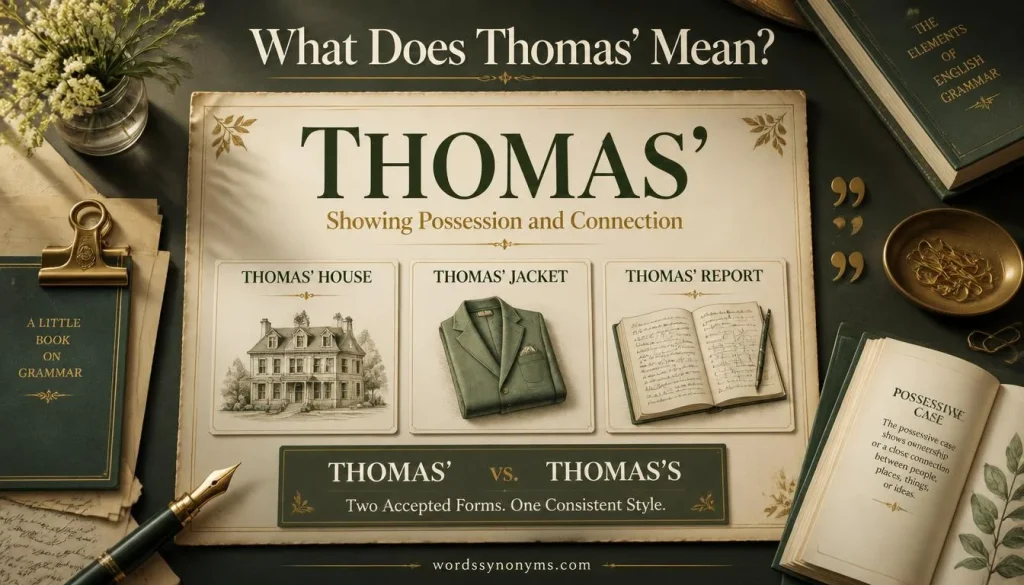
Thomas’ is a possessive form of the singular proper name Thomas. Writers use it to show that something belongs to, relates to, or is associated with one person named Thomas.
The apostrophe appears after the final s in the name. This spelling follows conventions that omit an additional s when forming the possessive of certain singular names ending in s.
For example:
- Thomas’ house has a beautiful garden.
- I borrowed Thomas’ jacket yesterday.
- Thomas’ presentation impressed the audience.
- The manager reviewed Thomas’ report.
- We attended Thomas’ birthday party.
In each sentence, the possessive form connects Thomas to an object, event, or responsibility.
Notice that the meaning doesn’t change when you replace Thomas’ with Thomas’s. Both forms indicate possession when used according to an accepted style convention.
Examples of Thomas’ in Sentences
Understanding real sentences makes the rule easier to remember. Here are several examples from everyday situations.
Example 1: Personal belongings
Thomas’ backpack is beside the front door.
This sentence identifies the backpack as Thomas’s property.
Example 2: Family and home
We visited Thomas’ house during the holidays.
The possessive form connects Thomas to the house where he lives or which he owns.
Example 3: Education
The teacher praised Thomas’ essay for its clear arguments.
Here, the apostrophe indicates that Thomas wrote the essay.
Example 4: Workplace
Thomas’ proposal helped the company improve its customer service.
The proposal belongs to Thomas in the sense that he created or presented it.
Example 5: Special occasions
Everyone attended Thomas’ wedding last Saturday.
The possessive form identifies the wedding associated with Thomas.
These examples show that Thomas’ can describe ownership, authorship, relationships, and associations.
When Should You Use Thomas’?
Use Thomas’ when your chosen style guide calls for an apostrophe alone after a singular proper name ending in s.
This form appears in journalism, publications, and other writing that follows conventions such as Associated Press style.
For instance, a news article might say:
Thomas’ decision surprised the entire team.
The sentence communicates possession or association without adding another s after the apostrophe.
However, don’t assume that every publication follows the same rule. Some editors prefer Thomas’s, while others prefer Thomas’.
Before submitting an article, check the publication’s style requirements. This small detail can make your writing more consistent and professional.
Read more: By Tomorrow: Meaning and How to Use It Correctly
What Does Thomas’s Mean?
Thomas’s is another accepted possessive form of the singular name Thomas. It uses an apostrophe followed by an additional s to show possession.
Many English grammar references recommend adding ’s to singular proper names, even when those names already end in s. The Chicago Manual of Style follows this general approach.
For example:
- Thomas’s car needs new tires.
- I found Thomas’s notebook under the desk.
- Thomas’s decision changed the project.
- The dog followed Thomas’s instructions.
- Thomas’s presentation received positive feedback.
Each example connects something to one person named Thomas.
The extra s doesn’t turn Thomas into a plural noun. It simply forms the possessive according to a particular grammatical convention.
Examples of Thomas’s in Sentences
Let’s examine how Thomas’s works in different contexts.
Example 1: Ownership
Thomas’s bicycle is leaning against the wall.
The bicycle belongs to Thomas.
Example 2: Schoolwork
I read Thomas’s assignment before the class discussion.
The assignment was written or submitted by Thomas.
Example 3: Professional responsibilities
Thomas’s report includes the latest sales figures.
The report is associated with Thomas because he prepared it or is responsible for it.
Example 4: Family relationships
Thomas’s brother lives in Chicago.
The possessive form identifies a family relationship. It doesn’t necessarily indicate ownership.
Example 5: Opinions and decisions
Thomas’s opinion differs from mine.
Here, the possessive form connects Thomas to his opinion.
These examples demonstrate an important point: possession in grammar doesn’t always mean physical ownership. It can also express relationships, responsibility, authorship, and personal characteristics.
When Should You Use Thomas’s?
Use Thomas’s when your style guide adds ’s to singular proper names ending in s.
The Chicago Manual of Style generally follows this convention. Many general English grammar guides also teach it because the same rule applies to most singular nouns.
For example:
- Thomas’s office is on the second floor.
- Thomas’s answer was correct.
- Thomas’s family arrived early.
This approach creates a consistent pattern for singular possessives.
Compare the following examples:
| Singular noun | Possessive form |
| John | John’s book |
| Mary | Mary’s book |
| James | James’s book |
| Thomas | Thomas’s book |
Notice how the possessive ending works similarly across the examples. The final s in James and Thomas doesn’t prevent another s from appearing after the apostrophe.
However, some style guides make different choices. Always check your required convention before editing formal work.
Thomas’ vs. Thomas’s: Key Differences
At first glance, Thomas’ and Thomas’s look like competing spellings. In practice, both can express the same grammatical relationship.
The key difference is the punctuation convention used to form the singular possessive.
| Feature | Thomas’ | Thomas’s |
| Grammatical role | Singular possessive | Singular possessive |
| Basic meaning | Belonging to Thomas | Belonging to Thomas |
| Apostrophe placement | After the final s | Before the added s |
| Common use | Some journalistic styles | Chicago style and many general guides |
| Example | Thomas’ jacket | Thomas’s jacket |
Neither form automatically makes a sentence more formal, more correct, or easier to understand. The surrounding style convention determines which spelling you should use.
Does Thomas’ Mean Something Different From Thomas’s?
No. In ordinary possessive usage, both forms communicate the same basic meaning.
Consider these sentences:
- Thomas’ dog sleeps near the fireplace.
- Thomas’s dog sleeps near the fireplace.
Both sentences tell you that the dog is associated with Thomas.
The difference lies in spelling, not meaning. A reader generally understands both sentences without difficulty.
Nevertheless, consistency matters. If you use Thomas’s throughout an article, suddenly switching to Thomas’ can make the text look poorly edited.
Choose a convention and stick with it. That simple habit prevents unnecessary punctuation inconsistencies.
What Do Major Style Guides Say About Thomas’ and Thomas’s?
Different style guides establish different rules for possessive names. Understanding those differences helps you make the right choice for academic, journalistic, and professional writing.
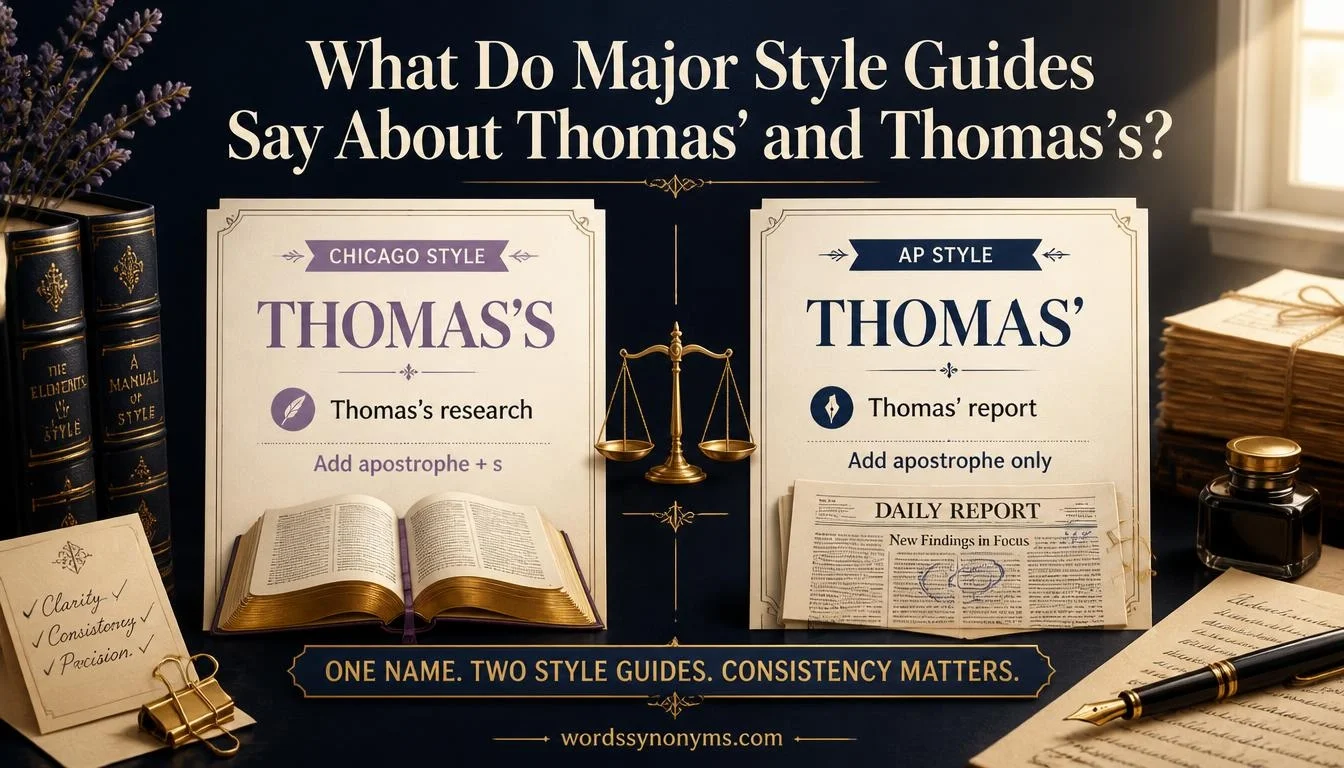
Chicago Manual of Style: Thomas’s
The Chicago Manual of Style generally recommends adding ’s to singular nouns and proper names, including names that end in s.
Under this convention, you would write:
- Thomas’s car
- James’s book
- Charles’s office
For example:
Thomas’s research helped the team understand the problem.
This approach follows a broad rule for singular possessives. It also makes the written form consistent with many other singular names.
If your university, publisher, or editor requires Chicago style, Thomas’s is generally the appropriate choice.
Associated Press Style: Thomas’
The Associated Press Stylebook generally forms the possessives of singular proper names ending in s by adding an apostrophe alone.
Under this convention, examples include:
- Thomas’ car
- James’ book
- Charles’ office
For example:
Thomas’ report appeared in the morning edition.
This approach is common in news writing, where publications often follow AP conventions for punctuation and grammar.
Because style rules can change and individual cases may have specific guidance, check the current edition when preparing work for a particular publication.
Academic and General Writing
Academic writing doesn’t always follow one universal possessive rule. Different institutions and assignments may require different style guides.
For example:
- A paper following Chicago style will generally use Thomas’s.
- A news article following AP style will generally use Thomas’.
- A school assignment may follow the teacher’s preferred grammar convention.
- A company report may follow an internal editorial guide.
The most important step is to identify the required style before you begin editing.
If no specific guide applies, either form may work. Pick one convention and apply it consistently throughout your document.
How to Make Thomas’ and Thomas’s Possessive
Forming the possessive becomes simple once you identify the noun and apply the correct convention.
Follow these steps whenever you need to write about something associated with Thomas.
Identify the Owner
First, determine whether you’re referring to one person named Thomas or multiple people.
If you mean one person, Thomas is the singular name.
Example:
Thomas has a new laptop.
This sentence simply identifies Thomas and his possession. It doesn’t require an apostrophe because the name isn’t possessive.
Now consider:
Thomas’s laptop is new.
The possessive form connects Thomas to the laptop.
Apply the Required Style Guide
Next, check whether your style guide adds ’s or only an apostrophe to singular names ending in s.
Under a convention that adds ’s, write:
Thomas’s laptop is new.
Under a convention that uses an apostrophe alone, write:
Thomas’ laptop is new.
Both express possession. The style guide determines which form fits the document.
Check the Sentence’s Meaning
Before finalizing the sentence, make sure you actually need a possessive form.
Compare these examples:
- Thomas arrived early. The name identifies the person.
- Thomas’s arrival surprised everyone. The possessive form connects Thomas to the arrival.
- Thomas’ arrival surprised everyone. This uses the apostrophe-only convention.
An apostrophe doesn’t belong in every sentence containing a name ending in s. Use it when the grammar requires possession or another appropriate apostrophe construction.
Keep Your Writing Consistent
Finally, check your document for inconsistent forms.
Suppose an article contains these sentences:
- Thomas’s office is upstairs.
- Thomas’ desk is downstairs.
- Thomas’s assistant arrived at noon.
The article switches between two possessive conventions without an apparent reason.
Choose one style and revise the sentences accordingly. Under the Chicago convention, use Thomas’s throughout. Under the relevant AP convention, use Thomas’ throughout.
Consistency makes your writing easier to edit and more professional to read.
Common Mistakes to Avoid
Even though Thomas’ and Thomas’s are straightforward possessive forms, writers sometimes confuse possession, plurality, and ordinary apostrophe rules.
Here are the mistakes worth avoiding.
Treating One Form as Universally Correct
A common mistake is insisting that Thomas’s is always correct or that Thomas’ is always wrong.
Both forms appear in established English writing conventions. Their acceptability depends on the style being followed.
Better approach: Check the relevant style guide before correcting someone else’s writing.
Confusing Possession With Plurality
The name Thomas refers to one person. Its possessive form indicates that something belongs to or relates to that person.
The plural form is different.
- Thomas is waiting outside.
- Thomas’s bag is outside.
- The Thomases are waiting outside.
The first sentence identifies one person. The second indicates possession. The third refers to multiple people named Thomas.
Don’t use an apostrophe merely to make a name plural.
Writing Thomas’s When You Mean Several People
The form Thomas’s normally indicates singular possession under the convention that adds ’s.
It isn’t the standard plural of Thomas.
For example:
Incorrect for a regular plural: Three Thomas’s attended the reunion.
Correct: Three Thomases attended the reunion.
If several people share the name Thomas, use Thomases to refer to them collectively.
Switching Between Thomas’ and Thomas’s
Mixing the forms can make an article look inconsistent.
For example, a writer might use Thomas’s car in one paragraph and Thomas’ house in the next. Unless the document has a specific reason for this difference, the change is unnecessary.
Better approach: Apply one convention throughout the document.
Adding Apostrophes Where They Aren’t Needed
Not every word ending in s needs an apostrophe.
Compare:
- Thomas works at the library.
- Thomas’s desk is near the window.
- The Thomases work at the library.
Only the second example uses a possessive form. The other sentences use a singular subject and a plural subject, respectively.
Understanding the sentence’s structure helps you avoid punctuation errors.
Thomas’ vs. Thomas’s vs. Thomases: What’s the Difference?
These three forms look similar, but each serves a distinct purpose.
| Form | Grammatical use | Example |
| Thomas | Singular name | Thomas arrived at noon. |
| Thomas’s | Singular possessive under styles adding ’s | Thomas’s car is outside. |
| Thomas’ | Singular possessive under styles using an apostrophe alone | Thomas’ car is outside. |
| Thomases | Plural of the name | The Thomases arrived at noon. |
| Thomases’ | Plural possessive | The Thomases’ cars are outside. |
The last form deserves special attention. Thomases’ indicates that something belongs to multiple people named Thomas.
For example:
The Thomases’ house has a large garden.
This sentence refers to a house associated with several people named Thomas, such as members of the same family.
Compare that with:
Thomas’s house has a large garden.
This sentence refers to one person named Thomas under the convention that adds ’s.
The number of people involved changes the grammatical form. That distinction matters more than the visual similarity between the words.

Real-World Examples: Choosing Thomas’ or Thomas’s
Let’s look at three common writing situations to see how the rules work in practice.
Case Study: A School Essay
A student writes an essay about a scientist named Thomas.
The first draft includes this sentence:
Thomas’ discovery changed the direction of the experiment.
The teacher requires Chicago style. The student should revise the sentence to:
Thomas’s discovery changed the direction of the experiment.
The meaning stays the same. Only the possessive spelling changes to match the required style.
Lesson: Follow the teacher’s or institution’s style requirements rather than relying on personal preference.
Case Study: A Newspaper Article
A journalist prepares a report about a business owner named Thomas.
The original sentence reads:
Thomas’s company announced a new hiring plan.
The publication follows AP style. Under its general rule for singular proper names ending in s, the journalist would write:
Thomas’ company announced a new hiring plan.
The punctuation now matches the publication’s convention.
Lesson: Editorial consistency matters in professional journalism.
Case Study: A Personal Blog
A blogger writes an article about organizing a home office.
The draft contains these sentences:
- Thomas’s desk needs more storage.
- Thomas’ chair sits beside the window.
- Thomas’s shelves hold several reference books.
The blogger hasn’t chosen a style guide and uses both forms randomly.
A simple edit resolves the problem. The blogger selects one accepted convention and applies it throughout the article.
Lesson: When no required style guide exists, consistency is more useful than switching between forms.
Read more: As to Why: Correct Usage and Examples
FAQs
Is Thomas’ or Thomas’s correct?
Both Thomas’ and Thomas’s are correct possessive forms. The choice depends on the style guide you follow. AP style generally uses Thomas’, while most other style guides prefer Thomas’s.
Why do people write Thomas’s with two S letters?
Writers add ’s to show possession, even when a name already ends in s. In Thomas’s, the final s belongs to the name, and the apostrophe plus another s marks possession.
Does AP style use Thomas’ or Thomas’s?
The Associated Press Stylebook generally recommends Thomas’ for singular proper names ending in s. If you’re writing news articles or following AP guidelines, use this form consistently.
How do you use Thomas’s in a sentence?
Use Thomas’s when following a style guide that adds apostrophe plus s to singular names ending in s. For example, “Thomas’s car is parked outside.” The phrase shows that the car belongs to Thomas.
How do you use Thomas’ in a sentence?
Use Thomas’ when your chosen style guide prefers an apostrophe without an additional s. For example, “Thomas’ office is on the second floor.” The sentence indicates that the office belongs to Thomas.
Should I use Thomas’ or Thomas’s in academic writing?
Check your institution’s formatting requirements or the style guide assigned to your work. Some guides prefer Thomas’s, while others may accept or recommend Thomas’. Whichever form you choose, keep it consistent throughout your paper.
Conclusion
Choosing between Thomas’ and Thomas’s becomes easier when you understand the rules behind each form. Both spellings show possession, but your preferred style guide determines which one to use. The Associated Press Stylebook generally recommends Thomas’, while most other style guides prefer Thomas’s. For example, you might write “Thomas’ office” in AP style or “Thomas’s office” when following a guide that adds ’s to singular names ending in s. Neither form changes the meaning of the sentence.
The best approach is to follow one set of grammar rules throughout your writing. Whether you’re preparing academic papers, business emails, professional reports, or everyday messages, consistency makes your work clearer and more polished. If you’re unsure which form to choose, check your required style guide before making a final decision. Once you establish that preference, applying the same rule to Thomas and similar names becomes much simpler.


