When writing about ownership, names ending in S can create confusion. The possessive form of Alexis, a popular name, raises an important question in English grammar: should you write Alexis’ or Alexis’s? Although plural possessives apply to plural nouns, Alexis is a singular name, so singular possessive rules are relevant.
Understanding proper nouns, singular nouns, and possessive apostrophe placement helps you follow grammar rules. An apostrophe shows ownership, possession, or belonging. These writing conventions make the possessive form of names easier to understand. Even experienced authors may find this tricky concept confusing, but learning the basic apostrophe rules can improve your English writing.
The Associated Press Stylebook, also called the AP Stylebook, generally recommends Alexis’. However, many other style guides prefer Alexis’s. Both forms can be correct under different style guides, so follow one grammar guide consistently. Pay attention to punctuation, spelling rules, and apostrophe placement when choosing the correct possessive form.
Understanding possessive spelling and writing rules helps you use the right form in different situations. Whether you choose Alexis’ or Alexis’s, consistency makes your writing clearer and more professional.
Quick Answer
Both Alexis’ and Alexis’s are correct possessive forms. The difference depends on the style guide you follow. Chicago style prefers Alexis’s, while AP style generally uses Alexis’. Both forms show ownership and have the same meaning. For general American English writing, Alexis’s is a practical default.
Alexis’ vs. Alexis’s: What’s the Difference?
The difference between Alexis’ and Alexis’s comes down to how you form the possessive of a singular name that already ends in s.
English has two common approaches. One adds an apostrophe and another s. The other adds only an apostrophe after the existing s.
| Form | Rule | Example |
| Alexis’s | Add apostrophe + s | Alexis’s backpack is blue. |
| Alexis’ | Add an apostrophe only | Alexis’ backpack is blue. |
Both sentences indicate that the backpack belongs to Alexis. Neither spelling changes the person’s name or the meaning of the sentence.
However, the style guide you follow can determine which form you should choose. Some publications prefer Alexis’s, while others use Alexis’ for singular proper names ending in s.
If you’re writing a general blog post, school assignment, or personal message, Alexis’s is a practical choice in standard American English. If your teacher, editor, or publication requires a specific style, follow that rule instead.

Is It Alexis’ or Alexis’s?
Both forms can be correct, but the right choice depends on your writing conventions.
The Alexis’s form follows the common rule of adding ’s to a singular noun or name to show possession. This approach appears in many general English texts and follows the convention used by The Chicago Manual of Style.
The Alexis’ form follows an alternative convention used by some style guides. The Associated Press (AP) style generally favors an apostrophe alone for singular proper names ending in s.
Consider these examples:
- Chicago-style approach: Alexis’s new car looks beautiful.
- AP-style approach: Alexis’ new car looks beautiful.
Both sentences express the same meaning. The difference lies in editorial preference, not ownership.
Which Alexis Possessive Form Should You Use?
Use these guidelines to make the decision easier:
- For general American English: Alexis’s is a sensible default.
- For AP-style journalism: Use Alexis’ according to the standard AP convention.
- For Chicago-style writing: Use Alexis’s.
- For school assignments: Follow your teacher’s instructions or your institution’s preferred style.
- For professional publications: Check the organization’s style guide before editing.
The key is consistency. Once you’ve chosen a convention, use it throughout your article, essay, or document.
What Does Alexis’s Mean?
Alexis’s is the possessive form of the singular name Alexis. It shows that something belongs to, relates to, or is associated with that person.
To form it, write the name as usual and add ’s at the end.
– Alexis → Alexis’s
For example, “Alexis’s laptop is charging” tells readers that the laptop belongs to Alexis. Similarly, “Alexis’s advice helped me” connects the advice with that person.
The possessive form can describe several kinds of relationships.
Ownership
Use Alexis’s when the person owns or possesses something.
- Alexis’s phone rang during class.
- I left my keys inside Alexis’s car.
- Alexis’s house has a beautiful garden.
Family and Personal Relationships
The possessive form can also connect Alexis to a family member or another person.
- Alexis’s sister studies biology.
- We met Alexis’s parents last weekend.
- Alexis’s best friend lives nearby.
Ideas, Feelings, and Actions
Possession doesn’t always mean physical ownership. It can also show a connection with thoughts, experiences, and actions.
- Alexis’s opinion changed the discussion.
- Everyone appreciated Alexis’s honesty.
- Alexis’s decision surprised the entire team.
In each example, Alexis’s connects the name to something associated with that person. You can use the same construction with many other singular names.
What Does Alexis’ Mean?
Alexis’ is another accepted way to form the singular possessive of a name ending in s. Instead of adding another s, you place an apostrophe after the final letter.
For example:
– Alexis → Alexis’
This form is particularly useful when a publication follows AP style. Some writers also prefer it because they find the spelling visually simpler.
The meaning remains the same as Alexis’s.
Consider these examples:
- Alexis’ phone rang during class.
- I left my keys inside Alexis’ car.
- Alexis’ sister studies biology.
- Everyone appreciated Alexis’ honesty.
- Alexis’ decision surprised the entire team.
Each sentence connects something with Alexis. The apostrophe signals the possessive relationship.
Remember that Alexis’ isn’t a plural form in these examples. It represents one person’s name in the singular possessive. The style convention simply omits the additional s.
Read more: No Need to Apologize: Meaning and 11 Better Alternatives
How to Make a Name Ending in S Possessive
Names ending in s follow a rule that can look different depending on the style guide. To understand the difference, start with the basic idea of a possessive noun.
A possessive noun shows ownership or a relationship. For most singular names, you add an apostrophe and s. When a name already ends in s, however, some style guides allow an apostrophe alone.
Here are the two common patterns:
- Add ’s: Alexis’s, James’s, Chris’s, and Charles’s.
- Add only an apostrophe: Alexis’, James’, Chris’, and Charles’.
The first pattern follows the approach used by Chicago and MLA style. The second appears in AP style for singular proper names ending in s, although AP has additional guidance for certain names and pronunciation situations.
The Chicago Manual of Style Online+2
Examples of Possessive Names Ending in S
| Singular name | Possessive with ’s | Possessive with apostrophe only |
| Alexis | Alexis’s | Alexis’ |
| James | James’s | James’ |
| Charles | Charles’s | Charles’ |
| Chris | Chris’s | Chris’ |
| Harris | Harris’s | Harris’ |
| Dennis | Dennis’s | Dennis’ |
For example, you could write, “James’s bicycle is outside” or “James’ bicycle is outside.” Both forms express possession, but you should select the one that matches your chosen style.
Important: Don’t confuse a singular possessive with a plural possessive. The two forms follow different rules.
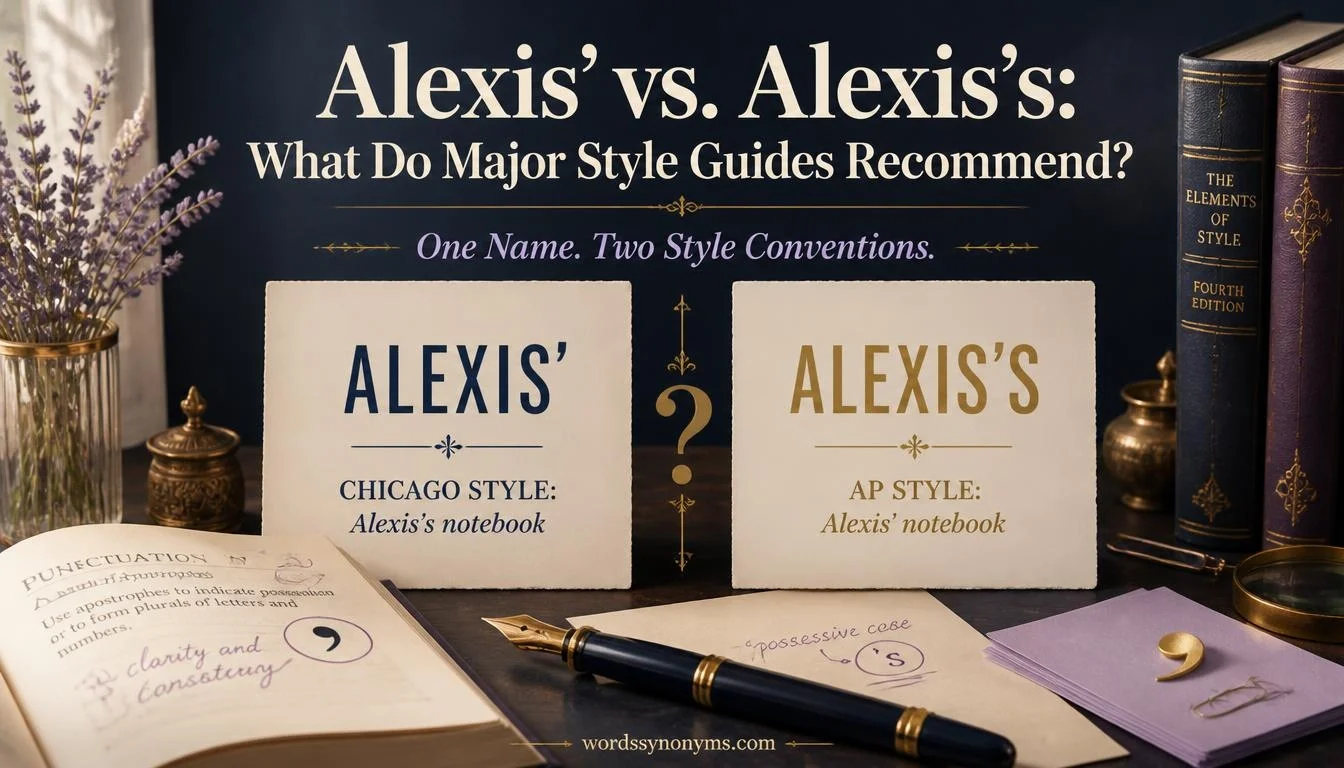
Alexis’ vs. Alexis’s: What Do Major Style Guides Recommend?
Style guides help writers make consistent decisions about grammar, punctuation, capitalization, and spelling. Their recommendations can differ even when both forms are understandable.
For the possessive of Alexis, two major American editorial conventions are especially useful.
The Chicago Manual of Style
The Chicago Manual of Style generally recommends adding ’s to singular proper names, including names that already end in s. Under this convention, you would write:
- Alexis’s notebook
- James’s car
- Charles’s letter
- Harris’s presentation
Chicago’s approach follows the general rule for singular possessives. It also avoids requiring writers to decide whether an additional s should appear in every individual case.
The Chicago Manual of Style Online+1
The Associated Press Stylebook
The Associated Press follows a different convention for many singular proper names ending in s. Its standard approach uses an apostrophe alone, making Alexis’ the expected form in AP-style writing.
Examples include:
- Alexis’ notebook
- James’ car
- Charles’ letter
- Harris’ presentation
Use your left or right arrow keys or drag and drop with the mouse to change the gradient position. Press the button to change the color or remove the control point.
This convention is particularly relevant to writers preparing news stories and other content that follows AP style. If a publication provides its own house style, that guidance takes priority for its content.
Quick Comparison of Chicago and AP Style
| Style guide | Preferred form for Alexis | Example |
| Chicago | Alexis’s | Alexis’s notebook is missing. |
| AP | Alexis’ | Alexis’ notebook is missing. |
The difference is editorial, not semantic. You don’t need to change the sentence’s meaning when switching between these forms.
Alexis’ or Alexis’s: Example Sentences
Examples make possessive rules easier to remember because you can see how they work in everyday writing. The following pairs demonstrate the same grammatical relationship in both styles.
Examples Using Alexis’s
Use these sentences to understand the apostrophe-plus-s form:
- Alexis’s car needs new tires before winter.
- I borrowed Alexis’s notebook to finish my assignment.
- Alexis’s presentation impressed everyone in the room.
- We visited Alexis’s house after the football game.
- Alexis’s favorite book is sitting beside the window.
- The teacher praised Alexis’s answer during the discussion.
- Alexis’s phone rang while we were eating dinner.
- I recognized Alexis’s handwriting on the envelope.
- Alexis’s decision helped the group move forward.
- Everyone enjoyed Alexis’s cooking at the family gathering.
In each example, the possessive form connects Alexis to an object, person, action, or idea.
Examples Using Alexis’
The following sentences express the same relationships using the apostrophe-only form:
- Alexis’ car needs new tires before winter.
- I borrowed Alexis’ notebook to finish my assignment.
- Alexis’ presentation impressed everyone in the room.
- We visited Alexis’ house after the football game.
- Alexis’ favorite book is sitting beside the window.
- The teacher praised Alexis’ answer during the discussion.
- Alexis’ phone rang while we were eating dinner.
- I recognized Alexis’ handwriting on the envelope.
- Alexis’ decision helped the group move forward.
- Everyone enjoyed Alexis’ cooking at the family gathering.
These examples show that the choice of spelling doesn’t change the underlying relationship. What matters is following the appropriate style convention.

A Practical Case Study: Editing a Paragraph About Alexis
Imagine you’re editing a short school newsletter about a student named Alexis. The original paragraph uses both possessive forms without a clear reason.
Alexis’s science project won first place. Alexis’ teacher praised the research, and Alexis’s parents attended the ceremony. Later, Alexis’ classmates celebrated the achievement.
The paragraph is understandable, but its possessive spelling is inconsistent. A simple edit can fix that problem.
Using the Chicago convention:
Alexis’s science project won first place. Alexis’s teacher praised the research, and Alexis’s parents attended the ceremony. Later, Alexis’s classmates celebrated the achievement.
Using the AP convention:
Alexis’ science project won first place. Alexis’ teacher praised the research, and Alexis’ parents attended the ceremony. Later, Alexis’ classmates celebrated the achievement.
Both edited paragraphs maintain the original meaning. The difference is that each version follows one convention consistently.
This example illustrates a useful editing principle: choose your style first, then check every possessive name against it. That small step makes articles, essays, and reports look more polished.
Common Mistakes to Avoid When Writing Alexis’ or Alexis’s
Apostrophes look small, but placing one incorrectly can change the meaning of a sentence. Keep these common mistakes in mind when writing possessive names.
Confusing Possession With a Plural
The name Alexis doesn’t become plural simply because you add an apostrophe.
- Correct: Alexis’s jacket is black.
- Correct under AP style: Alexis’ jacket is black.
- Incorrect for singular possession: Alexises’ jacket is black.
The last example would suggest that multiple people named Alexis own the jacket. To express ownership by one person, use the singular possessive form.
Using an Apostrophe to Form a Plural
An apostrophe usually doesn’t belong in an ordinary plural name.
For example, if you’re talking about two people named Alexis, you might write:
- Two people named Alexis attended the meeting.
- Both Alexises attended the meeting.
The second sentence uses Alexises as a plural form. It doesn’t need an apostrophe because it isn’t showing possession.
If you need to express joint ownership by those two people, the plural possessive would be Alexises’ under the conventional spelling.
Switching Between Alexis’ and Alexis’s
Using both forms in one article can make your writing look inconsistent.
For example:
- Inconsistent: Alexis’s room is clean, but Alexis’ desk is messy.
- Consistent with Chicago: Alexis’s room is clean, but Alexis’s desk is messy.
- Consistent with AP: Alexis’ room is clean, but Alexis’ desk is messy.
Choose one style and stick with it unless you’re quoting text that uses another convention.
Confusing a Possessive With a Contraction
One particularly useful detail is that Alexis’s can sometimes mean Alexis is or Alexis has, depending on the sentence.
Compare these examples:
- Possession: Alexis’s phone is ringing.
- Contraction: Alexis’s waiting outside.
In the first sentence, the phone belongs to Alexis. In the second, Alexis’s means Alexis is.
Context makes the difference clear. If you’re unsure, replace the contraction with Alexis is or Alexis has and see whether the sentence still makes sense.
Alexis’s vs. Alexis’: Quick Grammar Comparison
Use this table to review the most important forms and their meanings.
| Word or form | Meaning | Example |
| Alexis | Singular name | Alexis arrived early. |
| Alexis’s | Singular possessive | Alexis’s bag is blue. |
| Alexis’ | Alternative singular possessive | Alexis’ bag is blue. |
| Alexises | Plural of the name | Two Alexises joined the club. |
| Alexises’ | Plural possessive | The two Alexises’ projects won awards. |
Notice that Alexises’ refers to more than one person named Alexis. It isn’t an alternative spelling for the singular possessive.
When a sentence becomes difficult to read because several people share the same name, rewrite it for clarity. For example, “The projects belonging to both students won awards” may be easier to understand.
Read more: By Tomorrow: Meaning and How to Use It Correctly
FAQs
1. Is Alexis’ or Alexis’s correct?
Both Alexis’ and Alexis’s can be correct. The Associated Press Stylebook generally prefers Alexis’, while many other style guides use Alexis’s.
2. Is Alexis’s grammatically correct?
Yes, Alexis’s is grammatically correct under many style guides. It adds an apostrophe and an S to show that something belongs to Alexis.
3. Why do some writers use Alexis’ instead of Alexis’s?
Some writers follow AP style, which generally uses only an apostrophe after singular names ending in S. This approach keeps the spelling consistent with that style guide.
4. Does Alexis’ mean the same as Alexis’s?
Yes, both forms express possession. The difference comes from the writing style you follow, rather than a change in meaning.
5. How do you use Alexis’s in a sentence?
You can write, “Alexis’s book is on the table.” The apostrophe and S show that the book belongs to Alexis.
6. Should I always use Alexis’s in formal writing?
Not always. Check your required style guide before choosing a form. Use Alexis’ for AP-style writing and Alexis’s when your chosen guide recommends adding apostrophe-S.
Conclusion
Choosing between Alexis’ and Alexis’s becomes much easier when you understand the rules behind possessive names. Both forms show ownership, but the correct choice depends on the style guide you follow. The Associated Press Stylebook generally prefers Alexis’, while many other style guides recommend Alexis’s. Neither form automatically makes your writing incorrect. What matters most is understanding the difference and using the appropriate form for your situation.
When writing about Alexis or any other name ending in S, take a moment to check your preferred writing style. If you’re preparing a school assignment, blog post, or professional document, follow the required guidelines consistently. Remember, grammar rules help you communicate clearly, but consistency makes your writing look polished. Once you understand how apostrophes work with names, you’ll find it easier to handle similar possessive forms without second-guessing yourself.

Franklin Hayes is a writer and editor at WordsConfusing.com, focused on making English vocabulary, grammar, and commonly confused words easy to understand. He writes clear, practical articles with simple explanations and useful examples to help readers improve their English with confidence.
His goal is simple: Making Confusing Words Simple.