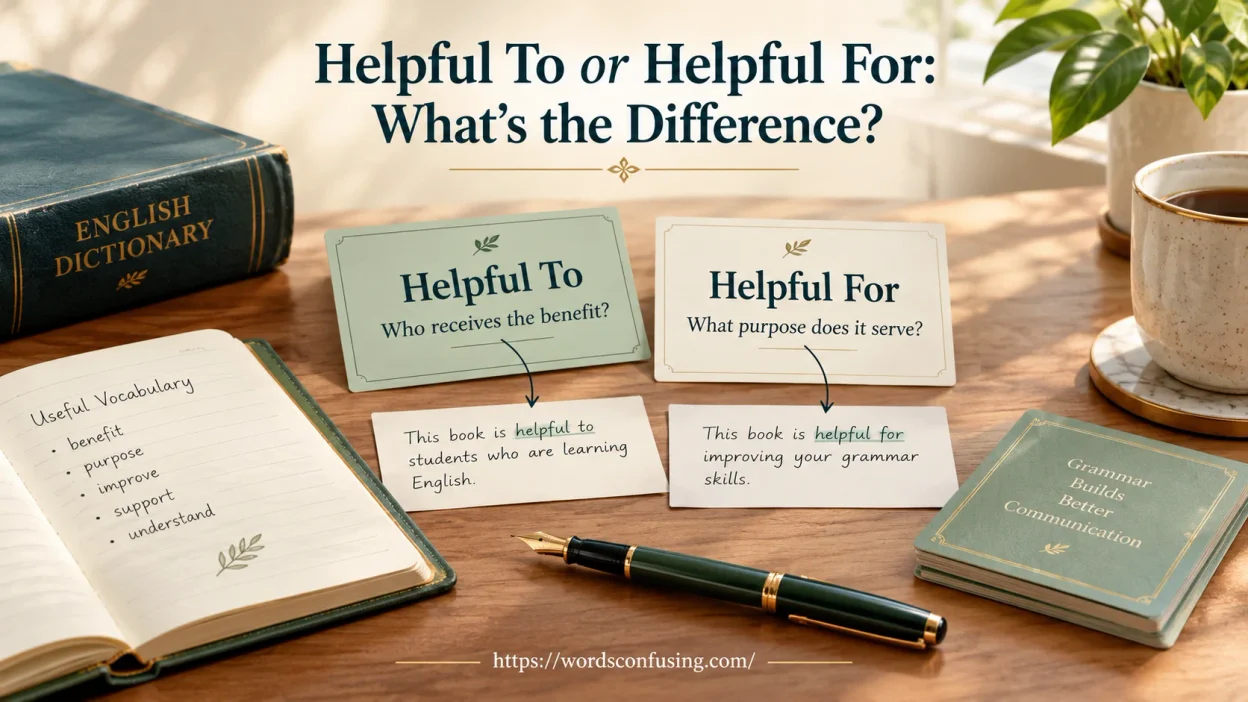
Choosing between helpful to and helpful for depends on the meaning and context of your sentence. Helpful to generally focuses on a person, group, or thing receiving help or assistance.
For example, “This advice is helpful to me” explains how someone benefits from useful advice. In contrast, helpful for usually highlights a purpose, activity, task, or benefit. Consider “Exercise is helpful for your health.” Here, the focus is on a positive result or outcome.
Although both expressions are correct, their usage can change depending on what you want to communicate. Understanding these simple rules helps English learners avoid confusion in everyday communication.
These usage differences also matter in formal writing, email writing, and business communication. Using the correct preposition improves sentence structure, grammatical accuracy, and clarity.
For example, clear word choice helps you write a precise message about project management, important meetings, time management, or workplace collaboration. The same applies to scheduling, online booking, and daily conversations.
With practical examples and natural expressions, you can avoid common mistakes and strengthen your communication skills. Regular practice builds confidence and improves your English communication.
Quick Answer
Both “helpful to” and “helpful for” are correct English expressions. The main difference involves the relationship between something useful and the person, purpose, or activity receiving its benefit.
Helpful to commonly identifies the person or group receiving assistance, support, or an advantage.
Helpful for commonly identifies the purpose, activity, situation, or beneficiary that something supports.
Consider these examples:
| Expression | Example | Meaning |
| Helpful to | This guide is helpful to beginners. | Beginners benefit from the guide. |
| Helpful for | This guide is helpful for learning English. | The guide supports English learning. |
| Helpful to | Your feedback was helpful to me. | I benefited from your feedback. |
| Helpful for | Exercise is helpful for your health. | Exercise supports your health. |
Here’s an easy way to remember the distinction:
- Use helpful to when you want to emphasize who receives a benefit.
- Use helpful for when you want to emphasize what something benefits or supports.
However, this distinction isn’t an absolute rule. Both expressions can describe people, situations, and practical benefits depending on context.
What Does Helpful To Mean?
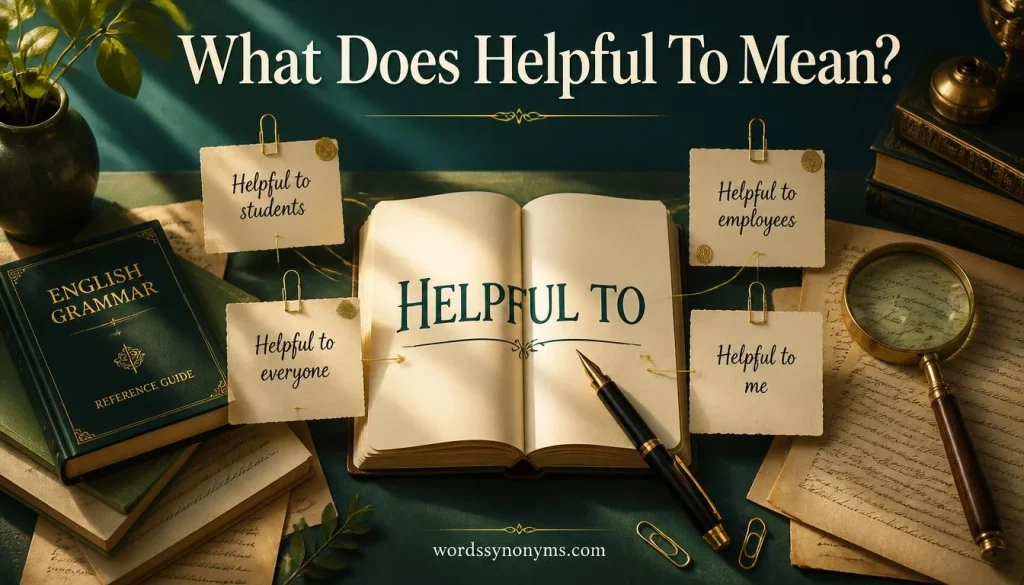
The expression “helpful to” describes something that provides assistance, support, guidance, or an advantage to someone or something.
The preposition “to” commonly introduces the recipient of that benefit. It connects the useful thing with the person or group that gains something from it.
For example:
- Your advice was helpful to me.
- This explanation is helpful to beginners.
- The new policy is helpful to employees.
- Her suggestions were helpful to the entire team.
In each sentence, the expression identifies who receives the benefit.
Imagine that a teacher explains a difficult grammar rule. Students understand the topic more easily because of that explanation. You could say, “The teacher’s explanation was helpful to the students.”
The sentence focuses on the students who gained an advantage.
Grammar Structure of Helpful To
The most common structure follows this pattern:
Helpful + to + noun or pronoun
The noun or pronoun identifies the person, group, or recipient benefiting from something.
Examples include:
| Structure | Example |
| Helpful to + me | This information is helpful to me. |
| Helpful to + you | Your explanation is helpful to you. |
| Helpful to + students | These notes are helpful to students. |
| Helpful to + employees | The new system is helpful to employees. |
| Helpful to + everyone | A clear schedule is helpful to everyone. |
You can also use “helpful to” when discussing organizations, communities, and other groups.
For example:
- The donation was helpful to the local community.
- The training program is helpful to new employees.
- These resources are helpful to small businesses.
Important grammar note: The word “to” doesn’t always introduce a recipient. It can also introduce an infinitive verb.
For example:
- It is helpful to review your notes.
- It is helpful to ask questions.
- It is helpful to practice regularly.
Here, “to review,” “to ask,” and “to practice” are infinitive constructions. They don’t follow the same pattern as the preposition in “helpful to students.”
Recognizing this difference will help you avoid confusion when building sentences.
When to Use Helpful To
Use “helpful to” when your sentence focuses on the person, group, or organization receiving assistance.
Here are some common situations where this expression works naturally.
When describing advice or guidance
Advice often benefits a particular person or group. In these situations, “helpful to” clearly identifies the recipient.
Examples:
- Your suggestions were helpful to me.
- This guidance is helpful to new parents.
- Her advice was helpful to the entire family.
When discussing education
Teachers, explanations, and learning materials can benefit students in different ways.
Examples:
- These grammar notes are helpful to English learners.
- The additional lessons are helpful to struggling students.
- Online resources can be helpful to independent learners.
When discussing workplace assistance
Professional communication frequently uses “helpful to” when describing support for employees, colleagues, and customers.
Examples:
- The new schedule is helpful to employees.
- Your feedback was helpful to our department.
- This training session will be helpful to new staff members.
When describing community benefits
The expression also works when discussing public services, organizations, and communities.
Examples:
- The new library is helpful to local residents.
- These programs are helpful to families.
- Better transportation is helpful to the community.
Examples of Helpful To in Sentences
The following examples show how “helpful to” works in different situations.
| Sentence | Explanation |
| Your message was helpful to me. | I received useful information. |
| This book is helpful to beginners. | Beginners benefit from reading it. |
| Her advice was helpful to everyone. | Everyone gained something from her advice. |
| The instructions are helpful to customers. | Customers can understand the process more easily. |
| These changes are helpful to employees. | Employees receive practical benefits. |
| The new facilities are helpful to residents. | Residents benefit from the facilities. |
| His explanation was helpful to the students. | Students understood the topic better. |
| The scholarship program is helpful to young people. | Young people receive educational support. |
Notice how every example identifies a recipient or beneficiary.
What Does Helpful For Mean?
The expression “helpful for” describes something that provides practical value for a particular purpose, activity, situation, or person.
The preposition “for” commonly introduces the reason something is useful. It can also identify the person or group who benefits from a particular resource.
For example:
- Walking is helpful for your health.
- This dictionary is helpful for learning new words.
- The checklist is helpful for busy employees.
- Drinking enough water is helpful for staying hydrated.
Each sentence explains how something provides value or identifies who can benefit from it.
Think about a language learner who wants to improve their vocabulary. A dictionary provides useful definitions, examples, and pronunciation guidance. You could say, “A dictionary is helpful for learning new words.”
Here, the phrase emphasizes the purpose rather than simply identifying a recipient.
Grammar Structure of Helpful For
The expression “helpful for” commonly follows two grammatical patterns.
Pattern 1: Helpful + for + noun
Use this structure when describing a purpose, situation, person, or beneficiary.
Examples:
- Helpful for beginners.
- Helpful for students.
- Helpful for professional development.
- Helpful for everyday communication.
- Helpful for personal growth.
Pattern 2: Helpful + for + gerund (-ing verb)
Use this structure when describing an activity or action that benefits from something.
Examples:
- Helpful for learning.
- Helpful for studying.
- Helpful for improving communication.
- Helpful for remembering information.
- Helpful for making decisions.
A gerund is a verb ending in “-ing” that functions as a noun. After the preposition “for,” you generally use this form when describing an activity.
Compare these examples:
| Correct expression | Incorrect expression |
| Helpful for learning English | Helpful for learn English |
| Helpful for improving skills | Helpful for improve skills |
| Helpful for studying grammar | Helpful for study grammar |
| Helpful for understanding instructions | Helpful for understand instructions |
The distinction becomes easier when you remember that prepositions generally take nouns or noun-like forms rather than bare verbs.
When to Use Helpful For
Use “helpful for” when you want to explain what something supports, improves, or makes easier.
Here are some common situations.
When describing a purpose
Use this expression to explain why something is useful.
Examples:
- This application is helpful for managing daily tasks.
- A dictionary is helpful for checking unfamiliar words.
- A calendar is helpful for organizing appointments.
When discussing activities
“Helpful for” works naturally with activities expressed through gerunds.
Examples:
- Reading regularly is helpful for improving vocabulary.
- Taking notes is helpful for remembering important details.
- Practicing daily is helpful for developing confidence.
When discussing health and well-being
You can use the expression when describing habits or activities that support general well-being.
Examples:
- Regular exercise is helpful for maintaining fitness.
- Drinking water is helpful for staying hydrated.
- Proper sleep is helpful for maintaining concentration.
These examples describe general benefits rather than promising specific medical outcomes.
When identifying a particular group
Although “helpful for” frequently describes purposes, it can also identify people who benefit from something.
Examples:
- This course is helpful for beginners.
- These instructions are helpful for new employees.
- The website is helpful for small business owners.
This last use is particularly important. It shows why the simple rule “to means people and for means activities” doesn’t explain every situation.
Examples of Helpful For in Sentences
Here are additional examples from everyday English.
| Sentence | Explanation |
| This book is helpful for beginners. | Beginners can benefit from reading it. |
| Walking is helpful for your health. | Walking supports general well-being. |
| This guide is helpful for learning grammar. | The guide supports grammar learning. |
| A planner is helpful for organizing tasks. | It makes task management easier. |
| These videos are helpful for students. | Students can benefit from watching them. |
| Practice is helpful for improving pronunciation. | Practice supports better pronunciation. |
| This tool is helpful for managing projects. | It supports project management. |
| The instructions are helpful for new users. | New users can understand the process more easily. |
Notice that “for” can introduce both people and activities. The surrounding sentence determines its meaning.
Helpful To vs Helpful For: Key Differences
Although these expressions share the same adjective, their prepositions create slightly different relationships.
“Helpful to” commonly connects something useful with its recipient. Meanwhile, “helpful for” often connects usefulness with a purpose, activity, or beneficiary.
However, English allows some overlap between these meanings. You shouldn’t treat the distinction as a strict formula.
Difference in Meaning: Helpful To vs Helpful For
The most useful distinction involves what your sentence emphasizes.
Consider these examples:
Example 1: Helpful to students
“These study materials are helpful to students.”
This sentence emphasizes the students who benefit from the materials.
Example 2: Helpful for studying
“These study materials are helpful for studying.”
This sentence emphasizes the activity that the materials support.
Both sentences describe useful study materials. However, each one highlights a different aspect of their usefulness.
Here are more comparisons:
| Helpful To | Helpful For |
| Your advice is helpful to me. | Your advice is helpful for making decisions. |
| This course is helpful to beginners. | This course is helpful for learning English. |
| The program is helpful to employees. | The program is helpful for professional development. |
| These notes are helpful to students. | These notes are helpful for exam preparation. |
| The information was helpful to customers. | The information was helpful for solving problems. |
The key isn’t memorizing separate lists of nouns. Instead, consider the relationship you want to express.
Difference in Sentence Structure
Both expressions can introduce nouns, but “helpful for” also commonly introduces gerunds.
| Grammatical pattern | Example |
| Helpful to + person | Helpful to my brother |
| Helpful to + group | Helpful to teachers |
| Helpful for + person | Helpful for beginners |
| Helpful for + purpose | Helpful for education |
| Helpful for + gerund | Helpful for improving writing |
One important detail deserves attention.
The phrase “helpful to” can also introduce an infinitive when it appears in a different grammatical construction.
For example:
- It is helpful to read instructions carefully.
- It is helpful to ask for clarification.
- It is helpful to review your mistakes.
These sentences don’t identify the recipient of assistance. Instead, they describe an action that provides value.
Side-by-Side Sentence Examples
Sometimes the easiest way to understand a grammar distinction is to compare complete sentences.
| Helpful To | Helpful For | Difference |
| This advice is helpful to parents. | This advice is helpful for raising children. | Recipient versus purpose. |
| The website is helpful to teachers. | The website is helpful for preparing lessons. | People versus activity. |
| Exercise is helpful to older adults. | Exercise is helpful for maintaining mobility. | Beneficiaries versus purpose. |
| This information is helpful to customers. | This information is helpful for making purchases. | Recipients versus activity. |
| The training is helpful to employees. | The training is helpful for developing skills. | People versus purpose. |
Both constructions can describe the same resource from different perspectives.
That’s why context matters more than memorizing one fixed rule.

Can You Use Helpful To and Helpful For in the Same Sentence?
Yes, you can use both expressions in one sentence when each serves a different grammatical purpose.
For example:
“This guide is helpful to beginners and helpful for understanding difficult grammar rules.”
The first expression identifies the people who benefit. The second explains what the guide helps them accomplish.
Here are additional examples:
- The new software is helpful to employees and helpful for managing projects.
- These lessons are helpful to children and helpful for developing reading skills.
- Her advice was helpful to the team and helpful for solving the problem.
Notice that both expressions add useful information rather than repeating the same idea.
However, you don’t need to include both phrases every time. If one expression communicates your meaning clearly, use that simpler construction.
Helpful To Me or Helpful For Me: Which Is Correct?
Both “helpful to me” and “helpful for me” are grammatically correct. However, they can emphasize different aspects of a situation.
Use “helpful to me” when describing something that provides assistance, guidance, or useful information directly to you.
Examples:
- Your explanation was helpful to me.
- The feedback was helpful to me.
- Her suggestions were extremely helpful to me.
Use “helpful for me” when describing something that serves your needs, circumstances, or personal interests.
Examples:
- This schedule is helpful for me.
- Morning exercise is helpful for me.
- A flexible routine is helpful for my lifestyle.
Compare these sentences:
| Sentence | Meaning |
| This advice is helpful to me. | I receive useful guidance from the advice. |
| This advice is helpful for me. | The advice serves my needs or situation. |
| This routine is helpful to me. | The routine provides me with assistance. |
| This routine is helpful for me. | The routine suits my circumstances. |
The difference can be subtle. In everyday conversation, both expressions may sound natural depending on the context.
Helpful To You or Helpful For You: Which Is Better?
Both expressions work naturally when addressing someone directly. Your choice depends on the message you’re trying to communicate.
Use “helpful to you” when emphasizing assistance or information that benefits someone.
Examples:
- I hope this explanation is helpful to you.
- These instructions should be helpful to you.
- The additional resources may be helpful to you.
Use “helpful for you” when emphasizing someone’s needs, circumstances, or a particular purpose.
Examples:
- This learning method may be helpful for you.
- A flexible schedule could be helpful for you.
- These exercises might be helpful for your daily routine.
Consider professional communication. If you’re sending someone a document, you might write:
“Please let me know if this information is helpful to you.”
If you’re recommending a study technique, you might say:
“This approach could be helpful for you when preparing for exams.”
Both sound natural because each sentence emphasizes a slightly different relationship.
Helpful For Someone or Helpful To Someone?
This comparison often causes confusion because both expressions can describe benefits received by people.
The important point is that “helpful for someone” isn’t grammatically incorrect.
For example:
- This scholarship is helpful to students.
- This scholarship is helpful for students.
Both sentences are correct. However, their emphasis can differ.
“Helpful to students” focuses on the students receiving the benefit. “Helpful for students” presents the scholarship as something that serves their needs or interests.
Consider these additional examples:
| Helpful To Someone | Helpful For Someone |
| The advice was helpful to my sister. | This advice is helpful for my sister. |
| The training was helpful to employees. | The training is helpful for employees. |
| These resources are helpful to beginners. | These resources are helpful for beginners. |
| The program was helpful to families. | The program is helpful for families. |
In many everyday situations, the two expressions overlap considerably.
For instance, both “helpful to beginners” and “helpful for beginners” can describe a beginner-friendly learning resource.
Choose the version that sounds most natural in your sentence and communicates your intended emphasis.
Helpful For or Helpful In: What’s the Difference?
Besides “to” and “for,” another preposition frequently appears with the adjective “helpful.” That preposition is “in.”
Although all three expressions describe usefulness, they introduce different relationships.
Helpful for commonly identifies a purpose, beneficiary, or activity. Helpful in often identifies the area, process, or situation where something provides assistance.
For example:
- This book is helpful for learning English.
- This book is helpful in learning English.
- This book is helpful to English learners.
All three sentences can be grammatically correct. However, their emphasis changes slightly.
When to Use Helpful In
Use “helpful in” when describing assistance within a particular activity, process, or situation.
Examples:
- Her advice was helpful in solving the problem.
- Regular practice is helpful in improving pronunciation.
- The new software is helpful in managing customer records.
- These techniques are helpful in reducing unnecessary mistakes.
The expression frequently appears before a gerund or an activity-related noun.
Compare the following patterns:
| Expression | Example |
| Helpful for + gerund | Helpful for improving writing |
| Helpful in + gerund | Helpful in improving writing |
| Helpful to + person | Helpful to writers |
“Helpful for improving writing” emphasizes the purpose or benefit. “Helpful in improving writing” emphasizes assistance within the improvement process.
In many situations, “for” and “in” can overlap. However, they aren’t automatically interchangeable in every sentence.
Common Mistakes When Using Helpful To and Helpful For
Even experienced English speakers sometimes choose awkward prepositions. Most mistakes happen because writers memorize simple rules without considering sentence meaning.
Here are several mistakes worth avoiding.
Assuming Helpful To Only Works With People
One common misunderstanding is that “helpful to” must always identify a person.
That’s not true.
The expression can introduce an infinitive construction when the sentence follows a different grammatical pattern.
Examples:
- It is helpful to read before an examination.
- It is helpful to understand the instructions.
- It is helpful to practice difficult words.
These sentences are completely natural.
The word “to” introduces the base form of a verb, creating an infinitive. It doesn’t introduce a recipient.
Remember these two different structures:
- Helpful to students.
- It is helpful to study.
The first identifies a recipient. The second describes an action.
Assuming Helpful For Only Works With Activities
Another mistake involves using “helpful for” exclusively with activities or purposes.
However, “helpful for” can also describe people and groups.
Examples:
- This course is helpful for beginners.
- These instructions are helpful for employees.
- The program is helpful for local families.
- This resource is helpful for new business owners.
Each sentence uses “for” naturally before a noun referring to people.
The phrase identifies the intended beneficiaries rather than an activity.
Using the Wrong Verb Form After For
A frequent grammatical error occurs when writers place a base verb directly after the preposition “for.”
For example:
Correct: This application is helpful for organizing your schedule.
Incorrect: This application is helpful for organize your schedule.
The reason is straightforward. In this construction, “for” functions as a preposition and takes a noun or gerund.
More examples:
| Incorrect | Correct |
| Helpful for learn English | Helpful for learning English |
| Helpful for improve skills | Helpful for improving skills |
| Helpful for understand grammar | Helpful for understanding grammar |
| Helpful for prepare exams | Helpful for preparing for exams |
| Helpful for remember details | Helpful for remembering details |
One additional detail matters in the fourth example. The natural expression is “preparing for exams,” where the first “for” belongs to the verb phrase.
Choosing a Preposition Without Considering Meaning
Sometimes a sentence isn’t grammatically wrong, but it doesn’t express your intended meaning clearly.
For example:
- This information is helpful to students.
- This information is helpful for students.
Both are acceptable. However, the first emphasizes students receiving useful information. The second emphasizes information that serves their needs.
Instead of choosing a preposition randomly, identify the relationship between the useful thing and its beneficiary or purpose.
A little attention can make your writing much clearer.
Read more: Never Put a Hat on the Bed: Meaning and Bad Luck Superstition
How to Choose Between Helpful To and Helpful For
You don’t need complicated grammar terminology to make the right choice. A few simple questions can help you select the appropriate expression.
Ask Who Receives the Benefit
If your sentence focuses on someone receiving assistance, consider using “helpful to.”
Examples:
- The explanation was helpful to my teacher.
- Your feedback was helpful to the team.
- These resources are helpful to students.
Ask yourself: Who benefited from this information or assistance?
If the answer identifies a recipient, “helpful to” may express your meaning naturally.
Ask What Purpose Something Serves
If your sentence explains an activity, purpose, or goal, consider using “helpful for.”
Examples:
- This application is helpful for organizing files.
- Reading is helpful for improving vocabulary.
- A planner is helpful for managing daily responsibilities.
Ask yourself: What activity or purpose does this thing support?
If the answer identifies an activity or goal, “helpful for” may be appropriate.
Consider Whether You’re Describing a Beneficiary
Sometimes your sentence identifies a person but doesn’t make the choice obvious.
For example:
- This course is helpful to beginners.
- This course is helpful for beginners.
Both expressions work because beginners receive benefits from the course. The second also presents the course as suitable for their needs.
In these situations, don’t force a distinction that English doesn’t strictly require.
A Simple Decision-Making Table
| What You Want to Express | Natural Construction |
| Someone receives useful advice | Helpful to someone |
| Something serves a particular purpose | Helpful for a purpose |
| Something supports an activity | Helpful for + gerund |
| Someone benefits from a resource | Helpful to someone |
| Something suits a particular group | Helpful for someone |
| Something assists within a process | Helpful in + gerund |
The most reliable approach is to consider meaning first and sentence structure second.

Case Study: Choosing the Right Expression in Everyday Communication
Imagine a fictional English teacher named Sarah who creates an online grammar course for beginners.
She wants to describe the course on her website. However, she isn’t sure whether to write “helpful to beginners” or “helpful for beginners.”
Let’s examine how she can use both expressions naturally.
Situation: Describing the course audience
Sarah writes:
“This course is helpful to beginners who struggle with English grammar.”
The sentence emphasizes the students who receive benefits from the course.
Situation: Explaining the course purpose
She also writes:
“This course is helpful for learning basic English grammar.”
Now the sentence explains what the course helps students accomplish.
Situation: Describing practical activities
Sarah adds:
“The exercises are helpful for improving sentence structure.”
This sentence focuses on an activity and uses the gerund “improving.”
Situation: Recommending the course
Finally, she writes:
“This course is helpful for new English learners.”
Here, “for” identifies the intended audience.
The case study demonstrates an important point: Sarah doesn’t need to choose one expression for her entire website.
She can use both naturally because each sentence communicates a different idea.
Helpful To vs Helpful For: Practice Examples
Understanding grammar rules is useful, but applying them makes the knowledge stick. Try completing these sentences with “to” or “for.”
Choose the Correct Preposition
Fill in each blank with the most suitable preposition.
- Your explanation was helpful ___ me.
- This dictionary is helpful ___ learning new words.
- The training program is helpful ___ employees.
- Regular reading is helpful ___ improving vocabulary.
- These instructions are helpful ___ beginners.
- Her advice was helpful ___ solving the problem.
- This new schedule is helpful ___ our team.
- Exercise is helpful ___ maintaining physical fitness.
- The additional resources were helpful ___ students.
- This application is helpful ___ organizing daily tasks.
Answer Key With Explanations
| Question | Answer | Explanation |
| Your explanation was helpful ___ me. | To | Identifies the person receiving assistance. |
| This dictionary is helpful ___ learning new words. | For | Introduces an activity. |
| The training program is helpful ___ employees. | To / For | Both can describe employee benefits. |
| Regular reading is helpful ___ improving vocabulary. | For | Introduces a beneficial activity. |
| These instructions are helpful ___ beginners. | To / For | Both can identify the intended beneficiaries. |
| Her advice was helpful ___ solving the problem. | In / For | Both can work with slightly different emphasis. |
| This new schedule is helpful ___ our team. | To / For | Both are natural depending on context. |
| Exercise is helpful ___ maintaining physical fitness. | For | Introduces an activity or purpose. |
| The additional resources were helpful ___ students. | To / For | Both can describe benefits for students. |
| This application is helpful ___ organizing daily tasks. | For | Introduces an activity. |
Remember: Some questions allow more than one correct answer. The intended meaning and surrounding context determine which expression works best.
Read more: A Wise Man Knows That He Knows Nothing: Life Lessons
FAQs
1. Is it helpful to me or helpful for me?
Both expressions are correct, but they have slightly different meanings. Use helpful to me when emphasizing how something benefits you. Use helpful for me when describing something that suits your needs or serves a purpose.
2. What is the main difference between helpful to and helpful for?
Helpful to usually focuses on the person receiving help. Helpful for generally describes something useful for a particular purpose, activity, or situation.
3. Is helpful for grammatically correct?
Yes, helpful for is grammatically correct. For example, “This guide is helpful for beginners” explains who can benefit from the guide.
4. Can I use helpful to when talking about a purpose?
Sometimes, but helpful for is usually more natural when discussing a purpose. For example, “This tool is helpful for organizing your schedule.”
5. Is it helpful to your health or helpful for your health?
Helpful for your health is generally the more natural choice. For example, “Regular exercise is helpful for your health.” You can also say “Exercise is helpful to your overall well-being.”
6. Do native English speakers use both helpful to and helpful for?
Yes, native English speakers use both expressions in everyday conversations and professional communication. The correct choice depends on the sentence’s meaning and context.
Conclusion
Understanding the difference between helpful to and helpful for makes your English sound clearer and more natural. Remember, helpful to generally emphasizes the person receiving help, while helpful for highlights a purpose, activity, or benefit. Both expressions are grammatically correct, so you don’t need to avoid either one. Just consider what you want to communicate before choosing a preposition.
With regular practice, you’ll find it easier to use these phrases in everyday conversations, emails, and professional writing. Pay attention to how each expression works in different sentences rather than memorizing rules alone. A little attention to word choice can make a noticeable difference in your English communication.