


By Tomorrow: Meaning and How to Use It Correctly helps you understand deadlines, avoid confusion, and communicate clearly in everyday conversations and professional situations.
This common expression usually means completing a task no later than tomorrow, although the exact deadline depends on the situation. You may see it in business communication, emails, and workplace messages. Understanding this phrase helps improve time management, maintain professional consistency, and prevent misunderstandings.
Whether you’re coordinating tasks on a calendar, responding to a client, or managing workplace expectations, the wording can affect scheduling, meetings, project management, and online booking arrangements.
In personal and professional settings, clear wording supports productivity, accountability, and effective communication. The phrase also has a role in modern English usage, grammar, and formal writing. Consider workplace deadlines, professional correspondence, and broadcasting, where timing matters. Practical examples can help you understand the phrase and avoid common mistakes.
For instance, if someone asks you to send a report by tomorrow, confirm whether they expect it before the workday ends or at another agreed time. Remember that “by” sets a time limit, not necessarily a specific meeting time. When expectations are unclear, ask for clarification to communicate with confidence and precision.
Quick Answer
“By tomorrow” means no later than tomorrow. You can complete something today or tomorrow, as long as you meet the expected deadline. For example, “Please submit your assignment by tomorrow” means you must turn it in no later than tomorrow.

What Does “By Tomorrow” Mean?
“By tomorrow” means that something must happen or be completed no later than tomorrow. The phrase sets a time limit for an action, task, decision, or expected result.
The word “by” indicates a deadline or the latest acceptable time for something to happen. Meanwhile, “tomorrow” refers to the day after today.
When you combine these words, you create an expression that gives someone a deadline without necessarily specifying an exact hour.
Consider this example:
“I need your assignment by tomorrow.”
This sentence means that the speaker expects to receive the assignment no later than tomorrow. You might submit it this evening or tomorrow, depending on the instructions and circumstances.
Here are a few more examples:
- “Please finish the report by tomorrow.”
- “I’ll call you by tomorrow.”
- “We need to make a decision by tomorrow.”
- “Your package should arrive by tomorrow.”
- “She promised to send the documents by tomorrow.”
Each sentence establishes a deadline or expected completion time.
The Simple Meaning of “By Tomorrow”
You can understand the phrase by remembering one straightforward rule:
By tomorrow = no later than tomorrow.
For example, imagine that today is Monday and your manager asks you to complete a project by tomorrow.
Your manager expects the project to be finished by Tuesday. Completing it on Monday would also meet the deadline.
However, finishing it on Wednesday would generally mean you missed the deadline.
The exact cutoff on Tuesday depends on the situation. Your manager might expect the project before the workday ends, while a school assignment could have a specific submission time.
When the deadline isn’t clear, ask for the exact time instead of making assumptions.
What Does “By Tomorrow” Mean in Different Situations?
The meaning of “by tomorrow” stays generally consistent across different situations. However, the context helps you understand what the speaker expects and when the deadline applies.
“By Tomorrow” at Work
In professional settings, people commonly use “by tomorrow” to establish deadlines for tasks and deliverables.
A manager might use the phrase when assigning work that needs prompt attention. A coworker might use it when requesting information before an upcoming meeting.
For example:
“Please send me the updated sales report by tomorrow.”
This request means the report must reach the recipient no later than tomorrow. The sender hasn’t necessarily specified an exact hour.
Other workplace examples include:
- “I’ll finish the presentation by tomorrow.”
- “We need the client’s approval by tomorrow.”
- “Can you review this proposal by tomorrow?”
- “The finance team will share the figures by tomorrow.”
- “Please confirm your availability by tomorrow.”
In professional communication, “by tomorrow” creates a deadline without requiring a lengthy explanation.
Nevertheless, deadlines involving important meetings, payments, or client commitments should include a specific time when necessary.
For instance, “Please submit the report by 3 p.m. tomorrow” gives the recipient a clearer target than “Please submit the report by tomorrow.”
“By Tomorrow” in Everyday Conversations
People also use the phrase when discussing ordinary responsibilities, personal plans, and promises.
Imagine that your friend lends you a book and asks when you’ll return it. You might respond:
“I’ll return your book by tomorrow.”
Your friend can reasonably expect the book back no later than tomorrow. You might return it tonight if you finish reading it early.
Here are some everyday examples:
- “I’ll clean my room by tomorrow.”
- “We should know the answer by tomorrow.”
- “I’ll let you know by tomorrow.”
- “She’ll be home by tomorrow.”
- “I’ll finish studying these chapters by tomorrow.”
Notice that the phrase focuses on the expected deadline, not necessarily the precise moment when the action occurs.
In casual conversations, people often leave the exact time unstated because the situation provides enough context. For important arrangements, however, a more precise time can save both people from unnecessary confusion.
“By Tomorrow” in Text Messages
Text messages frequently use “by tomorrow” because it communicates a deadline in just a few words.
For example, a friend might text:
“I’ll tell you by tomorrow.”
This means the friend expects to give you an answer no later than tomorrow. They might respond tonight or sometime tomorrow.
Other common text-message examples include:
- “I’ll send you the pictures by tomorrow.”
- “Can you finish it by tomorrow?”
- “I’ll check and let you know by tomorrow.”
- “Your results should arrive by tomorrow.”
- “I’ll explain everything by tomorrow.”
The phrase can sound casual, polite, or professional depending on the rest of the message.
If someone tells you, “I’ll get back to you by tomorrow,” they’re usually promising to respond within that timeframe. It doesn’t automatically mean they’ll contact you at midnight or at a particular hour.
Does “By Tomorrow” Mean Before Tomorrow or During Tomorrow?
This is one of the most common questions about the phrase.
In ordinary English, “by tomorrow” often includes tomorrow as the deadline day. It generally means the action must happen no later than that day, rather than necessarily before tomorrow begins.
Suppose today is Monday and someone says:
“I’ll finish the assignment by tomorrow.”
The statement generally means the assignment should be finished by Tuesday. Completing it on Monday evening would meet the deadline, and completing it on Tuesday may also meet the deadline.
However, the exact cutoff depends on the context.
If your teacher expects the assignment before Tuesday’s class, submitting it Tuesday afternoon might be too late. If your manager simply needs the document sometime Tuesday, an afternoon submission might be acceptable.
Compare these expressions:
| Expression | Meaning | Example |
| By tomorrow | No later than tomorrow, subject to the relevant deadline | I’ll finish it by tomorrow. |
| Before tomorrow | Before tomorrow begins | Finish the task before tomorrow. |
| By tomorrow morning | No later than the expected morning deadline | Send the file by tomorrow morning. |
| By the end of tomorrow | No later than the end of tomorrow | I’ll complete the repairs by the end of tomorrow. |
| By noon tomorrow | No later than noon tomorrow | Please submit the form by noon tomorrow. |
The key difference is how precisely each phrase defines the deadline.
Does “By Tomorrow” Include the Entire Day?
Not necessarily in every situation.
People often use “by tomorrow” to mean sometime during tomorrow, with the latest acceptable time determined by the circumstances. However, workplace policies, school instructions, appointment arrangements, and formal agreements might establish a more specific cutoff.
For example, a teacher could expect an assignment before the first class on Tuesday. A customer service representative might mean the end of Tuesday’s business hours.
If someone says, “I’ll send it by tomorrow,” and the timing matters, ask:
“Do you mean by tomorrow morning or by the end of the day?”
That simple question removes uncertainty without sounding demanding.
“By Tomorrow” vs. “Until Tomorrow” vs. “Before Tomorrow”
These three expressions refer to time, but they don’t communicate the same thing.
The most important distinction is that “by” usually sets a deadline, while “until” describes how long something continues.
By Tomorrow
Use “by tomorrow” when an action needs to happen or reach completion before a deadline passes.
Examples:
- “Please finish the report by tomorrow.”
- “I’ll pay you by tomorrow.”
- “We need your answer by tomorrow.”
The focus is on completing an action or meeting an expectation.
Until Tomorrow
Use “until tomorrow” when an action, condition, or situation continues up to tomorrow.
Examples:
- “I’ll stay here until tomorrow.”
- “The store is offering this discount until tomorrow.”
- “You can keep the book until tomorrow.”
- “I’ll wait for your reply until tomorrow.”
In these examples, the phrase describes the duration of a situation or activity.
Before Tomorrow
Use “before tomorrow” when something must happen before tomorrow begins.
Examples:
- “Please finish your homework before tomorrow.”
- “We need to resolve this issue before tomorrow.”
- “I’ll complete the paperwork before tomorrow.”
This wording usually points to an earlier deadline than “by tomorrow,” although context still matters.
Comparison Table
| Phrase | Main purpose | Example |
| By tomorrow | Sets a deadline | Submit the application by tomorrow. |
| Until tomorrow | Describes continuation | I’ll remain here until tomorrow. |
| Before tomorrow | Requires an earlier completion time | Finish the application before tomorrow. |
Remember: You finish a task by a deadline, but you can wait until a deadline.
For example, “I’ll finish the assignment by tomorrow” describes completion. “I’ll work on the assignment until tomorrow” describes how long the work continues.
“By Tomorrow” vs. “Tomorrow”
Although these expressions sound similar, they emphasize different things.
“Tomorrow” identifies when something will happen, while “by tomorrow” emphasizes the deadline by which it must happen.
Consider these examples:
Example 1: Tomorrow
“I’ll finish the report tomorrow.”
This sentence suggests that the speaker plans to finish the report on the following day.
Example 2: By Tomorrow
“I’ll finish the report by tomorrow.”
This sentence establishes a deadline. The speaker might finish the report today or tomorrow, but generally shouldn’t finish it later.
Here’s another comparison:
| Sentence | What it communicates |
| I’ll call you tomorrow. | The call is expected tomorrow. |
| I’ll call you by tomorrow. | The call should happen no later than tomorrow. |
| She’ll send the email tomorrow. | The email is expected to be sent tomorrow. |
| She’ll send the email by tomorrow. | The email must be sent no later than tomorrow. |
| We’ll make a decision tomorrow. | The decision is expected tomorrow. |
| We’ll make a decision by tomorrow. | Tomorrow is the deadline for the decision. |
Is “I’ll Do It Tomorrow” Better Than “I’ll Do It by Tomorrow”?
Neither sentence is automatically better. The right choice depends on what you want to communicate.
Use “I’ll do it tomorrow” when you expect to perform the action the next day.
Use “I’ll do it by tomorrow” when you want to emphasize that the task will be completed no later than the next day.
For example, if your friend asks you to repair a chair, you might say, “I’ll fix it tomorrow.” You’re describing your plan.
If your friend needs the chair repaired before an event tomorrow, you might say, “I’ll fix it by tomorrow.” You’re emphasizing the deadline.
Read more: Suits You Well – Meaning and Examples
How to Use “By Tomorrow” in Different Tenses
The phrase “by tomorrow” works with several verb constructions. The correct choice depends on whether you’re making a promise, describing an expectation, or emphasizing completion.
By Tomorrow in the Future Simple
The future simple commonly uses will + the base form of a verb.
You can use this construction to express promises, predictions, decisions, and expected future actions.
Examples:
- “I’ll finish the assignment by tomorrow.”
- “She’ll send the documents by tomorrow.”
- “We’ll make a decision by tomorrow.”
- “They’ll repair the computer by tomorrow.”
The structure is:
Subject + will + base verb + by tomorrow.
For example:
“I will complete the project by tomorrow.”
Here, the speaker expresses an expectation or commitment to finish the project before the deadline passes.
By Tomorrow With Modal Verbs
Modal verbs such as “should,” “might,” and “may” can express expectations or possibilities.
Examples:
- “I should finish the report by tomorrow.”
- “She might arrive by tomorrow.”
- “The package may reach you by tomorrow.”
- “We ought to have an answer by tomorrow.”
These sentences don’t all express the same level of certainty.
“I should finish it by tomorrow” expresses an expectation. “I might finish it by tomorrow” indicates that completion is possible but uncertain.
Choose the modal that reflects what you genuinely expect to happen.
By Tomorrow in the Future Perfect
The future perfect emphasizes that an action will be complete by a particular future point.
Its basic structure is:
Subject + will have + past participle + by tomorrow.
Examples:
- “I will have finished the report by tomorrow.”
- “She will have completed the course by tomorrow.”
- “They will have repaired the road by tomorrow.”
- “We will have made our decision by tomorrow.”
Consider this example:
“By tomorrow, I will have finished three chapters.”
The speaker expects all three chapters to be complete by tomorrow. The future perfect highlights the completed result at that future deadline.
This tense can be especially useful when discussing projects, schedules, milestones, and expected progress.
Can You Use “By Tomorrow” With the Present Perfect?
Yes, but the meaning depends on the complete sentence.
For example:
“I hope to have finished the project by tomorrow.”
This sentence expresses a hope about future completion. The phrase “to have finished” is a perfect infinitive rather than the present perfect tense.
Another example is:
“By tomorrow, I should have completed the assignment.”
Here, “should have completed” expresses an expected result by a future deadline.
However, this sentence is usually inappropriate when the speaker simply wants to promise a future action:
Less natural for a straightforward promise: “I have finished the assignment by tomorrow.”
Better: “I’ll finish the assignment by tomorrow.”
For future deadlines, the future simple, future perfect, and appropriate modal constructions are generally more useful.
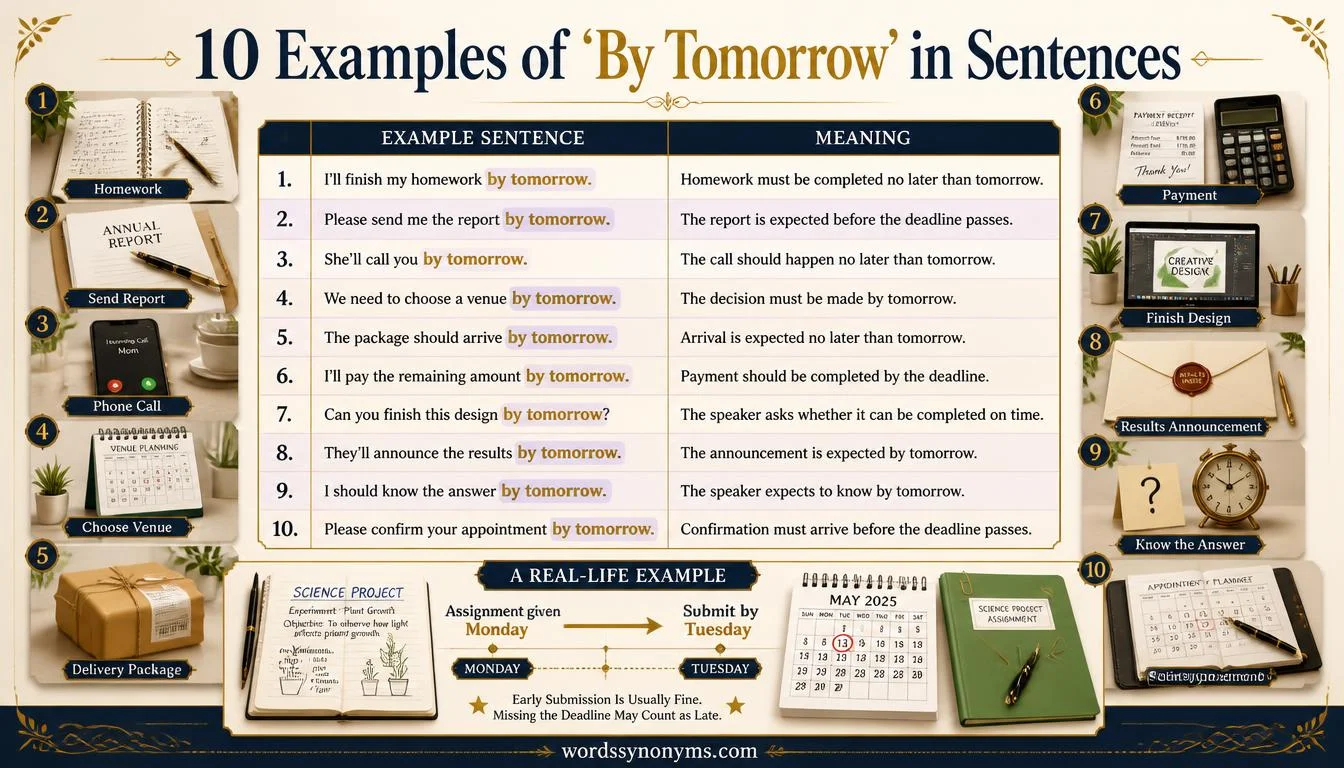
10 Examples of “By Tomorrow” in Sentences
Examples make the meaning easier to understand because they show how people use the phrase in real situations.
| Example sentence | Meaning |
| 1. I’ll finish my homework by tomorrow. | The homework should be complete no later than tomorrow. |
| 2. Please send me the report by tomorrow. | The sender expects the report before the deadline passes. |
| 3. She’ll call you by tomorrow. | The call should happen no later than tomorrow. |
| 4. We need to choose a venue by tomorrow. | The decision must be made by tomorrow. |
| 5. The package should arrive by tomorrow. | Tomorrow is the expected latest arrival day. |
| 6. I’ll pay the remaining amount by tomorrow. | The payment should be completed by the deadline. |
| 7. Can you finish this design by tomorrow? | The speaker asks whether completion by tomorrow is possible. |
| 8. They’ll announce the results by tomorrow. | The announcement is expected no later than tomorrow. |
| 9. I should know the answer by tomorrow. | The speaker expects to have the answer by tomorrow. |
| 10. Please confirm your appointment by tomorrow. | Confirmation must arrive by the deadline. |
Notice that some examples describe promises, while others express expectations or requests.
The phrase remains focused on timing. The surrounding verbs tell you what must happen and how certain the outcome seems.
A Short Real-Life Scenario
Imagine that a student has a science assignment due Tuesday. On Monday afternoon, the teacher says, “Please submit your project by tomorrow.”
The student has several options:
- Submit the project on Monday evening.
- Submit it early Tuesday morning.
- Submit it before the teacher’s stated deadline on Tuesday.
All three options could meet the deadline if the teacher accepts submissions during those times.
However, submitting the project after the required cutoff might count as late.
The lesson: “By tomorrow” gives you a deadline, but you still need to understand the rules surrounding that deadline.
Common Mistakes When Using “By Tomorrow”
Although “by tomorrow” is a common expression, several mistakes can make your meaning unclear.
Confusing “By Tomorrow” With “Until Tomorrow”
These expressions aren’t interchangeable.
Incorrect for a deadline: “I’ll finish the report until tomorrow.”
Correct: “I’ll finish the report by tomorrow.”
The first sentence doesn’t express the intended completion deadline naturally. The second clearly establishes when the report should be finished.
However, “until tomorrow” works when describing an ongoing action:
“I’ll work on the report until tomorrow.”
This sentence emphasizes how long the work continues rather than when the finished report must be delivered.
Assuming “By Tomorrow” Always Means Midnight
The phrase doesn’t automatically establish midnight as the deadline.
For example, a teacher who says, “Submit your assignment by tomorrow,” might expect it before the next class. A manager might expect it before the office closes.
The situation determines the intended cutoff.
If you need to avoid confusion, use a precise expression such as:
- “By 10 a.m. tomorrow.”
- “By noon tomorrow.”
- “By 5 p.m. tomorrow.”
- “By the end of the day tomorrow.”
Specific times work especially well for deadlines involving work, school, payments, and appointments.
Using “On Tomorrow”
In standard American English, you generally don’t place “on” directly before “tomorrow” when referring to the next day.
Incorrect: “I’ll send you the document on tomorrow.”
Correct: “I’ll send you the document tomorrow.”
Also correct: “I’ll send you the document by tomorrow.”
The difference is simple. “Tomorrow” already identifies the day, so you don’t need “on” before it.
However, you can use “on” with a named day:
“I’ll send you the document on Tuesday.”
You can also say, “I’ll send you the document by Tuesday,” when Tuesday represents the deadline.
Using the Wrong Verb Tense
Your verb tense should match the meaning you want to express.
Incorrect for a simple future promise: “I finish the report by tomorrow.”
Correct: “I’ll finish the report by tomorrow.”
Also correct: “I’ll have finished the report by tomorrow.”
The first correct sentence emphasizes the planned action. The second emphasizes that the report will be complete by the deadline.
Forgetting to Clarify Important Deadlines
Sometimes, the problem isn’t grammar. It’s a lack of detail.
Suppose your supervisor says, “I need the file by tomorrow,” but you plan to send it tomorrow evening. Your supervisor might expect it before the morning meeting.
Both of you could understand the words differently.
To prevent this problem, ask a simple follow-up question:
“Would tomorrow afternoon be okay, or do you need it in the morning?”
Clear communication matters more than guessing the intended deadline.
What Does “By Tomorrow Morning” or “By Tomorrow Night” Mean?
Adding a time of day makes “by tomorrow” more specific. These expressions narrow the expected deadline, although the exact cutoff can still depend on the situation.
By Tomorrow Morning
“By tomorrow morning” means no later than the relevant morning deadline tomorrow.
Examples:
- “Please send me the file by tomorrow morning.”
- “The technician should arrive by tomorrow morning.”
- “I’ll finish reviewing the applications by tomorrow morning.”
The phrase suggests that the task should be complete by morning. However, it doesn’t identify a precise hour unless the speaker provides one.
If the deadline matters, ask whether the speaker means 8 a.m., 9 a.m., or another time.
By Tomorrow Afternoon
“By tomorrow afternoon” means no later than the expected afternoon deadline tomorrow.
Examples:
- “I’ll send you the payment confirmation by tomorrow afternoon.”
- “The office should receive the documents by tomorrow afternoon.”
- “We need your decision by tomorrow afternoon.”
This expression provides more information than “by tomorrow,” but it still leaves some room for interpretation.
For an exact deadline, use a specific hour.
By Tomorrow Night
“By tomorrow night” means no later than the relevant nighttime deadline tomorrow.
Examples:
- “I’ll finish reading the book by tomorrow night.”
- “She expects to arrive by tomorrow night.”
- “I’ll send you the photographs by tomorrow night.”
People might interpret “night” differently depending on their schedules and circumstances. For important deadlines, a specific time provides greater clarity.
Quick Comparison
| Expression | General meaning |
| By tomorrow morning | No later than the expected morning deadline |
| By tomorrow afternoon | No later than the expected afternoon deadline |
| By tomorrow evening | No later than the expected evening deadline |
| By tomorrow night | No later than the expected nighttime deadline |
| By midnight tomorrow | No later than midnight at the end of tomorrow |
The last expression is more precise because it identifies a particular cutoff rather than relying on a general time-of-day label.
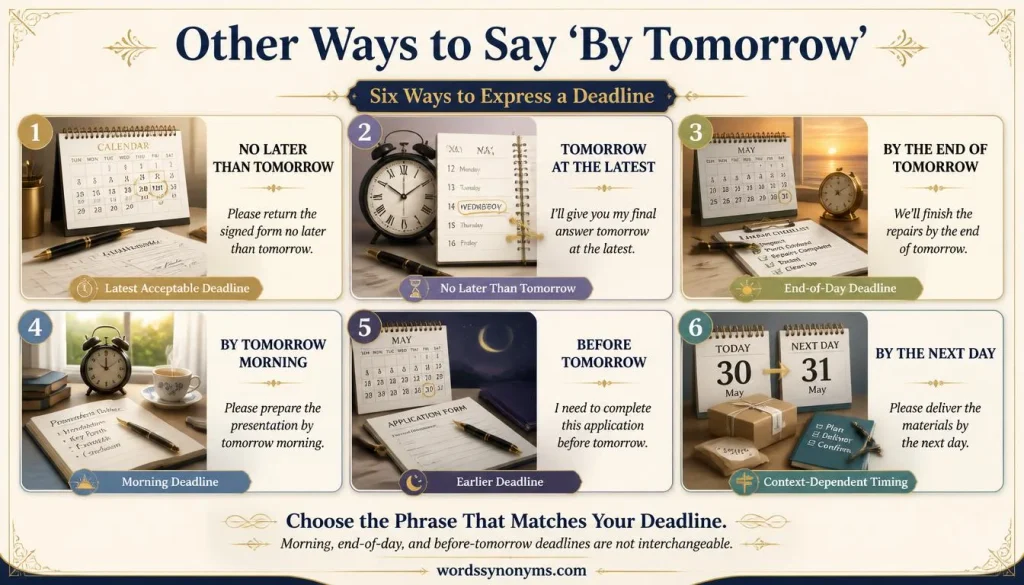
Other Ways to Say “By Tomorrow”
You can replace “by tomorrow” with several expressions, depending on the context. Some alternatives emphasize the deadline, while others identify a more specific time.
No Later Than Tomorrow
This expression has nearly the same meaning as “by tomorrow.”
Example: “Please return the signed form no later than tomorrow.”
It’s useful when you want to emphasize the latest acceptable time.
Tomorrow at the Latest
This phrase also emphasizes a deadline.
Example: “I’ll give you my final answer tomorrow at the latest.”
It communicates that the answer might arrive earlier but shouldn’t arrive later.
By the End of Tomorrow
Use this expression when you mean the task should be complete before tomorrow ends.
Example: “We’ll finish the repairs by the end of tomorrow.”
It offers a clearer timeframe than “by tomorrow” when you intend to allow the full day.
By Tomorrow Morning
This alternative narrows the deadline to the morning.
Example: “Please prepare the presentation by tomorrow morning.”
It’s useful when someone needs the result early in the day.
Before Tomorrow
Use this expression when something must happen before tomorrow begins.
Example: “I need to complete this application before tomorrow.”
Be careful with this alternative because it can establish an earlier deadline than “by tomorrow.”
By the Next Day
This expression can replace “by tomorrow” when the surrounding context identifies which day comes next.
Example: “Please deliver the materials by the next day.”
However, “the next day” can refer to a different day depending on the starting point. In everyday conversation, “by tomorrow” is often more direct.
Read more: 7 Words to Describe the Feeling of Missing Someone
How to Reply to “Please Do It by Tomorrow”
When someone asks you to complete something by tomorrow, your response should reflect whether you can meet the deadline.
You don’t need a complicated sentence. A brief, clear reply usually works best.
If You Can Meet the Deadline
Try these responses:
- “Sure, I’ll have it done by tomorrow.”
- “Absolutely. I’ll send it over by tomorrow.”
- “No problem. I’ll finish it before the deadline.”
- “I’ll take care of it and update you by tomorrow.”
These replies acknowledge the request and communicate your commitment.
If You Need More Information
Sometimes, you need to clarify the expected time.
You could say:
- “Do you need it by tomorrow morning or afternoon?”
- “What time tomorrow would work best?”
- “Would the end of the day tomorrow be okay?”
These questions are helpful when the deadline affects your schedule or other responsibilities.
If You Cannot Meet the Deadline
It’s better to communicate early than promise something you can’t deliver.
Consider these responses:
- “I may need one extra day. Would Wednesday work?”
- “I can finish most of it by tomorrow, but the final section may take longer.”
- “Could I send you the completed version tomorrow afternoon?”
- “I won’t be able to finish everything by tomorrow. Can we discuss another deadline?”
A clear explanation gives the other person an opportunity to adjust their plans.
A good response acknowledges the deadline, communicates what you can do, and clarifies any limitations.
FAQs
1. What does “by tomorrow” mean?
“By tomorrow” means you should complete something no later than tomorrow. The exact deadline depends on the situation and any time agreed upon.
2. Does “by tomorrow” mean before tomorrow or during tomorrow?
It usually means the task can be completed by the specified deadline tomorrow. However, it doesn’t always tell you the exact hour, so ask for clarification if timing matters.
3. Does “by tomorrow” mean midnight?
Not necessarily. Some people mean midnight, while others expect the task before the workday ends. Always confirm the expected time when a deadline is important.
4. How do you use “by tomorrow” in a sentence?
You can use it when giving or discussing a deadline. For example, “Please finish your assignment by tomorrow” means the assignment should be completed by the agreed deadline tomorrow.
5. Is “by tomorrow” formal or informal?
“By tomorrow” works in both formal and informal communication. You can use it in emails, workplace messages, school assignments, and everyday conversations.
6. What is the difference between “by tomorrow” and “until tomorrow”?
“By tomorrow” sets a deadline for completing something. “Until tomorrow” usually describes how long a situation continues. For example, “Submit the report by tomorrow” gives a deadline, while “The office is closed until tomorrow” describes a continuing situation.
Conclusion
Understanding “by tomorrow” makes everyday conversations and professional communication much easier. The phrase usually sets a deadline for completing a task no later than tomorrow, but the exact time can vary depending on the situation. Whether you’re replying to emails, finishing assignments, or managing workplace responsibilities, knowing how to interpret this expression helps you avoid confusion and stay organized. A small phrase can make a big difference when time and expectations matter.
The best way to use “by tomorrow” correctly is to consider the context and clarify the deadline whenever necessary. Don’t assume everyone has the same finishing time in mind. If you’re giving instructions, include a specific hour when precision matters. With a little attention to wording, you can communicate more clearly, manage your time effectively, and handle deadlines with greater confidence.

Shafiq Ur Rehman is a writer and content contributor at WordsConfusing.com. He enjoys exploring the English language, common word confusions, vocabulary, and practical writing tips. His goal is to make English easier to understand through clear, simple, and useful articles.


