


Never Put a Hat on the Bed: Meaning and Bad Luck Superstition explores an old belief connecting a hat, a bed, and bad luck.
This curious expression belongs to folklore, cultural beliefs, and historical traditions passed down through generations. Some people believe that placing a hat on a bed invites misfortune, although no single explanation confirms the origin of the phrase. Stories about old funeral customs, traditional beliefs, and superstitious beliefs offer possible explanations.
These popular superstitions show how symbolism influences common sayings, everyday language, and cultural customs. Understanding the historical background helps explain the phrase’s meaning and origin.
From a language history perspective, this memorable warning illustrates how English idioms, traditional sayings, and common expressions survive in modern culture. Its phrase meaning, expression origin, and historical context connect old traditions with modern language. Studying phrase origins, language development, and cultural practices improves language learning and accurate interpretation.
Whether used in conversation, formal writing, or business communication, the phrase depends on its language context. Exploring folklore traditions, cultural symbolism, and bad luck beliefs helps explain the continuing cultural relevance of the hat superstition without presenting folklore as proven fact.
Quick Answer
The superstition “Never put a hat on the bed” means that placing a hat on a bed may bring bad luck, illness, or even death. The belief appears in historical folklore records dating back to the late 19th century, but its exact origin remains uncertain. Some explanations involve old household customs, cowboy traditions, and concerns about cleanliness. However, no scientific evidence shows that putting a hat on a bed causes bad luck.
What Does “Never Put a Hat on the Bed” Mean?
The phrase “never put a hat on the bed” refers to a superstition that considers placing a hat on a bed unlucky. According to this belief, something as ordinary as setting down your headwear could invite trouble into your life.
The meaning varies depending on the family, community, and tradition. Some people associate the act with general misfortune. Others connect it with sickness, death, arguments, or other unwanted events.
For example, imagine someone returning home after a long day and tossing a baseball cap onto the bed. A family member might immediately pick it up and place it on a chair, warning that hats should never touch bedding.
That reaction reflects a traditional belief rather than a proven danger.
The central idea is simple: keeping hats off beds supposedly helps prevent bad luck. However, the superstition doesn’t offer one universally accepted explanation for why the rule exists.
What Counts as Putting a Hat on the Bed?
Different families interpret the warning in slightly different ways. Some apply it only when someone deliberately places a hat on a bed. Others avoid even letting a hat fall onto the mattress.
The rule may apply to several types of headwear, including:
- Cowboy hats and Western-style hats
- Baseball caps and sports hats
- Dress hats and formal headwear
- Wool hats, beanies, and winter caps
- Older hats decorated with pins or other accessories
In most modern versions, the type of hat matters less than its location. The bed is the object people want to keep free from the supposed bad luck.
Still, this isn’t a universal rule. Some people follow the superstition strictly, while others have never heard of it.

Why Is It Bad Luck to Put a Hat on a Bed?
The superstition has several explanations, but no single theory accounts for every version. Some explanations involve death and misfortune, while others focus on practical concerns from earlier times.
It Is Believed to Invite Misfortune
The most common interpretation is that a hat resting on a bed signals bad luck. People who follow the tradition may avoid the arrangement even when they cannot explain its history.
This is typical of folklore. A warning can survive for generations after people forget why it began. Parents repeat it to their children, who eventually pass it along to their own families.
The supposed consequences also vary. One person might associate the act with a difficult week, while another may connect it with a serious family tragedy.
However, these interpretations don’t establish a reliable connection between hats and unfortunate events. The superstition documents what people believe, not what a hat can actually cause.
Some People Associate It With Death or Illness
One of the more unsettling versions links a hat on a bed with death or serious illness. This interpretation gives the superstition a darker meaning than a simple warning about everyday trouble.
Folklore often connects ordinary household actions with major life events. Similar traditions warn against certain activities because people believe they might predict a death, disturb a spirit, or bring hardship to a household.
The hat-on-the-bed belief sometimes appears in this broader tradition of ominous household signs. However, not every version predicts death, and the meaning isn’t consistent across families.
It’s important to distinguish between a recorded belief and a verified historical explanation. Evidence that people associated hats with death doesn’t prove that fear of death created the superstition in the first place.
The Belief May Reflect Older Ideas About Cleanliness
A more practical explanation focuses on hygiene. Before modern laundry practices and widespread access to effective treatments for parasites, hats could collect sweat, dust, and other unwanted material.
People often wore hats outdoors, where they encountered dirt and shared crowded spaces. Placing those hats on bedding might have seemed unhygienic, particularly when several household members shared sleeping areas.
Older headwear could also contain insects or other contaminants. Although these concerns make the custom understandable, they don’t prove that hygiene concerns originated the superstition.
This distinction matters because a sensible household habit can acquire a supernatural explanation over time. A parent might initially tell a child to keep a hat off the bed because it is dirty. Eventually, the warning could become a rule about bad luck.
The hygiene explanation is plausible, but it remains a theory rather than a confirmed origin.
Read more: No Need to Apologize: Meaning and 11 Better Alternatives
What Is the Origin of the Hat-on-the-Bed Superstition?
The exact origin of the hat-on-the-bed superstition remains uncertain. Historical folklore records show that the belief existed long before many modern explanations became popular.
That evidence offers a useful starting point. Instead of assuming that one colorful story explains everything, it’s better to examine when the belief appears in recorded folklore and how different communities interpreted it.
Early Records From Jamaican Folklore
An important historical reference appears in Folk-Lore, a journal associated with the study of traditional beliefs and customs. Folklore collected from Jamaican students in 1896 was published in 1904.
The material included a warning about placing a hat on a bed. One recorded interpretation connected the act with misfortune, while another version related it to marriage prospects.
These details matter because they show that the superstition had multiple interpretations more than a century ago. They also challenge the assumption that the belief must have originated in modern American cowboy culture.
However, an early written record doesn’t necessarily reveal where a tradition first began. People may follow a custom for decades before anyone documents it in a book or journal.
The Jamaican example therefore provides evidence of the superstition’s historical existence, not proof of its original birthplace.
The American Folklore Connection
The belief also appears in American family traditions and folklore accounts. Different communities have preserved the warning through oral storytelling, everyday habits, and advice passed between generations.
In some households, the rule sounds like a firm command: never put a hat on the bed. In others, people explain it through stories about death, illness, or unfortunate events.
These differences reveal something important about folklore. A tradition can travel between communities while its explanation changes along the way.
For example, one family might remember a warning from a grandparent without knowing its earlier history. Another family might attach a dramatic story to the same rule, making it easier to remember and repeat.
Neither account automatically establishes the original meaning. Together, however, such traditions show how ordinary household customs can develop several layers of interpretation.
The Cowboy and Rodeo Tradition
Cowboy culture offers another familiar setting for the superstition. A cowboy hat isn’t merely a piece of clothing. It can represent personal identity, regional heritage, practical work, and pride in a particular way of life.
Because hats carry this symbolic value, some cowboys and rodeo competitors treat them with special care. Certain people avoid placing a hat on a bed because they believe doing so brings bad luck.
Rodeo culture includes many rituals associated with confidence and performance. Competitors may carry particular objects, follow personal routines, or avoid actions they consider unlucky.
Such customs can provide a sense of control when the outcome depends on unpredictable circumstances. A rider can practice diligently, but can’t control every movement of an animal or every event during a competition.
Still, cowboy traditions shouldn’t be mistaken for the superstition’s proven origin. The historical record of the belief extends beyond that setting.
The Theater and Sports Connection
Performers and athletes have long maintained superstitions around preparation, equipment, and competition. Some actors avoid particular words backstage, while athletes may repeat specific routines before important events.
The hat-on-the-bed rule fits naturally into this larger pattern. If someone believes a particular action invites misfortune, avoiding it becomes a small ritual that helps them feel prepared.
Consider a performer getting ready for opening night. They might arrange their costume carefully, repeat a familiar warm-up routine, and keep their hat away from the bed. Following these habits may ease anxiety even when none affects the performance itself.
However, the presence of similar customs in different professions doesn’t establish a single shared origin. Traditions can spread between groups, develop independently, or change as people repeat them.
The strongest conclusion is that the hat superstition belongs to a broader world of occupational and household folklore.
Did the Superstition Begin With Gangsters?
One popular explanation links the superstition to gangsters and hotel rooms. According to this story, criminals sometimes placed hats on beds while hiding weapons or preparing for dangerous encounters.
The theory offers an exciting explanation for an otherwise puzzling rule. It also gives the superstition a memorable connection to crime and danger.
Unfortunately, a memorable story isn’t the same as a documented origin. The existence of earlier folklore records makes it difficult to claim that gangster practices created the superstition in its entirety.
Even if someone once used a hat to conceal an object, that isolated event wouldn’t prove where the widespread belief began. A convincing origin story needs evidence connecting the alleged event to the tradition’s broader history.
The gangster explanation should therefore be treated as an unverified theory, not established historical fact.
What Are the Different Explanations Behind the Hat-on-the-Bed Superstition?
Several explanations attempt to account for the rule, but they don’t all have equal historical support. Comparing them helps you understand what folklore records establish and where speculation begins.
| Explanation | What it suggests | How strong is the evidence? |
| General bad luck | A hat on a bed invites misfortune | Strong evidence that people hold this belief |
| Death or illness | The act predicts serious harm | Documented as an interpretation in some traditions |
| Hygiene concerns | Outdoor hats could bring dirt or insects onto bedding | Practical possibility, but unconfirmed as the origin |
| Hatpins and sharp accessories | Older headwear could cause physical injury | Plausible safety concern, not a proven source of the superstition |
| Gangster stories | Hats were associated with concealed weapons or dangerous encounters | Unverified as the original explanation |
| Spiritual interpretations | The act may symbolize harmful influences or disturbed spiritual order | Depends on the particular folklore tradition |
Could Old Hatpins Explain the Warning?
Older hats sometimes featured decorative pins, including long hatpins that helped secure elaborate women’s hairstyles and headwear. These accessories could cause injury if someone handled them carelessly.
A hat with an exposed pin could also scratch someone who accidentally pressed against it. Keeping such an object away from a mattress might therefore make practical sense.
However, this explanation has a limitation. The hat-on-the-bed superstition isn’t restricted to pinned hats, and its recorded versions include broader warnings about headwear.
The hatpin theory may explain why some people wanted to keep certain hats away from beds. It doesn’t establish why the wider superstition developed.
Could Hats Have Symbolized Something More Serious?
Hats can represent identity, status, work, and authority. In some settings, removing a hat carries social meaning, while placing one somewhere inappropriate may appear disrespectful.
A bed also holds a special place in household life. People associate it with sleep, privacy, illness, birth, and death. Combining these two meaningful objects may have made the superstition memorable.
Still, symbolism alone cannot identify the tradition’s original cause. Without direct historical evidence, it would be misleading to claim that people created the rule for one specific symbolic reason.
The most reasonable approach is to recognize that several explanations may have shaped different versions of the belief.

Which Cultures and Communities Follow the Hat-on-the-Bed Belief?
The superstition doesn’t belong exclusively to one profession or community. Historical records and modern folklore accounts show that people have interpreted the rule in different ways.
Family and Household Traditions
For many people, the superstition begins at home. A parent or grandparent notices a hat on the bed and immediately moves it elsewhere.
A child may ask why. The answer might be simple: “It’s bad luck.” Sometimes the adult remembers a story about illness or misfortune. Other times, the original explanation has disappeared entirely.
This process illustrates how oral traditions work. People don’t always need to understand a custom’s history before adopting it.
Family habits can also change over time. One generation might avoid all hats on beds, while the next follows the rule only for cowboy hats or formal headwear.
Cowboys and Rodeo Competitors
In cowboy communities, hats can carry personal and cultural significance. A well-worn hat may represent years of work, family history, or attachment to Western traditions.
Some people therefore treat their hats carefully and avoid actions they associate with bad luck. Keeping a hat off the bed becomes part of a larger collection of personal customs.
However, not every cowboy or rodeo competitor believes in the superstition. Personal beliefs differ, even among people who share the same profession or cultural background.
Actors and Theater Professionals
The performing arts have a long association with superstitions. Actors may avoid certain words backstage, follow familiar pre-show routines, or treat particular objects as lucky charms.
These rituals often help performers manage uncertainty. A person who feels nervous before a performance might find comfort in repeating a familiar routine.
The hat-on-the-bed belief fits this pattern, although it shouldn’t be described as a universal theater rule. Some performers follow it, while others don’t give it any attention.
Other Cultural Interpretations
Folklore changes as people exchange stories across regions and generations. A warning that begins in one community may acquire a different meaning elsewhere.
The Jamaican folklore record is especially useful because it shows that the superstition existed in a context beyond the modern cowboy image. Its recorded interpretations also demonstrate that people haven’t always agreed about the consequences.
When discussing cultural traditions, avoid treating a community as if everyone shares identical beliefs. Folklore is often local, personal, and inconsistent.
Read more: By Tomorrow: Meaning and How to Use It Correctly
Does Putting a Hat on the Bed Really Bring Bad Luck?
No reliable evidence shows that putting a hat on a bed causes bad luck. The superstition belongs to folklore rather than an established scientific explanation of cause and effect.
That doesn’t mean the tradition has no cultural value. People can preserve a custom because it connects them with relatives, communities, or childhood memories.
The important distinction is between respecting a belief and treating its prediction as fact.
Why Do People Connect Ordinary Actions With Misfortune?
Human beings naturally look for patterns, especially when something upsetting happens. If an unfortunate event follows an action that someone considers unlucky, they may connect the two.
Psychologists call one related tendency confirmation bias. People often notice evidence that supports an existing belief while overlooking evidence that challenges it.
Imagine someone places a hat on the bed and receives disappointing news the following day. They might remember the coincidence and blame the hat.
Now imagine another person does the same thing repeatedly without experiencing any trouble. That person may never think about the superstition again.
Neither experience proves a supernatural connection. They simply show how personal experiences can influence what people believe.
Why Superstitions Can Feel Convincing
Superstitions often survive because they offer simple rules for dealing with uncertainty. Avoiding one small action can feel easier than accepting that many events remain outside personal control.
This effect becomes especially noticeable before competitions, performances, journeys, or other stressful events. A familiar ritual can create a sense of order, even when it doesn’t change the outcome.
The hat-on-the-bed rule works similarly for people who follow it. Moving a hat to a chair costs little effort and may provide peace of mind.
However, feeling reassured by a ritual doesn’t prove that the ritual prevents misfortune. Comfort and supernatural protection are two different claims.
What Should You Do If You Accidentally Put a Hat on the Bed?
If you’ve accidentally placed a hat on the bed, there’s no need to panic. The superstition doesn’t establish that anything bad will happen, and no universal remedy exists.
If you want to respect the tradition, simply move the hat somewhere else. A hook, shelf, chair, or designated storage space will work perfectly well.
Here are a few sensible steps:
- Move the hat: Place it on a suitable surface away from the bedding.
- Check its condition: If the hat is dusty or damp, clean or dry it as needed.
- Store it safely: Keep hats with pins or rigid accessories somewhere they won’t cause accidental injuries.
- Respect household preferences: If a family member follows the tradition, moving the hat can be a simple courtesy.
- Don’t worry about punishment: An accidental placement doesn’t provide evidence that bad luck will follow.
The goal isn’t to reverse a supernatural event. It’s simply to handle the situation in a way that feels comfortable and practical.
Is There a Ritual to Reverse the Bad Luck?
Different families may have their own responses, but no single remedy applies across every version of the superstition.
Some people may brush the hat off, move it immediately, or repeat a reassuring phrase. Others may do nothing at all.
These actions reflect personal or family customs rather than proven methods for preventing misfortune. If a ritual helps someone feel calm and doesn’t harm anyone, it can remain a personal choice.
Still, nobody needs to perform a special ceremony because a hat accidentally touched a mattress.
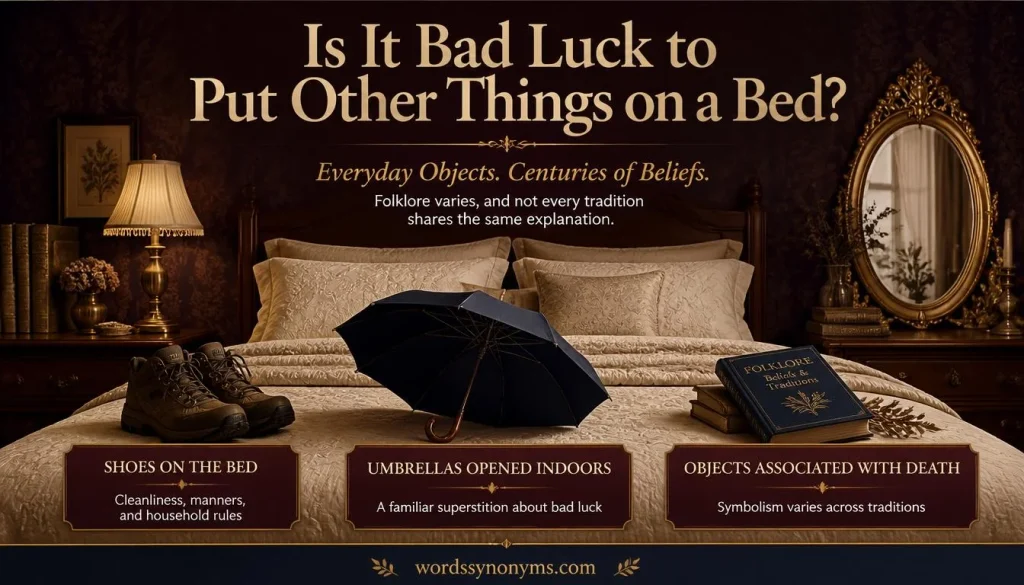
Is It Bad Luck to Put Other Things on a Bed?
The hat-on-the-bed superstition is part of a much wider collection of beliefs about household objects. Across different cultures, people have attached symbolic meanings to everyday actions involving beds, shoes, mirrors, and other possessions.
However, these traditions have separate histories. They shouldn’t be treated as evidence that all household objects carry the same kind of bad luck.
Shoes on the Bed
Some households discourage placing shoes on beds because shoes collect dirt from outdoor surfaces. This rule has an obvious practical benefit, especially when people use their beds for sleeping.
In other settings, the concern may involve manners, cleanliness, or family customs. These explanations don’t necessarily involve supernatural beliefs.
Umbrellas Opened Indoors
Another familiar superstition warns against opening an umbrella indoors. One popular explanation connects the belief with older umbrella designs that could injure people or damage nearby objects when opened inside.
Other accounts trace the tradition to broader beliefs about luck. As with the hat superstition, a practical explanation may sound convincing without proving the custom’s exact origin.
Objects Associated With Death
Some household traditions warn against particular actions because people interpret them as signs of death or misfortune. Their meanings vary between families and communities.
The hat-on-the-bed belief sometimes falls into this category, particularly when people associate it with illness or death. Nevertheless, that interpretation represents one version of the superstition rather than a universal rule.
FAQs
1. What does “Never Put a Hat on the Bed” mean?
“Never Put a Hat on the Bed” is an old superstition suggesting that placing a hat on a bed brings bad luck. Some people still follow this belief because of family traditions or cultural folklore.
2. Why do people believe putting a hat on a bed brings bad luck?
Several explanations connect the superstition to old funeral customs and historical beliefs. However, the exact origin remains uncertain, and no evidence proves that putting a hat on a bed causes misfortune.
3. Where did the hat-on-the-bed superstition originate?
The precise origin is unclear. Different stories link the belief to traditional customs, historical practices, and fears surrounding death. These explanations have circulated through folklore over generations.
4. Is putting a hat on the bed really bad luck?
No scientific evidence shows that placing a hat on a bed causes bad luck. It is a cultural superstition rather than an established fact. Whether you follow it depends on your personal beliefs and traditions.
5. Does the superstition have any connection to funeral traditions?
Some explanations associate the belief with funeral customs and historical attitudes toward death. However, these connections are not conclusively established as the superstition’s original source.
6. Why do people still say “Never Put a Hat on the Bed” today?
People continue using the phrase because old sayings often survive through family stories, cultural traditions, and everyday conversations. Even when people don’t believe in the superstition, they may repeat it as a familiar warning or an interesting piece of folklore.
Conclusion
The saying “Never Put a Hat on the Bed” is a fascinating example of how folklore, cultural beliefs, and old traditions shape everyday language. Although its exact origin remains uncertain, stories about funeral customs and historical superstitions offer possible explanations for its connection to bad luck. Like many traditional sayings, this warning has passed from one generation to another, keeping an interesting piece of cultural history alive. However, there is no scientific evidence that placing a hat on a bed actually brings misfortune.
Today, this expression remains a reminder of how language, symbolism, and cultural customs influence the way people understand the world. You might hear it from an older family member, encounter it in a discussion about superstitions, or discover it while exploring unusual English idioms. Whether you follow the belief or simply find its history interesting, understanding its background helps you appreciate the stories behind familiar expressions. After all, sometimes an ordinary hat and an everyday bed can reveal a surprising connection between language, tradition, and human beliefs.

Shafiq Ur Rehman is a writer and content contributor at WordsConfusing.com. He enjoys exploring the English language, common word confusions, vocabulary, and practical writing tips. His goal is to make English easier to understand through clear, simple, and useful articles.


