
The saying A Wise Man Knows That He Knows Nothing: Origin and Life Lessons explains why true wisdom begins with recognizing the limits of your knowledge.
This old saying is often linked to Socrates, whose philosophical approach to life encouraged people to question their beliefs. Although the phrase “a wise man knows nothing” may seem confusing or makes no sense, its deeper meaning is simple. A wise person understands that nobody knows everything.
This self-awareness, humility, and intellectual humility create opportunities to learn and grow. These life lessons encourage curiosity, open-mindedness, and critical thinking instead of blind confidence.
In everyday experience, human understanding develops through questions, mistakes, and reflection. Recognizing limitations and accepting ignorance are not signs of weakness. Instead, they support personal growth, self-improvement, and personal development. Lifelong learning, thoughtful reflection, and the pursuit of knowledge help you understand the truth more clearly.
Through asking questions, listening to others, and checking facts, you can improve your judgment. This practical application of philosophical wisdom shows how wisdom and knowledge work together. Keep an open mind, treat every mistake as an opportunity to learn, and use this life philosophy to guide your daily choices.
Quick Answer
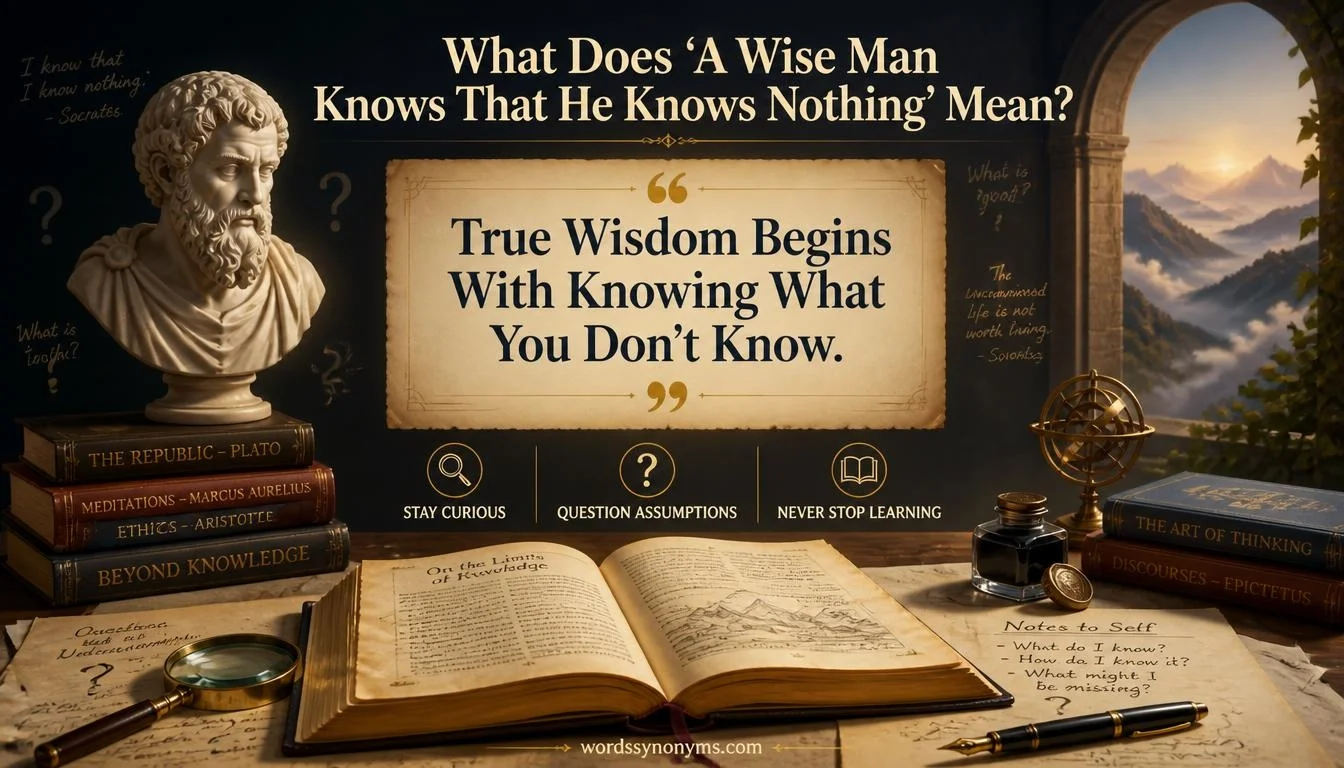
“A wise man knows that he knows nothing” means that true wisdom begins when you recognize the limits of your knowledge. The saying is associated with Socrates, who believed that admitting what you don’t know is wiser than pretending to have all the answers. It encourages you to stay curious, question your assumptions, and remain open to learning throughout life.
What Does “A Wise Man Knows That He Knows Nothing” Mean?
The phrase “a wise man knows that he knows nothing” means that true wisdom begins when you recognize what you don’t know. Rather than pretending to understand everything, a wise person acknowledges uncertainty and remains open to learning.
Imagine two people discussing a complicated subject. The first person immediately claims to know all the answers. The second person listens, asks questions, and admits when something isn’t clear.
The first person may appear more confident at first. However, the second person has a better opportunity to discover the truth because they aren’t afraid to examine their understanding.
This is the central message behind the quote. Wisdom doesn’t require you to have every answer. It requires you to recognize the difference between what you know, what you believe, and what you still need to understand.
For example, a student who asks a teacher to explain a difficult concept may learn more than someone who stays silent to protect their reputation. Admitting confusion creates an opportunity for improvement.
The same principle applies to adults. A successful business owner might understand marketing exceptionally well but know very little about cybersecurity. Recognizing that limitation helps them seek expert advice instead of making costly assumptions.
In simple words, the quote teaches you to:
- Recognize your limitations: Understand that your knowledge has boundaries.
- Stay curious: Keep asking questions, even when you already know a great deal.
- Question assumptions: Don’t automatically treat your beliefs as facts.
- Accept correction: Be willing to change your mind when stronger evidence appears.
- Continue learning: Treat education as a lifelong process rather than a destination.
The real lesson is simple: you don’t have to know everything to become wiser. You need to recognize what you don’t know and remain willing to learn.
Where Does “A Wise Man Knows That He Knows Nothing” Come From?
The saying is commonly associated with Socrates, a Greek philosopher who lived from approximately 470 to 399 BCE. He became famous for questioning people about justice, morality, knowledge, and the meaning of a good life.
However, the familiar wording is best understood as a paraphrase of his philosophical position rather than a confirmed, exact quotation.
Socrates left no known writings of his own. Much of what people know about his ideas comes from accounts written by others, particularly his student Plato.
One important source is Plato’s Apology, a philosophical account of Socrates’ defense during his trial in Athens. The work explores why Socrates became known for wisdom and why his questioning made him unpopular with some influential citizens.
The Connection Between Socrates and Wisdom
According to Plato’s Apology, Socrates became puzzled when his friend Chaerephon reported that the oracle at Delphi had declared nobody wiser than Socrates.
Socrates didn’t believe he possessed extraordinary wisdom. To investigate the oracle’s meaning, he questioned people who enjoyed reputations for knowledge and good judgment.
He spoke with politicians, poets, and skilled craftsmen. His conversations revealed an interesting pattern.
Some people possessed genuine abilities or specialized knowledge. However, they sometimes assumed that their expertise made them knowledgeable about subjects beyond their experience.
A skilled craftsperson might understand their trade thoroughly yet have little understanding of ethics or politics. A respected public figure might speak confidently about justice without being able to explain what justice actually meant.
Socrates recognized an important difference between these people and himself. They often believed they understood things they couldn’t adequately explain. He was more willing to acknowledge the limits of his understanding.
His advantage wasn’t that he possessed all the answers. Instead, he didn’t automatically mistake his assumptions for knowledge.
This idea became central to what people now call Socratic ignorance: recognizing your own lack of knowledge rather than confidently overlooking it.
Did Socrates Actually Say “I Know That I Know Nothing”?
The popular statement “I know that I know nothing” summarizes an idea associated with Socrates, but it doesn’t appear in Plato’s Apology in that exact form.
In the dialogue, Socrates explains that he has a small advantage over someone who claims knowledge without possessing it. He neither knows nor thinks he knows what he doesn’t understand.
This distinction matters because the familiar quotation can make Socrates sound as though he denied all possible knowledge. His argument was more subtle.
He wasn’t simply declaring that every fact was unknowable. He was explaining why recognizing your ignorance can be wiser than confidently claiming knowledge you haven’t established.
For instance, saying “I don’t know whether this claim is true” differs from saying “Nothing can ever be known.” The first statement acknowledges a limitation. The second makes a much broader philosophical claim.
Socrates’ approach encouraged investigation rather than surrender. When he encountered something he couldn’t explain, he questioned people, examined arguments, and continued searching.
His example therefore supports an active form of humility. You recognize your limits not to stop learning but to give learning a proper starting point.
Read more: “Special Thanks Go To” or “Special Thanks Goes To”
The Philosophy Behind Knowing That You Know Nothing
The quote carries several philosophical ideas that remain useful in education, work, relationships, and everyday decision-making.
Intellectual Humility
Intellectual humility means recognizing that your beliefs and understanding can be incomplete or mistaken.
It doesn’t require you to consider yourself unintelligent. Instead, it encourages you to evaluate your knowledge honestly without exaggerating your abilities.
Consider someone who has worked as a teacher for twenty years. That experience gives them valuable knowledge, but it doesn’t guarantee that every teaching method they use remains effective.
New research, different student needs, and changing classroom conditions may reveal better approaches. An intellectually humble teacher can consider these developments without feeling that their experience has become worthless.
Intellectual humility also helps during disagreements. Instead of immediately dismissing another person’s argument, you can ask what evidence supports it and whether it reveals something you overlooked.
This approach makes conversations more productive because the goal becomes understanding rather than winning.
Being willing to admit a mistake is not a weakness. It’s a sign that your commitment to truth matters more than protecting your pride.
The Difference Between Knowledge and Wisdom
Knowledge and wisdom are connected, but they aren’t identical.
Knowledge involves facts, information, skills, and understanding. Wisdom involves using knowledge thoughtfully, recognizing context, considering consequences, and exercising sound judgment.
For example, someone might know the mathematical formula for calculating investment returns. Wisdom involves understanding the risks, considering personal circumstances, and avoiding decisions based on unrealistic expectations.
A person can accumulate information without learning how to apply it responsibly. Likewise, a wise person may recognize when a problem requires expertise they don’t possess.
| Knowledge | Wisdom |
| Understanding facts and information | Applying understanding with good judgment |
| Learning how a process works | Recognizing when and why to use it |
| Remembering established principles | Considering context and consequences |
| Developing expertise in a subject | Recognizing the limits of that expertise |
| Finding answers to questions | Knowing which questions deserve attention |
The quote connects wisdom with self-awareness. The more honestly you assess your understanding, the easier it becomes to identify where additional knowledge would help.
Questioning Your Own Assumptions
Assumptions influence everyday decisions, often without your awareness.
You might assume a quiet coworker dislikes you, a student who asks few questions understands everything, or a popular opinion must be correct. Yet none of these conclusions necessarily follows from the available evidence.
Socratic questioning encourages you to examine these beliefs before accepting them.
Ask yourself:
- What evidence supports this conclusion?
- Could another explanation make sense?
- Am I confusing an opinion with a fact?
- What information would change my mind?
- Have I considered a perspective different from my own?
These questions don’t require you to doubt every thought. They simply help you distinguish reasonable conclusions from unsupported assumptions.
When you question your own thinking, you become less likely to confuse familiarity with truth.
Why Admitting You Don’t Know Something Is a Sign of Wisdom
Many people feel uncomfortable admitting ignorance because they worry about appearing unprepared or incapable. However, pretending to know something can create greater problems than acknowledging a knowledge gap.
It Encourages Lifelong Learning
Learning becomes easier when you recognize what needs improvement.
A student who identifies weaknesses in mathematics can focus on specific topics instead of repeatedly practicing what they already understand. An employee who recognizes gaps in their technical skills can seek training before those gaps affect their work.
The process begins with honest self-assessment.
Once you identify what you don’t understand, you can ask better questions, find suitable resources, and measure your progress. Without that awareness, improvement becomes little more than guesswork.
It Reduces Overconfidence
Confidence helps you take action, but excessive confidence can lead to poor decisions.
Suppose a driver believes they understand every aspect of vehicle maintenance because they’ve owned a car for years. They might ignore an unfamiliar warning light and continue driving.
A more careful driver recognizes the limits of their experience and consults a qualified mechanic.
The difference isn’t necessarily intelligence. It’s the willingness to acknowledge uncertainty before it becomes a problem.
It Makes Feedback More Useful
Constructive criticism can reveal weaknesses you might not notice yourself.
Imagine a writer who believes every article they publish is clear and engaging. An editor points out that the introductions are repetitive and the explanations lack useful examples.
The writer has two choices: defend every sentence or consider the feedback carefully.
By examining the criticism, the writer can improve their work. Intellectual humility makes that process possible.
Of course, not every criticism is accurate. Wisdom also involves evaluating feedback instead of accepting it blindly.
It Improves Relationships
Healthy relationships depend partly on the willingness to understand another person’s experience.
When a friend seems distant, you might assume they’re upset with you. Yet they could be tired, worried about family matters, or dealing with a difficult day.
Asking a thoughtful question is usually more useful than treating your first interpretation as fact.
The same principle applies to disagreements. You can acknowledge that another person sees a situation differently without immediately agreeing with them.
Recognizing the limits of your perspective creates room for empathy.
It Helps You Recognize When to Seek Expert Advice
No individual can develop deep expertise in every field.
A doctor may understand human health exceptionally well but still consult another specialist. An experienced engineer may seek advice about a legal contract. A successful entrepreneur may hire an accountant to handle complex tax matters.
Seeking expertise doesn’t diminish your abilities. It helps you make better decisions by recognizing when another person’s knowledge can fill an important gap.
Real-Life Examples of “A Wise Man Knows That He Knows Nothing”
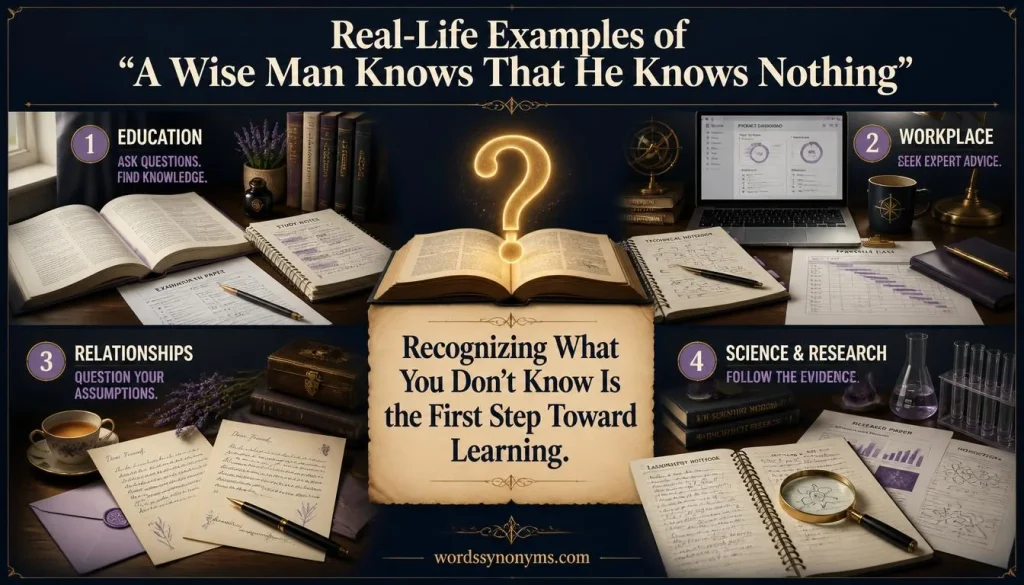
The quote becomes easier to understand when you see how its principles work in ordinary situations.
Example in Education
Imagine two students preparing for a difficult examination.
Student A reads the textbook and assumes that recognizing the material means understanding it. Student B tests their knowledge, identifies confusing concepts, and asks the teacher for clarification.
Student B may initially feel less confident because they recognize more gaps. However, that awareness helps them prepare more effectively.
The important lesson is that recognizing a weakness gives you a chance to address it. Ignoring the weakness doesn’t make it disappear.
Teachers can apply the same principle by reviewing their methods and learning from student feedback.
Example in the Workplace
A manager must decide whether to introduce a new software system.
Rather than assuming they understand every technical detail, the manager consults the IT team, asks about security risks, and compares the available options.
This approach doesn’t make the manager indecisive. It helps them make a more informed choice.
The manager still has responsibility for the final decision. However, they use the team’s expertise instead of pretending to possess knowledge that belongs to specialists.
Example in Everyday Relationships
Suppose two friends argue because one person cancels a planned meeting.
The disappointed friend assumes the cancellation means the friendship no longer matters. Instead of immediately ending the relationship, they ask what happened.
They discover that the other friend was dealing with an unexpected family emergency.
The original assumption was understandable, but it wasn’t accurate.
This example shows why recognizing uncertainty matters emotionally as well as intellectually. You rarely have complete access to another person’s thoughts, motives, or circumstances.
Example in Science and Research
Scientific progress depends on asking questions and testing explanations against evidence.
Researchers develop hypotheses, conduct experiments, analyze results, and revise their conclusions when necessary. A hypothesis may be reasonable without being correct.
This process doesn’t mean scientists know nothing. It means reliable conclusions depend on evidence, careful testing, and openness to correction.
For example, researchers studying a disease may discover that a treatment works under certain conditions but not others. Further investigation can reveal why the results differ.
The willingness to revise an explanation is part of scientific rigor, not evidence that research has failed.
What This Quote Does Not Mean
The saying can be misunderstood if you interpret it too literally. Recognizing your limitations doesn’t mean abandoning confidence, rejecting facts, or treating every opinion as equally valid.
It Doesn’t Mean You Should Doubt Everything
Healthy skepticism involves examining claims and evaluating evidence. Constant suspicion, however, can prevent you from reaching reasonable conclusions.
You don’t need to investigate every ordinary fact from the beginning each time you use it. Reliable evidence, established methods, and trustworthy expertise can justify confidence.
For example, you can reasonably rely on basic arithmetic without questioning every calculation. However, if a financial report contains an unexpected figure, checking the numbers makes sense.
The goal is to match your confidence to the strength of the evidence.
It Doesn’t Mean You Know Absolutely Nothing
People acquire genuine knowledge through education, experience, observation, and careful reasoning.
A trained nurse understands medical procedures. An experienced carpenter knows how to work with wood. A language learner can develop a strong grasp of grammar through practice.
The quote doesn’t erase those achievements.
Instead, it reminds you that expertise in one area doesn’t automatically make you an expert in every other area. You can know a great deal about your profession while remaining a beginner elsewhere.
Recognizing that distinction helps you respect both your abilities and the expertise of others.
It Doesn’t Mean You Should Never Trust Your Judgment
Self-doubt becomes unhelpful when it prevents you from acting on sound information.
Imagine an experienced teacher who has prepared thoroughly for a lesson. They don’t need to question every decision simply because they recognize that mistakes are possible.
They can trust their preparation while remaining open to feedback.
This balance is essential. Intellectual humility means being open to correction, not being permanently uncertain about everything.
How to Apply This Philosophy in Your Daily Life
You don’t need to study ancient philosophy to practice intellectual humility. Small changes in how you ask questions, make decisions, and respond to other people can put the idea into action.
Ask Questions Before Forming Conclusions
When something seems confusing, ask for clarification rather than filling the gaps with assumptions.
Instead of saying, “That explanation makes no sense,” try asking, “Could you explain how you reached that conclusion?”
The second approach encourages discussion and may reveal information you missed.
Separate Facts From Opinions
A fact can be supported by reliable evidence, while an opinion expresses an interpretation, preference, or judgment.
For instance, “The meeting lasted one hour” describes a measurable event. “The meeting was a waste of time” expresses an evaluation.
Recognizing the difference helps you discuss disagreements more clearly.
Some claims require interpretation, and some facts remain uncertain. Still, separating evidence from opinion is a useful starting point.
Learn to Say “I Don’t Know”
Those three words can save time, prevent mistakes, and build trust.
If a colleague asks about a technical issue outside your expertise, acknowledge the limitation. Then explain how you’ll find a reliable answer or identify someone who can help.
You don’t have to stop at uncertainty. Turn it into a plan.
For example:
“I haven’t worked with that system before. Let me check the documentation before recommending a solution.”
This response combines honesty with responsibility.
Listen to People With Different Perspectives
You don’t have to agree with every person you meet. However, listening carefully can reveal why they hold a particular view.
Ask questions that help you understand their reasoning. Consider their experiences and compare their claims with the available evidence.
Sometimes you’ll strengthen your original position. Other times, you’ll discover a better explanation.
Both outcomes can be useful.
Welcome Constructive Criticism
Feedback often feels uncomfortable because it challenges the picture you have of yourself.
Instead of reacting immediately, consider whether the criticism identifies a genuine weakness. Look for specific examples and ask how you could improve.
You can reject inaccurate feedback without dismissing every uncomfortable observation.
The aim isn’t to please everyone. It’s to learn from information that helps you grow.
Revisit Your Opinions When New Evidence Appears
Changing your mind doesn’t automatically mean your earlier thinking was foolish. Sometimes you simply receive better information.
Suppose you support a particular solution to a workplace problem. Later, new data reveals that another approach would save money and reduce errors.
Keeping your original position merely to avoid embarrassment makes little sense. Revising it shows that your decision-making responds to evidence.
A useful rule is this: be loyal to the search for truth rather than to the need to be right.
The Psychological Lesson: Why People Think They Know More Than They Do
Human beings don’t always assess their own abilities accurately. Sometimes we overlook important gaps in our understanding because familiar information feels easier to grasp.
This can create a dangerous illusion: the feeling that understanding a little means understanding everything.
Overconfidence and the Dunning–Kruger Effect
The Dunning–Kruger effect is a psychological concept associated with research by David Dunning and Justin Kruger, published in 1999.
Their original research examined how people’s self-assessments of certain abilities could differ from their measured performance. In some tasks, lower-performing participants overestimated their abilities.
The concept is often simplified online into the claim that incompetent people always think they’re experts. That interpretation is too broad.
Self-assessment varies by task, experience, and circumstances. The research doesn’t establish that everyone with limited knowledge behaves arrogantly or that every confident person lacks competence.
Still, the broader lesson fits the philosophy behind the quote: your ability to judge your own knowledge can have limitations too.
For example, a beginner learning photography might believe they understand lighting after mastering a few basic settings. As they gain experience, they discover more subtle challenges involving exposure, composition, and color.
Their growing knowledge reveals how much more there is to learn.
This doesn’t mean knowledge makes everyone less confident. It means deeper understanding can help people recognize complexities they previously overlooked.
Why Asking Questions Helps You Learn
Questions turn vague uncertainty into specific learning goals.
If you say, “I don’t understand science,” the problem feels enormous. If you ask, “Why does increasing temperature change the rate of this reaction?” you have a clearer starting point.
Specific questions help you identify what information you need and whether an explanation actually resolves your confusion.
They also encourage active learning. Instead of merely reading or listening, you test ideas, compare explanations, and identify contradictions.
A practical learning routine can include three questions:
- What do I understand? Identify the concepts you can explain confidently.
- What remains unclear? Find the gaps that require more attention.
- How can I check my understanding? Use examples, practice questions, or reliable evidence.
This simple habit makes learning more focused and helps you avoid mistaking familiarity for mastery.
“A Wise Man Knows That He Knows Nothing” Compared With Similar Ideas
Several familiar sayings explore the relationship between knowledge, humility, and wisdom. Although their messages overlap, each emphasizes a slightly different lesson.
| Saying or idea | Main meaning | Practical lesson |
| A wise man knows that he knows nothing | Recognize the limits of your understanding | Stay curious and question assumptions |
| Knowledge is power | Information can help people make informed choices | Seek useful, reliable knowledge |
| Learn something new every day | Growth comes through continued learning | Make curiosity part of your routine |
| The more you learn, the more you realize how much you don’t know | Greater understanding can reveal further questions | Keep exploring beyond the basics |
| Think before you speak | Reflection can prevent careless claims | Check your reasoning before responding |
The first saying focuses on intellectual humility. It reminds you that wisdom requires an honest understanding of your limitations.
“Knowledge is power,” by contrast, emphasizes the value of information and understanding. The two ideas complement each other because knowledge becomes more useful when you recognize its scope and limitations.
Together, they suggest that learning involves both acquiring information and developing the judgment to use it responsibly.

Case Study: How Intellectual Humility Can Change a Decision
Consider a fictional small-business owner named Daniel who wants to increase sales.
Daniel initially believes that lowering prices will attract more customers. He feels confident because several competitors advertise discounts, and he assumes that price is the main reason customers choose one business over another.
Instead of immediately changing every price, he decides to investigate.
He reviews customer feedback, examines sales records, and speaks with several regular customers. The information reveals that many buyers value dependable delivery and clear product information more than small discounts.
Daniel also discovers that delivery delays have caused several customers to shop elsewhere.
He changes his plan. Rather than cutting prices across the board, he improves delivery coordination and provides clearer product details. He tests these changes before investing in a larger overhaul.
The lesson isn’t that discounts never work. It’s that Daniel’s first assumption didn’t fully explain the problem.
By acknowledging that he didn’t yet understand his customers’ priorities, he found a more targeted solution.
This fictional example illustrates how intellectual humility can improve decision-making:
- Recognize uncertainty: Don’t assume your first explanation is correct.
- Gather evidence: Look for information that can confirm or challenge your belief.
- Consider alternatives: Explore other explanations before committing.
- Test your approach: Check whether your decision produces the intended result.
- Adjust when necessary: Use the results to improve your next decision.
The same process can help with study plans, career choices, household budgets, and personal relationships.
Read more: Drove or Driven: Which Is Correct?
FAQs
1. What does “A Wise Man Knows That He Knows Nothing” mean?
It means a truly wise person understands that their knowledge is limited. Instead of pretending to know everything, they stay curious, ask questions, and remain open to new ideas.
2. Who originally said “A Wise Man Knows That He Knows Nothing”?
The saying is commonly associated with Socrates, the ancient Greek philosopher. However, it is a popular summary of his philosophical ideas rather than a confirmed word-for-word quotation.
3. Why is admitting that you know nothing a sign of wisdom?
Admitting what you don’t know shows self-awareness and intellectual humility. It helps you recognize mistakes, learn from others, and make better decisions without letting pride get in the way.
4. Does this saying mean that a wise person has no knowledge?
No. It doesn’t suggest that wise people know absolutely nothing. Instead, it highlights that even knowledgeable people have unanswered questions and room to improve their understanding.
5. How can you apply this saying to everyday life?
You can practice this lesson by listening carefully, asking questions, checking facts, and accepting constructive criticism. When you make a mistake, treat it as a chance to learn rather than something to hide.
6. What is the main life lesson behind this saying?
The main lesson is that learning never truly ends. When you stay humble, question your assumptions, and welcome new information, you develop better judgment and a deeper understanding of the world.
Conclusion
The saying “A Wise Man Knows That He Knows Nothing” reminds us that true wisdom isn’t about having every answer. It’s about recognizing what we don’t know and being willing to learn more. Often associated with Socrates, this idea encourages humility, curiosity, and open-mindedness. Instead of pretending to be right all the time, a wise person listens to different opinions, questions their assumptions, and learns from mistakes. After all, the more you discover about the world, the more you realize how much remains unknown.
You can apply this lesson to everyday life by staying curious and accepting that nobody has all the answers. Whether you’re studying, working, or building relationships, admitting that you don’t know something can open the door to meaningful learning. Wisdom grows when pride makes room for understanding. So, rather than being afraid of what you don’t know, use it as motivation to keep asking questions, exploring new ideas, and becoming a better version of yourself.

Franklin Hayes is a writer and editor at WordsConfusing.com, focused on making English vocabulary, grammar, and commonly confused words easy to understand. He writes clear, practical articles with simple explanations and useful examples to help readers improve their English with confidence.
His goal is simple: Making Confusing Words Simple.