As to why is a common expression in the English language that introduces an explanation or reasons behind a situation.
Understanding its meaning, phrase function, and correct use helps writers follow modern English usage, grammar standards, and language rules. In casual communication, professional communication, and formal writing, the phrase can support clarity, writing precision, and effective communication.
For example, “We are investigating as to why the meeting was delayed” is understandable, but “We are investigating why the meeting was delayed” offers simpler wording and sounds more natural. Choosing between phrase alternatives depends on the communication context, sentence structure, word choice, and writing style. Using appropriate phrasing improves writing accuracy, consistency, and professionalism.
In professional settings, business communication often involves scheduling, project management, calendar management, meetings, and online booking. Explaining delays in business emails, professional reports, workplace correspondence, and administrative discussions requires clear explanations.
Avoid common mistakes, grammar mistakes, and usage mistakes by choosing natural wording. These helpful examples show how simplified wording, correct grammar, and appropriate use improve communication skills, communication clarity, and writing confidence. A professional tone, strong vocabulary, and clear writing help make your message easy for readers to understand.
Quick Answer
“As to why” means “concerning why” or “regarding the reason why.” It introduces a question about the cause of something. Although grammatically acceptable in certain contexts, it can sound wordy. For clearer writing, use “why” or “about why” when either phrase expresses your meaning naturally.
Example: “There is confusion as to why the meeting was canceled.”
Simpler version: “There is confusion about why the meeting was canceled.”

What Does “As to Why” Mean?
“As to why” means “concerning the reason why” or “regarding why.” It introduces a topic or question about the cause of an event, an action, or a situation.
The phrase combines “as to,” which can mean “regarding” or “concerning,” with “why,” which asks about a reason.
For instance:
- “There is some confusion as to why the project was delayed.”
- “The committee discussed the issue, particularly as to why costs had increased.”
- “Questions remain as to why the two accounts contain different figures.”
In each example, the phrase points toward a reason that needs clarification or discussion.
However, “as to why” does not always improve a sentence. In many situations, you can remove “as to” without changing the main meaning.
Compare these examples:
| Wordy sentence | Clearer sentence |
| We don’t understand as to why she left. | We don’t understand why she left. |
| He asked as to why the price changed. | He asked why the price changed. |
| There is uncertainty as to why the system failed. | There is uncertainty about why the system failed. |
The clearer versions communicate the same basic ideas with fewer words.
Understanding the Phrase Through Its Parts
Each part contributes something to the overall meaning.
- As to: Introduces a subject or matter under consideration.
- Why: Introduces a question about a reason or cause.
- As to why: Connects a statement or discussion to a question about a reason.
Think of “as to why” as a signpost pointing toward an explanation. It tells readers which question needs attention, but it doesn’t necessarily provide the answer.
For example, “The report raises questions as to why sales declined” identifies an issue without explaining what caused the decline.
That distinction matters. The phrase introduces a question about a reason rather than naming the reason itself.
Is “As to Why” Grammatically Correct?
Yes, “as to why” can be grammatically correct, but its naturalness depends on the sentence. The phrase appears in constructions that introduce uncertainty, discussion, or questions about reasons.
Consider this example:
“Researchers remain uncertain as to why the results differed.”
The sentence is grammatical. The phrase “as to why” introduces the question researchers haven’t resolved.
Now compare it with this version:
“Researchers remain uncertain why the results differed.”
The second sentence is more concise and sounds natural in many contexts. Both communicate uncertainty about the cause of the difference.
When “As to Why” Works Well
The phrase can work when a sentence discusses an unresolved question or a matter under consideration.
Example:
“The investigation uncovered conflicting accounts as to why the equipment stopped working.”
Here, “as to why” connects the conflicting accounts to the question of what caused the equipment failure.
Another example:
“The board requested further clarification as to why the proposed budget exceeded its original estimate.”
This construction suits formal business writing because it identifies the specific issue requiring clarification.
When “As to Why” Sounds Awkward
Problems arise when writers insert the phrase into sentences that need only “why.”
For example:
- Awkward: “She explained as to why she rejected the offer.”
- Better: “She explained why she rejected the offer.”
The verb “explain” can introduce the reason directly. Adding “as to” makes the sentence unnecessarily wordy.
Similarly:
- Awkward: “Can you tell me as to why this happened?”
- Better: “Can you tell me why this happened?”
The shorter version sounds more natural in conversation and everyday writing.
The key distinction: Grammatical acceptability and good writing aren’t always the same thing. A phrase can be grammatically possible while remaining less clear or less natural than its alternatives.
How to Use “As to Why” Correctly
To use “as to why” effectively, place it where your sentence introduces a question about a reason. Make sure the surrounding words support that construction.
The following sections explain three common situations.
Use “As to Why” to Introduce a Reason or Explanation
When you need to discuss an unresolved cause, “as to why” can connect the main statement to the question under consideration.
For example:
- “The team disagreed as to why the original plan failed.”
- “There is little agreement as to why the policy produced unexpected results.”
- “The report offers several theories as to why demand increased.”
- “The evidence remains inconclusive as to why the machine overheated.”
Each sentence identifies a question that needs an explanation.
Notice that the phrase doesn’t necessarily introduce a confirmed cause. Instead, it points toward the reason people are investigating, debating, or trying to understand.
For instance, a company might discover that customer complaints have doubled. Its managers may investigate as to why complaints increased, but the investigation still needs to establish the actual cause.
In many cases, however, you can replace the phrase with a simpler construction:
- “The team disagreed about why the original plan failed.”
- “There is little agreement on why the policy produced unexpected results.”
- “The report offers several theories about why demand increased.”
These alternatives preserve the meaning while improving the flow.
Use “As to Why” in Indirect Questions
An indirect question reports or discusses a question without asking it directly.
Consider the difference between these sentences:
- Direct question: “Why did the machine stop?”
- Indirect question: “Nobody knows why the machine stopped.”
In the second sentence, the question appears inside a larger statement. English normally uses statement word order in this construction.
For example, you would write:
- Correct: “We don’t know why the machine stopped.”
- Incorrect: “We don’t know why did the machine stop.”
The same principle applies when a sentence uses “as to why.”
Examples:
- “The investigators disagreed as to why the alarm sounded.”
- “The manager requested clarification as to why the shipment arrived late.”
- “There was considerable debate as to why the results changed.”
These sentences use statement word order after “why.” The verb doesn’t move in front of the subject as it would in a direct question.
However, indirect questions don’t require “as to.” In many cases, “why” alone works perfectly well.
Use “As to Why” in Formal Writing
Formal writing sometimes uses “as to why” to identify a question that requires discussion or clarification.
You may encounter it in:
- Business reports and internal reviews
- Legal discussions and written arguments
- Academic analysis
- Investigative reports
- Formal correspondence
- Discussions of conflicting evidence
For example:
“The audit raised concerns as to why several transactions lacked supporting documentation.”
The phrase introduces the specific issue raised by the audit.
Another example:
“The researchers offered no definitive conclusion as to why the treatment produced different outcomes.”
Here, the wording emphasizes the absence of a settled explanation.
Still, formal writing doesn’t need to sound complicated. Clear, direct sentences often communicate expertise more effectively than wordy constructions.
Compare the following:
| Formal or wordy | More direct |
| The report examines questions as to why costs increased. | The report examines why costs increased. |
| The committee requested clarification as to why the proposal changed. | The committee asked why the proposal changed. |
| There remains uncertainty as to why the figures differ. | It remains unclear why the figures differ. |
Choose the longer version when its structure serves a purpose. Otherwise, the simpler option usually reads better.
“As to Why” Sentence Examples
Examples make it easier to recognize where the phrase fits and where it becomes unnecessary. The sentences below cover everyday conversations, professional settings, academic writing, and investigative discussions.
Everyday Examples
Example 1: “Nobody could explain as to why the lights suddenly went out.”
The intended meaning is clear, but “Nobody could explain why the lights suddenly went out” sounds more natural.
Example 2: “There was confusion as to why the invitation never arrived.”
The phrase introduces uncertainty about the missing invitation.
Example 3: “I’m not sure as to why he changed his mind.”
A simpler version is “I’m not sure why he changed his mind.”
Example 4: “We had different opinions as to why the trip was canceled.”
The phrase connects the disagreement to the reason for canceling the trip.
Workplace Examples
Example 5: “The supervisor requested an explanation as to why the report was submitted late.”
The sentence suits a formal workplace exchange, although “requested an explanation of why” or “asked why” may sound smoother.
Example 6: “The finance team investigated as to why operating costs had increased.”
A clearer alternative is “The finance team investigated why operating costs had increased.”
Example 7: “Management remains uncertain as to why several customers canceled their orders.”
The sentence identifies a business problem whose cause remains unknown.
Academic and Analytical Examples
Example 8: “The study raises important questions as to why participants responded differently.”
The phrase introduces a question about differences in the study’s findings.
Example 9: “Historians continue to debate as to why the settlement was abandoned.”
A more natural version is “Historians continue to debate why the settlement was abandoned.”
Example 10: “The available evidence provides little insight as to why the pattern emerged.”
The wording emphasizes that the evidence doesn’t adequately explain the observed pattern.
Investigative and Formal Examples
Example 11: “Investigators found conflicting statements as to why the alarm had been disabled.”
The phrase identifies the point of disagreement between the statements.
Example 12: “The committee requested further information as to why the deadline had changed.”
The wording fits a formal request for additional information.
Example 13: “The report offers no clear conclusion as to why the system failed.”
The phrase introduces the unresolved cause of the failure.
Example 14: “Questions remain as to why the original figures differ from the revised estimates.”
The sentence signals that an explanation is still needed.
Example 15: “The review examined several possible explanations as to why the project exceeded its budget.”
The sentence is understandable, although “possible explanations for why” or simply “reasons the project exceeded its budget” may be more concise.
What These Examples Teach You
Across these examples, three patterns appear repeatedly:
- Uncertainty: Nobody knows why something happened.
- Discussion: People disagree about a cause or explanation.
- Investigation: Someone seeks evidence to explain an event.
The phrase can appear in all three situations. However, you should check whether “as to” contributes anything meaningful before keeping it.
“As to Why” vs. “As for Why”
Although these expressions look similar, they don’t always serve the same purpose. The difference becomes clearer when you examine their emphasis and sentence structure.
“As to why” generally introduces a matter concerning a reason. “As for why” often shifts attention to a particular question or topic.
Understanding “As to Why”
Use this expression when discussing a question, uncertainty, or matter under consideration.
Examples:
- “There is disagreement as to why the figures changed.”
- “The report provides no conclusion as to why the system failed.”
Both sentences focus on uncertainty about a cause.
Understanding “As for Why”
“As for” commonly introduces a subject that the speaker wants to address separately or contrast with another subject.
Examples:
- “We know when the shipment arrived. As for why it was delayed, the records offer no explanation.”
- “The team agreed on what happened. As for why it happened, opinions differed.”
In these examples, “as for why” shifts attention from one issue to another.
Comparison Table
| Feature | As to why | As for why |
| Main function | Introduces a matter concerning a reason | Shifts attention to a question about a reason |
| Typical tone | Formal or analytical | Conversational or contrastive |
| Common context | Reports, discussions, explanations | Topic changes and comparisons |
| Example | “There is uncertainty as to why costs increased.” | “As for why costs increased, nobody knows.” |
The expressions can overlap in meaning. Their naturalness depends on the surrounding sentence.
Practical tip: Use “as to why” when discussing a question under consideration. Choose “as for why” when you want to shift the reader’s attention toward that question.
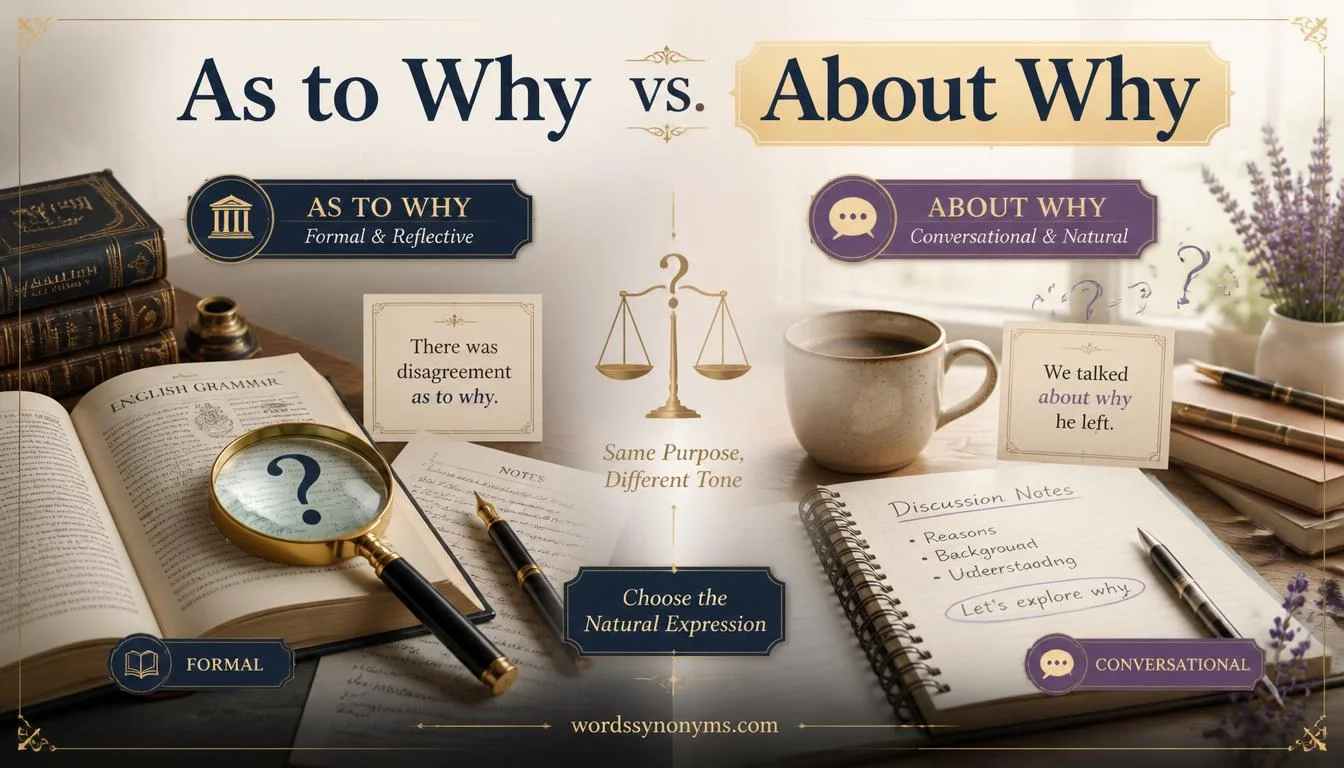
“As to Why” vs. “About Why”
The expressions “as to why” and “about why” both connect a statement to a question concerning a reason. However, they differ in tone and in the grammatical structures that commonly surround them.
“About why” often sounds more conversational and works naturally after words such as “questions,” “discussion,” and “information.”
For example:
- “We had a discussion about why the event was canceled.”
- “She asked questions about why the results had changed.”
- “The article provides information about why the policy was introduced.”
These sentences sound natural because “about” introduces the subject of the discussion.
By comparison, “as to why” often appears in more formal constructions:
- “There was disagreement as to why the event was canceled.”
- “The report raises questions as to why the results changed.”
- “The committee requested clarification as to why the policy was introduced.”
Both expressions can work in appropriate contexts. Neither automatically makes a sentence more accurate or professional.
Which Expression Should You Choose?
Your choice should depend on the sentence rather than the desire to sound formal.
| Situation | Natural wording | Example |
| Casual conversation | About why | “We talked about why he left.” |
| Formal discussion | As to why | “There was disagreement as to why he left.” |
| General uncertainty | Why | “Nobody knows why he left.” |
| Detailed explanation | The reason why | “The report explains the reason why he left.” |
The simplest option is often the strongest. If “why” communicates your meaning clearly, there’s usually no reason to add extra words.
Read more: Lucas’ or Lucas’s? Here’s the Correct Possessive Form
“As to Why” vs. “The Reason Why”
These expressions may appear in similar sentences, but they perform different grammatical functions. Understanding that difference helps you avoid awkward or repetitive wording.
“As to why” introduces a question about a reason. “The reason why” introduces or identifies the reason itself.
Consider these examples:
- “The committee disagreed as to why the proposal failed.”
- “The report explains the reason why the proposal failed.”
The first sentence emphasizes disagreement about the cause. The second introduces an explanation of that cause.
How “As to Why” Works
The phrase often appears after words associated with uncertainty, disagreement, or discussion.
Examples:
- “There is confusion as to why the figures don’t match.”
- “The investigators disagree as to why the equipment stopped.”
- “Questions remain as to why the results changed.”
In each case, the sentence focuses on an unresolved question.
How “The Reason Why” Works
“The reason why” identifies the cause or explanation behind an event.
Examples:
- “The reason why sales declined was the sudden price increase.”
- “She explained the reason why she rejected the offer.”
- “The report identifies the reason why the system failed.”
These sentences focus on explaining or identifying a cause.
However, “the reason why” can also become unnecessarily wordy. In many cases, “the reason” or “why” is enough.
Compare:
- Wordy: “The reason why sales declined was the price increase.”
- Clearer: “Sales declined because prices increased.”
- Also clear: “The reason sales declined was the price increase.”
Each version communicates the cause directly.
Quick Comparison
| Expression | Main purpose | Example |
| As to why | Introduces a question about a cause | “They disagreed as to why sales declined.” |
| The reason why | Identifies or introduces a cause | “She explained the reason why sales declined.” |
| Why | Introduces a reason or indirect question | “She explained why sales declined.” |
| Because | Directly gives a cause | “Sales declined because prices increased.” |
Remember: Use the expression that matches your intended meaning. A question about a cause isn’t quite the same as an explanation of that cause.
Better Alternatives to “As to Why”
If you want your writing to sound clear and natural, several alternatives can replace “as to why.” The best choice depends on whether you’re asking a question, discussing an uncertainty, or explaining a cause.
Why
“Why” is usually the simplest alternative when a sentence already contains a verb that introduces a question or explanation.
Examples:
- Wordy: “I don’t understand as to why she left.”
- Better: “I don’t understand why she left.”
Another example:
- Wordy: “The manager asked as to why the figures had changed.”
- Better: “The manager asked why the figures had changed.”
Use “why” when you want direct, uncomplicated wording.
About Why
“About why” works well when you’re describing a conversation, discussion, or set of questions.
Examples:
- “We talked about why the event was canceled.”
- “The students asked questions about why the experiment failed.”
- “The meeting focused on why customer complaints had increased.”
This option often feels natural in everyday and professional English.
Regarding Why
“Regarding why” can introduce a question in formal communication, although it sometimes sounds stiff.
For example:
“The department requested additional documentation regarding why the deadline had changed.”
A more direct alternative is:
“The department requested additional documentation explaining why the deadline had changed.”
The second sentence makes the purpose of the documentation clearer.
The Reason Why
Use this expression when the sentence focuses on an explanation or cause.
For example:
- “The report explains the reason why the project failed.”
- “She described the reason why the original plan changed.”
You can often shorten these sentences:
- “The report explains why the project failed.”
- “She described why the original plan changed.”
Choose the longer form only when the sentence benefits from emphasizing the reason itself.
Why Exactly
“Why exactly” works when you want a more specific explanation.
Examples:
- “Why exactly did the schedule change?”
- “Can you explain why exactly the figures don’t match?”
The second sentence is possible, but the placement can feel awkward. A smoother version is “Can you explain exactly why the figures don’t match?”
This alternative is especially useful when a general explanation isn’t enough.
As for Why
Choose “as for why” when shifting the discussion toward a particular question.
For example:
“We know the product failed. As for why it failed, the investigation is still underway.”
The expression works because the second sentence shifts attention from the known event to its unknown cause.
The Reason For
“The reason for” introduces a noun or noun phrase rather than a clause beginning with “why.”
Examples:
- “The reason for the delay remains unclear.”
- “The reason for her absence wasn’t recorded.”
- “The reason for the price increase requires further investigation.”
Notice the grammatical difference:
- Correct: “The reason for the delay”
- Correct: “The reason why the delivery was delayed”
- Incorrect: “The reason for why the delivery was delayed” in standard concise usage
The final construction isn’t always impossible in actual English, but it often sounds redundant. Prefer “the reason for the delay” or “why the delivery was delayed.”
Choosing the Right Alternative
| Alternative | Best use | Example |
| Why | Direct explanations | “We don’t know why it happened.” |
| About why | Discussions and questions | “We talked about why it happened.” |
| Regarding why | Formal communication | “The letter asks regarding why it happened.” |
| The reason why | Introducing a cause | “She explained the reason why it happened.” |
| Why exactly | Requesting specific details | “Why exactly did it happen?” |
| As for why | Shifting the topic | “As for why it happened, nobody knows.” |
| The reason for | Introducing a noun phrase | “The reason for the delay remains unclear.” |
One important qualification: “regarding why” doesn’t fit every sentence naturally. For example, “The letter asks regarding why it happened” is awkward. Write “The letter asks why it happened” or “The letter requests clarification regarding the cause.”
Common Mistakes When Using “As to Why”
Even when readers understand your meaning, a poorly constructed sentence can make your writing less effective. The following mistakes are worth avoiding.
Using “As to Why” When “Why” Is Enough
The most common problem is adding unnecessary words.
Incorrect or awkward:
“She wanted to know as to why the office closed early.”
Better:
“She wanted to know why the office closed early.”
The verb phrase “wanted to know” already introduces the question. The extra words don’t add useful information.
Rule of thumb: If removing “as to” leaves the sentence grammatical and preserves its meaning, consider removing it.
Confusing “As to Why” With “As for Why”
These expressions have related meanings, but they don’t always fit the same situations.
Consider:
“The report contains uncertainty as to why the figures differ.”
This sentence discusses uncertainty about a reason.
Now consider:
“The figures differ. As for why, the report offers no explanation.”
Here, “as for why” shifts the focus toward the unanswered question.
Both constructions are possible, but their sentence structures and emphasis differ.
Using Incorrect Word Order in Indirect Questions
Indirect questions normally follow statement word order.
Incorrect: “The manager asked why had the figures changed.”
Correct: “The manager asked why the figures had changed.”
The same rule applies when using “as to why.”
Incorrect: “The committee debated as to why had the proposal failed.”
Better: “The committee debated why the proposal had failed.”
Another possible version is “The committee debated the question of why the proposal had failed.”
When “why” appears inside a statement, place the subject before the verb in the usual way.
Repeating “Reason” and “Why” Unnecessarily
Some constructions repeat the same idea without improving clarity.
For example:
“The reason as to why the system failed remains unknown.”
This sentence combines “reason,” “as to,” and “why” in a cumbersome structure.
Better alternatives include:
- “The reason the system failed remains unknown.”
- “Why the system failed remains unknown.”
- “The cause of the system failure remains unknown.”
Each version expresses the same general idea more efficiently.
Adding “As to” After Verbs That Already Introduce Reasons
Certain verbs naturally connect to a question about a reason.
Examples include:
- Explain why
- Ask why
- Understand why
- Investigate why
- Discover why
Consequently, these sentences usually read better without “as to”:
- “She explained why the schedule changed.”
- “They investigated why the equipment failed.”
- “Nobody understands why the results differ.”
- “The manager asked why the payment was late.”
The direct construction avoids unnecessary wording while preserving the intended meaning.
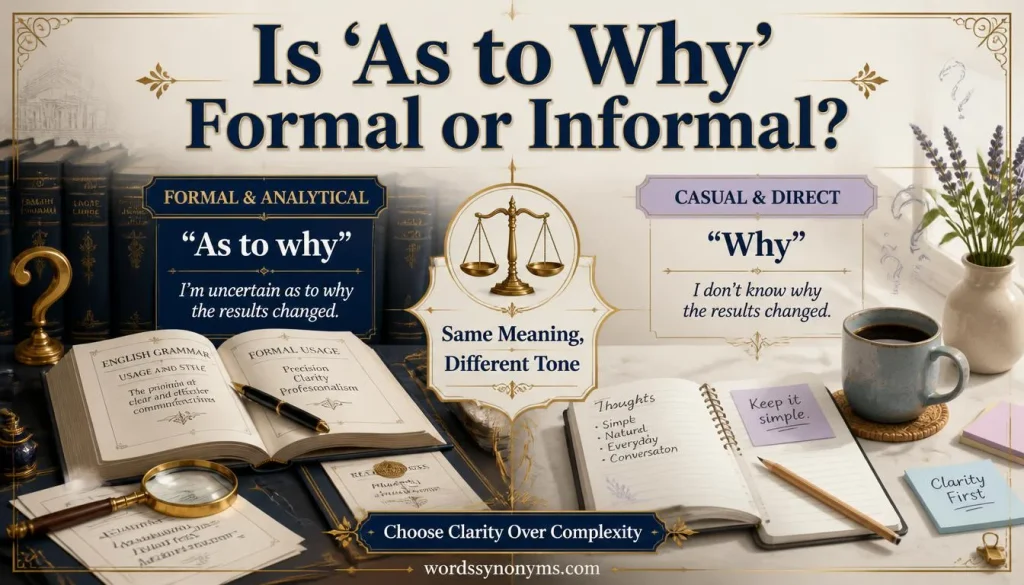
Is “As to Why” Formal or Informal?
“As to why” generally sounds formal, analytical, or somewhat stiff. Its tone depends on the surrounding sentence and the situation in which you use it.
In everyday conversation, people usually prefer simpler expressions. Formal documents may use the phrase when discussing uncertainty, conflicting explanations, or unresolved questions.
In Everyday Conversation
Most speakers would naturally say:
- “I don’t know why he left.”
- “Why did the price change?”
- “We talked about why the meeting was canceled.”
These sentences are direct and easy to understand.
By comparison, “I’m uncertain as to why he departed” sounds more formal than most everyday conversations require.
That doesn’t make the sentence wrong. It simply makes it less conversational.
In Professional Writing
The phrase can appear in formal business communication, especially when a sentence discusses a disputed or unresolved issue.
For example:
“The review identified several unanswered questions as to why the original estimates differed from the final figures.”
This sentence is understandable and suitable for an analytical report.
However, the following version is more direct:
“The review identified several unanswered questions about why the original estimates differed from the final figures.”
Both versions work. The second may be easier for readers to process quickly.
In Academic Writing
Academic writing often examines causes, evidence, and competing explanations. The phrase can introduce an unresolved question in that context.
For example:
“The findings raise questions as to why participants responded differently under similar conditions.”
A more concise version is:
“The findings raise questions about why participants responded differently under similar conditions.”
Neither construction automatically makes an argument more scholarly. Strong academic writing depends on clear reasoning, accurate evidence, and precise language.
In Formal Emails
If you’re writing to a manager, professor, or organization, choose wording that sounds professional without becoming unnecessarily complicated.
For example:
Wordy: “I am writing to inquire as to why my application status has changed.”
Clearer: “I’m writing to ask why my application status has changed.”
More formal: “Could you please clarify why my application status has changed?”
The final version remains polite while expressing the request directly.
A Practical Case Study: Editing “As to Why” in Real Sentences
Imagine an employee preparing a report after a company discovers an unexpected increase in shipping costs. The first draft contains several instances of “as to why.”
The goal isn’t to remove every occurrence automatically. Instead, the writer should decide whether each construction improves clarity.
| Original sentence | Revised sentence | Why the revision works |
| The team investigated as to why shipping costs increased. | The team investigated why shipping costs increased. | “Investigated why” is direct and natural. |
| There was disagreement as to why the supplier changed its rates. | There was disagreement about why the supplier changed its rates. | “About why” fits the discussion of disagreement. |
| The report raises questions as to why delivery times increased. | The report raises questions about why delivery times increased. | The revision sounds smoother without changing the meaning. |
| The reason as to why costs increased remains unclear. | The reason costs increased remains unclear. | Removing redundant wording improves readability. |
| As for why the costs increased, the team has no explanation. | As for why costs increased, the team has no explanation. | The original structure works, although the shorter version is slightly tighter. |
This example illustrates an important editing principle: good writing preserves meaning while removing unnecessary complexity.
The phrase “as to why” isn’t automatically a mistake. However, writers should examine each occurrence instead of treating it as the default way to introduce a reason.
Read more: Teachers or Teacher’s or Teachers’? Correct Possessive Explained
How to Decide Whether “As to Why” Belongs in Your Sentence
When editing your writing, ask three simple questions before keeping the phrase.
Does the phrase introduce a useful distinction?
If “as to why” helps connect a statement to an unresolved issue, it may fit the sentence. If it merely repeats the meaning of “why,” you can usually remove it.
Does the sentence sound natural when read aloud?
Compare “We are uncertain as to why the figures changed” with “We’re uncertain why the figures changed.” The second version feels more conversational without losing meaning.
Would another expression communicate the idea more precisely?
Sometimes “about why,” “the reason for,” or “because” expresses the intended relationship more clearly. Choose the wording that matches your meaning.
Use this quick editing checklist:
- Confirm that the sentence introduces a question about a reason.
- Check whether “as to” adds anything useful.
- Preserve correct word order in indirect questions.
- Remove redundant expressions such as “the reason as to why.”
- Choose wording that suits your audience and purpose.
- Read the revised sentence aloud to check its flow.
A few small edits can make formal writing clearer without making it sound simplistic.
FAQs
1. What does “as to why” mean?
“As to why” means “about the reason why” or “concerning why something happened.” It introduces an explanation or question about a cause.
2. Is “as to why” grammatically correct?
Yes, “as to why” is grammatically acceptable in many contexts. However, it can sound wordy, so using “why” alone often makes your sentence clearer.
3. What is an example of “as to why” in a sentence?
For example, “The manager asked as to why the meeting was canceled.” A simpler version is, “The manager asked why the meeting was canceled.”
4. Is “as to why” formal or informal?
The phrase appears more often in formal writing, business communication, reports, and administrative discussions. However, it can also appear in everyday conversation.
5. What can I use instead of “as to why”?
You can often replace it with “why,” “the reason why,” or “about why.” For example, “We discussed as to why the project was delayed” becomes “We discussed why the project was delayed.”
6. Should I use “as to why” in professional emails?
You can use it when it fits the sentence, but “why” is usually more direct. In professional emails, clear and simple wording helps readers understand your message quickly.
Conclusion
Understanding “as to why” helps you make better choices when writing emails, reports, and everyday messages. The phrase is grammatically acceptable in certain contexts, especially when you need to introduce a reason or explanation. However, it can sometimes make a sentence sound unnecessarily complicated. In most cases, using “why” alone keeps your writing simple, natural, and easy to understand.
Whether you’re writing for work, discussing a project delay, or explaining a decision, focus on clarity rather than complicated wording. Choose the expression that fits your sentence, audience, and purpose. With a little practice, you’ll use “as to why” more confidently and recognize when a simpler alternative works better.

Franklin Hayes is a writer and editor at WordsConfusing.com, focused on making English vocabulary, grammar, and commonly confused words easy to understand. He writes clear, practical articles with simple explanations and useful examples to help readers improve their English with confidence.
His goal is simple: Making Confusing Words Simple.