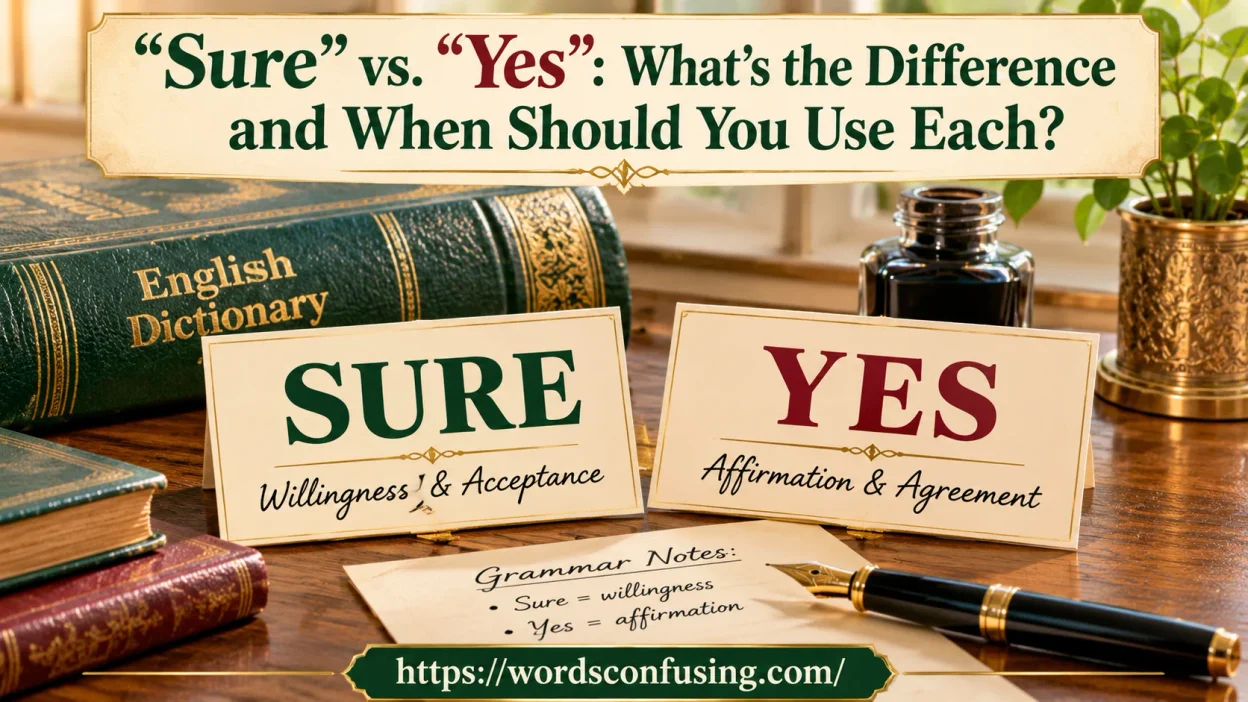
In “Sure” vs. “Yes”: What’s the Difference and When Should You Use Each?, the right reply depends on the tone, context, and purpose of your message.
Both words express agreement, but their meaning, tone, and politeness vary across different situations. In everyday English usage, Yes provides a direct answer and clear answer, while Sure sounds more relaxed and friendly. For example, when a colleague asks about a meeting, saying Yes confirms your decision, whereas Sure creates a warmer conversational impression.
Although these common words seem interchangeable, your relationship, message, and contextual differences help determine the appropriate response. Both expressions work in casual settings, informal conversations, and professional settings, depending on the impression you want to create.
In formal writing, business communication, and workplace communication, choosing the right word improves clarity, confidence, and consistency. Yes suits written communication, business writing, and situations requiring precise communication, while Sure creates a friendly conversational tone during verbal communication and everyday exchanges.
Consider real-world examples involving online booking, broadcasting, project management, and scheduling arrangements. When discussing calendar management, time management, or meeting confirmation, your word choice shapes the impression your message creates.
Understanding grammar rules, usage patterns, and agreement expressions strengthens your communication skills and supports effective communication. Whether you’re replying, confirming, managing, or discussing plans, practical explanations and clear examples make response selection easier.
Developing your understanding of language, professional language, and professional conversations helps you choose a natural response and master the effective usage of both words in different situations. These skills also improve communication clarity and strengthen your time management skills.
Quick Answer
“Sure” and “yes” both express agreement, but they carry slightly different meanings. “Yes” gives a direct, clear confirmation, while “sure” often shows willingness or casual acceptance. For example, say “Yes, I received your message” to confirm something. Use “Sure, I’d be happy to help” when accepting a request.

What Does “Sure” Mean?
The word sure generally means certain, confident, or willing to do something. It commonly functions as an adjective when describing confidence or certainty. However, people also use it as an informal affirmative response during everyday conversations.
When someone responds with “sure,” they’re often showing agreement or willingness to accept something. The expression can communicate that they’re happy to help, participate, or consider a suggestion.
For example:
- “Can you lend me your notebook?” — “Sure!”
- “Would you like another cup of coffee?” — “Sure, thanks.”
- “Can we meet after work?” — “Sure, that works for me.”
- “Could you explain this question?” — “Sure, I’d be happy to.”
In these examples, sure communicates acceptance without making the response sound overly formal. It’s particularly common among friends, family members, classmates, and coworkers.
Different Meanings of “Sure”
Although people frequently use sure to express agreement, the word has several related meanings.
1. Certain or confident
Sure can describe someone who feels confident about information, a decision, or an outcome.
Examples:
- “I’m sure she knows the answer.”
- “Are you sure about your decision?”
- “He’s sure that everything will work out.”
2. Willing or agreeable
In everyday conversation, sure often indicates that someone is willing to do something.
Examples:
- “Can you help me move these chairs?” — “Sure.”
- “Would you like to come along?” — “Sure, why not?”
3. Definitely or without doubt
People also use sure in expressions that emphasize certainty.
Examples:
- “Are you coming tomorrow?” — “For sure!”
- “That’s sure to make everyone laugh.”
- “She’s sure to enjoy the surprise.”
4. Informal acceptance
As a conversational response, sure can acknowledge a request, invitation, or suggestion.
Examples:
- “Can I borrow your charger?” — “Sure, go ahead.”
- “Let’s order pizza tonight.” — “Sure, sounds good.”
Does “Sure” Always Sound Enthusiastic?
Not necessarily. Your tone of voice and the surrounding conversation can completely change its impression.
Consider these three responses:
- Enthusiastic: “Sure! I’d love to help.”
- Neutral: “Sure, that’s fine.”
- Reluctant: “Sure, whatever.”
The first response sounds genuinely welcoming. The second communicates ordinary acceptance. The third might suggest irritation or indifference.
Therefore, don’t judge someone’s feelings based on the word alone. Their delivery and the situation provide important clues.
What Does “Yes” Mean?
The word yes expresses affirmation, agreement, or a positive answer. People commonly use it to answer questions, confirm information, accept offers, and agree with statements.
Unlike sure, yes provides a direct affirmative response. It tells the other person that your answer is positive.
For example:
- “Are you ready?” — “Yes.”
- “Did you finish your homework?” — “Yes, I did.”
- “Would you like some tea?” — “Yes, please.”
- “Can you attend the meeting?” — “Yes, I can.”
In each example, yes answers the question directly. You don’t need additional explanation unless the situation requires clarification.
Different Uses of “Yes”
The word yes serves several purposes depending on the conversation.
1. Answering a direct question
People frequently use yes to answer questions that expect a positive or negative response.
Examples:
- “Do you understand the instructions?” — “Yes, I do.”
- “Have you visited London?” — “Yes, I have.”
- “Is this your book?” — “Yes, it is.”
2. Expressing agreement
Yes can communicate that you agree with another person’s suggestion, opinion, or decision.
Examples:
- “I think we should leave early.” — “Yes, that’s a good idea.”
- “This restaurant has excellent food.” — “Yes, I agree.”
3. Accepting an offer
When someone offers you something, yes provides a clear acceptance.
Examples:
- “Would you like some water?” — “Yes, please.”
- “Can I get you another plate?” — “Yes, thank you.”
4. Confirming information
Yes works particularly well when someone needs confirmation.
Examples:
- “Is your appointment at 10 a.m.?” — “Yes, that’s correct.”
- “Did you receive the document?” — “Yes, I received it.”
5. Expressing enthusiasm
Although yes can sound neutral, it can also communicate excitement.
Examples:
- “Are you excited about the trip?” — “Yes! I can’t wait.”
- “Do you want to celebrate tonight?” — “Yes, absolutely!”
The surrounding words, punctuation, and vocal emphasis help communicate the intended emotion.
Read more: 6 Good Synonyms for “Kill Two Birds With One Stone”
What Is the Difference Between “Sure” and “Yes”?
The main difference between sure and yes involves their emphasis and conversational purpose. Yes directly expresses affirmation, while sure often communicates willingness, acceptance, or agreement.
Imagine someone asks you to help with a project. Saying “yes” confirms your agreement to help. Saying “sure” sounds like you’re willingly accepting the request.
Both responses can work. However, they create slightly different impressions.
Let’s examine their differences more closely.
Meaning and Intention: “Sure” vs. “Yes”
Although both words can communicate agreement, they emphasize different ideas.
Sure often focuses on willingness or acceptance. It suggests that you’re comfortable doing something or have no objection to a suggestion.
Yes focuses on affirmation. It confirms that something is true, correct, acceptable, or agreed upon.
Consider these examples:
- “Can you help me with my assignment?” — “Sure.”
- “Can you help me with my assignment?” — “Yes, I can.”
Both answers accept the request. However, the second response explicitly confirms the speaker’s ability to help.
Here’s another comparison:
- “Are you certain about your answer?” — “Yes.”
- “Are you certain about your answer?” — “I’m sure.”
The first answer confirms the speaker’s certainty. The second uses sure to describe that confidence more directly.
Remember: Yes generally answers affirmatively, while sure often adds a sense of willingness or confidence.
Tone and Politeness: “Sure” vs. “Yes”
Your choice between these words can influence how friendly, direct, or formal your response sounds.
Sure often creates a relaxed and approachable impression. It works naturally when someone asks for a favor or suggests something.
Examples:
- “Could you send me the notes?” — “Sure, no problem.”
- “Would you like to join us?” — “Sure, that sounds fun.”
Yes can sound more direct and straightforward. It’s useful when someone expects a clear answer or needs confirmation.
Examples:
- “Did you complete the report?” — “Yes, I did.”
- “Can you attend the interview?” — “Yes, I can.”
However, neither word automatically sounds more polite. Your wording and delivery matter just as much.
Compare these responses:
| Response | Possible impression |
| “Sure!” | Friendly and agreeable |
| “Yes, absolutely!” | Enthusiastic and confident |
| “Sure, I guess.” | Hesitant or uncertain |
| “Yes, thank you.” | Polite and appreciative |
| “Sure, whatever.” | Potentially dismissive |
| “Yes, I’d be happy to.” | Warm and professional |
A short response isn’t necessarily rude. Still, adding a few thoughtful words can make your intention easier to understand.
Formality and Everyday Usage
Both words appear in formal and informal communication. However, they don’t always fit the same situations.
Yes works comfortably in professional environments because it provides a clear answer. You can use it during meetings, interviews, presentations, and formal discussions.
For example:
- “Have you reviewed the proposal?” — “Yes, I have.”
- “Can you complete this task by Friday?” — “Yes, I can.”
Sure appears more frequently in relaxed conversations. It sounds natural when accepting everyday requests or agreeing with suggestions.
For example:
- “Can you check this document?” — “Sure, I’ll take a look.”
- “Let’s grab lunch after the meeting.” — “Sure, sounds good.”
Nevertheless, sure isn’t automatically unprofessional. In a friendly workplace, it can make communication feel more approachable.
For formal emails, consider using complete responses rather than relying on a single word.
For example:
- Instead of: “Sure.”
- Write: “Certainly. I’ll review the document this afternoon.”
Likewise:
- Instead of: “Yes.”
- Write: “Yes, I can complete the requested changes by Friday.”
The goal isn’t to avoid sure. It’s to choose wording that matches your audience and purpose.
Grammar and Sentence Structure
Another important difference between sure and yes involves their grammatical roles.
Sure primarily functions as an adjective. It describes certainty, confidence, or reliability.
Examples:
- “I’m sure about the results.”
- “She is sure that he will arrive.”
- “We need a sure answer.”
However, English speakers also use sure independently as an informal affirmative response.
Examples:
- “Can you help me?” — “Sure.”
- “Would you like to come?” — “Sure!”
Yes commonly functions as an adverb or interjection. It expresses affirmation or agreement.
Examples:
- “Yes, I understand.”
- “Yes, that’s correct.”
- “Did you finish?” — “Yes.”
People can also use yes as a noun in certain expressions.
For example:
- “I finally received a yes from the manager.”
- “She gave her approval with a simple yes.”
These grammatical differences explain why the words don’t always fit identical sentence structures.
Enthusiasm and Willingness
One subtle distinction involves how each word communicates someone’s attitude.
When you say sure, you’re often showing that you’re willing to participate, help, or accept something. The expression can make your response feel cooperative.
When you say yes, you’re confirming something positively. Your response doesn’t necessarily reveal how enthusiastic you feel.
Consider this situation:
Your friend asks, “Would you like to help me organize my birthday party?”
Possible responses include:
- “Sure, I’d love to help!” — Enthusiastic acceptance.
- “Yes, I can help.” — Clear agreement.
- “Yes, I suppose so.” — Acceptance with possible hesitation.
- “Sure, no problem.” — Casual willingness.
Notice how the additional words influence the meaning. Neither sure nor yes automatically guarantees excitement.
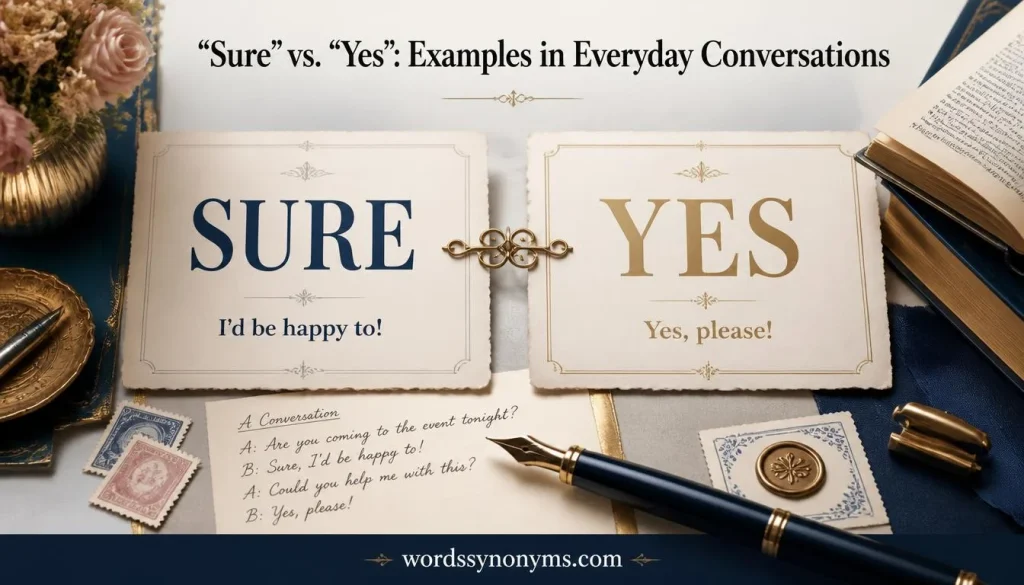
“Sure” vs. “Yes”: Examples in Everyday Conversations
Understanding definitions helps, but real conversations make the distinction easier to remember. The following examples show how both words work in common situations.
Responding to a Request
When someone asks you to do something, sure often communicates willingness. Yes can provide a more direct confirmation.
Example conversation:
Person A: “Could you help me carry these boxes?”
Person B: “Sure, where should I put them?”
Another possible response:
Person B: “Yes, I can help. Just give me a minute.”
Both answers are correct. However, the second explicitly confirms the person’s ability to help.
Accepting an Invitation
When accepting an invitation, either expression can sound natural.
Example conversation:
Person A: “Would you like to join us for dinner?”
Person B: “Sure, that sounds great!”
Another possible response:
Person B: “Yes, I’d love to join you.”
The first sounds relaxed and conversational. The second expresses acceptance with a little more warmth.
You can also add details to make your response more engaging.
For example:
- “Sure, what time should I arrive?”
- “Yes, I’d be delighted to come.”
Answering a Direct Question
When someone asks for factual information, yes usually provides the clearest answer.
Example conversation:
Person A: “Are you ready for the presentation?”
Person B: “Yes, I am.”
You could also respond:
Person B: “Sure, I’m ready.”
However, this version sounds less like a straightforward confirmation and more like conversational reassurance.
Another example:
Person A: “Did you submit your application?”
Person B: “Yes, I submitted it yesterday.”
Here, yes directly confirms the action. Simply saying sure wouldn’t provide the same clear answer.
Agreeing With a Suggestion
Both expressions work naturally when someone suggests a plan.
Example conversation:
Person A: “Let’s meet at 6 p.m. instead.”
Person B: “Sure, that works for me.”
Another possible response:
Person B: “Yes, 6 p.m. works perfectly.”
The first response sounds casual and agreeable. The second directly confirms the proposed time.
Confirming Information
When someone needs accurate information, yes generally works better.
Example conversation:
Person A: “Did you receive my email?”
Person B: “Yes, I received it this morning.”
A response such as “Sure” would sound unusual because the question asks for factual confirmation rather than willingness.
Consider another example:
Person A: “Is your appointment scheduled for Monday?”
Person B: “Yes, that’s correct.”
This response leaves little room for confusion.
Responding to an Offer
When someone offers you food, assistance, or another service, both words can communicate acceptance.
Example conversation:
Person A: “Would you like another slice of cake?”
Person B: “Sure, thank you!”
Another possible response:
Person B: “Yes, please.”
Both are polite. However, yes, please is a particularly clear way to accept an offer.
When Should You Use “Sure”?
Choose sure when you want to communicate willingness, casual agreement, or acceptance. It works especially well in everyday conversations where a relaxed tone feels appropriate.
Here are situations where sure sounds natural:
Accepting casual requests
When someone asks for a small favor, sure provides a friendly response.
Example: “Can you pass me the salt?” — “Sure!”
Agreeing with suggestions
Use sure when someone proposes an idea or activity you find acceptable.
Example: “Let’s watch a movie tonight.” — “Sure, why not?”
Accepting invitations
Sure works naturally when responding to casual invitations from friends or family.
Example: “Do you want to come shopping?” — “Sure, I’d love to.”
Showing willingness to help
When someone needs assistance, sure can communicate that you’re happy to cooperate.
Example: “Could you explain this exercise?” — “Sure, let’s work through it.”
Expressing confidence
Use sure when describing something you believe is certain.
Example: “I’m sure everything will be fine.”
When “Sure” Might Not Be the Best Choice
Although sure works in many situations, sometimes another response communicates your meaning more clearly.
Avoid relying on a standalone sure when:
- Someone needs a definite answer about an important decision.
- You’re confirming specific facts or information.
- A professional situation requires a precise commitment.
- Your response could sound hesitant without additional explanation.
- The question asks whether something actually happened.
For example, if your manager asks, “Did you complete the assignment?” responding with “Sure” sounds unclear.
A better answer would be:
“Yes, I completed it this morning.”
When Should You Use “Yes”?
Choose yes when you need to affirm something directly. It’s particularly useful for answering questions, confirming facts, and communicating agreement clearly.
Here are some common situations:
Answering direct questions
Yes provides an immediate affirmative response.
Example: “Do you understand the instructions?” — “Yes, I do.”
Confirming facts
Use yes when someone needs confirmation about information or an event.
Example: “Did the package arrive?” — “Yes, it arrived today.”
Communicating in professional settings
Yes works well during interviews, meetings, and workplace discussions.
Example: “Can you prepare the presentation?” — “Yes, I’ll have it ready tomorrow.”
Agreeing with someone’s opinion
Use yes when you want to express agreement with a statement.
Example: “This approach seems more practical.” — “Yes, I agree.”
Accepting offers politely
Yes becomes especially natural when combined with please or thank you.
Example: “Would you like some coffee?” — “Yes, please.”
When “Yes” Might Need Additional Words
Although yes is clear, a single-word response doesn’t always provide enough information.
For instance:
Person A: “Can you finish this today?”
Person B: “Yes.”
The answer confirms willingness or ability, but the other person might appreciate a specific commitment.
A more helpful response would be:
“Yes, I’ll finish it before the end of the day.”
Similarly, when accepting an invitation, you can make your answer warmer:
- “Yes, I’d love to.”
- “Yes, that sounds wonderful.”
- “Yes, thank you for inviting me.”
Adding a few words can make your response more personal and informative.
Read more: Can You End a Sentence With “For”? Rules, Usage and Examples
Can You Use “Sure” and “Yes” Interchangeably?
Yes, you can use sure and yes interchangeably in certain situations. Both expressions can communicate agreement, acceptance, or a positive response.
However, they aren’t interchangeable in every sentence.
Consider this example:
Person A: “Would you like to come with us?”
- Person B: “Sure!”
- Person B: “Yes!”
Both responses communicate acceptance.
Now consider another situation:
Person A: “Did you receive the invitation?”
- Person B: “Yes, I did.”
- Person B: “Sure.”
The first response correctly confirms the information. The second sounds unnatural because sure doesn’t directly answer the factual question.
Here’s another comparison:
| Situation | “Sure” | “Yes” |
| Accepting a casual invitation | Natural | Natural |
| Agreeing to help | Natural | Natural |
| Confirming a completed task | Usually unclear | Natural |
| Answering a factual question | Often unsuitable | Natural |
| Accepting a casual suggestion | Natural | Natural |
| Confirming an appointment | Less direct | Natural |
| Expressing certainty | Natural in “I’m sure” | Natural in an affirmative answer |
The important distinction: Use yes when you need direct affirmation. Choose sure when you want to express willingness or casual acceptance.
Common Mistakes to Avoid When Using “Sure” and “Yes”
Even though these words seem simple, their conversational differences can create confusion. Understanding a few common mistakes will help you choose more appropriate responses.
Treating both words as identical
Sure and yes overlap in meaning, but they don’t serve identical purposes.
For example, “Yes, I received your message” confirms an event. “Sure” usually doesn’t communicate that information clearly.
Assuming sure always expresses excitement
A simple sure doesn’t necessarily mean someone feels enthusiastic.
For example, “Sure, whatever” might communicate irritation rather than genuine agreement.
Thinking yes always sounds more polite
Politeness depends on the complete response, not one particular word.
Compare:
- “Sure, I’d be happy to help.”
- “Yes, whatever you say.”
The first sounds warmer, even though it uses sure.
Using sure when factual confirmation matters
If someone asks whether you submitted a report, give a direct answer.
Better: “Yes, I submitted it yesterday.”
Ignoring professional context
A short sure might sound too casual in certain formal exchanges. Consider using complete sentences when discussing important responsibilities.
Forgetting that tone changes meaning
A cheerful sure can sound welcoming. A flat response might suggest reluctance. Pay attention to delivery before interpreting someone’s intention.

“Sure” vs. “Yes”: Quick Comparison Table
The following table summarizes the most important differences between these expressions.
| Feature | Sure | Yes |
| Basic meaning | Certain, willing, or agreeable | Affirmative or positive |
| Main purpose | Expressing willingness or acceptance | Confirming or affirming |
| Common grammatical role | Adjective; informal response | Adverb or interjection |
| Conversational tone | Often casual and friendly | Direct, neutral, or enthusiastic |
| Formality | Common in informal conversations | Appropriate in formal and informal settings |
| Typical use | Accepting requests and suggestions | Answering direct questions |
| Certainty | “I’m sure.” | “Yes, that’s correct.” |
| Accepting an invitation | “Sure, I’d love to.” | “Yes, I’d love to.” |
| Confirming information | Sometimes unclear | Usually clear |
| Example | “Sure, I can help.” | “Yes, I can help.” |
FAQs
1. Is “Sure” the Same as “Yes”?
Not exactly. Both words express agreement, but they have slightly different tones. Yes gives a direct answer, while Sure sounds more relaxed and conversational.
2. Is “Sure” More Polite Than “Yes”?
It depends on the situation and your tone. Sure can sound friendly and welcoming, while Yes often sounds more neutral and straightforward. Both are polite when used appropriately.
3. Can I Use “Sure” in Professional Conversations?
Yes. You can use Sure when responding to colleagues, accepting requests, or agreeing to simple tasks. However, Yes may be better when you need a formal or precise response.
4. Should I Use “Sure” or “Yes” in Formal Writing?
Yes is generally the safer choice in formal writing, official emails, and business documents. Sure works better in friendly messages and informal workplace conversations.
5. Does Saying “Sure” Sound Less Confident Than “Yes”?
Not necessarily. Sure can communicate willingness and confidence, especially in casual conversations. However, Yes often sounds more decisive when confirming an important decision.
6. What Are Some Natural Alternatives to “Sure” and “Yes”?
You can use several expressions depending on the situation. Some natural alternatives include Absolutely, Of course, Certainly, Definitely, Agreed, and That works for me. Each expression communicates agreement with a slightly different tone.
Conclusion
Choosing between “Sure” and “Yes” may seem like a small decision, but it can change how your message sounds. Yes works well when you want to give a direct, clear, and confident answer. On the other hand, Sure adds a friendly, relaxed touch to everyday conversations. Neither word is automatically better or more polite. Your relationship with the listener, the situation, and the level of formality all matter. Understanding these differences helps you avoid awkward replies and communicate more naturally.
Before choosing either expression, think about what you want your response to convey. Use Yes for clear confirmations, formal replies, and important decisions. Choose Sure when you want to sound approachable and willing to help. You don’t need complicated grammar rules to make the right choice. Simply pay attention to your audience and the context. With regular practice, you’ll know when each word fits and use both expressions confidently in personal and professional conversations.

Franklin Hayes is a writer and editor at WordsConfusing.com, focused on making English vocabulary, grammar, and commonly confused words easy to understand. He writes clear, practical articles with simple explanations and useful examples to help readers improve their English with confidence.
His goal is simple: Making Confusing Words Simple.