
The article “Can You End a Sentence With “For”? Rules, Usage and Examples” explains when ending a sentence with this preposition sounds natural.
In modern English grammar, ending a sentence with for is acceptable, although some traditional grammar rules discourage this practice. A preposition doesn’t always need to appear in the middle of a sentence.
Its prepositional usage depends on how you arrange words to express complete thoughts. Both beginning a sentence with for and ending a sentence with for can work in all kinds of cases, depending on the intended meaning. Unders
tanding how prepositions work helps you recognize correct usage, preposition placement, and natural sentence formation. In everyday conversations and written examples, ending sentences with prepositions is common in natural English.
For instance, “What are you waiting for?” is a grammar example of a complete question with for at the end. This grammatical construction follows modern language rules, not outdated writing rules.
Once you understand these patterns, you’ll find it easier to recognize the answers to common questions about sentence beginnings, sentence endings, and the English language.
Quick Answer
Yes, you can end a sentence with “for” when it works as a preposition. Sentences like “Who is this gift for?” and “What are you looking for?” are grammatically correct. The old rule against ending sentences with prepositions isn’t a strict rule in modern English. Just make sure your sentence sounds natural and communicates a clear meaning.
Can You End a Sentence With “For”?
Yes, you can end a sentence with “for” when it functions as a preposition. English grammar permits this structure, even though some traditional writing advice discourages it. You can use sentence-ending prepositions in questions, statements, and relative clauses.
Consider these examples:
- What are you looking for?
- Who did you buy this gift for?
- This is the opportunity I’ve been waiting for.
- That’s exactly what I asked for.
- What purpose was this tool designed for?
- Is this the person you were speaking for?
Each sentence places “for” at the end. Nevertheless, every example communicates a complete and understandable thought.
The reason is simple: the object associated with the preposition appears earlier in the sentence. For example, in “Who is this present for?” the word “who” represents the person receiving the present.
The preposition doesn’t need to appear immediately before its object. English allows speakers to separate prepositions from their objects in certain constructions. Grammarians call this practice preposition stranding.
This construction appears frequently in everyday English. It also occurs in professional communication and established literary writing.
The important rule: Ending a sentence with “for” isn’t automatically incorrect. What matters is its grammatical function and the sentence’s overall structure.
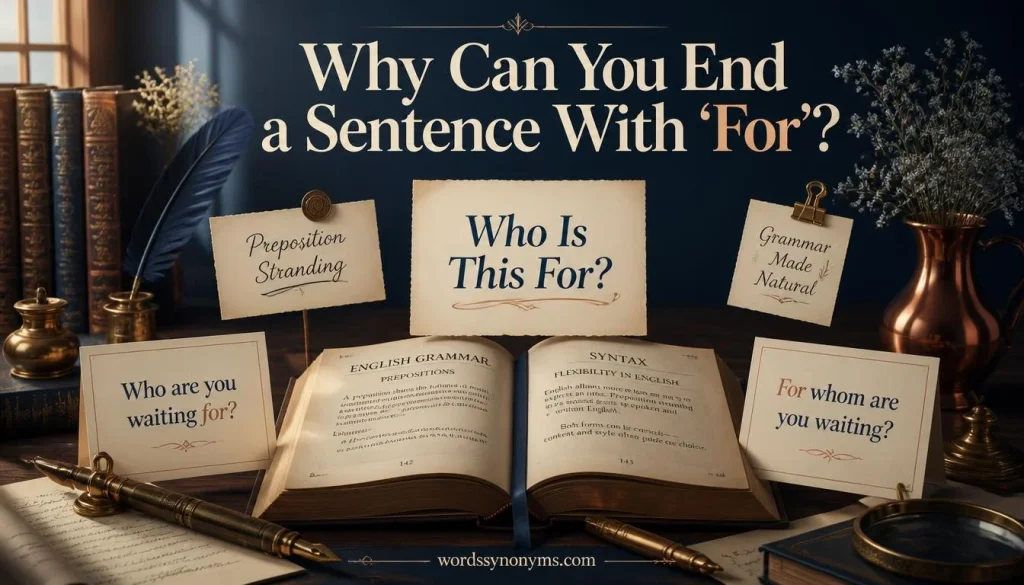
Why Can You End a Sentence With “For”?
The English language doesn’t require every preposition to appear directly before its object. Although prepositions usually introduce nouns or pronouns, certain sentence structures allow them to remain at the end.
This flexibility makes questions and statements sound more natural. It also allows writers to emphasize information without creating unnecessarily complicated sentences.
For example, consider these two questions:
- Natural: Who is this package for?
- Formal: For whom is this package intended?
Both sentences are grammatically correct. However, their tone and structure differ.
The first question sounds conversational and direct. You might use it when asking about a delivery or checking someone’s belongings. The second sounds more formal and may suit a business letter or official conversation.
Moving a preposition to the beginning doesn’t automatically improve a sentence. Sometimes, it makes ordinary communication unnecessarily stiff.
Understanding Preposition Stranding
Preposition stranding happens when a preposition appears separately from its object, usually toward the end of a clause.
This structure commonly occurs when a question word or relative pronoun moves to the beginning.
For example:
- What are you searching for?
- Which organization does she work for?
- That’s the house I told you about.
- This is the friend I traveled with.
Notice how the prepositions appear at the ends of their respective clauses. Their objects appear earlier through words such as what, which, and friend.
This arrangement doesn’t create a grammatical error. Instead, it follows a recognized pattern in English sentence construction.
Preposition stranding also explains why certain sentences sound awkward when rewritten. Compare these examples:
| Natural Construction | More Formal Construction |
| Who are you waiting for? | For whom are you waiting? |
| What are you looking for? | For what are you searching? |
| Who did you write this letter for? | For whom did you write this letter? |
| That’s the person I voted for. | That’s the person for whom I voted. |
The formal versions are grammatically possible. However, the natural versions usually work better in everyday communication.
When Is It Grammatically Correct to End a Sentence With “For”?
You can end a sentence with “for” in several grammatical situations. The most common examples involve questions, relative clauses, and expressions where the preposition connects an earlier word to the rest of the sentence.
Understanding these situations helps you recognize correct usage.
When “For” Functions as a Preposition
The word “for” commonly functions as a preposition that expresses purpose, intended recipients, benefits, support, or reasons.
When its object appears earlier in a sentence, the preposition can remain at the end.
Consider these examples:
- Who is this birthday card for?
- What did you purchase these supplies for?
- This is the project I’ve been preparing for.
- That’s the organization she volunteers for.
- Which team are you playing for?
In the first example, who identifies the intended recipient. The preposition for connects that person to the birthday card.
Similarly, the word what represents the purpose in the second question. The sentence remains complete even though the preposition appears last.
You can also use this construction in statements.
For example:
- This is the cause I stand for.
- That’s the responsibility I signed up for.
- She finally found the opportunity she had hoped for.
In each example, the preposition connects the final part of the sentence with information introduced earlier.
When “For” Appears in Questions
Questions frequently end with prepositions because English naturally places question words at the beginning.
This structure allows speakers to ask direct questions without changing their ordinary sentence patterns.
Here are several examples:
- What are you waiting for?
- Who are you working for?
- What is this machine used for?
- Who did you prepare dinner for?
- What are these instructions for?
- Which position did you apply for?
These questions are grammatically correct because “for” functions as a preposition.
You can also rewrite them using more formal structures. However, the alternatives sometimes sound less natural.
For example:
Conversational: What are you waiting for?
Formal: For what are you waiting?
The second construction is grammatically possible but uncommon in ordinary conversation. Most English speakers naturally choose the first version.
When “For” Appears in Relative Clauses
Relative clauses provide another common situation where you can end a sentence with “for.”
A relative clause adds information about a person, place, thing, or idea. It often begins with a relative pronoun such as who, which, or that.
Sometimes, the relative pronoun appears before the preposition that belongs with it.
Consider these examples:
- This is the cause I stand for.
- She finally received the position she applied for.
- That’s the person I was speaking for.
- This is the result we’ve been hoping for.
- He found the opportunity he had been searching for.
Each sentence contains a relative clause that provides additional information.
Take this example:
She finally received the position she applied for.
The phrase she applied for describes the position. The word position serves as the object associated with the final preposition.
You could rewrite the sentence as:
She finally received the position for which she had applied.
Both versions are grammatically correct. The first sounds more conversational while the second has a more formal tone.
One detail matters here: the preposition must express the intended relationship. You shouldn’t add “for” merely to make a sentence sound more sophisticated or conversational.
Read more: 6 Good Synonyms for “Kill Two Birds With One Stone”
When Should You Avoid Ending a Sentence With “For”?
Although ending a sentence with “for” is grammatically acceptable in many situations, it doesn’t work everywhere. You must consider the word’s grammatical function before deciding where it belongs.
The biggest distinction involves its use as a preposition versus a coordinating conjunction. These two functions follow different grammatical rules.
When “For” Is a Coordinating Conjunction
The word “for” can function as a coordinating conjunction that introduces a reason or explanation. In this role, it has a meaning similar to because or since.
A coordinating conjunction connects two independent clauses. The second clause explains or provides a reason for the first.
For example:
- I stayed home, for I wasn’t feeling well.
- She brought an umbrella, for the weather forecast predicted rain.
- He couldn’t attend the meeting, for he had another appointment.
- They left early, for the journey would take several hours.
In these sentences, “for” introduces a complete clause that explains the preceding statement.
Unlike prepositional “for,” this conjunction doesn’t introduce a noun or pronoun as its object. Instead, it connects two complete thoughts.
You shouldn’t simply leave this coordinating conjunction at the end without the clause it introduces.
Consider the following comparison:
| Sentence | Correct or Incorrect | Explanation |
| I stayed home, for I felt sick. | Correct | “For” introduces a reason. |
| She left early, for she felt tired. | Correct | Both clauses are complete. |
| I stayed home, for. | Incorrect | The conjunction introduces no explanation. |
| He bought flowers, for. | Incorrect | The required explanatory clause is missing. |
The distinction is straightforward. A preposition can appear at the end when its object appears earlier. A coordinating conjunction introduces another clause instead.
Remember: The grammatical role of for matters more than its position alone.
When the Sentence Sounds Awkward or Unclear
Sometimes, a sentence can follow an acceptable grammatical pattern but still sound awkward. Good writing requires more than following technical grammar rules.
You should also consider readability, meaning, and the relationship between different words.
For example:
Awkward: The issue is something I have concerns for.
Better: I have concerns about the issue.
The first sentence uses an unsuitable preposition for the intended meaning. Changing the construction makes the relationship clearer.
Consider another example:
Awkward: The person I have been waiting for has arrived.
Better: The person I’ve been waiting for has arrived.
Here, the first sentence isn’t grammatically incorrect. However, the contraction makes the second version sound more natural in conversational writing.
You don’t need to eliminate every sentence-ending preposition. Instead, revise constructions that create genuine confusion or unnecessary wordiness.
Watch for these problems:
- Unclear relationships: Make sure readers understand which noun or pronoun the preposition connects to.
- Incorrect prepositions: Choose the preposition that expresses your intended meaning.
- Unnecessary formality: Don’t rearrange natural questions simply to avoid ending with a preposition.
- Incomplete constructions: Ensure the sentence contains all the information needed to communicate its meaning.
- Poor readability: Rewrite sentences when their structure distracts readers from the message.
The goal isn’t to avoid prepositions at the end. It’s to make every sentence clear and grammatically sound.
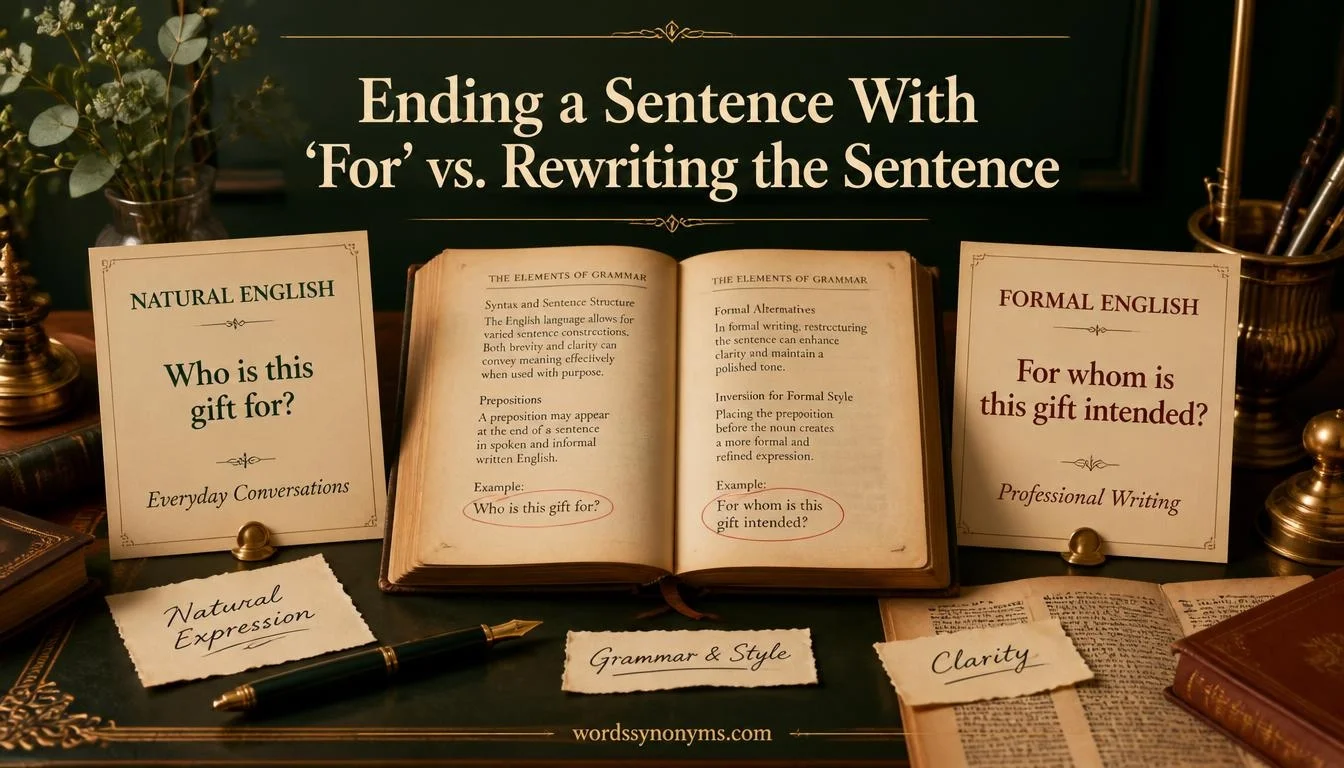
Ending a Sentence With “For” vs. Rewriting the Sentence
English gives you more than one way to express the same idea. Sometimes, you can leave “for” at the end. Other times, you can move it toward the beginning without changing the basic meaning.
Both approaches have their place. The best choice depends on your audience, purpose, and writing style.
Consider these examples:
| Sentence Ending With “For” | Alternative Construction |
| Who is this gift for? | For whom is this gift intended? |
| What are you looking for? | For what are you searching? |
| That’s the person I voted for. | That’s the person for whom I voted. |
| What are you saving money for? | For what purpose are you saving money? |
| This is the opportunity I’ve been waiting for. | This is the opportunity for which I’ve been waiting. |
| Who did you prepare this meal for? | For whom did you prepare this meal? |
Notice how the alternative constructions often sound more formal. They also tend to use more words.
However, the original sentences aren’t inferior. They follow accepted English grammar and often communicate ideas more efficiently.
When Should You Keep “For” at the End?
Keep the preposition at the end when it makes your sentence sound natural and clear.
This approach works particularly well in:
- Everyday conversations.
- Friendly emails and messages.
- Direct questions.
- Informal articles and blog posts.
- Most general-audience writing.
- Sentences containing relative clauses.
For example, asking “Who is this present for?” sounds natural and direct.
Rewriting it as “For whom is this present intended?” adds formality without providing much additional information.
Unless your context requires a formal tone, the shorter version usually communicates better.
When Should You Move “For” to the Beginning?
Moving “for” toward the beginning can suit formal writing or a specific sentence structure.
For example:
- Conversational: Who did you arrange the meeting for?
- Formal: For whom did you arrange the meeting?
The second version places greater emphasis on formal grammatical structure.
You might encounter similar constructions in academic discussions, official correspondence, or carefully edited prose.
However, don’t assume that moving a preposition automatically makes your writing more professional. Readers generally value clear and natural language more than unnecessary formality.
Is Ending a Sentence With “For” Formal or Informal?
Ending a sentence with “for” isn’t automatically informal. The construction is grammatically acceptable in both conversational and formal English.
Its suitability depends on the sentence, audience, and communication style.
For example, consider this question:
Who is this report for?
You can comfortably use it in a workplace conversation or professional email. It sounds direct and doesn’t create any grammatical problems.
Now compare it with:
For whom is this report intended?
This version sounds more formal. It may suit an official document or a formal presentation.
Neither construction is inherently incorrect. They simply create different impressions.
Here’s how sentence-final “for” works across different writing situations:
| Writing Situation | Example | Suitability |
| Everyday conversation | What are you waiting for? | Natural |
| Friendly email | Who is this message for? | Natural |
| Workplace communication | Which department is this proposal for? | Appropriate |
| Academic writing | This is the principle the research argues for. | Appropriate |
| Formal correspondence | For whom is this document intended? | Formal alternative |
Academic and professional writing doesn’t require you to avoid every final preposition. Modern English accepts preposition stranding when the construction is grammatically appropriate.
Nevertheless, certain institutions, style guides, or editors may prefer a more formal construction. Following a specific publication’s style requirements is sensible when those requirements apply.
The practical lesson is simple: Choose the construction that communicates your meaning clearly while matching your audience.
Why Do Some People Say You Shouldn’t End a Sentence With a Preposition?
The belief that sentences shouldn’t end with prepositions comes from traditional grammar teaching. Many students encounter this rule in school, where teachers encourage writers to place prepositions before their objects.
However, this advice doesn’t reflect every accepted English sentence structure.
One historical influence came from grammarians who admired Latin grammatical patterns. Latin generally handles prepositions differently because its sentence structure doesn’t allow the same kind of preposition stranding found in English.
Some traditional grammar authorities therefore encouraged English writers to avoid ending sentences with prepositions.
However, English and Latin don’t follow identical grammatical systems. A rule that fits one language doesn’t automatically work for another.
English speakers have long used sentence-final prepositions in ordinary speech and writing. Questions such as “What are you talking about?” demonstrate how naturally this structure works.
Consider these familiar examples:
- Who are you going with?
- What are you interested in?
- Which topic are you writing about?
- What are you waiting for?
Trying to eliminate every final preposition would force speakers into unnecessarily complicated sentences.
For example:
Natural: What are you talking about?
Unnatural in everyday conversation: About what are you talking?
The second version changes the sentence structure and sounds unusual to most modern English speakers.
The traditional advice can still encourage careful editing. However, it shouldn’t become an absolute rule that prevents natural and grammatically correct expression.
Common Mistakes When Ending a Sentence With “For”
Understanding the basic rule is helpful. Recognizing common mistakes makes it easier to apply that knowledge in your own writing.
Here are several errors worth avoiding.
Confusing Prepositional “For” With Conjunction “For”
This is one of the most important distinctions.
Prepositional “for” can appear at the end when its object appears earlier. Conjunction “for” introduces an explanatory independent clause.
Compare:
- Correct: What is this money for?
- Correct: I saved the money, for I needed a new laptop.
- Incorrect: I saved the money, for.
The first example uses a preposition. The second uses a coordinating conjunction. The third leaves the conjunction without its explanatory clause.
Assuming Every Sentence-Ending Preposition Is Incorrect
Some writers still avoid final prepositions because of traditional grammar advice.
However, that approach can produce stiff or unnatural sentences.
For example:
Natural: Who are you working for?
Overly formal: For whom are you working?
The formal version is grammatically correct. Nevertheless, the conversational version is more common in everyday English.
Don’t mistake a traditional preference for a universal grammatical requirement.
Using the Wrong Preposition
Not every sentence becomes correct simply because it ends with “for.”
The preposition must match the intended relationship.
For example:
- Correct: Who did you buy this gift for?
- Incorrect for the intended meaning: Who did you buy this gift about?
The first question asks about the recipient. The second uses a preposition that doesn’t express that relationship.
Always check whether the selected preposition communicates the right meaning.
Creating Unnecessarily Complicated Sentences
Some writers move prepositions to the beginning simply to sound more formal.
However, this can make ordinary questions harder to read.
For example:
Natural: What are you looking for?
Less conversational: For what are you searching?
The second sentence isn’t necessarily wrong. However, it may sound overly formal in an everyday conversation.
Choose straightforward wording unless your context calls for a more formal style.
Leaving the Sentence Incomplete
A sentence-ending preposition doesn’t excuse missing grammatical information.
For example:
Incomplete: That’s the reason I was looking.
Complete: That’s the reason I was looking for.
The second sentence expresses the intended meaning when the speaker refers to something being sought.
However, context matters. The first sentence can also be complete if looking means watching or observing.
This example shows why you must consider meaning rather than judging individual words in isolation.
Examples of Sentences Ending With “For”
Examples make grammar rules easier to understand because they show how words work in real situations. The following sentences demonstrate several ways to end a sentence with “for” correctly.
| Example Sentence | Explanation |
| Who is this birthday cake for? | “For” identifies the intended recipient. |
| What are you searching for? | “For” connects to the question word “what.” |
| This is the book I asked for. | “For” belongs to the relative clause. |
| Who did you make this invitation for? | “For” identifies the intended recipient. |
| That’s exactly what I’ve been hoping for. | “For” completes the expression “hoping for.” |
| Which company do you work for? | “For” connects the question to the employer. |
| Is this the position you applied for? | “For” completes the expression “applied for.” |
| What are these keys for? | “For” asks about the keys’ purpose. |
| That’s the cause she has always fought for. | “For” expresses support for a cause. |
| Who are these flowers for? | “For” identifies the intended recipient. |
| This is the opportunity we’ve waited for. | “For” completes the phrase “waited for.” |
| What did you buy those materials for? | “For” asks about their purpose. |
More Examples in Everyday Conversations
You can also encounter sentence-final “for” in ordinary exchanges. These examples show how naturally the construction fits different situations.
At home:
- “Who is this sandwich for?”
- “What did you make that special meal for?”
- “Is this the charger you were looking for?”
At work:
- “Which client is this proposal for?”
- “What position did you apply for?”
- “Is this the department you work for?”
While shopping:
- “What is this discount coupon for?”
- “Who did you purchase this gift for?”
- “Is this the size you asked for?”
During everyday conversations:
- “What are you waiting for?”
- “Who are you rooting for?”
- “What’s that unusual noise coming from the room for?”
The last example is awkward without additional context, so a clearer alternative would be: “Why is that unusual noise coming from the room?” This illustrates why natural phrasing matters alongside grammatical correctness.

A Practical Case Study: Choosing Between Sentence Structures
Imagine you’re writing an email to a colleague about a new company presentation. You want to ask who will receive the document.
You have two possible sentences:
Option A: Who is this presentation for?
Option B: For whom is this presentation intended?
Both options are grammatically correct. However, they create slightly different tones.
Option A sounds direct and approachable. It works well in everyday workplace communication.
Option B sounds more formal and carefully structured. It may suit official correspondence or a formal report.
Now consider a different situation. You’re writing an academic paper about an organization that supports environmental protection.
You might write:
The organization promotes the environmental principles it stands for.
This sentence ends with “for” because the preposition belongs to the relative clause it stands for. Rewriting it as the environmental principles for which it stands is possible, but it may sound unnecessarily formal.
The lesson from both examples is straightforward:
- Use natural preposition placement when it improves readability.
- Choose formal alternatives when your audience or context requires them.
- Don’t change correct sentences simply because they end with prepositions.
- Always check that the preposition expresses the intended relationship.
How to Check Whether Ending a Sentence With “For” Is Correct
When you’re unsure about a sentence, a few simple checks can help you make the right decision.
Start by identifying the grammatical role of “for.” Ask yourself whether it introduces a noun or pronoun as a preposition or connects two independent clauses as a conjunction.
Next, check whether the sentence communicates a complete thought. If the preposition’s object appears earlier, the construction may be perfectly acceptable.
Use these practical steps:
- Identify the function: Determine whether “for” acts as a preposition or coordinating conjunction.
- Check the object: If it’s a preposition, identify the noun or pronoun associated with it.
- Read the sentence aloud: Natural phrasing often becomes easier to recognize when spoken.
- Check the meaning: Make sure the preposition expresses the relationship you intend.
- Consider your audience: Choose conversational or formal wording according to the situation.
- Avoid unnecessary changes: Don’t rewrite a grammatically correct sentence just to move its final preposition.
For example, consider this question:
What are you preparing for?
The word what represents the event, situation, or purpose. The preposition for connects that idea to the action of preparing.
The construction is natural and grammatically acceptable.
However, if you write:
I prepared everything, for.
You’ve used the conjunction incorrectly because you haven’t supplied the explanatory clause.
A simple grammatical check can prevent this mistake.
Read more: 3 Terms for Asking a Question You Already Know the Answer To
FAQs
1. Is it grammatically correct to end a sentence with “for”?
Yes, ending a sentence with for is grammatically acceptable. Modern English allows prepositions at the end when they make sentences sound natural and clear.
2. Why do some people say you shouldn’t end a sentence with “for”?
This belief comes from traditional grammar rules that discourage ending sentences with prepositions. However, modern English recognizes that this structure is perfectly acceptable.
3. Can you start a sentence with the word “for”?
Yes, you can begin a sentence with for. It can function as a conjunction meaning “because” or appear in other grammatical constructions, depending on the context.
4. What is an example of ending a sentence with “for”?
A common example is, “What are you waiting for?” The preposition for appears at the end because it connects the question to the thing someone expects.
5. Is ending a sentence with a preposition informal?
Not necessarily. People use this structure in everyday conversations, professional writing, and published works. What matters most is clarity and natural sentence flow.
6. Should you avoid ending sentences with prepositions in formal writing?
No, you don’t need to avoid them automatically. However, if rewriting makes a sentence clearer without making it awkward, you can choose that alternative.
Conclusion
Ending a sentence with for isn’t a grammar mistake. Modern English allows you to place prepositions at the end when the sentence sounds natural and communicates your meaning clearly. Questions like “What are you waiting for?” show how easily this structure fits everyday communication. You don’t need to rearrange every sentence just to satisfy outdated grammar advice. Instead, focus on clarity, meaning, and proper sentence structure.
Whether you’re writing a casual message, an email, or a formal article, let readability guide your choices. Pay attention to how for connects different parts of your sentence. If moving the preposition makes your wording awkward, keep it where it sounds right. Good grammar isn’t about following rigid rules blindly. It’s about expressing your thoughts in clear, natural, and understandable English.

Franklin Hayes is a writer and editor at WordsConfusing.com, focused on making English vocabulary, grammar, and commonly confused words easy to understand. He writes clear, practical articles with simple explanations and useful examples to help readers improve their English with confidence.
His goal is simple: Making Confusing Words Simple.