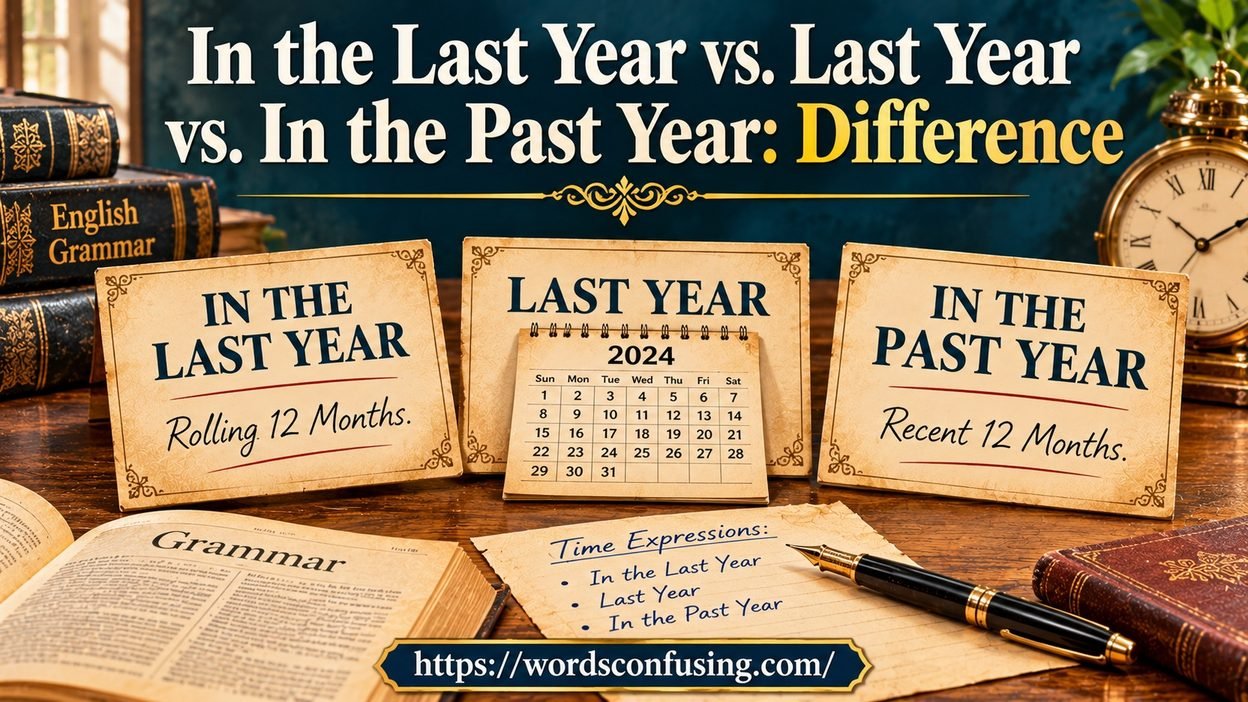
In the Last Year vs. Last Year vs. In the Past Year: Difference explains how each phrase describes a time frame in clear, accurate English.
Choosing the right expression becomes easier when you consider the period you’re discussing. “Last year” usually identifies a completed calendar year, whereas “in the last year” and “in the past year” generally refer to the previous twelve months.
This language distinction matters in formal writing, informal writing, and everyday communication. It also improves word choice, grammatical accuracy, and contextual meaning in email messages and professional documents.
In professional settings, business communication, and project management, accurate time references help maintain consistency. Whether you’re preparing a report, examining performance reviews, conducting data analysis, or identifying trends, clear dates, durations, and timelines matter.
The same applies to broadcasting, online booking, calendar management, meetings, and scheduling. Paying attention to chronological accuracy, timeline clarity, and the reporting period helps readers understand your message.
Consider the context, sentence structure, and time duration before selecting an appropriate phrase. Through practical examples, this article explains the key differences, addresses common mistakes, and demonstrates the best usage of these expressions. These skills also support better document preparation and written communication, whether you’re discussing an annual period, the previous year, the current year, or results recorded year-to-date.
Quick Answer
- In the last year: Refers to something that happened during the most recent 12 months. For example, “I’ve learned several new skills in the last year.”
- Last year: Refers to the previous calendar year. For example, “I visited California last year.”
- In the past year: Usually refers to the same rolling 12-month period as “in the last year.” For example, “Our company has hired 15 new employees in the past year.”
The simplest rule: Use last year when you mean the previous calendar year. Use in the last year or in the past year when you mean the most recent 12 months.
What Is the Difference Between “In the Last Year,” “Last Year,” and “In the Past Year”?
Although these expressions share similar words, their time references differ. The important question is whether you’re talking about a calendar year or a period measured backward from now.
Let’s examine each expression.
In the Last Year
“In the last year” generally refers to the 12 months immediately preceding the present moment or another established reference point.
It doesn’t necessarily mean January through December. Instead, the period moves forward as time passes.
For example:
- I’ve visited three different countries in the last year.
- Our business has grown significantly in the last year.
- She has completed several professional courses in the last year.
Each sentence describes an experience or development within a recent 12-month period.
Last Year
“Last year” generally refers to the calendar year immediately before the current year.
For example, if the current year is 2026, last year means 2025. The expression doesn’t normally describe the previous 12 months from today’s date.
Consider these examples:
- I graduated from college last year.
- We moved into our new house last year.
- The company opened two additional offices last year.
These sentences refer to events that happened during the previous calendar year.
In the Past Year
“In the past year” usually describes the 12 months leading up to the present or another reference point.
It often emphasizes recent progress, developments, experiences, and changes.
For example:
- I’ve improved my writing skills in the past year.
- The company has expanded its services in the past year.
- Several important changes have occurred in the past year.
In most everyday situations, you can use “in the past year” and “in the last year” interchangeably.
Comparison Table
| Expression | Meaning | Typical Time Reference |
| In the last year | During the preceding 12 months | Rolling 12-month period |
| Last year | During the previous calendar year | Previous January–December |
| In the past year | During the preceding 12 months | Rolling 12-month period |
The distinction becomes particularly important when your sentence includes a specific date or reporting period.
When to Use “In the Last Year”
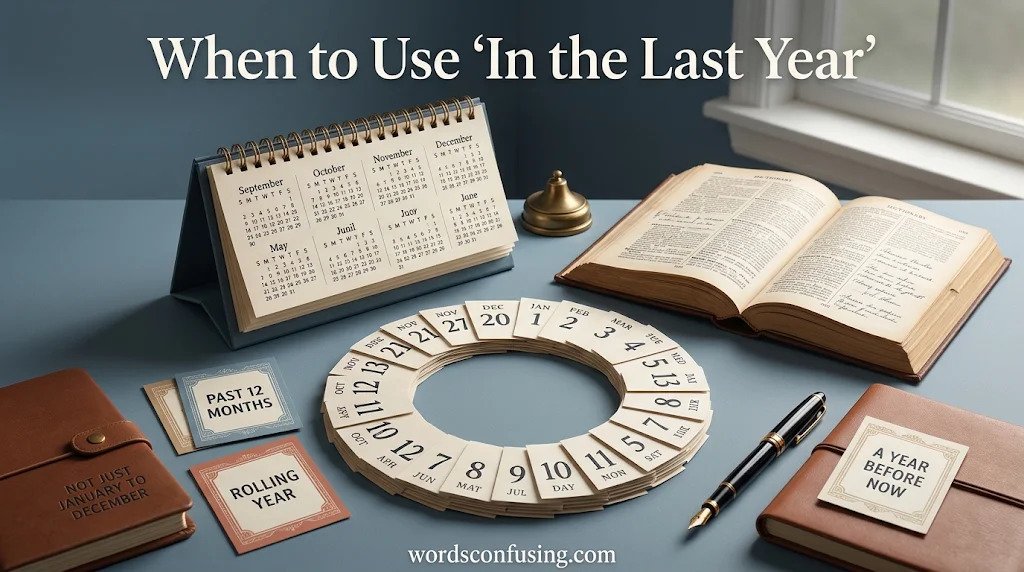
Use “in the last year” when discussing something that happened during the 12 months immediately before your reference point.
This expression works particularly well when describing recent experiences, personal achievements, business growth, and ongoing changes.
Meaning and Usage of “In the Last Year”
The phrase combines the preposition in with the time expression the last year.
Here, the last year generally identifies a period extending backward from the present. It doesn’t automatically follow the January-to-December calendar.
For example, imagine today is November 14, 2026.
The last year generally covers November 14, 2025, through November 14, 2026.
If you say:
“I’ve traveled to four countries in the last year.”
You’re referring to trips taken during that recent 12-month period.
The exact starting date depends on the reference point. If someone discusses the last year from a date in March, the period begins around the previous March.
Examples of “In the Last Year” in Sentences
Here are several examples showing how this expression works in different situations.
- Personal development: I’ve learned three new languages in the last year.
- Education: She has completed four professional courses in the last year.
- Business: Our company has gained 500 new customers in the last year.
- Travel: We have visited several European cities in the last year.
- Technology: The software has received multiple updates in the last year.
- Employment: He has changed jobs twice in the last year.
- Health and fitness: I’ve become much stronger in the last year.
- Personal relationships: They’ve spent more time together in the last year.
Notice that these examples describe developments within a recent period rather than one completed calendar year.
Is “In the Last Year” Always a Rolling 12-Month Period?
Not necessarily. Context can change how readers understand the expression.
In ordinary conversation, “in the last year” generally refers to the previous 12 months. However, a writer might use it when discussing a particular reporting period or another established timeframe.
For example:
“Our department introduced several improvements in the last year of the project.”
Here, the phrase refers to the project’s final year rather than the 12 months preceding today.
Similarly:
“She accomplished remarkable things in the last year of her career.”
The reference point is the final year of her career.
Therefore, always consider the surrounding sentence. The phrase usually describes a rolling period, but its reference point can depend on context.
When to Use “Last Year”
Use “last year” when referring to the calendar year immediately before the current one.
This expression is common in everyday conversations, professional communication, academic writing, and news reports.
Meaning and Usage of “Last Year”
Unlike “in the last year,” this expression normally identifies a completed calendar year.
For example, if you’re speaking in November 2026, last year means 2025.
The expression doesn’t automatically include the most recent 12 months.
Consider this example:
“I bought my first car last year.”
If you’re speaking in November 2026, the sentence refers to a purchase made sometime during 2025.
It doesn’t mean you bought the car within the 12 months immediately before November 2026.
This distinction matters when you discuss achievements, historical events, business performance, or completed activities.
Examples of “Last Year” in Sentences
Here are some practical examples:
- Education: I graduated from university last year.
- Travel: We visited New York last year.
- Employment: She started her new job last year.
- Business: The company launched its latest product last year.
- Personal achievements: He won a national competition last year.
- Family: My parents celebrated their 30th wedding anniversary last year.
- Technology: The organization introduced a new security system last year.
- Entertainment: That movie became popular last year.
Each example refers to an event that occurred during the previous calendar year.
Does “Last Year” Always Mean the Previous Calendar Year?
In standard everyday usage, yes. “Last year” normally means the calendar year before the current one.
However, the surrounding context can establish a different reference period.
For example:
“During the last year of university, I completed two internships.”
Here, the last year means the final academic year, not necessarily the previous calendar year.
Another example:
“During his last year at the company, he managed several major projects.”
This sentence identifies the final year of his employment.
Notice the difference between these constructions:
- Last year: Usually the previous calendar year.
- The last year: The final year of a particular period or sequence, depending on context.
- In the last year: Usually the preceding 12 months.
That small article, the, can help establish the intended meaning.
Read more: 15 Best Replies to “You’re Mine” Funny and Confident
When to Use “In the Past Year”
Use “in the past year” when describing events, experiences, or developments during the preceding 12 months.
This expression often appears in reports, professional discussions, research summaries, and personal conversations.
Meaning and Usage of “In the Past Year”
The phrase identifies a period extending backward from a particular reference point.
Unlike “last year,” it doesn’t normally refer to the previous January-to-December calendar year.
For example:
“Our website traffic has increased by 35% in the past year.”
This sentence describes growth during the preceding 12 months. It doesn’t necessarily mean the growth occurred between January and December.
The expression is especially useful when discussing:
- Recent achievements and accomplishments.
- Business growth and financial performance.
- Changes in technology and customer behavior.
- Personal development and learning.
- Research findings and recent discoveries.
- Social and economic developments.
Because it emphasizes a recent period, it works naturally with sentences about progress and change.
Examples of “In the Past Year” in Sentences
Consider these examples:
- Personal development: I’ve become more confident in the past year.
- Education: She has improved her academic performance in the past year.
- Business: The company has expanded into three new markets in the past year.
- Technology: Artificial intelligence tools have become more accessible in the past year.
- Employment: He has gained valuable management experience in the past year.
- Travel: We’ve explored several new destinations in the past year.
- Writing: My writing skills have improved considerably in the past year.
- Customer service: The business has received more positive reviews in the past year.
These examples focus on developments within a recent 12-month period.
Is “In the Past Year” Different From “In the Last Year”?
In most situations, “in the past year” and “in the last year” mean essentially the same thing.
Both expressions generally describe the 12 months immediately preceding a reference point.
For example:
- I’ve read 20 books in the last year.
- I’ve read 20 books in the past year.
Both sentences communicate that the speaker read 20 books during the preceding 12 months.
The difference is usually stylistic rather than grammatical.
However, some writers prefer “in the past year” because it sounds natural in formal reports and summaries. Others use “in the last year” in everyday conversations.
Neither expression is inherently more correct.
Choose the version that sounds natural and communicates your intended timeframe clearly.
“In the Last Year” vs. “Last Year”: Key Differences
The most important distinction involves the period each expression describes.
Although both contain the word year, they don’t necessarily identify the same dates.
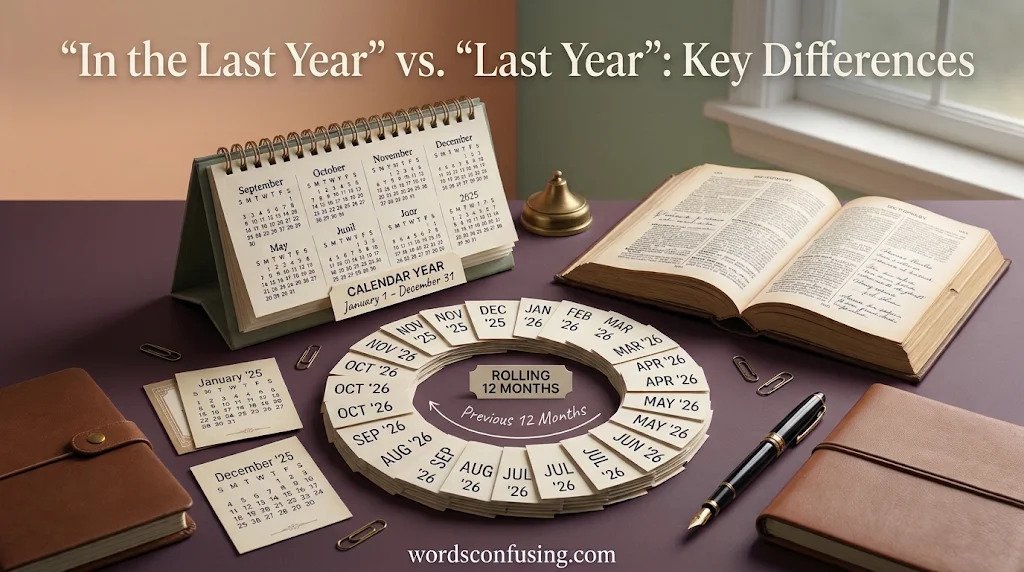
Calendar Year vs. Rolling 12-Month Period
A calendar year begins on January 1 and ends on December 31.
A rolling 12-month period moves forward with the reference date.
For example, assume someone makes a statement on November 14, 2026.
- Last year: January 1 through December 31, 2025.
- In the last year: Approximately November 14, 2025, through November 14, 2026.
This difference becomes easier to understand with practical examples.
Example One:
“I started learning Spanish last year.”
This means the person started learning Spanish sometime during 2025.
Example Two:
“I’ve practiced Spanish regularly in the last year.”
This describes regular practice during the 12 months preceding November 14, 2026.
The first sentence identifies a calendar year. The second describes a rolling period.
Verb Tense Differences
These expressions also commonly appear with different verb tenses.
“Last year” frequently accompanies the simple past because the previous calendar year has finished.
For example:
- I purchased a laptop last year.
- She completed her degree last year.
- They opened a new restaurant last year.
However, “in the last year” commonly appears with the present perfect.
For example:
- I’ve purchased several books in the last year.
- She has completed three courses in the last year.
- They’ve opened two additional restaurants in the last year.
The present perfect connects past events with a period extending to the present.
Remember that these are common patterns rather than absolute grammatical rules.
“In the Last Year” vs. “In the Past Year”: Are They Interchangeable?
Yes. In most everyday situations, you can use these expressions interchangeably without changing the intended meaning.
Both generally refer to a period of approximately 12 months leading up to the present or another reference point.
Examples Showing Their Similarity
Consider these sentence pairs:
| In the Last Year | In the Past Year |
| I’ve learned several new skills in the last year. | I’ve learned several new skills in the past year. |
| Our sales have increased in the last year. | Our sales have increased in the past year. |
| She has traveled abroad twice in the last year. | She has traveled abroad twice in the past year. |
| We’ve introduced new services in the last year. | We’ve introduced new services in the past year. |
The meaning remains essentially unchanged in each pair.
Are There Any Differences in Tone?
Although the meanings overlap, the expressions can create slightly different impressions.
“In the last year” often sounds direct and conversational. It’s common when discussing recent experiences or changes.
For example:
“I’ve made considerable progress in the last year.”
“In the past year” can sound slightly more reflective or report-oriented.
For example:
“The organization has made considerable progress in the past year.”
However, these aren’t strict stylistic rules. Both expressions work in casual and formal writing.
The surrounding sentence matters more than the small difference in wording.
“Last Year” vs. “In the Past Year”: Which One Should You Use?
Choosing between these expressions becomes simple once you identify the timeframe.
Use “last year” when discussing something that happened during the previous calendar year.
Use “in the past year” when discussing something that happened during the preceding 12 months.
When “Last Year” Is the Right Choice
Choose this expression when:
- You’re discussing an event from the previous calendar year.
- You’re referring to a completed activity during that year.
- You’re comparing annual results.
- You’re describing a historical event using the previous year as a reference.
Examples:
- I visited Japan last year.
- Our school organized a science exhibition last year.
- The company earned $2 million last year.
When “In the Past Year” Is the Right Choice
Choose this expression when:
- You’re describing recent personal experiences.
- You’re discussing developments during the preceding 12 months.
- You’re reporting recent business growth.
- You’re discussing progress that continues to matter today.
Examples:
- I’ve visited Japan twice in the past year.
- Our school has organized several science exhibitions in the past year.
- The company has gained 500 new customers in the past year.
A Simple Decision-Making Rule
Ask yourself one question:
Am I referring to the previous calendar year or the 12 months immediately before my reference point?
If you mean the previous calendar year, use last year.
If you mean the preceding 12 months, use in the past year or in the last year.
This simple distinction will help you choose correctly in most situations.
Which Verb Tense Should You Use With These Expressions?
Verb tense plays an important role in making these expressions sound natural.
However, the correct tense depends on what you want to communicate. The time expression alone doesn’t determine every grammatical choice.
Present Perfect With “In the Last Year” and “In the Past Year”
The present perfect commonly appears with these expressions because they describe periods extending to the present.
The present perfect follows this structure:
Subject + has/have + past participle
Examples:
- I have learned several new skills in the last year.
- She has completed two training programs in the past year.
- They have introduced several improvements in the last year.
- Our team has achieved impressive results in the past year.
The present perfect connects earlier events with a period that includes the present.
For instance, consider:
“I have worked on five projects in the past year.”
The sentence summarizes experiences within a recent period that reaches the present.
Simple Past With “Last Year”
The simple past commonly accompanies “last year” because the previous calendar year represents a completed period.
Its basic structure is:
Subject + past-tense verb
Examples:
- I started a new business last year.
- She graduated from college last year.
- They purchased a new house last year.
- We attended an international conference last year.
Each sentence describes an event that happened during a completed calendar year.
The simple past makes the timing clear without connecting the event to the present.
Can You Use Other Verb Tenses With These Expressions?
Yes. You can use other tenses when the sentence requires them.
The important thing is to establish a clear reference point.
For example:
Past perfect:
“By the time I changed jobs, I had worked there for several years.”
This sentence uses the past perfect because the speaker refers to an event before another past event.
Future perspective:
“By this time next year, I will have completed another year of training.”
Here, the speaker looks ahead to a future reference point.
Past continuous:
“During the last year of the project, we were working on several important improvements.”
The past continuous describes an ongoing activity during a particular period.
Therefore, don’t memorize one tense for each expression. Understand the timeframe and choose the tense that matches your intended meaning.
Common Mistakes to Avoid
Even experienced writers sometimes confuse these expressions. Most mistakes happen because they overlook the difference between a calendar year and a rolling period.
Here are some common problems and their corrections.
Treating “Last Year” and “In the Last Year” as Identical
These expressions generally describe different periods.
Incorrect interpretation:
“Last year” always means the previous 12 months.
Better understanding:
- Last year = Previous calendar year.
- In the last year = Usually the preceding 12 months.
For example, someone speaking in November 2026 uses “last year” to refer to 2025. However, “in the last year” generally covers November 2025 through November 2026.
Using the Wrong Expression for a Specific Calendar Year
If you’re discussing an event from the previous calendar year, don’t automatically replace “last year” with “in the last year.”
For example:
Clear: I graduated from college last year.
Different meaning: I’ve completed several professional courses in the last year.
The first sentence identifies a calendar year. The second describes recent experiences.
Assuming “In the Past Year” Always Means January Through December
This is another common misunderstanding.
“In the past year” generally describes the preceding 12 months rather than a fixed calendar year.
For example:
“Our website has gained 10,000 visitors in the past year.”
The statement doesn’t tell readers that all those visitors arrived between January and December.
It describes a rolling period unless the context establishes another timeframe.
Confusing “In the Past Year” With “Over the Past Year”
These expressions are closely related, but their emphasis can differ slightly.
“In the past year” can describe events or developments that occurred during the period.
Example:
“We introduced three new products in the past year.”
“Over the past year” often emphasizes change, progress, or activity throughout that period.
Example:
“Our customer base has grown steadily over the past year.”
Both constructions can describe the same general timeframe. However, over often highlights the progression of events.
Choosing Verb Tenses Without Considering the Time Period
Writers sometimes use the present perfect with a finished time reference.
For example:
Less natural: I have visited London last year.
Correct: I visited London last year.
The simple past works because “last year” identifies a completed calendar period.
However:
Correct: I have visited London twice in the past year.
Here, the present perfect naturally connects the experiences to a period extending to the present.

Practical Examples: How to Choose the Right Expression
The best way to understand these expressions is to see how they work in different situations.
Everyday Conversations
In casual conversations, these phrases often describe personal experiences, recent activities, and memorable events.
Consider these examples:
- I bought a new phone last year.
- I’ve read 15 books in the last year.
- We’ve become much closer in the past year.
- She started learning photography last year.
- He’s traveled to several countries in the past year.
The choice depends on the intended timeframe.
If someone asks when you purchased your phone, “last year” identifies the previous calendar year.
However, if someone asks about your recent reading habits, “in the last year” describes the preceding 12 months.
Academic and Educational Writing
Academic writing often requires precise references to time.
The distinction becomes especially important when discussing research findings, student performance, and educational developments.
Examples:
- The university introduced a new degree program last year.
- Researchers have published several relevant studies in the past year.
- Student enrollment has increased in the last year.
- The department established a new research laboratory last year.
For academic reports, consider including specific dates whenever the exact period matters.
For example:
“Student enrollment increased by 12% between November 2025 and November 2026.”
This version provides a clearer reporting period than simply saying “in the past year.”
Business and Professional Writing
Businesses frequently use these expressions when reporting performance, describing company growth, and discussing organizational changes.
However, annual reporting periods can create confusion.
For example:
“Our revenue increased by 18% last year.”
This statement normally refers to the previous calendar year. However, it doesn’t automatically describe the most recent 12 months.
Compare it with:
“Our revenue has increased by 18% in the past year.”
This version generally describes a rolling 12-month period.
When writing business reports, always identify the reporting dates if readers need precise financial comparisons.
For example:
“Revenue increased by 18% between October 2025 and October 2026.”
Specific dates remove uncertainty and make financial statements easier to interpret.
News and Historical References
News writing also benefits from choosing the correct expression.
For example:
“The government introduced a new education policy last year.”
This sentence refers to the previous calendar year.
However:
“The government has introduced several education reforms in the past year.”
This sentence describes developments during the preceding 12 months.
When reporting historical events, use specific years whenever possible.
For example:
“The organization was established in 2024.”
This sentence provides a fixed historical reference. Readers don’t need to calculate which year the writer means.
Case Studies: Understanding the Difference Through Realistic Situations
Sometimes, the difference becomes clearer when you apply these expressions to a particular situation.
The following examples use hypothetical situations to demonstrate how each phrase works.
Case Study: A Student Discussing Academic Progress
Imagine a student speaking in November 2026 about her education.
She says:
“I graduated from high school last year.”
This means she graduated sometime during 2025.
Later, she adds:
“I’ve completed three online courses in the last year.”
This means she completed those courses during the 12 months preceding November 2026.
Finally, she says:
“I’ve improved my English considerably in the past year.”
This describes her progress during approximately the same recent 12-month period.
What does this teach us?
The student uses “last year” for a previous calendar-year event. She uses the other two expressions for experiences and developments within a rolling period.
Case Study: A Small Business Reporting Growth
Imagine a small business owner preparing a company performance summary.
The owner writes:
“Our business opened its second location last year.”
This identifies an expansion during the previous calendar year.
Next, the owner writes:
“We’ve gained 800 new customers in the last year.”
This describes customer growth during the preceding 12 months.
Finally:
“Our online sales have increased steadily in the past year.”
This emphasizes progress throughout the same general period.
What does this teach us?
Although all three expressions discuss recent business activity, they establish different time references.
Clear wording helps customers, employees, and investors understand the information.

Quick Comparison: Which Expression Should You Choose?
Use this table whenever you’re unsure which expression belongs in your sentence.
| Situation | Correct Expression | Example |
| Referring to the previous calendar year | Last year | I graduated last year. |
| Describing experiences within the preceding 12 months | In the last year | I’ve traveled twice in the last year. |
| Discussing recent progress | In the past year | My confidence has improved in the past year. |
| Reporting previous calendar-year results | Last year | Sales increased by 10% last year. |
| Discussing recent business growth | In the last year | We’ve gained 200 customers in the last year. |
| Summarizing developments over 12 months | In the past year | Several improvements have occurred in the past year. |
A Simple Memory Trick
Remember these three distinctions:
- Last year = Previous calendar year.
- In the last year = Usually the previous 12 months.
- In the past year = Usually the previous 12 months.
If you’re still uncertain, identify the starting and ending dates of the period you’re describing.
That small step can prevent a surprisingly common writing mistake.
Read more: 5 Words for Someone Who Plays the Victim
FAQs
1. Is “in the last year” the same as “last year”?
Not exactly. “Last year” usually refers to the previous calendar year. “In the last year” generally describes the twelve months leading up to the present. The correct choice depends on the time period you mean.
2. Is “in the past year” grammatically correct?
Yes, “in the past year” is grammatically correct. It refers to the twelve months immediately before now. For example, I’ve learned several new skills in the past year.
3. Should I use “last year” or “in the last year”?
Use “last year” when discussing the previous calendar year. Choose “in the last year” when referring to a period of twelve months. For example, Sales increased last year refers to a calendar year, while Sales increased in the last year refers to the recent twelve months.
4. Does “in the past year” mean the previous calendar year?
No. “In the past year” usually refers to the twelve months before today, not necessarily January through December. It can include parts of two different calendar years.
5. Can I use “in the past year” in formal writing?
Absolutely. It’s suitable for reports, professional emails, academic writing, and business documents. It also sounds natural when discussing recent developments, achievements, or changes.
6. Which phrase is better for a business report?
The best phrase depends on your reporting period. Use “last year” for completed calendar-year results. Use “in the past year” or “in the last year” when discussing changes over the most recent twelve months.
7. Can I use “last year” with the present perfect tense?
Generally, no. “Last year” refers to a finished time period, so the simple past is usually appropriate. For example, say I visited London last year, rather than I have visited London last year.
8. Is “over the past year” different from “in the past year”?
Both expressions describe the previous twelve months. However, “over the past year” often emphasizes changes or developments throughout that period. For example, Prices have increased over the past year.
9. Can “in the last year” refer to the current year?
Yes, depending on the date and context. It refers to the twelve months immediately before the present, which may include months from both the current and previous calendar years.
10. How can I avoid confusing these three expressions?
Focus on the time period you want to describe. Use “last year” for the previous calendar year. Choose “in the last year” or “in the past year” for the most recent twelve months. This simple distinction will make your writing clearer and more accurate.
Conclusion
Understanding the difference between “in the last year,” vs “last year,” vs “in the past year” makes your writing clearer and more accurate. Although these expressions seem interchangeable, they don’t always describe the same period. “Last year” refers to the previous calendar year, while “in the last year” and “in the past year” generally refer to the twelve months leading up to the present. Once you understand this distinction, choosing the right phrase becomes much easier.
Whether you’re writing an email, preparing a business report, or discussing recent events, always consider the time frame you want to communicate. A small difference in wording can change how readers understand your message. Pay attention to context, choose your expressions carefully, and avoid using these phrases interchangeably without checking their meaning. With a little practice, you’ll use all three confidently in everyday and professional writing.

Franklin Hayes is a writer and editor at WordsConfusing.com, focused on making English vocabulary, grammar, and commonly confused words easy to understand. He writes clear, practical articles with simple explanations and useful examples to help readers improve their English with confidence.
His goal is simple: Making Confusing Words Simple.