The guide “Here Is” or “Here Are”: Which One Is Correct? explains how singular and plural nouns determine the correct phrase in everyday English.
Use Here Is before a singular noun and Here Are before a plural noun. This basic grammar rule supports subject-verb agreement and keeps sentence structure clear. For example, “Here is the calendar” is correct, while “Here are the calendar” is not. The noun after the phrase helps you choose the right verb.
You will use these expressions in spoken English, written English, emails, reports, and business communication. They also appear in meeting updates, project management messages, calendar notifications, and booking confirmations.
Match is or are with the noun number, rather than the nearest word. This simple check prevents common grammar mistakes, improves writing accuracy, and makes professional communication sound natural.
With practical examples and regular practice, students, professionals, and English learners can build confidence in everyday and formal writing and share important information with greater clarity.
Quick Answer
Use “here is” with singular nouns and uncountable nouns. Use “here are” with plural nouns. For example, say “Here is your book” when referring to one book and “Here are your books” when referring to several. The trick is simple: identify the subject and match the verb to it.
“Here Is” or “Here Are”: What’s the Difference?
The main difference between “here is” and “here are” involves subject-verb agreement. English verbs must generally agree with their subjects in number.
Use “here is” when introducing one singular subject or an uncountable noun. Use “here are” when introducing two or more items.
Consider these examples:
| Expression | When to use it | Example |
| Here is | Singular nouns | Here is your invitation. |
| Here is | Uncountable nouns | Here is some helpful advice. |
| Here are | Plural nouns | Here are your invitations. |
| Here are | Multiple people or things | Here are the new employees. |
Both expressions introduce something that the speaker wants to present, identify, or draw attention to. However, the verb changes according to the grammatical subject.
One important detail often causes confusion: “here” isn’t the grammatical subject in these constructions. It functions as an introductory adverb that points toward a person, place, or thing.
For example, consider this sentence:
- Here is your package.
The subject is “your package,” not “here.” Since “package” is singular, the sentence uses “is.”
Now consider another example:
- Here are your packages.
The subject is “your packages.” Because the noun is plural, “are” is the appropriate verb.
Understanding this difference makes the entire rule easier to remember.
When to Use “Here Is”
Use “here is” when you introduce one person, object, idea, or thing. It also works with uncountable nouns that don’t normally take plural forms.
The expression commonly appears when someone presents something, provides information, or points out a particular item.
For example:
- Here is your coffee.
- Here is the answer to your question.
- Here is my suggestion.
- Here is the information you requested.
- Here is an interesting example.
- Here is your opportunity to explain.
- Here is the reason behind the decision.
Each sentence introduces a singular or uncountable subject.
However, remember that the noun doesn’t always need to appear immediately after “is.” Other words can separate the verb from its subject.
For instance:
- Here is the new book you ordered.
- Here is another useful tip for beginners.
- Here is everything you need for the assignment.
In the first example, “book” is the singular noun. In the second, “tip” is singular. The third uses “everything,” which takes a singular verb.
Using “Here Is” With Uncountable Nouns
Uncountable nouns describe things that we don’t normally count individually. They include concepts, substances, information, and general quantities.
Common examples include:
- Advice
- Information
- Furniture
- Equipment
- Research
- Knowledge
- Traffic
- Water
- Luggage
- Evidence
These nouns generally take singular verbs in standard English.
For example:
- Here is some useful information.
- Here is my advice.
- Here is the research you requested.
- Here is the evidence supporting the claim.
- Here is your luggage.
Even when an uncountable noun represents a large amount, it generally takes “is.”
You can make an uncountable noun countable by adding an appropriate unit or expression. For example, “a piece of advice” becomes singular, while “three pieces of advice” becomes plural.
Compare:
- Here is a piece of advice.
- Here are three pieces of advice.
The noun “advice” remains uncountable in both examples. However, the countable expressions “a piece” and “three pieces” determine the verb.
When to Use “Here Are”
Use “here are” when introducing two or more people, objects, ideas, or other plural subjects.
The expression helps you present multiple things clearly. You’ll frequently encounter it in conversations, emails, instructions, and professional documents.
For example:
- Here are your keys.
- Here are the documents you requested.
- Here are three possible solutions.
- Here are my favorite books.
- Here are the results of your examination.
- Here are some important details.
- Here are the people attending the meeting.
In each sentence, the subject refers to more than one item or person.
Plural nouns often end in “-s” or “-es,” but English has several irregular plural forms. Therefore, you shouldn’t rely entirely on word endings.
Consider these examples:
| Singular noun | Plural noun | Correct expression |
| Child | Children | Here are the children. |
| Person | People | Here are the people. |
| Man | Men | Here are the men. |
| Woman | Women | Here are the women. |
| Mouse | Mice | Here are the mice. |
| Foot | Feet | Here are the feet. |
| Tooth | Teeth | Here are the teeth. |
| Criterion | Criteria | Here are the criteria. |
Although these plural nouns look different, they follow the same subject-verb agreement principle.
Using “Here Are” With Compound Subjects
A compound subject contains two or more nouns or pronouns joined together. When those subjects refer to separate people or things, they generally require a plural verb.
For example:
- Here are Sarah and Emily.
- Here are the laptop and the charger.
- Here are your notebook and textbook.
- Here are the manager and the employees.
The conjunction “and” connects multiple subjects. Consequently, “are” agrees with the combined subject.
However, some expressions describe one combined item or a single unit. Context matters when deciding whether the subject represents one thing or multiple things.
For ordinary writing, use “here are” when you introduce clearly separate items.
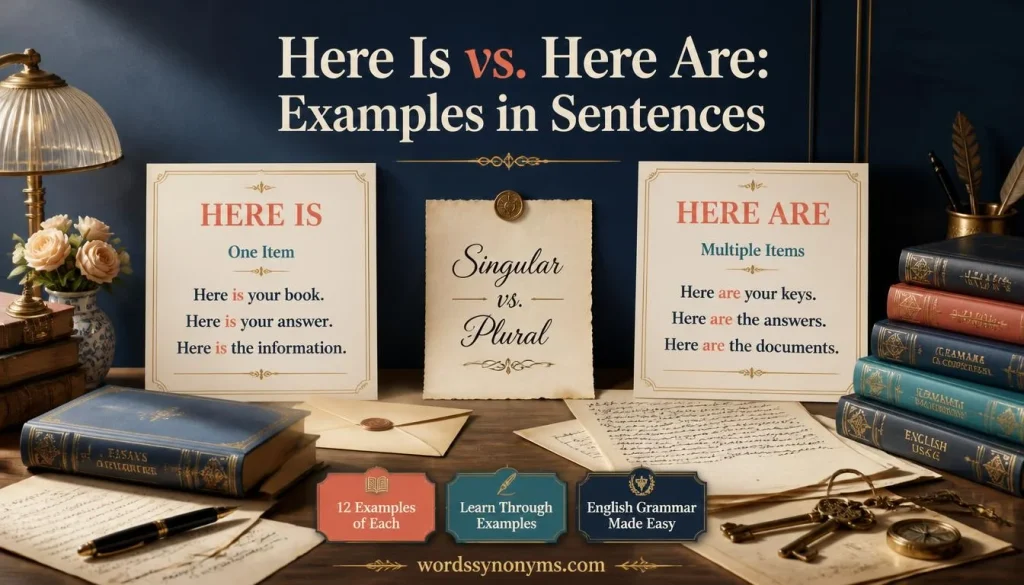
“Here Is” vs. “Here Are”: Examples in Sentences
Examples make grammatical rules easier to understand because they show how people actually use expressions.
The following sentences demonstrate the difference between these constructions in everyday situations.
Examples of “Here Is” in a Sentence
Use “here is” when presenting one particular item, person, or uncountable subject.
- Here is your answer. The sentence introduces one answer.
- Here is the book you wanted. The subject is one book.
- Here is my phone number. The sentence provides one phone number.
- Here is an important announcement. The subject is singular.
- Here is your opportunity. The sentence introduces one opportunity.
- Here is the information you requested. Information is uncountable.
- Here is another example. The sentence presents one example.
- Here is the final decision. Decision is a singular noun.
- Here is some good news. News takes a singular verb.
- Here is everything you need. Everything takes a singular verb.
- Here is the reason I called. The subject is one reason.
- Here is a simple explanation. The sentence introduces one explanation.
Notice that the verb remains “is” even when additional descriptive words appear.
For example, “Here is the beautiful old house near the river” still introduces one house. The length of the description doesn’t change the grammatical number.
Examples of “Here Are” in a Sentence
Use “here are” when introducing multiple items or people.
- Here are your keys. The subject contains multiple keys.
- Here are the answers. The sentence introduces several answers.
- Here are my friends. Friends is a plural noun.
- Here are the documents. The subject refers to multiple documents.
- Here are three important reasons. Reasons is plural.
- Here are some useful suggestions. Suggestions is plural.
- Here are your clothes. Clothes is a plural noun.
- Here are the meeting notes. Notes refers to multiple written points.
- Here are the children. Children is an irregular plural noun.
- Here are the latest updates. Updates is plural.
- Here are the available options. Options refers to multiple choices.
- Here are the results. The sentence introduces multiple results.
The same principle applies regardless of sentence length.
For example, “Here are the three interesting books that your teacher recommended last week” uses “are” because the subject is “books.”
The descriptive phrase doesn’t change the plural subject.
Read more: Can You Start a Sentence With “For”? Grammar Rules and Examples
What’s the Difference Between “Here’s” and “Here Are”?
“Here’s” is the contraction of “here is.” It combines the adverb “here” with the verb “is” using an apostrophe.
People frequently use this contraction in everyday conversations because it sounds natural and conversational.
For example:
- Here’s your coffee.
- Here’s the answer.
- Here’s my suggestion.
- Here’s another example.
- Here’s the information you requested.
In each example, “here’s” introduces a singular or uncountable subject.
However, you’ll sometimes hear people use “here’s” before plural nouns. This happens frequently in informal American English.
For example:
- Here’s your keys.
- Here’s the documents you requested.
- Here’s some examples.
These constructions occur in everyday speech, but they don’t follow the traditional subject-verb agreement rule.
In standard edited writing, “here are your keys” and “here are the documents you requested” are preferable.
The distinction becomes particularly important in professional emails, academic assignments, and formal documents.
Can You Use “Here’s” Before a Plural List?
Yes, you may encounter “here’s” before a plural list, especially in conversational introductions.
For example:
- Here’s what you’ll need: notebooks, pens, and folders.
- Here’s what we’re discussing today: grammar, punctuation, and vocabulary.
- Here’s the plan: three meetings and two presentations.
These examples contain a different grammatical structure.
The subject is the singular word “what” or “plan,” rather than the individual plural items introduced afterward.
That’s why “here’s” works in these sentences.
Compare the following constructions:
| Sentence | Explanation |
| Here’s what you need: pens and paper. | “What you need” functions as a singular subject. |
| Here are the pens and papers. | The subject is plural. |
| Here’s the list of requirements. | “List” is singular. |
| Here are the requirements. | “Requirements” is plural. |
This distinction helps explain why some sentences containing plural words can still correctly use “here is.”
Is “Here’re” a Correct Contraction?
“Here’re” represents a contraction of “here are.” However, it isn’t commonly used in standard written English.
Although the construction is understandable, it looks awkward and can interrupt the flow of a sentence.
For example:
- Here’re your books.
- Here’re the documents.
- Here’re the answers.
These contractions may appear in informal writing or attempts to represent spoken pronunciation. However, most readers find the full expression clearer.
Instead, write:
- Here are your books.
- Here are the documents.
- Here are the answers.
Practical tip: Avoid “here’re” in professional writing, academic assignments, articles, and business emails. The full expression looks more natural and remains easy to understand.
Is “Here Is” Correct With Plural Nouns?
This question deserves attention because everyday speech doesn’t always follow formal grammatical conventions.
In standard English, “here is” generally introduces a singular subject. Meanwhile, “here are” introduces a plural subject.
Therefore, when the subject is an ordinary plural noun, “here are” is the grammatically preferred choice.
For example:
- Here are your shoes.
- Here are the new employees.
- Here are my favorite recipes.
However, informal speakers sometimes use “here’s” before plural nouns.
Consider this example:
“Here’s your keys.”
You might hear someone say this while handing over a set of keys. The expression sounds natural in some conversational settings, but standard subject-verb agreement favors “Here are your keys.”
The same distinction applies to sentences such as:
- Here’s the documents. (Informal usage)
- Here are the documents. (Standard agreement)
When writing for a broad audience, choose the standard construction.
What Happens When “Here Is” Introduces Two Nouns?
When two separate nouns form a compound subject, they generally require a plural verb.
For example:
- Here are the book and the notebook.
- Here are the manager and the assistant.
- Here are the invitation and the registration form.
The word “and” combines two separate subjects. Therefore, “are” agrees with the compound subject.
However, you can use “here is” when introducing a singular expression that contains several items.
For example:
- Here is a collection of books.
- Here is a list of requirements.
- Here is a set of instructions.
Why?
Because the grammatical subjects are “collection,” “list,” and “set.” Each noun is singular.
The plural nouns following “of” describe what each collection, list, or set contains. They don’t determine the verb.
Compare:
| Sentence | Correct verb | Reason |
| Here is a list of books. | Is | “List” is singular. |
| Here are the books. | Are | “Books” is plural. |
| Here is a group of students. | Is | “Group” is singular. |
| Here are the students. | Are | “Students” is plural. |
| Here is a set of instructions. | Is | “Set” is singular. |
| Here are the instructions. | Are | “Instructions” is plural. |
This rule also applies to many other expressions, including “a bunch of,” “a collection of,” and “a series of.”
Always identify the main subject before choosing your verb.

Common Mistakes to Avoid When Using “Here Is” and “Here Are”
Even experienced English speakers sometimes mix up these expressions. Most mistakes happen when writers focus on nearby words instead of the actual grammatical subject.
Here are several common problems and their corrections.
Using “Here Is” With an Ordinary Plural Subject
A plural subject requires a plural verb in standard English.
Incorrect: Here is your new shoes.
Correct: Here are your new shoes.
The noun “shoes” refers to multiple items. Therefore, “are” is the appropriate choice.
Using “Here Are” With a Singular Subject
A singular subject requires “is” rather than “are.”
Incorrect: Here are your new phone.
Correct: Here is your new phone.
The sentence introduces one phone, so the singular verb fits.
Confusing “Here” With the Grammatical Subject
Some writers mistakenly assume that “here” determines the verb.
However, “here” doesn’t function as the subject in these introductory constructions.
For example:
- Here is the package.
- Here are the packages.
The nouns “package” and “packages” determine the verb forms.
Ignoring Uncountable Nouns
Uncountable nouns generally take singular verbs, even when they represent large quantities.
Incorrect: Here are some useful information.
Correct: Here is some useful information.
You can also make the sentence countable by changing its structure:
Correct: Here are some useful pieces of information.
Now the countable noun “pieces” determines the verb.
Assuming Every Noun Ending in “-S” Is Plural
Some English nouns end in “-s” but take singular verbs.
For example:
- Here is the news.
- Here is the mathematics assignment.
- Here is the series you recommended.
“News” is grammatically singular despite its final “-s.” Similarly, “mathematics” can refer to one academic subject.
Don’t judge grammatical number by spelling alone.
Using “Here’re” in Formal Writing
Although readers may understand “here’re,” the contraction looks unusual in most written contexts.
Prefer “here are” when introducing plural subjects.
It creates clearer sentences and avoids unnecessary distractions.
“Here Is” or “Here Are” in Different Contexts
Both expressions appear in everyday conversations and professional communication. However, choosing the right construction helps your writing sound polished and natural.
Using “Here Is” and “Here Are” in Everyday Conversations
In casual conversations, people use these expressions when giving someone something, sharing information, or presenting choices.
For example:
When giving someone one item:
- Here is your jacket.
- Here is your coffee.
- Here is the receipt.
When giving someone multiple items:
- Here are your bags.
- Here are your shoes.
- Here are the tickets.
These expressions also work when introducing suggestions or explanations.
For example:
- Here is what I think.
- Here are some ideas we could try.
- Here is another way to solve the problem.
- Here are three reasons I disagree.
The subject determines the verb, even in relaxed conversations.
Using “Here Is” and “Here Are” in Emails and Professional Writing
Professional communication often requires you to introduce attachments, documents, information, or action items.
Choosing the correct expression helps your message sound clear and professional.
Consider these examples:
When sharing one attachment:
“Here is the report you requested.”
When sharing multiple attachments:
“Here are the three documents you requested.”
When providing information:
“Here is the information about tomorrow’s meeting.”
When presenting multiple action items:
“Here are the action items from today’s discussion.”
These expressions also work well in business updates and customer communications.
For instance:
“Here is the updated schedule for next week.”
“Here are the revised deadlines for each department.”
Notice how the subject determines the verb in every example.
Using “Here Is” and “Here Are” in Academic and Formal Writing
Academic writing requires careful attention to grammatical agreement. A small subject-verb error can make an otherwise strong sentence look less polished.
Use “here is” when introducing one example, explanation, or piece of information.
For example:
- Here is an explanation of the research method.
- Here is the central argument of the paper.
- Here is the main finding from the experiment.
Use “here are” when presenting multiple findings, examples, or supporting points.
For example:
- Here are three examples of subject-verb agreement.
- Here are the findings from the survey.
- Here are the main arguments supporting the theory.
In particularly formal academic prose, you may sometimes prefer more direct constructions.
For example, instead of writing “Here are the results of the experiment,” you could write “The results of the experiment are presented below.”
Both sentences can work, but the second may fit a more formal research style.

Real-Life Case Studies: Choosing Between “Here Is” and “Here Are”
Understanding grammar becomes easier when you apply it to realistic situations. The following examples demonstrate how the choice works in common writing situations.
Case Study: Sending Documents to a Colleague
Imagine that your manager asks you to send an updated report.
You attach one file and write:
“Here is the updated report.”
The subject is “report,” which is singular. Therefore, “is” is correct.
Now imagine that you attach three files instead.
You write:
“Here are the updated reports.”
The subject is “reports,” which is plural. Consequently, “are” is correct.
Lesson: Count the documents you’re introducing before selecting the verb.
Case Study: Sharing Information With a Customer
Suppose a customer asks about your company’s delivery policy.
You respond:
“Here is the information about our delivery service.”
This sentence works because “information” is uncountable.
However, you might provide several specific delivery details:
“Here are the delivery options available in your area.”
Now “options” is plural, so the sentence requires “are.”
Lesson: Uncountable nouns take singular agreement, while plural countable nouns take plural agreement.
Case Study: Introducing a List in an Article
Imagine that you’re writing a blog post about improving productivity.
You introduce several suggestions with this sentence:
“Here are five practical ways to manage your time.”
The subject is “ways,” which is plural.
However, you could introduce the same information differently:
“Here is a list of five practical ways to manage your time.”
Now the subject is “list,” which is singular.
Lesson: The main noun determines the verb, not the number of items inside the list.
Read more: Of Course: Meaning and Examples in Everyday English
Quick Trick: How to Choose Between “Here Is” and “Here Are”
You don’t need to memorize dozens of examples to understand this rule. A simple subject-verb agreement check will usually give you the answer.
Follow these steps whenever you’re unsure.
Step 1: Identify the subject.
Find the noun or noun phrase that the sentence introduces.
For example:
“Here ___ your new books.”
The subject is “your new books.”
Step 2: Determine whether the subject is singular or plural.
Ask yourself whether you’re referring to one item or multiple items.
In this example, “books” is plural.
Step 3: Choose the matching verb.
Use “is” for singular subjects and “are” for plural subjects.
The correct sentence becomes:
“Here are your new books.”
Step 4: Check for uncountable nouns and collective expressions.
Remember that words such as “information,” “advice,” and “furniture” generally take singular verbs.
For example:
“Here is some useful advice.”
Similarly, a singular collective noun such as “list” or “collection” takes “is.”
Quick reference table:
| Subject | Correct expression | Example |
| One book | Here is | Here is the book. |
| Several books | Here are | Here are the books. |
| Information | Here is | Here is the information. |
| Three suggestions | Here are | Here are three suggestions. |
| A collection | Here is | Here is a collection of poems. |
| Several collections | Here are | Here are several collections. |
| Everything | Here is | Here is everything. |
| Two options | Here are | Here are two options. |
The easiest reminder is simple: look at the subject, not the word “here.”
FAQs
1. Is “Here Is” or “Here Are” grammatically correct?
Both phrases are grammatically correct. Use “Here Is” with a singular noun and “Here Are” with a plural noun. The correct choice depends on the noun you introduce.
2. Should I use “Here Is” before a singular noun?
Yes. Use “Here Is” when introducing one person, place, thing, or idea. For example, “Here is your appointment letter” is correct.
3. When should I use “Here Are” in a sentence?
Use “Here Are” when introducing two or more people, places, things, or ideas. For example, “Here are your documents” is correct.
4. Is “Here Is the Books” correct?
No. This sentence is grammatically incorrect because books is plural. You should write, “Here are the books” to maintain subject-verb agreement.
5. Can I use “Here Is” and “Here Are” in formal writing?
Yes. Both expressions work well in formal writing, emails, reports, business messages, and professional documents. Just make sure the verb agrees with the noun that follows.
6. What is the easiest way to remember “Here Is” vs. “Here Are”?
Remember this simple rule: Here Is = singular and Here Are = plural. If you’re introducing one item, use is. If you’re introducing multiple items, use are.
Conclusion
Choosing between “Here Is” and “Here Are” becomes easy once you understand the difference between singular and plural nouns. Use “Here Is” when introducing one thing and “Here Are” when presenting two or more things. This small grammar rule makes your sentences clearer and helps you avoid common writing mistakes.
Whether you’re writing an email, sharing meeting updates, or preparing professional documents, always check the noun that follows the phrase. A little attention to subject-verb agreement can make a noticeable difference in your English. Practice with everyday examples, and you’ll soon use both expressions naturally and confidently.

Shafiq Ur Rehman is a writer and content contributor at WordsConfusing.com. He enjoys exploring the English language, common word confusions, vocabulary, and practical writing tips. His goal is to make English easier to understand through clear, simple, and useful articles.