
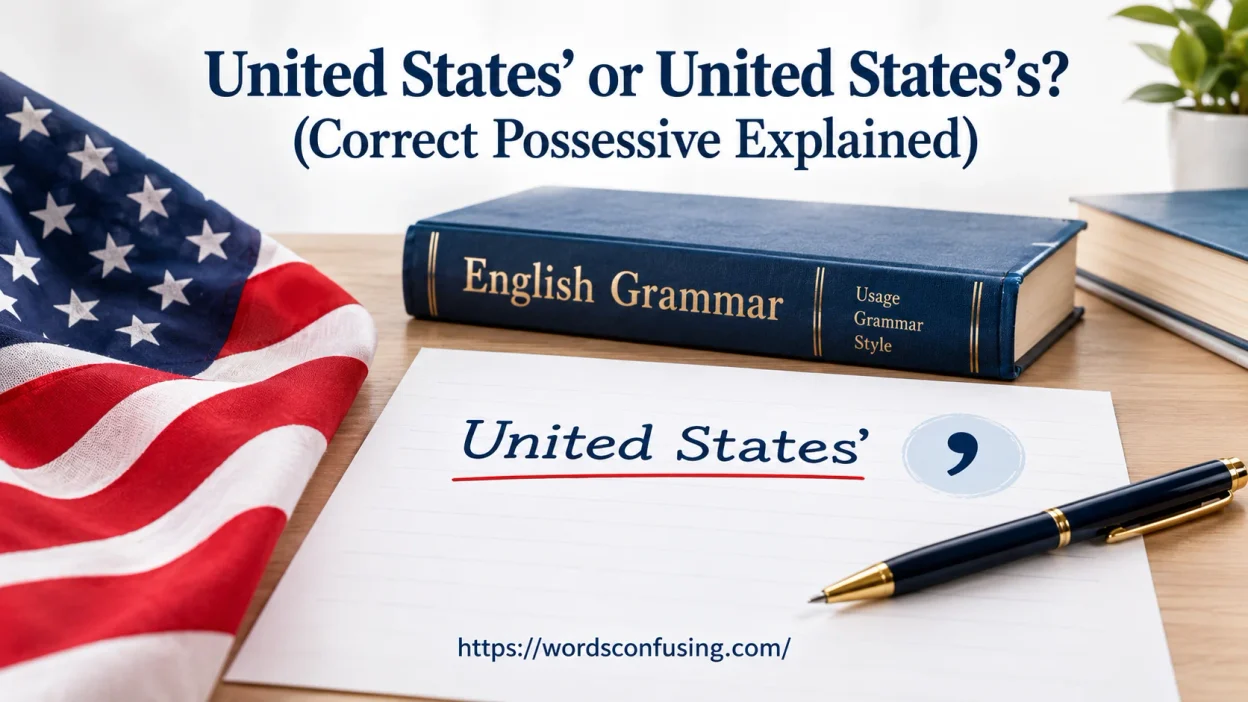
The United States’ or United States’s possessive form can seem tricky, but the plural form and standard rules make the correct use easier.
The United States is a noun that already ends in “s,” which can make the usual rules for nouns feel less obvious. Since the name refers to a group of states, its plural form affects how the possessive form is written.
A useful way to remember it is to treat the final “s” as already belonging to the name rather than adding another one.
The standard possessive form is United States’, with the apostrophe placed after the final “s.” This pattern clearly shows possession and follows conventional use in formal English.
For example, you might see “the United States’ economy” or “the United States’ history.” In this article, the goal is to help you use the expression correctly when choosing between United States’ and United States’s.
The form United States’s may appear occasionally, but United States’ is the established form in standard usage.
Quick Answer
The standard possessive form is United States’.
Use United States’ when you want to show that something belongs to, relates to, or is associated with the United States.
Correct examples
- The United States’ government
- The United States’ economy
- The United States’ Constitution
- The United States’ population
- The United States’ borders
- The United States’ history
- The United States’ military
Usually incorrect in standard usage
- ❌ United States’s government
- ❌ United State’s government
The basic rule is simple:
A plural noun that already ends in “s” normally forms its possessive by adding only an apostrophe.
Since States ends in s and functions as a plural noun, the possessive form becomes States’.
That gives you:
United States → United States’
Not:
United States → United States’s
Why Is “United States’” Correct?
To understand the possessive form, you first need to understand the structure of United States.
The country’s official short name is United States. The word States is plural. It refers to the collection of individual states that make up the country.
That plural ending remains important when you form the possessive.
Consider the following pattern:
| Noun | Possessive |
| state | state’s |
| states | states’ |
| student | student’s |
| students | students’ |
| country | country’s |
| countries | countries’ |
| company | company’s |
| companies | companies’ |
| United States | United States’ |
The distinction becomes much easier when you compare singular and plural nouns.
A singular noun such as state normally takes ’s:
The state’s government
A plural noun ending in s, such as states, normally takes only an apostrophe:
The states’ governments
The same pattern applies to United States:
The United States’ government
The apostrophe comes after the final s because the name already ends in a plural s.
Is “United States” a Plural Noun?
This question causes much of the confusion.
United States is the name of one country. However, its internal grammatical form contains the plural noun States.
English can use plural-looking names for single entities. The name refers to one country while retaining the plural form States.
For example:
The United States is a country in North America.
Notice that the verb is is singular.
That’s because the sentence treats the United States as one country.
Now look at the possessive:
The United States’ economy is one of the largest in the world.
Here, United States’ shows possession or association.
So there’s no contradiction between these two ideas:
- United States refers to one country.
- States has a plural form.
- United States’ follows the possessive pattern associated with a plural noun ending in s.
This is why you shouldn’t assume that a singular meaning automatically requires ’s.
United States’ or United States’s: Which One Should You Use?
For standard modern writing, United States’ is the form to use.
The form United States’s occasionally appears because writers apply a broad rule that says singular nouns should take ’s. However, that approach doesn’t fit the conventional treatment of United States.
Compare these examples:
The United States’ economy continues to influence global markets.
The United States’s economy continues to influence global markets.
The first version follows the established possessive convention for United States.
The second version looks awkward to many readers and isn’t the normal choice in edited American English.
Why does “United States’s” look wrong?
The problem isn’t simply that two s sounds appear together. English contains plenty of words where an apostrophe and s occur together.
The issue is the grammatical form of the noun.
States already ends in s as a plural noun. The possessive marker therefore comes after that ending:
States + ’ = States’
Adding another s produces:
States + ’s = States’s
That isn’t the conventional possessive construction used for United States.
United State’s or United States’?
This distinction is even easier.
When you mean the country, use:
United States
When you mean the possessive form of the country, use:
United States’
The form United State’s doesn’t correctly name the country because United State isn’t the country’s name.
Compare these forms
| Form | Correct? | Explanation |
| United States | ✅ | Standard name of the country |
| United States’ | ✅ | Standard possessive form |
| United States’s | ❌ | Not the standard possessive form |
| United State | ❌ | Not the country’s standard name |
| United State’s | ❌ | Incorrect country name plus possessive |
However, state’s can absolutely be correct in another context.
For example:
The state’s population increased this year.
Here, state is singular. The apostrophe and s are therefore appropriate.
You could also write:
The states’ populations increased this year.
Now states is plural, so the possessive uses only an apostrophe.
The difference is one letter, but that letter changes the grammatical structure.
The Basic Rule for Plural Possessives
The easiest way to remember United States’ is to learn the broader possessive rule.
For most regular singular nouns, add ’s.
For regular plural nouns ending in s, add only an apostrophe.
Singular possessives
- student → student’s
- teacher → teacher’s
- country → country’s
- company → company’s
- state → state’s
Plural possessives ending in “s”
- students → students’
- teachers → teachers’
- countries → countries’
- companies → companies’
- states → states’
Now apply the same pattern to the country’s name:
- United States → United States’
The rule becomes much less mysterious once you stop treating United States’ as a special exception.
United States vs. United States’: What’s the Difference?
The apostrophe changes the grammatical function of the phrase.
United States
Use United States when the name itself functions as the noun.
Examples:
The United States has 50 states.
She moved to the United States.
The United States borders Canada and Mexico.
The United States participates in international organizations.
None of these examples requires a possessive apostrophe.
United States’
Use United States’ when the phrase modifies another noun to express possession, association, origin, or connection.
Examples:
The United States’ economy is highly diversified.
Its government operates through three branches.
A federal system was established by the United States’ Constitution.
With more than 340 million people, the country has a large population.
The possessive construction tells readers that the following noun relates to the United States.
Examples of United States’ in Sentences
Seeing the form in different contexts makes the rule easier to remember.
United States’ Government
The United States’ government operates through three branches.
Here, United States’ modifies government.
The phrase identifies the government associated with the country.
United States’ Economy
The United States’ economy includes manufacturing, services, technology, agriculture, and many other sectors.
The apostrophe shows the relationship between the country and its economy.
United States’ Population
The United States’ population is distributed across large cities, suburbs, rural communities, and smaller towns.
Again, United States’ modifies population.
United States’ History
The United States’ history includes periods of expansion, conflict, reform, industrialization, and social change.
The apostrophe connects history with the country.
United States’ Military
The United States’ military includes the Army, Navy, Air Force, Marine Corps, Space Force, and Coast Guard.
The possessive construction identifies the military institutions associated with the United States.
United States’ in Formal Writing
You’ll often see United States’ in government, academic, legal, journalistic, and business writing.
The construction works particularly well when the following noun directly identifies something associated with the country.
Common examples include:
- United States’ policy
- United States’ economy
- United States’ government
- United States’ population
- United States’ territory
- United States’ borders
- United States’ history
- United States’ military
- United States’ Constitution
- United States’ legal system
- United States’ education system
- United States’ workforce
- United States’ energy production
However, possessive constructions aren’t always necessary.
Sometimes another structure sounds cleaner.
For example:
The economy of the United States
can replace:
The United States’ economy
Both constructions can communicate the relationship clearly. Your choice depends on sentence rhythm and context.
United States’ vs. “of the United States”
English gives you two common ways to express this relationship.
Possessive form
The United States’ economy
Of-phrase
The economy of the United States
Both can be grammatically correct.
The possessive version is usually shorter and more direct.
The of construction can sometimes sound more formal or provide clearer emphasis, especially when several nouns appear together.
Consider:
The United States’ economic policy
This is concise and natural.
You could also write:
The economic policy of the United States
The second version places slightly more emphasis on the United States.
Neither construction requires you to change the underlying meaning.
United States’ or U.S.’?
Abbreviations create another layer of confusion.
The United States is commonly abbreviated as U.S. in American English. When the abbreviation becomes possessive, you’ll often see U.S. followed by an apostrophe when the surrounding construction follows the plural possessive pattern.
For example:
U.S. citizens
is not possessive.
It simply uses U.S. as an adjective modifying citizens.
By contrast, a phrase such as:
the U.S.’ economic interests
can appear in writing that treats U.S. as a possessive abbreviation.
However, this construction can look visually awkward.
For that reason, writers sometimes prefer:
the economic interests of the U.S.
or simply rewrite the sentence.
The exact treatment of abbreviations can vary by style guide. The full name United States’ remains the clearest choice when there is any possibility of confusion.
What About “USA’s”?
You may also encounter USA’s.
Unlike United States, USA is an initialism rather than a phrase containing the plural noun States.
As a result, writers sometimes form its possessive with ’s:
USA’s Olympic team
However, usage varies depending on the publication and context.
For polished formal writing, U.S. or United States is often more natural than repeatedly using USA as a noun modifier.
Compare:
The United States’ economy
The U.S. economy
USA’s economy
The first two generally sound more natural in standard American prose.
Read more: Jess’ or Jess’s: Which Is the Correct Possessive Form?
What Is the Possessive Form of “United States of America”?
The longer official name creates a slightly different construction.
The full name is:
United States of America
When you form a possessive phrase using the entire name, the apostrophe is normally attached to the final element:
United States of America’s
For example:
The United States of America’s government has three branches.
However, this construction is much less common than:
The United States’ government
The shorter version is usually more natural because United States already identifies the country clearly.
Compare the two
| Form | Example | Typical use |
| United States | The United States has 50 states. | Country name |
| United States’ | The United States’ economy is large. | Possessive form |
| United States of America | The United States of America is a federal republic. | Full country name |
| United States of America’s | The United States of America’s government… | Possessive full name |
In everyday writing, United States’ is usually the more efficient construction.
Why “United States’s” Creates Confusion
The confusion often starts with a legitimate English rule: singular possessive nouns commonly take ’s.
For example:
- James’s book
- the company’s policy
- the country’s economy
- the state’s government
A writer may then reason:
“The United States is one country, so shouldn’t it be United States’s?”
That reasoning focuses on the country’s singular identity rather than the grammatical form of the name.
The phrase United States contains the plural noun States. Standard usage treats that ending as the basis for the possessive form.
Therefore:
United States’
is the conventional choice.
The important lesson is broader than this one phrase:
Don’t form every possessive based solely on whether the thing itself is singular. Examine the noun’s grammatical form.
A Useful Comparison: State, States, and United States
This three-way comparison makes the distinction crystal clear.
| Word or phrase | Meaning | Possessive |
| state | One state | state’s |
| states | More than one state | states’ |
| United States | One country | United States’ |
Consider these examples:
The state’s government announced new regulations.
One state is involved.
The states’ governments adopted different policies.
Multiple states are involved.
The United States’ government operates at the federal level.
The country is one entity, but its name ends with the plural noun States.
That’s why the possessive form doesn’t follow the simple “one thing equals ’s” shortcut.
Common Mistakes With United States’ Possessives
A few errors appear repeatedly.
Mistake: United State’s
❌ United State’s economy
The country’s name is United States, not United State.
Correct:
✅ United States’ economy
Mistake: United States’s
❌ United States’s government
This isn’t the standard possessive construction.
Correct:
✅ United States’ government
Mistake: United States
Sometimes writers leave out the apostrophe when the phrase clearly needs a possessive.
❌ The United States economy
In many contexts, this should be:
✅ The United States’ economy
There are exceptions when United States functions as a noun modifier rather than a possessive. However, when you’re specifically expressing possession or association, the possessive form is appropriate.
Mistake: States’s
The same issue occurs when using states alone.
❌ The states’s governments
Correct:
✅ The states’ governments
The plural noun already ends in s, so the apostrophe comes afterward.
United States’ or States’: Are They the Same?
Not quite.
States’ is the possessive form of the plural noun states.
United States’ is the possessive form of the proper name United States.
For example:
The states’ governments
This means the governments of multiple states.
But:
The United States’ government
This refers to the federal government of the United States.
The words look similar because the second phrase contains the first noun. Their meanings depend on the full context.
Compare these sentences
The states’ laws differ from one another.
This refers to multiple individual states.
The United States’ laws apply at the federal level.
This refers to the country and its federal legal framework.
That small word United makes a substantial difference.
Is “United States’” Singular or Plural?
This question has two different answers depending on what you’re asking.
United States names one country. Therefore, the country takes a singular verb in standard American English:
The United States is a country.
Not:
❌ The United States are a country.
The possessive form is different because possessive formation depends on the grammatical structure of the noun phrase.
The United States’ economy is enormous.
The noun economy is singular, so the verb is follows it.
Notice how the sentence works:
The United States’ + economy + is
The possessive phrase modifies economy. It doesn’t determine the number of the following noun.
United States’ Constitution or United States Constitution?
Both structures can appear in writing, but they aren’t identical in style.
The United States Constitution
Here, United States functions as a noun modifier.
The United States’ Constitution
Here, the apostrophe explicitly marks a possessive relationship.
In many contexts, the official name Constitution of the United States is also used.
The important point is that English can express relationships between nouns in more than one way. Not every noun modifier requires an apostrophe.
For example:
United States citizens
doesn’t normally need an apostrophe.
You wouldn’t write:
❌ United States’ citizens
if you simply mean citizens of the United States as a standard noun-modifier construction.
This distinction is worth remembering because not every phrase containing United States is possessive.
When Should You Use “United States’”?
Use United States’ when the apostrophe accurately expresses possession or a close relationship.
Examples include:
- the United States’ borders
- the United States’ population
- the United States’ economy
- the United States’ history
- the United States’ territory
- the United States’ legal system
- the United States’ foreign policy
- the United States’ government
- the United States’ military
- the United States’ role in international trade
A quick test can help.
Ask:
Does the following noun belong to, originate from, or closely relate to the United States?
If yes, a possessive construction may work naturally.
For example:
the United States’ population
The population is the population of the United States.
the United States’ borders
The borders belong geographically to the country.
the United States’ government
The government belongs institutionally to the country.
When You Don’t Need an Apostrophe
An apostrophe isn’t required simply because United States appears before another noun.
Consider:
United States citizens
Here, United States identifies what kind of citizens you’re discussing.
The same pattern appears in:
- United States history
- United States law
- United States citizens
- United States territory
- United States forces
Depending on the phrase and intended meaning, these constructions may function as noun modifiers rather than possessives.
Compare:
United States citizens voted in the election.
with:
The United States’ population changed over time.
The first uses United States as a modifier.
The second uses United States’ as a possessive.
This distinction prevents unnecessary apostrophes.
A Simple Decision Test
When you’re unsure whether to write United States or United States’, try this quick process.
Ask whether the phrase expresses possession
If the answer is yes, United States’ may be appropriate.
the United States’ economy
If not, you may simply need United States.
United States citizens
Check whether “of the United States” works
If you can naturally replace the phrase with of the United States, the possessive construction may be appropriate.
For example:
the United States’ population
can become:
the population of the United States
That confirms the possessive relationship.
However:
United States citizens
doesn’t naturally become:
❌ citizens of the United States in exactly the same grammatical structure
The meaning may remain similar, but the original phrase functions differently.
Quick Reference Table
| Expression | Correct? | Reason |
| United States | ✅ | Standard country name |
| United States’ | ✅ | Standard possessive form |
| United States’s | ❌ | Not the standard possessive form |
| United State | ❌ | Incorrect country name |
| United State’s | ❌ | Incorrect country name |
| states | ✅ | Plural common noun |
| states’ | ✅ | Plural possessive |
| state’s | ✅ | Singular possessive |
| United States citizens | ✅ | Noun-modifier construction |
| United States’ economy | ✅ | Possessive construction |
| economy of the United States | ✅ | Of-phrase construction |
A Few Easy Examples to Remember
If you only remember a handful of examples, make them these:
The United States’ economy is highly diversified.
Its government has three branches.
More than 340 million people live in the country.
Land borders connect the United States with Canada and Mexico.
The country’s history spans more than two centuries.
Each example uses the same grammatical principle.
United States + apostrophe = United States’
You don’t add another s.
FAQs
Is “United States’” correct?
Yes. United States’ is the standard possessive form in formal English. The apostrophe comes after the final “s” because United States already has an “s” ending.
Is “United States’s” ever correct?
You may encounter United States’s, especially in some style systems or informal writing. However, United States’ is the conventional form most commonly used in standard written English.
Why does “United States” use an apostrophe after the “s”?
United States functions as a plural noun ending in “s.” For plural nouns that already end in “s,” English commonly forms possession by adding an apostrophe after the existing “s.”
Which is correct: “United States’ economy” or “United States’s economy”?
United States’ economy is the standard choice. It follows the conventional possessive pattern used for plural nouns ending in “s.”
Can I write “the United States’ government”?
Yes. The United States’ government is grammatically acceptable because the government belongs to or is associated with the United States.
How can I remember the correct form?
Think of United States as a plural name that already ends in “s.” Instead of adding another “s,” simply place an apostrophe after it: United States’.
Conclusion
Getting United States’ right is easier than it first appears. The key is to remember that United States is already plural, so you don’t need to add another “s” after the apostrophe. Once this simple rule becomes familiar, choosing between United States’ and United States’s becomes much more straightforward.
So, whenever you’re writing about something belonging to the country, look for United States’. It’s a small punctuation detail, but using it correctly can make your writing feel clearer, smoother, and more polished.

Shafiq Ur Rehman is a writer and content contributor at WordsConfusing.com. He enjoys exploring the English language, common word confusions, vocabulary, and practical writing tips. His goal is to make English easier to understand through clear, simple, and useful articles.