
The question “In Average” or “On Average”: Which Is Correct? matters when you describe typical numbers, amounts, or results in clear English.
The correct phrase is on average, which native speakers use in natural English. Although both expressions contain different prepositions, they don’t serve the same purpose in standard usage.
Understanding English grammar, usage rules, and English phrases helps you avoid phrase confusion and common mistakes. In formal writing, business communication, and everyday conversations, choosing the proper phrase improves clarity, consistency, and professionalism.
While in average might seem grammatically possible, it isn’t the widely accepted expression for describing typical amounts, numbers, or results. This phrase comparison also shows why preposition choice, grammatical correctness, and correct spelling matter.
You can use on average in practical examples involving meetings, scheduling, calendar planning, online booking, and other real-world situations. For instance, you might write, “Employees attend three meetings on average each week.” This correct phrase usage also fits reports, project management, broadcasting content, and professional documents.
Understanding average calculations, sentence construction, and contextual usage strengthens your English skills, writing skills, and language proficiency. These simple tips can improve your writing accuracy, writing confidence, and effective communication.
Whether you’re working on business writing, professional communication, or written communication, pay attention to phrase selection, correct form, and idiomatic expressions. With regular practice, you can develop better language usage, follow correct grammar, and communicate more naturally in the English language.
Quick Answer
“On average” is the correct expression when you want to describe a typical amount, general result, or mathematical mean. The phrase indicates what usually happens or what a group of numbers produces when calculated together.
On the other hand, “in average” is generally incorrect when used with this meaning. English speakers don’t normally use in before average in this established expression.
Consider these examples:
| Expression | Example | Correct or Incorrect? |
| On average | On average, employees work eight hours daily. | Correct |
| In average | In average, employees work eight hours daily. | Incorrect |
| On average | The journey takes 35 minutes on average. | Correct |
| In average | The journey takes 35 minutes in average. | Incorrect |
The difference is small, but it matters when you’re writing clearly and naturally.
Remember this simple rule: Whenever you mean typically, usually, or as a calculated mean, choose on average.
For example:
- Correct: On average, a person spends several hours using digital devices daily.
- Incorrect: In average, a person spends several hours using digital devices daily.
The first sentence follows standard English usage. The second uses an unsuitable preposition.
Read more: “Sure” vs. “Yes”: What’s the Difference and When Should You Use Each?
What Does “On Average” Mean?
The expression “on average” refers to the typical result or calculated mean of several values. It helps you describe a general pattern without suggesting that every individual experience produces exactly the same result.
For example, imagine five students receive these test scores:
- Student A: 70
- Student B: 75
- Student C: 80
- Student D: 85
- Student E: 90
Their average score is 80. You can therefore say, “The students scored 80 points on average.”
This statement summarizes the group’s performance rather than describing each student’s individual score.
Understanding the Mathematical Meaning of “On Average”
In mathematics, an average often refers to the arithmetic mean. You calculate it by adding all the values and dividing the total by the number of values.
The formula looks like this:
Average=SumofallvaluesNumberofvalues
For example, suppose you spend $10, $15, $20, and $25 on lunch across four days.
The calculation becomes:
10+15+20+254=17.50
Your average lunch expense is $17.50.
You could express this result naturally by saying:
“On average, I spend $17.50 on lunch each day.”
However, remember that an average doesn’t mean every lunch costs exactly $17.50. Some days cost less while others cost more.
Understanding the Everyday Meaning of “On Average”
You don’t need mathematical calculations every time you use this expression. People also use it to describe general tendencies and common patterns.
For example:
- On average, our meetings last approximately 45 minutes.
- The restaurant serves around 120 customers daily on average.
- On average, children need different amounts of sleep depending on their age.
- The delivery usually takes three days on average.
These sentences communicate typical results rather than guaranteed outcomes.
The key distinction: An average summarizes information. It doesn’t necessarily describe every individual case.

Why Is “On Average” Correct Instead of “In Average”?
English prepositions can be tricky because their meanings depend heavily on established usage. Although in and on sometimes describe similar relationships, you can’t freely exchange them in every expression.
For example, English speakers say:
- On purpose, not in purpose.
- On time, not in time when referring to punctuality.
- On vacation, not usually in vacation.
- On average, not in average when describing a typical result.
These expressions follow conventional English patterns. Their prepositions are part of how the phrases developed and became established.
“On” Forms Part of an Established Expression
The word on appears in many English expressions that describe a condition, basis, or way of considering something.
For example:
- On purpose means intentionally.
- On duty means performing assigned responsibilities.
- On sale means available at a reduced price.
- On average means considering the average result.
This doesn’t mean every expression containing on follows one universal grammatical rule. Rather, English has established combinations that speakers recognize and use naturally.
On average is one of those conventional combinations.
Why “In Average” Sounds Incorrect
The preposition in often describes location, inclusion, or involvement within something.
For example:
- The documents are in the folder.
- She works in education.
- There are several mistakes in the report.
However, these meanings don’t make in suitable before average when discussing a typical result.
Consider the following corrections:
| Incorrect Sentence | Correct Sentence |
| In average, customers spend $50. | On average, customers spend $50. |
| The journey takes 30 minutes in average. | The journey takes 30 minutes on average. |
| In average, students read 12 books yearly. | On average, students read 12 books yearly. |
| The company hires 20 people in average. | The company hires 20 people on average. |
The corrected versions sound natural because they use the established expression.
How to Use “On Average” in a Sentence
Knowing the correct phrase is only the beginning. You should also understand where it fits within a sentence and how punctuation affects its placement.
Fortunately, “on average” is flexible. You can place it at the beginning, middle, or end of a sentence, depending on what you want to emphasize.
At the Beginning of a Sentence
Starting with “on average” works particularly well when introducing statistics, general observations, or numerical information.
A comma usually follows the phrase when it introduces the main statement.
Examples:
- On average, employees spend seven hours working each day.
- On average, a family spends $200 monthly on groceries.
- On average, the train arrives within 15 minutes of its scheduled departure.
This structure immediately tells readers that the information represents a general figure rather than an individual result.
It’s especially useful in reports, educational articles, research summaries, and everyday explanations.
In the Middle of a Sentence
You can also place “on average” between the subject and the remaining information when it fits naturally.
Examples:
- Our customers, on average, place three orders each month.
- Children, on average, develop different reading skills at different ages.
- The employees, on average, complete their assignments within two days.
When the phrase interrupts the main sentence, commas can help separate it from the surrounding information.
However, you don’t always need two commas. The exact punctuation depends on how the phrase functions within your sentence.
For example:
- The company receives 500 applications on average each month.
- These apartments cost $1,200 on average.
In these examples, the phrase appears naturally without interrupting the sentence.
When Discussing Numbers and Statistics
Statistics become easier to understand when you use “on average” to summarize several observations.
Instead of listing every individual result, you can present one figure that represents the group.
Examples:
- On average, the survey participants completed the questionnaire in 12 minutes.
- The five branches generate $8,000 in monthly revenue on average.
- Students achieved 82 points on average in the final examination.
This expression also works when discussing percentages and rates.
For example:
- The business experiences 5% monthly growth on average.
- The website receives 10,000 visits per day on average.
- The department processes 85 applications weekly on average.
One important detail deserves attention: always make sure your numbers support the statement. An average can hide substantial differences between individual results.
For example, two departments might have the same average sales despite having very different individual performances.
When Describing Time, Money, and Quantities
Everyday conversations frequently involve estimates and measurements. “On average” makes these statements sound natural and precise.
Here are examples involving different situations:
| Context | Example Sentence |
| Time | On average, the journey takes 40 minutes. |
| Money | Families spend $300 on groceries monthly on average. |
| Distance | The runners cover five miles per day on average. |
| Shopping | Customers purchase three items per visit on average. |
| Education | Students complete four assignments weekly on average. |
| Business | The store receives 200 visitors daily on average. |
| Productivity | Employees complete six tasks per shift on average. |
Notice how the phrase works across different subjects. You can use it whenever you’re describing a typical figure or general result.
However, don’t confuse an average with a fixed amount. A journey might take 40 minutes on average, but traffic could make today’s trip considerably longer.
Is “In Average” Ever Correct?
The phrase “in average” is generally incorrect when you want to express a typical amount, calculated mean, or general result. However, that doesn’t mean the words in and average can never appear together in a grammatical sentence.
The important distinction involves how the words function within the sentence.
For example, consider these two sentences:
- Incorrect: In average, the employees work eight hours daily.
- Correct: On average, the employees work eight hours daily.
The first sentence attempts to use in average as a fixed expression. English doesn’t recognize that construction for this meaning.
However, you might encounter sentences where in appears before a phrase containing the word average.
When “In” and “Average” Can Appear Together
The preposition in can introduce a phrase in which average serves as a noun modifier or part of a larger grammatical structure.
Consider these examples:
- The difference in average income between the two regions was substantial.
- Changes in average household spending affected the company’s forecast.
- Researchers noticed an increase in average test scores.
- The report identifies variations in average customer satisfaction.
These sentences are grammatically correct.
Why? Because in connects the preceding noun to a following noun phrase. It doesn’t directly create the expression in average.
Look closely at this example:
The difference in average income was noticeable.
Here, in connects difference with average income. The word average describes the type of income being discussed.
It doesn’t mean typically or on average.
“In the Average” Can Also Work in Specific Contexts
The expression “in the average” can appear in specialized mathematical or statistical discussions. Its meaning depends on the surrounding sentence.
For example:
- The value falls within the average range for this group.
- The researchers identified an error in the average calculation.
- The variation in the average was smaller than expected.
Notice that these sentences use additional words to create complete grammatical structures.
You shouldn’t remove those words and replace the resulting expression with in average.
The practical rule is simple: Use on average when describing a typical result. Use in when the sentence requires it for another grammatical purpose.
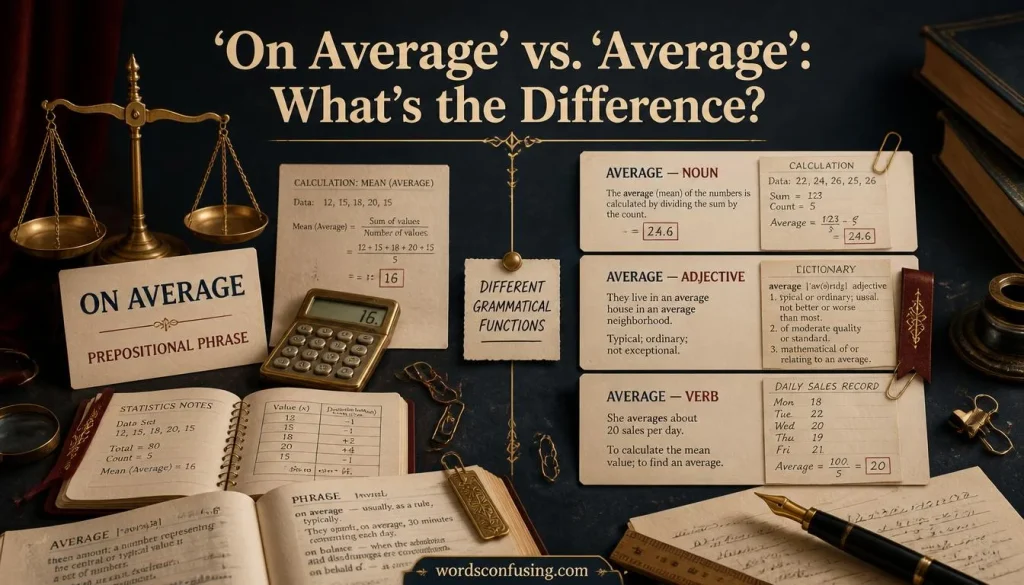
“On Average” vs. “Average”: What’s the Difference?
Although “on average” and “average” share the same main word, they don’t perform exactly the same grammatical function.
On average is a prepositional phrase that describes how you should interpret a result. Meanwhile, average can function as a noun, adjective, or verb.
Understanding these differences helps you avoid unnecessary prepositions and awkward sentences.
“On Average” as a Prepositional Phrase
The expression “on average” describes a typical result or calculated mean.
Examples:
- On average, employees arrive at 8:30 a.m.
- The store sells 50 products daily on average.
- Customers spend approximately $75 per visit on average.
In each example, the phrase explains the general pattern or typical figure.
“Average” as a Noun
When average functions as a noun, it refers to a calculated or typical value.
Examples:
- The average of these five numbers is 24.
- Her exam average improved significantly.
- The class average increased after the final examination.
You don’t need to add on before the noun.
For instance, saying “The average of these numbers is 24” is already complete.
“Average” as an Adjective
The word average can also describe something ordinary, typical, or representative of a group.
Examples:
- An average employee completes several tasks daily.
- The average household spends money on food and transportation.
- He received an average score on the examination.
- This restaurant offers average service at reasonable prices.
Here, average describes a noun rather than explaining how a figure was calculated.
“Average” as a Verb
Less commonly, average can function as a verb meaning to achieve or produce a particular average amount.
Examples:
- The restaurant averages 150 customers each day.
- She averages 85 points per examination.
- The business averages $10,000 in monthly sales.
These constructions don’t require the preposition on.
Quick Comparison: On Average vs. Average
| Expression | Grammatical Function | Example |
| On average | Prepositional phrase | On average, sales reach $5,000. |
| Average | Noun | The average is $5,000. |
| Average | Adjective | The average price is $50. |
| Average | Verb | The store averages 100 sales daily. |
The distinction becomes easier once you identify the role of each word.
If you’re describing a general result, choose on average. If you’re naming, describing, or calculating an average, the word average may work independently.
Common Mistakes to Avoid When Using “On Average”
Even though “on average” is a straightforward expression, writers sometimes misuse it. Most mistakes involve incorrect prepositions, misleading statistics, or unnecessary repetition.
Understanding these problems can make your writing clearer and more accurate.
Using “In Average” Instead of “On Average”
This is the most common mistake associated with the expression.
Because in and on both function as prepositions, writers sometimes assume they can exchange them.
However, standard English uses “on average” for this meaning.
Incorrect: In average, customers spend $40 per visit.
Correct: On average, customers spend $40 per visit.
The correction requires only one word, but it makes the sentence natural.
Treating an Average as a Guaranteed Result
An average describes a typical or calculated figure. It doesn’t guarantee that every individual experience will match that number.
Consider a delivery company that completes five deliveries in these times:
| Delivery | Time Taken |
| First | 20 minutes |
| Second | 30 minutes |
| Third | 40 minutes |
| Fourth | 50 minutes |
| Fifth | 60 minutes |
| Average | 40 minutes |
You can correctly write:
“On average, the company completes deliveries in 40 minutes.”
However, saying every delivery takes exactly 40 minutes would be misleading.
Some deliveries take less time while others take longer.
Using “On Average” for an Individual Result
The phrase usually describes a group, repeated observations, or a general pattern. Using it for one isolated event can create confusion.
Incorrect: I scored 90 points on average in one examination.
Better: I scored 90 points in the examination.
If you took several examinations and earned an average of 90 points, the original expression becomes appropriate.
For example:
“On average, I scored 90 points across five examinations.”
The difference is the number of observations being summarized.
Repeating “On Average” Unnecessarily
Using the same expression repeatedly can make writing sound awkward.
Consider this sentence:
“On average, customers spend $50 on average during each visit.”
The phrase appears twice without adding useful information.
A better version would be:
“Customers spend $50 per visit on average.”
Another option is:
“On average, customers spend $50 during each visit.”
Both sentences communicate the same information without unnecessary repetition.
Confusing “Average” With “Median”
This mistake matters particularly when discussing statistics.
The mean is calculated by adding values and dividing by their number. The median is the middle value when observations appear in numerical order.
Consider these five salaries:
$30,000, $35,000, $40,000, $45,000, and $150,000.
The mean salary is $60,000. The median salary is $40,000.
The unusually high salary increases the mean considerably.
Therefore, saying “employees earn $60,000 on average” is mathematically correct if you’re reporting the mean. However, it might not describe the typical employee’s experience very well.
Always consider which statistical measure best represents your information.
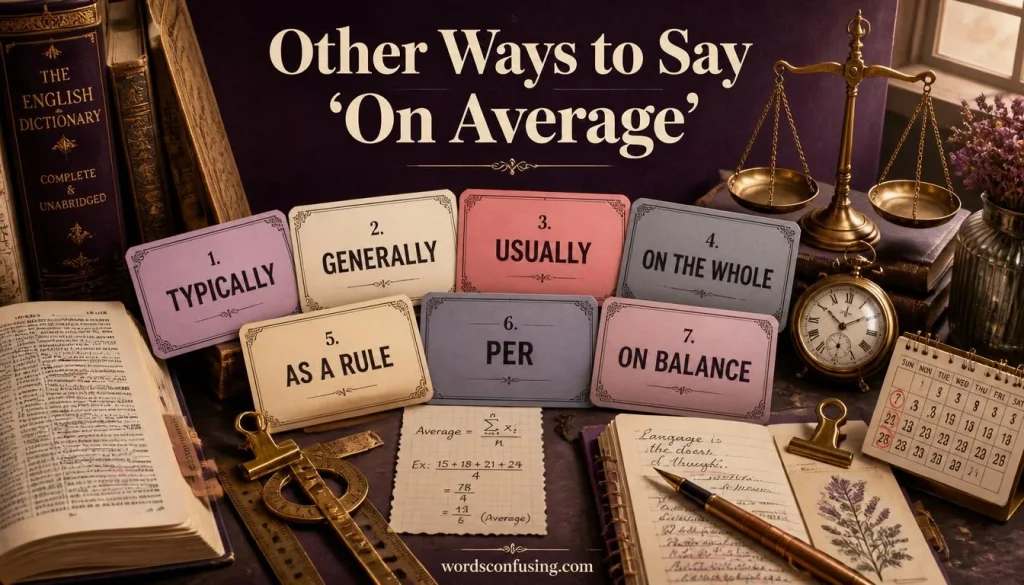
Other Ways to Say “On Average”
Although “on average” is the standard expression, you don’t always need to repeat it. Several alternatives can communicate a similar idea while making your writing more varied.
However, these expressions aren’t perfect replacements in every situation. Some describe general habits while others emphasize an overall judgment or a numerical rate.
Here are seven useful alternatives.
Typically
Typically describes something that happens under normal or usual circumstances.
It’s particularly useful when discussing common behaviors, routines, and expected situations.
Examples:
- Employees typically arrive at the office before 9 a.m.
- The journey typically takes around 30 minutes.
- Customers typically spend $60 during each visit.
Use typically when you’re describing a common pattern rather than reporting a calculated mean.
Generally
Generally refers to something that’s usually true across a group or situation.
It’s useful when making broad observations without suggesting that every case follows the same pattern.
Examples:
- Students generally perform better when they prepare consistently.
- Prices generally increase during periods of high demand.
- Customers generally prefer convenient payment options.
Unlike on average, this word doesn’t necessarily indicate a mathematical calculation.
Usually
Usually describes something that happens most of the time.
It’s a natural choice for everyday conversations and informal writing.
Examples:
- I usually spend $20 on lunch.
- The store usually closes at 9 p.m.
- Our meetings usually last 30 minutes.
Use this alternative when discussing regular habits or repeated events.
On the Whole
On the whole expresses an overall impression after considering different details.
It’s particularly useful when evaluating experiences, performance, or general results.
Examples:
- On the whole, customers were satisfied with the service.
- The project was successful on the whole.
- On the whole, the employees performed well.
Unlike on average, this expression doesn’t necessarily refer to numerical calculations.
As a Rule
As a rule introduces something that generally happens or follows a common practice.
It works well when discussing regular procedures and typical behavior.
Examples:
- As a rule, employees arrive before the morning meeting.
- As a rule, the company reviews applications within five days.
- As a rule, customers receive confirmation emails after purchasing.
This expression can sound slightly more formal than usually.
Per
Per expresses a rate, amount, or quantity for each unit.
It’s particularly useful when discussing measurements, prices, schedules, and statistics.
Examples:
- The company processes 100 orders per day.
- Employees earn $25 per hour.
- The vehicle travels 30 miles per gallon.
Although per can replace certain numerical expressions, it doesn’t always mean the same as on average.
For example, “100 orders per day” describes a rate. It doesn’t automatically establish that 100 orders represent a calculated daily average.
On Balance
On balance means considering all relevant factors before reaching an overall judgment.
It’s useful when comparing advantages and disadvantages or evaluating a situation.
Examples:
- On balance, the investment produced positive results.
- The new schedule was beneficial on balance.
- On balance, the team made the right decision.
This expression focuses on an overall assessment rather than a numerical mean.
Comparison of Alternatives to “On Average”
| Alternative | Main Meaning | Best Used For |
| Typically | Under normal circumstances | Common patterns |
| Generally | In most situations | Broad observations |
| Usually | Most of the time | Habits and routines |
| On the whole | Considering everything | Overall impressions |
| As a rule | Following a common pattern | Procedures and practices |
| Per | For each unit | Rates and measurements |
| On balance | Considering all factors | Overall evaluations |
Writing tip: Choose an alternative based on your intended meaning. Don’t replace on average with another expression simply to avoid repetition if the replacement changes your message.
Practical Examples and Case Studies of “On Average”
Realistic examples make the difference between understanding a phrase and using it confidently. The following situations demonstrate how “on average” works in everyday communication, education, and business.
Case Study: Calculating Average Daily Expenses
Imagine that someone tracks their daily food expenses over five days.
Their spending looks like this:
| Day | Food Expenses |
| Monday | $12 |
| Tuesday | $15 |
| Wednesday | $18 |
| Thursday | $10 |
| Friday | $20 |
| Total | $75 |
To calculate the average, add the five amounts and divide the total by five.
12+15+18+10+205=15
The average daily expense is $15.
You can describe the result using this sentence:
“On average, I spend $15 on food each day.”
This example demonstrates why the expression works so naturally with calculated figures.
Case Study: Comparing Employee Productivity
Consider a company that tracks how many customer requests three employees handle daily.
| Employee | Requests Handled |
| Employee A | 20 |
| Employee B | 25 |
| Employee C | 30 |
| Average | 25 |
The company can report:
“Employees handle 25 customer requests per day on average.”
However, this figure doesn’t mean every employee handles exactly 25 requests.
One employee handles fewer requests while another handles more. The average simply summarizes their combined performance.
Case Study: Understanding Average Travel Time
Imagine that someone records their commuting time over five working days.
| Day | Travel Time |
| Monday | 30 minutes |
| Tuesday | 40 minutes |
| Wednesday | 35 minutes |
| Thursday | 45 minutes |
| Friday | 50 minutes |
| Average | 40 minutes |
The calculation produces an average commuting time of 40 minutes.
A natural sentence would be:
“My commute takes 40 minutes on average.”
This sentence communicates the general travel time without claiming that every journey takes exactly 40 minutes.
These examples demonstrate an important principle: “On average” helps summarize several observations in one clear statement.
Read more: “In Fact”: When to Use a Comma Before and After It
FAQs
1. Is “On Average” grammatically correct?
Yes, on average is grammatically correct and widely used in English. It describes a typical amount, number, or result based on several observations. For example, “I spend two hours reading on average every day.”
2. Is “In Average” ever correct in English?
No, in average isn’t the standard expression when discussing typical numbers or amounts. You should use on average instead. The preposition on makes the phrase natural and grammatically correct.
3. Why do people say “On Average” instead of “In Average”?
English uses certain prepositions in established expressions. On average is one of those expressions. Although in average might sound reasonable, native speakers use on average to describe general results or typical figures.
4. Can I use “On Average” in formal writing?
Absolutely! On average works well in academic papers, business reports, professional emails, and everyday writing. It helps you present numerical information clearly without making your sentences complicated.
5. What is an example of “On Average” in a sentence?
Here’s a simple example: “Students study for three hours on average before their final exams.” This sentence suggests that three hours represents the typical study time among the students.
6. Is “On Average” the same as “Usually”?
Not exactly. On average describes a typical figure or result calculated from several observations. Usually describes something that happens regularly or most of the time. For example, “I usually wake up early” describes a habit, while “I sleep seven hours on average” describes an average amount of sleep.
Conclusion
Choosing between “in average” or “on average” becomes easy once you understand how English prepositions work. On average is the correct and widely accepted expression when discussing typical numbers, amounts, or results. You can use it confidently in everyday conversations, school assignments, business reports, and professional documents. Although in average may look reasonable at first, it doesn’t fit this meaning in standard English. Remembering this small grammar rule can save you from unnecessary mistakes and make your writing clearer.
The next time you compare figures, discuss schedules, or describe everyday habits, choose on average. Pay attention to how native speakers use the expression in different contexts. A little practice will help you remember the correct form without stopping to question your word choice. Good English isn’t always about learning complicated rules. Sometimes, mastering a small phrase makes all the difference.