The guide “Driver License or Driver’s License, or Drivers License: Which Is Correct?” explains the apostrophe and standard American usage for you.
In standard American English, driver’s license is the traditional, widely accepted spelling. The apostrophe marks possession because the license belongs to, or is issued to, one driver.
This possessive form suits formal writing and everyday communication. By contrast, driver license appears in official government terminology and on some forms. Check local requirements before completing an application in your jurisdiction.
Drivers license, without an apostrophe, is generally not the standard possessive spelling. Do not confuse it with drivers’ licenses, the plural possessive form for licenses belonging to multiple drivers. Similar appearance and pronunciation cause confusion in online searches and informal messages.
Knowing apostrophe rules, plural nouns, singular nouns, and punctuation helps you choose correctly. Use consistent spelling when discussing identification documents, driving permits, road safety, or license requirements. Careful proofreading improves accuracy and credibility in academic, legal, and professional writing.
Quick Answer
The correct spelling depends on the expression’s grammatical purpose and context. However, one form stands out as the conventional choice for general American English writing.
| Expression | Correctness | When to Use It |
| Driver’s license | Standard American English | Everyday writing and conversation |
| Driver license | Accepted official variant | Certain state government documents |
| Drivers license | Generally incorrect | Avoid in standard writing |
| Drivers’ licenses | Correct plural possessive | Referring to licenses belonging to multiple drivers |
Driver’s license is the safest choice when writing for a general American audience. It follows the conventional singular possessive pattern and clearly identifies the relationship between the driver and the document.
For example:
- Correct: I need to renew my driver’s license next month.
- Official variant: The state requires a valid driver license for certain applications.
- Incorrect: I need to renew my drivers license next month.
- Correct plural possessive: The drivers’ licenses were checked before the group rented the vehicles.
One important distinction deserves attention. Official government terminology doesn’t always follow the spelling conventions people use in everyday writing. Therefore, you may encounter driver license on an official form even though driver’s license remains the conventional expression.

Is It Driver License or Driver’s License?
Driver’s license is the conventional spelling in American English. The apostrophe appears because driver’s is the singular possessive form of the noun driver.
A driver’s license identifies a document associated with an individual who has permission to operate a motor vehicle. The possessive construction expresses that relationship.
Consider this example:
– She forgot her driver’s license at home.
The word driver’s identifies whose license she’s talking about. The sentence refers to one person’s license rather than a document shared by several drivers.
However, driver license also appears in official American terminology. Some government agencies use this spelling as the formal name of the credential or licensing category.
For everyday writing, the distinction is straightforward:
- Choose driver’s license for ordinary sentences.
- Use driver license when reproducing an agency’s official terminology.
- Avoid drivers license because it lacks the apostrophe needed for the intended meaning.
Why Does Driver’s License Have an Apostrophe?
The apostrophe in driver’s license marks possession or association. English commonly uses an apostrophe followed by s to create the singular possessive form.
The basic pattern looks like this:
Singular noun + ’s = singular possessive
For example:
| Singular Noun | Possessive Form | Example |
| Driver | Driver’s | Driver’s license |
| Student | Student’s | Student’s ID |
| Teacher | Teacher’s | Teacher’s desk |
| Customer | Customer’s | Customer’s receipt |
| Employee | Employee’s | Employee’s badge |
| Parent | Parent’s | Parent’s permission |
In each example, the possessive form establishes a relationship between two things.
A student’s ID belongs to or identifies one student. Similarly, a driver’s license identifies the person authorized to drive.
The apostrophe doesn’t necessarily mean someone physically owns the document. Instead, it shows an association between the person and the item.
For example, a government agency issues the license. Nevertheless, people commonly call it a driver’s license because it identifies the authorized driver.
Remember: When one driver is associated with one license, the conventional form is driver’s license.
Why Do Some States Write Driver License Without an Apostrophe?
Here’s where the spelling question becomes interesting. Not every American government agency uses the conventional possessive form.
Some state licensing agencies officially use driver license without an apostrophe. They treat the expression as an established administrative term rather than an ordinary possessive phrase.
This spelling appears in government terminology, application materials, licensing categories, and administrative documents.
For example, a state agency might use headings such as:
- Driver License Renewal
- Driver License Application
- Driver License Replacement
- Driver License Eligibility
The absence of an apostrophe doesn’t automatically make these official labels grammatical errors. Government agencies can establish their own terminology for legal and administrative purposes.
There is also a practical reason for this variation. An agency may treat driver license as the fixed name of a credential rather than a phrase describing possession.
However, this doesn’t mean every writer should remove the apostrophe. Official terminology and conventional everyday usage serve slightly different purposes.
Practical rule: If you’re copying a government agency’s exact wording, preserve its spelling. Otherwise, use driver’s license in general American English writing.
Read more: Can You End a Sentence With “For”? Rules, Usage and Examples
Is Drivers License Ever Correct?
The spelling drivers license is generally incorrect in standard American English. The problem comes from using the plural noun drivers without the apostrophe.
To understand why, look at the difference between these three forms:
- Driver: Refers to one person who operates a vehicle.
- Driver’s: The singular possessive form of driver.
- Drivers: The plural form of driver, referring to two or more people.
When you write drivers license, you’re using a plural noun without showing possession. That construction doesn’t express the intended relationship between an individual driver and their license.
Compare these examples:
- Incorrect: He forgot his drivers license.
- Correct: He forgot his driver’s license.
- Correct: The drivers’ licenses were stored in separate folders.
The second sentence uses a singular possessive. The third uses a plural possessive.
Although readers will usually understand drivers license, understanding a sentence doesn’t automatically make its spelling grammatically correct.
Drivers License vs. Drivers’ Licenses
The difference between drivers license and drivers’ licenses comes down to apostrophe placement and number.
Drivers’ licenses is the plural possessive form. It describes licenses associated with multiple drivers.
For example, imagine a transportation company employing 25 drivers. The manager collects everyone’s licensing documents before assigning vehicles.
You could write:
- The company checked all 25 drivers’ licenses.
- Several drivers’ licenses expired during the same month.
- The manager kept copies of the drivers’ licenses in a secure office.
In each sentence, multiple drivers have individual licenses.
Here’s how the forms compare:
| Expression | Meaning | Example |
| Driver | One person | The driver arrived early. |
| Driver’s license | One driver’s license | Her driver’s license expired. |
| Drivers | Multiple people | The drivers attended training. |
| Drivers’ licenses | Licenses associated with multiple drivers | The drivers’ licenses were verified. |
Notice that the plural possessive places the apostrophe after the s. This follows the standard rule for plural nouns ending in s.
Quick tip: One driver takes driver’s. Multiple drivers take drivers’ when expressing possession.
Driver’s License Meaning and Definition
A driver’s license is an official government-issued document that authorizes an individual to operate certain motor vehicles on public roads.
It serves as proof that the holder has met the applicable licensing requirements. These requirements commonly involve identity verification, knowledge of traffic laws, and driving skills.
In the United States, state governments generally issue driver’s licenses through their motor vehicle agencies. Each state establishes its own licensing procedures, fees, classifications, and renewal requirements.
A driver’s license commonly contains several identifying details:
- Full legal name of the holder
- Date of birth
- Photograph
- Residential or mailing address
- Signature
- License identification number
- Expiration date
- License class or restrictions
The exact information and design depend on the issuing jurisdiction.
What Is the Purpose of a Driver’s License?
A driver’s license serves several important purposes beyond simply allowing someone to drive.
1. Legal authorization to drive
The primary purpose is to establish that someone has permission to operate specific vehicles under applicable laws.
2. Identity verification
A driver’s license contains identifying information that can help verify someone’s identity. Many businesses and institutions accept it as identification.
3. Proof of licensing status
The document helps law enforcement officers and other authorized officials determine whether someone holds a valid driving credential.
4. Vehicle category identification
Different license classes authorize drivers to operate different types of vehicles. Commercial vehicles, motorcycles, and passenger cars may require separate classifications.
5. Identification for official transactions
People frequently use driver’s licenses when opening certain accounts, completing applications, or verifying personal information.
However, a driver’s license isn’t the only acceptable identification document. Acceptance depends on the organization and the specific transaction.
Driver’s License vs. Learner’s Permit
A driver’s license and a learner’s permit aren’t interchangeable. They represent different stages or levels of driving authorization.
A learner’s permit generally allows someone to practice driving under specific conditions. These conditions often include supervision by a qualified licensed driver.
A full driver’s license usually provides broader driving privileges after the applicant satisfies the required conditions.
| Feature | Learner’s Permit | Driver’s License |
| Main purpose | Allows supervised driving practice | Authorizes driving under applicable conditions |
| Eligibility | Usually available before full licensing | Requires meeting licensing requirements |
| Supervision | Generally required | Generally not required for ordinary driving |
| Restrictions | Often includes additional limitations | Depends on license class and restrictions |
| Typical stage | Learning and practice | Licensed driving |
For example, a teenager may first obtain a learner’s permit. After completing the required training and passing the driving test, the teenager may qualify for a provisional or full license.
The exact process varies by state.
Driver’s License vs. Driving License: What’s the Difference?
The expressions driver’s license and driving license refer to the same general type of document. However, their popularity differs across English-speaking countries.
American English commonly uses driver’s license. British English generally uses driving licence.
The difference involves both vocabulary and spelling conventions.
| Expression | English Variety | Common Usage |
| Driver’s license | American English | United States |
| Driver license | American official terminology | Some US government agencies |
| Driving licence | British English | United Kingdom |
| Driving license | Some international English contexts | Countries using license as the noun spelling |
In British English, licence is the standard noun spelling. The spelling license is generally used as a verb.
For example:
- British English: She applied for a driving licence.
- American English: She applied for a driver’s license.
Both sentences communicate the same basic meaning.
Why Do Americans Say Driver’s License Instead of Driving License?
American English commonly uses the noun driver to identify the person authorized to operate a vehicle.
The expression driver’s license describes the credential associated with that person.
British English commonly uses driving to describe the activity for which the document grants permission.
For example:
- American: I need to renew my driver’s license.
- British: I need to renew my driving licence.
Neither expression is inherently more correct than the other. Each follows the conventions of its respective English variety.
License vs. Licence: Which Spelling Is American?
This distinction causes another common spelling question.
In American English, license serves as both a noun and a verb.
Examples:
- Noun: She received her professional license.
- Verb: The state will license the new business.
In British English, the spellings generally differ according to grammatical function:
- Licence: Noun.
- License: Verb.
Examples:
- Noun: He applied for a driving licence.
- Verb: The authority will license the business.
If you’re writing for an American audience, use license in both situations.
Driver’s License or Drivers’ License: Which Possessive Form Is Correct?
Both driver’s license and drivers’ licenses are grammatically correct. However, they communicate different meanings.
The first describes a license associated with one driver. The second describes licenses associated with multiple drivers.
This distinction becomes easier when you understand singular and plural possessives.
Singular Possessive: Driver’s License
Use driver’s when referring to one driver.
The construction follows this pattern:
Singular noun + apostrophe + s
Examples:
- My driver’s license expires in December.
- The driver’s license contains a photograph.
- She presented her driver’s license at the counter.
- A driver’s license can serve as identification.
Each example refers to an individual driver’s document.
Plural Possessive: Drivers’ Licenses
Use drivers’ when referring to something associated with multiple drivers.
The construction follows this pattern:
Plural noun ending in s + apostrophe
Examples:
- The drivers’ licenses were checked.
- Several drivers’ licenses needed renewal.
- The company reviewed its employees’ driving records.
- All drivers’ documents were organized alphabetically.
Here, the apostrophe comes after the plural s.
What About Drivers License?
Drivers license doesn’t follow either possessive pattern.
It lacks the apostrophe required to distinguish singular possession from plural possession.
Compare the following:
| Form | Explanation |
| Driver’s license | Singular possessive; one driver |
| Drivers’ licenses | Plural possessive; multiple drivers |
| Drivers license | Missing the appropriate apostrophe |
| Driver license | Established official spelling in certain contexts |
A useful way to remember the distinction is to count the people involved.
If you’re talking about one person, use driver’s. If you’re talking about several people and their documents, use drivers’.
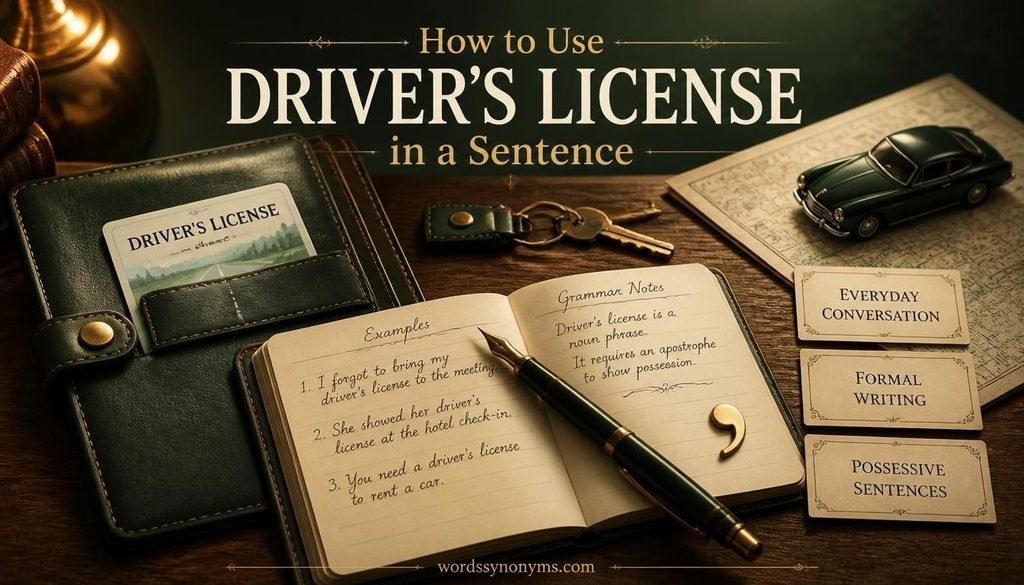
How to Use Driver’s License in a Sentence
Knowing the correct spelling is important. However, you also need to understand how the expression works in everyday sentences.
Driver’s license commonly appears in conversations about identification, driving privileges, applications, renewals, and legal requirements.
Here are practical examples from different situations.
Driver’s License in Everyday Conversation
People frequently mention their driver’s licenses when discussing driving, identification, or routine errands.
Consider these examples:
- I left my driver’s license in the other jacket.
- Do you have your driver’s license with you?
- She finally received her driver’s license yesterday.
- My driver’s license expires next summer.
- He showed his driver’s license to the security officer.
- You should keep your driver’s license somewhere safe.
- I need my driver’s license to rent a car.
- Her driver’s license was damaged in the washing machine.
These examples use the singular possessive because each sentence refers to an individual driver’s document.
Driver’s License in Formal and Official Writing
Formal writing often involves applications, government instructions, and administrative procedures.
In these situations, accuracy matters because the wording may relate to legal requirements or official documents.
Here are some examples:
- Applicants must present a valid driver’s license during registration.
- Please provide your driver’s license number on the application.
- The applicant’s driver’s license must remain valid throughout the process.
- A photocopy of the driver’s license may be required for verification.
- The driver’s license must match the identification details provided.
- Applicants should renew their driver’s licenses before expiration.
Notice the difference in the final sentence. Drivers’ licenses would be appropriate if the sentence referred to licenses belonging to multiple applicants.
When writing official material, always check whether the relevant agency uses driver license as its prescribed terminology.
Driver’s License in Questions
Questions about licenses frequently appear in everyday conversations and customer service situations.
Here are some natural examples:
- Do you have a valid driver’s license?
- When does your driver’s license expire?
- Where did you get your driver’s license?
- Have you renewed your driver’s license?
- Can I use my driver’s license as identification?
- What documents do I need to replace my driver’s license?
- How long does it take to receive a new driver’s license?
- Did you bring your driver’s license to the appointment?
These examples show how the expression works naturally in different sentence structures.
You can also use it in indirect questions:
- She asked whether my driver’s license was valid.
- The officer wanted to know when his driver’s license expired.
- I don’t remember where I placed my driver’s license.
The apostrophe remains unchanged regardless of whether the expression appears in a statement or question.
Driver’s License in Possessive Sentences
Sometimes, a sentence contains more than one possessive expression. This can make apostrophe placement confusing.
For example:
- My brother’s driver’s license expired last week.
- The employee’s driver’s license needs verification.
- Sarah’s driver’s license was issued in another state.
- The applicant’s driver’s license contains an incorrect address.
In these sentences, both nouns use singular possessive forms.
The apostrophe in brother’s identifies the relationship between the brother and the license. The apostrophe in driver’s identifies the credential associated with the driver.
This construction is perfectly natural in English.
Common Mistakes When Writing Driver’s License
Even familiar expressions can cause punctuation problems. The phrase driver’s license is especially confusing because several spellings appear in everyday and official writing.
Understanding these common mistakes will help you avoid them.
Using Drivers License Without an Apostrophe
This is one of the most frequent errors.
- Incorrect: I forgot my drivers license.
- Correct: I forgot my driver’s license.
The word drivers is plural. It doesn’t express the intended singular possessive relationship.
Add the apostrophe before the s to create the conventional form.
Confusing Driver’s and Drivers’
These two forms aren’t interchangeable.
- Driver’s: Singular possessive.
- Drivers’: Plural possessive.
For example:
- The driver’s license was expired.
- The drivers’ licenses were expired.
The first sentence refers to one driver. The second refers to multiple drivers.
Assuming Driver License Is Always Incorrect
Not every expression without an apostrophe is a spelling mistake.
Some government agencies officially use driver license as their administrative term.
For example, the Texas Department of Public Safety uses driver license throughout its licensing materials. New York’s DMV also uses the same form in its driver manual.
Your Texas Drivers License / ID+2
Therefore, you shouldn’t automatically correct the wording when quoting an official document.
Mixing American and British English
Another common mistake involves combining different regional spelling conventions.
For example:
- American English: Driver’s license.
- British English: Driving licence.
If you’re writing an article for American readers, stick with American spelling throughout the article.
Consistency makes your writing easier to follow.
Capitalizing Driver’s License Unnecessarily
In ordinary sentences, driver’s license doesn’t require capitalization.
For example:
- Incorrect: I Renewed My Driver’s License Yesterday.
- Correct: I renewed my driver’s license yesterday.
However, capitalization may be appropriate in titles, headings, official document names, and agency-specific labels.
For example:
- Driver’s License Requirements
- Texas Driver License Application
Always distinguish ordinary sentence capitalization from title case and official names.
Using the Wrong Plural Form
A license belonging to one driver becomes driver’s license. When referring to several licenses belonging to several drivers, use drivers’ licenses.
Avoid writing driver’s licenses when you specifically mean licenses belonging to multiple drivers.
However, driver’s licenses can also be grammatically correct when referring to multiple licenses associated with one driver, such as licenses from different jurisdictions or different periods. Context determines the intended meaning.

Driver License vs. Driver’s License vs. Drivers License: Real-World Usage
The difference between conventional grammar and official terminology becomes clearer when you examine actual government wording.
Government agencies don’t always use identical labels. Their terminology can differ even when they describe the same general document.
Example: California Driver License Terminology
California’s Department of Motor Vehicles uses both forms in its published materials.
Its official information includes the heading Driver’s Licenses. Other California DMV materials use driver license when describing the credential.
California DMV+1
This demonstrates that both spellings can appear within the same agency’s materials.
The important lesson is that official wording can vary by document and context.
Example: Texas Driver License Terminology
Texas provides another clear example of the spelling without an apostrophe.
The Texas Department of Public Safety uses Driver License Services and Apply for a Texas Driver License in its official materials.
Its application instructions also repeatedly use driver license when discussing licensing requirements and procedures.
Your Texas Drivers License / ID+1
This spelling is an established part of Texas’s administrative terminology.
Example: New York Driver License Terminology
New York’s Department of Motor Vehicles also uses driver license without an apostrophe.
Its driver manual includes a chapter titled Driver Licenses. The document uses the expression throughout its explanations of licensing rules and application procedures.
NY DMV
These examples show why it’s inaccurate to claim that driver license is always a mistake.
The difference isn’t simply about correct and incorrect spelling. It also involves the distinction between conventional English usage and official terminology.
Read more: “In Fact”: When to Use a Comma Before and After It
Driver License vs. Driver’s License vs. Drivers License: Final Comparison
Now that you’ve seen the grammatical rules and real-world examples, let’s bring everything together.
The following table summarizes the differences and helps you choose the appropriate spelling.
| Expression | Singular/Plural | Apostrophe | Recommended Usage |
| Driver | Singular | No | One person who drives |
| Driver’s license | Singular possessive | Before s | Standard American English |
| Driver license | Singular compound expression | No | Official terminology in some states |
| Drivers | Plural | No | Two or more drivers |
| Drivers’ licenses | Plural possessive | After s | Licenses associated with multiple drivers |
| Drivers license | Plural noun construction | Missing | Generally avoid |
Here are the essential rules to remember:
- Use driver’s license in ordinary American English writing.
- Use driver license when following an official agency’s terminology.
- Avoid drivers license in standard writing.
- Use drivers’ licenses when referring to licenses associated with multiple drivers.
- Use driving licence when following standard British English conventions.
The apostrophe isn’t decorative punctuation. Its placement changes the grammatical meaning of the expression.
FAQs
1. Is it driver’s license or drivers license?
Driver’s license is the standard spelling in American English. The apostrophe shows that the license belongs to or is issued to an individual driver.
2. Is driver license grammatically correct?
Yes. Driver license is an accepted form used in official government terminology. Some states and government agencies use it on forms and identification documents.
3. Why does driver’s license need an apostrophe?
The apostrophe indicates possession. It connects the singular noun driver with the license issued to that person.
4. What is the plural form of driver’s license?
The usual plural form is driver’s licenses. The apostrophe stays after driver because each license belongs to an individual driver.
5. When should you use drivers’ licenses?
Use drivers’ licenses when referring to licenses belonging to multiple drivers. The apostrophe after s marks plural possession.
6. Is drivers license acceptable in formal writing?
Generally, no. Drivers license without an apostrophe is not the standard possessive form. Use driver’s license unless an official agency specifies driver license.
Conclusion
Choosing between driver’s license, driver license, and drivers license becomes easier once you understand the apostrophe rule. In standard American English, driver’s license is the preferred spelling because it shows possession. However, driver license also appears in official government terminology, so context matters. Remember that drivers’ licenses has a different meaning because it refers to licenses belonging to multiple drivers. These small punctuation differences can make your writing clearer and more accurate.
Before using the phrase, consider where and why you’re writing it. For emails, school assignments, articles, and professional documents, driver’s license is generally the safest choice. If you’re completing an official form, follow the spelling used by the relevant government agency. A quick grammar check can prevent unnecessary mistakes and help your writing look polished.

Shafiq Ur Rehman is a writer and content contributor at WordsConfusing.com. He enjoys exploring the English language, common word confusions, vocabulary, and practical writing tips. His goal is to make English easier to understand through clear, simple, and useful articles.