
Forgot or Forgotten: Which Is Correct? becomes easier when you understand these irregular verb forms.
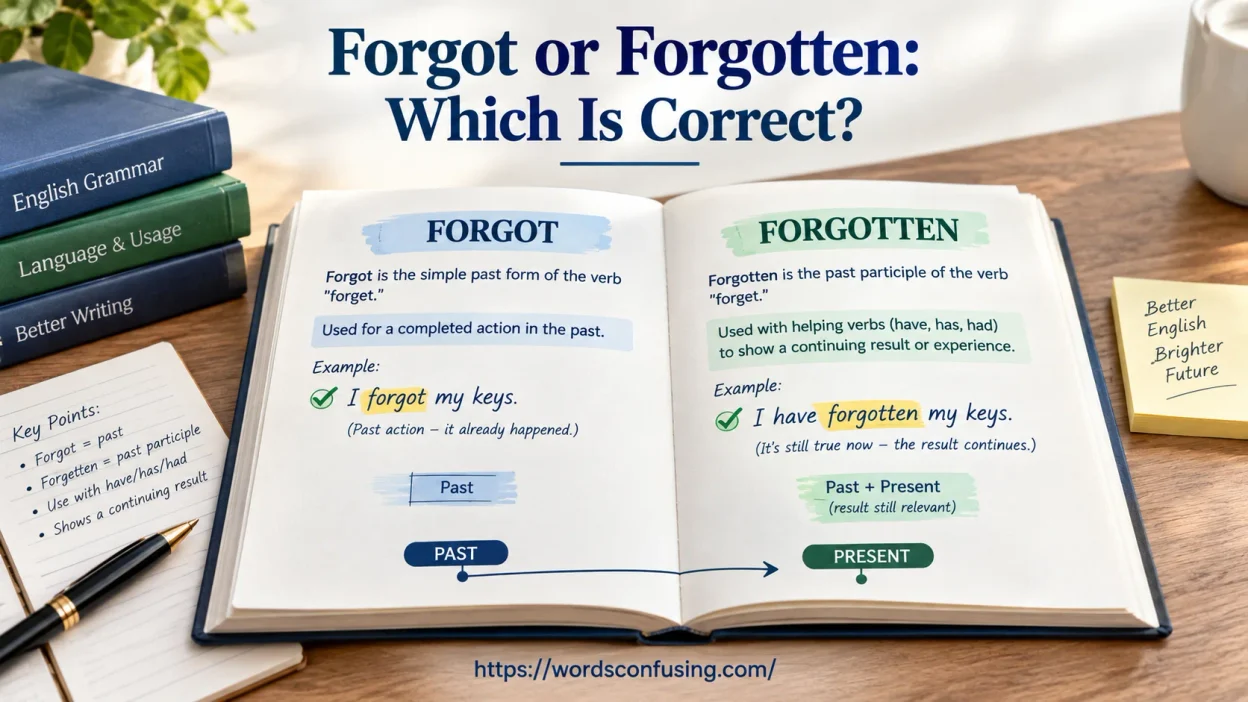
Forgot is the simple past form of forget, while forgotten is the standard past participle. The main verb pattern is forget, forgot, forgotten. You use forgot for a completed action in the past, such as forgetting a password yesterday. You use forgotten with auxiliary verbs like have, has, and had.
This grammar rule helps you choose the correct form and avoid common mistakes in everyday English grammar. The difference becomes clearer when you focus on each verb’s grammatical role and sentence structure.
These verb forms also matter in formal writing, speaking, and everyday English. In professional situations, correct English usage supports clear communication, credibility, and accuracy.
The same principle applies to business communication, workplace communication, meetings, scheduling, time management, online booking, and project management.
Learning these usage rules gives you a simple way to remember which form belongs in each sentence. With regular practice, you can use both forms confidently and make your writing sound more natural.
Quick Answer
The easiest rule is this:
- Forget = base form
- Forgot = simple past
- Forgotten = past participle
- Forgetting = present participle or -ing form
- Forgets = third-person singular present form
Use forgot when describing a completed event in the past.
Example:
I forgot my password yesterday.
Use forgotten with auxiliary verbs such as have, has, or had.
Example:
I have forgotten my password.
You can also use forgotten in passive constructions.
Example:
The old password was forgotten.
One particularly important rule involves did. After did or didn’t, use the base form forget, not forgot.
Correct: Did you forget the appointment?
Incorrect: Did you forgot the appointment?
Think of it this way: forgot can stand as the main past-tense verb, while forgotten usually needs grammatical support.
Forgot vs. Forgotten: The Main Difference
The central difference between forgot and forgotten is grammatical rather than semantic. Both words relate to the act of failing to remember something, but English uses them in different verb structures.
Forgot is the simple past tense of forget. It tells you that something happened at a past point or during a completed past period.
Forgotten is the past participle. It commonly appears with an auxiliary verb in perfect constructions, such as have forgotten, has forgotten, and had forgotten.
Consider these examples:
| Sentence | Verb form | Explanation |
| I forget names easily. | Forget | Present/base form |
| I forgot his name. | Forgot | Simple past |
| I have forgotten his name. | Forgotten | Present perfect |
| I had forgotten his name. | Forgotten | Past perfect |
| His name was forgotten. | Forgotten | Passive construction |
The meaning remains closely connected, but the grammar changes the relationship between the action and the time being discussed.
What Does “Forgot” Mean?
Forgot is the simple past form of forget.
You use it when you describe something that happened in the past. The action may have happened yesterday, last year, five minutes ago, or at another completed point in time.
For example:
- I forgot my keys this morning.
- She forgot his birthday last week.
- We forgot to buy milk.
- They forgot the address.
- He forgot what the teacher said.
Notice how naturally forgot works with finished past situations.
You don’t need have, has, or had before it.
What Does “Forgotten” Mean?
Forgotten is the past participle of forget.
A past participle doesn’t normally function as the simple past form. Instead, it commonly works with auxiliary verbs.
For example:
- I have forgotten your name.
- She has forgotten the instructions.
- They had forgotten the meeting.
- The tradition was forgotten.
- His contribution should never be forgotten.
The word forgotten can also function as a participial adjective.
For example:
- a forgotten village
- a forgotten promise
- a forgotten tradition
- a forgotten language
Here, forgotten describes a noun rather than simply expressing a completed verb action.
Forget, Forgot, Forgotten: The Complete Verb Forms
Because forget is an irregular verb, its past forms don’t follow the usual -ed pattern.
You don’t say forgetted. Instead, English uses forgot and forgotten.
| Verb form | Word | Example |
| Base form | forget | I sometimes forget names. |
| Third-person singular | forgets | She often forgets appointments. |
| Simple past | forgot | I forgot the address. |
| Past participle | forgotten | I have forgotten the address. |
| Present participle | forgetting | He is forgetting the details. |
This distinction matters because English tense formation depends heavily on verb forms.
For regular verbs, learners often get used to adding -ed. For instance:
- walk → walked → walked
- work → worked → worked
- remember → remembered → remembered
Irregular verbs behave differently.
With forget, the pattern is:
forget → forgot → forgotten
That makes memorizing the three principal forms especially useful.
When to Use “Forgot”
“Forgot” for a Completed Past Action
Use forgot when you describe something that happened in the past.
For example:
- I forgot my umbrella yesterday.
- Maria forgot the meeting.
- Tom forgot his locker combination.
- We forgot the restaurant’s name.
- She forgot her passport at home.
These sentences place the forgetting in a past situation.
The sentence can include a specific past-time expression, but it doesn’t have to.
Compare:
I forgot my keys.
I forgot my keys yesterday.
Both are grammatically correct. The second sentence simply gives more information about when the forgetting happened.
“Forgot” After “Did” or “Didn’t”
This is one of the most common mistakes involving forgot.
When did carries the past tense, the main verb returns to its base form.
Therefore:
Did + forget
Not:
Did + forgot
For example:
- Did you forget your wallet?
- Did she forget the appointment?
- Why did he forget my name?
- When did they forget the instructions?
The same rule applies to negative sentences:
- I didn’t forget your birthday.
- She didn’t forget the address.
- We didn’t forget the tickets.
The reason is straightforward. Did already marks the sentence as past tense. Adding forgot would duplicate the past-tense marking.
A useful rule is:
After did or didn’t, use the base form of the verb.
So you say:
Did you forget?
Not:
Did you forgot?
“Forgot” in Questions and Negative Sentences
Simple past questions often use did:
- Did you forget the appointment?
- Why did she forget the password?
- When did he forget about the deadline?
Simple past negatives use didn’t:
- I didn’t forget.
- She didn’t forget the address.
- They didn’t forget the instructions.
However, positive statements don’t require did unless you want emphasis.
- I forgot the keys.
- She forgot the meeting.
You can also use did for emphasis:
I did forget the keys.
That sentence emphasizes that the speaker genuinely forgot them.
When to Use “Forgotten”
“Forgotten” With “Have” or “Has”
Use forgotten with have or has when forming the present perfect.
The basic structure is:
have/has + past participle
Since forgotten is the past participle of forget, you get:
- I have forgotten.
- You have forgotten.
- We have forgotten.
- They have forgotten.
- She has forgotten.
- He has forgotten.
For example:
I have forgotten where I parked the car.
The sentence doesn’t simply report a finished past event. It connects the past forgetting with the present situation.
The speaker still doesn’t know where the car is.
That’s an important difference.
“Forgotten” With “Had”
Use forgotten after had to form the past perfect.
The structure is:
had + past participle
For example:
I had forgotten the appointment before you reminded me.
Two past events appear in that sentence:
- The person forgot the appointment.
- Someone reminded the person later.
The past perfect identifies the earlier event.
More examples include:
- She had forgotten the password before the meeting started.
- We had forgotten the address when we reached the neighborhood.
- He had forgotten about the deadline until his manager called.
This construction becomes especially useful when you need to establish which past event happened first.
“Forgotten” in Passive Constructions
Forgotten can also appear in passive sentences.
The structure commonly looks like:
be + forgotten
For example:
- The old tradition was forgotten.
- His contribution was quickly forgotten.
- The village had been forgotten for decades.
- Her kindness will never be forgotten.
Here, the sentence focuses on the person, thing, or idea that experienced the forgetting rather than the person who forgot it.
Compare:
Active:
People forgot the old tradition.
Passive:
The old tradition was forgotten.
The meaning is related, but the grammatical focus changes.
Forgot vs. Forgotten in Different Tenses
The following table shows how the two forms behave in common constructions.
| Tense or construction | Correct form | Example |
| Simple present | forget | I often forget names. |
| Simple past | forgot | I forgot her name. |
| Present perfect | have/has forgotten | I have forgotten her name. |
| Past perfect | had forgotten | I had forgotten her name. |
| Future perfect | will have forgotten | I will have forgotten it by then. |
| Present continuous | am/is/are forgetting | I am forgetting the details. |
| Passive | be + forgotten | The story was forgotten. |
The pattern becomes easier once you separate tense from verb form.
The simple past uses forgot directly.
Perfect constructions use forgotten after an auxiliary verb.
That distinction explains most cases where learners hesitate between the two.
“I Forgot” vs. “I Have Forgotten”
These two sentences can describe closely related situations, but they don’t always carry the same emphasis.
“I Forgot”
I forgot uses the simple past.
It generally presents the forgetting as a completed past event.
For example:
I forgot my wallet yesterday.
The word yesterday clearly places the event in a finished past period.
Another example:
I forgot her phone number during the meeting.
The sentence reports what happened.
“I Have Forgotten”
I have forgotten uses the present perfect.
It connects a past event with the present.
For example:
I have forgotten her phone number.
The practical message is that the number isn’t remembered now.
This distinction becomes clearer in context:
Past event:
I forgot my wallet yesterday.
Present result:
I have forgotten where I put my wallet.
The first sentence emphasizes when the forgetting occurred. The second emphasizes the current consequence.
“I Forgot” vs. “I Have Forgotten” Comparison
| Sentence | Main emphasis |
| I forgot his name. | A past event |
| I have forgotten his name. | I don’t remember it now |
| I forgot the address. | The past act of forgetting |
| I have forgotten the address. | The address isn’t remembered now |
| I forgot to call her. | The missed action occurred |
| I have forgotten to call her. | The omission still matters |
Context can influence the exact nuance. However, the grammatical distinction remains useful.
“I Forgot” vs. “I Had Forgotten”
The difference between these forms involves two points in the past.
Use forgot when you simply report a past event.
I forgot the appointment.
Use had forgotten when the forgetting occurred before another past event.
I had forgotten the appointment before my friend reminded me.
The word had establishes an earlier past reference point.
Consider this sequence:
First: I forgot the appointment.
Second: My friend reminded me.
A sentence can express that sequence as:
I had forgotten the appointment when my friend reminded me.
The past perfect makes the timeline especially clear.
You don’t need past perfect every time two past events occur. Simple past can often handle the sequence when context already makes it obvious. However, had forgotten becomes valuable when the order needs emphasis or clarification.
Forgot to vs. Forgot + -ing
This distinction deserves special attention because changing the structure can change the meaning.
Forgot to Do Something
Use:
forget + to + verb
when someone fails to remember that they need to perform an action.
For example:
I forgot to lock the door.
This means the person didn’t remember to perform the action.
Other examples include:
- She forgot to send the email.
- He forgot to bring his notebook.
- We forgot to book a table.
- They forgot to charge the phone.
The action after to did not happen because the person failed to remember it.
Forgot Doing Something
Use:
forget + -ing
when referring to a past event or experience that someone no longer remembers.
For example:
I forgot meeting him years ago.
This means the meeting happened, but the memory of it disappeared.
Compare the two meanings:
| Structure | Meaning | Example |
| forgot to + verb | Failed to perform an intended action | I forgot to call her. |
| forgot + -ing | No longer remembered a past event | I forgot calling her. |
The distinction can produce a surprisingly different message.
Consider:
I forgot to lock the door.
The door wasn’t locked because the speaker failed to remember.
Now consider:
I forgot locking the door.
The speaker means the door was locked, but the memory of doing it disappeared.
That difference is small in form but substantial in meaning.
Read more: Flew or Flown: Which Is Correct?
Can “Forgotten” Stand Alone?
In standard grammar, forgotten usually appears as a past participle within a larger construction.
For example:
- I have forgotten.
- She has forgotten.
- They had forgotten.
- It was forgotten.
However, forgotten can also appear as a participial adjective.
Consider:
The forgotten village sat beyond the mountain.
Here, forgotten describes the village. It tells you that people no longer remembered or paid attention to it.
Other examples include:
- a forgotten promise
- a forgotten tradition
- a forgotten language
- a forgotten hero
- a forgotten chapter
In these cases, forgotten behaves much like an adjective.
Is “Forgotten” an Adjective?
Yes, forgotten can function adjectivally depending on the sentence.
Compare:
Verb:
She has forgotten the promise.
Adjective-like modifier:
The forgotten promise still mattered.
In the first sentence, forgotten forms part of the present perfect verb phrase.
In the second, it directly modifies promise.
This distinction matters because English often allows past participles to develop adjective-like uses.
Words such as broken, closed, finished, and forgotten can all operate this way depending on context.
Common Mistakes With Forgot and Forgotten
Understanding the rules becomes easier when you see the mistakes learners make most often.
“I Have Forgot” vs. “I Have Forgotten”
The standard form is:
I have forgotten.
Not:
I have forgot.
Why? Because have requires the past participle in the present perfect.
The pattern is:
have/has + past participle
Therefore:
- I have forgotten.
- She has forgotten.
- They have forgotten.
“I Had Forgot” vs. “I Had Forgotten”
The same principle applies after had.
Correct:
I had forgotten the appointment.
Incorrect in standard English:
I had forgot the appointment.
The past perfect requires:
had + forgotten
“Did You Forgot?” vs. “Did You Forget?”
This mistake occurs because learners recognize that the sentence refers to the past and automatically choose forgot.
However, did already carries the past-tense marking.
Correct:
Did you forget your keys?
Incorrect:
Did you forgot your keys?
The formula is simple:
Did + base verb
Therefore:
- Did you forget?
- Did she remember?
- Did they leave?
- Did he call?
Not:
- Did you forgot?
- Did she remembered?
- Did they left?
- Did he called?
Forgot vs. Forgotten in Everyday Situations
Grammar becomes much easier when you connect it with ordinary situations.
At School
I forgot my homework this morning.
This describes a completed past event.
I have forgotten what the teacher explained.
This emphasizes the speaker’s current lack of memory.
At Work
She forgot the meeting yesterday.
The sentence reports a past event.
She has forgotten the meeting details.
The sentence highlights what she doesn’t remember now.
While Traveling
We forgot our passports.
This reports the mistake.
We have forgotten where we parked the rental car.
This connects the earlier forgetting with the current problem.
In Daily Conversations
Sorry, I forgot your name.
This is a natural way to acknowledge that you don’t remember someone’s name.
You can also say:
Sorry, I’ve forgotten your name.
Both forms occur in natural English. The present perfect places slightly more emphasis on the current state of not remembering.
A Practical Case Study: One Situation, Different Verb Forms
Imagine someone preparing for a job interview.
First, they fail to write down the interview time.
Simple past:
I forgot to write down the interview time.
Later, they realize they can’t remember it.
Present perfect:
I’ve forgotten what time the interview starts.
Then, they explain what happened before receiving a reminder.
Past perfect:
I had forgotten the interview time until my friend reminded me.
Finally, they describe the information that disappeared from their memory.
Participial adjective:
The forgotten appointment became a source of confusion.
The underlying idea remains similar throughout. The grammatical structure changes according to the relationship between the forgetting and the surrounding events.
Common Expressions With “Forgot” and “Forgotten”
Certain expressions appear frequently in everyday English.
“Forget It”
Forget it can mean several things depending on context.
It may mean that someone should stop worrying about something.
Forget it. It’s not important.
It can also mean that an idea or plan should be abandoned.
Forget it. We’ll take the train instead.
Tone matters here. Depending on delivery, the expression can sound casual, dismissive, frustrated, or reassuring.
“Never Forgotten”
Never forgotten commonly describes something or someone that people continue to remember.
For example:
Her kindness will never be forgotten.
The construction uses will be + forgotten, creating a future passive meaning.
Another example:
The historic event remains unforgettable and will never be forgotten.
“Long Forgotten”
Long forgotten describes something that people stopped remembering a long time ago.
For example:
The ruins tell the story of a long-forgotten settlement.
Here, forgotten modifies settlement.
The phrase often appears in historical, literary, and descriptive writing.
“Forgotten About”
Forget about is a common construction in conversational English.
For example:
I completely forgot about the appointment.
Here, about introduces the thing that slipped from someone’s attention.
More examples include:
- Don’t forget about your homework.
- She forgot about the deadline.
- We had completely forgotten about the old plan.
The phrase often emphasizes something that disappeared from someone’s attention rather than simply disappearing from memory.
A Simple Decision Guide: Forgot or Forgotten?
When you’re unsure, ask yourself what comes before the verb.
Use “Forgot” When:
- You’re describing a simple past event.
- No perfect auxiliary is required.
- The sentence directly reports what happened.
- You’re using did only as a question or emphasis marker.
Examples:
- I forgot my keys.
- She forgot the address.
- Why did you forget?
- I didn’t forget.
Use “Forgotten” When:
- It follows have.
- It follows has.
- It follows had.
- It appears in a passive construction.
- It modifies a noun as a participial adjective.
Examples:
- I have forgotten.
- She has forgotten.
- We had forgotten.
- The promise was forgotten.
- A forgotten tradition survived.
Quick Grammar Rules to Remember
If you only remember a handful of rules, make them these:
- Forgot = simple past.
- Forgotten = past participle.
- Use have/has + forgotten for the present perfect.
- Use had + forgotten for the past perfect.
- Use be + forgotten in passive constructions.
- After did, use forget, not forgot.
- Use forgot to + verb when someone failed to remember an action.
- Use forgot + -ing when someone no longer remembers a past event.
- Forgotten can also work as an adjective-like participle.
- Forget → forgot → forgotten is the key verb-form sequence.
Forgot vs. Forgotten: Examples at a Glance
| Situation | Correct sentence | Why? |
| Simple past | I forgot my keys. | Forgot is the simple past. |
| Present perfect | I have forgotten my keys. | Have + forgotten forms present perfect. |
| Past perfect | I had forgotten my keys. | Had + forgotten forms past perfect. |
| Past question | Did you forget your keys? | Did + base form |
| Past negative | I didn’t forget my keys. | Didn’t + base form |
| Passive | My keys were forgotten. | Were + forgotten |
| Missed action | I forgot to bring my keys. | Forgot to + verb |
| Lost memory | I forgot bringing my keys. | Forgot + -ing |
Why This Difference Matters
At first glance, forgot and forgotten might seem interchangeable. They aren’t.
Using the wrong form can make a sentence grammatically incorrect or change its meaning.
Compare:
I forgot my password.
This tells you that the forgetting happened.
Now:
I have forgotten my password.
This naturally suggests that the password remains unavailable from memory.
Likewise:
Did you forget the appointment?
works because did already establishes the past.
Did you forgot the appointment?
doesn’t follow the standard English auxiliary-verb pattern.
These aren’t merely stylistic preferences. They reflect the underlying structure of English verb grammar.
FAQs
Is “forgot” or “forgotten” correct?
Both forgot and forgotten are correct, but they serve different grammatical purposes. Forgot is the simple past form, while forgotten is the past participle.
What is the past tense of “forget”?
The simple past tense of forget is forgot. For example, you can say, “I forgot my keys this morning.”
When should I use “forgotten”?
Use forgotten when the sentence needs a past participle. It commonly appears with have, has, or had, such as “She has forgotten the appointment.”
Can I say “I have forgot”?
In standard English, “I have forgotten” is the correct form. Have requires the past participle forgotten, not the simple past forgot.
Is “forgotten” also an adjective?
Yes. Forgotten can sometimes work as an adjective when it describes something that has been overlooked, neglected, or no longer remembered. The surrounding sentence usually makes its role clear.
What is an easy way to remember “forgot” and “forgotten”?
Think of forgot as the simple past and forgotten as the past participle. If you see have, has, or had, forgotten is usually the form you need.
Conclusion
Choosing between forgot and forgotten becomes much simpler once you recognize their roles. Use forgot for the simple past, while forgotten works as the past participle with have, has, or had. Keeping that basic pattern in mind can prevent many everyday grammar mistakes.
With a little practice, you’ll start noticing the difference naturally while writing and speaking. Whether you’re sending a quick message, writing professionally, or having an everyday conversation, using the right form helps your English sound clearer, smoother, and more confident.