


When Was the Letter “J” Invented? And Was It Before Jesus? Explore its origins, early writing systems, and journey through the English alphabet.
The letter J is one of the recent additions to the English alphabet, although its roots go back much further. To understand when it was invented, we must explore the history of the letter J, its origin, and its development through different writing systems. The alphabet history includes the ancient alphabet, Greek alphabet, Hebrew alphabet, Latin alphabet, and Roman alphabet tradition.
These systems influenced letter origins, English letters, and the evolution of letters. This linguistic history explains alphabet evolution, alphabet development, and language development, which shaped our written language and written communication. The early writing systems of ancient languages also reveal how letter formation and the alphabetic system changed over time.
The distinction between I and J is essential to understanding this story. For centuries, letter I and J appeared as variations of the same character, although their sounds gradually became different. The J sound eventually developed, leading to the introduction of J as an independent letter.
This letter invention reflects broader linguistic evolution, language origins, historical linguistics, and the history of writing. So, was J before Jesus? Its early written form existed long before Jesus, but J became a distinct letter much later.
Understanding the language before J and the historical use of letters helps establish a clearer historical timeline of how the English alphabet reached its modern form.
Quick Answer:
The letter J became a separate letter from I during the 15th and 16th centuries, with Italian scholar Gian Giorgio Trissino helping establish the distinction in 1524. Since Jesus lived in the first century, J wasn’t a separate letter during his lifetime. His name passed through forms such as Yeshua, Greek Iēsous, and Latin Iesus before becoming Jesus in English.

When Was the Letter J Invented?
The letter J became distinct from I during the 15th and 16th centuries. The year 1524 is an important milestone because Gian Giorgio Trissino advocated distinguishing the two letters in Italian.
However, saying that J was invented in 1524 doesn’t tell the whole story. People had used forms resembling J before the letter gained its independent status.
The modern letter emerged through gradual changes in handwriting, printing, and pronunciation. Different languages also adopted the distinction at different times.
How the Letter J Developed From I
The history of J begins with the Latin alphabet used by ancient Romans. In that alphabet, I represented both a vowel sound and a consonant sound similar to the English Y.
For example, the Latin name Iulius is the source of the English name Julius. The initial sound in the Latin form was closer to a Y than the J in modern English jump.
Because one letter represented different sounds, readers relied on context and established pronunciation patterns. This arrangement worked for centuries, even though it differed from modern English spelling conventions.
Over time, writers began using different forms of I to distinguish its functions. Some handwriting styles added a tail or flourish to I, creating a shape that gradually developed into J.
Printers later helped make these visual differences more consistent. Eventually, I represented the vowel while J represented a consonant in many European writing systems.
Why 1524 Matters in the History of J
Gian Giorgio Trissino was an Italian Renaissance scholar interested in improving the way written letters represented spoken sounds. In 1524, he published work advocating clearer distinctions between letters, including I and J.
His proposal helped give the J distinction a formal linguistic foundation. It also made it easier to represent certain consonant sounds separately from the vowel sound associated with I.
However, Trissino didn’t create the letter’s entire shape from nothing. Earlier scribes had already used modified forms of I, and the change continued after his proposal.
Think of it this way: a familiar object can exist before people agree on its name or function. Similarly, a J-shaped character could appear in writing before people treated J as an independent alphabet letter.
The key distinction is that 1524 marks an important step toward separating I and J, not the first appearance of every J-like symbol.
Who Invented the Letter J?
Gian Giorgio Trissino is often called the father of the letter J because of his role in distinguishing it from I.
Born in 1478, Trissino was a writer, poet, and scholar during the Italian Renaissance. His work explored language, pronunciation, and the relationship between written letters and spoken sounds.
His contribution matters because alphabets work best when readers can recognize meaningful differences between sounds. When one letter serves several functions, spelling and pronunciation can become less predictable.
Gian Giorgio Trissino’s Role in J’s History
Trissino argued that Italian writing could benefit from distinguishing sounds that the existing alphabet represented with the same letter. His proposals included separating I and J and making other distinctions in written Italian.
The distinction between I and J eventually became useful beyond the specific reforms Trissino proposed. Printers and scholars continued developing spelling conventions as printed books became more widespread.
His 1524 work is therefore a useful historical landmark. It shows that scholars were actively reconsidering how letters should represent sounds during the Renaissance.
Still, it would be misleading to say that Trissino invented every part of modern J or immediately changed the alphabet throughout Europe.
Why J Wasn’t Invented by One Person Alone
Letters develop through shared habits as much as through individual ideas. A scholar might suggest a distinction, but writers, printers, teachers, and readers must adopt it before it becomes standard.
J followed this pattern. Earlier scribes used modified forms of I, Renaissance scholars proposed clearer distinctions, and printers helped spread new conventions.
Different languages also followed different paths. Some adopted J as a separate letter, while others continued using different letters to represent similar sounds.
For instance, modern Italian generally writes the sound in English jam with combinations involving G rather than using J in native Italian words. Spanish uses J for a different sound, often resembling an English H.
These examples show why the history of J cannot be reduced to one person or one date. Trissino helped formalize an important distinction, but centuries of writing practices shaped the letter we recognize today.
Read more: What Does “Pipeline” Mean in a Business Context?
Did the Letter J Exist Before Jesus?
No, J did not exist as a separate letter during Jesus’ lifetime. However, the ancestor of J, the letter I, had existed for centuries.
Jesus lived in the first century CE, when the Roman alphabet was already in use. Roman writers used I as both a vowel and a consonant, rather than treating I and J as fully separate letters.
The distinction that produced the modern English alphabet developed much later. By the Renaissance, European scholars and printers were increasingly treating I and J as separate letters.
This means Jesus could not have written his name using the modern English letter J in its current form and function. His name belonged to a different linguistic and writing tradition.
What Did the Alphabet Look Like During Jesus’ Lifetime?
The Roman alphabet during the first century CE differed from the English alphabet you know today. It did not use I and J as two fully independent letters.
Latin inscriptions and manuscripts used I for vowel sounds and certain consonant sounds. The letter’s precise pronunciation depended on the word, the period, and the language being spoken.
Meanwhile, Jesus lived in a region where several languages were used. Aramaic was widely spoken among Jewish communities, Hebrew held an important religious and literary role, and Greek was widely used across the eastern Roman Empire.
Each language had its own writing traditions. None required the modern English letter J to represent the name of Jesus.
Does This Mean the Name Jesus Didn’t Exist?
No. The absence of a separate J doesn’t mean the name itself didn’t exist.
A name can survive as it moves between languages, even when its spelling and pronunciation change. For example, the same person may have a different written name in English, Spanish, Arabic, or Greek.
The English spelling Jesus reflects a long process of linguistic change. It doesn’t reproduce the exact spelling that people used in first-century Aramaic.
The same principle applies to many ancient names. We commonly write Julius Caesar in English, even though the Latin spelling was Iulius Caesar.
The modern spelling helps English readers identify a historical person. It doesn’t mean that ancient Romans used precisely the same spelling conventions.
What Was Jesus’ Name Before the Letter J Existed?
The name commonly associated with Jesus in his Jewish and Aramaic-speaking setting was Yeshua, a form related to the Hebrew name Yehoshua.
These names have a long history in Jewish tradition. Yehoshua is also the Hebrew name represented in English as Joshua.
The forms Yeshua and Yehoshua are related, but they shouldn’t be treated as identical spellings from every historical period. The shorter form became common in later Hebrew and Aramaic contexts.
When the name moved into Greek and Latin, each language adapted it to its own sounds and grammatical patterns. The English form Jesus developed through this broader history.
The Name Yeshua in Its Historical Context
Yeshua was a personal name used in Jewish communities during the period associated with Jesus. Its longer relative, Yehoshua, appears much earlier in Hebrew tradition.
The name is commonly understood in relation to the Hebrew expression for divine salvation. Its historical forms reflect the linguistic traditions of the people who used it.
Jesus’ name would not have been written in English during his lifetime. English as we know it developed later, and its modern alphabet conventions were not available to first-century speakers.
It is also important to avoid assuming that everyone in the region used one language in every situation. People could speak one language in everyday life and encounter another in religious, administrative, or commercial settings.
The historical question isn’t simply what English spelling existed at the time. It is how the name was spoken and written within its original linguistic setting.
How Yeshua Became Iesus and Then Jesus
The development of the English name can be summarized through several stages:
- Hebrew: Yehoshua is an older form related to the name.
- Aramaic: Yeshua was a form used in the linguistic environment of first-century Jewish communities.
- Greek: The name appeared as Iēsous (Ἰησοῦς) in Greek texts.
- Latin: Greek Iēsous was represented as Iesus in Latin.
- English: The familiar spelling Jesus emerged as English spelling and the distinction between I and J developed.
This pathway illustrates how languages adapt names to their own writing systems. Greek did not reproduce every sound of the source language exactly. Instead, it used the letters and sound patterns available to Greek speakers.
Latin then adopted the Greek form, and English inherited the name through the history of Latin, French, and English usage.
The modern spelling didn’t appear because the historical person suddenly acquired a new name. It developed because languages and spelling conventions changed.

How Did J Become a Separate Letter From I?
The development of J involved more than a change in handwriting. It also reflected a growing desire to represent different speech sounds with different letters.
In ancient Latin, I could represent a vowel or a consonant resembling Y. Over time, writers began using a modified form of I to mark the consonant more clearly.
The distinction gradually spread through European writing. By the 16th and 17th centuries, printers and language scholars were helping establish the separate identities of I and J.
When I and J Were the Same Letter
For much of their shared history, I and J were considered forms of the same letter. Their shapes could differ, but the distinction wasn’t always meaningful in the way it is today.
Medieval scribes sometimes used a longer I with a descending stroke. Such forms could help distinguish the final I in a sequence of Roman numerals or make handwriting easier to read.
Consider the following examples:
| Historical form | Modern form | Explanation |
| Iulius | Julius | The initial Latin consonant was closer to Y. |
| Iesus | Jesus | The spelling changed as I and J became distinct. |
| Iohannes | Johannes | Related historical spellings reflect changing conventions. |
These examples demonstrate why old documents can look unfamiliar to modern readers. A historical spelling may represent the same name even when its letters differ from today’s version.
However, the use of a J-shaped character didn’t automatically mean writers considered it a separate letter. The shape came before the fully established distinction.
How Printing Helped Establish J
The spread of movable-type printing in Europe during the 15th century helped standardize written forms. Printers needed reusable metal characters, and consistent spelling made books easier to produce and read.
As printing expanded, different forms of I and J became more recognizable. Scholars also discussed how written letters should correspond to the sounds of their languages.
These developments didn’t happen everywhere at once. A convention might gain acceptance in one country while remaining uncommon elsewhere.
English spelling took time to settle into its modern form. Even after J appeared in print, some dictionaries and writing traditions continued grouping I and J together.
By the 17th century, the distinction was increasingly established in English usage. The process shows how printing can help turn a variation in handwriting into a standard feature of a writing system.
When Did J Become the Tenth Letter of the English Alphabet?
Today, J occupies the tenth position in the English alphabet, immediately after I. However, this familiar arrangement reflects a gradual historical process rather than an ancient rule.
Once I and J became distinct letters, alphabet lists and dictionaries could treat them separately. Their positions remained close because J developed from I.
The modern English alphabet contains 26 letters. Its present arrangement reflects centuries of changes in spelling, printing, and education.
J is often described as the last letter added to the English alphabet as a distinct letter. That description is useful as a general summary, but it needs context: the symbol and its earlier forms existed before its modern status became established.
When Did J Start Making Its Modern English Sound?
The history of the letter’s shape is closely related to, but not identical to, the history of its pronunciation.
Modern English J usually represents the consonant sound heard at the beginning of jam, jump, and jacket. Linguists write this sound as /dʒ/.
However, J doesn’t represent the same sound in every language. Spanish J commonly represents a sound similar to the H in English house. German J usually represents a sound similar to English Y.
These differences show that a letter’s name, shape, and sound are separate features. A writing system can use the same symbol differently depending on the language.
Why Modern J Sounds Different From Ancient Latin I
In Latin, I could represent a consonant similar to the Y in yes. That sound differs from the /dʒ/ sound of modern English J.
As Latin developed into different languages and influenced later European speech, consonant sounds changed. The sounds represented by I and J also developed differently across linguistic traditions.
English inherited many words and names through centuries of contact with Latin, French, and other languages. Their pronunciations evolved as they entered English.
Consequently, the J in Jesus doesn’t preserve the exact pronunciation associated with the earliest forms of the name. It reflects the development of English pronunciation and spelling.
Did Trissino Invent the Sound of J?
Trissino’s 1524 proposal helped distinguish I and J in writing, but it didn’t instantly create the modern English sound.
His reforms belonged to a broader effort to improve the relationship between spelling and pronunciation. The precise sound associated with J developed through language history rather than through a single person’s decision.
The distinction matters because inventing a letter and establishing its modern sound are not the same event.
A letter may acquire a new sound value, spread to another language, or change pronunciation over time. J’s history offers a clear example of all three processes.
Read more: What Is a Period of 25 Years Called? Meaning and Related Terms
Why Do We Spell Jesus With J If J Came Later?
The answer lies in the difference between a name’s history and its modern spelling.
The name Jesus passed through Greek and Latin before becoming established in English. During much of that history, I and J weren’t fully separate letters.
As European spelling conventions changed, the written form developed into the version familiar to English readers. The name retained its identity even as its spelling and pronunciation evolved.
This process isn’t unusual. Many historical names have different forms in different languages.
For example, the Latin name Iulius is written as Julius in modern English. The change doesn’t mean Julius Caesar lived after the modern letter J appeared. It means English uses a later spelling convention for an ancient name.
The same principle applies to Jesus. The familiar English form reflects the history of English, not the writing system used during his lifetime.
Does the Late Development of J Make the Name Jesus Incorrect?
No. The historical development of a spelling doesn’t automatically make that spelling inaccurate.
When people discuss ancient figures in modern English, they generally use familiar English names. We write Socrates, Julius Caesar, and Jesus rather than trying to reproduce every original spelling convention.
Transliteration—the process of representing a word from one writing system in another—often changes how a name looks. Pronunciation can change as well.
For example, Greek adapted names from Hebrew and Aramaic using Greek letters and sound patterns. Latin then represented those Greek names according to Latin conventions.
English inherited forms shaped by those earlier languages. The resulting spellings may differ from the original names without erasing their historical connections.
Why Some People Prefer the Name Yeshua
Some people use Yeshua because they want to emphasize the Jewish and linguistic context of Jesus’ life. Others use Jesus, the familiar English form used in centuries of Christian writing and worship.
These choices often reflect religious, cultural, or linguistic preferences. The historical development of the names can be explained without dismissing either usage.
From a linguistic perspective, the essential point is that Yeshua, Greek Iēsous, Latin Iesus, and English Jesus belong to a connected history of naming.
The modern English J doesn’t need to have existed in the first century for the name’s historical roots to reach that period.
Timeline of the Letter J: From Ancient I to Modern English
The timeline below separates the development of the character from the history of the name Jesus. These milestones help explain why J’s origin can’t be assigned to one exact year.
| Period | What happened | Why it matters |
| Ancient Rome | Latin used I for vowel and consonant sounds. | J’s historical ancestor was already in use. |
| First century CE | Jesus lived in a multilingual region where Aramaic, Hebrew, and Greek had important roles. | His name belonged to a linguistic world that didn’t use modern English spelling. |
| Middle Ages | Scribes used modified forms of I in some writing traditions. | The visual form associated with J developed gradually. |
| 15th century | European printing spread and helped standardize written forms. | Separate letter shapes became easier to reproduce consistently. |
| 1524 | Gian Giorgio Trissino advocated distinguishing I and J. | This became an important milestone in the letter’s history. |
| 16th–17th centuries | The distinction gained wider acceptance in European writing. | J increasingly functioned as a separate letter. |
| Modern English | J became firmly established as the tenth letter of the alphabet. | Its spelling and pronunciation became familiar features of English. |
The timeline shows that the history of J spans centuries. Its ancestor existed in antiquity, its shape developed over time, and its status as a separate letter emerged much later.
It also explains why the name Jesus can be ancient even though its familiar English spelling is comparatively recent.
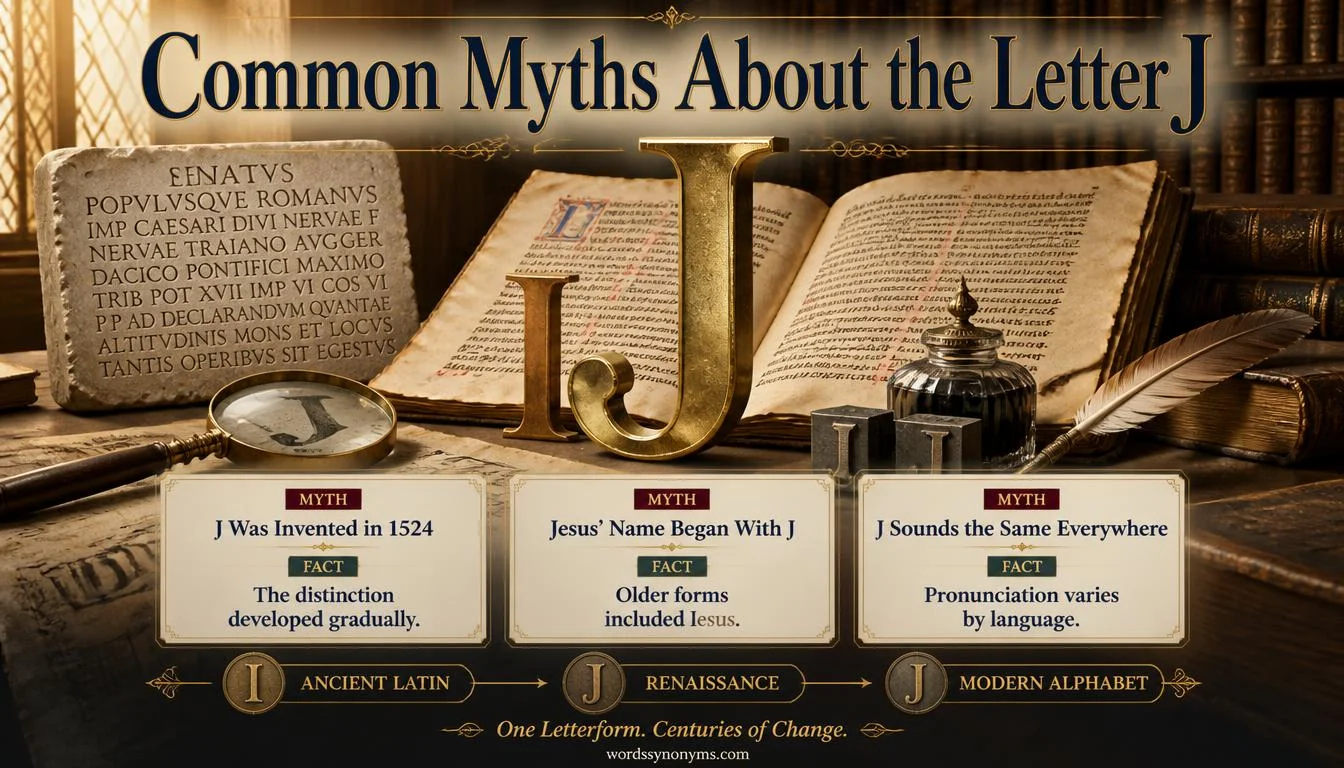
Common Myths About the Letter J
Several popular claims about J’s history contain a grain of truth but leave out important details. Understanding the difference helps prevent confusion about both the alphabet and Jesus’ name.
Myth: Gian Giorgio Trissino Invented J in 1524
Fact: Trissino helped establish the distinction between I and J, but the character had earlier forms.
Writers had already used modified versions of I before 1524. Trissino’s contribution helped formalize the distinction between letters and sounds.
The year 1524 is an important milestone, not a precise date for the first appearance of every J-shaped character.
Myth: Nobody Could Write Jesus’ Name Before J Existed
Fact: People wrote the name using the writing systems available to them.
The Greek form Iēsous and the Latin form Iesus existed long before J became a separate English letter. These forms reflect the adaptation of a name across languages.
The modern English spelling developed later. It doesn’t mean the name itself began in the Renaissance.
Myth: The Letter J Has Always Made the Same Sound
Fact: J represents different sounds in different languages, and its pronunciation changed historically.
Modern English J usually represents /dʒ/, as in jump. German J commonly represents /j/, the sound heard in English yes.
Spanish J generally represents a different consonant sound, often similar to English H. The letter’s pronunciation depends on the language and its history.
Myth: J Didn’t Exist in Any Form Before 1524
Fact: J-like forms existed before the letter gained its independent status.
Scribes sometimes used a modified I, including forms with a tail. These shapes gradually contributed to the modern letter.
The important distinction is between seeing a character that resembles J and recognizing J as a separate letter in the alphabet.
Myth: The Name Jesus Was Invented After the Letter J
Fact: The English spelling developed later, but the name has much older linguistic roots.
The Greek Iēsous and Latin Iesus connect the English form to earlier Hebrew and Aramaic forms. The change from I to J affected the written form, not the historical beginning of the name.
This is why the question “When was J invented?” doesn’t have the same answer as “When did the name Jesus originate?”
FAQs
1. When was the letter J invented?
The letter J developed from the letter I over many centuries. It became a distinct letter during the Middle Ages and gained wider recognition in the 16th century.
2. Was the letter J invented before Jesus?
No, not as a separate letter. Although its early written form existed before Jesus was born, J developed into an independent letter much later.
3. What letter was used before J existed?
The letter I was used for both vowel and consonant sounds in Latin writing. Over time, writers began distinguishing I and J to represent different sounds.
4. Who invented the letter J?
Italian Renaissance scholar Gian Giorgio Trissino helped establish the distinction between I and J in the 16th century. However, he did not create the letter from scratch. Its development happened gradually.
5. Why were I and J considered the same letter?
In ancient Latin writing, I represented both vowel and consonant sounds. J began as a longer or modified form of I before writers increasingly used it for a separate consonant sound.
6. When did J become part of the English alphabet?
J became established as a separate letter in English during the 16th and 17th centuries. Before that, writers often used I for sounds that English speakers now associate with J.
Conclusion
The history of the letter J shows how languages and writing systems change over time. Although J is now a familiar part of the English alphabet, it wasn’t always a separate letter. Its story began with I, which served both vowel and consonant sounds in early Latin writing. As pronunciation and writing habits evolved, people gradually began using I and J for different purposes.
So, when was the letter J invented, and was it before Jesus? The answer depends on what you mean by invented. Its early written form existed long before Jesus, but J became an independent letter many centuries later. During the 16th century, scholars helped establish the distinction between I and J, making written language clearer and more consistent.
This change also reminds us that alphabets aren’t fixed systems. Letters can develop new shapes, sounds, and uses as languages evolve. From ancient Latin writing to modern English, the history of the letter J reflects centuries of linguistic development. Today, J appears in countless names and everyday words, including Jesus, journey, and joy. It’s fascinating to realize that a letter we use so naturally has such a long and gradual history.

Shafiq Ur Rehman is a writer and content contributor at WordsConfusing.com. He enjoys exploring the English language, common word confusions, vocabulary, and practical writing tips. His goal is to make English easier to understand through clear, simple, and useful articles.


