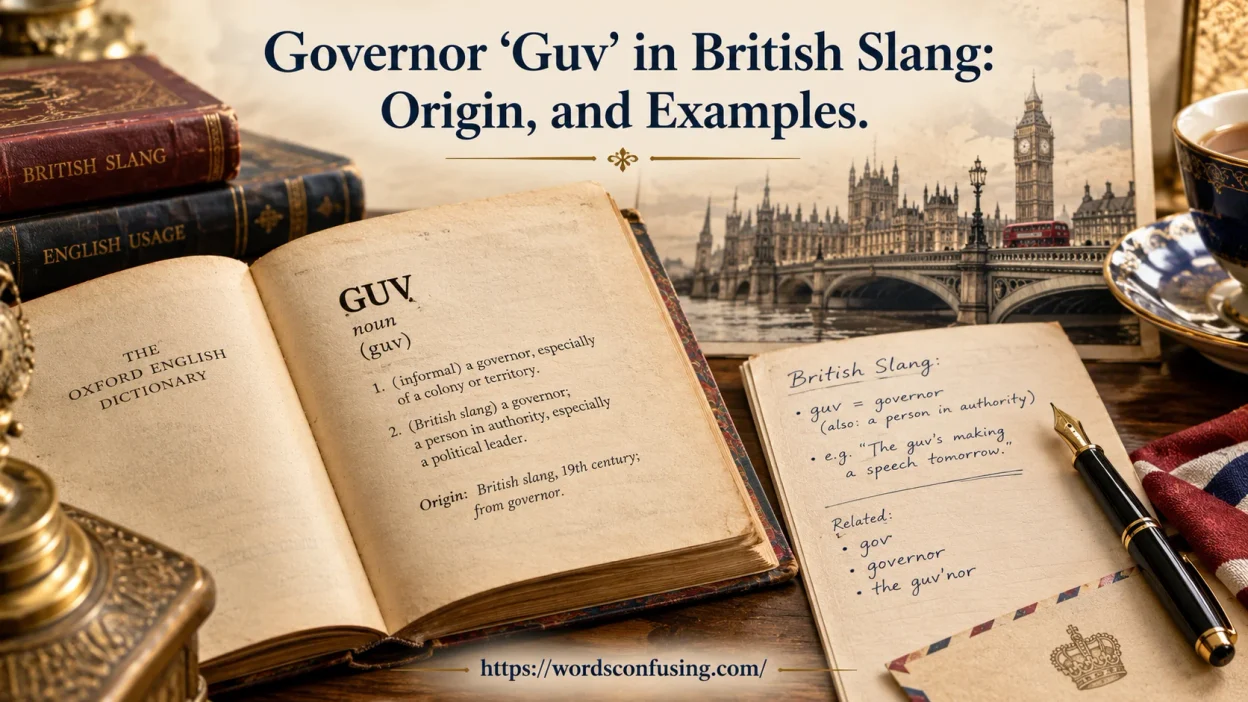
Governor “Guv” in British Slang: Origin, and Examples explains how this familiar expression became part of British slang and British English.
“Guv” is a shortened form of “Governor,” commonly used as an informal address for a person in authority. You might hear “Alright Guv” in a British movie, an old British TV show, or a television show featuring classic London speech.
This well-known expression has historical roots in Britain and remains associated with modern British slang. Its origin reflects language evolution and changing social relationships. Depending on the social context, it can communicate respectful address, friendliness, or familiarity.
In everyday language, “Guv” appears mainly in spoken communication, conversational English, and popular British expressions. Its use in literature, broadcasting, and popular culture has strengthened its cultural associations with London and British society. However, regional variations, social groups, and the speaker’s tone can influence its contextual meaning.
Understanding this informal speech improves your vocabulary, grammar knowledge, and awareness of appropriate language choices. Although it suits casual conversations, formal writing and professional business communication usually require more conventional forms of address.
Quick Answer:
In British slang, “guv” is an informal way to address a man, similar to “sir,” or refer to a boss or someone in charge. It comes from “guvnor,” a colloquial form of “governor.” For example, “Cheers, guv!” means “Thanks, sir!” while “Ask the guv” means “Ask the boss.”
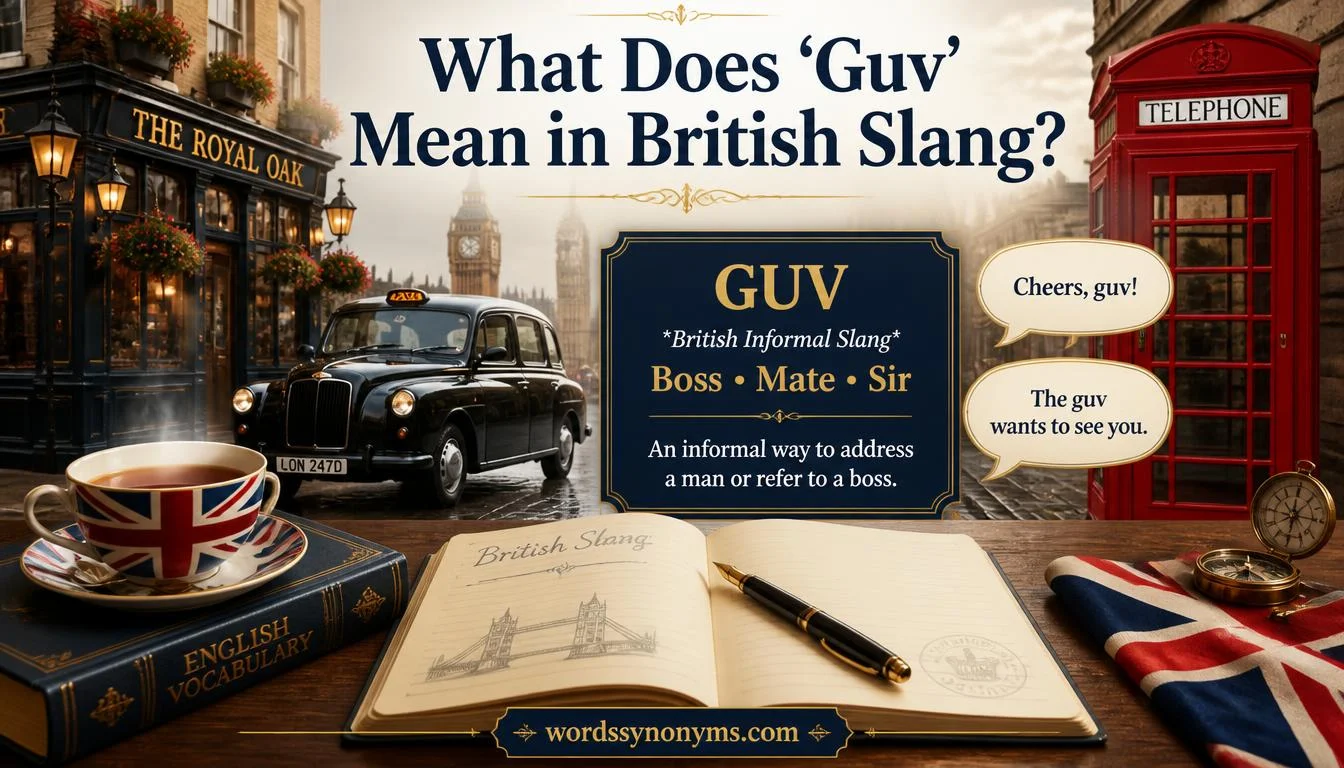
What Does “Guv” Mean in British Slang?
“Guv” is an informal British English word used to address a man or refer to a person in charge. Depending on the situation, it can sound friendly, respectful, familiar, or slightly old-fashioned.
For example, a shopkeeper might say, “There you go, guv,” while handing a customer his receipt. A worker might tell a colleague, “The guv wants to see you,” meaning the boss wants to speak with them.
The word doesn’t usually describe a person’s official job title. Instead, it works as a conversational expression that can signal familiarity or acknowledge someone’s authority.
What Does “Guv” Mean in a Conversation?
The meaning of “guv” becomes clearer when you hear it in a sentence. Speakers generally use it in two main ways.
First, “guv” can address someone directly. A person might use it when speaking to a male customer, stranger, colleague, or superior.
Examples include:
- “What can I get you, guv?”
- “Cheers, guv. That’s very kind of you.”
- “Right away, guv.”
- “Here you are, guv. Have a good day.”
In these examples, “guv” works as an informal form of address. Depending on the situation, it may serve a similar purpose to “sir,” although it sounds less formal.
Second, “the guv” can refer to a boss or person in charge. This use treats the word as a noun rather than simply a way to address someone.
For example:
- “Ask the guv before changing the schedule.”
- “The guv wants everyone in the office.”
- “I’ll check with the guv and get back to you.”
In these sentences, “the guv” means the boss or someone with authority over a particular situation.
The distinction is simple: “Thanks, guv” addresses a person, while “the guv” identifies someone in charge.
Is “Guv” a Respectful or Informal Word?
“Guv” is informal, but that doesn’t automatically make it disrespectful. Its tone depends on how people use it and how well they know each other.
In a casual service interaction, it may sound friendly or politely familiar. In a workplace where people use traditional forms of address, it might acknowledge a supervisor’s position.
However, some people may find it overly familiar, especially during a formal introduction or serious professional discussion. Others may associate it with older styles of British speech or fictional police dialogue.
Consider these examples:
| Expression | Likely impression |
| “Thanks, guv!” | Friendly and informal |
| “Yes, guv.” | Familiar and potentially deferential |
| “Thank you, sir.” | More formal and respectful |
| “The guv has approved it.” | Informal reference to a boss |
These are general impressions rather than fixed rules. A person’s tone, relationship with the listener, and local speech habits can change how an expression sounds.
Where Does “Guv” Come From?
The word “guv” is commonly traced to “guvnor,” a colloquial form of “governor.” Over time, the expression developed an informal role in British speech, particularly when addressing a man or referring to a boss.
The connection makes more sense when you consider how English speakers shorten words in everyday conversation. People often reduce longer expressions to forms that are quicker and easier to say.
For instance, “laboratory” sometimes becomes “lab,” while “advertisement” may become “ad.” These shortened forms can become familiar words in their own right.
“Guv” follows a similar pattern, although its history involves changes in pronunciation and the development of colloquial meanings.
The Origin of “Governor” as Slang
The standard word “governor” refers to someone who governs or holds a position of authority. It can describe an official who oversees a state, region, institution, or organization.
In colloquial British English, however, “governor” has also been used to mean a boss, employer, or other person in charge. This informal meaning helped establish the word’s connection with authority in everyday speech.
“Guvnor” reflects a spoken form of “governor” that became associated with familiar British expressions. “Guv” is a shorter version used in direct address and informal references to authority figures.
The development illustrates an important feature of slang: a word can keep its original association while acquiring a more casual meaning.
A governor in government holds a specific official role. A person called “guv” in a shop or workplace doesn’t necessarily hold any government position.
The shared word history doesn’t mean the two uses are interchangeable in every context. Their meanings depend on how speakers employ them.
When Did “Guv” First Appear?
The expression has historical roots in British colloquial English, but its precise starting point is difficult to establish from dictionary evidence alone.
The date attached to a word can vary depending on what a reference work tracks. One dictionary may record the first known use of “guv,” while another may focus on “guvnor” or an earlier form of “governor.”
These distinctions matter because the earliest surviving written example isn’t necessarily the first time people spoke the word. Informal expressions often circulate in conversation long before someone records them in print.
The development of “guv” should therefore be understood as part of a broader history of colloquial British English rather than an invention that can confidently be assigned to one person or exact moment.
Its connection to “governor” and “guvnor” provides the clearest explanation of its linguistic background. Claims about a specific inventor, neighborhood, or first conversation would require stronger historical evidence.
What Is the Difference Between “Guv,” “Guvnor,” and “Governor”?
Although these three forms are related, they don’t always serve the same purpose. Their spelling and context help readers understand whether someone means an official, a boss, or simply the man they’re addressing.
| Word | Meaning | Typical use |
| Guv | Informal term of address for a man; sometimes a reference to a boss | Casual British conversation |
| Guvnor / Guv’nor | Colloquial form associated with a boss or person in authority | Informal speech and dialogue |
| Governor | Official authority figure; also an informal term for a boss | Formal contexts and colloquial expressions |
The formal word “governor” remains appropriate when discussing an actual officeholder. For example, “The governor announced the new policy” uses the word in its standard sense.
By contrast, “The guv wants to speak with you” normally refers to a boss or supervisor. No government position is implied.
“Guv” is especially useful in direct address because it is short and conversational. A person might say, “Morning, guv,” rather than using the longer “guvnor.”
The forms overlap, but they aren’t always interchangeable. A writer should choose the one that fits the intended meaning and tone.
Is “Guv” Short for “Governor” or “Guvnor”?
The clearest explanation is that “guv” is associated with “guvnor,” which represents a colloquial pronunciation of “governor.”
These forms belong to the same linguistic family. However, it helps to distinguish their relationship from the way people use them today.
- Governor: The standard spelling, used for official titles and informal references to a boss.
- Guvnor: A colloquial form associated with British speech.
- Guv: A shorter informal form often used to address a man.
For example, someone might say, “Ask the governor for approval” when referring to an official. In a workplace conversation, another person might say, “Ask the guv.”
The intended meaning comes from the context rather than the spelling alone. The word “governor” can be formal or colloquial, while “guv” generally signals informal speech.
Why Does “Guv” Sometimes Appear as “Guv’nor”?
The spelling “guv’nor” represents a colloquial pronunciation of “governor.” The apostrophe signals that the spoken form differs from the standard spelling.
You’ll also see “guvnor” without an apostrophe. Both spellings are used to represent the colloquial form, although a particular dictionary or publication may prefer one version.
“Guv” is shorter still. It works as a standalone term of address rather than requiring the longer form.
When writing an article or dialogue, consistency matters more than switching between spellings without a reason. Choose the form that fits the intended voice and follow it throughout the piece.
Read more: What Does Education Level Mean?
How Do British People Use “Guv” Today?
“Guv” remains a recognizable expression in British English, particularly in informal speech and familiar representations of British dialogue. However, recognition doesn’t mean everyone uses it regularly.
Some speakers may use it naturally in casual exchanges. Others may mainly recognize it from television, films, or older styles of speech.
Its use also depends on context. A service worker addressing a male customer may use it differently from an employee talking about a supervisor.
“Guv” When Addressing a Customer or Stranger
One familiar setting for “guv” is a casual exchange between a service worker and a male customer.
For example, someone might say:
- “What can I get you, guv?”
- “That’s five pounds, guv.”
- “There you go, guv. Keep the receipt.”
- “Cheers, guv. Have a good one.”
In these examples, the speaker uses “guv” as a conversational form of address. It can sound friendly without implying that the two people know each other.
However, it isn’t a universal British customer-service expression. Some workers may prefer “sir,” a person’s name, or no form of address at all.
The word may also feel dated or overly familiar to certain listeners. When speaking to someone you don’t know, it’s sensible to consider the setting and the other person’s response.
“Guv” When Addressing a Boss
Another use connects the word with workplace authority. In an informal workplace, a person might call a supervisor “guv” when speaking directly to them.
For example:
“Morning, guv. The delivery has arrived.”
Here, the speaker addresses the supervisor directly. The expression can suggest familiarity while still acknowledging the person’s position.
The phrase “the guv” works slightly differently:
“The guv wants the report before lunch.”
This sentence refers to the supervisor rather than addressing them. The speaker is talking about the person in charge to someone else.
The expression doesn’t necessarily imply a close personal relationship. It can simply reflect a familiar way of speaking about a boss.
Nevertheless, workplaces differ. A relaxed construction site, a traditional trade environment, and a corporate office may have different expectations about informal language.
“Guv” in British Films and Television
British crime dramas and police procedurals frequently use “guv” in dialogue involving officers and their superiors. A junior officer might say, “We’ve found something, guv,” when reporting new information.
The expression helps establish the relationship between the speakers. It can signal that one character is addressing someone who holds a higher rank or has authority over the investigation.
However, television dialogue doesn’t provide a complete picture of everyday British speech. Writers may use familiar expressions to establish a setting, evoke a particular style, or make characters sound recognizable.
This is especially important when interpreting older films or dramas. A phrase that appears frequently in scripted dialogue may be less common in some modern workplaces.
Treat television as an example of how “guv” is represented, not proof that every British speaker uses it.
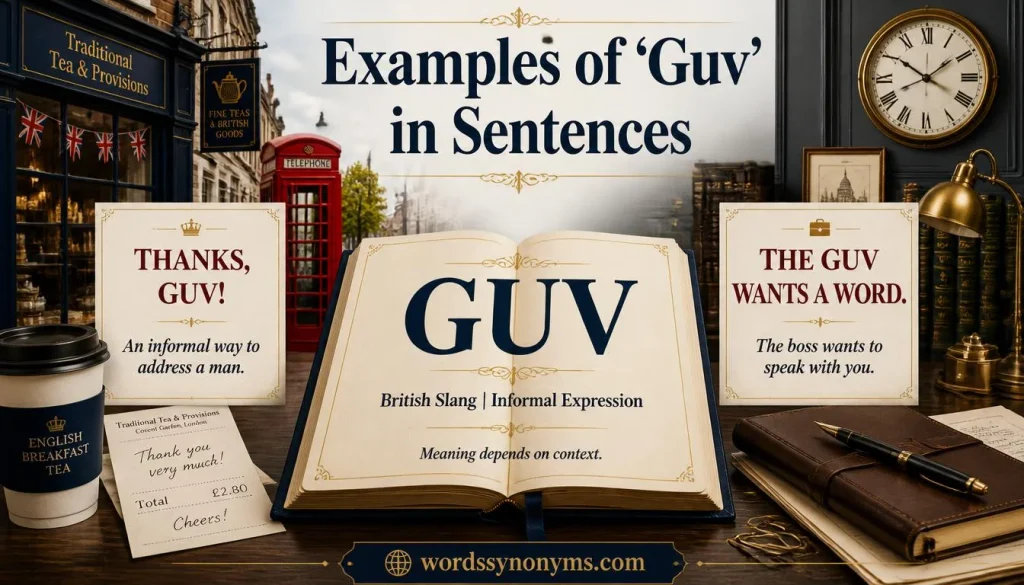
Examples of “Guv” in Sentences
The easiest way to understand “guv” is to see how it works in different situations. The following examples illustrate its main meanings in natural, informal British English.
| Example sentence | Meaning |
| “What can I get you, guv?” | A casual way to address a male customer |
| “Cheers, guv. I appreciate it.” | An informal expression of thanks |
| “Ask the guv before changing the schedule.” | Refers to the person in charge |
| “Right away, guv.” | A familiar response to a superior |
| “Here you are, guv. That’s your receipt.” | A service worker addresses a customer |
| “The guv wants everyone in the meeting room.” | Refers to a boss or supervisor |
| “We’ve found the missing keys, guv.” | Illustrates a familiar form of address in police-style dialogue |
| “Thanks for sorting that out, guv.” | A friendly expression of appreciation |
These sentences are illustrative examples rather than quotations from real conversations. They show how the meaning changes with sentence structure and context.
Example: “Thanks, Guv”
Imagine that someone helps you carry a heavy box into a shop. You might hear the person say, “Thanks, guv.”
The word functions as a casual term of address. It adds a familiar tone to the expression of gratitude, much like “thanks, mate” might in another conversation.
However, the two expressions aren’t identical. “Guv” may suggest a traditional or slightly deferential way of addressing a man, while “mate” more directly signals familiarity.
Example: “The Guv Wants a Word”
Suppose a worker tells a colleague, “The guv wants a word with you.”
In this situation, “the guv” refers to the boss or supervisor. The phrase “wants a word with you” means the person wants to speak with you.
The sentence doesn’t tell us whether the conversation will be positive or negative. Context may suggest a reason, but the words alone don’t establish one.
Example: “Morning, Guv”
A person might greet a male customer or colleague with “Morning, guv.”
The expression is informal and may sound friendly. Depending on the speaker and setting, it may also evoke traditional British working-class speech.
In a formal office or unfamiliar professional setting, “Good morning” is a safer choice. You don’t need to use slang to sound warm or approachable.
What Is the Difference Between “Guv” and “Mate”?
“Guv” and “mate” are both informal expressions used in British English, but they carry different associations.
“Guv” often connects with authority, service interactions, or a familiar form of address. “Mate” more commonly expresses friendship or casual familiarity.
Consider the following comparison:
| Expression | Typical meaning | General tone |
| Guv | Informal address for a man; sometimes a boss | Familiar, sometimes deferential |
| Mate | Friend or person addressed casually | Friendly and familiar |
| Sir | Respectful form of address | More formal |
| Boss | Person in charge; sometimes an informal form of address | Depends on context |
These descriptions are general rather than absolute. Tone, regional habits, and personal relationships can influence how each word sounds.
For example, a customer might hear “What can I get you, guv?” from a service worker. A friend might say, “You all right, mate?” during an informal conversation.
Both expressions address another person, but they create slightly different impressions.
Can You Use “Guv” Instead of “Sir”?
Sometimes, but the two words aren’t perfect substitutes.
“Sir” is widely understood as a respectful form of address and works in many formal situations. “Guv” is more informal and carries stronger associations with British colloquial speech.
Compare these examples:
- Informal: “Can I help you, guv?”
- Formal: “Can I help you, sir?”
Both sentences offer assistance. However, the second sounds more appropriate in many formal service environments.
If you’re unsure how someone prefers to be addressed, use their name when appropriate or choose a neutral, polite expression. Slang works best when it suits the setting rather than feeling forced.
Is “Guv” Cockney Slang?
“Guv” is associated with traditional London speech and is often linked with Cockney slang. However, the expression isn’t exclusive to Cockney speakers.
Cockney traditionally refers to a form of English associated with London, especially its East End. Its vocabulary, pronunciation, and cultural associations have influenced how people understand certain British expressions.
Because “guv” appears in portrayals of London working-class speech, people may associate it strongly with that setting. British crime dramas and films can reinforce the connection.
Still, an association with London doesn’t prove that a word originated in one particular neighborhood. Nor does it mean that only people from that area can use it.
It’s useful to separate three ideas:
- Regional association: A word is strongly linked with a particular place or speech community.
- Historical origin: Evidence shows where or when the word first developed.
- Modern usage: People use or recognize the word in present-day conversations.
These ideas overlap, but they aren’t interchangeable. The safest description is that “guv” is informal British slang with traditional London associations.
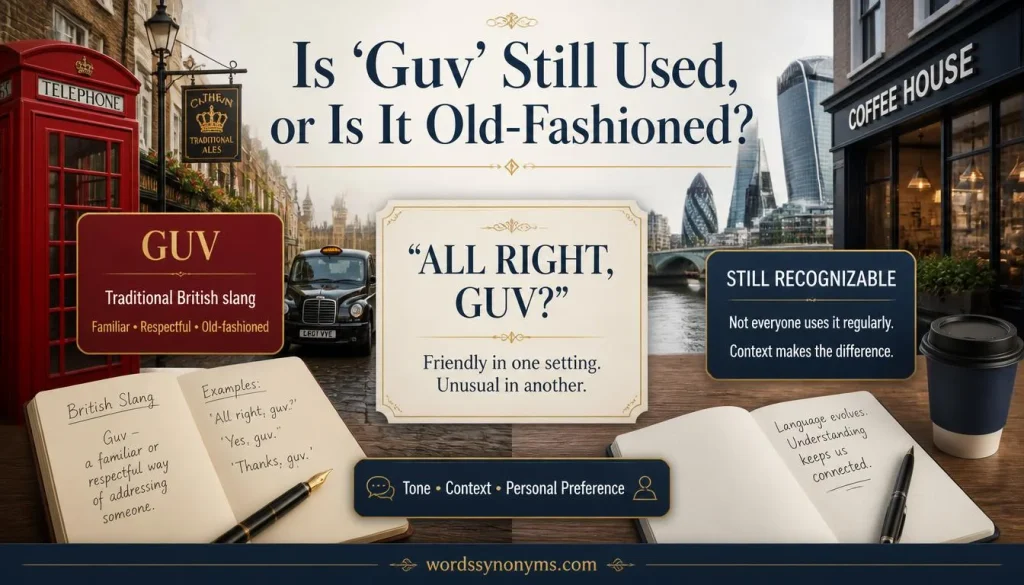
Is “Guv” Still Used, or Is It Old-Fashioned?
“Guv” remains recognizable, but it can sound old-fashioned or context-specific to some speakers. Its appearance in British media helps keep the expression familiar even when people don’t use it regularly.
A distinction between recognition and frequency is important here. Someone may understand “guv” immediately without ever using it in conversation.
The word’s tone can also depend on the setting. In a familiar workplace, it may sound natural. In a modern corporate office, it might seem unusual or overly casual.
There isn’t one universal rule for how often British people use it. Speech habits vary by region, age, occupation, social setting, and personal preference.
For writers, the practical lesson is straightforward: use “guv” when the context supports an informal British voice. Don’t add it to dialogue simply because a character is British.
Does “Guv” Sound Rude?
Not necessarily. “Guv” can sound friendly, respectful, or familiar when speakers use it naturally.
However, informal expressions can occasionally sound dismissive or patronizing. A sarcastic tone may change the impression of an otherwise ordinary phrase.
For example, “All right, guv?” might sound friendly during a casual exchange. Said sharply during an argument, it could sound mocking.
The word itself doesn’t automatically communicate disrespect. Tone and context carry much of the meaning.
Read more: What Are People From India Called?
When Should You Use “Guv”?
Use “guv” when you want an informal expression that fits a British conversational setting. It can work in casual dialogue, familiar workplace exchanges, or fictional writing that reflects a particular speech style.
However, it isn’t suitable for every situation. A word can be grammatically understandable yet still sound out of place in a formal environment.
When “Guv” Sounds Natural
The expression may fit naturally in these situations:
- Casual service interactions: A worker addresses a male customer informally.
- Familiar workplace conversations: Colleagues use traditional or relaxed forms of address.
- British dialogue: A character’s speech reflects a setting where the expression feels plausible.
- Informal exchanges with a supervisor: The workplace culture supports familiar language.
For example, “I’ll check with the guv” can sound natural in a casual workplace conversation. The same sentence might feel unusual in a formal corporate report.
When to Choose Another Word
Consider alternatives in these situations:
- Formal emails: Use the person’s name or an appropriate professional greeting.
- Academic writing: Avoid slang unless you’re discussing the word itself.
- First-time professional introductions: Choose a neutral and respectful form of address.
- Unfamiliar social situations: Avoid assuming someone will appreciate overly familiar language.
For instance, instead of writing “Dear Guv” in a business email, address the recipient by name when you know it. If you don’t know their name, choose a suitable professional greeting.
The goal isn’t to avoid slang altogether. It’s to use language that matches the audience, purpose, and setting.
FAQs
1. What does “guv” mean in British slang?
“Guv” is an informal British term derived from “governor.” People use it to address someone casually, often as a sign of familiarity or respect. For example, “Cheers, guv!” means “Thanks, mate!” in certain contexts.
2. Where did the word “guv” originate?
“Guv” developed as a shortened form of “governor” in British English. It became associated with traditional London speech and working-class culture. Movies, television, and popular culture later helped make the expression recognizable to wider audiences.
3. Is “guv” short for governor?
Yes, “guv” is a shortened, informal version of “governor.” However, it usually doesn’t refer to an actual government official. Instead, speakers use it as a casual form of address in everyday conversation.
4. Is “guv” a polite or rude expression?
“Guv” is generally friendly or respectful, but its meaning depends on the speaker’s tone and situation. Someone might say, “Here you go, guv,” in a polite exchange. However, using it sarcastically can make the same expression sound dismissive.
5. Do people still use “guv” in modern British English?
Yes, “guv” remains recognizable in modern British English, although its use varies by region, age, and social setting. You may hear it in casual conversations, British dramas, or portrayals of traditional London speech. It isn’t equally common in every part of Britain.
6. Can you use “guv” in formal writing or professional conversations?
It’s usually better to avoid “guv” in formal writing, business emails, and professional meetings. The expression sounds informal and may seem overly familiar with someone you don’t know well. Use a person’s name, title, or a more appropriate form of address instead.
Conclusion
“Guv” is a distinctive part of British slang that comes from the word “governor.” Over time, this shortened form became a familiar way to address someone in casual conversation. It’s often associated with traditional London speech, working-class culture, and classic British films and television shows. Depending on the situation, it can express friendliness, respect, or simple familiarity.
You might hear phrases such as “Cheers, guv,” “Alright, guv?” or “Thanks, guv” in informal exchanges. However, the expression doesn’t carry exactly the same meaning in every situation. A speaker’s tone, relationship with the listener, and regional background can all influence how it sounds. Although “guv” remains recognizable in modern British English, it’s not equally common among all age groups or communities.
Understanding expressions like “guv” can help you recognize the differences between formal English and everyday British speech. It also offers a glimpse into how language changes through culture, social interaction, and popular media. If you hear someone say “Alright, guv?” they’re usually offering a casual greeting rather than referring to an actual governor. Feel free to use the expression when the situation feels natural, but choose a more conventional form of address in professional conversations or formal writing.

Shafiq Ur Rehman is a writer and content contributor at WordsConfusing.com. He enjoys exploring the English language, common word confusions, vocabulary, and practical writing tips. His goal is to make English easier to understand through clear, simple, and useful articles.