
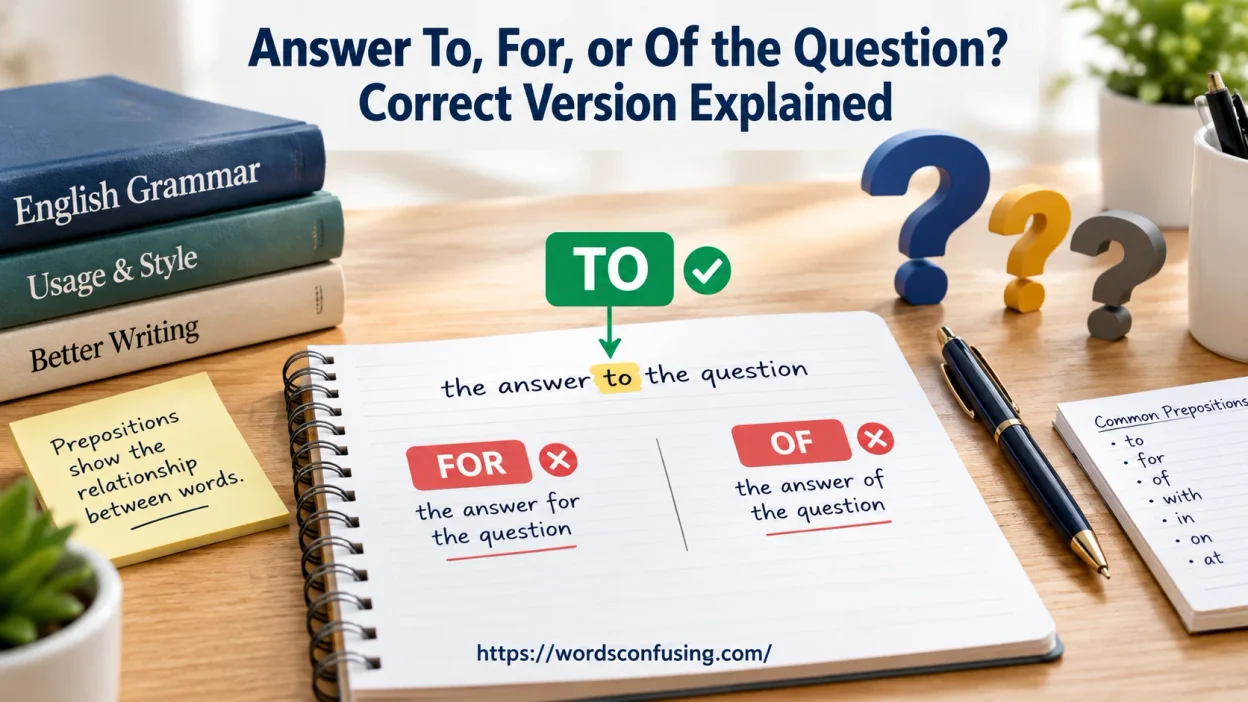
Answer To, For, or Of the Question? Correct Version Explained helps you choose the right preposition for accurate English usage with care.
When you’ve ever paused while writing an email and wondered about the correct phrase, this distinction can feel confusing. It is a common issue in English usage, particularly where accuracy matters in business communication, meetings, formal writing, and creating content.
Choosing the right form can improve clarity, professionalism, and reader confidence, while careful grammar choices can have a real impact on professional settings such as project management, scheduling, time management, online booking, broadcasting, and a shared calendar.
Precise language also reduces misunderstandings when you need an answer to a question, an answer for someone, or an answer of something. The rules of grammar may seem stylistic, but context, meaning, and consistency matter in written communication and spoken communication.
This guide covers the exact difference, practical examples, usage tips, and common mistakes involving answer to, answer for, and answer of. Native speakers generally follow common usage when they choose among prepositions, although the rules we associate with these forms can vary by context.
Typically, an acceptable expression depends on the question and its intended meaning in real-world communication. This article can build a stronger grasp of English usage, improve formal writing skills, and make your everyday conversation and professional communication more natural.
Quick Answer
The correct phrase depends on how you use answer in the sentence.
- Answer the question — correct when answer is a verb.
- The answer to the question — correct when answer is a noun.
- Answer for something — correct when answer for means take responsibility for something.
- Answer to someone — correct when it means be accountable to someone.
- Answer of the question — generally incorrect when you mean the response to a question.
- Answer for the question — usually incorrect when you mean the response to a question.
For example:
Please answer the question.
Here, answer is a verb.
Compare it with:
I know the answer to the question.
Here, answer is a noun, so to introduces the thing the answer relates to.
That small grammatical difference explains most of the confusion.
Is It “Answer the Question” or “Answer to the Question”?
Both expressions can be correct, but they have different grammatical structures.
The important question isn’t simply which preposition sounds right. Instead, look at the role of answer in the sentence.
“Answer the Question” Is Correct
When answer works as a verb, it normally takes the question directly as its object.
The basic pattern is:
answer + object
Examples include:
- Please answer the question.
- She answered my question.
- Can you answer this question?
- The student answered every question correctly.
- He refused to answer the question.
Notice that no to appears between the verb and its object.
You wouldn’t normally say:
❌ Please answer to the question.
Instead, write:
✅ Please answer the question.
The same pattern works with other direct objects:
- answer the phone
- answer an email
- answer a letter
- answer a request
- answer a question
Here, answer directly connects with the thing being answered.
“The Answer to the Question” Is Correct
The structure changes when answer becomes a noun.
The usual pattern is:
the answer + to + noun
For example:
- What is the answer to this question?
- I know the answer to the question.
- She couldn’t find the answer to the problem.
- There isn’t an easy answer to this issue.
- The answer to your question is yes.
Here, to connects the noun answer with the question, problem, or issue it addresses.
This distinction is worth remembering:
You answer a question. You give an answer to a question.
That’s the central rule.
Why Does “Answer to the Question” Use “To”?
The preposition to often identifies the thing that an answer addresses or relates to.
Consider these examples:
- the answer to a question
- the answer to a problem
- the answer to an issue
- the answer to a puzzle
- the answer to a riddle
In each case, the noun answer connects with something that requires a response or solution.
For example:
The answer to the puzzle was surprisingly simple.
The puzzle needs a solution. The answer provides that solution.
Likewise:
We finally found the answer to the question.
The question creates a need for information. The answer supplies that information.
This is why “answer to the question” sounds natural in standard English.
The Grammar Pattern
You can remember the difference like this:
| Structure | Function | Example |
| answer + noun | Verb | Answer the question. |
| answer + to + noun | Noun | The answer to the question is obvious. |
The preposition isn’t random. It appears because the grammatical structure has changed.
When Should You Use “Answer To”?
Answer to has more than one legitimate use. Its meaning depends on what follows it.
The most familiar use describes a response or solution.
Answer to a Question
This is the construction most learners need.
Examples:
- What is the answer to the question?
- I don’t know the answer to your question.
- Her answer to the question was accurate.
- That isn’t the answer to my question.
Here, answer to means the response that addresses the question.
Answer to a Problem
You can also use answer to when answer means a solution.
For example:
Better planning may be the answer to this problem.
The problem isn’t literally asking a spoken question. Instead, answer means a solution.
Other examples include:
- Is there an answer to this problem?
- They found an answer to the technical issue.
- There may be no simple answer to this challenge.
This use shows why answer to isn’t limited to questions.
Answer to a Need
The expression can also describe something that satisfies a need.
For example:
The new system could be an answer to the company’s growing needs.
Here, answer means something that addresses a particular need.
The same structure appears in phrases such as:
- an answer to demand
- an answer to a need
- an answer to a challenge
- an answer to a problem
“Answer To Someone” Has a Different Meaning
Here’s where things get interesting.
Answer to someone can mean be accountable to that person or be under that person’s authority.
For example:
The department manager answers to the company president.
This doesn’t mean the manager responds to every question from the president.
Instead, it means the manager is accountable to the president.
More examples:
- Employees answer to their supervisors.
- The director answers to the board.
- The regional manager answers to the chief executive.
So, don’t assume every use of answer to relates to questions.
When Should You Use “Answer For”?
Answer for has a different meaning from answer to.
Most commonly, answer for means take responsibility for something or be held accountable for something.
For example:
You must answer for your actions.
That sentence doesn’t mean you need to provide a literal answer to a question.
It means you must accept responsibility for what you did.
Examples of “Answer For”
- He will have to answer for his decisions.
- Someone must answer for the damage.
- The manager may have to answer for the mistake.
- They should answer for their actions.
- You can’t make that decision and refuse to answer for it.
The construction often appears in serious or formal contexts.
“Answer For” and Accountability
Think of for as pointing toward the thing someone is responsible for.
Compare:
She answered the question.
This means she provided a response.
Now consider:
She answered for the mistake.
This means she accepted responsibility for the mistake.
The two structures look similar, but their meanings are worlds apart.
“Answer For Someone”
Answer for someone can also mean taking responsibility for another person’s behavior or actions.
For example:
I can’t answer for everyone on the team.
This means the speaker can’t claim responsibility for everyone’s views or actions.
Another example:
He can’t answer for his brother’s decisions.
The speaker is saying that one person shouldn’t be held responsible for another person’s choices.
Read more: Grew or Grown: Which One Is Correct?
Is “Answer of the Question” Correct?
In standard English, “answer of the question” is generally not the natural construction when you mean the response to a question.
The standard expression is:
the answer to the question
For example:
❌ What is the answer of the question?
✅ What is the answer to the question?
Likewise:
❌ I don’t know the answer of this question.
✅ I don’t know the answer to this question.
Why Do People Use “Of”?
The confusion often comes from other English expressions where of correctly connects two nouns.
For example:
- the color of the car
- the name of the student
- the beginning of the story
- the end of the movie
Because of frequently connects nouns, learners may assume it works in answer of the question.
English doesn’t always follow that kind of substitution.
Certain nouns conventionally pair with particular prepositions. Answer normally takes to when you identify the question or problem being addressed.
“Answer To the Question” vs. “Answer Of the Question”
The difference becomes clearer when you place the expressions side by side.
| Expression | Standard English? | Meaning |
| the answer to the question | ✅ Yes | The response to the question |
| the answer of the question | ❌ Generally no | Not the normal construction |
| answer the question | ✅ Yes | Respond to the question |
| answer to the question | ⚠️ Depends on structure | Usually needs answer as a noun |
| answer for the question | ❌ Usually no | Not the normal way to describe a response |
| answer for something | ✅ Yes | Take responsibility for something |
The safest choice is straightforward:
Use “answer to the question” when “answer” is a noun.
Is “Answer for the Question” Correct?
Usually, no.
If you mean that someone responds to a question, use:
answer the question
If you’re talking about the response itself, use:
the answer to the question
For example:
❌ Please answer for the question.
✅ Please answer the question.
And:
❌ I know the answer for the question.
✅ I know the answer to the question.
However, answer for isn’t grammatically wrong in every situation. It simply has another meaning.
For example:
He must answer for his actions.
That’s perfectly natural because for introduces something for which a person is accountable.
Why “Answer for the Question” Sounds Wrong
The problem is semantic as much as grammatical.
A question receives an answer.
A person can answer for an action, mistake, decision, or responsibility.
Therefore, these patterns are more natural:
- answer a question
- the answer to a question
- answer for an action
- answer for a mistake
- answer for a decision
“Answer” vs. “Respond”: Why the Preposition Changes
Another useful comparison involves answer and respond.
Both verbs can describe reactions to questions. However, they don’t always use the same grammatical pattern.
You can say:
She answered the question.
But with respond, standard English normally uses to:
She responded to the question.
This creates an easy trap for learners.
Compare These Structures
| Verb | Correct Structure | Example |
| answer | answer + object | She answered the question. |
| respond | respond + to + object | She responded to the question. |
| reply | reply + to + object | She replied to the question. |
That’s why “answer to the question” can sometimes feel tempting when you have learned respond to the question.
The verbs simply behave differently.
“Answer” vs. “Reply” vs. “Respond”
These words overlap, but they aren’t always interchangeable.
Answer
Answer commonly refers to providing information, a solution, or a response to a question.
She answered the question correctly.
It can also mean responding to a phone call or similar communication:
He answered the phone.
Respond
Respond is broader. It can describe reacting to a question, request, statement, event, or situation.
She responded to the complaint quickly.
The word often sounds slightly more formal.
Reply
Reply usually refers to responding to something someone has said, written, or communicated.
He replied to my email.
The important grammar point is that reply normally takes to when identifying what receives the reply.
Common Mistakes With “Answer To, For, or Of”
Several errors appear repeatedly because English learners transfer patterns from other verbs.
Mistake: “Answer to the Question”
This phrase isn’t always wrong. The problem comes when answer functions as a verb.
❌ Please answer to the question.
✅ Please answer the question.
However:
✅ I know the answer to the question.
The first sentence uses answer as a verb. The second uses it as a noun.
Mistake: “Answer of the Question”
❌ What is the answer of the question?
Use:
✅ What is the answer to the question?
The noun answer normally takes to when referring to the question it addresses.
Mistake: “Answer for the Question”
❌ Please give me the answer for the question.
More natural:
✅ Please give me the answer to the question.
However, answer for remains correct when it means accepting responsibility.
He must answer for his mistake.
Mistake: Adding “To” After the Verb
Some learners write:
❌ She answered to my question.
The usual form is:
✅ She answered my question.
The verb answer can take a direct object without to.
A Simple Rule for Remembering the Difference
Here’s a practical shortcut:
You answer a question. The answer goes to the question.
That means:
Verb:
I answered the question.
Noun:
I gave an answer to the question.
Then remember the separate accountability meaning:
I must answer for my actions.
This three-part rule handles most everyday situations.
The Three Main Patterns
| Pattern | Use It When | Example |
| answer + question | answer is a verb | Answer the question. |
| answer to + question | answer is a noun | The answer to the question is clear. |
| answer for + action | answer for means responsibility | He must answer for his actions. |
Examples in Everyday English
Seeing the patterns in realistic sentences makes them easier to recognize.
In School
The teacher asked a difficult question, but Maya answered it correctly.
Here, answered is a verb.
Now compare:
Maya knew the answer to the question before anyone else.
Here, answer is a noun.
At Work
Please answer the client’s question clearly.
The verb directly takes question.
Now:
We need to find an answer to the client’s question.
The noun answer takes to.
In a Discussion
He didn’t answer my question.
But:
His answer to my question surprised everyone.
Again, the grammatical structure changes because answer changes from verb to noun.
When Discussing Responsibility
The manager must answer for the decision.
Here, for expresses accountability.
It doesn’t mean the manager must provide a response to a question.
Case Study: One Word, Three Different Structures
Consider the sentence:
The director answered the question about the failed project.
Here, answered means responded to the question.
Now change the structure:
The director gave an answer to the question about the failed project.
The meaning remains closely related. However, answer now functions as a noun.
Finally:
The director had to answer for the failed project.
The meaning changes significantly.
Now answer for means the director had to accept responsibility.
This example shows why prepositions matter. A tiny word can redirect the entire meaning of a sentence.
Facts About the Grammar
A few reliable grammar principles make these expressions easier to understand:
- Answer can function as both a verb and a noun.
- As a verb, answer commonly takes a direct object.
- As a noun, answer commonly combines with to.
- Answer for often expresses responsibility or accountability.
- Answer to can also mean being accountable to someone.
- Answer of the question isn’t the standard phrase for identifying a question’s response.
- Respond to and reply to follow different verb patterns from answer.
These aren’t arbitrary rules. They reflect the way English assigns grammatical relationships to words.
Quick Comparison: To, For, and Of
| Preposition | Common Construction | Meaning | Example |
| to | answer to a question | Response or solution | The answer to the question is five. |
| to | answer to someone | Be accountable to someone | She answers to the director. |
| for | answer for something | Accept responsibility | He must answer for his actions. |
| for | answer for someone | Take responsibility for another | I can’t answer for him. |
| of | answer of the question | Generally nonstandard | Use answer to the question instead |
FAQs
Is “answer to the question” grammatically correct?
Yes, “answer to the question” is the standard and most natural expression. You use to when referring to a response that addresses a particular question, problem, or issue. For example, “She finally found the answer to the question.”
Should I say “answer for the question” or “answer to the question”?
In most situations, “answer to the question” is the correct choice. Answer for has a different use, usually referring to something intended for a person, situation, or purpose. For example, “I have an answer for you” sounds natural because the answer is being provided to someone.
Can I use “answer of the question” in English?
“Answer of the question” is generally not the natural choice in standard English. You’ll sometimes see it in non-native usage, but “answer to the question” is preferred when referring to a response to something that was asked.
When should I use “an answer for someone”?
Use “an answer for someone” when you mean that a response is intended for or provided to that person. For instance, “I have an answer for Sarah” means you have a response that Sarah needs or can use.
Is “answer to” used only with questions?
No. Answer to can also describe a response to a problem, request, issue, or situation. You might say, “We need an answer to this problem” or “He gave an answer to my request.” The exact meaning depends on the context.
How can I remember which preposition follows “answer”?
Think about what the answer connects to. Use answer to when responding to a question or issue, while answer for often points toward a person or purpose. Avoid answer of unless a particular context or fixed expression specifically requires it.
Conclusion
Choosing between answer to, answer for, and answer of becomes much easier when you focus on the intended meaning. In everyday English, answer to the question is usually the phrase you want when responding to something that was asked. Answer for can work when the response is meant for a person or serves a particular purpose, while answer of is generally uncommon in standard usage.
Once you notice how each preposition connects the words around it, these choices start feeling less like grammar rules and more like natural patterns. Whether you’re writing an email, speaking in a meeting, creating content, or handling formal writing, the right phrase can make your message clearer and more polished. A little attention to context goes a long way, and with regular practice, choosing the correct expression becomes almost automatic.