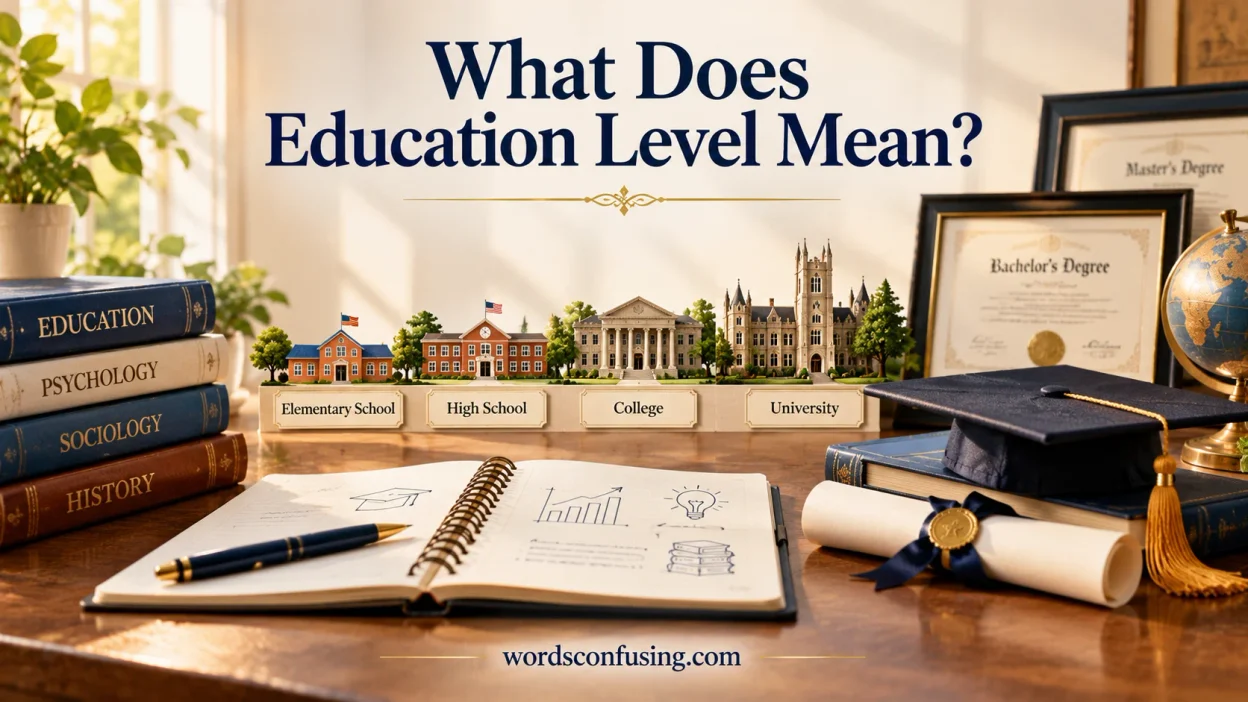
What Does Education Level Mean? It describes the formal education you have completed or are currently pursuing, from preschool to university.
Your level of education includes different stages, such as preschool education, high school, college, and postsecondary education. These stages form your formal educational journey within an education system.
Understanding the major levels of education helps you recognize the role of education in personal and professional life. Education supports personal growth, societal growth, and developing skills that help people handle life’s complexities.
Your educational background may include a degree, diploma, or certificate, such as an undergraduate degree, graduate degree, or postgraduate education. Your highest level of education refers to the most advanced qualification you’ve completed, while your current education describes what you’re studying now.
Academic qualifications, educational attainment, and educational credentials help explain your background. These qualifications can influence career opportunities, career development, and professional development.
Understanding your options also helps you choose suitable educational opportunities, achieve personal goals, and plan your next step toward a successful future.
Quick Answer
Education level means the highest grade, diploma, or degree you’ve completed. For example, if you’ve graduated from high school but haven’t earned a college degree, your education level is high school graduate. If you’re currently studying for a degree, report your highest completed qualification when a form asks for completed education.
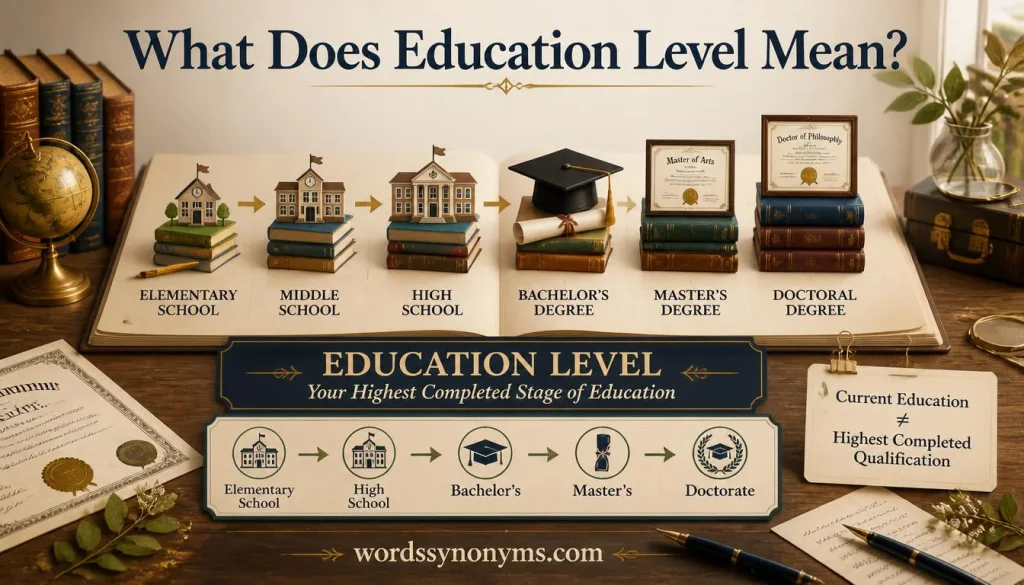
What Does Education Level Mean?
Education level means the highest stage of formal education you’ve completed or the stage you’re currently attending, depending on the context. It describes your educational progress, from elementary school through advanced university degrees.
For example, someone who completed high school but never attended college generally has a high school education level. Someone who earned a bachelor’s degree has a bachelor’s-level education. A person who completed a doctoral degree has a doctoral-level education.
The exact meaning depends on the question you’re answering. Some forms ask for your highest completed education, while others ask about your current grade or program.
Consider these examples:
- A student attending 10th grade may report their current education level as high school.
- Someone who graduated from high school may select high school graduate.
- A college student working toward a bachelor’s degree may report their current enrollment separately from their highest completed qualification.
- Someone who earned a master’s degree may select master’s degree as their highest completed education.
The key is to understand what the form actually requests before selecting an answer.
Education Level vs. Educational Attainment
These terms are closely related, but they don’t always mean exactly the same thing.
Education level generally describes a stage of education, such as elementary school, high school, or graduate school. Educational attainment usually refers to the highest grade or qualification a person has completed.
For example, a student may currently attend college while their highest completed qualification remains a high school diploma. Their current educational stage and completed educational attainment are different.
This distinction matters when filling out official forms. If an employer asks for your highest completed education, you shouldn’t select a degree you’re still pursuing.
Why Do Forms Ask About Your Education Level?
Organizations ask about education levels for several practical reasons. Employers may use the information to assess whether applicants meet a position’s requirements. Colleges need academic records to determine admission eligibility, while scholarship programs may require proof of enrollment or previous qualifications.
You might encounter education-level questions when:
- Applying for a job or internship.
- Completing a résumé or professional profile.
- Registering for college or vocational training.
- Applying for a scholarship or educational grant.
- Completing a government or employment survey.
- Enrolling in a certification program.
- Applying for professional training or licensing.
The same person may need to provide different details on different forms. A job application might request your highest completed degree, while a college application may ask which qualification you’re currently pursuing.
Read more: Families or Family’s or Families’: What’s the Difference?
What Are the Different Levels of Education?
Education systems vary by country, but many follow a progression from primary education to secondary school and then postsecondary education.
In the United States, educational categories commonly include elementary schooling, high school, some college, associate degrees, bachelor’s degrees, master’s degrees, professional degrees, and doctoral degrees.
The following sections explain each level, including what it means and how to identify it.
No Formal Education or Incomplete Elementary Education
This category generally applies to people who haven’t attended formal school or haven’t completed elementary education.
However, these situations aren’t identical. Someone who never attended school has a different educational history from someone who attended several elementary grades but left before completing them.
On a form, the appropriate option depends on the available categories. You might see choices such as:
- No formal education.
- Some elementary school.
- Elementary school completed.
- Some high school.
If a form asks for your highest completed grade, report the grade you actually finished. Don’t select elementary school graduate unless you’ve completed the relevant stage under the applicable education system.
Elementary or Primary Education
Elementary education, also called primary education in many countries, introduces students to foundational academic skills. These typically include reading, writing, mathematics, science, and social studies.
In the United States, elementary school commonly covers kindergarten through fifth grade, although some districts extend it through sixth grade. Other countries use different grade structures and school names.
For example, a student who completed fifth grade but hasn’t attended middle school has completed elementary schooling under a system that ends elementary school in fifth grade.
Keep in mind that elementary education and secondary education are separate stages. Completing primary school doesn’t mean you’ve completed high school or earned a secondary-school qualification.
Middle School or Lower Secondary Education
Middle school typically bridges elementary school and high school in the United States. It commonly includes grades six through eight, although local arrangements differ.
During these years, students study a broader range of subjects and prepare for more advanced coursework. Some education systems use the term lower secondary education instead of middle school.
For example, a student who completes eighth grade but leaves school before ninth grade may report eighth grade as their highest completed grade.
The correct category depends on the form. If it lists middle school separately, choose that option when appropriate. If it asks for the highest grade completed, enter the grade requested rather than assuming that middle school is equivalent to a high school diploma.
High School or Secondary Education
High school is a major stage of education because completing it can open the door to college, vocational training, apprenticeships, and many entry-level jobs.
In the United States, high school commonly covers grades nine through twelve. Students who meet their school’s graduation requirements typically receive a high school diploma.
Common categories include:
- Some high school: You attended high school but didn’t graduate.
- High school graduate: You completed the requirements and earned a diploma.
- High school equivalency: You earned a recognized alternative credential, such as a GED credential.
- Secondary school certificate: You completed an equivalent stage in an education system that uses different terminology.
These categories shouldn’t be treated as interchangeable in every situation. Some applications group high school diplomas and equivalency credentials together, while others list them separately.
Example: Suppose you completed 12th grade and received your high school diploma. If an application asks for your highest completed education, high school graduate is generally the appropriate choice unless you’ve completed a higher qualification.
Some College or Postsecondary Education Without a Degree
Attending college doesn’t automatically mean you’ve earned a college degree. This distinction often confuses applicants who completed several semesters but left before graduating.
The category some college, no degree generally describes people who attended college or another postsecondary institution but didn’t earn a degree.
For example, imagine that Maya completed two years of university coursework before accepting a full-time job. She earned credits but never graduated. If an application offers a some-college category, that option may accurately describe her education.
This category can also apply to people who completed substantial coursework toward a degree but haven’t fulfilled every graduation requirement.
Remember these points:
- College attendance isn’t the same as degree completion.
- Completed courses may still demonstrate useful knowledge and skills.
- Credits earned at one institution may or may not transfer to another.
- A partially completed degree shouldn’t be presented as a completed qualification.
If a form asks for your highest completed degree, report the last degree you actually earned. You can mention ongoing studies or completed coursework separately when the application permits it.
Associate Degree
An associate degree is an undergraduate qualification commonly offered by community colleges and other postsecondary institutions in the United States.
Many associate degree programs take about two years of full-time study, although the actual duration depends on the program, course load, transfer credits, and individual circumstances.
Common examples include:
- Associate of Arts (AA).
- Associate of Science (AS).
- Associate of Applied Science (AAS).
An AA or AS may support transfer into a bachelor’s degree program. An AAS often emphasizes occupational or career-focused preparation, although program structures vary.
Suppose you completed an Associate of Science degree at a community college. If a job application lists associate degree as an option, you can generally select it as your highest completed education if you haven’t earned a higher degree.
An associate degree is more than college attendance. It represents completion of a defined academic program and its graduation requirements.
Bachelor’s Degree
A bachelor’s degree is an undergraduate academic qualification commonly awarded by colleges and universities. In the United States, traditional full-time programs often take about four years, but the duration varies by major, institution, course load, and transfer credits.
Common bachelor’s degrees include:
- Bachelor of Arts (BA).
- Bachelor of Science (BS).
- Bachelor of Fine Arts (BFA).
- Bachelor of Business Administration (BBA).
The qualification typically reflects completion of a required set of courses, credits, and other academic requirements.
For example, someone who graduated with a Bachelor of Science in Biology has a bachelor’s-level education. Someone who completed three years of a bachelor’s program without graduating generally shouldn’t claim to hold the degree.
A bachelor’s degree may qualify graduates for jobs that require an undergraduate qualification. It can also serve as a prerequisite for many master’s programs and some professional programs.
However, earning a bachelor’s degree doesn’t guarantee admission to graduate school or eligibility for every job. Institutions and employers set their own requirements.
Master’s Degree
A master’s degree is a graduate-level qualification that usually follows a bachelor’s degree. Programs often provide advanced knowledge in a specific academic or professional field.
Examples include:
- Master of Arts (MA).
- Master of Science (MS).
- Master of Business Administration (MBA).
- Master of Education (MEd).
- Master of Public Health (MPH).
Many master’s programs take one to two years of full-time study, although some take longer. Part-time programs may extend over several years.
Consider someone who completed a bachelor’s degree in accounting and then earned an MBA. Their highest completed education is a master’s degree.
However, enrolling in a master’s program doesn’t mean you’ve already earned the qualification. If you’re still studying, your highest completed degree may remain your bachelor’s degree.
This distinction becomes especially important on employment forms that ask applicants to select a completed education level rather than their current academic program.
Professional Degree
A professional degree prepares students for specialized work in a profession. Depending on the field and jurisdiction, the degree may be part of the pathway toward professional licensing.
Examples in the United States include:
- Doctor of Medicine (MD).
- Juris Doctor (JD).
- Doctor of Dental Surgery (DDS).
- Doctor of Pharmacy (PharmD).
These qualifications have different entry requirements, program structures, and professional purposes. Some require previous undergraduate education, while others follow different academic pathways.
A professional degree isn’t automatically equivalent to every other doctoral degree. For instance, an MD prepares graduates for medical practice, while a PhD typically emphasizes original research in a specific discipline.
When a form lists professional degree separately, use that category if it accurately describes your completed qualification. If the form doesn’t provide a matching option, check its instructions rather than guessing.
Doctoral Degree
A doctoral degree is an advanced qualification awarded after completing a program’s academic and research or professional requirements. It represents a high level of specialized study.
Common examples include:
- Doctor of Philosophy (PhD).
- Doctor of Education (EdD).
- Doctor of Business Administration (DBA).
A PhD often emphasizes original research and the development of new knowledge. An EdD typically focuses on educational practice and leadership, although individual programs differ. A DBA commonly addresses advanced business practice and research.
Doctoral programs vary in length. Some students complete them in several years, while others need longer because of research demands, dissertation work, or part-time enrollment.
If you’ve completed a PhD, your highest completed education is generally doctoral degree. If you’re still working toward one, report your previous completed qualification when a form asks for your highest completed degree.
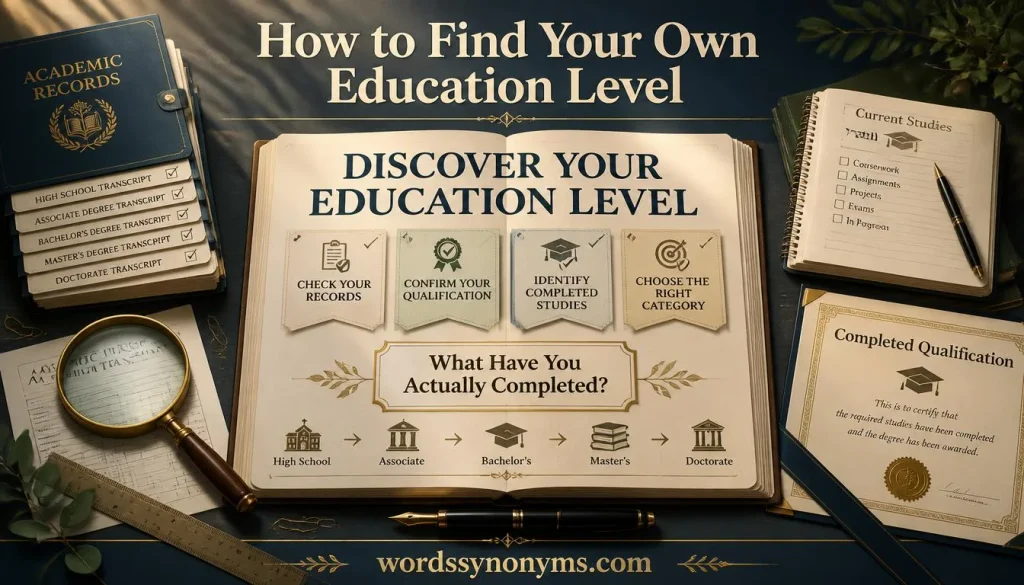
How to Find Your Own Education Level
Identifying your education level becomes easier when you separate completed qualifications from ongoing studies. You don’t need to guess or choose the most advanced option available.
Follow these steps to determine which category fits your educational background.
Identify the Highest Grade or Qualification You’ve Completed
Start by reviewing your education history. Identify the highest grade you completed or the highest qualification you officially earned.
For example:
- If you completed 10th grade but didn’t graduate from high school, report your completed grade or the closest matching category.
- If you earned a high school diploma, select high school graduate when available.
- If you completed an associate degree, choose associate degree.
- If you earned a bachelor’s degree, choose bachelor’s degree.
- If you completed a master’s degree, select master’s degree.
- If you earned a doctorate, select the appropriate doctoral category.
Your most recent school isn’t necessarily the best answer. What matters is the qualification you completed and what the form asks you to report.
Check Whether You Actually Earned the Qualification
Attending classes, passing individual courses, and earning a degree are different milestones. Before selecting an education level, confirm whether you’ve completed the requirements for the qualification.
For instance, a student may finish every course except the final project required for graduation. That student may have completed substantial coursework without officially earning the degree.
If you’re unsure, review your transcript, diploma, graduation confirmation, or academic records. These documents can help establish your completed qualifications.
The same principle applies to professional certificates and vocational training. Completing a short course doesn’t automatically mean you’ve earned a college degree.
Separate Your Current Studies From Your Completed Education
Your current studies describe what you’re working toward. Your highest completed education describes what you’ve already finished.
Consider this example:
Daniel is pursuing a bachelor’s degree in computer science. He has completed two years of coursework but hasn’t graduated. If a form asks for his current education, he can report that he’s working toward a bachelor’s degree. If it asks for his highest completed degree, he should report his existing completed qualification.
This distinction prevents misunderstandings on applications and résumés.
When possible, use separate fields for your completed education and current enrollment. If the form provides only one field, read its instructions carefully before responding.
Match Your Answer to the Form’s Available Options
Not every form uses the same terminology. One employer might offer a category called some college, while another might ask applicants to enter their highest completed grade or degree.
Use the option that most accurately describes your situation.
If the form doesn’t provide an exact match, look for an equivalent category or additional instructions. For international qualifications, the organization may ask for a recognized equivalency or credential evaluation.
Never assume that two qualifications are identical simply because their names sound similar.
Education Level Examples: Which One Applies to You?
Sometimes a few real-world examples explain education categories better than a long definition. The following table covers common situations and the options that may apply.
| Your educational background | Likely education level |
| You never attended formal school | No formal education |
| You attended elementary school but didn’t complete it | Some elementary education or highest grade completed |
| You completed elementary school | Elementary or primary education completed |
| You finished eighth grade but not high school | Middle school completed or highest grade completed |
| You attended high school but didn’t graduate | Some high school |
| You earned a high school diploma | High school graduate |
| You earned a recognized high school equivalency credential | High school equivalency |
| You attended college but didn’t earn a degree | Some college, no degree |
| You earned an associate degree | Associate degree |
| You earned a bachelor’s degree | Bachelor’s degree |
| You completed a master’s degree | Master’s degree |
| You earned a professional degree | Professional degree, where listed |
| You earned a PhD | Doctoral degree |
These examples use common US education categories. The precise answer may differ depending on the wording of the form and the education system involved.
Case Study: A College Student Applying for a Job
Imagine that Alex is studying business administration at a university. Alex completed high school and has finished three semesters of college but hasn’t earned a degree.
A job application offers four options:
- High school diploma.
- Associate degree.
- Bachelor’s degree.
- Master’s degree.
Which option should Alex choose?
High school diploma is the most accurate option among those listed if the application asks for the highest completed qualification. Alex hasn’t earned an associate, bachelor’s, or master’s degree.
If another section asks about current education, Alex can explain that a bachelor’s degree is in progress. This approach communicates both completed qualifications and ongoing studies without overstating academic achievements.
What Does Education Level Mean on a Job Application?
On a job application, education level generally helps employers understand your academic background and determine whether you meet a position’s stated requirements.
Some jobs require a particular degree, license, or professional qualification. Other positions accept applicants with a high school diploma, relevant experience, vocational training, or demonstrated skills.
The correct response depends on the question.
For example, an application may ask you to select your highest completed education from a dropdown menu. Another may ask you to list every school you’ve attended, your graduation dates, and the degrees you’ve earned.
Read the wording carefully before submitting your information.
What Should You Select if You Haven’t Graduated Yet?
If you’re still studying, don’t automatically select the degree you’re pursuing when the application asks for completed education.
Instead, consider the following situations:
- You’re in high school: Report your current grade if requested, or your highest completed education if the form asks for a completed qualification.
- You’re attending college: Select your highest completed qualification when asked about completed education.
- You’re finishing a degree soon: Include your expected graduation date if the application allows it.
- You’ve completed all coursework but haven’t officially graduated: Check whether the institution has confirmed that you’ve met its degree requirements.
An expected graduation date can help employers understand your plans. However, it shouldn’t be presented as a completed degree.
What if You Attended College but Didn’t Finish?
You can still describe your college education accurately even if you never graduated.
If the application includes some college, no degree, that option may fit your situation. If it asks for institutions attended, list the college and the dates you studied there.
You can also mention relevant coursework when it supports the position. For example, a candidate who completed programming, database, and networking courses may include those subjects when applying for an entry-level technology role.
However, don’t label yourself a graduate of an institution unless you earned the qualification. Accurate information helps employers assess your background fairly.
What if You Have a Certificate or Trade Qualification?
Certificates and trade qualifications can demonstrate specialized training. Depending on the program, they may prepare you for work in fields such as electrical installation, automotive repair, healthcare support, information technology, or skilled manufacturing.
However, a certificate isn’t automatically equivalent to an associate or bachelor’s degree.
The term certificate covers different types of credentials. Some programs last a few weeks, while others require extensive coursework, practical training, and assessments.
When completing a job application:
- Select a certificate or vocational-training option if it accurately matches your credential.
- List the issuing institution when requested.
- Include the credential’s official title.
- Report any required license separately.
- Check whether the employer requires a particular qualification.
If the form doesn’t offer a suitable category, use any available additional-information field or contact the employer for clarification.
What Education Level Should You Put on Your Résumé?
Your résumé should present your educational background clearly and accurately. Most applicants list their completed degrees, relevant certifications, and current studies when these details support their career goals.
You don’t necessarily need to include every school you’ve attended. The most useful information depends on your experience, the position, and the employer’s requirements.
Examples of Education Levels on a Résumé
High school graduate
- High School Diploma
- Lincoln High School
- Graduation year: 2024
College student
- Bachelor of Science in Biology, In Progress
- State University
- Expected graduation: May 2027
Bachelor’s degree holder
- Bachelor of Arts in English
- State University
- Graduated: 2025
Vocational qualification holder
- Certificate in Automotive Technology
- Technical Training Institute
- Completion year: 2025
These are illustrative examples. Replace the sample details with your actual qualification, institution, and dates.
Should You Include an Unfinished Degree on Your Résumé?
Yes, you can include relevant studies that you haven’t completed. The important thing is to describe them honestly.
For example, you might write:
Bachelor of Science in Information Technology — Coursework completed through the third year; degree not completed.
Alternatively, you could list relevant coursework if it directly supports your application.
Avoid wording that suggests you’ve graduated when you haven’t. If an employer needs to verify your qualifications, the details on your résumé should match your academic records.
What’s the Difference Between Education Level and Education Qualification?
Although people sometimes use these terms interchangeably, they describe different aspects of a person’s educational background.
| Term | What it means | Example |
| Education level | The stage or highest level of education completed | Bachelor’s level |
| Educational attainment | The highest grade or qualification completed | High school diploma |
| Education qualification | A credential earned through an educational program | Bachelor of Science |
| Field of study | The subject area studied | Computer science |
| Current education | The program or stage you’re attending now | Master’s degree in progress |
| Vocational training | Education focused on occupational skills | Electrical installation certificate |
For example, someone might have a bachelor’s-level education, hold a Bachelor of Science qualification, and specialize in computer science.
Each term provides a different piece of information. Understanding these differences helps you answer forms more accurately.

Does Education Level Mean Your Current Grade or Highest Degree?
Education level can refer to either your current educational stage or your highest completed qualification. The exact meaning depends on the question’s wording.
If a school asks what grade you’re currently attending, report your current grade. If a job application asks for your highest completed degree, report the highest qualification you’ve earned.
Consider a student who is currently enrolled in the second year of college. Their current education is college-level study. However, if they haven’t earned a college degree, their highest completed qualification may still be a high school diploma.
The same distinction applies to graduate students. Someone pursuing a PhD doesn’t necessarily hold a doctoral degree yet.
Before answering, look for phrases such as:
- Current education level: Usually refers to your present educational stage.
- Highest level completed: Refers to the highest stage or qualification you’ve finished.
- Highest degree earned: Refers specifically to a degree you’ve already received.
- Expected degree: Refers to a qualification you’re working toward.
These small wording differences can change the correct answer.
Read more: 5 Words for Something That Is Similar but Different
Does Education Level Mean the Same Thing in Every Country?
No. Education systems differ in their grade structures, qualification names, and academic pathways.
For example, the US system commonly uses terms such as high school diploma, associate degree, bachelor’s degree, and master’s degree. Other countries may use different names for secondary-school certificates, college qualifications, or professional credentials.
Even familiar words can have different meanings. In some countries, college refers to a stage of secondary education, while in the United States it commonly refers to an institution offering postsecondary education.
International qualifications can also differ in length, curriculum, admission requirements, and recognition.
If you’re completing an application in another country, follow these guidelines:
- Use the official name of your qualification.
- Provide the institution’s name and country when requested.
- Don’t assume that a foreign credential directly equals a US degree.
- Check whether the employer or institution requires an official credential evaluation.
- Follow the organization’s instructions for international applicants.
For example, a person who completed secondary school outside the United States shouldn’t automatically describe that qualification as a US high school diploma unless the relevant institution recognizes it as equivalent.
The goal is to communicate your educational background accurately, even when the terminology differs.
FAQs
1. What does education level mean?
Education level refers to the highest stage of formal education you have completed. It may include high school, college, an undergraduate degree, or postgraduate education.
2. How do I answer when someone asks about my education level?
Mention your highest completed qualification. For example, you can say, “I have a high school diploma,” or “I hold a bachelor’s degree.”
3. What are the different levels of education?
Common levels include preschool, elementary school, middle school, high school, undergraduate education, and postgraduate education. The exact stages vary by country and educational system.
4. Is education level the same as a degree?
No. Education level describes your stage of education, while a degree is a specific qualification earned through an academic program. You can also have a high school diploma or professional certificate.
5. What should I write for education level on a job application?
Enter your highest completed educational qualification, such as a high school diploma, associate degree, bachelor’s degree, or master’s degree. If the form asks for your current studies, mention those separately.
6. Can I include education I haven’t completed yet?
Yes, if the form allows you to list ongoing studies. Clearly state that your qualification is in progress and include your expected graduation date when relevant.
Conclusion
Understanding your education level helps you explain your academic background clearly and confidently. Whether you’ve completed high school, earned a college degree, or started postgraduate studies, your education level reflects your progress through formal learning. It can also help employers assess your qualifications and identify suitable career opportunities.
When someone asks about your education level, share your highest completed qualification and mention any ongoing studies if relevant. If you’re filling out a job application, school form, or professional profile, provide accurate details about your education history. Remember, education isn’t limited to degrees or certificates. The knowledge, practical experience, and skills you gain along the way also contribute to your personal and professional growth. Your education level describes where you are in your academic journey, not the full extent of your abilities or potential.