What Is a Period of 25 Years Called? A quarter-century means a quarter of a century, or one-fourth of one hundred years.
A period 25 years of has several unofficial names, including silver jubilee, silver anniversary, and quadranscentennial. In everyday English terminology, the common expression is simply 25 years or twenty-five years. Unlike a decade, which covers ten years, or a century, a 25-year period has no widely accepted official term.
The best expression depends on the context and specific time frame. A silver jubilee often marks a 25th anniversary or an important milestone, while quadranscentennial serves as a more formal unofficial term.
These period names help describe a chronological period, a historical period, or a particular time period. When naming periods, you can use terms that explain the duration, time span, and length of time.
These expressions also relate to the measurement of time, including calendar years, numerical periods, and other time units. A 25-year duration or quarter-century period clearly describes this long period in general time terminology.
Quick Answer
A period of 25 years is called a quarter-century, which equals two and a half decades. The term describes any 25-year span, whether you’re talking about a person’s career, a family business, a friendship, or an important historical period. For a special 25-year milestone, silver jubilee and silver anniversary are also common expressions. However, quarter-century describes the length of time, while the other terms emphasize the celebration or anniversary.
What Is a Period of 25 Years Called?
A period of 25 years is called a quarter-century. This term combines two words: quarter, meaning one-fourth, and century, meaning 100 years.
When you divide a century into four equal parts, each part lasts 25 years. That’s why the expression quarter-century accurately describes this length of time.
For example, if someone has worked at the same company for 25 years, you could say, “She has dedicated a quarter-century to the organization.”
The phrase works in many situations because it describes a length of time rather than a specific event. You can use it when discussing history, careers, relationships, businesses, scientific research, or cultural changes.
Here are a few examples:
- Career: He spent a quarter-century working as a teacher.
- Business: The family-owned restaurant has served customers for a quarter-century.
- History: The country experienced major economic changes over a quarter-century.
- Relationships: They have been close friends for a quarter-century.
- Entertainment: The television series celebrated a quarter-century of popularity.
In each example, the phrase emphasizes a period lasting 25 years.
Why Is 25 Years Called a Quarter-Century?
The name comes from simple mathematics. A century contains 100 years, and a quarter represents one-fourth of a whole.
Dividing 100 by four gives you 25.
100 years ÷ 4 = 25 years
Therefore, one quarter-century equals 25 years. Two quarter-centuries equal 50 years, while four quarter-centuries make a complete century.
Think of a century as a large pie divided into four equal slices. Each slice represents a quarter-century. The name follows the same principle, making it easy to understand and remember.
The term also provides a convenient way to describe long periods without repeating the number 25. Instead of saying “a period of 25 years” throughout an article, you can use quarter-century when the meaning remains clear.
How Many Years Are in a Quarter-Century?
A quarter-century contains exactly 25 years. The term refers to a fixed number of calendar years, not a particular number of days.
However, the total number of days depends on which dates the period covers. Leap years add an extra day to February, so different 25-year spans can contain slightly different numbers of days.
For example, a 25-year period may include six or seven leap days, depending on the dates involved and the applicable calendar rules.
This distinction matters when calculating exact durations for legal agreements, historical research, financial records, or scientific studies. In ordinary conversation, however, 25 years and a quarter-century mean the same length of time.
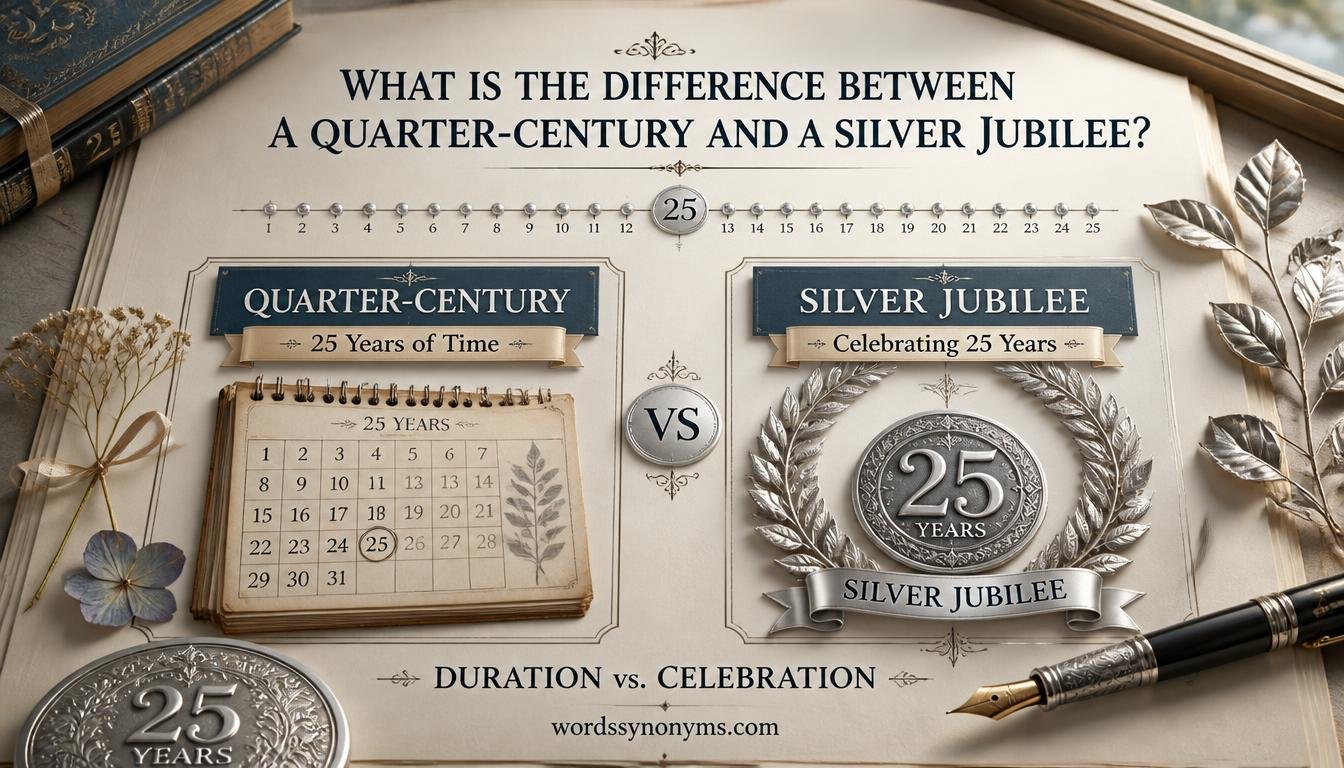
What Is the Difference Between a Quarter-Century and a Silver Jubilee?
Although quarter-century and silver jubilee both relate to 25 years, they serve different purposes.
A quarter-century describes a period of time. A silver jubilee refers to a celebration or commemoration marking a 25-year milestone.
For example, a business might operate for a quarter-century before organizing a silver jubilee celebration. The first expression describes how long the business has existed, while the second emphasizes the anniversary event.
Consider these examples:
- “The company has completed a quarter-century in business.”
- “The company celebrated its silver jubilee with employees and customers.”
- “Their silver jubilee marked 25 years of marriage.”
Each sentence uses the terminology for a slightly different purpose.
A silver jubilee often appears in discussions about royal reigns, public service, religious institutions, organizations, and other long-term achievements. A quarter-century, by comparison, works naturally in almost any context involving 25 years.
Is a 25th Anniversary Called a Silver Anniversary?
Yes. A 25th anniversary is commonly called a silver anniversary, particularly when discussing marriage.
The association with silver comes from the traditional anniversary gift system, which assigns particular materials to different anniversary milestones. Silver represents the 25th anniversary, while gold traditionally represents the 50th.
People also use silver anniversary for organizational and professional milestones. A school might celebrate 25 years of educating students, or a nonprofit organization might mark 25 years of community service.
Here are examples of how the expression works:
- “My parents celebrated their silver anniversary last summer.”
- “The school hosted a special event for its silver anniversary.”
- “The charity marked its silver anniversary by recognizing its volunteers.”
Although silver anniversary and silver jubilee often overlap in meaning, silver anniversary is especially familiar in wedding and relationship contexts.
Remember: Use quarter-century when emphasizing a duration. Choose silver anniversary or silver jubilee when the focus is a 25-year milestone or celebration.
Read more: Did vs. Done: What’s the Difference?
Is There Another Word for a Period of 25 Years?
Yes. Besides quarter-century, you may encounter the word quadranscentennial.
This uncommon term relates to a 25-year anniversary or milestone. It draws on word elements associated with a quarter and a hundred-year period.
However, quadranscentennial isn’t nearly as familiar as quarter-century. Most readers will understand the simpler expression immediately, while the specialized word may require an explanation.
For everyday writing, conversations, and general-interest articles, quarter-century remains the clearest choice.
The more specialized term may appear in formal commemorative contexts, but writers should verify its intended meaning in a reliable dictionary before using it. Related anniversary terminology can vary by context, so clarity matters more than choosing an unusual word.
What Does Quadranscentennial Mean?
Quadranscentennial is a rare term associated with a 25-year milestone or anniversary.
The word may sound impressive, but that doesn’t automatically make it the best choice for every sentence. In most situations, a familiar phrase communicates the same idea more effectively.
Compare these examples:
- Common: The university celebrated its 25th anniversary.
- Common: The university marked a quarter-century of academic achievement.
- Uncommon: The university held a quadranscentennial celebration.
All three examples point toward a 25-year milestone. The first two communicate the meaning more directly to a general audience.
If you’re writing an academic article, preparing a commemorative speech, or discussing anniversary terminology, the specialized word may be useful. For a general audience, however, familiar language usually works better.

Examples of a Quarter-Century in Everyday Life
The expression quarter-century becomes easier to understand when you see how people use it in real-life situations. It can describe anything from a long career to an organization’s history.
A Quarter-Century in Business
Businesses often use 25-year milestones to recognize stability, customer loyalty, and long-term growth.
Imagine a family-owned bakery that opened in 2001. In 2026, the owners could celebrate a quarter-century in business. They might recognize longtime employees, thank loyal customers, or introduce a special anniversary menu.
Here are examples:
- The bookstore has served local readers for a quarter-century.
- The company celebrated 25 years of customer service.
- After a quarter-century in business, the restaurant expanded into another neighborhood.
The term doesn’t automatically suggest that a business has succeeded financially. It simply describes the length of time the business has operated.
A Quarter-Century in Personal Life
Twenty-five years can represent a significant portion of someone’s personal or professional life. The expression helps communicate that long stretch without requiring extra explanation.
For example, someone might describe a friendship that began in elementary school and continued into adulthood as a quarter-century friendship.
Other examples include:
- She has worked as a nurse for a quarter-century.
- They have lived in the same neighborhood for 25 years.
- The couple celebrated a quarter-century together.
- He spent a quarter-century studying local history.
These sentences show how the term can describe relationships, careers, and personal experiences.
In some cases, the phrase also carries emotional weight. Saying “a quarter-century of friendship” can emphasize shared memories, personal growth, and a bond that has lasted through changing circumstances.
A Quarter-Century in History
Historians frequently examine periods of 25 years to understand how societies change over time.
A quarter-century can encompass changes in technology, political leadership, cultural habits, economic conditions, and everyday life. For instance, comparing life in 2001 with life in 2026 can reveal major developments in communication, entertainment, and digital technology.
Here are examples of the expression in historical writing:
- The historian examined economic changes over a quarter-century.
- The report traced the city’s development across 25 years.
- A quarter-century of scientific research transformed our understanding of the subject.
A quarter-century is particularly useful when researchers want to study long-term trends without examining an entire century.
However, the term doesn’t represent a formal historical era by itself. Historians choose their study periods according to the events, evidence, and questions they investigate.
A Quarter-Century in Entertainment and Sports
Entertainment and sports provide familiar examples of 25-year milestones.
A television program might celebrate 25 years since its premiere. A sports club could commemorate its founding anniversary, or a musician might reflect on a quarter-century in the music industry.
For example:
- The tournament celebrated a quarter-century of competition.
- The band reflected on 25 years of performing together.
- The documentary explored how the sport changed over a quarter-century.
These examples illustrate how the phrase describes a period of activity or achievement. The expression doesn’t imply that a team, show, or performer remained equally popular throughout those years.
Instead, it highlights the time elapsed since an event began or a milestone occurred.

How Does a Quarter-Century Compare With Other Time Periods?
Several familiar terms describe different lengths of time. Understanding their meanings helps you avoid mixing up decades, quarter-centuries, half-centuries, and centuries.
| Length of time | Common term | Explanation |
| 10 years | Decade | A period lasting 10 years |
| 20 years | Two decades | Two periods of 10 years |
| 25 years | Quarter-century | One-fourth of 100 years |
| 50 years | Half-century | One-half of 100 years |
| 100 years | Century | A period of 100 years |
| 1,000 years | Millennium | A period of 1,000 years |
Each term describes a different duration, although some are more widely used than others.
What Is the Difference Between a Decade and a Quarter-Century?
A decade lasts 10 years, while a quarter-century lasts 25 years.
Consequently, a quarter-century equals two and a half decades. The two expressions describe different lengths, even though both help people discuss long periods.
For example, a person who has worked at a company for 10 years has completed a decade of service. Someone who has worked there for 25 years has completed a quarter-century.
You can calculate the relationship by dividing 25 by 10.
25 ÷ 10 = 2.5 decades
This calculation is helpful when comparing timelines, career milestones, historical periods, and organizational anniversaries.
What Is the Difference Between a Quarter-Century and a Half-Century?
A quarter-century lasts 25 years, while a half-century lasts 50 years.
The difference is straightforward: a half-century contains two quarter-centuries.
For example, a business celebrating its 25th anniversary has reached a quarter-century milestone. When it reaches its 50th anniversary, it has completed half a century.
These expressions also work in historical writing. A researcher might examine developments over a quarter-century, then compare them with changes across a half-century.
What Is the Difference Between a Century and a Millennium?
A century contains 100 years, while a millennium contains 1,000 years.
A millennium therefore includes ten centuries or forty quarter-centuries.
These terms describe much longer periods than a decade or quarter-century. They’re particularly useful when discussing historical timelines, archaeological discoveries, civilizations, and broad cultural changes.
For example, a historian studying a medieval city might examine its development across several centuries. A researcher studying ancient civilizations could examine changes across a millennium.
The right term depends on the period being discussed and the level of detail the reader needs.
Read more: Yep vs. Yup: Which One Should You Use?
Common Mistakes When Talking About 25 Years
Although the term quarter-century is straightforward, related expressions can create confusion. A few simple distinctions will help you use them correctly.
Confusing a Quarter-Century With a Silver Jubilee
A quarter-century describes a 25-year duration. A silver jubilee marks a celebration or commemoration associated with 25 years.
For example, “The organization has completed a quarter-century of service” emphasizes its history. “The organization celebrated its silver jubilee” emphasizes the commemorative event.
Both expressions can describe the same milestone, but they focus on different aspects of it.
Calling 25 Years a Decade
A decade contains 10 years, not 25.
If someone has worked for 25 years, you could say they’ve completed two and a half decades. However, quarter-century is more concise when you’re referring to that exact duration.
Using the correct term makes your writing clearer and prevents confusion.
Using Quadranscentennial When a Simpler Word Works
Specialized vocabulary can be useful, but an uncommon term may distract readers from your main point.
If you’re writing for a general audience, quarter-century or 25-year anniversary usually communicates the meaning more naturally.
Consider your audience before choosing a word. A technical or commemorative document may call for specialized terminology, while an everyday blog post benefits from familiar expressions.
Treating Every 25-Year Period as an Anniversary
An anniversary marks the recurrence of a date associated with an event, such as a wedding, a company’s founding, or the opening of a school.
A quarter-century, however, can describe any 25-year span. It doesn’t need to begin with a founding date or end with a celebration.
For example, a historian might examine a quarter-century of economic changes without referring to an anniversary at all.
This distinction is important because every 25th anniversary marks a 25-year milestone, but not every quarter-century represents an anniversary celebration.
FAQs
1. What is a period of 25 years called?
A period of 25 years is commonly called a quarter-century. Other terms include silver jubilee and quadranscentennial, although these are less commonly used.
2. Is a quarter-century the same as 25 years?
Yes, a quarter-century equals 25 years because a full century contains 100 years. Twenty-five years represents one-fourth of that total.
3. What is a silver jubilee?
A silver jubilee marks the 25th anniversary of an important event, achievement, or milestone. For example, a couple may celebrate their silver jubilee after 25 years of marriage.
4. Is quadranscentennial another word for 25 years?
Yes, quadranscentennial is a formal term associated with a 25-year anniversary or period. However, quarter-century is generally easier to understand and more familiar to readers.
5. Does a period of 25 years have an official name?
There is no universally established everyday term for a 25-year period. Quarter-century is widely understood, while silver jubilee and quadranscentennial are used in specific contexts.
6. What is the difference between a decade, a quarter-century, and a century?
A decade lasts 10 years, a quarter-century lasts 25 years, and a century lasts 100 years. These terms help describe different lengths of time in history, personal milestones, and everyday conversations.
Conclusion
A period of 25 years is most commonly called a quarter-century, representing one-fourth of a full century. Although there is no universally recognized official term for every 25-year period, several expressions can describe this length of time. Silver jubilee is often used to celebrate a 25th anniversary, such as 25 years of marriage, business success, or service. The word quadrans centennial is another term associated with a 25-year milestone, although it is less familiar in everyday conversation.
Choosing the right expression depends on what you want to describe. If you’re talking about history, personal achievements, or the passage of time, quarter-century is usually the simplest and clearest choice. For celebrations, silver jubilee often sounds more meaningful and appropriate. Unlike a decade, which lasts 10 years, or a century, which spans 100 years, a quarter-century offers a useful way to describe a significant period without using complicated language. Understanding these terms helps you communicate more precisely, whether you’re writing an article, discussing an anniversary, or describing an important milestone in someone’s life.

Shafiq Ur Rehman is a writer and content contributor at WordsConfusing.com. He enjoys exploring the English language, common word confusions, vocabulary, and practical writing tips. His goal is to make English easier to understand through clear, simple, and useful articles.