


Can You Start a Sentence With “With”? Grammar Rules explains why this opening is acceptable and how to use it clearly in everyday English writing.
Starting a sentence with with is acceptable in English grammar, even if you worry about sentence beginnings and opening words. The basic grammar rules allow you to begin with with, a preposition that introduces a prepositional phrase and adds meaning to your sentence structure. When you start a sentence this way, you can provide context, describe a situation, or connect ideas naturally.
For example, “With a little practice, you can improve your writing.” This sentence demonstrates correct usage and grammatical correctness without breaking any grammatical rules. Common grammar misconceptions suggest that beginning a sentence with a preposition is incorrect, but rules about sentence beginnings do not support that restriction.
When exploring different sentence patterns, remember that acceptable sentence openings depend on meaning and clarity, not rigid writing rules. A suitable introductory phrase can improve sentence formation, sentence construction, and sentence flow.
In everyday writing, choose words that support natural writing, effective word choice, and a consistent writing style. These language conventions, grammar guidelines, and language rules help you understand preposition usage, word usage, and language usage in the English language.
This article provides practical grammar explanations and usage examples to strengthen your English writing, improve sentence clarity, and develop better writing techniques. Pay attention to sentence openings, sentence-level grammar, English usage, and correct sentence structure when choosing sentence-starting words. These simple tips help you write natural sentences while following standard writing conventions.
Quick Answer
Yes, you can start a sentence with “with.” It’s grammatically correct when the introductory phrase connects clearly to the main clause. For example, “With enough practice, you can improve your writing.” Use a comma after longer introductory phrases when needed for clarity, and make sure the sentence expresses a complete thought.
Can You Start a Sentence With “With”?
Yes, starting a sentence with “with” is grammatically acceptable in standard English. The word commonly introduces a prepositional phrase that provides additional information about the main clause.
A prepositional phrase usually begins with a preposition and includes a noun or pronoun as its object. It may also contain modifiers that provide more detail.
For example:
- With a little patience, you can solve this problem.
- With her family nearby, Maria felt more comfortable.
- With the deadline approaching, everyone worked faster.
- With careful planning, the journey became much easier.
Each example begins with “with,” yet every sentence communicates a complete thought. The introductory phrase adds useful context without changing the sentence’s basic meaning.
Why Is It Correct to Start a Sentence With “With”?
The idea that you shouldn’t begin a sentence with a preposition is a common grammar misconception. English doesn’t have a general rule that forbids prepositions at the beginning of sentences.
In fact, many natural and effective sentences begin with prepositional phrases. Words such as “with,” “after,” “before,” “during,” and “without” can all introduce useful information.
Consider these examples:
- After the rain stopped, the children went outside.
- Before the meeting began, everyone reviewed the agenda.
- Without enough evidence, the claim remained unproven.
- With the right instructions, the process becomes simpler.
Notice how each opening phrase establishes context before the main idea appears. This arrangement helps readers understand the circumstances surrounding an action.
The important point is simple: judge a sentence by its grammar, clarity, and meaning rather than by its first word alone.
Examples of Sentences That Start With “With”
The easiest way to understand this rule is to see how writers use “with” in different situations.
| Example sentence | Purpose of “with” |
| With enough sleep, you can feel more alert. | Shows a helpful condition |
| With her notebook in hand, Olivia entered the classroom. | Describes a person and her surroundings |
| With the store closing soon, we hurried inside. | Explains a situation |
| With a smile on his face, Daniel greeted his guests. | Adds descriptive detail |
| With your permission, I’ll begin the presentation. | Expresses a polite condition |
| With the road covered in snow, driving became difficult. | Provides background information |
These examples demonstrate that “with” can serve several purposes. It can introduce a condition, describe a scene, or explain why an event unfolds in a particular way.

How to Use “With” at the Beginning of a Sentence
Starting a sentence with “with” becomes easier when you understand the patterns behind it. You don’t need to memorize complicated grammar terminology. Instead, learn how the introductory phrase relates to the main clause.
Start With a Prepositional Phrase
A common pattern looks like this:
With + noun phrase + additional information, main clause.
For example:
“With the final report ready, the manager scheduled a meeting.”
Here, “with the final report ready” introduces the situation. The main clause explains what the manager did next.
You can also use a shorter opening:
- With care, you can handle the equipment safely.
- With practice, your pronunciation will improve.
- With permission, students may enter the laboratory.
Longer phrases can provide more detailed context:
- With the final guests arriving and the food nearly ready, the host checked the dining room.
- With several important documents missing from the file, the assistant contacted the office.
The opening phrase should support the main idea rather than distract from it. If readers struggle to connect the two parts, revise the sentence.
Start With “With” to Show a Condition
Sometimes, “with” introduces a circumstance that makes an action possible or affects its outcome.
For example, “With enough time, we can finish the project today.”
The sentence suggests that having enough time makes completion possible. The phrase doesn’t guarantee success, but it establishes a relevant condition.
More examples include:
- With proper preparation, you can approach the exam confidently.
- With enough sunlight, these plants grow well.
- With your approval, we can move forward with the proposal.
- With better communication, the team could avoid unnecessary delays.
This construction works particularly well when you want to explain what supports an outcome.
However, be careful not to imply a stronger relationship than you intend. “With enough practice, you can improve” describes a reasonable possibility. It doesn’t promise that practice alone will solve every problem.
Start With “With” to Describe a Person or Thing
An introductory “with” phrase can add visual details that help readers imagine a scene.
For instance, “With her blue jacket on, Emma stood out in the crowd.”
The opening phrase describes Emma’s appearance. The main clause explains the effect of that detail.
Here are a few more examples:
- With its tall windows, the room feels bright and spacious.
- With a backpack over his shoulder, Marcus walked toward the bus stop.
- With its wooden shelves and soft lighting, the library felt welcoming.
- With a red ribbon around the box, the gift looked ready to present.
These phrases are especially useful in descriptive writing. Rather than listing disconnected details, you can place a description before the main action.
Still, don’t overload the opening. One or two meaningful details usually create a stronger image than a long list of unnecessary adjectives.
Start With “With” to Explain a Situation
Writers also use “with” to establish circumstances before describing what happens next.
For example, “With everyone waiting outside, the organizers finally opened the doors.”
The introductory phrase explains the situation. The main clause presents the action that follows.
Other examples include:
- With the meeting over, the employees returned to their desks.
- With the weather getting colder, we decided to stay indoors.
- With traffic moving slowly, the delivery arrived late.
- With the power restored, the office resumed normal operations.
This structure helps readers follow events in a logical order. It can be especially effective when you want to move from background information to an important action.
Do You Need a Comma After “With” at the Beginning of a Sentence?
A comma often follows an introductory “with” phrase, especially when the phrase is long or provides substantial context. The comma helps readers distinguish the opening information from the main clause.
For example:
“With the storm approaching quickly, the fishermen returned to shore.”
The comma marks the end of the introductory phrase. It also gives readers a natural pause before the main idea.
However, comma usage depends on the sentence’s structure and readability. You shouldn’t assume that every sentence beginning with “with” requires exactly the same punctuation.
Examples That Need a Comma
Use a comma when the introductory phrase is substantial or when punctuation improves clarity.
| Sentence | Why the comma helps |
| With the assignment nearly finished, Ava took a short break. | Separates background information from the action |
| With several guests arriving late, dinner started behind schedule. | Makes the longer opening easier to follow |
| With the instructions clearly explained, everyone understood the task. | Marks the transition to the main clause |
| With the road blocked by fallen branches, the driver chose another route. | Separates the circumstances from the decision |
These examples follow a useful pattern: the introductory phrase provides context, and the main clause delivers the central message.
When Can You Omit the Comma After “With”?
Short introductory phrases sometimes appear without commas when the sentence remains clear. However, conventions vary by style and context, so follow the punctuation rules required by your assignment or publication.
For example:
- With luck we may finish early.
- With care the glass can be moved safely.
Both sentences may be understandable without commas, although many writers would include them for readability:
- With luck, we may finish early.
- With care, the glass can be moved safely.
When you’re unsure, using a comma after an introductory “with” phrase is often a clear and practical choice. It helps readers identify the sentence’s main clause without forcing them to reconsider the opening words.
Don’t Confuse an Introductory Phrase With a Complete Sentence
A phrase beginning with “with” doesn’t automatically form a complete sentence.
For example:
Incomplete: With the project almost finished.
Complete: With the project almost finished, the team reviewed its final details.
The first example leaves readers waiting for the main idea. The second explains what happened when the project neared completion.
Remember that a comma cannot turn an incomplete phrase into a complete sentence. You need a main clause that expresses a complete thought.
Can You Start a Formal Sentence With “With”?
Yes, you can begin a formal sentence with “with.” The construction works in academic papers, professional reports, business emails, and other formal documents.
Formal writing doesn’t require every sentence to begin with its subject. Instead, writers should choose sentence structures that communicate ideas accurately and clearly.
For example, compare these two sentences:
- We reviewed the evidence carefully before reaching a conclusion.
- With the evidence carefully reviewed, the committee reached a conclusion.
Both sentences are grammatical, but they emphasize different information. The first focuses on the review process. The second highlights the circumstances surrounding the committee’s conclusion.
Can You Start an Academic Sentence With “With”?
Academic writing often requires precise explanations of evidence, conditions, methods, and findings. An introductory “with” phrase can help establish this information before presenting the main point.
Consider these examples:
- With these findings in mind, researchers examined the results more closely.
- With additional evidence, the researchers could evaluate the hypothesis.
- With the sample size limited, the results require careful interpretation.
- With the relevant variables controlled, the experiment produced consistent measurements.
Each example uses “with” to introduce information that helps readers understand the main clause.
However, academic writing requires more than grammatical correctness. You should also ensure that the opening phrase accurately represents the relationship between the circumstances and the conclusion.
For example, “With these results, the hypothesis is proven” might overstate what the evidence supports. A more careful sentence would be, “With these results, the hypothesis receives additional support.”
The goal is precision, not complicated sentence structure. Use an introductory phrase when it makes your explanation clearer.
Can You Start a Business Email With “With”?
Starting a professional email sentence with “with” is perfectly acceptable. It can make requests sound polite, explain next steps, or introduce information the recipient needs.
Here are some practical examples:
- With your approval, we can proceed with the proposed changes.
- With the report attached, you have all the information requested.
- With the deadline approaching, please send your feedback by Friday.
- With your confirmation, I’ll arrange the meeting.
- With the revised schedule in place, the team can resume work.
These openings are useful because they establish context before presenting a request or action.
However, don’t force “with” into every professional sentence. If a simpler construction sounds more natural, use it.
For example:
Less direct: With the completion of your review, we will proceed to the next stage.
More direct: After you finish the review, we’ll move to the next stage.
Both are grammatically acceptable. The second version uses fewer words and sounds more conversational.
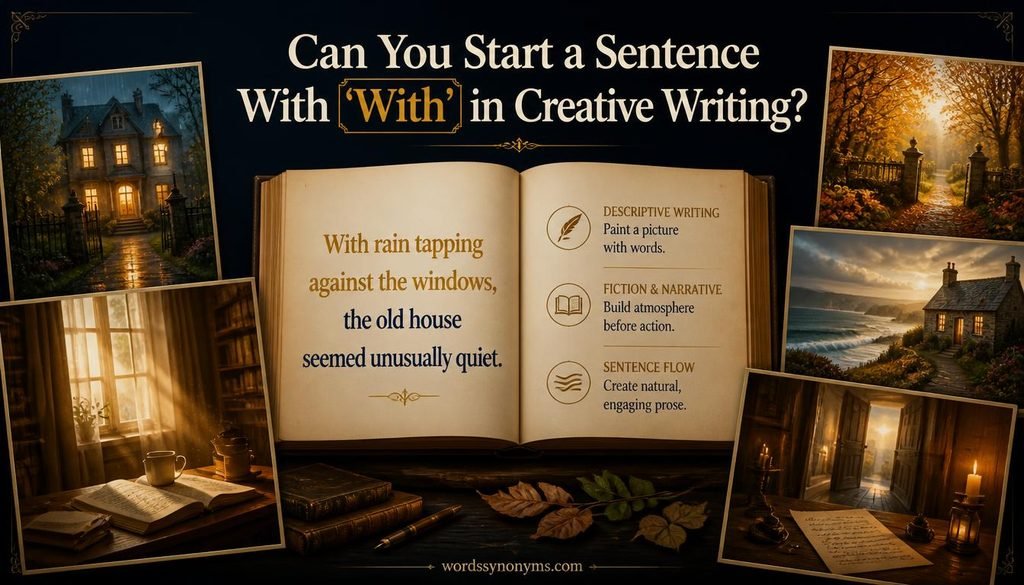
Can You Start a Sentence With “With” in Creative Writing?
Creative writing gives you plenty of opportunities to begin sentences with “with.” Writers use introductory phrases to establish atmosphere, describe characters, and prepare readers for an important action.
Imagine a story that begins with this sentence:
“With rain tapping against the windows, the old house seemed unusually quiet.”
The opening phrase establishes the weather and atmosphere before introducing the main description. Readers can picture the scene before the story moves forward.
This technique also works in short stories, novels, personal essays, and descriptive passages.
Examples of “With” in Descriptive Writing
When you want readers to visualize a setting, an introductory “with” phrase can combine several details naturally.
Examples include:
- With sunlight streaming through the curtains, the kitchen looked warm and inviting.
- With golden leaves covering the path, the garden resembled a painted landscape.
- With the ocean stretching beyond the windows, the small cottage felt peaceful.
- With distant thunder rolling across the hills, the travelers hurried toward shelter.
Notice how each sentence introduces a detail before presenting the main description. This arrangement creates a natural flow without relying on several short, disconnected sentences.
You can also use the construction to describe objects:
- With its polished wooden surface, the desk looked almost new.
- With a handwritten note tucked inside, the book became a treasured gift.
The trick is to choose details that serve a purpose. A useful description helps readers understand the scene rather than simply decorating the sentence.
Examples of “With” in Fiction and Narrative Writing
Narrative writing often focuses on actions, reactions, and changes. Introductory “with” phrases can connect a character’s circumstances to what happens next.
For example:
- With her heart racing, Elena stepped onto the stage.
- With one final glance at the doorway, Marcus left the room.
- With the clock ticking loudly, the students waited for the results.
- With the secret finally revealed, the family began asking questions.
These sentences establish a mood or circumstance before the central action.
However, variety matters. If every sentence begins with “with,” the writing may start to feel repetitive.
You can alternate between different structures:
“With the storm approaching, Lena closed the windows. She checked the weather forecast and called her brother. Outside, the wind rattled the shutters.”
This short passage uses one introductory “with” phrase, followed by two different sentence openings. The result feels more natural than repeating the same construction throughout.
Read more: Drunk or Drank: Which Is Correct?
Common Mistakes When Starting a Sentence With “With”
Although beginning a sentence with “with” is correct, certain sentence structures can cause problems. The most common issues involve incomplete thoughts, unclear modifiers, and unnecessary repetition.
Starting With “With” and Creating a Sentence Fragment
A sentence fragment is a group of words that doesn’t function as a complete sentence in its intended context.
An introductory “with” phrase often needs a main clause to complete the thought.
Incorrect as a standalone sentence: With the weather getting colder.
Correct: With the weather getting colder, we turned on the heater.
The first example introduces a circumstance but doesn’t explain what happened. The second adds a main clause and expresses a complete thought.
More examples:
| Incomplete fragment | Complete sentence |
| With everyone ready. | With everyone ready, the instructor began the lesson. |
| With no money in his wallet. | With no money in his wallet, James returned the item. |
| With the final exam tomorrow. | With the final exam tomorrow, Priya studied after dinner. |
| With the lights turned off. | With the lights turned off, the room became dark. |
A fragment can work intentionally in informal writing or creative dialogue. However, in standard academic and professional writing, make sure your sentence expresses a complete thought.
Starting With “With” and Creating a Dangling Modifier
A dangling modifier occurs when an introductory phrase doesn’t clearly or logically connect to the word it describes.
Consider this example:
Incorrect: With the report finished, the office was finally quiet.
The phrase “with the report finished” doesn’t identify who finished the report. Although readers may understand the intended meaning, the sentence could be clearer.
Better: With the report finished, the employees finally left the office.
Now the sentence connects the completed report with the employees’ actions more naturally.
Another example:
Unclear: With the final presentation completed, the conference room looked empty.
Clearer: With the final presentation completed, the team packed its materials and left the conference room.
The second version creates a more logical connection between the introductory phrase and the main clause.
When checking your writing, ask yourself two questions:
- Does the introductory phrase clearly describe the intended situation, person, or thing?
- Does the main clause connect logically to that phrase?
If the answer to either question is no, rewrite the sentence.
Using an Unclear or Awkward Introductory Phrase
Sometimes, a sentence is grammatically correct but still sounds unnatural.
For example:
“With the situation being one that required a considerable amount of attention, the manager decided to investigate.”
The sentence is unnecessarily wordy. You can express the same idea more directly:
“Because the situation required careful attention, the manager investigated.”
The revised version communicates the point with fewer words.
Here are additional examples:
- Wordy: With the fact that the road was closed, we changed our route.
- Clearer: With the road closed, we changed our route.
- Wordy: With the completion of the necessary preparations, the event began.
- Clearer: With preparations complete, the event began.
The goal isn’t to eliminate every long introductory phrase. Instead, remove unnecessary wording that makes the sentence harder to understand.
Overusing “With” at the Beginning of Sentences
Repeating the same sentence opening can make your writing sound mechanical, even when every sentence is grammatically correct.
For example:
“With the sun rising, we left the house. With the roads clear, we reached the town early. With plenty of time available, we visited a nearby café.”
Each sentence works individually, but the repeated opening becomes noticeable.
A more varied version sounds smoother:
“With the sun rising, we left the house. Because the roads were clear, we reached the town early. Since we had plenty of time, we visited a nearby café.”
The revised passage keeps the meaning while varying its structure.
Use “with” when it adds useful context, not simply because it sounds formal.
Alternatives to Starting a Sentence With “With”
Sometimes, another word expresses your meaning more precisely. Choosing an alternative can also help you avoid repetitive sentence openings.
The best replacement depends on the relationship you want to communicate.
| Alternative | Example sentence | Meaning |
| Because of | Because of the heavy rain, the match was postponed. | Explains a cause |
| After | After the meeting ended, we returned to work. | Shows sequence |
| Since | Since everyone agreed, we moved forward. | Gives a reason |
| Using | Using the new software, she finished the task. | Explains a method |
| As | As the sun set, the temperature dropped. | Shows time or a related circumstance |
| When | When the bell rang, the students left. | Identifies a time |
| Without | Without enough evidence, the claim remained unproven. | Describes an absence or condition |
| Despite | Despite the delay, the team completed the project. | Shows contrast |
These alternatives aren’t interchangeable in every sentence. Each one expresses a different relationship, so select the word that preserves your intended meaning.
How to Choose the Right Alternative
Start by identifying what your introductory phrase communicates.
If you’re explaining a reason, “because of” may work better. If you’re describing an event’s timing, “after” or “when” might be clearer.
For example:
Original: With the road closed, we took another route.
Alternative: Because the road was closed, we took another route.
Both sentences are correct. However, the second emphasizes the reason for changing routes more directly.
Consider another example:
Original: With the meeting finished, everyone went home.
Alternative: After the meeting finished, everyone went home.
The second version emphasizes the sequence of events. The first presents the completed meeting as the surrounding circumstance.
Before replacing “with,” consider what you want readers to notice. A small change in wording can shift the emphasis of an entire sentence.

“With” at the Beginning vs. “With” in the Middle of a Sentence
The position of “with” can change which information receives the most attention. Both sentence structures can be correct, but they don’t always emphasize the same detail.
Compare these examples:
| “With” at the beginning | “With” later in the sentence |
| With a clear plan, we completed the project. | We completed the project with a clear plan. |
| With her parents nearby, Maya felt safe. | Maya felt safe with her parents nearby. |
| With the work finished, they took a break. | They took a break with the work finished. |
| With a flashlight in hand, he entered the basement. | He entered the basement with a flashlight in hand. |
In the first column, the opening phrase establishes context before the main action. In the second column, the sentence begins with the subject and action before adding the context.
Which Sentence Structure Should You Choose?
Choose the structure that best supports your message.
Use “with” at the beginning when you want to establish a circumstance before presenting the main idea.
For example:
“With the deadline approaching, the team worked late.”
The approaching deadline sets the scene before the sentence describes the team’s response.
Use “with” later when the main action deserves immediate attention.
For example:
“The team worked late with the deadline approaching.”
This sentence is also grammatical, although the ending may sound less natural depending on the surrounding paragraph.
When editing, read both versions aloud. The clearer option usually fits your intended emphasis and the rhythm of the surrounding sentences.
Read more: When Was the Letter “J” Invented? And Was It Before Jesus?
Quick Rules for Starting a Sentence With “With”
If you need a quick reminder, keep these practical rules in mind.
- Starting with “with” is grammatically correct. You don’t need to avoid it simply because it begins the sentence.
- Use it to introduce relevant information. The phrase might describe a condition, situation, person, object, or circumstance.
- Complete the thought. An introductory phrase alone usually doesn’t form a complete sentence.
- Use commas thoughtfully. Longer introductory phrases generally benefit from a comma. Short phrases may not require one when the meaning remains clear.
- Check the connection. Make sure the opening phrase relates logically to the main clause.
- Avoid unnecessary wording. A short, direct phrase often communicates the idea better than an elaborate one.
- Vary your openings. Use different sentence structures to keep your writing natural and engaging.
- Choose alternatives when appropriate. Words such as “after,” “because,” and “without” may express your intended meaning more clearly.
A useful editing habit is to examine the first few words of every sentence in a paragraph. If several begin with “with,” consider whether a different structure would improve the flow.
FAQs
Can you start a sentence with “with”?
Yes, you can start a sentence with “with.” It is grammatically correct when the phrase introduces relevant information and connects smoothly to the main clause. For example, “With enough practice, your writing will improve.”
Is “with” a preposition?
Yes, “with” is a preposition. It shows relationships involving things such as company, tools, or circumstances. For example, “She wrote the letter with a blue pen.”
Is it grammatically incorrect to start a sentence with a preposition?
No, starting a sentence with a preposition is not inherently incorrect. Prepositional phrases can appear at the beginning, middle, or end of a sentence. The important thing is to make the meaning clear.
How do you use “with” at the beginning of a sentence?
Place “with” before a noun or noun phrase to introduce additional information, then complete the sentence with a main clause. For example, “With the rain slowing down, we decided to go outside.”
Should you avoid starting sentences with “with” in formal writing?
No, you do not need to avoid it in formal writing. A sentence beginning with “with” can sound professional when it expresses the intended meaning clearly. However, avoid using the same opening repeatedly.
What are some examples of sentences that begin with “with”?
Here are three natural examples:
- With careful planning, the team finished the project on time.
- With her friends beside her, Maya felt more confident.
- With the deadline approaching, everyone focused on completing their work.
Conclusion
Starting a sentence with “with” is perfectly acceptable in English grammar. This preposition helps you introduce background information, describe circumstances, and connect ideas naturally. Whether you’re writing a casual message, a school assignment, or a formal article, the key is to build a complete sentence that communicates your meaning clearly. For example, “With a little patience, you can solve the problem” is both natural and grammatically correct.
Instead of worrying about outdated grammar misconceptions, focus on sentence structure, clarity, and readability. Use introductory phrases when they add useful information, and avoid repeating the same sentence patterns too often. Once you understand how prepositions work, you’ll find it easier to vary your writing style and create smoother sentences. Good grammar isn’t about following unnecessary restrictions; it’s about expressing your ideas clearly and confidently.