
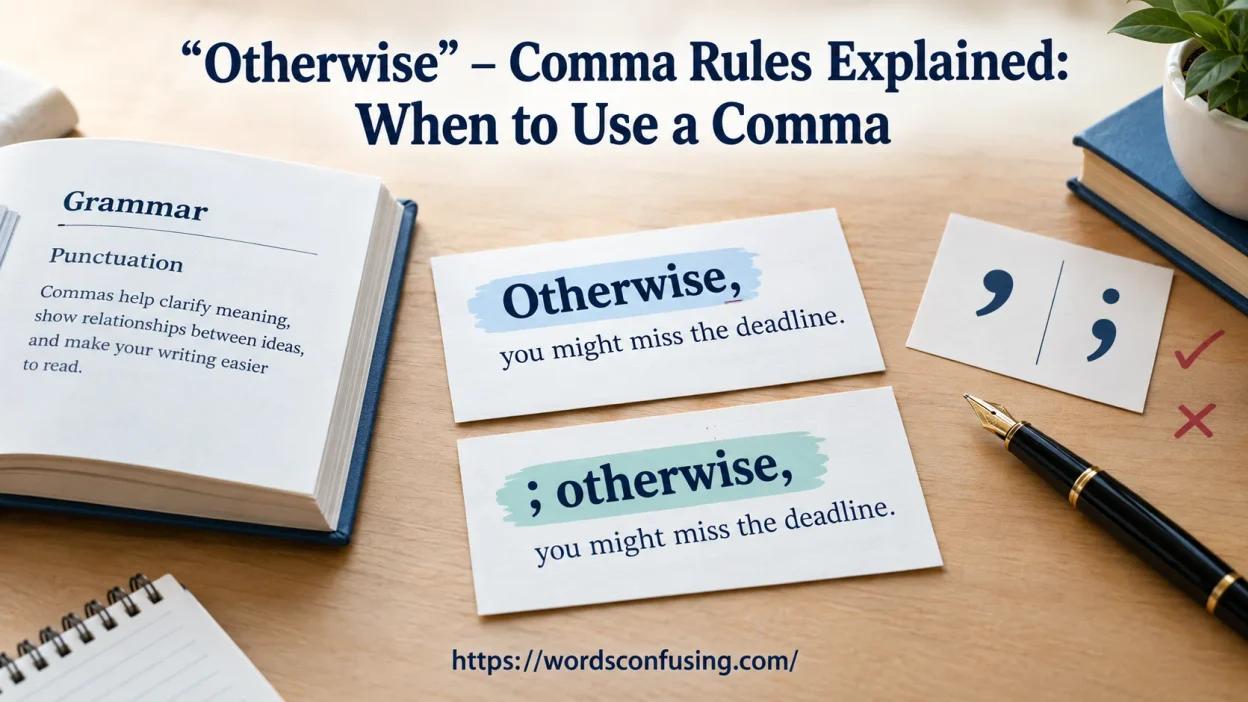
“Otherwise” Comma Rules Explained shows how otherwise works as a conjunctive adverb and where a comma may fit in sentences.
The comma rules can seem finicky, but this article will explain the main rules and help you understand the punctuation. When using otherwise, focus on how it connects the ideas in your sentence. This approach helps you use the word correctly without adding punctuation where it does not belong.
When otherwise connects independent thoughts, a semicolon often comes before it, while a comma follows it. However, the correct punctuation can change with the sentence structure and the role of the word.
These basic rules are what you need to know to use otherwise naturally. The associated punctuation depends on the relationship between the ideas, which makes the rules much easier to understand clearly.
Quick Answer
Sometimes.
When otherwise begins a sentence as an introductory word, a comma commonly follows it:
Otherwise, you’ll miss the deadline.
When otherwise connects two independent clauses, the traditional formal pattern uses a semicolon before it and a comma after it:
Finish the report; otherwise, the project may be delayed.
However, when otherwise means “in a different way,” a comma usually isn’t necessary:
I wouldn’t have guessed otherwise.
Likewise, when otherwise modifies an adjective, don’t insert a comma between the two words:
The otherwise quiet street became crowded.
The key isn’t simply where the word appears. You need to determine what “otherwise” means and what grammatical job it performs.
| Use of “otherwise” | Typical punctuation | Example |
| Introductory word | Comma after it | Otherwise, you’ll miss the bus. |
| Connects two independent clauses | Semicolon before; comma after | Leave now; otherwise, you’ll be late. |
| Means “in a different way” | Usually no comma | She thought otherwise. |
| Means “apart from that” | Depends on placement | The car is old but otherwise reliable. |
| Modifies an adjective | Usually no comma | An otherwise simple task became difficult. |
| Parenthetical interruption | Commas may surround it | The proposal is, otherwise, reasonable. |
The American Heritage Dictionary identifies several meanings of “otherwise,” including “in another way,” “under other circumstances,” “in other respects,” and “or else.” It also notes the traditional semicolon-or-period construction when “otherwise” connects related clauses.
What Does “Otherwise” Mean?
Before deciding where to place a comma, identify the meaning of otherwise. This small step solves most punctuation problems.
“Otherwise” Meaning “If Not” or “Or Else”
This is one of the most common uses.
Here, “otherwise” introduces a consequence that could occur if the first action or condition isn’t followed.
For example:
Hurry up; otherwise, you’ll miss the train.
The underlying meaning is:
Hurry up. If you don’t, you’ll miss the train.
Another example:
Back up your files; otherwise, you could lose important data.
The second clause explains the consequence of failing to back up the files.
Cambridge Dictionary describes this use as showing what happens when someone doesn’t follow an order or suggestion.
“Otherwise” Meaning “In a Different Way”
Sometimes “otherwise” means differently.
Consider:
I wouldn’t have handled it otherwise.
Here, “otherwise” means in another way.
Another example:
The evidence suggests otherwise.
That means the evidence suggests something different from what was previously stated or assumed.
Because “otherwise” functions differently here, the punctuation pattern also changes.
“Otherwise” Meaning “In Other Respects”
“Otherwise” can also mean apart from the fact just mentioned.
For example:
The house is small but otherwise comfortable.
The house is small. Apart from its size, however, it is comfortable.
Cambridge gives the same general meaning in examples such as a bike needing a new wheel while being “otherwise” in good condition.
“Otherwise” Meaning “Under Other Circumstances”
The word can also describe a different set of circumstances:
Otherwise, I couldn’t have afforded the trip.
This means:
Under different circumstances, I couldn’t have afforded the trip.
Oxford lists this conditional meaning as one of the major uses of “otherwise.”
When to Put a Comma After “Otherwise” at the Beginning of a Sentence
When otherwise opens a sentence and functions as an introductory sentence adverb, a comma commonly follows it.
Examples include:
Otherwise, you’ll miss your appointment.
Otherwise, the machine may stop working.
Otherwise, we could lose the entire file.
Otherwise, the result might be completely different.
The comma gives readers a clear boundary before the main clause.
Think of it as a small signpost. The reader sees otherwise, recognizes the conditional relationship, and then moves into the consequence.
Why Does the Comma Help?
Compare these two versions:
Otherwise, you’ll miss the deadline.
Otherwise you’ll miss the deadline.
The second version can occur in English, particularly in less formal contexts. However, the comma is often preferred when otherwise works as an introductory sentence adverb.
The comma makes the structure immediately visible.
The general principle also applies to other introductory words and phrases. Style guidance from Google recommends commas after introductory words and phrases when they help establish the sentence structure.
Examples With Different Sentence Types
Conditional consequence:
Otherwise, the payment may be rejected.
Warning:
Otherwise, you could damage the equipment.
Advice:
Otherwise, consider choosing another option.
Hypothetical situation:
Otherwise, the outcome might have been very different.
In each case, “otherwise” prepares the reader for a result or alternative circumstance.
When “Otherwise” Connects Two Independent Clauses
This is where comma rules become especially important.
Suppose you write:
Leave now; otherwise, you’ll miss the train.
The sentence contains two independent clauses:
- Leave now.
- You’ll miss the train.
Both clauses can stand alone as sentences.
Because “otherwise” connects these related independent clauses, standard formal punctuation commonly uses a semicolon before otherwise and a comma after it.
The basic pattern is:
Independent clause; otherwise, independent clause.
For example:
Save your work; otherwise, you could lose everything.
Call the office today; otherwise, your request may be delayed.
Wear protective equipment; otherwise, you could get hurt.
Check the address carefully; otherwise, the package may go to the wrong place.
The University of Wisconsin–Madison Writing Center lists otherwise among conjunctive adverbs and explains that when such a word connects two independent clauses, a semicolon precedes it and a comma follows it.
Why Isn’t a Comma Enough?
Consider:
Leave now, otherwise you’ll be late.
Many readers encounter this construction in everyday writing. However, under traditional formal punctuation rules, the comma alone doesn’t adequately separate two independent clauses when “otherwise” functions as a conjunctive adverb.
That creates what is commonly called a comma splice.
A clearer formal version is:
Leave now; otherwise, you’ll be late.
You can also use two sentences:
Leave now. Otherwise, you’ll be late.
Both versions clearly separate the two complete thoughts.
The University of Illinois Extension specifically recommends a semicolon before conjunctive adverbs such as otherwise when they join independent clauses.
Can You Use a Comma Before “Otherwise”?
This question deserves a more nuanced answer.
You may encounter sentences such as:
Hurry up, otherwise you’ll miss the bus.
This construction isn’t rare. In fact, dictionaries recognize that otherwise can function like “or else” in some contexts. The American Heritage Dictionary notes that usage varies because “otherwise” can be treated as a conjunction in this sense. It also reports that copyeditors often prefer the more traditional semicolon or period.
For formal American English, however, the safest choice is:
Hurry up; otherwise, you’ll miss the bus.
Or:
Hurry up. Otherwise, you’ll miss the bus.
This approach avoids ambiguity and follows the conventional punctuation pattern for a conjunctive adverb.
A Useful Rule
When both sides can stand as complete sentences, use:
Clause; otherwise, clause.
For example:
Take an umbrella; otherwise, you’ll get soaked.
Both parts can stand independently:
Take an umbrella.
You’ll get soaked.
That’s your clue.
“Otherwise” at the End of a Sentence
When “otherwise” appears at the end of a sentence, it often means “in a different way.”
In that situation, you usually don’t need a comma.
For example:
I wouldn’t have guessed otherwise.
She couldn’t have acted otherwise.
The evidence suggests otherwise.
We had no reason to believe otherwise.
He might have chosen otherwise.
Adding a comma would usually make the sentence sound unnatural:
❌ I wouldn’t have guessed, otherwise.
The word is closely connected to the verb or predicate. It isn’t functioning as a detachable introductory transition.
“Otherwise” Can Refer Back to an Earlier Idea
Consider:
The facts suggest otherwise.
The word otherwise points backward to an implied alternative.
Perhaps someone claimed the project had failed. The evidence suggests otherwise, meaning the evidence indicates that the project did not fail.
Cambridge describes this meaning as “differently, or in another way.”
“Otherwise” in the Middle of a Sentence
The comma rules become more flexible when otherwise appears inside a sentence.
Its punctuation depends heavily on whether it belongs to the main grammatical structure or acts as a parenthetical interruption.
“Otherwise” as Part of the Main Phrase
Consider:
The otherwise quiet neighborhood became noisy.
Here, “otherwise” modifies quiet.
It means:
The neighborhood was generally quiet apart from this situation.
You don’t need a comma between “otherwise” and “quiet.”
Correct:
The otherwise quiet neighborhood became noisy.
Not:
❌ The otherwise, quiet neighborhood became noisy.
The same pattern appears in many common combinations:
- otherwise healthy
- otherwise normal
- otherwise useful
- otherwise reliable
- otherwise successful
- otherwise harmless
- otherwise reasonable
- otherwise effective
Oxford gives examples such as “an otherwise happy life” and “an otherwise unhurt” person.
“Otherwise” as a Parenthetical Word
A different situation occurs when “otherwise” interrupts an otherwise complete sentence.
For example:
The proposal is, otherwise, reasonable.
Here, the writer treats “otherwise” as a parenthetical interruption.
However, this structure is less common and can sound stiff. In many cases, a smoother sentence would be:
The proposal is reasonable in other respects.
Or:
The proposal is otherwise reasonable.
Good punctuation isn’t only about technical correctness. Natural phrasing matters, too.
“Otherwise” Before an Adjective or Adverb
One of the most useful patterns to understand is:
otherwise + adjective
This construction normally doesn’t need a comma.
Examples
It was an otherwise ordinary day.
She remained otherwise healthy.
The device is otherwise reliable.
The building is otherwise safe.
The plan seems otherwise practical.
In these sentences, “otherwise” modifies the adjective that follows.
The meaning is usually similar to:
“apart from this particular fact”
For example:
The otherwise ordinary day became unforgettable.
This means the day was ordinary in most respects. One event changed that description.
Why the Comma Doesn’t Belong There
A comma would separate words that naturally belong together.
Compare:
an otherwise ordinary day
with:
❌ an otherwise, ordinary day
The second version incorrectly interrupts the adjective phrase.
Think of otherwise ordinary as a compact unit. The word “otherwise” changes the scope of “ordinary.”
“Otherwise” With “But”
The combination but otherwise appears frequently in natural English.
For example:
The apartment is small but otherwise comfortable.
The car is old but otherwise reliable.
The plan has several flaws but is otherwise practical.
Here, “otherwise” means “apart from that”.
The sentence says the apartment is small. Apart from its size, it is comfortable.
Cambridge specifically gives examples of this construction, including sentences where something has a particular flaw but is otherwise in good condition.
Does “But Otherwise” Need a Comma?
Not automatically.
Consider:
The laptop is expensive but otherwise excellent.
There’s no reason to insert a comma before “otherwise.”
The word is part of the phrase otherwise excellent.
However, if the sentence contains two independent clauses, punctuation may change:
The laptop is expensive, but it performs extremely well otherwise.
Here, the comma belongs before but because but joins two independent clauses.
The punctuation isn’t caused by “otherwise.” It’s caused by the grammatical structure created by but.
That’s an important distinction.
“Otherwise” vs. “Or Otherwise”
The phrase or otherwise can cause another layer of confusion.
In many sentences, it means something like “or in another way” or “whether in this form or another.”
Examples include:
The information may be written or otherwise recorded.
The company may sell the property or otherwise dispose of it.
The policy applies to intentional damage or otherwise.
The exact punctuation depends on what or otherwise connects.
When “Or Otherwise” Joins Words or Phrases
No special comma is automatically required:
The documents can be printed or otherwise distributed.
Here, “printed” and “distributed” form the coordinated elements.
When “Otherwise” Introduces a Separate Clause
If it introduces another independent clause, you need to examine the clause boundary.
For formal writing, a semicolon may be appropriate:
Submit the form today; otherwise, the request may be denied.
You wouldn’t replace the semicolon with a comma simply because “otherwise” appears in the sentence.
“Otherwise” and “Otherwise Known As”
The phrase otherwise known as has a different structure.
For example:
Samuel Clemens, otherwise known as Mark Twain, became one of America’s best-known writers.
Here, otherwise known as Mark Twain is a parenthetical phrase identifying Samuel Clemens.
Because the phrase interrupts the sentence, commas set it off.
Another example:
The animal, otherwise known as the gray wolf, lives across much of the Northern Hemisphere.
The punctuation comes from the parenthetical phrase, not from a universal rule that says “otherwise” always requires commas.
The American Heritage Dictionary and Cambridge both recognize otherwise known as as a standard expression.
“Otherwise” and Sentence Adverbs
A conjunctive adverb helps show the relationship between ideas.
Words such as:
- however
- therefore
- otherwise
- nevertheless
- consequently
- moreover
- thus
can perform this function.
When otherwise connects two independent clauses, it behaves similarly to these other transitional adverbs.
For example:
The road was dangerous; therefore, we turned around.
The road was dangerous; otherwise, we would have continued.
The punctuation pattern is similar.
Why This Matters
Some writers assume that “otherwise” works exactly like and, but, or or.
It doesn’t always.
A coordinating conjunction can join two independent clauses with a comma:
The road was dangerous, so we turned around.
But a conjunctive adverb traditionally requires stronger punctuation:
The road was dangerous; therefore, we turned around.
Likewise:
The road was dangerous; otherwise, we would have continued.
Google’s developer style guide explicitly recommends a semicolon or period before conjunctive adverbs such as otherwise and a comma after them.
Common “Otherwise” Comma Mistakes
Mistake: Adding a Comma Every Time You See “Otherwise”
A common misconception says:
“Otherwise always needs a comma.”
That’s incorrect.
Compare:
Otherwise, you’ll miss the deadline.
with:
I wouldn’t have known otherwise.
And:
The otherwise simple process became complicated.
All three sentences use “otherwise” differently.
The punctuation must follow the function of the word, not merely its spelling.
Mistake: Using a Comma Between Two Independent Clauses
A common error looks like this:
❌ Leave now, otherwise you’ll miss the train.
For formal writing, use:
Leave now; otherwise, you’ll miss the train.
Or:
Leave now. Otherwise, you’ll miss the train.
This is one of the most important otherwise comma rules to remember.
Mistake: Adding a Comma in “Otherwise + Adjective”
Incorrect:
❌ The otherwise, quiet room became noisy.
Correct:
The otherwise quiet room became noisy.
The phrase otherwise quiet works as a unit.
Mistake: Forgetting the Comma After Introductory “Otherwise”
Standard edited writing commonly uses:
Otherwise, the system may fail.
Not:
Otherwise the system may fail.
The comma isn’t merely decorative. It signals that “otherwise” functions as an introductory element.
Mistake: Treating Every “Otherwise” as a Conjunction
“Otherwise” has multiple grammatical uses.
It can function as:
- an adverb
- a conjunctive adverb
- a word meaning “if not”
- a modifier meaning “apart from that”
- part of a parenthetical phrase such as “otherwise known as”
The punctuation changes accordingly.
A Practical Test for “Otherwise” Commas
When you’re unsure, follow these steps.
Ask What “Otherwise” Means
Does it mean:
- if not
- or else
- in another way
- apart from that
- under different circumstances
This often reveals the correct structure immediately.
Check Whether the Second Clause Is Independent
Look at the words after “otherwise.”
Can they form a complete sentence?
For example:
You’ll miss the train.
Yes.
Therefore:
Leave now; otherwise, you’ll miss the train.
The semicolon separates the independent clauses.
Check Whether “Otherwise” Modifies an Adjective
If you see a structure such as:
otherwise healthy
or:
otherwise useful
don’t insert a comma between the two words.
Check Whether the Word Starts the Sentence
If “otherwise” introduces the main clause, a comma commonly follows:
Otherwise, we may lose the opportunity.
Ask Whether the Word Is Parenthetical
If “otherwise” interrupts the sentence rather than forming part of the main structure, commas may set it off.
However, don’t add parenthetical commas simply because a word feels like it deserves a pause.
Grammar comes before breath.
“Otherwise” Comma Rules in Formal Writing
Formal writing benefits from punctuation that makes relationships between clauses obvious.
Consider:
Complete the application; otherwise, your request may not be processed.
The semicolon clearly separates the two independent clauses. The comma after “otherwise” marks the transitional word.
This pattern works particularly well in:
- academic essays
- business reports
- technical documentation
- instructions
- policies
- professional correspondence
- explanatory articles
The University of Illinois Extension gives otherwise as an example of a conjunctive adverb that takes a semicolon before it and a comma after it when joining independent clauses.
Formal Writing Favors Clarity Over Shortcuts
Informal writing often bends punctuation rules.
You might see:
Call me otherwise I’ll worry.
A reader can understand it. Yet formal editing would normally improve the sentence:
Call me; otherwise, I’ll worry.
Or:
Call me. Otherwise, I’ll worry.
A small punctuation change makes the relationship easier to scan.
“Otherwise” in Academic and Professional Writing
The word can make formal writing more concise when used correctly.
Instead of:
If you do not submit the application by Friday, your request may not be considered.
You might write:
Submit the application by Friday; otherwise, your request may not be considered.
Both sentences work. The second is more compact.
Examples for Professional Writing
Instructions:
Save the document before closing the program; otherwise, your changes may be lost.
Policy:
Employees must complete the form; otherwise, the request cannot be processed.
Academic writing:
The evidence must be evaluated carefully; otherwise, the conclusion may be misleading.
Technical writing:
Restart the device after installation; otherwise, the update may not take effect.
The word creates a clear cause-and-consequence relationship.
“Otherwise” vs. Similar Transition Words
Understanding similar words can make punctuation easier.
| Word | Main meaning | Example |
| Otherwise | If not / in another way | Leave now; otherwise, you’ll be late. |
| However | In contrast | The task was difficult; however, we finished it. |
| Therefore | As a result | The data was incomplete; therefore, we repeated the test. |
| Instead | As a replacement | We didn’t take the bus; instead, we walked. |
| Moreover | In addition | The plan is affordable; moreover, it’s practical. |
| Nevertheless | Despite that | The task was difficult; nevertheless, we completed it. |
These words may share similar punctuation patterns. Their meanings aren’t interchangeable.
“Otherwise” vs. “However”
Compare:
Otherwise, the plan will fail.
This expresses a consequence.
However, the plan has weaknesses.
This expresses contrast.
The punctuation may look similar because both words can function as sentence adverbs. Their logical relationships are different.
A Closer Look at “Otherwise” and “If Not”
One of the easiest ways to understand “otherwise” is to mentally replace it with if not.
For example:
Wear a jacket; otherwise, you’ll be cold.
Try the substitution:
Wear a jacket; if not, you’ll be cold.
The meaning remains clear.
This test works especially well when “otherwise” introduces a warning or consequence.
More Examples
Leave early; otherwise, you’ll miss the appointment.
Equivalent:
Leave early; if not, you’ll miss the appointment.
Back up the files; otherwise, you could lose them.
Equivalent:
Back up the files; if not, you could lose them.
If the substitution works naturally, you’re probably dealing with the conditional meaning of “otherwise.”
Read more: Heroes or Hero’s or Heroes’: Which Is Correct?
A Closer Look at “Otherwise” and “In a Different Way”
Now try a different substitution.
She thought otherwise.
Replace “otherwise” with:
She thought differently.
The meaning remains.
That tells you “otherwise” isn’t introducing a consequence. It describes a different view.
More examples:
The evidence suggests otherwise.
The evidence suggests differently.
He couldn’t have acted otherwise.
He couldn’t have acted differently.
These sentences don’t need commas around “otherwise.”
Case Study: Three Sentences, Three Punctuation Patterns
Consider these three examples:
Otherwise, the machine will stop.
Turn it off; otherwise, the machine may overheat.
The otherwise reliable machine suddenly failed.
The same word appears in every sentence. Yet the punctuation differs.
Sentence One
Otherwise, the machine will stop.
“Otherwise” begins the sentence as an introductory element.
Sentence Two
Turn it off; otherwise, the machine may overheat.
“Otherwise” connects two independent clauses. The semicolon separates them.
Sentence Three
The otherwise reliable machine suddenly failed.
“Otherwise” modifies the adjective reliable. No comma belongs between them.
This comparison demonstrates why memorizing one universal comma rule doesn’t work.
Quick Reference: Correct and Incorrect Examples
| Incorrect or questionable | Better formal version | Why |
| Leave now, otherwise you’ll be late. | Leave now; otherwise, you’ll be late. | Separates two independent clauses |
| Otherwise you’ll miss it. | Otherwise, you’ll miss it. | Introductory “otherwise” |
| The otherwise, useful tool failed. | The otherwise useful tool failed. | “Otherwise useful” forms a phrase |
| I wouldn’t have guessed, otherwise. | I wouldn’t have guessed otherwise. | “Otherwise” means differently |
| The car is old but, otherwise, reliable. | The car is old but otherwise reliable. | “Otherwise reliable” is an integrated phrase |
| Samuel Clemens otherwise known as Mark Twain… | Samuel Clemens, otherwise known as Mark Twain,… | Parenthetical identification |
Does “Otherwise” Always Need a Comma?
No.
That’s the most important answer to remember.
“Otherwise” needs punctuation based on its role, position, and relationship to surrounding words.
Use a comma after introductory otherwise:
Otherwise, you’ll miss the deadline.
Use a semicolon before and comma after otherwise when it joins two independent clauses:
Submit the form; otherwise, your request may be delayed.
Usually use no comma when it means “differently”:
The evidence suggests otherwise.
Usually use no comma when it modifies an adjective:
The otherwise simple task became difficult.
Use commas when a longer phrase containing otherwise functions parenthetically:
The author, otherwise known as a critic, rejected the proposal.
Can You Start a Sentence With “Otherwise”?
Yes.
Starting a sentence with otherwise is completely acceptable.
For example:
Otherwise, the results may be misleading.
Otherwise, you could miss an important detail.
Otherwise, there isn’t much reason to change the plan.
There’s no grammatical rule that prohibits beginning a sentence with “otherwise.”
In fact, Oxford provides examples where “otherwise” begins a sentence and introduces a consequence or alternative circumstance.
The important issue is punctuation.
In standard edited prose, a comma after introductory otherwise often makes the structure easier to read.
Is “Otherwise” a Conjunction?
The answer depends on the grammatical analysis.
Dictionaries can classify otherwise as both an adverb and a conjunction depending on how it functions.
The American Heritage Dictionary notes that when “otherwise” connects related clauses, it is traditionally classified as a conjunctive adverb. It also recognizes the word’s conjunction-like use meaning “or else.”
This difference helps explain why you’ll encounter more than one punctuation pattern in real-world English.
For formal writing, however, the most reliable approach is straightforward:
When otherwise connects two independent clauses, use a semicolon before it and a comma after it.
That structure is clear, conventional, and easy for readers to process.
The Easiest Way to Remember the Otherwise Comma Rules
Think of otherwise as having three major punctuation personalities.
Personality One: The Sentence Opener
Otherwise, + sentence
Example:
Otherwise, you’ll miss your chance.
Personality Two: The Clause Connector
Sentence; otherwise, sentence
Example:
Act quickly; otherwise, the opportunity may disappear.
Personality Three: The Integrated Modifier
otherwise + adjective
Example:
The otherwise simple process became complicated.
There is also a fourth useful pattern:
Personality Four: The “Differently” Meaning
verb + otherwise
Example:
The evidence suggests otherwise.
No comma is normally needed.
Once you recognize these patterns, most otherwise comma rules become much easier.
FAQs
Do you put a comma before “otherwise”?
Usually, you can place a comma before otherwise when it connects ideas in a sentence. However, the exact punctuation depends on how otherwise functions in that sentence.
Do you need a comma after “otherwise”?
Not always. A comma may follow otherwise when it introduces or interrupts part of a sentence. If it simply modifies a verb or phrase, you may not need one.
Is “otherwise” a conjunctive adverb?
Yes. Otherwise can function as a conjunctive adverb when it connects two independent clauses. In that role, it often works with a semicolon before it and a comma after it.
Can “otherwise” start a sentence?
Yes, otherwise can appear at the beginning of a sentence. When it introduces an introductory element, a comma often follows it.
Is “otherwise” always separated by commas?
No. Treating otherwise as a word that always needs commas can create unnecessary punctuation. Its position and grammatical role determine whether commas are appropriate.
What is the easiest way to punctuate “otherwise”?
First, identify what otherwise is doing in the sentence. If it connects two complete thoughts, consider a semicolon and comma combination. In other uses, follow the sentence structure rather than applying one fixed rule.
Conclusion
Using otherwise correctly becomes much easier once you understand what the word is doing in a sentence. Don’t place a comma beside it simply because it sounds like a pause. Instead, check whether it connects independent thoughts or serves another role.
Once you understand the sentence structure, the right punctuation usually becomes clear. With a little practice, these comma rules stop feeling so finicky, and you can use otherwise naturally and confidently.

Franklin Hayes is a writer and editor at WordsConfusing.com, focused on making English vocabulary, grammar, and commonly confused words easy to understand. He writes clear, practical articles with simple explanations and useful examples to help readers improve their English with confidence.
His goal is simple: Making Confusing Words Simple.