“Involved With” or “Involved In”: What’s the Difference? asks whether you mean participation or a connection with someone or something in English.
The verb “involved” usually takes two prepositions: “with” and “in.” However, their contextual meaning changes depending on the situation. Involved in generally describes participation in an activity, event, or situation.
In contrast, involved with usually expresses a connection, relationship, or association with someone or something. Understanding these grammatical rules makes using prepositions easier and helps you choose the right expression.
These differences influence your word choice, sentence construction, and overall language usage. This phrase comparison also shows how prepositional usage works in everyday English expressions. When choosing between these verb-preposition combinations, consider whether you’re describing participation or a personal or professional connection.
Recognizing the meaning of each phrase helps you select the correct preposition. Clear explanations and practical examples make these distinctions easier to understand and apply in everyday English.
Quick Answer
Both “involved with” and “involved in” are correct, but they express slightly different meanings. Use “involved in” when someone participates in an activity, project, or situation. Use “involved with” when describing a personal relationship, professional connection, or association with someone or something.
Examples:
- She’s helping organize a charity event. (She helps organize it.)
- She works with a local charity. (She has a connection with the organization.)

What Does “Involved In” Mean?
The expression “involved in” describes someone’s participation, engagement, or role in a particular activity, event, process, or situation. It suggests that someone takes part in something rather than simply having a connection to it.
You can use this expression when discussing professional responsibilities, educational activities, personal projects, investigations, and everyday experiences.
For example:
- Maria is organizing the school event.
- Several students are competing in the science competition.
- My brother works on a community development project.
- The company develops new technology.
In each example, the person or organization participates in a particular activity or process.
Definition and Meaning of “Involved In”
The word involved means engaged, participating, or having a connection with something. When you combine it with the preposition in, the expression commonly emphasizes participation within a particular activity or situation.
Consider this sentence:
Daniel is working on the marketing campaign.
This statement suggests that Daniel contributes to the campaign. He might develop strategies, create advertisements, analyze results, or coordinate promotional activities.
The expression can describe different levels of participation. Someone doesn’t need to manage an entire project to take part in it.
For example, a student who collects research information contributes to the research project. Similarly, an employee who attends planning meetings takes part in a company initiative.
Common situations that use “involved in” include:
- Work: Participating in meetings, projects, or business operations.
- Education: Taking part in research, assignments, or academic activities.
- Sports: Participating in competitions, tournaments, or training.
- Community: Helping with local programs, fundraising, or volunteer activities.
- Legal matters: Having a role in an investigation, dispute, or criminal incident.
- Personal activities: Participating in hobbies, discussions, or social events.
Examples of “Involved In” in Sentences
Examples make the meaning easier to understand. Here are practical sentences showing how people use “involved in” across different situations.
| Example sentence | Meaning |
| Sarah is involved in a school project. | Sarah participates in the project. |
| He was involved in an accident yesterday. | He had a role in the accident or was affected by it. |
| My parents are involved in community activities. | They participate in local activities. |
| She is involved in scientific research. | She contributes to research work. |
| They were involved in a heated discussion. | They participated in the discussion. |
| Jack is involved in several business ventures. | Jack participates in multiple business activities. |
| The police are involved in the investigation. | The police are participating in the investigation. |
| We are involved in planning the wedding. | We help organize the wedding. |
Notice that “involved in” doesn’t always mean someone actively chose to participate.
For instance, “An accident happened, and he was one of those affected” doesn’t necessarily mean he caused it. He could have been a driver, passenger, cyclist, or pedestrian affected by the incident.
Context determines the exact meaning.
When to Use “Involved In”
Although the expression appears in many situations, certain contexts make its use especially natural.
Use “involved in” when describing participation in the following situations: For example, you can use this phrase when someone takes part in an activity, contributes to a project, or participates in an event.
A project or assignment
When someone contributes to a specific project, they take an active part in its activities. For example, they may share ideas, complete tasks, or support the team.
- I’m involved in a new marketing project.
- Three teachers are involved in preparing the curriculum.
- She was involved in designing the company website.
An event or competition
Use this expression when someone takes part in an organized event or competition. For example, students may compete in a science fair or participate in a school tournament.
- Our school is involved in the annual science fair.
- He was involved in the football tournament.
- Several volunteers are involved in organizing the festival.
A discussion or conversation
Additionally, you can use this expression when someone takes part in conversations, discussions, or debates.
- Everyone was involved in the discussion.
- She became involved in an argument.
- The manager was involved in negotiations.
A process or investigation
When someone takes part in a procedure or investigation, the expression “involved in” describes their participation or role.
- The detectives are involved in the investigation.
- Several departments are involved in the approval process.
- He was involved in making the final decision.
An activity or profession
Additionally, you can use this expression to describe someone’s participation in ongoing activities or professional work.
- My sister is involved in teaching.
- They are involved in environmental protection.
- He is involved in local politics.
The main idea remains consistent: someone participates in an activity, process, or situation.
What Does “Involved With” Mean?
The expression “involved with” describes a connection, relationship, or association between a person and someone or something else.
It frequently appears when discussing personal relationships, professional connections, organizations, businesses, and social groups.
For example:
- Sarah is involved with a local charity.
- He is involved with someone from his university.
- Our company is involved with several international organizations.
- She has been involved with the same community group for years.
These examples emphasize relationships or associations rather than participation within a specific activity.
However, “involved with” can sometimes describe active participation too. The surrounding context determines whether the expression emphasizes association, collaboration, or engagement.
Definition and Meaning of “Involved With”
The expression “involved with” generally means connected, associated, or engaged with someone or something.
It can describe different kinds of relationships, including personal, romantic, professional, and organizational connections.
Consider this example:
“James is involved with a nonprofit organization.”
This sentence suggests that James has an association with the organization. He might work there, volunteer, support its activities, or serve in another capacity.
Now consider another example:
“Emily is involved with Mark.”
Depending on the context, this sentence might suggest a romantic relationship. However, it could also describe another personal connection.
The expression doesn’t automatically indicate romance. Context provides the necessary details.
Common situations that use “involved with” include:
- Personal relationships: Describing a connection with another person.
- Romantic relationships: Referring to dating or romantic involvement.
- Organizations: Describing an association with a company, charity, or institution.
- Professional connections: Explaining someone’s relationship with colleagues or business partners.
- Community groups: Describing an association with local organizations.
- Social causes: Explaining someone’s connection with particular movements or initiatives.
Examples of “Involved With” in Sentences
Let’s examine how “involved with” works in different situations.
| Example sentence | Meaning |
| She is involved with a local charity. | She has an association with the charity. |
| John is involved with a software company. | John has a professional connection with the company. |
| Maria is involved with someone from work. | Maria may have a romantic relationship with that person. |
| He has been involved with the organization for years. | He has maintained a long-term association. |
| Our school is involved with several community groups. | The school has connections with those groups. |
| I’m involved with a professional network. | I have an association with the network. |
| She became involved with a new business partner. | She developed a professional association. |
| They are involved with environmental organizations. | They have connections with those organizations. |
The examples show that the expression can describe different relationships. The exact interpretation depends on the people, organizations, and circumstances involved.
When to Use “Involved With”
Understanding the common situations can help you choose this expression naturally.
A personal or romantic relationship
Use “involved with” when describing someone’s personal connection with another person.
- She is involved with someone from her office.
- He’s been involved with Laura for several months.
- I don’t know whether they’re romantically involved with each other.
Remember that this expression can suggest romance without explicitly confirming a relationship’s status.
An organization or company
Use this phrase when someone has an association with a particular institution or business.
- My father is involved with a local business.
- She has been involved with the organization since 2020.
- Our university is involved with several research institutions.
A professional connection
The expression also works when describing business relationships and professional associations.
- He’s involved with several international clients.
- The manager is involved with a consulting firm.
- Our department works closely with people involved with the project.
A community group or charity
When discussing volunteer work, community participation, or organizational relationships, “involved with” can sound natural.
- She’s involved with a local animal shelter.
- They are involved with a neighborhood association.
- My brother is involved with a youth development organization.
A particular cause or movement
You can also use this expression to describe someone’s association with a social or environmental cause.
- Many students are involved with environmental organizations.
- She became involved with a campaign supporting education.
- He’s involved with several community initiatives.
In these examples, the expression highlights an association or ongoing connection.
Read more: On the Market or In the Market: Meaning and Correct Usage
“Involved With” vs. “Involved In”: Key Differences
The main difference concerns what you want to emphasize. “Involved in” generally highlights participation, while “involved with” usually highlights association or connection.
However, these expressions sometimes overlap. You shouldn’t treat their meanings as completely separate.
For example, someone can be involved in a charity’s fundraising campaign and involved with the charity itself.
The first expression identifies the activity. The second identifies the broader association.
Participation vs. Association
This distinction provides the easiest way to understand both expressions.
“Involved in” emphasizes participation.
When you use this expression, you’re focusing on what someone does or the situation they’re part of.
Examples:
- She is involved in organizing the conference.
- He is involved in a research project.
- They are involved in community development.
“Involved with” emphasizes association.
When you use this expression, you’re focusing on someone’s connection or relationship with another person or organization.
Examples:
- She is involved with a conference organization.
- He is involved with a research institution.
- They are involved with a community group.
Consider the following comparison:
| Involved In | Involved With |
| She is involved in a charity event. | She is involved with a charity. |
| He is involved in a company project. | He is involved with a company. |
| They are involved in community activities. | They are involved with a community organization. |
| I’m involved in a research study. | I’m involved with a research institution. |
| She is involved in organizing the campaign. | She is involved with the campaign organizers. |
The difference becomes clearer when you identify the object following each preposition.
One expression focuses on the activity or situation. The other highlights the connection or relationship.
Differences in Context and Usage
Sometimes, both expressions work with the same noun. However, changing the preposition can change the emphasis.
Consider these sentences:
Example 1: A research project
- “She is involved in the research project.”
- “She is involved with the research project.”
The first sentence emphasizes her participation in the research. The second emphasizes her connection or association with the project.
Both can be correct, although “involved in” is generally more direct when discussing active participation.
Example 2: A company
- “He is involved in the company.”
- “He is involved with the company.”
The first sentence suggests that he participates in the company’s operations or activities. The second highlights his association with the business.
The second sentence might describe an employee, consultant, partner, or other professional connection.
Example 3: A criminal investigation
- “He was involved in the crime.”
- “He was involved with the criminals.”
The first sentence suggests participation in the criminal act. The second describes an association with the people who committed crimes.
These statements communicate different information. A person might associate with criminals without participating in their illegal activities.
Comparison Table: “Involved With” vs. “Involved In”
Use this table as a quick reference whenever you’re unsure which expression fits.
| Comparison | Involved In | Involved With |
| Main emphasis | Participation | Association |
| Common meaning | Taking part in something | Having a connection |
| Common objects | Activities, projects, events, situations | People, organizations, companies |
| Professional context | Participating in work | Maintaining a professional connection |
| Personal context | Participating in an activity | Having a personal relationship |
| Romantic context | Less commonly used to identify a partner | Can suggest a romantic relationship |
| Example | She’s involved in the investigation. | She’s involved with the organization. |
Quick rule: Use “involved in” when emphasizing participation. Choose “involved with” when emphasizing a connection or relationship.
Can You Use “Involved With” and “Involved In” Interchangeably?
Sometimes, yes. However, you shouldn’t automatically replace one expression with the other.
Both phrases can describe someone’s connection to an activity, project, or organization. Nevertheless, their meanings may shift depending on the preposition.
The important thing is to understand the message your sentence communicates.
When Both Expressions Are Grammatically Possible
Certain nouns can naturally follow both prepositions.
For example, consider the word “project.”
- Sarah is involved in the project.
- Sarah is involved with the project.
Both sentences are grammatically acceptable.
However, the first emphasizes Sarah’s participation in the project’s activities. The second emphasizes her connection or association with it.
Another example involves a business:
- My brother is involved in the business.
- My brother is involved with the business.
The first might suggest that he participates in managing or operating the business. The second might describe his broader professional association.
Neither sentence automatically provides every detail about his responsibilities.
Here are additional examples:
| With “Involved In” | With “Involved With” |
| He is involved in the campaign. | He is involved with the campaign. |
| She is involved in the organization. | She is involved with the organization. |
| They are involved in the project. | They are involved with the project. |
| I’m involved in the business. | I’m involved with the business. |
In each pair, both sentences can work. The intended meaning determines which expression communicates your message more accurately.
When You Should Not Substitute One for the Other
Although some situations allow both expressions, others strongly favor one preposition.
Consider these examples:
Incorrect or unnatural: She is involved with organizing the meeting.
Better: She is involved in organizing the meeting.
Why? The sentence emphasizes her participation in the activity of organizing. Therefore, “involved in” is the more natural choice.
Another example:
Incorrect or unclear: He’s romantically involved in Sarah.
Better: He’s romantically involved with Sarah.
The preposition “with” naturally introduces the person involved in a romantic relationship.
Here are more useful comparisons:
| Awkward or Incorrect | More Natural |
| She is involved with completing the assignment. | She is involved in completing the assignment. |
| He is romantically involved in Lisa. | He is romantically involved with Lisa. |
| They are involved in a relationship with each other. | They are involved with each other. |
| I’m involved with conducting research. | I’m involved in conducting research. |
One important distinction deserves attention: “involved in a relationship” is also correct.
For example:
“She is involved in a complicated relationship.”
Here, the relationship itself is the situation she’s part of. However, when identifying the other person in a romantic relationship, “involved with” is generally more natural.
Common Expressions and Collocations With “Involved In”
Certain word combinations appear frequently in everyday English. Learning these expressions helps you recognize natural sentence patterns.
Here are common collocations using “involved in.”
| Expression | Example sentence |
| Involved in a project | I’m involved in a website development project. |
| Involved in an activity | Children should be involved in creative activities. |
| Involved in a discussion | Everyone was involved in the discussion. |
| Involved in an incident | Several people were involved in the incident. |
| Involved in research | She’s involved in medical research. |
| Involved in a decision | The entire management team was involved in the decision. |
| Involved in a crime | The investigation revealed who was involved in the crime. |
| Involved in politics | His family has been involved in politics for years. |
| Involved in education | She is involved in improving education. |
| Involved in business | My uncle is involved in international business. |
| Involved in planning | We’re involved in planning the annual celebration. |
| Involved in negotiations | Both companies are involved in negotiations. |
These combinations appear in professional, academic, social, and everyday contexts.
Examples in Different Writing Situations
Professional writing:
“Our department is involved in developing a new customer service strategy.”
This sentence describes the department’s participation in a business activity.
Academic writing:
“Several researchers are involved in studying the effects of climate change.”
The expression highlights their participation in scientific research.
Everyday conversation:
“I’m involved in organizing my friend’s birthday party.”
Here, the speaker helps plan and arrange the celebration.
News reporting:
“Authorities confirmed that three vehicles were involved in the accident.”
The expression identifies the vehicles connected to the incident. It doesn’t establish who caused the accident.
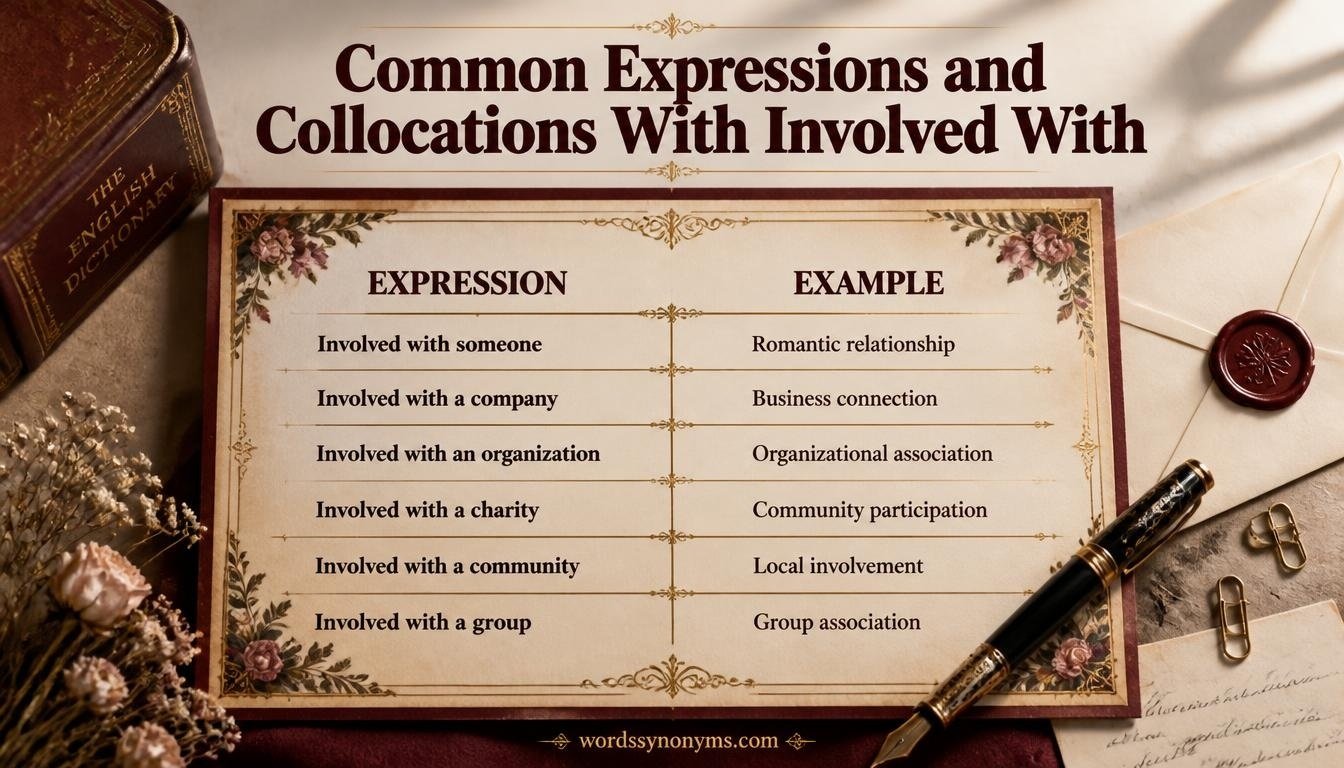
Common Expressions and Collocations With “Involved With”
The phrase “involved with” also appears in several established word combinations.
These expressions generally describe relationships, connections, or associations.
| Expression | Example sentence |
| Involved with someone | She’s involved with someone from her university. |
| Involved with a company | He’s involved with a technology company. |
| Involved with an organization | My sister is involved with a nonprofit organization. |
| Involved with a charity | They’re involved with a local charity. |
| Involved with a community | Our school is involved with the local community. |
| Involved with a group | She’s involved with a professional group. |
| Involved with a business | He’s involved with a family business. |
| Involved with a partner | The company is involved with several business partners. |
| Involved with an institution | Researchers are involved with the institution. |
| Involved with a movement | Many young people are involved with the environmental movement. |
Examples in Different Writing Situations
Professional writing:
“Our organization is involved with several international partners.”
This sentence describes the organization’s professional connections.
Personal conversation:
“Is she involved with anyone right now?”
The question asks whether she has a romantic relationship.
Community communication:
“My neighbors are involved with a local volunteer group.”
This indicates their association with the group.
Business communication:
“The company is involved with several technology providers.”
The sentence highlights business relationships rather than specific project responsibilities.
Common Mistakes to Avoid When Using “Involved With” and “Involved In”
Even fluent English speakers sometimes confuse these expressions. The problem usually comes from choosing a preposition without considering the intended meaning.
Here are common mistakes worth avoiding.
Choosing a Preposition Without Considering Meaning
The most common mistake involves treating both expressions as interchangeable in every situation.
Remember that “involved in” usually emphasizes participation. Meanwhile, “involved with” often emphasizes association.
For example:
- Less natural: She’s involved with writing the report.
- Better: She’s involved in writing the report.
The second sentence clearly identifies her participation in the writing activity.
However, consider this example:
- Natural: She’s involved with a publishing company.
Here, the sentence describes her connection with the company.
Confusing Romantic Involvement With General Participation
The expression “involved with someone” can suggest a romantic relationship. However, its meaning depends on context.
For example:
“Is Mark involved with Jessica?”
This question might ask whether Mark and Jessica are romantically connected.
However:
“Mark is involved with Jessica on the research project.”
This sentence describes their professional collaboration.
The additional information removes the romantic interpretation.
Using Both Prepositions Without Understanding the Context
Sometimes, a sentence remains grammatically correct after changing the preposition. However, the intended meaning becomes less precise.
Compare:
- “She’s involved in the organization.”
- “She’s involved with the organization.”
The first emphasizes her participation in the organization’s work. The second emphasizes her association with the organization.
Before choosing either phrase, ask yourself what information you want to communicate.
Assuming One Expression Is Always More Formal
Neither expression automatically sounds more formal than the other.
Both appear in everyday conversations, business communication, academic writing, and professional documents.
For example:
- “I’m involved in the project.”
- “I’m involved with the organization.”
Both sentences are suitable for professional communication.
The choice depends on meaning rather than formality.
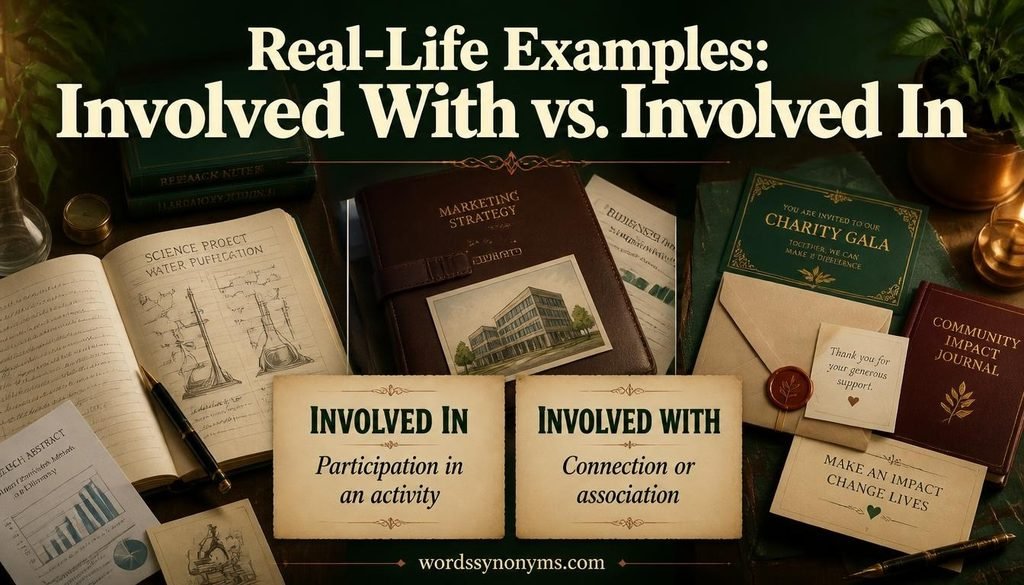
Real-Life Examples: Choosing Between “Involved With” and “Involved In”
Sometimes, understanding a grammar rule becomes easier when you see it working in realistic situations.
Consider these examples to understand how the expressions differ in everyday life.
A Student Participating in a Science Project
Imagine a university student named Emma who joins a research team. She collects information, reviews existing studies, and helps prepare the final report.
You could say:
“Emma is involved in a science project.”
This sentence emphasizes her participation in the research.
Now imagine Emma also maintains a connection with the university’s research department.
You could say:
“Emma is involved with the university’s research department.”
The first sentence focuses on her activity. The second describes her association with the department.
An Employee Working With a Business
Suppose David works on a marketing campaign for a technology company.
You might say:
“David is involved in the company’s marketing campaign.”
This explains his participation in a specific business activity.
However, if David works as an external consultant, you could say:
“David is involved with the technology company.”
This describes his professional relationship with the business.
Both statements provide useful information, but they emphasize different aspects of his work.
Someone Associated With a Charity
Imagine Olivia regularly supports a local charity. She attends fundraising meetings and helps the organization whenever possible.
You could say:
“Olivia is involved with a local charity.”
This describes her association with the organization.
If you want to explain her specific contribution, you could say:
“Olivia is involved in organizing the charity’s fundraising events.”
The second sentence identifies the activity she participates in.
These examples reveal an important point: the same person can correctly use both expressions in different sentences.
How to Remember the Difference Between “Involved With” and “Involved In”
You don’t need to memorize complicated grammar rules to distinguish these expressions. A simple memory trick can help you choose the correct preposition.
Remember: “Involved In” Means Participating
Think of the word “in” as being inside an activity or situation.
When someone participates in a project, event, or process, they’re involved in it.
Examples:
- Involved in a meeting.
- Involved in a project.
- Involved in an investigation.
- Involved in a competition.
- Involved in organizing an event.
Ask yourself:
“Am I talking about someone’s participation in an activity?”
If the answer is yes, “involved in” will usually fit.
Remember: “Involved With” Means Having a Connection
Think of “with” as describing a connection between people or things.
When someone has a relationship or association with another person, organization, or business, “involved with” often works.
Examples:
- Involved with a friend.
- Involved with a company.
- Involved with an organization.
- Involved with a charity.
- Involved with a business partner.
Ask yourself:
“Am I describing someone’s relationship or association with another person or organization?”
If the answer is yes, “involved with” will usually be appropriate.
A Quick Memory Comparison
| If You Mean… | Choose… |
| Participating in an activity | Involved in |
| Taking part in a project | Involved in |
| Being part of an investigation | Involved in |
| Having a professional connection | Involved with |
| Having a romantic relationship | Involved with |
| Being associated with an organization | Involved with |
This simple distinction works in most everyday situations. When both expressions seem possible, consider the emphasis and choose the one that communicates your meaning most clearly.
Practice Exercise: “Involved With” or “Involved In”?
Now it’s time to test your understanding. Choose the correct preposition for each sentence.
Read each example carefully before checking the answers.
Fill-in-the-Blank Questions
Complete these sentences using either “in” or “with.”
- Sarah is involved ___ organizing the annual school festival.
- My brother is involved ___ a local charity.
- Several employees are involved ___ the investigation.
- Is John involved ___ anyone at the moment?
- Our company is involved ___ developing new software.
- She’s been involved ___ the organization for five years.
- The students were involved ___ a heated discussion.
- He is romantically involved ___ his colleague.
- My parents are involved ___ community development activities.
- The university is involved ___ several international research organizations.
Answers and Explanations
1. Sarah is involved in organizing the annual school festival.
Use “in” because Sarah participates in the activity of organizing the festival.
2. My brother is involved with a local charity.
Use “with” because the sentence describes his association with the charity.
3. Several employees are involved in the investigation.
Use “in” because the employees participate in the investigation.
4. Is John involved with anyone at the moment?
Use “with” because the question suggests a possible personal or romantic relationship.
5. Our company is involved in developing new software.
Use “in” because the company participates in the software development process.
6. She’s been involved with the organization for five years.
Use “with” because the sentence describes a continuing association.
7. The students were involved in a heated discussion.
Use “in” because the students participated in the discussion.
8. He is romantically involved with his colleague.
Use “with” because this expression identifies the person involved in the romantic relationship.
9. My parents are involved in community development activities.
Use “in” because the sentence emphasizes participation in those activities.
10. The university is involved with several international research organizations.
Use “with” because the sentence describes the university’s associations with other organizations.
How Did You Do?
Your answers can help you identify which situations still need practice.
- 9–10 correct: Excellent! You understand the main distinction.
- 7–8 correct: Good work! Review the examples involving relationships and activities.
- 5–6 correct: You’re making progress. Practice identifying participation versus association.
- Fewer than 5 correct: Review the definitions and try the exercise again.
Remember that context matters. Some sentences can accept both expressions with slightly different meanings.
Read more: At That Time vs. At The Time: What’s the Difference?
FAQs
1. Is it involved in or involved with a project?
Use “involved in a project” when you participate in its planning, development, or completion. For example, “She is involved in a new marketing project.”
2. What does involved with someone mean?
“Involved with someone” usually describes a personal, professional, or social connection. It can also suggest a romantic relationship, depending on the context.
3. Is involved in used for activities?
Yes. “Involved in” is commonly used when someone participates in an activity, task, event, or process. For example, “He is involved in organizing the school event.”
4. Can I say involved with a company?
Yes. “Involved with a company” describes a connection or working relationship with that organization. For example, “She has been involved with the company for five years.”
5. What is the difference between being involved in and involved with a person?
“Involved with a person” usually describes a relationship or association. “Involved in a person’s life” suggests taking part in their experiences, decisions, or activities.
6. Is involved with always romantic?
No. Although it can describe a romantic relationship, it also refers to friendships, professional connections, and other associations. The surrounding sentence helps clarify its meaning.
Conclusion
Choosing between “involved with” or “involved in” becomes easier once you understand what each phrase describes. Use “involved in” when talking about participating in an activity, project, event, or situation. Choose “involved with” when describing a connection, relationship, or association with someone or something. Although these expressions look similar, their meanings depend on the context.
When writing or speaking, think about the message you want to convey before choosing a preposition. A small change can make your sentence sound more natural and precise. With regular practice and attention to everyday examples, you’ll become more confident using both expressions without second-guessing your word choice.