Is Equal To vs. Equals: What’s the Difference? This guide explains how both expressions show equality but follow different grammatical patterns. In mathematics, is equal to is a verb phrase, while equals is a singular verb.
Both are correct, but their sentence structure differs. For example, “Five plus three is equal to eight” and “Five plus three equals eight” express the same mathematical relationship. Your choice depends on the subject, context, and meaning you want to convey.
These expressions appear in everyday English, formal writing, technical writing, business communication, and educational content. Use is equal to when you want a linking verb followed by an adjective phrase. Choose equals when the subject takes a singular verb.
This grammar rule supports accuracy, clarity, and consistency in reports, presentations, and conversations. You may see both forms when discussing scheduling, time management, online booking, meetings, project management, calendar planning, or broadcasting. In each case, choose the expression that makes the comparison easy to understand.
Quick Answer
“Is equal to” and “equals” express the same basic relationship, but they use different grammatical constructions.
- Is equal to: A verb phrase containing the linking verb is and the adjective equal. It describes a relationship between two quantities.
- Equals: A single verb that directly expresses equality between two quantities.
Consider these examples:
| Is Equal To | Equals |
| Five plus three is equal to eight. | Five plus three equals eight. |
| Ten is equal to ten. | Ten equals ten. |
| The total cost is equal to $75. | The total cost equals $75. |
| Her score is equal to his score. | Her score equals his score. |
Both expressions are grammatically correct when you use them in the appropriate sentence structure.
The main difference concerns the grammatical role of equal:
- In is equal to, equal functions as an adjective.
- In equals, equal functions as a verb.
A simple way to remember this distinction is to consider the sentence’s construction. If you use the linking verb is, follow it with the adjective equal and the preposition to. If you use equals, you don’t need another verb.
What Does “Is Equal To” Mean?
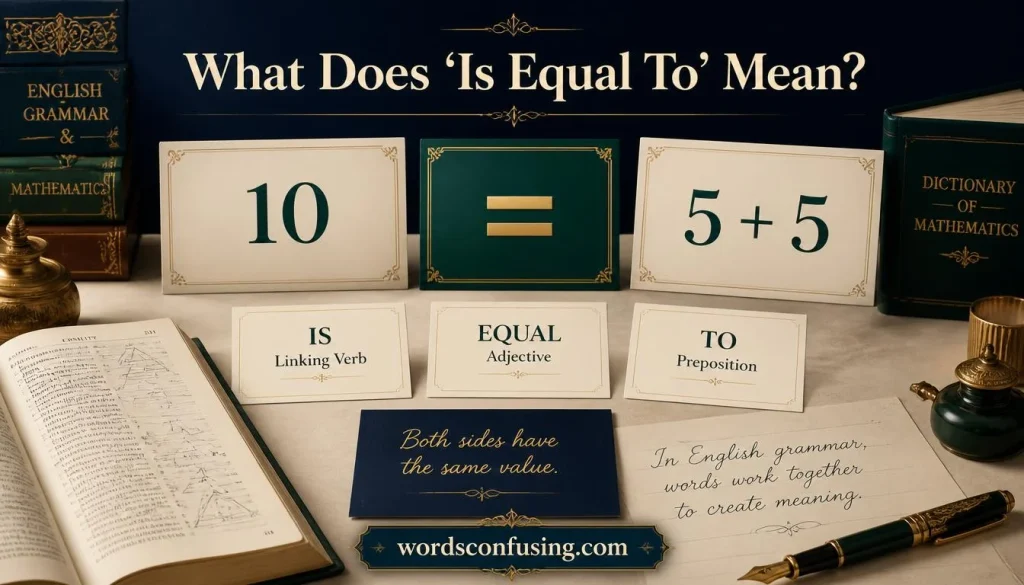
“Is equal to” means that one quantity has the same value, amount, measurement, or status as another. It describes equality between two things without using equal as the main verb.
The expression commonly appears in mathematical explanations, financial statements, academic writing, and everyday comparisons.
For example:
- Twelve is equal to six multiplied by two.
- The final price is equal to the original price.
- Her monthly payment is equal to $500.
- The length of the first ribbon is equal to the length of the second.
In each example, the expression establishes a relationship between two values.
Understanding the Grammar of “Is Equal To”
To understand why this expression works, examine its three components separately.
| Word | Grammatical Function | Explanation |
| Is | Linking verb | Connects the subject with a description or identity. |
| Equal | Adjective | Describes the relationship between two quantities. |
| To | Preposition | Introduces the quantity being compared. |
The linking verb is connects the subject to the adjective equal. The preposition to then introduces the other quantity.
Consider this sentence:
Ten is equal to five plus five.
Its grammatical structure looks like this:
- Subject: Ten
- Linking verb: Is
- Subject complement: Equal
- Prepositional phrase: To five plus five
The adjective equal describes the relationship between the two mathematical expressions.
This structure also explains why you cannot simply remove is without changing the sentence’s grammar.
For example:
- Correct: Ten is equal to ten.
- Incorrect: Ten equal to ten.
The second example lacks a verb, so it doesn’t form a complete standard sentence.
Examples of “Is Equal To” in Sentences
The expression works in several contexts beyond basic arithmetic. Here are examples showing how you can use it naturally.
Mathematics:
- Twenty is equal to four multiplied by five.
- Nine is equal to three squared.
- One hundred centimeters is equal to one meter.
- The sum of six and seven is equal to thirteen.
Money and finances:
- The total purchase price is equal to $250.
- Her monthly rent is equal to half her salary.
- The company’s annual revenue is equal to its projected target.
- The remaining balance is equal to $1,200.
Measurements and comparisons:
- Both sides of the square are equal to four inches.
- The two distances are equal to each other.
- His examination score is equal to hers.
- The weight of the package is equal to five kilograms.
Notice that the expression often sounds natural when explaining or describing a relationship. It gives readers a clear statement about how two values compare.
Can You Use “Is Equal To” Outside Mathematics?
Yes. Although the expression frequently appears in mathematical contexts, it also describes equality in ordinary writing.
For example, consider a workplace discussion about employee compensation:
“Her annual salary is equal to the salary offered for the same position.”
Here, the expression communicates that two compensation amounts match.
Similarly, you might write:
“An additional hour of preparation is equal to an additional hour of practice.”
This sentence compares two amounts of time while emphasizing their identical duration.
However, remember that equality doesn’t always mean two things share every characteristic. Two products can have equal prices without having identical quality, features, or performance.
The expression describes the specific relationship established by the sentence.
What Does “Equals” Mean?
“Equals” is the third-person singular present-tense form of the verb equal. It means that one quantity has the same value, amount, or significance as another.
Unlike is equal to, this expression uses equal directly as the main verb.
For example:
- Five plus five equals ten.
- Eight minus three equals five.
- The total equals $150.
- Their combined experience equals twenty years.
In these sentences, equals connects the subject with its result or equivalent value.
The expression is especially common in arithmetic because it communicates mathematical equality concisely.
Understanding the Grammar of “Equals”
The word equals comes from the verb equal. Its final -s indicates the third-person singular present-tense form.
Consider the following sentence:
Six multiplied by four equals twenty-four.
Its grammatical structure includes:
- Subject: Six multiplied by four
- Verb: Equals
- Complement: Twenty-four
The subject represents a mathematical expression. The verb connects that expression with its resulting value.
Unlike is equal to, this construction doesn’t need a separate linking verb.
Compare these sentences:
- Six multiplied by four equals twenty-four.
- Six multiplied by four is equal to twenty-four.
Both communicate the same mathematical relationship. However, their grammatical structures differ.
The first uses equals as its main verb. The second uses is as its linking verb and equal as an adjective.
Examples of “Equals” in Sentences
You can use equals in mathematical statements and ordinary descriptions of equivalent values.
Addition and subtraction:
- Seven plus eight equals fifteen.
- Twenty minus twelve equals eight.
- Three plus nine equals twelve.
- Fifty minus twenty equals thirty.
Multiplication and division:
- Six multiplied by seven equals forty-two.
- Forty-eight divided by six equals eight.
- Nine multiplied by five equals forty-five.
- One hundred divided by four equals twenty-five.
Money and financial statements:
- The total cost equals $300.
- Her monthly savings equals $200.
- The outstanding balance equals $850.
- The combined expenses equal the available budget.
Everyday comparisons:
- One hour equals sixty minutes.
- One kilometer equals one thousand meters.
- His experience equals hers.
- The value of the two gift cards equals $100.
One important grammatical detail deserves attention: the verb must agree with its subject.
For instance, the total takes equals, while the expenses takes equal. The correct choice depends on whether the subject is singular or plural.
Does “Equals” Always Refer to Mathematics?
No. The verb equals can describe equivalence in several nonmathematical situations.
For example:
- Good communication equals better teamwork.
- Consistent practice equals steady improvement.
- Greater responsibility equals greater accountability.
- In some situations, silence equals agreement.
These examples use equals to express a relationship between ideas rather than numerical quantities.
However, such statements often express a general comparison rather than strict mathematical equality. Their meaning depends on context.
Is Equal To vs. Equals: Key Differences
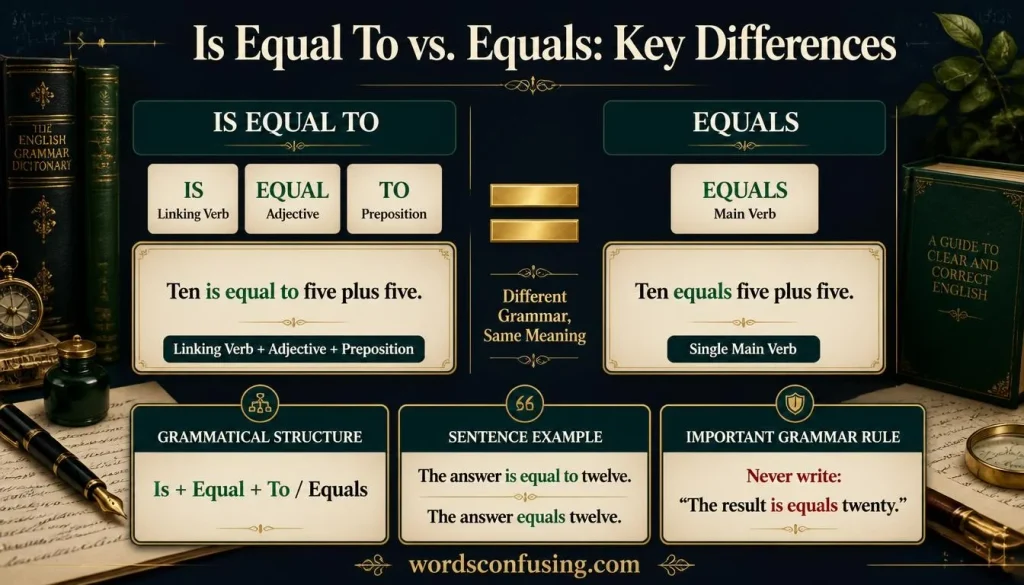
Although both expressions communicate equality, their grammatical construction determines how you should use them.
Understanding the following differences will help you choose the correct expression without second-guessing yourself.
Difference in Grammatical Structure
The most important distinction involves the grammatical function of equal.
In “is equal to,” the word equal functions as an adjective. The linking verb is connects the subject with that adjective.
In “equals,” the word functions as a verb. It directly expresses the relationship between the subject and its complement.
Compare:
| Expression | Grammatical Construction | Example |
| Is equal to | Linking verb + adjective + preposition | Eight is equal to eight. |
| Equals | Main verb | Eight equals eight. |
The difference becomes clearer when you examine the sentence structure.
Example one:
“Ten is equal to five plus five.”
Here, is acts as the linking verb. The adjective equal describes the subject’s relationship with the following quantity.
Example two:
“Ten equals five plus five.”
Here, equals performs the main verb’s job. No additional linking verb is necessary.
Both constructions work because each sentence follows its own grammatical pattern.
Difference in Sentence Construction
The two expressions can communicate identical meanings, but you must construct the surrounding sentence correctly.
Consider these paired examples:
| Using “Is Equal To” | Using “Equals” |
| The answer is equal to twelve. | The answer equals twelve. |
| Four plus six is equal to ten. | Four plus six equals ten. |
| The total weight is equal to 20 pounds. | The total weight equals 20 pounds. |
| One hour is equal to sixty minutes. | One hour equals sixty minutes. |
Notice that the subject remains unchanged in each pair. Only the verb construction changes.
This makes switching between the expressions relatively simple. However, you must never combine their grammatical structures incorrectly.
For example:
- Correct: The result is equal to twenty.
- Correct: The result equals twenty.
- Incorrect: The result is equals twenty.
The incorrect version combines the linking verb is with the third-person singular verb equals. Standard English doesn’t require both constructions together.
Difference in Formal and Everyday Usage
Neither expression is automatically more formal or more correct than the other. Both work in standard English.
However, their frequency and naturalness can vary depending on the situation.
“Equals” often works well in:
- Arithmetic statements.
- Short mathematical explanations.
- Financial calculations.
- Scientific descriptions.
- Concise statements of equivalence.
“Is equal to” often works well in:
- Detailed mathematical explanations.
- Descriptive comparisons.
- Academic discussions.
- Statements emphasizing equality.
- Explanations involving measurements or quantities.
For example, a textbook might write:
“Three multiplied by four equals twelve.”
A teacher explaining the relationship might say:
“The product of three and four is equal to twelve.”
Both sentences are appropriate. The choice depends on sentence style and the surrounding explanation.
When to Use “Is Equal To”
Choose “is equal to” when you want to describe equality using an adjective. This construction works particularly well in explanatory sentences and detailed comparisons.
It allows you to present a relationship without making equal the main verb.
Here are the main situations where this expression fits naturally.
When Describing a Relationship Between Two Values
Use is equal to when explaining that two quantities share the same value.
Examples:
- The value of X is equal to the value of Y.
- The total number of students is equal to 250.
- The distance between the two points is equal to five miles.
- The final measurement is equal to the original measurement.
These sentences describe a specific relationship between two quantities.
When Explaining Mathematical Concepts
Teachers and textbooks often use is equal to when explaining mathematical relationships in complete sentences.
For example:
“According to the equation, the value of X is equal to twelve.”
This construction makes the explanation straightforward. It also allows the writer to emphasize the relationship rather than simply present a calculation.
Consider another example:
“If both sides of an equation have the same value, the left side is equal to the right side.”
Here, the expression helps explain the concept of equality rather than merely announce an answer.
When Making Descriptive Comparisons
The expression also works when comparing measurements, scores, costs, and other quantities.
For example:
- The two examination scores are equal to each other.
- The length of this table is equal to six feet.
- The monthly payment is equal to the agreed amount.
- The company’s expenses are equal to its available budget.
These examples show that is equal to isn’t restricted to arithmetic.
However, pay attention to subject-verb agreement. When the subject is plural, use “are equal to” instead of is equal to.
For example:
- Singular: The measurements are not applicable here; the measurement is equal to ten inches.
- Plural: The measurements are equal to ten inches each.
The linking verb must agree with the subject.
Read more: “Hundred Thousands” or “Hundreds of Thousands”
When to Use “Equals”
Use “equals” when equal functions as the main verb in a sentence. This construction is particularly useful for mathematical results and concise statements of equivalence.
Unlike is equal to, it doesn’t need an additional linking verb.
When Writing Mathematical Statements
In ordinary arithmetic explanations, equals provides a direct way to express a result.
Examples:
- Four plus six equals ten.
- Twelve divided by three equals four.
- Seven multiplied by eight equals fifty-six.
- Twenty-five minus nine equals sixteen.
The expression connects the mathematical operation with its result.
For example, when explaining multiplication, you might write:
“Nine multiplied by five equals forty-five.”
This sentence is direct and grammatically complete. You don’t need to add is before equals.
When Expressing a Total or Amount
Use equals when describing the final value of a calculation or financial amount.
Examples:
- The total bill equals $125.
- The remaining balance equals $600.
- The combined cost equals $950.
- The company’s annual expenses equal $80,000.
Notice the difference in the final example.
The subject annual expenses is plural, so the sentence uses equal, not equals.
This distinction matters because the verb must agree with its subject.
When Describing Equivalence Outside Mathematics
The verb equals can also express relationships between ideas, actions, and outcomes.
For example:
- More practice equals better preparation.
- Greater responsibility equals greater accountability.
- Consistent effort equals meaningful progress.
- Better planning equals fewer unnecessary delays.
These statements use equals to express a connection between two concepts.
However, they don’t necessarily establish strict mathematical equality. Instead, they communicate an equivalent relationship or general principle.
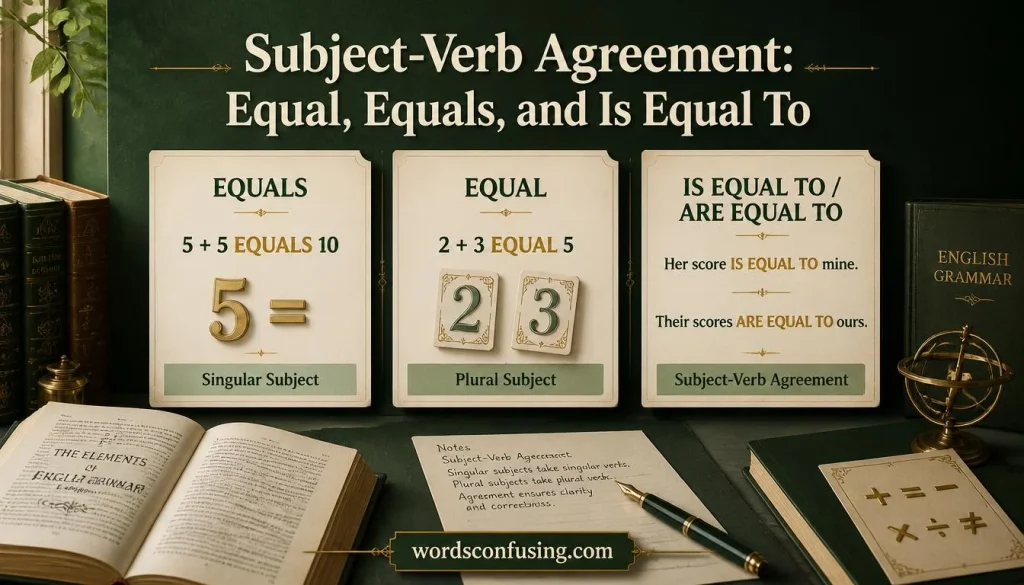
Subject-Verb Agreement: Equal, Equals, and Is Equal To
One of the easiest ways to make mistakes with these expressions is to overlook subject-verb agreement.
The verb changes according to whether the subject is singular or plural. Understanding this rule helps you choose between equal, equals, and is equal to.
When to Use “Equals”
Use equals with a third-person singular subject in the simple present tense.
Examples:
- Five plus five equals ten.
- The total equals $200.
- Her score equals mine.
- One kilometer equals 1,000 meters.
Each subject takes the singular verb form.
When to Use “Equal”
Use equal with plural subjects and the pronouns I, you, we, and they when it functions as a present-tense verb.
Examples:
- Two plus three equal five.
- The two amounts equal $100.
- Their salaries equal each other.
- These measurements equal the required standard.
The plural subjects take the base form equal.
When to Use “Is Equal To” or “Are Equal To”
When using equal as an adjective, choose the correct form of the linking verb be.
| Subject | Correct Construction | Example |
| He | Is equal to | His score is equal to mine. |
| She | Is equal to | Her contribution is equal to ours. |
| It | Is equal to | The amount is equal to $50. |
| They | Are equal to | Their scores are equal to ours. |
| We | Are equal to | Our shares are equal to theirs. |
The adjective equal doesn’t change its form. Instead, the linking verb changes to match the subject.
Remember: Use equals with singular subjects when equal is the main verb. Use equal with plural subjects. When using the adjective, choose is equal to or are equal to according to the subject.
“Is Equal To” vs. “Equals” in Mathematical Expressions
Mathematics provides some of the clearest examples of these expressions. Both constructions describe the relationship between two mathematical quantities.
The equals sign (=) represents equality between expressions. You can read it aloud as equals or is equal to.
For example:
5+3=8
You can read this equation in two ways:
- Five plus three equals eight.
- Five plus three is equal to eight.
Both readings communicate the same mathematical relationship.
Addition
Addition combines two or more quantities to produce a sum.
Consider this example:
7+5=12
You can express it in words using either construction:
- Seven plus five equals twelve.
- Seven plus five is equal to twelve.
Both sentences are grammatically correct.
Subtraction
Subtraction finds the difference between quantities.
For example:
18-6=12
The corresponding sentences are:
- Eighteen minus six equals twelve.
- Eighteen minus six is equal to twelve.
Again, the choice depends on your preferred sentence construction.
Multiplication
Multiplication represents repeated addition or the product of quantities.
Consider:
84=32
You can write:
- Eight multiplied by four equals thirty-two.
- Eight multiplied by four is equal to thirty-two.
Both expressions communicate the same result.
Division
Division separates a quantity into equal parts or groups.
For example:
366=6
The two grammatical versions are:
- Thirty-six divided by six equals six.
- Thirty-six divided by six is equal to six.
Neither construction changes the mathematical result.
Understanding the Equals Sign (=)
The equals sign deserves special attention because its meaning extends beyond announcing an answer.
In mathematics, the equals sign indicates that the expressions on its two sides have the same value.
For example:
4+6=7+3
Both sides equal ten. Therefore, the equation is mathematically correct.
The equals sign doesn’t simply mean that the calculation on the left produces an answer on the right. It expresses a relationship between two equivalent expressions.
This distinction becomes especially important when studying algebra.
Consider:
x+5=12
The equation states that the expression x+5 has the same value as twelve. Solving it reveals that x=7.
Similarly:
3x=21
Both sides represent equal values when x=7.
Understanding equality as a relationship helps students interpret equations correctly instead of treating the equals sign as an instruction to calculate.
Common Grammar Mistakes to Avoid
Even though these expressions are straightforward, a few common mistakes can make your sentences incorrect. Most problems involve missing verbs, unnecessary words, or incorrect subject-verb agreement.
Here are the mistakes worth watching.
Using “Equal” Instead of “Equals”
When equal functions as the main verb, a singular third-person subject generally requires equals.
Incorrect: Five plus five equal ten.
Correct: Five plus five equals ten.
Why? The subject represents a single mathematical expression. Therefore, the singular verb equals is appropriate.
Compare these examples:
- Incorrect: The total equal $100.
- Correct: The total equals $100.
- Incorrect: Her score equal his score.
- Correct: Her score equals his score.
However, don’t automatically add -s to every use of equal. Plural subjects require the base verb.
For example:
“The two amounts equal $100.”
Here, amounts is plural, so equal is correct.
Confusing “Is Equal To” With “Equals”
The two expressions communicate equality, but they follow different grammatical patterns.
Incorrect: Ten is equals twenty.
Correct: Ten is equal to twenty.
Correct: Ten equals twenty.
The incorrect sentence combines two different verb constructions. It uses is and equals together unnecessarily.
Remember these patterns:
- Subject + is + equal + to + complement.
- Subject + equals + complement.
Following either structure will help you avoid this particular mistake.
Forgetting Subject-Verb Agreement
Subject-verb agreement determines whether you should use equal, equals, is, or are.
Consider these examples:
| Incorrect Sentence | Correct Sentence |
| The results equals ten. | The results equal ten. |
| The total equal $50. | The total equals $50. |
| The measurements is equal to five inches. | The measurements are equal to five inches. |
| The amount are equal to $100. | The amount is equal to $100. |
The key is identifying the subject before choosing your verb.
Sometimes, the subject contains several words. In those situations, don’t let nearby nouns distract you from the actual subject.
For example:
“The total of the expenses equals $500.”
Although expenses is plural, the subject is the total. Therefore, equals is correct.
Using Both Expressions Together
Another common mistake involves combining is equal to and equals in one construction.
Incorrect: Eight plus two is equals ten.
Correct: Eight plus two equals ten.
Also correct: Eight plus two is equal to ten.
The problem occurs because is already introduces the adjective equal. Adding the verb equals creates an unnecessary second verb.
Keep the two constructions separate. Your sentences will sound more natural and remain grammatically correct.
Forgetting the Preposition “To”
When using the adjective equal after the linking verb is, you generally need the preposition to before the comparison.
Incorrect: The amount is equal $75.
Correct: The amount is equal to $75.
The same pattern applies to plural subjects:
Incorrect: Their scores are equal our scores.
Correct: Their scores are equal to our scores.
However, the preposition to doesn’t belong after the verb equals.
Correct: Their combined scores equal 150.
Incorrect: Their combined scores equal to 150.
This distinction is especially useful when switching between the two expressions.
Read more: 7 Words for Doing Something Without Thinking
Real-World Usage: How to Choose the Correct Expression
Mathematical equality appears in everyday situations more often than you might realize. You encounter it when comparing prices, reviewing examination results, calculating measurements, and discussing financial figures.
The following situations demonstrate how both expressions work in practical writing.
Comparing Prices During Shopping
Imagine that two stores sell the same product at identical prices.
Store A charges $40, and Store B also charges $40.
You could write:
“The price at Store A is equal to the price at Store B.”
Alternatively:
“The price at Store A equals the price at Store B.”
Both sentences are correct. The second version sounds more concise, while the first emphasizes the comparison.
Calculating Monthly Expenses
Suppose your monthly expenses include:
| Expense | Amount |
| Rent | $800 |
| Groceries | $300 |
| Transportation | $100 |
| Utilities | $150 |
| Total | $1,350 |
You can describe the calculation in two ways:
- The total monthly expense equals $1,350.
- The total monthly expense is equal to $1,350.
Both sentences correctly describe the calculated amount.
You could also write:
“The combined expenses are equal to the available monthly budget.”
Here, the plural subject expenses requires are rather than is.
Comparing Examination Scores
Suppose two students receive identical examination results.
Student A scores 85 points, and Student B also scores 85 points.
Possible descriptions include:
- Student A’s score equals Student B’s score.
- Student A’s score is equal to Student B’s score.
- Both students have equal scores.
The first two sentences use the expressions discussed in this article. The third uses equal as an adjective.
These examples demonstrate why understanding grammatical structure matters beyond mathematics.
Comparing Measurements
Measurements provide another practical example of equality.
Consider these standard metric conversions:
| Measurement | Equivalent Measurement |
| 1 kilometer | 1,000 meters |
| 1 meter | 100 centimeters |
| 1 centimeter | 10 millimeters |
| 1 hour | 60 minutes |
| 1 minute | 60 seconds |
| 1 kilogram | 1,000 grams |
You can describe these relationships using either expression.
For example:
“One meter equals one hundred centimeters.”
Or:
“One meter is equal to one hundred centimeters.”
Both sentences accurately express the same measurement relationship.
Explaining Business Results
Business writing frequently uses equality when discussing budgets, revenue, targets, and expenses.
Imagine a company with $50,000 in revenue and $50,000 in expenses.
You could write:
“The company’s revenue is equal to its expenses.”
Alternatively:
“The company’s revenue equals its expenses.”
However, remember that equal revenue and expenses mean the company has no profit before considering any additional accounting adjustments.
This example demonstrates an important point: grammatical equality describes matching values, but the surrounding context determines what those values mean.

“Is Equal To” vs. “Equals”: Complete Comparison Table
The following table summarizes the main differences between these expressions.
| Feature | Is Equal To | Equals |
| Grammatical structure | Verb phrase | Single verb |
| Function of equal | Adjective | Verb |
| Meaning | Expresses equality | Expresses equality |
| Common construction | Subject + is + equal to | Subject + equals |
| Singular example | Ten is equal to ten. | Ten equals ten. |
| Plural variation | They are equal to each other. | They equal each other. |
| Mathematical usage | Correct | Correct |
| Everyday writing | Correct | Correct |
| Requires a linking verb | Yes, in this construction | No |
| Requires the preposition to | Yes | No |
The essential distinction: Is equal to uses an adjective with a linking verb, while equals uses a verb to express equality directly.
Practice Exercises: Is Equal To or Equals?
Understanding a grammar rule becomes easier when you apply it yourself. Try these exercises to check whether you can distinguish between the two constructions.
Choose the correct option for each sentence.
Fill in the Blanks
1 Question: Five plus seven ______ twelve.
- A. is equal to
- B. equals
- C. is equals
2 Question: The total cost ______ $250.
- A. equal
- B. equals
- C. are equal
3 Question: Her examination score ______ her brother’s score.
- A. is equal to
- B. are equal to
- C. equal to
4 Question: The two measurements ______ each other.
- A. equals
- B. is equal to
- C. equal
5 Question: One kilometer ______ 1,000 meters.
- A. equals
- B. equal
- C. are equal to
6 Question: Their monthly salaries ______ $4,000 each.
- A. equals
- B. equal
- C. is equal to
7 Question: The final amount ______ the original estimate.
- A. are equal to
- B. equal
- C. is equal to
8 Question: Ten multiplied by three ______ thirty.
- A. equals
- B. equal
- C. are equal to
9 Question: The values of both expressions ______ each other.
- A. equals
- B. equal
- C. is equal to
10 Question: The remaining balance ______ $500.
- A. are equal to
- B. equal
- C. is equal to
Answer Key With Explanations
| Question | Correct Answer | Explanation |
| 1 | B. Equals | The mathematical expression takes a singular verb. |
| 2 | B. Equals | The singular subject cost requires equals. |
| 3 | A. Is equal to | The singular subject requires is. |
| 4 | C. Equal | The plural subject measurements requires equal. |
| 5 | A. Equals | The singular subject kilometer takes equals. |
| 6 | B. Equal | The plural subject salaries takes equal. |
| 7 | C. Is equal to | The singular subject amount requires is. |
| 8 | A. Equals | The mathematical expression takes the singular verb. |
| 9 | B. Equal | The plural subject values requires equal. |
| 10 | C. Is equal to | The singular subject balance requires is. |
If you answered all ten correctly, you’ve understood the central grammatical distinction.
If you missed a few, revisit the subject-verb agreement section. That’s where most mistakes occur.
FAQs
1. Is “is equal to” grammatically correct?
Yes, is equal to is grammatically correct. It works as a verb phrase that describes equality between two values, quantities, or things. For example, “Ten minus four is equal to six.”
2. Is “equals” better than “is equal to”?
Neither expression is automatically better. Equals is shorter and often sounds more direct in mathematical statements. Is equal to offers a slightly fuller construction. Both communicate the same mathematical relationship.
3. Can I use “is equal to” and “equals” interchangeably?
Yes, you can often use them interchangeably when expressing mathematical equality. However, you must adjust the sentence structure to keep the grammar correct. For example, “Two plus two equals four” and “Two plus two is equal to four” are both correct.
4. Should I use “equals” or “equal” in a sentence?
Use equals with a singular subject when it functions as a verb. Use equal when the sentence requires an adjective or another grammatical form. For example, “Three plus five equals eight” is correct, while “Three values are equal” uses equal as an adjective.
5. Why do mathematical equations use the word “equals”?
Mathematical equations use equals to show that the expressions on both sides have the same value. It connects the calculation to its result. For example, “Seven multiplied by three equals twenty-one.”
6. Is “is equal to” more formal than “equals”?
Not necessarily. Both expressions work in formal and informal communication. Is equal to may sound more explanatory, while equals is often more concise. Your choice should depend on sentence structure, readability, and context rather than formality.
Conclusion
Choosing between is equal to and equals becomes much easier once you understand how each expression works. Both communicate equality, so neither is incorrect. The main difference lies in how you build your sentence. Use is equal to when you need a linking verb followed by an adjective phrase. Choose equals when you want a shorter expression that functions as a singular verb. These small grammatical details can make your writing clearer and more natural.
The next time you write a mathematical equation, explain a comparison, or describe two matching values, consider your sentence structure. You don’t need to avoid either expression or worry about choosing the supposedly better one. Simply make sure the verb agrees with its subject and fits your intended meaning. With a little practice, you’ll use both expressions confidently in everyday conversations, academic work, and professional writing.

Shafiq Ur Rehman is a writer and content contributor at WordsConfusing.com. He enjoys exploring the English language, common word confusions, vocabulary, and practical writing tips. His goal is to make English easier to understand through clear, simple, and useful articles.