In Of Course: Meaning and Examples in Everyday English, you’ll learn its meaning, correct use, and role in everyday conversations and writing.
Of course is a common English phrase used in everyday conversations and everyday writing. Its simple meanings depend on the context, situation, and intended meaning. You can use it for expressing agreement, granting permission, offering reassurance, or showing enthusiasm.
For example, when someone asks for help, saying “Of course!” gives a positive response with a friendly tone. It also works as a polite response in formal communication, informal communication, and casual conversations.
Understanding its phrase meaning, phrase usage, and conversational tone helps you choose an appropriate expression during social interactions. Whether you’re using spoken English, written communication, or digital communication, this phrase makes your message sound warm, natural, and clear.
However, Ofcourse is not the correct spelling in standard English. The correct form contains two separate words: of course. This English grammar rule applies to email writing, essay writing, business messages, social media posts, online posts, and text messages.
Many English learners and language learners make this common spelling mistake because of fast typing, writing habits, and informal habits. This spelling confusion can cause writing mistakes, grammar mistakes, and repeated errors in exams and assignments.
Paying attention to detail and practicing proofreading improves your grammar accuracy, spelling accuracy, writing quality, and communication clarity.
Whether you practice professional writing, workplace writing, or casual writing, following spelling rules and grammar rules supports effective communication. It also strengthens your English vocabulary, English speaking, English writing, and overall communication skills.
Quick Answer
“Of course” means certainly, definitely, or naturally. You can use it to agree with someone, accept a request, express willingness, or emphasize something expected. For example, if someone asks, “Can you help me?” replying “Of course!” shows that you’re happy to help.

What Does “Of Course” Mean?
“Of course” is an English expression that means certainly, naturally, definitely, or without a doubt. People use it to show agreement, express willingness, confirm something, or emphasize an expected fact.
The expression often communicates that something is obvious, acceptable, or expected under the circumstances.
Consider these examples:
- Of course, I’ll help you with your homework.
- She is of course welcome to join us.
- Of course, everyone wants to succeed.
- Can I borrow your dictionary? Of course!
In the first example, the speaker willingly agrees to help. The second expresses acceptance, while the third emphasizes an expected idea. The final example shows a friendly response to a request.
Although these examples share the same expression, each communicates a slightly different intention.
The Basic Meaning of “Of Course”
At its simplest, “of course” tells someone that your answer is affirmative or that something should be expected.
You can think of it as a stronger or more expressive version of “yes” in many conversations. However, it doesn’t always function as a direct replacement.
For instance:
- “Can you explain this question?”
- “Of course!”
This response sounds warmer and more welcoming than a plain “yes.”
Similarly:
- “Is water necessary for human survival?”
- “Of course!”
Here, the expression communicates certainty because the answer is widely understood.
Key takeaway: “Of course” generally expresses agreement, willingness, certainty, or an expected outcome. Its precise meaning depends on context.
Different Meanings and Uses of “Of Course”
The expression “of course” serves several purposes in spoken and written English. Recognizing these different uses helps you choose the right tone.
“Of Course” to Express Agreement
One common use of “of course” is agreeing with another person’s opinion, suggestion, or statement.
It shows that you accept what someone says or believe their statement is correct.
For example:
- “We should leave early to avoid traffic.”
- “Of course. That’s a sensible idea.”
Another example:
- “Regular exercise improves your overall health.”
- “Of course, it also supports better sleep.”
In both conversations, the speaker agrees with the other person’s point.
You can also use this expression when discussing shared opinions or familiar facts.
More examples:
- Of course, I agree with your decision.
- That’s of course a reasonable suggestion.
- Of course, we should consider every available option.
- You can invite your friends, of course.
- Of course, teamwork makes difficult projects easier.
Notice that agreement doesn’t always require a question. You can use the expression to reinforce someone’s statement during an ordinary conversation.
“Of Course” to Show Willingness
Another important use involves accepting requests or offering assistance. In this situation, “of course” communicates that you’re happy to do something.
It often sounds friendly, cooperative, and reassuring.
Imagine that your friend needs help preparing for an examination. When they ask whether you can explain a difficult topic, you might respond:
“Of course! Let’s go through it together.”
Your response communicates willingness rather than simply confirming your ability.
Here are additional examples:
- “Could you help me carry these bags?” “Of course!”
- “Would you mind checking my assignment?” “Of course, I’d be happy to.”
- “Can I use your laptop for a moment?” “Of course.”
- “Could you send me the meeting notes?” “Of course. I’ll send them shortly.”
- “May I sit here?” “Of course, please have a seat.”
This use works particularly well when you want someone to feel comfortable asking for help.
“Of Course” to Express Certainty
Sometimes, people use “of course” when they feel completely certain about something.
It reinforces a statement and communicates confidence in the information being presented.
For example:
- Of course, the sun rises in the east.
- She will, of course, receive an invitation.
- Of course, proper preparation improves your chances of success.
- Everyone knows that practice makes a difference, of course.
In these examples, the speaker presents information as certain or generally accepted.
However, be careful when using this expression with information that isn’t universally understood. What seems obvious to you might be unfamiliar to someone else.
“Of Course” to Introduce an Expected Result
You can also use “of course” when introducing a result that naturally follows from a particular situation.
This use often appears in explanations, discussions, and descriptive writing.
For example:
- If you don’t water the plants, they will, of course, eventually dry out.
- She practiced every day and, of course, improved her performance.
- The restaurant was fully booked, so we, of course, needed another plan.
- When temperatures drop below freezing, water can, of course, turn into ice.
Here, the expression highlights an outcome that the speaker considers predictable.
It can also introduce a reasonable qualification:
“Of course, the final decision depends on your budget.”
This sentence acknowledges an important condition without changing the main discussion.
“Of Course” to Add Emphasis
Another useful function is adding emphasis to a statement. It helps highlight an idea, reinforce an opinion, or remind someone about an important point.
For example:
- Of course, your safety should always come first.
- She is of course capable of handling the responsibility.
- You can, of course, contact us if you need assistance.
- Of course, nobody wants to make unnecessary mistakes.
The expression gives the statement additional weight. Depending on your tone, it can sound reassuring, confident, or slightly impatient.
How to Use “Of Course” in a Sentence
You can place “of course” at the beginning, middle, or end of a sentence. Its position depends on the sentence structure and the meaning you want to communicate.
Let’s examine each position separately.
“Of Course” at the Beginning of a Sentence
Starting a sentence with “of course” is common in everyday English. It introduces an affirmative response, emphasizes a statement, or signals agreement.
When it functions as an introductory expression, place a comma after it.
Examples:
- Of course, you can attend the meeting.
- Of course, we should respect other people’s opinions.
- Of course, I’ll help you complete the project.
- Of course, learning a language takes consistent practice.
- Of course, everyone deserves an opportunity to succeed.
The comma creates a natural pause between the introductory expression and the main statement.
In conversations, you can also use “of course” as a complete response.
Example:
“Can I ask you something?”
“Of course!”
In this exchange, the expression works independently as an affirmative answer.
“Of Course” in the Middle of a Sentence
You can insert “of course” into the middle of a sentence to add emphasis or provide an additional comment.
When it functions as a parenthetical expression, separate it with commas.
Examples:
- Your brother is, of course, welcome to join us.
- The decision will, of course, depend on the available budget.
- She has, of course, completed all the necessary paperwork.
- We should, of course, consider everyone’s suggestions.
- The final result is, of course, important to the team.
In these examples, removing “of course” doesn’t change the basic grammatical structure.
Compare these sentences:
With the expression:
“Your parents are, of course, invited to the celebration.”
Without the expression:
“Your parents are invited to the celebration.”
Both sentences communicate the same central message. However, the first adds emphasis or acknowledges an expectation.
Remember that not every middle-position use requires commas. When “of course” forms an integrated part of the sentence rather than an interrupting comment, punctuation may differ.
For example:
“That is of course the answer we expected.”
Here, the expression is closely connected to the surrounding words. However, writers often use commas when they intend a noticeable parenthetical pause.
“Of Course” at the End of a Sentence
You can also place “of course” at the end of a sentence. This position often emphasizes a statement or adds a conversational afterthought.
Examples:
- You can bring your children, of course.
- We’ll be happy to help you, of course.
- Everyone wants a better future, of course.
- She agreed to attend the event, of course.
- You already knew the answer, of course.
When you place the expression at the end, it can sound natural and conversational.
However, the tone matters. In some situations, an ending like “You knew that, of course” might sound impatient or sarcastic.
Read more: 4 Formal Alternatives to “I Would Like to Know”
Is “Of Course” Formal or Informal?
“Of course” works in both formal and informal English. It isn’t restricted to casual conversations or professional communication.
You can use it when speaking with friends, writing workplace emails, participating in meetings, or discussing serious subjects.
However, its suitability depends on the surrounding sentence and the impression you want to create.
Using “Of Course” in Casual Conversations
In everyday conversations, “of course” sounds natural and friendly.
People commonly use it to accept invitations, agree with friends, answer questions, or offer assistance.
Examples:
- “Are you coming to my birthday party?” “Of course!”
- “Can I call you later?” “Of course.”
- “Do you want some coffee?” “Of course, thanks!”
- “Will you help me move this table?” “Of course!”
These responses sound relaxed and approachable.
Using “Of Course” in Professional Communication
You can also use “of course” in professional emails and workplace conversations.
It communicates cooperation and confidence when you respond to requests or discuss responsibilities.
Examples:
- Of course, I’ll review the report before the meeting.
- We can, of course, discuss the proposed changes tomorrow.
- Of course, our team will provide the necessary assistance.
- I’d be happy to share the updated documents.
However, avoid repeating the expression in every professional response. Excessive use can make your writing sound repetitive or occasionally dismissive.
For particularly formal situations, alternatives such as “Certainly” or “I would be pleased to assist” may sound more suitable.
Formal vs. Informal Examples
| Situation | Example | Tone |
| Casual conversation | Of course! | Friendly |
| Helping a friend | Of course, I’ll help. | Warm |
| Workplace email | Of course, I’ll review the document. | Professional |
| Business meeting | Of course, we can discuss that. | Cooperative |
| Formal correspondence | Certainly, I would be happy to assist. | Formal |
| Academic discussion | This is, of course, an important consideration. | Formal and explanatory |
Important: “Of course” isn’t automatically informal. Context, sentence structure, and tone determine how appropriate it sounds.
Is “Of Course” Polite or Rude?
Generally, “of course” is a polite and acceptable expression. It often communicates friendliness, agreement, and willingness.
However, it can also sound sarcastic, impatient, or condescending when someone uses it with the wrong tone.
The words themselves aren’t necessarily rude. The speaker’s attitude and the surrounding conversation make the difference.
When “Of Course” Sounds Polite
The expression usually sounds polite when you use it to accept a request, reassure someone, or show genuine agreement.
Examples:
- “Could you explain this again?” “Of course. Take your time.”
- “May I ask another question?” “Of course!”
- “Would you mind helping me?” “Of course, I’d be glad to.”
- “Can we reschedule the meeting?” “Of course. What time works for you?”
These responses make the other person feel welcome.
When “Of Course” Sounds Rude or Sarcastic
Sometimes, “of course” suggests that someone should already know something. In these situations, it can sound dismissive or mocking.
Consider this conversation:
Person A: “I forgot to bring my notebook.”
Person B: “Of course you did!”
Depending on the delivery, Person B might sound annoyed or sarcastic.
Here are additional examples:
- “Of course, you made another mistake.”
- “Of course, nobody listened to my advice.”
- “Of course, you would say that.”
- “Of course, everything is somehow my fault.”
These statements can communicate frustration rather than genuine agreement.
How to Avoid Sounding Condescending
If you want your response to sound respectful, consider these practical tips:
- Use a warm and natural tone.
- Avoid emphasizing “of course” when someone asks a simple question.
- Don’t use it to suggest that someone should already know something.
- Add a helpful explanation when necessary.
- Choose softer alternatives when discussing sensitive matters.
For example, instead of saying “Of course, that’s obvious,” try “Yes, that’s a good point.”
A small change can make your response considerably more welcoming.
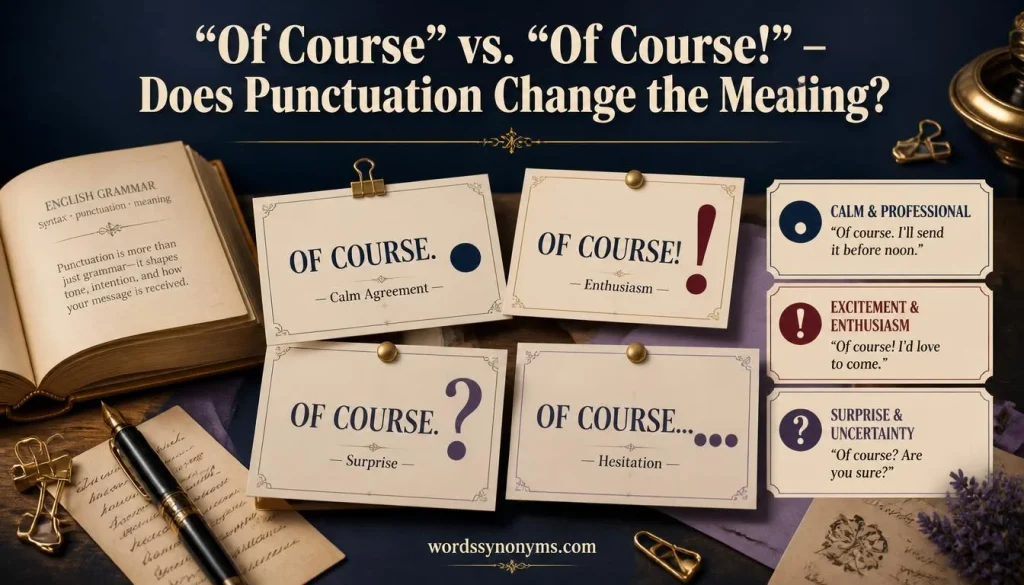
“Of Course” vs. “Of Course!” – Does Punctuation Change the Meaning?
Punctuation doesn’t completely change the dictionary meaning of “of course.” However, it influences how readers interpret the speaker’s tone.
A period generally creates a neutral impression. An exclamation point can communicate excitement, enthusiasm, or strong emphasis.
Consider the following examples:
| Expression | Example | Possible meaning or tone |
| Of course. | Of course, I’ll help you. | Calm agreement |
| Of course! | Of course! I’d love to come. | Enthusiastic agreement |
| Of course? | Of course? Are you sure? | Surprise or questioning |
| Of course… | Of course… I should have expected that. | Hesitation or sarcasm |
| Of course! | Of course you can join us! | Warm reassurance |
When to Use a Period
Use a period when you want your response to sound neutral, calm, or professional.
Example:
“Can you send the report today?”
“Of course. I’ll send it before noon.”
When to Use an Exclamation Point
Use an exclamation point when you want to express enthusiasm or excitement.
Example:
“Would you like to come to the concert?”
“Of course! I’ve been waiting for this.”
When to Use a Question Mark
A question mark can suggest disbelief, surprise, or uncertainty.
Example:
“Of course? I thought you disagreed with that decision.”
This punctuation makes the speaker’s response sound questioning rather than confidently affirmative.
Synonyms and Alternatives to “Of Course”
Although “of course” works in many situations, you don’t always need to repeat it.
Several alternatives communicate similar meanings while creating slightly different tones. The best choice depends on whether you’re agreeing, offering help, expressing certainty, or responding professionally.
Alternatives to “Of Course” for Agreeing
When someone shares an opinion or makes a suggestion, these expressions can help you communicate agreement.
| Alternative | Meaning | Example |
| Absolutely | Complete agreement | Absolutely, that’s a great idea. |
| Definitely | Strong agreement or certainty | Definitely, we should try it. |
| Certainly | Polite agreement | Certainly, I agree with your suggestion. |
| Sure | Casual agreement | Sure, let’s go together. |
| For sure | Informal confirmation | For sure, I’ll be there. |
| Without a doubt | Complete confidence | Without a doubt, she’s qualified. |
Absolutely sounds enthusiastic and confident. Meanwhile, certainly often feels more polished in professional conversations.
Alternatives to “Of Course” for Offering Help
When someone asks for assistance, choose an expression that communicates willingness.
Here are some natural alternatives:
| Alternative | Example |
| I’d be happy to. | I’d be happy to help you with that. |
| No problem. | No problem. I’ll take care of it. |
| Not at all. | Not at all. You can borrow my book. |
| With pleasure. | With pleasure. I’ll prepare the documents. |
| My pleasure. | My pleasure. I’m glad I could help. |
| I’d be glad to. | I’d be glad to explain the process. |
These expressions make requests and responses feel more comfortable.
However, remember that “not at all” works especially well when responding to questions such as “Do you mind?”
Alternatives to “Of Course” for Expressing Certainty
Sometimes, you want to emphasize that something is true, expected, or highly likely.
The following alternatives can help:
- Certainly: The results will certainly improve with practice.
- Obviously: Obviously, safety should remain a priority.
- Naturally: Naturally, everyone wants to feel appreciated.
- Undoubtedly: She is undoubtedly a talented writer.
- Without question: His contribution was valuable without question.
- Clearly: Clearly, the situation requires attention.
- Definitely: We definitely need more preparation.
Be careful with obviously because it can sometimes sound condescending. Use it when the point genuinely needs emphasis rather than assuming everyone shares your knowledge.
Professional and Formal Alternatives to “Of Course”
In workplace emails, business meetings, and formal correspondence, you might prefer more polished expressions.
Consider these options:
| Alternative | Best situation | Example |
| Certainly | Formal agreement | Certainly, I’ll review the proposal. |
| I’d be pleased to | Offering professional assistance | I’d be pleased to arrange the meeting. |
| I’d be happy to | Friendly professional response | I’d be happy to provide further details. |
| Without question | Strong confirmation | Without question, this deserves attention. |
| Absolutely | Confident agreement | Absolutely, we support the proposed changes. |
| Gladly | Willingness | Gladly, I’ll assist with the presentation. |
Choose an alternative that matches your relationship with the reader and the seriousness of the situation.
Common Mistakes When Using “Of Course”
Although “of course” is relatively simple, people sometimes misuse it in conversations and written communication.
Understanding these mistakes helps you use the expression more accurately.
Using “Of Course” When a Softer Response Is Better
One common mistake involves using “of course” when someone needs reassurance or understanding.
For example:
“Of course, you should have checked before submitting the application.”
This response might sound judgmental.
A softer alternative would be:
“I understand. Next time, checking the application beforehand might help.”
The second response communicates the same practical suggestion without sounding unnecessarily critical.
Confusing Agreement With Willingness
Agreement and willingness are related, but they aren’t identical.
When you agree, you accept an opinion or statement. When you show willingness, you express readiness to do something.
Compare these examples:
Agreement:
“Should we start the meeting now?”
“Of course.”
Willingness:
“Could you start the meeting?”
“Of course.”
The expression works in both situations, but the intention differs.
Overusing “Of Course” in Professional Writing
Repeating the same phrase throughout an email can make your communication sound monotonous.
For example:
“Of course, I’ll review the document. Of course, I’ll contact the manager. Of course, I’ll send the update.”
A more natural version would be:
“Certainly, I’ll review the document. I’ll also contact the manager and send you an update.”
Varying your expressions makes professional writing smoother.
Misplacing Commas Around “Of Course”
Punctuation depends on how the expression functions within a sentence.
When “of course” introduces a sentence as an introductory comment, a comma usually follows it.
Correct: Of course, you can ask another question.
When it interrupts a sentence as a parenthetical expression, commas usually surround it.
Correct: You can, of course, ask another question.
However, when the expression forms an integrated part of the sentence, punctuation may not be necessary.
Example: That is of course what we expected.
Using “Of Course” Sarcastically Without Realizing It
Sometimes, people use “of course” to express frustration without intending to sound particularly harsh.
For example:
“Of course, the internet stopped working during my presentation.”
This sentence communicates frustration through irony.
Although this use is common in casual conversations, it might sound inappropriate in professional correspondence.
“Of Course” in Everyday Conversations
The expression appears in many communication settings. Its meaning remains recognizable, but the surrounding situation influences its tone.
Using “Of Course” at Work
At work, “of course” can communicate cooperation, agreement, and professional courtesy.
For example:
Scenario: A colleague requests assistance.
Colleague: “Could you help me prepare the presentation?”
You: “Of course. Let’s review the slides together.”
Scenario: Your manager requests a document.
Manager: “Can you send me the updated report?”
You: “Of course. I’ll email it this afternoon.”
Scenario: A teammate suggests an idea.
Teammate: “We could divide the project into smaller tasks.”
You: “Of course. That would make everything easier to manage.”
In professional situations, keep your response clear and respectful. Avoid sarcastic emphasis that might create unnecessary tension.
Using “Of Course” With Friends and Family
With friends and family, the expression often sounds warm, relaxed, and reassuring.
You can use it when accepting invitations, answering requests, or showing someone that you care.
Examples:
- “Can you come over this weekend?” “Of course!”
- “Will you save me a seat?” “Of course.”
- “Can I tell you something personal?” “Of course. I’m listening.”
- “Do you remember our childhood vacation?” “Of course!”
- “Would you help me prepare dinner?” “Of course. What should I do?”
In close relationships, a simple “of course” can communicate affection and support.
Using “Of Course” in Text Messages and Online Chats
Text messages often lack facial expressions and vocal cues. Therefore, punctuation and surrounding words become especially important.
Compare these messages:
| Text message | Possible interpretation |
| Of course | Neutral agreement |
| Of course! | Excited or friendly agreement |
| Of course 🙂 | Warm and reassuring |
| Of course… | Hesitant or possibly sarcastic |
| Of course lol | Playful or joking |
| Of course, no worries! | Friendly reassurance |
These interpretations aren’t fixed rules. Your relationship with the recipient and the conversation’s context also matter.
For example, a close friend might understand “Of course…” as a joke. A coworker could interpret the same message as frustration.
When the meaning matters, add a few words to make your intention clear.
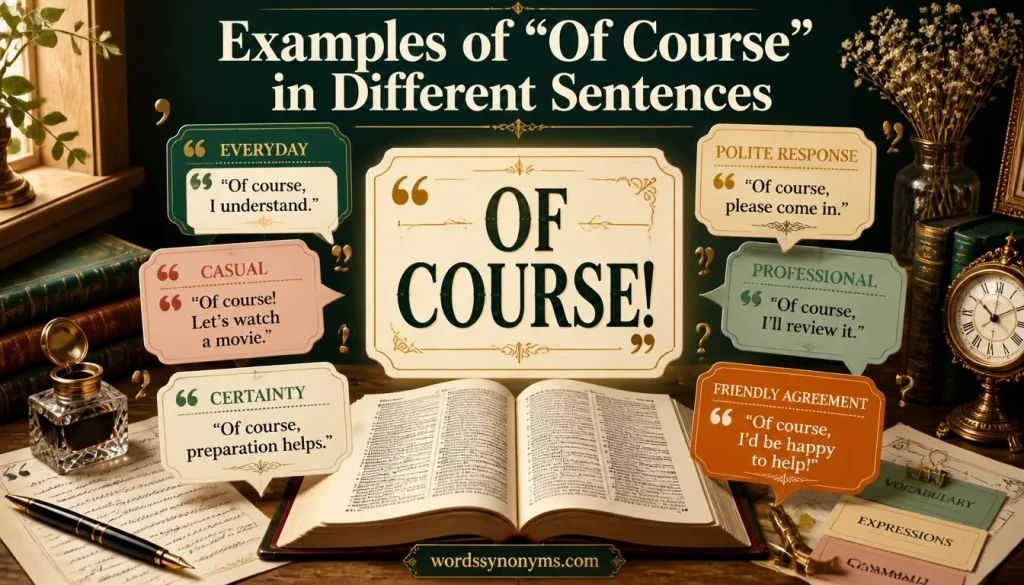
Examples of “Of Course” in Different Sentences
Seeing the expression in different sentence structures makes its usage easier to understand.
Here are practical examples organized by situation.
Simple Affirmative Sentences
- Of course, I understand your concern.
- Of course, she knows the correct answer.
- Of course, you can join our team.
- Of course, we should respect our elders.
- Of course, everyone needs enough rest.
- Of course, he deserves another opportunity.
Questions and Answers
- “Can I borrow your pen?” “Of course!”
- “Do you believe in hard work?” “Of course.”
- “May I come inside?” “Of course, please come in.”
- “Can we discuss this tomorrow?” “Of course.”
- “Would you like another cup of tea?” “Of course, thank you.”
Polite Requests and Responses
- “Could you explain the instructions?” “Of course. I’d be happy to.”
- “Would you mind opening the window?” “Of course, not at all.”
- “Can you check this document?” “Of course. I’ll review it.”
- “May I use your phone?” “Of course, go ahead.”
Professional Conversations
- Of course, I’ll forward the necessary information.
- We can, of course, arrange another meeting.
- Of course, your feedback is important to us.
- I’ll, of course, keep you informed about the progress.
- Of course, we should review the final proposal.
Casual Conversations
- Of course, I’ll come to your party.
- You can stay here, of course.
- Of course, I remember that funny story.
- Of course! Let’s watch a movie tonight.
- She can join us, of course.
Sentences Expressing Certainty
- Of course, exercise supports physical fitness.
- Everyone makes mistakes, of course.
- Of course, preparation can improve performance.
- The decision will, of course, affect the entire team.
- Of course, good communication helps prevent misunderstandings.
Read more: “Involved With” or “Involved In”: What’s the Difference?
Practical Case Studies: Understanding “Of Course” Through Context
The same expression can communicate different intentions. These short situations demonstrate how context changes its meaning.
Case Study: Accepting a Friend’s Invitation
Situation: Your friend invites you to a weekend gathering.
Friend: “Would you like to come to my house on Saturday?”
You: “Of course! I’d love to.”
What does it mean?
Here, “of course” expresses enthusiasm and willingness. The exclamation point reinforces the friendly tone.
Case Study: Responding to a Workplace Request
Situation: Your supervisor asks you to review a document.
Supervisor: “Could you check this report before tomorrow’s meeting?”
You: “Of course. I’ll review it this afternoon.”
What does it mean?
In this situation, “of course” communicates professional cooperation. The additional sentence explains when you’ll complete the task.
Case Study: Making a Sarcastic Comment
Situation: Someone repeatedly forgets an important appointment.
Friend: “I forgot about the meeting again.”
You: “Of course you did!”
What does it mean?
Depending on your delivery, this response can express frustration or playful sarcasm. The speaker suggests that forgetting appointments has become predictable.
These situations demonstrate why you shouldn’t judge the expression by its words alone. Context and tone carry much of its meaning.
FAQs
1. Is “Of Course” One Word or Two?
Of course is always written as two separate words. It consists of the preposition “of” and the noun “course.” Writing it as ofcourse is a spelling mistake in standard English.
2. What Does “Of Course” Mean in Everyday English?
Of course usually means yes, certainly, or without a doubt. People use it to agree with someone, give permission, or offer reassurance. Its exact meaning depends on the conversation.
3. Can You Use “Of Course” in Formal Writing?
Yes, of course is acceptable in formal writing. You can use it in professional emails, business messages, and academic communication. However, make sure its tone fits the situation.
4. Why Do People Commonly Write “Ofcourse”?
People often write ofcourse because they type quickly or follow informal texting habits. Since both words sound connected when spoken, the spelling mistake can be easy to make. Remembering the two-word rule helps prevent it.
5. Does “Of Course” Sound Polite or Rude?
Of course usually sounds polite and friendly when spoken with a warm tone. However, your voice and choice of words can change its effect. In some situations, a sharp or impatient delivery may make it sound sarcastic.
6. What Are Some Alternatives to Saying “Of Course”?
You can use several alternatives depending on the situation. Certainly, absolutely, sure, definitely, and no problem work well in different conversations. For professional situations, “certainly” and “absolutely” often sound more appropriate.
Conclusion
Knowing when and how to use of course makes everyday English communication easier and more natural. Whether you’re replying to a friend, writing an email, or speaking in a workplace situation, this phrase helps you express agreement, permission, and reassurance without sounding complicated. Its meaning may change slightly with your tone and the context, but its spelling never changes. Always write of course as two separate words, not ofcourse. Remembering this simple grammar rule can save you from an unnecessary spelling mistake.
Good English writing comes from paying attention to small details and using familiar expressions correctly. Make of course part of your everyday vocabulary, but choose your words according to the person and situation. A friendly reply may need warmth, while a professional message may call for a more formal expression. With regular practice and careful proofreading, you’ll improve your grammar accuracy, writing confidence, and overall communication skills. Sometimes, getting one small phrase right makes your entire message clearer.

Franklin Hayes is a writer and editor at WordsConfusing.com, focused on making English vocabulary, grammar, and commonly confused words easy to understand. He writes clear, practical articles with simple explanations and useful examples to help readers improve their English with confidence.
His goal is simple: Making Confusing Words Simple.