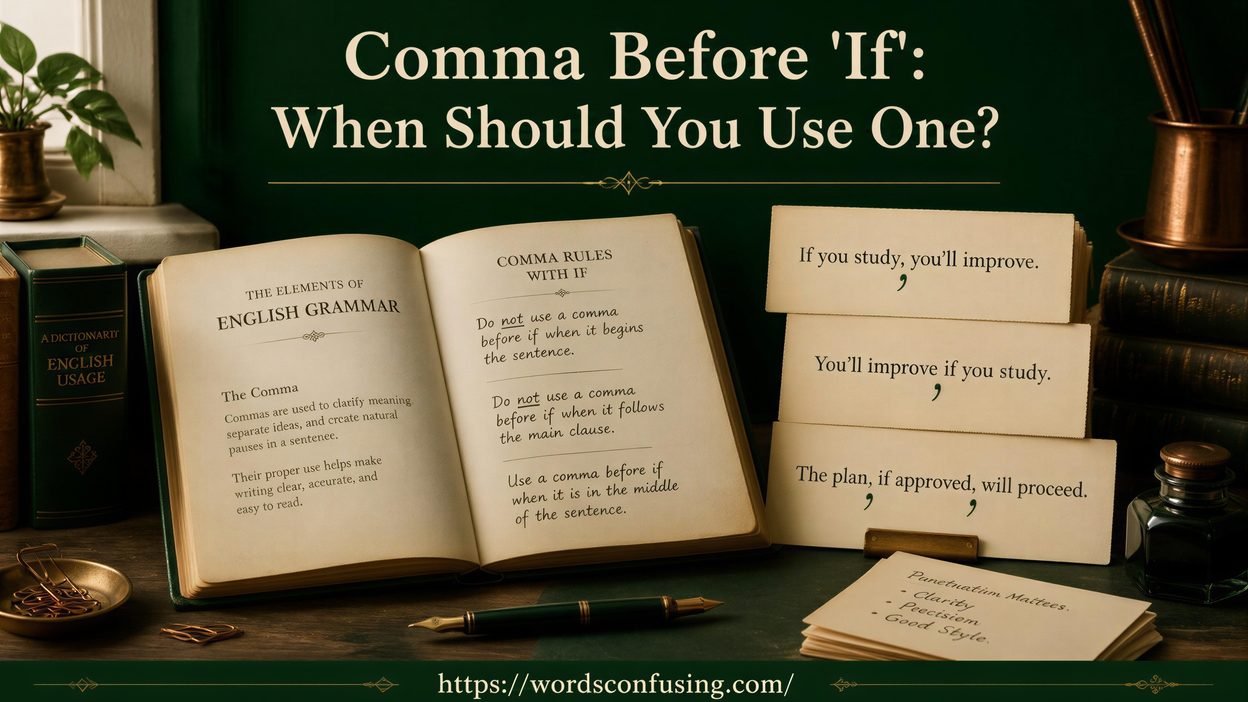
In this guide, Comma Before “If”: When Should You Use One? becomes easier to understand when you look at how “if” connects ideas in everyday writing.
In English grammar, “if” acts as a conditional conjunction or subordinating conjunction that connects an independent clause with a dependent clause. Its position within the sentence structure helps determine the correct comma placement.
For example, an introductory remark or introductory phrase may need different punctuation from a mid-sentence transitive phrase. Understanding these comma rules in English helps you avoid grammar mistakes and follow basic writing rules. It also makes your English writing clearer and easier to read.
You should understand when to use a comma and when not to use a comma before applying different punctuation rules. A comma may separate an introductory remark from the main clause or set off a parenthetical element.
However, comma insertion and comma omission depend on how each phrase functions within the sentence. Studying comma usage examples can help you recognize the difference between a comma before a conjunction, a comma after an introductory remark, and a comma before a parenthetical element.
This grammar guide and punctuation guide will help you apply correct punctuation, understand sentence punctuation, and improve your correct comma usage. You can also recognize comma rule exceptions and understand the use of “if,” including the comma before “if,” comma with “if,” and comma after “if.”
Quick Answer
You generally don’t need a comma before “if” when an if-clause follows the main clause. However, when an if-clause introduces the sentence, place a comma after the entire dependent clause.
Consider these examples:
| Sentence | Correct punctuation |
| I’ll help you if I have time. | No comma before “if” |
| If I have time, I’ll help you. | Comma after the introductory clause |
| You can join us if you finish early. | No comma before “if” |
| If you finish early, you can join us. | Comma after the introductory clause |
| The decision, if approved, will take effect Monday. | Commas around the interruption |
Remember: The usual rule depends on clause order. A following conditional clause generally doesn’t need a comma, while an introductory conditional clause usually does.

Understanding How “If” Works in a Sentence
Before learning comma placement, you need to understand what “if” does grammatically. This small word plays an important role in connecting conditions with possible results.
In most conditional sentences, “if” functions as a subordinating conjunction. It introduces a dependent clause that describes a condition.
For example:
- If you study regularly, you can improve your grades.
- I’ll attend the meeting if my schedule allows.
- We can order dinner if everyone agrees.
In each example, “if” introduces a condition that affects the main statement.
However, the position of that condition determines the usual comma placement. Understanding the clauses makes the punctuation much easier to recognize.
What Is an If-Clause?
An if-clause is a dependent clause that expresses a condition. It explains what must happen, might happen, or could be true for another situation to occur.
For example:
“If you save enough money” is an if-clause.
It doesn’t express a complete thought by itself. The reader naturally expects additional information.
You could complete the sentence like this:
“If you save enough money, you can buy a new laptop.”
Here, the if-clause introduces the condition. The main clause explains the possible result.
An if-clause can appear before or after the main clause.
At the beginning:
- If you work hard, you’ll achieve your goals.
- If the weather improves, we’ll visit the park.
At the end:
- You’ll achieve your goals if you work hard.
- We’ll visit the park if the weather improves.
Both arrangements communicate the same basic ideas. Their punctuation changes because their sentence structures differ.
What Is the Difference Between an Independent and Dependent Clause?
Understanding independent and dependent clauses helps you identify where commas belong.
An independent clause expresses a complete thought. It can stand alone as a grammatically complete sentence.
For example:
- She finished her homework.
- The children went outside.
- We ordered pizza.
A dependent clause contains a subject and verb but doesn’t express a complete thought independently.
For example:
- If she finishes her homework
- Because the children were tired
- Although we ordered pizza
These expressions leave the reader expecting more information.
When you combine a dependent clause with an independent clause, you create a complete sentence.
For example:
“If she finishes her homework, she can watch television.”
Here is how the sentence works:
| Clause | Example | Function |
| Dependent clause | If she finishes her homework | Establishes a condition |
| Independent clause | She can watch television | Expresses the possible result |
This distinction explains why introductory if-clauses generally need commas.
When to Use a Comma Before “If”
The general rule is simple: Don’t automatically place a comma before “if” when it introduces a dependent clause after the main clause.
However, certain sentence structures require commas around an interrupting if-clause. You need to recognize the difference between an essential condition and additional information.
When “If” Introduces a Dependent Clause at the End
When the main clause comes first, you generally don’t need a comma before the following if-clause.
This structure appears frequently in everyday English. The main clause communicates the statement, while the if-clause explains its condition.
Consider these examples:
- I’ll visit your house if I finish work early.
- You can use my phone if yours stops working.
- She’ll join the team if the coach approves.
- We’ll cancel the picnic if it rains tomorrow.
- You can improve your vocabulary if you read regularly.
Notice how each sentence places the main clause before the conditional clause.
The comma isn’t necessary because the if-clause completes the meaning without interrupting the main statement.
Incorrect: I’ll visit your house, if I finish work early.
Correct: I’ll visit your house if I finish work early.
The second version follows the standard punctuation rule.
When “If” Introduces a Nonessential or Parenthetical Clause
Sometimes an if-clause interrupts a sentence rather than simply adding an essential condition.
In these situations, commas can separate the interruption from the surrounding sentence.
A parenthetical expression adds information without changing the sentence’s basic grammatical structure. Readers can remove it and still understand the central statement.
For example:
- The proposal, if approved, will begin next month.
- Your application, if accepted, will move to the next stage.
- The event, if everything goes according to plan, will happen Friday.
- This approach, if used correctly, can improve your writing.
Look at the first example:
“The proposal will begin next month.”
The sentence remains complete without “if approved.”
Therefore, the writer places commas around the additional information.
However, don’t confuse this construction with an ordinary conditional sentence.
Compare:
- The proposal will begin next month if approved.
- The proposal, if approved, will begin next month.
Both sentences are grammatical. The first places the condition at the end. The second treats the condition as an interruption.
The key difference is the sentence structure, not simply the presence of “if.”
When a Comma Before “If” Helps Prevent Confusion
Some sentences contain additional phrases that affect their meaning or rhythm. In these cases, commas can help readers understand how the parts connect.
However, you shouldn’t insert a comma simply because you hear a natural pause.
Consider this example:
“The company plans to expand, if market conditions remain favorable.”
In ordinary conditional writing, the comma isn’t necessary:
“The company plans to expand if market conditions remain favorable.”
The second version clearly connects the expansion plan with its condition.
Now consider:
“The company plans to expand, if only into neighboring markets.”
Here, “if only into neighboring markets” adds a qualifying or limiting thought. The comma helps distinguish this supplementary expression from an ordinary conditional clause.
Another example:
“I wanted to attend, if only for a few minutes.”
The phrase “if only for a few minutes” adds an explanatory qualification. The comma separates that supplementary expression from the main statement.
These examples show why you must examine the entire sentence rather than apply one rule blindly.

When Not to Use a Comma Before “If”
Most ordinary conditional sentences don’t require a comma before “if” when the main clause appears first.
This rule applies to everyday conversations, emails, academic writing, and professional communication.
When the If-Clause Expresses an Essential Condition
An essential condition supplies information that directly affects the meaning of the main clause.
Without that condition, the statement may become broader or communicate something different.
For example:
- I’ll lend you my car if you promise to drive carefully.
- You can enter the building if you have permission.
- We’ll start the meeting if everyone arrives.
- She’ll receive a refund if the company approves her request.
In each sentence, the if-clause establishes the condition for the action.
Removing it changes the meaning.
Compare:
“I’ll lend you my car.”
This statement suggests that the speaker intends to lend the car.
Now consider:
“I’ll lend you my car if you promise to drive carefully.”
The second sentence makes the offer conditional. The promise matters.
Therefore, the if-clause remains connected to the main clause without a preceding comma.
When “If” Appears in the Middle of a Sentence
An if-clause can appear after the main clause, even when the complete sentence contains several words.
Its length doesn’t automatically create a need for a comma.
Consider these examples:
- You should contact your teacher if you don’t understand the assignment.
- The organization will provide financial assistance if applicants meet the eligibility requirements.
- We can arrange another appointment if the current schedule doesn’t work for you.
- The students may participate in the competition if they complete their registration before Friday.
Each sentence follows the same basic pattern:
Main clause + if-clause
The conditional clause directly explains when the main statement applies.
Therefore, no comma is normally needed before “if.”
Remember that sentence length alone doesn’t determine comma placement. Grammatical structure matters more.
When “If” Introduces an Embedded Question
Here’s another important situation that deserves attention.
The word “if” doesn’t always introduce a conditional clause. Sometimes it introduces an indirect yes-or-no question.
For example:
- I don’t know if she’s coming.
- Please check if the office is open.
- She asked if I needed assistance.
- We haven’t decided if the event will continue.
In these sentences, “if” introduces an embedded question rather than a condition.
The following clauses complete the meaning of verbs such as “know,” “check,” “asked,” and “decided.”
You generally don’t place a comma before “if” in these constructions.
Incorrect: I don’t know, if she’s coming.
Correct: I don’t know if she’s coming.
This distinction matters because not every sentence containing “if” expresses a condition.
Read more: Maximal vs. Maximum: What’s the Difference?
When to Use a Comma After “If”
A comma usually appears after an introductory if-clause when that clause comes before the main clause.
This is one of the easiest comma rules to remember.
When a dependent clause introduces a sentence, place a comma between it and the independent clause.
When an If-Clause Begins a Sentence
If the sentence starts with an if-clause, place a comma after the complete clause.
For example:
- If you need assistance, contact the support team.
- If it rains tomorrow, we’ll stay indoors.
- If you practice every day, your pronunciation will improve.
- If she finishes her assignment, she can watch television.
- If everyone agrees, we’ll schedule another meeting.
Notice where each comma appears.
It separates the introductory dependent clause from the main clause. It doesn’t separate the word “if” from the remaining words.
Incorrect: If, you need assistance contact the support team.
Correct: If you need assistance, contact the support team.
The entire phrase “If you need assistance” forms one dependent clause. Keep its words together.
When the If-Clause Appears Before the Main Clause
An introductory conditional clause establishes the situation before presenting its result.
This arrangement helps readers understand the condition first.
Consider these examples:
Example 1: Everyday conversation
“If you arrive early, save me a seat.”
The first clause establishes the condition. The second tells the reader what to do.
Example 2: Professional communication
“If you have additional questions, please contact our customer service department.”
The opening clause identifies when the instruction applies.
Example 3: Academic writing
“If students receive regular feedback, they can identify weaknesses and improve their performance.”
The introductory clause establishes the condition for the main statement.
Example 4: Business communication
“If the client approves the proposal, the development team will begin the project.”
The comma separates the condition from the expected result.
In each example, the introductory clause ends before the comma.
This pattern makes longer sentences easier to follow.
When Not to Put a Comma Immediately After “If”
One common mistake involves placing a comma directly after the word “if.”
However, “if” introduces a dependent clause. It must remain connected to the words that complete that clause.
Consider these examples:
Incorrect: If, you finish early, call me.
Correct: If you finish early, call me.
Incorrect: If, the weather improves, we’ll go hiking.
Correct: If the weather improves, we’ll go hiking.
Incorrect: If, she accepts the invitation, we’ll celebrate.
Correct: If she accepts the invitation, we’ll celebrate.
The comma belongs after the entire introductory clause.
A useful way to remember this rule is to treat the if-clause as one grammatical unit. Don’t interrupt it unnecessarily.

Comma Before or After “If”: Side-by-Side Examples
Sometimes, the easiest way to understand punctuation is to compare similar sentences.
The following examples demonstrate how moving the if-clause changes comma placement.
| Sentence structure | Example | Comma placement |
| Main clause + if-clause | I’ll call you if I arrive early. | No comma before “if” |
| If-clause + main clause | If I arrive early, I’ll call you. | Comma after the if-clause |
| Main clause + interrupting clause | The plan, if approved, will continue. | Commas around the interruption |
| Main clause + embedded question | I wonder if she’s available. | No comma |
| Main clause + qualifying expression | I wanted to attend, if only briefly. | Comma before the supplementary expression |
Let’s examine a few additional comparisons.
Pair 1: Conditional sentences
- If you study tonight, you’ll understand the lesson.
- You’ll understand the lesson if you study tonight.
Both sentences express the same condition. Only the clause order changes.
Pair 2: Workplace communication
- If the manager approves your request, you’ll receive an email.
- You’ll receive an email if the manager approves your request.
The first sentence requires a comma after the introductory clause. The second doesn’t need a comma before “if.”
Pair 3: Additional information
- The document, if completed correctly, should take five minutes to review.
- The document should take five minutes to review if completed correctly.
The first sentence places the conditional phrase inside the main statement. The second moves it to the end.
These comparisons reveal a useful principle: Comma placement depends on how the clause connects to the rest of the sentence.
Common Mistakes When Using Commas With “If”
Even experienced writers sometimes misuse commas around conditional clauses. Most mistakes happen when writers rely on pauses instead of grammatical structure.
Here are the errors worth avoiding.
Placing a Comma Before Every “If”
Not every occurrence of “if” requires a preceding comma.
Writers sometimes add one because they naturally pause before the word while speaking.
However, ordinary conditional clauses following the main clause don’t need that punctuation.
Incorrect: You can attend the workshop, if you register today.
Correct: You can attend the workshop if you register today.
Incorrect: I’ll help you, if you explain the problem.
Correct: I’ll help you if you explain the problem.
The correct versions connect the condition directly to the main statement.
Forgetting the Comma After an Introductory If-Clause
Another frequent mistake happens when writers begin with a conditional clause but forget the separating comma.
Incorrect: If you miss the bus you’ll arrive late.
Correct: If you miss the bus, you’ll arrive late.
Incorrect: If the store closes early we can shop tomorrow.
Correct: If the store closes early, we can shop tomorrow.
The comma helps readers recognize where the introductory condition ends.
This becomes especially useful when the opening clause contains several words.
Putting a Comma Immediately After “If”
Never separate “if” from the rest of its dependent clause without a grammatical reason.
Incorrect: If, you need anything, let me know.
Correct: If you need anything, let me know.
Incorrect: If, the application gets approved, we’ll celebrate.
Correct: If the application gets approved, we’ll celebrate.
The conjunction introduces the clause. The comma belongs after that complete clause.
Confusing a Natural Pause With a Grammatical Requirement
Speaking and writing follow different rhythms.
When speaking, you might pause before a word to emphasize an idea. However, that pause doesn’t automatically justify a comma.
For example:
“I’ll visit you if I finish early.”
You might naturally pause before “if” while speaking. Nevertheless, the sentence doesn’t normally require a comma.
On the other hand:
“If I finish early, I’ll visit you.”
The introductory clause takes a comma even when you read the sentence quickly.
Grammar determines punctuation more reliably than breathing or speaking habits.
How to Decide Whether a Comma Is Needed Before or After “If”
You don’t need to memorize dozens of complicated punctuation examples. A simple checking process can help you make the right decision.
Follow these steps whenever you’re unsure.
Step 1: Find the word “if.”
Identify the clause that follows it. Determine whether it expresses a condition or introduces an indirect question.
Step 2: Identify the main clause.
Find the part of the sentence that expresses a complete thought independently.
Step 3: Check the clause order.
Ask yourself whether the if-clause appears before or after the main clause.
- If the if-clause comes first, place a comma after the complete clause.
- If the main clause comes first, you generally don’t need a comma before “if.”
Step 4: Check whether the clause interrupts the sentence.
If the if-clause adds nonessential information in the middle, commas may surround it.
Step 5: Read the sentence for clarity.
Make sure the punctuation reflects the intended meaning. Don’t add commas simply because a pause sounds natural.
Quick Reference Table for Comma Placement With “If”
| Situation | Comma needed? | Example |
| If-clause at the beginning | Yes | If you agree, we’ll proceed. |
| If-clause at the end | Usually no | We’ll proceed if you agree. |
| Nonessential interrupting if-clause | Yes | The plan, if approved, will proceed. |
| Embedded indirect question | Usually no | I wonder if he’ll attend. |
| If-clause after a long main clause | Usually no | We can reconsider the proposal after the committee reviews the results if necessary. |
This table provides a quick reminder for everyday writing.
Comma Before “If” in Different Types of Writing
Comma placement remains important across different writing situations. Whether you’re preparing an academic assignment or sending a quick message, the same basic grammatical principles apply.
However, understanding the context helps you create clearer sentences.
Comma Before “If” in Academic Writing
Academic writing often contains longer sentences with multiple clauses. Correct punctuation helps readers understand relationships between ideas.
Consider these examples:
- If researchers collect accurate data, they can produce more reliable results.
- Students may improve their academic performance if they develop consistent study habits.
- The findings, if interpreted correctly, can provide valuable information.
- The experiment will produce meaningful results if researchers control the relevant variables.
Notice how the introductory condition takes a comma. The following conditional clause generally doesn’t.
When writing essays, reports, or research papers, avoid inserting commas before every conditional “if.”
Instead, examine the grammatical relationship between clauses.
Comma Before “If” in Professional Writing
Professional communication needs clear instructions and precise conditions.
A misplaced comma can make an instruction harder to understand. Fortunately, the standard rules work well in workplace emails and business documents.
Examples include:
- If you need further assistance, please contact our support department.
- We can extend the deadline if your manager approves the request.
- Your application, if accepted, will move to the next stage.
- Please submit the completed form if you want to participate.
These examples cover instructions, conditions, and additional information.
In professional writing, clarity matters more than unnecessary punctuation.
Comma Before “If” in Casual Conversations
Informal writing follows the same basic grammar rules as formal writing.
You don’t need to change comma placement simply because you’re texting a friend or writing a social media message.
Consider these examples:
- If you’re free tonight, let’s grab dinner.
- I’ll message you if anything changes.
- If you want, we can watch a movie.
- You can borrow my jacket if you get cold.
- The party, if you’re interested, starts around seven.
These sentences sound natural because their punctuation supports their meaning.
Whether you’re writing an email or sending a text, the same principles apply.

Practical Case Studies: Understanding Comma Placement With “If”
Let’s put the rules into realistic situations. These examples show how small changes in sentence structure affect punctuation.
Case Study: Writing a Conditional Email
Imagine you’re emailing a colleague about an upcoming project.
You want to explain what happens when the client approves a proposal.
Incorrect:
We’ll begin the project, if the client approves the proposal.
Correct:
We’ll begin the project if the client approves the proposal.
Why?
The main clause comes first. The if-clause follows it and explains the condition.
Now reverse the sentence:
“If the client approves the proposal, we’ll begin the project.”
This version needs a comma after the introductory conditional clause.
Case Study: Explaining a School Rule
Imagine a teacher explaining when students can submit an assignment.
Example 1:
Students can submit their assignments late if they receive special permission.
No comma is needed before “if.”
Example 2:
If students receive special permission, they can submit their assignments late.
A comma separates the introductory condition from the main clause.
The meaning stays the same. The sentence structure changes.
Case Study: Adding Extra Information to a Statement
Suppose a company announces a new workplace policy.
Example:
The new policy, if approved by senior management, will take effect next month.
Here, the if-clause interrupts the main statement.
Remove the additional information:
“The new policy will take effect next month.”
The sentence remains grammatically complete.
Therefore, commas surround the interrupting phrase.
These examples demonstrate three different constructions. Recognizing them makes punctuation decisions much easier.
Read more: 6 Words to Describe Someone Who Is Always Negative: Meanings
FAQs
1. Should you always put a comma before “if”?
No, you don’t always need a comma before “if.” When an if-clause comes after the main clause, you usually don’t need a comma. For example, “I’ll call you if I need help.”
2. When should you use a comma before “if”?
Use a comma when “if” introduces a parenthetical remark or an interrupting phrase. The comma helps separate that extra information from the main sentence.
3. Do you put a comma after an introductory if-clause?
Yes. When an if-clause comes at the beginning of a sentence, place a comma after it. For example, “If it rains, we’ll stay home.”
4. Is a comma necessary before “if” in the middle of a sentence?
Usually, no. If the if-clause follows the main clause and expresses a condition, you generally don’t need a comma. For example, “You can borrow my book if you return it tomorrow.”
5. Can a comma change the meaning of a sentence with “if”?
Yes, punctuation can affect how readers understand a sentence. A comma can separate an additional or parenthetical thought from the main message. Without it, the sentence may express a straightforward condition.
6. What is the most common mistake when using a comma before “if”?
One common mistake is placing a comma before every occurrence of “if.” Remember that ordinary conditional clauses usually don’t need a comma when they follow the main clause. Pay attention to sentence structure rather than adding punctuation automatically.
Conclusion
Knowing when to use a comma before “if” becomes much easier once you understand how the word functions in a sentence. You don’t need to add a comma every time you write “if.” Instead, pay attention to whether the if-clause introduces a condition, appears at the beginning, or adds extra information. These small details help you follow proper English grammar and keep your sentences clear.
The best way to master these comma rules is to practice with different sentence patterns. Read your sentences aloud and notice how each phrase connects to the main idea. When you understand the purpose of an if-clause, choosing the right punctuation feels more natural. A little attention to comma placement can make a noticeable difference in your everyday writing.