

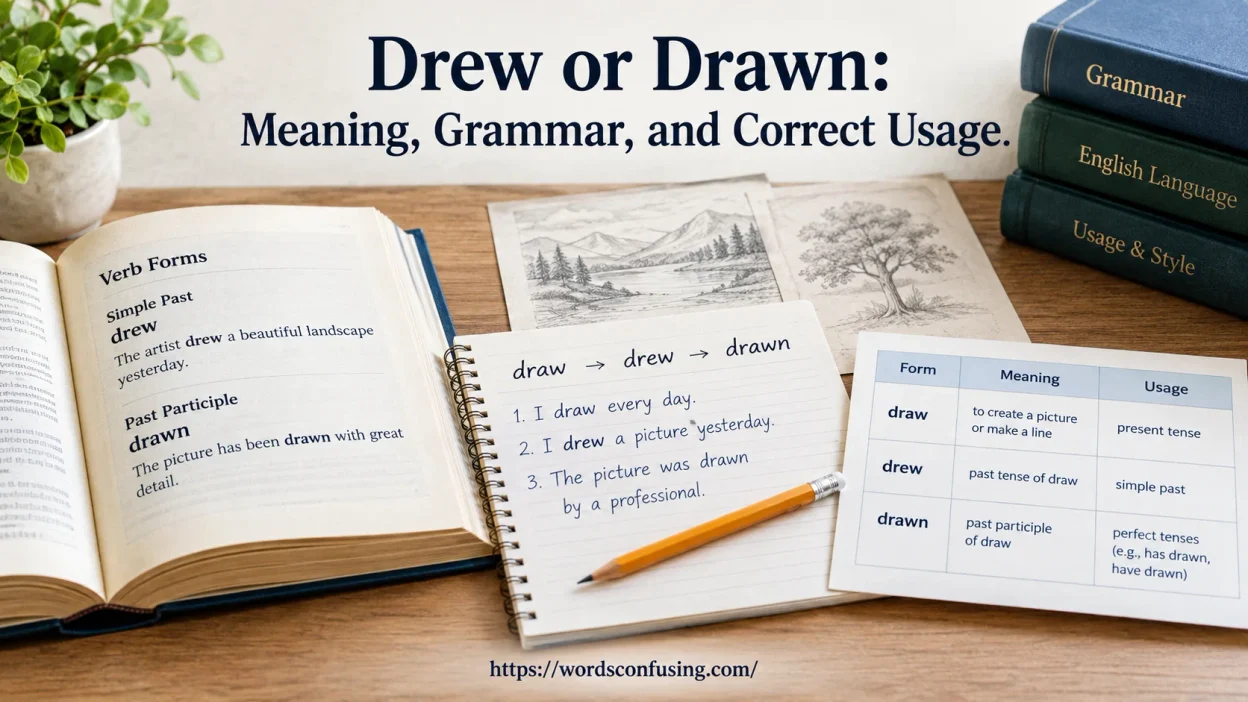
The difference between Drew and Drawn is central to Drew or Drawn: Meaning and Correct Usage, especially when discussing past actions.
When you draw, you describe an action in the present, while Drew is the simple past tense of the irregular verb to draw and describes a completed action in the past. Drawn is the past participle form, so its meaning and correct usage depend on the sentence.
For example, “She drew a picture yesterday” is correct, while “She has drawn a picture” uses drawn with an auxiliary verb. The key to avoiding mistakes is understanding how each verb works rather than using the words interchangeably.
Has, have, and had commonly work with drawn to create perfect tenses, while is and was can form the passive voice. Drawn can also function as an adjective, depending on the sentence construction.
In this article, we explore these past tense forms to help you understand their usage and grammar without worry about getting it wrong in the future. These distinctions become easier to remember through natural writing and reliable language resources.
Quick Answer
Use drew when you’re describing a completed action in the simple past.
She drew a picture yesterday.
Use drawn when the sentence requires a past participle, usually after have, has, had, or a form of be.
She has drawn a picture.
Here’s the basic comparison:
| Word | Verb Form | Main Use | Example |
| Draw | Base form | Present tense and other constructions | I draw every weekend. |
| Drew | Simple past | Completed past action | I drew yesterday. |
| Drawn | Past participle | Perfect and passive constructions | I have drawn a picture. |
So, “I drew” is correct, while “I have drawn” is correct. However, “I have drew” is not standard English.
What Is the Difference Between Drew and Drawn?
The difference between drew and drawn is grammatical rather than a difference in the basic meaning of the verb.
Both words describe an action associated with draw. The form you choose depends on how the verb functions within the sentence.
Drew is the simple past tense.
Marcus drew a detailed map.
The action happened in the past. The sentence doesn’t need another helping verb before drew.
Drawn is the past participle.
Marcus has drawn a detailed map.
Here, has acts as the auxiliary verb, while drawn supplies the past participle.
Think of the three forms as a small verb family:
draw → drew → drawn
This pattern resembles other irregular verbs:
| Base Form | Simple Past | Past Participle |
| draw | drew | drawn |
| write | wrote | written |
| sing | sang | sung |
| break | broke | broken |
| speak | spoke | spoken |
| drive | drove | driven |
The important point is that the simple past and past participle aren’t interchangeable.
When to Use “Drew”
“Drew” Is the Simple Past of “Draw”
Use drew when an action happened and finished in the past.
I drew a picture after dinner.
Sarah drew a cat for her younger brother.
The architect drew the first version of the plan.
These sentences describe completed actions. You don’t need have, has, or had before drew.
The time reference can be explicit or understood from context.
For example:
He drew the picture yesterday.
The word yesterday clearly places the action in the past.
You can also say:
He drew the picture.
Even without a time expression, drew tells the reader that the action belongs to the past.
“Drew” Works for More Than Making Pictures
One common mistake is assuming that draw only means creating an image with a pencil or pen. In reality, English uses draw in many different ways.
You can draw a conclusion, draw attention, draw a crowd, draw a line, or draw a comparison.
For example:
- The detective drew a conclusion from the evidence.
- The bright sign drew everyone’s attention.
- The performance drew a large crowd.
- She drew a line under the heading.
- The teacher drew a comparison between the two ideas.
In each example, drew describes a completed past action.
“Drew” With Different Meanings of Draw
The verb draw has a surprisingly broad semantic range. Its meaning changes according to the noun or phrase that follows it.
| Expression | Meaning | Past Example |
| draw a picture | Create an image | She drew a portrait. |
| draw a line | Make a line | He drew a straight line. |
| draw a conclusion | Reach an inference | They drew a conclusion. |
| draw attention | Attract notice | The poster drew attention. |
| draw a crowd | Attract people | The event drew thousands. |
| draw a comparison | Compare two things | The writer drew a comparison. |
| draw a card | Select a card | She drew a card. |
| draw money | Take money from an account | He drew money from the account. |
The grammar stays the same even when the meaning changes.
When to Use “Drawn”
“Drawn” With Have, Has, or Had
The word drawn commonly appears in perfect tenses.
The structure looks like this:
have/has/had + drawn
For example:
I have drawn three sketches.
She has drawn a new design.
They had drawn the diagram before the lesson began.
Here, drawn cannot normally stand alone as the main simple past verb.
Compare these sentences:
She drew a picture yesterday.
She has drawn several pictures this week.
The first sentence uses drew because it uses the simple past. The second uses drawn because has creates the present perfect construction.
“Drawn” in the Present Perfect
Use has drawn with a singular third-person subject such as he, she, or it.
She has drawn a beautiful landscape.
Use have drawn with I, you, we, or they.
They have drawn several possible designs.
The present perfect often connects a past action with the present situation.
For example:
The students have drawn their final diagrams.
This suggests that the drawings exist now and remain relevant.
“Drawn” in the Past Perfect
Use had drawn when one past action happened before another past event.
The artist had drawn the outline before the class started.
The sentence contains two past events:
- The artist drew the outline.
- The class started.
The past perfect construction had drawn identifies the earlier event.
This makes drawn particularly useful when you need to establish a sequence of past actions.
Read more: Heroes or Hero’s or Heroes’: Which Is Correct?
“Drawn” in Passive Constructions
Another major use of drawn appears in passive sentences.
For example:
The portrait was drawn by an experienced artist.
The subject, the portrait, receives the action rather than performing it.
You can also write:
The line was drawn across the page.
The diagram was drawn by the student.
A boundary was drawn around the area.
The basic structure is:
form of be + drawn
Common forms include:
- is drawn
- are drawn
- was drawn
- were drawn
- will be drawn
- has been drawn
- had been drawn
The form drew doesn’t fit these passive constructions.
For example:
The portrait was drew by Sarah. ❌
The portrait was drawn by Sarah. ✅
The helping verb was requires the past participle drawn.
“Drawn” as an Adjective
There’s another interesting wrinkle. Drawn can also function as an adjective.
In this use, drawn can describe someone’s face or appearance when they look tired, strained, worried, or worn out.
For example:
After several sleepless nights, his face looked drawn.
Here, drawn doesn’t mean that someone created a picture. It describes a physical appearance.
You may encounter expressions such as:
- a drawn face
- a drawn expression
- a drawn appearance
This meaning is especially common in descriptive writing.
Consider the difference:
She had drawn a portrait.
Here, drawn is a past participle.
She looked drawn after the exhausting journey.
Here, drawn functions as an adjective.
The spelling remains identical. The grammatical role changes.
Drew vs. Drawn Grammar Comparison
Understanding the grammar becomes easier when you place the forms side by side.
| Sentence | Correct Form | Why? |
| I ___ a picture yesterday. | drew | Simple past |
| I have ___ a picture. | drawn | Present perfect |
| She ___ a map last night. | drew | Simple past |
| She has ___ a map. | drawn | Present perfect |
| They had ___ a line. | drawn | Past perfect |
| The picture was ___. | drawn | Passive construction |
| We ___ several sketches. | drew | Simple past |
| We have ___ several sketches. | drawn | Present perfect |
A useful test is to look at the words immediately before the blank.
If you see have, has, or had, you probably need drawn.
If you’re describing a straightforward completed past action without a helping verb, drew is usually the right choice.
Drew or Drawn in Different Tenses
The verb draw appears in several tense structures. Knowing these patterns makes the distinction much easier.
| Tense | Correct Form | Example |
| Simple present | draw/draws | She draws every day. |
| Simple past | drew | She drew yesterday. |
| Present perfect | has/have drawn | She has drawn five pictures. |
| Past perfect | had drawn | She had drawn the outline. |
| Future perfect | will have drawn | She will have drawn it by noon. |
| Present passive | is/are drawn | The lines are drawn carefully. |
| Past passive | was/were drawn | The lines were drawn yesterday. |
| Present perfect passive | has/have been drawn | The designs have been drawn. |
Notice something important: drew appears specifically as the simple past form.
Meanwhile, drawn appears inside several compound structures.
That’s why simply memorizing “drew means past” isn’t enough. You also need to recognize the grammatical structure around the word.
Common Mistakes With Drew and Drawn
“I Have Drew” vs. “I Have Drawn”
This is one of the most common mistakes.
Incorrect:
I have drew a picture.
Correct:
I have drawn a picture.
The reason is straightforward. Have requires the past participle.
The same rule applies to has and had:
- She has drawn a picture.
- They have drawn a picture.
- He had drawn a picture.
You wouldn’t say:
She has wrote a letter.
You say:
She has written a letter.
The same grammatical principle applies to drawn.
“I Drawn a Picture” vs. “I Drew a Picture”
Incorrect:
I drawn a picture yesterday.
Correct:
I drew a picture yesterday.
Why? Because the simple past doesn’t require an auxiliary verb here.
You could say:
I have drawn a picture.
But you can’t simply replace drew with drawn.
“The Picture Was Drew” vs. “The Picture Was Drawn”
Incorrect:
The picture was drew by Emma.
Correct:
The picture was drawn by Emma.
The passive structure requires the past participle.
The same pattern appears with other irregular verbs:
The song was sung.
Not:
The song was sang.
Likewise:
The letter was written.
Not:
The letter was wrote.
Therefore:
The picture was drawn.
Is “Drew” the Past Tense of “Draw”?
Yes. Drew is the simple past tense of draw.
You use it for an action that occurred in the past.
Examples include:
He drew a picture last Sunday.
She drew a circle on the board.
The child drew a funny character.
The speaker drew a large audience.
The action may have happened seconds ago, yesterday, or years earlier. The crucial point is that you’re using the simple past structure.
Is “Drawn” the Past Tense of “Draw”?
Not exactly.
Drawn is the past participle of draw.
People sometimes call it a “past tense” because it describes actions that happened before now. Grammatically, however, that label isn’t precise.
A past participle doesn’t normally function as the simple past on its own.
For example:
She drew a picture.
Simple past.
She has drawn a picture.
Present perfect.
The picture was drawn yesterday.
Passive construction.
This distinction matters because it explains why “I drawn a picture” doesn’t work in standard English.
Drew or Drawn: A Simple Memory Trick
Here’s an easy way to remember the difference:
Drew stands alone. Drawn usually needs a helper.
For example:
I drew a picture.
But:
I have drawn a picture.
The word have acts as the helper.
You can extend this memory trick:
Drew = simple past
Drawn = past participle
When you see have, has, had, is, are, was, were, or similar auxiliary structures, check whether drawn belongs there.
This isn’t a universal shortcut for every sentence because drawn can also function as an adjective. Still, it works remarkably well for ordinary verb usage.
Drew or Drawn in Everyday Examples
Real-world examples make the distinction easier to remember.
Drawing Pictures
Yesterday, Maya drew a picture of her dog.
Maya has drawn several pictures of her dog.
The first sentence uses simple past. The second uses present perfect.
Drawing Conclusions
The investigators drew a conclusion from the evidence.
The investigators have drawn a conclusion from the evidence.
Both sentences can be grammatical. The tense changes the emphasis.
Drawing Attention
The unusual design drew attention from everyone nearby.
The unusual design has drawn considerable attention.
Again, the verb form depends on the construction.
Drawing a Crowd
The concert drew thousands of people.
The concert has drawn thousands of people this year.
The meaning of draw remains connected to attracting people, while the grammatical form changes.
Case Study: How One Verb Changes Across a Paragraph
Consider this short passage:
Liam drew a rough sketch before breakfast. By noon, he had drawn three different versions. His final design was drawn with careful attention to proportion. The finished illustration drew praise from his classmates.
Four uses of draw appear here, yet each form has a specific job.
Drew in the first sentence marks a completed past action.
Had drawn places the second action before another past reference point.
Was drawn creates a passive construction.
Drew praise uses the simple past because the completed action attracted praise.
This example shows why context matters more than memorizing isolated words.
Drew and Drawn With Other Meanings of Draw
The same grammar applies when draw doesn’t involve artwork.
Draw a Conclusion
The committee drew a conclusion from the available evidence.
The committee has drawn a conclusion from the available evidence.
Here, draw means reach or form a conclusion.
Draw Attention
The headline drew attention to the problem.
The headline has drawn attention to the problem.
Here, draw means attract.
Draw a Crowd
The festival drew a large crowd.
The festival has drawn visitors from nearby towns.
Here, draw means attract people.
Draw a Comparison
The article drew a comparison between the two systems.
The researcher has drawn a comparison between them.
Here, draw means make or establish a comparison.
These expressions prove that the drew vs. drawn distinction doesn’t depend on the meaning of draw. It depends on grammar.
A Quick Test for Drew or Drawn
When you’re unsure, ask yourself three questions.
Did the action simply happen in the past?
Use drew.
She drew a flower yesterday.
Does the sentence contain have, has, or had?
Use drawn.
She has drawn a flower.
Is the sentence passive?
Use drawn.
The flower was drawn by Sarah.
This quick check solves most everyday questions.
Practice: Choose Drew or Drawn
Try filling in each blank before checking the answers.
- James ___ a map yesterday.
- James has ___ a map.
- The artist had ___ several sketches.
- The portrait was ___ in charcoal.
- We ___ a conclusion after reviewing the evidence.
- The new campaign has ___ a lot of attention.
- She ___ a line across the page.
- They have ___ comparisons between the two products.
- The students ___ diagrams during class.
- The diagrams were ___ by the students.
Answer Key
- drew
- drawn
- drawn
- drawn
- drew
- drawn
- drew
- drawn
- drew
- drawn
The pattern becomes much clearer when you identify the sentence structure first.
A Practical Drew vs. Drawn Cheat Sheet
| If you want to say… | Use | Example |
| A completed past action | drew | She drew a picture. |
| An action with have | drawn | She has drawn a picture. |
| An action with has | drawn | He has drawn a picture. |
| An earlier past action with had | drawn | He had drawn it already. |
| A passive action | drawn | The picture was drawn by him. |
| A past action without an auxiliary | drew | He drew it yesterday. |
| A tired-looking appearance | drawn | Her face looked drawn. |
FAQs
Is “drew” the past tense of “draw”?
Yes. Drew is the simple past tense of draw. You use it for an action that happened and finished in the past. For example, “She drew a beautiful picture yesterday.”
Is “drawn” also a past tense of “draw”?
Drawn is the past participle of draw, not its simple past form. It usually appears with an auxiliary verb, such as has, have, or had. For example, “He has drawn several sketches.”
Can I say “I have drew a picture”?
No. The correct sentence is “I have drawn a picture.” After have or has, you need the past participle drawn, not the simple past drew.
When should I use “drew” in a sentence?
Use drew when you describe a completed action in the past without an auxiliary verb. For example, “The artist drew a portrait last night.”
When should I use “drawn” instead of “drew”?
Use drawn when another verb helps form a perfect tense or when grammar requires the p
Conclusion
Choosing between drew and drawn becomes much easier once you understand their grammatical roles. Drew works as the simple past form for a finished action, while drawn usually needs an auxiliary verb such as has, have, or had. A quick check of the surrounding sentence can often tell you which form belongs there.
The easiest way to remember the difference is to connect each word with its job. If you’re simply describing something that happened before, drew will usually fit. If another verb is helping create a perfect tense or passive construction, drawn is often the right choice. Once this pattern becomes familiar, these two forms stop being a common grammar trap.

Shafiq Ur Rehman is a writer and content contributor at WordsConfusing.com. He enjoys exploring the English language, common word confusions, vocabulary, and practical writing tips. His goal is to make English easier to understand through clear, simple, and useful articles.