


Choosing between Take a Decision and Make a Decision can confuse learners and native speakers. In everyday English usage, make a decision is the more natural expression in standard American and British English. Both expressions describe the act of choosing between options, but their phrase usage, meaning, and regional preferences differ.
While take a decision appears in some varieties, particularly South Asian English, make a decision remains preferable in formal writing and professional settings. Understanding these grammar rules helps you avoid common mistakes and improve your word choice, clarity, and writing skills.
This difference matters in business communication, project management, meetings, and workplace discussions. For example, you might write, “We need to make a decision before updating the calendar.” The same appropriate phrase works in email writing, scheduling, online booking, and professional communication. These real-world examples show how contextual usage influences phrase selection.
Understanding regional usage, expression differences, and practical application also strengthens your language understanding. With better communication styles and consistency, you can use both expressions more confidently across different contexts.
Quick Answer
Both “take a decision” and “make a decision” are grammatically correct. However, their popularity differs across English varieties.
- Make a decision: The preferred expression in American English. It’s also widely used in British English.
- Take a decision: An established expression used particularly in British English, including formal and professional contexts.
- Do a decision: Incorrect in standard English because do doesn’t naturally collocate with decision.
For American English writing, choose “make a decision.” If you’re communicating in British English, either expression can work depending on the context and your audience.
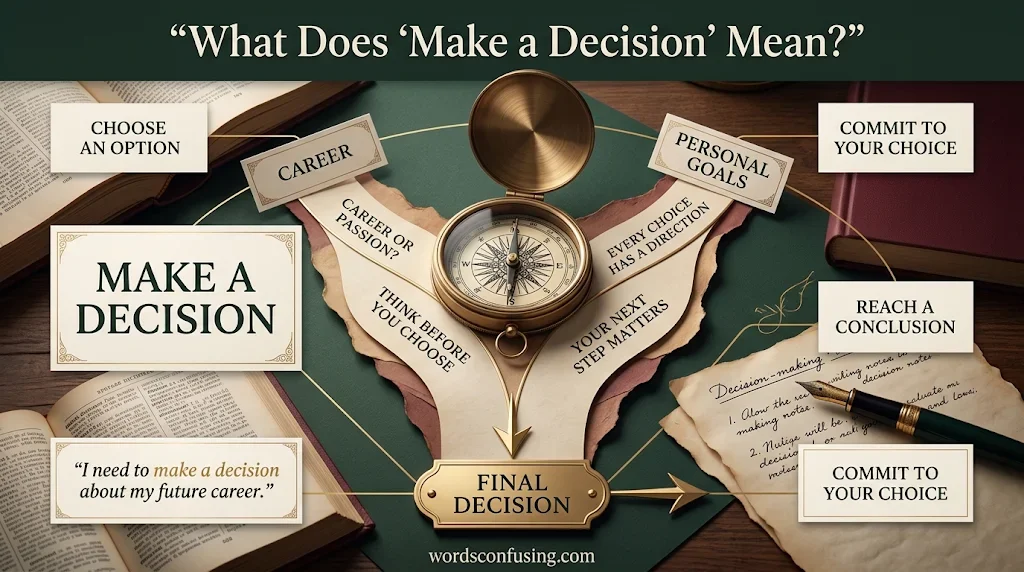
What Does “Make a Decision” Mean?
“Make a decision” means choosing an option after considering different possibilities. It describes the process of reaching a conclusion and committing to a particular choice.
The verb make works naturally with decision because English uses this combination to describe forming or reaching a choice. You can use it for everyday matters, personal goals, professional responsibilities, and major life changes.
For example, imagine you’re considering two job offers. One company offers a higher salary while the other provides better career opportunities. After comparing both positions, you finally choose one. You’ve made a decision.
This expression doesn’t require a complicated situation. Even choosing what to eat for dinner involves making a decision.
Examples of “Make a Decision” in Sentences
These examples show how the expression works in different situations.
- I need to make a decision about my future career.
- She made a decision to study medicine after graduation.
- We should make a decision before the application deadline.
- The manager made a decision to hire another employee.
- They finally made a decision about their vacation plans.
- He made a difficult decision to leave his hometown.
- Our team must make a decision before the meeting ends.
- You don’t have to make a decision immediately.
Notice how the expression works naturally with personal choices and professional responsibilities. You can also use it when someone needs additional time to consider available options.
When Should You Use “Make a Decision”?
“Make a decision” works in almost every ordinary situation. It’s particularly useful when you want your English to sound natural and clear.
Consider using it in these circumstances:
- Everyday conversations: When discussing ordinary choices with friends or family.
- Professional communication: When explaining decisions made at work.
- Academic writing: When discussing research methods, educational choices, or study plans.
- Personal discussions: When talking about relationships, careers, or important life changes.
- Formal documents: When describing decisions made by individuals or organizations.
For example, you might write, “The board made a decision to revise the company’s policies.” This sentence sounds natural in professional American English.
The expression also works when you haven’t reached a final conclusion. For instance, “I haven’t made a decision yet” clearly communicates that you’re still considering your options.
What Does “Take a Decision” Mean?
“Take a decision” means choosing a particular option or reaching a conclusion after considering a situation. It carries essentially the same meaning as “make a decision.”
The expression appears particularly often in British English and other varieties influenced by British usage. You’ll encounter it in formal discussions, business reports, government statements, and organizational communication.
For example, a committee might discuss several proposals before taking a decision about a new policy. Similarly, a government department might take a decision after reviewing public feedback.
Although American speakers understand this expression, many prefer “make a decision.” The difference concerns customary usage rather than a fundamental difference in meaning.
Examples of “Take a Decision” in Sentences
Here are practical examples showing how this expression works.
- The committee will take a decision after reviewing all applications.
- The government took a decision to introduce new regulations.
- Our department must take a decision before the end of the month.
- The board took a decision after discussing the proposal.
- The organization needs to take a decision about its future plans.
- The directors took a decision to restructure the company.
- The council will take a decision during its next meeting.
- Management has taken a decision to improve employee training.
These sentences demonstrate how the expression can describe decisions made by individuals, committees, and organizations.
Notice that take changes according to the tense and grammatical structure:
- Present: The committee takes a decision.
- Past: The committee took a decision.
- Present perfect: The committee has taken a decision.
- Future: The committee will take a decision.
When Should You Use “Take a Decision”?
You can use “take a decision” when writing or speaking in a variety of British English contexts. It’s particularly familiar in organizational and formal communication.
Consider these situations:
- Government communication: When describing decisions made by public authorities.
- Corporate discussions: When explaining decisions made by directors or management.
- Committee meetings: When reporting the outcome of discussions.
- Institutional documents: When describing official decisions and responsibilities.
- British English conversations: When the expression matches your usual regional language patterns.
For example:
“The board will take a decision after reviewing the financial report.”
This sentence communicates that the board will reach a conclusion after examining relevant information.
However, remember that formal writing doesn’t require you to choose take. You can write “The board will make a decision” without changing the essential meaning.
Difference Between “Take a Decision” and “Make a Decision”
Although both expressions describe deciding, their usage patterns deserve closer attention. The most useful distinction involves regional preference rather than a strict grammatical rule.
| Comparison | Make a Decision | Take a Decision |
| Basic meaning | To choose or decide | To choose or decide |
| Grammatical status | Correct | Correct |
| American English | Preferred and widely established | Less common |
| British English | Common | Also established |
| Formal communication | Suitable | Suitable |
| Everyday conversation | Natural | Depends on regional usage |
| General recommendation | Best choice for American English | Suitable for British English |
Let’s examine the differences more closely.
Difference in Regional Usage: British vs. American English
Regional vocabulary can influence how natural an expression sounds. British and American English share the same grammatical foundations, but they don’t always favor identical word combinations.
American English generally prefers “make a decision.” You’ll hear it in everyday conversations, workplace discussions, news reports, and academic writing.
For example:
- We need to make a decision before Friday.
- She made a decision to accept the offer.
- The company has made an important decision.
British English also uses “make a decision” frequently. However, “take a decision” is an established alternative in British usage.
For example:
- The committee took a decision after lengthy discussions.
- Ministers took a decision to review the policy.
- The council will take a decision next week.
The distinction isn’t absolute. British speakers use both expressions, and American readers can understand both.
The important point is that regional preference influences naturalness, not basic grammatical correctness.
Read more: 7 Words for Someone Who Uses Other People
Difference in Formality and Context
Some speakers associate “take a decision” with formal or institutional communication. This association makes sense because the expression often appears in discussions involving authorities and organizations.
However, you shouldn’t treat this difference as a strict rule.
“Make a decision” works perfectly well in formal writing. A company can make a major financial decision, and a government can make a policy decision.
Similarly, “take a decision” doesn’t automatically sound more formal in every British English conversation.
Compare these examples:
| Context | Natural Example |
| Casual conversation | I need to make a decision about dinner. |
| Professional discussion | We must make a decision about the budget. |
| British institutional context | The committee took a decision on the proposal. |
| Formal American report | The board made a decision to approve the plan. |
The situation and intended audience matter more than an assumed difference in formality.
Difference in Meaning: Do They Express Different Ideas?
A common misunderstanding suggests that “make a decision” means choosing something while “take a decision” means accepting an existing choice.
This distinction isn’t a reliable general rule.
Both expressions can describe reaching a conclusion or choosing between alternatives. Their meanings overlap considerably.
Consider these sentences:
- The manager made a decision to replace the old equipment.
- The manager took a decision to replace the old equipment.
Both communicate that the manager decided to replace the equipment.
Likewise:
- We need to make a decision about the new project.
- We need to take a decision about the new project.
The intended action remains the same.
Some writers may notice differences in tone because of regional habits or the surrounding sentence. However, those differences don’t establish two separate dictionary meanings.
Difference in Naturalness
An expression can be grammatically correct without being the most natural choice for every audience. That’s exactly what happens with these two phrases.
Imagine writing an email to an American client:
“We need to take a decision about the proposed changes.”
The recipient will probably understand your message. Nevertheless, “We need to make a decision about the proposed changes” sounds more familiar in American English.
Now consider a British workplace:
“The committee will take a decision after reviewing the applications.”
This wording can sound perfectly natural to British readers.
The practical lesson is simple: choose the expression that matches your audience’s English variety.
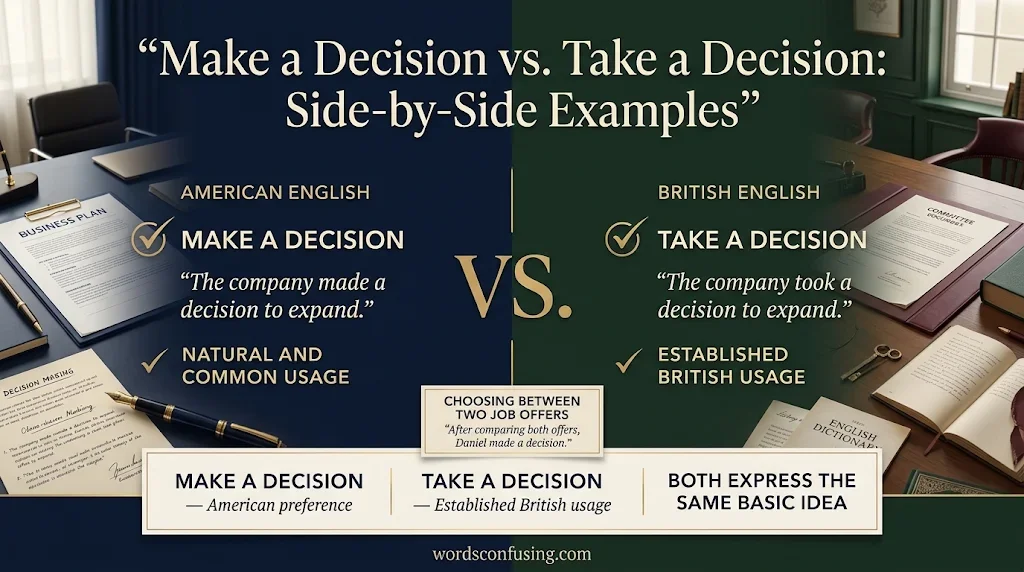
“Make a Decision” vs. “Take a Decision”: Side-by-Side Examples
Sometimes the easiest way to understand a grammar distinction is to compare complete sentences. The following examples show how both expressions work in similar situations.
| Make a Decision | Take a Decision |
| I must make a decision about my education. | I must take a decision about my education. |
| The company made a decision to expand. | The company took a decision to expand. |
| She made a decision after careful consideration. | She took a decision after careful consideration. |
| We need to make a decision today. | We need to take a decision today. |
| The committee made a decision about the proposal. | The committee took a decision about the proposal. |
| The director made a decision to change the schedule. | The director took a decision to change the schedule. |
| They made a decision to postpone the event. | They took a decision to postpone the event. |
Each pair communicates essentially the same decision. The main difference involves which expression sounds more familiar in a particular English variety.
A Practical Case Study: Choosing Between Two Job Offers
Consider a graduate who receives two job offers. The first company offers a higher salary, while the second provides better opportunities for professional growth.
After comparing the benefits, responsibilities, and long-term prospects, the graduate chooses the second position.
Here are two ways to describe the situation:
Using American English:
“After comparing both offers, Daniel made a decision to accept the position with better career opportunities.”
Using British English:
“After comparing both offers, Daniel took a decision to accept the position with better career opportunities.”
Both sentences communicate the same outcome. Neither changes the basic meaning of the graduate’s choice.
However, an American writer would generally prefer the first version.
A Workplace Example: A Committee Meeting
Imagine a committee discussing whether to introduce a new employee training program. Members review the budget, compare available providers, and discuss the expected benefits.
After considering the options, the committee approves the proposal.
You can describe the result in either way:
- Make: The committee made a decision to introduce the training program.
- Take: The committee took a decision to introduce the training program.
The first version works naturally in both American and British English. The second is also established, particularly in British English.
These examples show why audience awareness matters more than memorizing an artificial difference between the expressions.

Other Correct Expressions You Can Use Instead of “Make” or “Take a Decision”
English offers several alternatives when you want to describe reaching a conclusion. Although their meanings overlap, each expression carries a slightly different emphasis.
Understanding these alternatives will help you avoid repetitive writing and communicate more precisely.
Reach a Decision
“Reach a decision” means arriving at a conclusion after considering information, discussing possibilities, or evaluating different options.
It often emphasizes the result of a decision-making process rather than the act of choosing itself.
Examples:
- The committee reached a decision after two hours of discussion.
- We need to reach a decision before the deadline.
- After reviewing the evidence, the jury reached a decision.
- They finally reached a decision about their future plans.
When to use it: Choose this expression when you want to emphasize that someone has arrived at a conclusion after careful thought or discussion.
Come to a Decision
“Come to a decision” means finally deciding something after considering different possibilities. It often appears in everyday conversations and professional discussions.
Examples:
- We came to a decision after discussing all the available options.
- She finally came to a decision about her university.
- The family came to a decision about their holiday destination.
- Have you come to a decision about the job offer?
When to use it: Use this expression when describing the process of reaching an agreement or settling on a particular choice.
Arrive at a Decision
“Arrive at a decision” means reaching a conclusion through thought, discussion, or careful evaluation. It generally sounds more formal than “come to a decision.”
Examples:
- The board arrived at a decision after examining the financial reports.
- We must arrive at a decision before the next meeting.
- The investigation helped the team arrive at a reasonable decision.
- She arrived at a decision after considering every possibility.
When to use it: This expression works particularly well in formal reports, academic discussions, and professional communication.
Make Up Your Mind
“Make up your mind” is a conversational expression that means deciding what you want or which option you prefer.
Unlike “make a decision,” it often sounds more personal and informal.
Examples:
- You need to make up your mind about which course to choose.
- I can’t make up my mind between these two dresses.
- She finally made up her mind to move abroad.
- Have you made up your mind about joining the team?
When to use it: Use this phrase when speaking casually about personal preferences, choices, and decisions.
Make the Final Decision
“Make the final decision” means choosing the definitive option after considering the available possibilities.
This expression often highlights responsibility or authority over the outcome.
Examples:
- The director will make the final decision about the promotion.
- Parents sometimes make the final decision about their children’s education.
- The selection committee must make the final decision tomorrow.
- Our manager made the final decision after consulting the team.
When to use it: Choose this expression when you want to emphasize that someone has the authority to settle an issue.
Common Mistakes to Avoid When Using “Decision”
Choosing between “make” and “take” isn’t the only challenge. English learners also make mistakes with articles, prepositions, and related expressions.
Here are some common problems worth correcting.
Saying “Do a Decision” Instead of “Make a Decision”
One frequent mistake involves using do instead of make.
Although both verbs appear in many English expressions, they don’t work interchangeably. English uses established word combinations called collocations.
For example, you say:
- Do homework.
- Do the dishes.
- Do your work.
- Make a decision.
- Make a suggestion.
- Make a plan.
Therefore, “do a decision” doesn’t follow standard English usage.
Compare these examples:
| Incorrect | Correct |
| I need to do a decision. | I need to make a decision. |
| She did a difficult decision. | She made a difficult decision. |
| We have to do a decision today. | We have to make a decision today. |
Remember that the correct expression is make a decision, not do a decision.
Forgetting the Article Before “Decision”
Another common mistake involves leaving out the article a before the singular noun decision.
In standard English, decision is a singular countable noun. It generally needs an article or another determiner when used as a singular noun.
For example:
Incorrect: We need to make decision today.
Correct: We need to make a decision today.
However, you don’t always need a. Other determiners can also introduce the noun.
| Expression | Example |
| A decision | I need to make a decision. |
| The decision | We discussed the decision yesterday. |
| My decision | I have made my decision. |
| This decision | This decision could affect our future. |
| Several decisions | The manager made several decisions. |
The important thing is to use the appropriate determiner when the singular countable noun requires one.
Using the Wrong Preposition After “Decision”
The noun decision commonly appears with several prepositions. Choosing the right one depends on the sentence structure.
Here are three useful patterns:
Decision about
Use about when identifying the subject or matter being considered.
Examples:
- I made a decision about my career.
- We haven’t reached a decision about the proposal.
- She took a decision about her education.
Decision on
Use on when identifying the particular matter being decided.
Examples:
- The committee made a decision on the application.
- We need a decision on the budget.
- The board reached a decision on the new policy.
Decision to
Use to before a verb when describing the action someone has decided to take.
Examples:
- She made a decision to study abroad.
- They took a decision to close the branch.
- He reached a decision to accept the offer.
One mistake to avoid is writing “the decision of leaving” when you mean the choice to leave.
The natural construction is “the decision to leave.”
Confusing “Decision” With “Choice”
Although decision and choice have related meanings, they aren’t always interchangeable.
A choice refers to an available option or the act of selecting between alternatives. A decision emphasizes the conclusion or judgment involved in selecting an option.
Consider these examples:
- You have three choices for your university course.
- You must make a decision about which course to study.
The first sentence identifies the available alternatives. The second describes the process of selecting one.
Both nouns are useful, but choosing the right one makes your meaning clearer.
Is “Take a Decision” Correct in American English?
Yes, the expression exists in English, but it isn’t the usual choice for most American speakers.
American English strongly favors “make a decision” in everyday conversations, business communication, academic writing, and formal documents.
For example, an American writer would generally say:
- I need to make a decision about my career.
- The company made a decision to increase production.
- We haven’t made a decision yet.
- The committee will make a decision tomorrow.
Although American readers can understand “take a decision,” the expression may sound unfamiliar or noticeably British.
This doesn’t mean the phrase becomes grammatically incorrect simply because someone uses American English. It means that another expression better matches common American usage.
If your audience primarily lives in the United States, choosing “make a decision” is the clearest option.

Which Expression Should You Use in Everyday and Professional Writing?
Choosing between these expressions becomes easier when you consider your audience and communication setting.
Both can work, but consistency helps your writing sound natural.
Everyday Conversations
For everyday American English conversations, make a decision is the better choice.
It works naturally when discussing food, shopping, relationships, education, and personal plans.
Examples:
- I can’t make a decision about what to eat.
- We need to make a decision before leaving.
- Have you made a decision about your weekend plans?
British English speakers may also use “take a decision” in conversation. However, “make a decision” remains a widely understood alternative.
Academic Writing
Academic writing requires clear expressions that readers can understand without unnecessary effort.
If you’re writing for an American university, use “make a decision” as your standard expression.
For example:
“The researchers made a decision to exclude incomplete responses from the analysis.”
In British academic writing, “take a decision” can also appear. However, the writer should follow the institution’s preferred English variety and maintain consistency.
Business and Professional Communication
Both expressions can appear in business communication, particularly when discussing organizational decisions.
For American business writing, “make a decision” generally sounds more natural.
Examples:
- The management team made a decision to revise the annual budget.
- Our department needs to make a decision about the proposed changes.
- The directors made a final decision after reviewing the report.
In British business communication, “take a decision” is also an established option.
The key is to choose language that fits your organization’s usual writing style.
Emails and Formal Reports
Professional emails benefit from direct and familiar expressions. You don’t need complicated vocabulary to communicate an important decision.
Compare these examples:
Natural American English:
“Please let us know when you’ve made a decision about the proposal.”
British English alternative:
“Please let us know when you’ve taken a decision about the proposal.”
Both communicate the same request. The first is generally more suitable for an American audience.
For formal reports, you can also use alternatives such as “reached a decision” or “arrived at a decision” when they fit the intended meaning.
Read more: “Much More” Meaning & Correct Use
FAQs
1. Is it correct to say “take a decision” or “make a decision”?
Both expressions are used in English, but make a decision is more widely accepted in standard American and British English.
2. Why do some people say “take a decision”?
The phrase is common in South Asian English and some other regional varieties. It follows a regional usage pattern rather than the more widely preferred expression.
3. Is “make a decision” more suitable for formal writing?
Yes. Make a decision sounds natural in professional emails, business reports, academic writing, and everyday communication.
4. Can I use “take a decision” in a business meeting?
You may hear it in certain regions, but make a decision is generally the safer choice for international business communication.
5. What is another way to say “make a decision”?
You can use expressions such as reach a decision, come to a decision, make up your mind, and decide on something.
6. Is there any difference between making a decision and taking a decision?
Both expressions communicate the act of choosing between options. The main difference lies in regional preferences and standard English usage, not their basic meaning.
Conclusion
Choosing between take a decision and make a decision becomes easier when you understand their regional differences. Although both expressions describe the process of choosing between options, make a decision is the more natural and widely accepted choice in standard American and British English. You can confidently use it in everyday conversations, professional emails, business meetings, and formal writing. While take a decision remains common in some regional varieties, it may sound less natural to international readers.
When in doubt, stick with make a decision to keep your English clear and natural. Remember, small differences in word choice can make your communication sound more polished. Whether you’re discussing work, planning a meeting, or making an important personal choice, using the right expression helps you express your thoughts with confidence.

Franklin Hayes is a writer and editor at WordsConfusing.com, focused on making English vocabulary, grammar, and commonly confused words easy to understand. He writes clear, practical articles with simple explanations and useful examples to help readers improve their English with confidence.
His goal is simple: Making Confusing Words Simple.