
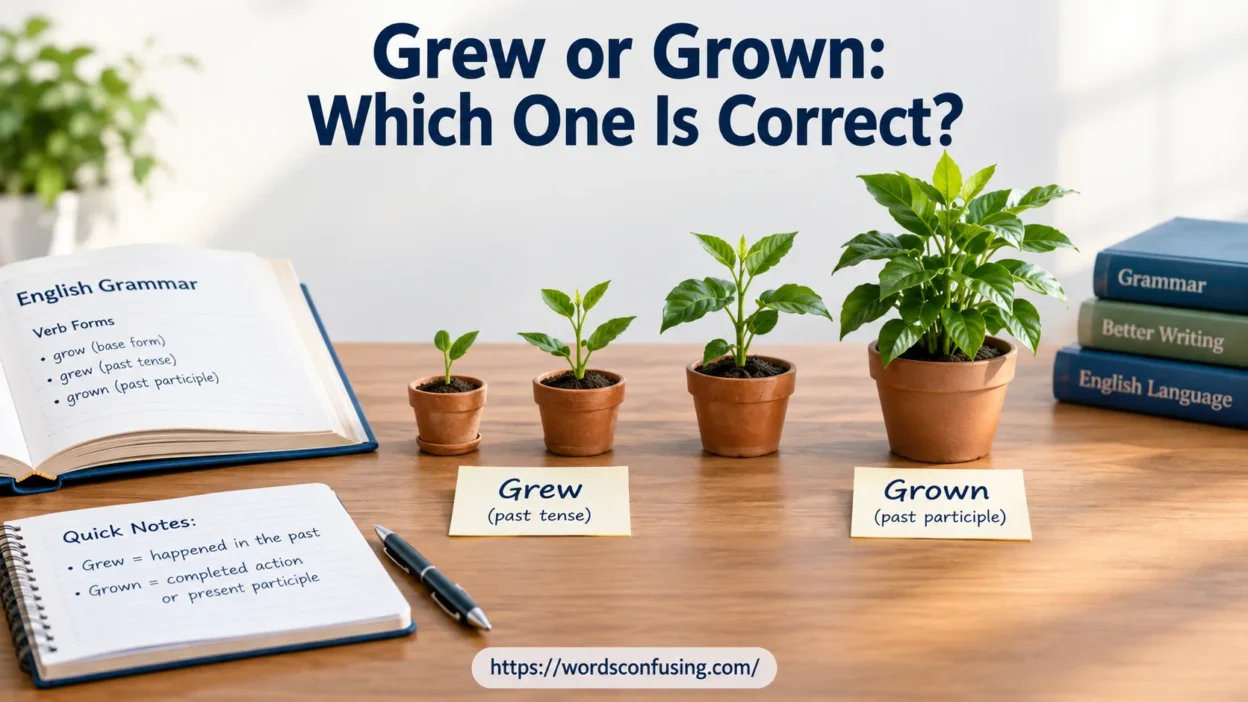
Grew or Grown: Which One Is Correct? becomes easier when you understand how English verbs change across different grammar situations and sentences.
For English learners and native speakers, Grew and Grown may seem similar because both come from the verb grow and describe the same action. However, their grammatical purposes differ. Grew is the past tense, while grown is the past participle used with a helping verb.
The plant grew quickly shows a completed action, whereas the plant has grown quickly following a different pattern. This simple difference makes the grammar rules easier to understand and helps with choosing the right word. These past tense forms can feel tricky because to grow is an irregular verb.
You may encounter grew or grown in writing, including emails, school assignments, business documents, social media posts, and everyday conversations. A sentence such as the company has grew quickly contains a grammar mistake.
Understanding the present tense, past tense, and past participle helps you use each form correctly, communicate clearly and professionally, and avoid common mistakes. The origins, examples, and practical advice in this article can guide writers around the world toward the correct difference.
Quick Answer
Grew and grown are both correct forms of grow, but you use them differently.
- Grow = base or present form
- Grew = simple past form
- Grown = past participle
- Growing = present participle or gerund
- Grows = third-person singular present form
Here are the key examples:
| Form | Example | Function |
| Grow | Plants grow quickly. | Present/base form |
| Grew | The plant grew quickly. | Simple past |
| Grown | The plant has grown quickly. | Past participle |
| Growing | The plant is growing quickly. | Present participle |
| Grows | This plant grows quickly. | Present tense, third person |
Think of grew as a complete past-tense verb. By contrast, grown usually needs grammatical support from another verb.
Easy rule: Use grew for simple past actions and grown after forms of have or in certain passive constructions.
Grew vs. Grown: The Main Difference
The central difference between grew and grown is grammatical rather than semantic. Both words describe development, increase, or change. The surrounding sentence determines which form you need.
Grew is the simple past form of grow. It can act as the main verb in a past-tense sentence.
For example:
- The child grew quickly.
- The company grew rapidly.
- The grass grew after the rain.
- She grew more confident with experience.
In each sentence, grew tells you that the action or change happened in the past.
Grown, on the other hand, is the past participle. It commonly appears with has, have, or had.
For example:
- The child has grown quickly.
- The company has grown rapidly.
- The grass has grown after the rain.
- She has grown more confident with experience.
The meaning remains closely related, but the tense changes.
What Does “Grew” Mean?
Grew describes something that happened or developed in the past.
It can refer to physical size, age, quantity, intensity, experience, or emotional development. The word doesn’t only describe plants or children.
Consider these examples:
- The tree grew several feet last year.
- His interest in music grew over time.
- The crowd grew larger as the concert approached.
- She grew nervous before the interview.
- The problem grew worse during the winter.
Notice how broadly grow can function. Something can literally become larger, or it can change in a more abstract way.
What Does “Grown” Mean?
Grown is the past participle of grow. It normally appears with another verb when forming perfect tenses.
For example:
- The tree has grown several feet.
- The children have grown considerably.
- The business had grown before the recession.
- The problem has grown worse.
The word can also appear in passive constructions:
- These vegetables are grown locally.
- The coffee beans are grown in tropical regions.
- The wheat was grown on a family farm.
Here, grown doesn’t function as the simple past. Instead, it forms part of a larger verb construction.
Grow, Grew, and Grown: All Three Verb Forms
Understanding the complete verb pattern makes the distinction much clearer.
The verb grow is an irregular verb. Its past form doesn’t use the regular -ed ending.
| Verb form | Grammatical role | Example |
| Grow | Base form | Plants grow in sunlight. |
| Grows | Present, third person singular | This plant grows quickly. |
| Grew | Simple past | The plant grew quickly. |
| Grown | Past participle | The plant has grown quickly. |
| Growing | Present participle/gerund | The plant is growing quickly. |
This pattern is worth memorizing:
grow → grew → grown
It’s similar to other irregular verbs:
- go → went → gone
- see → saw → seen
- write → wrote → written
- begin → began → begun
- drink → drank → drunk
You wouldn’t say, “I have went home.” You say, “I have gone home.” The same grammatical principle explains why you say, “I have grown,” not “I have grew.”
When to Use “Grew”
Use grew when you need the simple past form of grow.
The simple past generally describes something that happened at a definite or understood time in the past. The event may have happened once, repeatedly, or over a period.
“Grew” for a Completed Past Action
Consider this sentence:
The plant grew rapidly last summer.
The phrase last summer establishes a finished period. Therefore, grew fits naturally.
More examples include:
- The company grew quickly in the early 2000s.
- The child grew several inches last year.
- The tree grew beside the house for decades.
- Her confidence grew after the competition.
- The town grew rapidly during the oil boom.
Words such as yesterday, last year, last month, when I was young, and in 2015 often point toward the simple past.
That doesn’t mean every sentence containing a past-time expression must use grew. Context still matters. However, a completed past period strongly supports the simple past.
“Grew” for Physical Development
One of the most familiar meanings of grow involves physical development.
For example:
- The baby grew quickly.
- The puppy grew into a large dog.
- The tree grew several feet.
- He grew taller during high school.
The verb can describe height, size, weight, length, or general physical development.
You can also use grew with measurements:
- The tree grew two feet in one year.
- The child grew five inches during adolescence.
- The plant grew nearly a meter during the season.
“Grew” for Gradual Change
Growth doesn’t always involve physical size.
English frequently uses grow to describe gradual changes in feelings, conditions, relationships, or situations.
For example:
- She grew more patient with age.
- His concern grew after the phone call.
- The audience grew restless.
- Their friendship grew stronger.
- The situation grew more complicated.
In these examples, something develops gradually. The change may be emotional, social, financial, or abstract.
When to Use “Grown”
Use grown when the grammar requires the past participle of grow.
The most common pattern involves has, have, or had.
“Grown” With Has, Have, or Had
These auxiliary verbs create perfect constructions.
Has grown refers to something connected to the present:
- The child has grown considerably.
- The business has grown since 2020.
- The tree has grown taller.
- The problem has grown worse.
Have grown follows plural subjects and the pronouns I, you, we, and they:
- The children have grown quickly.
- We have grown accustomed to the change.
- They have grown closer over time.
- I have grown more confident.
Had grown establishes a past-before-past relationship:
- The tree had grown considerably before the storm.
- The company had grown rapidly before the market changed.
- She had grown tired before the meeting ended.
The crucial point is simple: has, have, and had take the past participle grown, not the simple past grew.
“Grown” in Passive Constructions
You can also find grown in passive sentences.
For example:
- The tomatoes are grown locally.
- The rice is grown in flooded fields.
- The cotton was grown on the farm.
- These vegetables are grown without artificial lighting.
Here, grown follows a form of be. The construction focuses on what happens to the crop rather than who grows it.
Compare:
Farmers grew the tomatoes locally.
This is active voice.
The tomatoes were grown locally.
This is passive voice.
Both sentences are grammatically correct. They simply emphasize different parts of the situation.
“Grown” as an Adjective
Grown can also function as an adjective in certain expressions.
For example:
- grown adults
- homegrown talent
- homegrown vegetables
- fully grown animals
In fully grown, the word describes a state of development.
For example:
The puppy is now fully grown.
Here, grown contributes to a description of the puppy’s mature state.
Grew vs. Grown in Different Sentence Structures
The easiest way to understand the distinction is to compare the structures directly.
| Sentence | Correct form | Reason |
| The tree grew quickly. | Grew | Simple past |
| The tree has grown quickly. | Grown | Past participle after has |
| The tree had grown quickly. | Grown | Past participle after had |
| The tree was grown commercially. | Grown | Passive construction |
| The tree is growing quickly. | Growing | Progressive construction |
| Trees grow quickly here. | Grow | Present/base form |
| This tree grows quickly. | Grows | Present tense with singular subject |
The surrounding verb acts like a grammatical signpost. It tells you which form belongs in the sentence.
Common Mistakes With Grew and Grown
Many mistakes happen because speakers recognize both forms but don’t recognize their grammatical roles.
“I Have Grew” vs. “I Have Grown”
I have grew is incorrect in standard English.
The correct sentence is:
I have grown.
Why? The auxiliary verb have requires the past participle.
The pattern is:
have + past participle
Therefore:
- have grown
- have seen
- have written
- have gone
- have taken
You wouldn’t normally say I have saw the movie. You say I have seen the movie. The same rule applies to grow.
“The Plant Has Grew” vs. “The Plant Has Grown”
This mistake follows exactly the same pattern.
Incorrect:
The plant has grew quickly.
Correct:
The plant has grown quickly.
The word has already signals a perfect construction. That means the past participle belongs after it.
Remember:
has + grown
not:
has + grew
“The Plant Grown” vs. “The Plant Grew”
A sentence such as The plant grown quickly doesn’t work as a normal simple-past sentence.
You need:
The plant grew quickly.
If you want the perfect construction, use:
The plant has grown quickly.
If you want a passive construction, you could say:
The plant was grown commercially.
Each sentence uses a different grammatical structure.
“Did It Grew?” vs. “Did It Grow?”
This mistake deserves special attention because auxiliary verbs change the main verb form.
Incorrect:
Did the plant grew quickly?
Correct:
Did the plant grow quickly?
Why?
The auxiliary did already marks the past tense. The main verb therefore returns to its base form.
The pattern is:
did + grow
not:
did + grew
Compare these sentences:
- The plant grew quickly.
- Did the plant grow quickly?
- The plant didn’t grow quickly.
Once did or didn’t appears, use grow.
Read more: Louis’ or Louis’s? The Correct Possessive Form Explained
Grew or Grown Up: Which Is Correct?
The phrase grow up often creates another point of confusion.
Use grew up for a completed past experience.
For example:
- I grew up in Texas.
- She grew up near the coast.
- They grew up together.
- He grew up on a farm.
You can also use grown up in perfect constructions:
- I have grown up since then.
- She has grown up considerably.
- They had grown up before moving away.
There’s an important difference between these constructions.
I grew up in Texas describes where you spent your childhood.
I have grown up emphasizes development that connects with the present.
In everyday English, I grew up is usually the natural choice when describing childhood location or upbringing.
Grew or Grown in Questions
Questions often reveal the difference especially clearly.
Questions With “Grew”
Use did + grow when asking about a simple past event:
- Did the tree grow quickly?
- How much did the child grow?
- When did the company grow?
- Where did she grow up?
Notice that grew doesn’t appear after did.
Questions With “Grown”
Use has/have + grown for present-perfect questions:
- Has the tree grown?
- How much has the child grown?
- Have the plants grown enough?
- How much has the company grown?
The difference is easy to spot:
Did + grow
versus
Has/have + grown
Grew or Grown in Negative Sentences
Negative sentences follow the same grammatical principles.
With simple past, use didn’t + grow:
- The plant didn’t grow.
- The child didn’t grow much that year.
- The business didn’t grow as expected.
Don’t use didn’t grew.
With the present perfect, use hasn’t/haven’t + grown:
- The plant hasn’t grown much.
- The children haven’t grown enough.
- The business hasn’t grown since last year.
Again, the auxiliary determines the structure.
| Incorrect | Correct |
| I have grew. | I have grown. |
| She has grew. | She has grown. |
| Did it grew? | Did it grow? |
| It didn’t grew. | It didn’t grow. |
| The plant grown quickly. | The plant grew quickly. |
Grew vs. Grown: How Tense Changes the Meaning
Although grew and grown share the same basic idea, their tenses can affect how you present the event.
Compare:
The company grew rapidly in 2018.
This places the growth firmly in a completed past period.
Now consider:
The company has grown rapidly since 2018.
This connects the past growth with the present. The growth began in the past and remains relevant now.
Another pair makes the difference clearer:
The child grew five inches last year.
This describes growth during a finished period.
The child has grown five inches since last year.
This connects that change to the current situation.
The distinction isn’t merely about grammar rules. It helps readers understand when the change happened and how it relates to now.
Case Study: “Grew” and “Grown” in Real Sentences
Consider a small family garden.
During the summer, the gardener might say:
The tomatoes grew quickly in July.
The sentence describes a completed event in the past.
A few weeks later, the gardener might say:
The tomatoes have grown much larger.
Now the speaker focuses on their current condition.
Later, when discussing the harvest, someone might say:
The tomatoes were grown without synthetic pesticides.
That sentence uses a passive construction.
Three sentences describe related facts, yet each requires a different form:
| Situation | Example | Form |
| Completed past growth | The tomatoes grew quickly. | Grew |
| Growth connected to now | The tomatoes have grown larger. | Grown |
| Passive description | The tomatoes were grown locally. | Grown |
This example demonstrates why memorizing a single substitution rule isn’t enough. You need to understand the structure.
Another Case Study: “Grew” and “Grown” With People
The same distinction applies to people.
Imagine discussing someone’s development over several years.
Alex grew more confident during college.
The sentence describes a change that happened in the past.
Now compare:
Alex has grown more confident since starting college.
The second sentence connects the development to the present.
You could also say:
Alex had grown more confident before taking the leadership role.
Here, had grown places one past development before another past event.
The three constructions show three different relationships with time:
- grew → simple past
- has grown → present perfect
- had grown → past perfect
A Simple Memory Trick for Grew vs. Grown
If grammar terminology feels cumbersome, use this shortcut:
Yesterday → grew
Has/have/had → grown
For example:
- Yesterday, the plant grew.
- Last year, the company grew.
- She grew up in California.
Then:
- The plant has grown.
- The company has grown.
- She has grown more confident.
There’s one more useful clue:
Did → grow
So you can remember the three common patterns:
Past: grew
Perfect: has/have/had grown
Questions with did: did grow
This simple framework handles most everyday uses.
Grew vs. Grown Examples
Examples With “Grew”
Here are several natural examples using grew:
- The oak tree grew rapidly after the rain.
- She grew more comfortable speaking in public.
- The town grew dramatically during the twentieth century.
- His interest in photography grew over time.
- The children grew up together.
- The problem grew worse overnight.
- The crowd grew larger as the event continued.
- My confidence grew after several successful presentations.
Each sentence uses grew as the simple past form.
Examples With “Grown”
Now consider examples using grown:
- The tree has grown considerably.
- The children have grown since their last visit.
- Her confidence has grown steadily.
- The business had grown before the merger.
- These vegetables are grown locally.
- The coffee is grown in several regions.
- The puppy is almost fully grown.
- The company has grown into a major employer.
The surrounding structure makes the role of grown clear.
Grew vs. Grown: Side-by-Side Comparison
| Grew | Grown |
| Simple past | Past participle |
| Can stand as the main past-tense verb | Usually requires an auxiliary verb |
| The plant grew quickly. | The plant has grown quickly. |
| She grew up in Ohio. | She has grown considerably. |
| The problem grew worse. | The problem has grown worse. |
| They grew closer over time. | They have grown closer over time. |
The biggest practical difference is the verb that comes before the form.
If you see has, have, or had, grown is usually the form you need.
If you’re simply describing something that happened in the past, grew is generally appropriate.
FAQs
Is “grew” the past tense of “grow”?
Yes. Grew is the simple past tense of grow. For example, “The child grew quickly” describes an action that happened in the past.
Is “grown” a past tense word?
Not exactly. Grown is the past participle of grow. It usually appears with helping verbs such as has, have, or had, as in “The plant has grown.”
Can I say “has grew”?
No. Has grew is grammatically incorrect. After has, use the past participle grown: “The company has grown quickly.”
When should I use “grew” in a sentence?
Use grew when describing a completed action in the past without a helping verb. For example, “The business grew rapidly last year.”
When should I use “grown” instead of “grew”?
Use grown when a helping verb such as has, have, or had comes before it. For example, “The business has grown rapidly.”
What is the easiest way to remember “grew” and “grown”?
Think of the verb pattern grow – grew – grown. Use grew for simple past actions and grown with helping verbs in perfect tenses.
Conclusion
The difference between grew and grown becomes much clearer once you focus on how each form works in a sentence. Grew describes a completed action in the past, while grown works as a past participle with helping verbs such as has, have, or had. Remembering the simple pattern grow – grew – grown can save you from many common grammar mistakes.
Whether you’re writing an email, completing an assignment, or simply chatting with someone, choosing the correct form makes your English sound more natural. When you pause and check the verb pattern, grew or grown doesn’t have to be confusing. A little practice is usually enough to make the right choice feel automatic.

Franklin Hayes is a writer and editor at WordsConfusing.com, focused on making English vocabulary, grammar, and commonly confused words easy to understand. He writes clear, practical articles with simple explanations and useful examples to help readers improve their English with confidence.
His goal is simple: Making Confusing Words Simple.