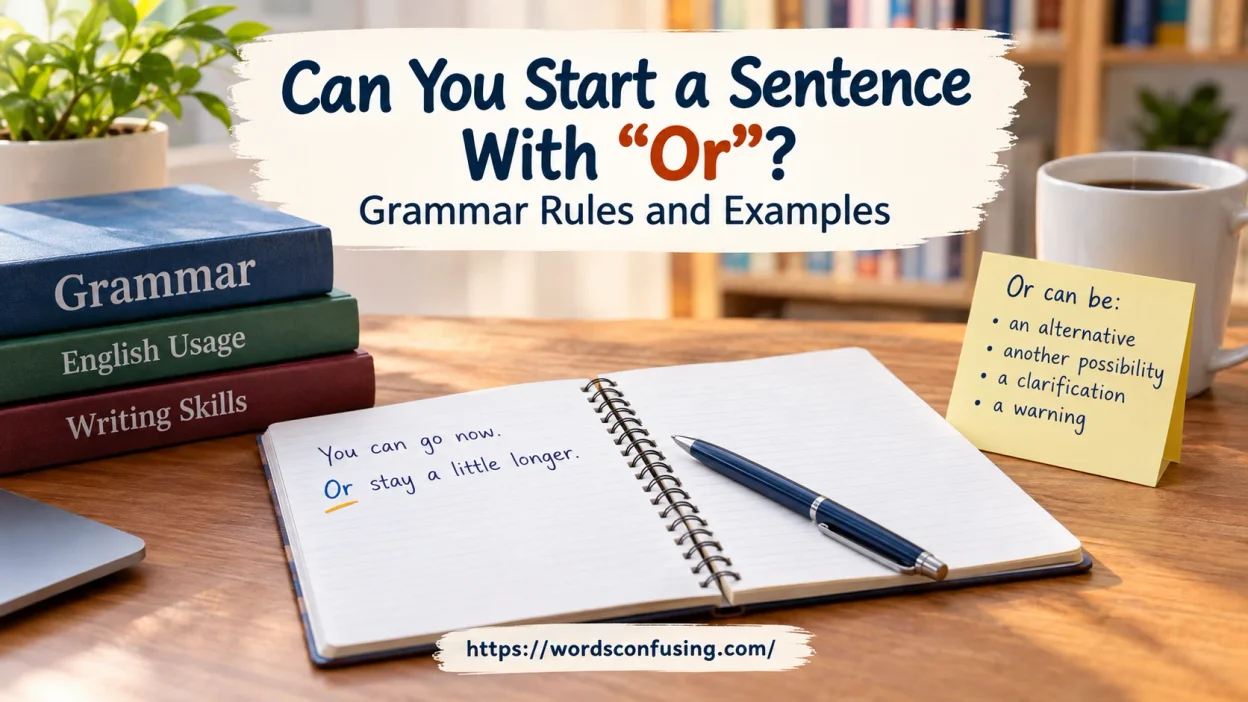
Can You Start a Sentence With “Or”? Examples explains how modern English grammar allows this useful word at the beginning of a sentence. There are no strict English rules against starting a sentence with Or, especially when it connects choices, alternatives, or different options.
As one of the conjunctions, a coordinating conjunction can introduce another possibility, continue an idea, or present a question. For example, “You can take the bus to school. Or you can walk if the weather is nice.” This sentence structure follows common grammar rules and maintains grammatical correctness.
When considering sentence beginnings, focus on meaning, flow, and clarity instead of outdated writing rules. Effective sentence construction depends on natural connections between ideas, not simply on particular words or traditional grammar conventions. Although some writers avoid certain sentence starters, starting sentences with or can improve readability when used thoughtfully.
In written English, this writing style works well in essays, stories and everyday communication. Consider your audience and overall language usage to maintain natural writing. This approach helps explore the answer through practical examples that demonstrate effective punctuation, grammar usage, and effective writing.
Quick Answer
Yes, you can start a sentence with “or.” It’s grammatically correct when you introduce an alternative, present another possibility, or emphasize a different choice. For example: “We can leave now. Or we can wait until tomorrow.” Just make sure the sentence connects logically to the previous idea and communicates a clear, complete thought.
Is It Grammatically Correct to Start a Sentence With “Or”?
Yes, starting a sentence with “or” is grammatically correct when the word introduces a meaningful alternative or continues a logical connection between ideas.
The word “or” is a coordinating conjunction. It connects words, phrases, and clauses that have a grammatical relationship. Traditional grammar instruction often teaches students to avoid beginning sentences with conjunctions, but that advice is a style preference rather than a universal grammatical rule.
Consider this example:
“Sarah can drive us to the airport. Or we can take a taxi.”
The second sentence begins with “or” because it presents another way to reach the airport. Readers can easily understand the relationship between the two sentences.
Now consider a different example:
“Sarah can drive us to the airport. Or the library closes at six.”
Both sentences are grammatically complete, but the connection between them is unclear. The library’s closing time doesn’t offer an obvious alternative to Sarah’s transportation arrangement.
The problem isn’t the word “or” itself. The problem is the missing logical connection between the ideas.
Why Do Some Teachers Discourage Starting a Sentence With “Or”?
Many students learn that sentences should not begin with coordinating conjunctions such as “and,” “but,” or “or.” Teachers sometimes introduce this rule to help beginners avoid fragments and choppy writing.
For example, a student might write several short sentences that begin with “or,” even when combining the alternatives would produce a smoother paragraph. In that situation, the teacher’s advice can improve readability.
However, experienced writers regularly begin sentences with conjunctions when doing so serves a clear purpose. The Chicago Manual of Style and other established editorial references recognize that sentence-initial conjunctions can be appropriate when used effectively.
The important distinction is between grammatical correctness and stylistic preference. A sentence can be grammatically correct without being the strongest choice for a particular assignment or publication.
If your instructor specifically prohibits beginning sentences with conjunctions, follow those instructions. Otherwise, judge the construction by its clarity, grammar, and purpose.
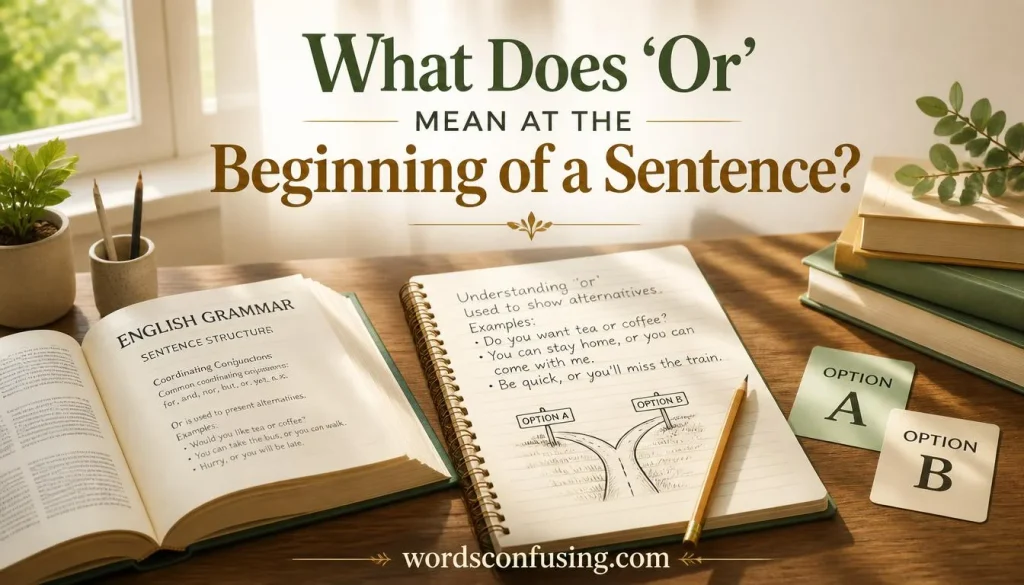
What Does “Or” Mean at the Beginning of a Sentence?
When “or” appears at the beginning of a sentence, it usually introduces an alternative to something mentioned earlier. The reader looks at the preceding sentence to understand which choices, explanations, or outcomes the writer wants to compare.
The word can perform several related functions:
- Introduce another choice.
- Suggest a possible explanation.
- Present an alternative interpretation.
- Clarify or restate an earlier idea.
- Warn about a possible consequence.
The exact meaning depends on the surrounding sentences. Understanding these uses will help you decide when beginning with “or” makes sense.
Using “Or” to Present an Alternative
One of the most common reasons to start a sentence with “or” is to present another choice. This construction works particularly well when the writer wants readers to consider two separate options.
For example:
“You can book your appointment online. Or you can call the office directly.”
The first sentence introduces one option. The second sentence presents another without forcing both choices into a longer sentence.
Here are additional examples:
- We could watch a movie tonight. Or we could play a board game.
- You can pay the fee by credit card. Or you can use a bank transfer.
- The team could finish the project today. Or it could request another day.
- You can travel by train. Or you can rent a car.
In each example, “or” helps readers compare alternatives. The construction also gives the second option a little more emphasis.
Using “Or” to Offer Another Possibility
Sometimes, “or” introduces a possible explanation rather than a direct choice. Writers use this pattern when they don’t know the exact cause of something or want to consider another reasonable interpretation.
For example:
“The computer may have overheated during the update. Or the battery might be failing.”
The second sentence offers another possible explanation for the problem. It doesn’t claim that either explanation is definitely correct.
More examples include:
- The meeting may have been delayed by traffic. Or the organizer might have changed the schedule.
- Your package could arrive tomorrow. Or the delivery service might need another day.
- The plant may need more sunlight. Or you might be watering it too frequently.
This use is especially helpful in explanations, troubleshooting guides, and everyday discussions. It allows you to explore possibilities without pretending to know more than the available evidence supports.
Using “Or” to Clarify or Rephrase an Idea
Writers sometimes use “or” to express an idea in another way. The second sentence may clarify the first, offer a more precise interpretation, or help readers understand what the writer means.
For example:
“The deadline is flexible. Or, more accurately, the manager will consider reasonable extensions.”
The second sentence refines the first statement. It explains that the deadline isn’t completely open-ended.
Another example:
“He needs additional time to complete the assignment. Or, to put it simply, he isn’t ready to submit it.”
Here, the second sentence offers a simpler interpretation of the first.
This construction requires care because “or” can imply a genuine alternative rather than a direct explanation. If you want to restate an idea without suggesting a choice, expressions such as “in other words” or “more precisely” may communicate your meaning more clearly.
Using “Or” to Express a Warning or Consequence
The word “or” can also introduce an undesirable outcome. This use often appears in instructions, warnings, and advice.
For example:
“Save your work before closing the program. Or you could lose your changes.”
The second sentence warns readers about what might happen if they ignore the instruction.
Consider these additional examples:
- Leave early to avoid traffic. Or you might arrive late.
- Keep the receipt in a safe place. Or you may have trouble returning the item.
- Follow the installation instructions carefully. Or the device might not work correctly.
In these examples, “or” introduces a possible consequence of failing to take the recommended action. The construction can make instructions more direct and easier to understand.
Read more: “Inherent In” or “Inherent To”: Which Is Correct?
Rules for Starting a Sentence With “Or”
Although you can start a sentence with “or,” a few practical rules will help you use the construction effectively. These guidelines focus on grammar, meaning, punctuation, and readability.
Make Sure the Sentence Is Complete
A sentence beginning with “or” should generally contain a complete independent clause when you intend it to stand alone. An independent clause expresses a complete thought and can function as a sentence.
For example:
Correct: We can finish the report today. Or we can submit it tomorrow.
Both sentences contain a subject and a verb. Each communicates a complete thought.
Incorrect as a standalone sentence: We can finish the report today. Or submit it tomorrow.
The second part, “Or submit it tomorrow,” is an incomplete alternative in standard formal prose because it lacks an explicitly stated subject and uses an implied verb structure.
You can easily revise the example:
“We can finish the report today, or we can submit it tomorrow.”
The combined sentence presents both choices clearly.
However, fragments aren’t always mistakes in every context. Informal conversations, advertisements, dialogue, and creative writing sometimes use intentional fragments for emphasis. The important point is to recognize when a fragment serves a purpose and when it simply leaves the reader confused.
Connect “Or” to the Previous Idea
The reader should understand which alternative your sentence introduces. Without that connection, “or” can make your writing feel disjointed.
Consider this example:
“The store sells fresh bread every morning. Or you can order groceries online.”
Both statements make sense individually. However, their relationship isn’t entirely clear. Does the online grocery service offer an alternative to buying bread at the store, or does the second sentence introduce an unrelated service?
A clearer version would be:
“You can buy fresh bread at the store every morning. Or you can order groceries online if you’d rather shop from home.”
The added context makes the alternative easier to understand.
Before beginning a sentence with “or,” ask yourself whether readers can identify the choices being compared. If they cannot, revise the surrounding text or combine the sentences.
Use Correct Punctuation
Sentence-initial “or” follows ordinary sentence capitalization and punctuation rules.
When “or” begins a complete sentence, capitalize the word and end the sentence with the appropriate punctuation mark.
For example:
- “We can leave now. Or we can wait until noon.”
- “Should we take the train? Or would driving be easier?”
- “You can choose either option. Or, if you prefer, you can ask for another choice.”
Notice that the third example includes a comma after “Or.” That comma belongs to the interrupting phrase “if you prefer,” which appears between commas. It isn’t required simply because “or” begins the sentence.
You generally don’t need a comma immediately after sentence-initial “or.” Add one only when the sentence’s structure or a parenthetical expression calls for it.
Compare these examples:
| Example | Explanation |
| Or we could leave tomorrow. | No comma is needed after “or.” |
| Or, if you prefer, we could leave tomorrow. | Commas set off the interrupting phrase. |
| Or perhaps we should wait. | No comma is normally necessary. |
| Or, to put it another way, we should reconsider. | Commas enclose the introductory explanatory phrase. |
Punctuation should reflect the sentence’s structure, not an assumed rule that every opening conjunction needs a comma.
Avoid Unclear or Repetitive Alternatives
Starting a sentence with “or” can become distracting if you repeat it too often. Although repetition may suit a deliberate rhetorical style, ordinary explanatory writing usually benefits from more varied sentence structures.
For example:
“We can go by bus. Or we can take a taxi. Or we can ask a friend. Or we can stay home.”
Every sentence is understandable, but the paragraph sounds repetitive.
A smoother version might read:
“We can go by bus, take a taxi, or ask a friend for a ride. Alternatively, we could stay home.”
The revised version groups related options and uses a transition to introduce the final possibility.
The goal isn’t to eliminate sentence-initial “or.” Instead, use it when the sentence break adds emphasis or improves readability. When it doesn’t, combine the ideas or choose a different structure.
When Should You Start a Sentence With “Or”?
The best time to begin with “or” is when the word strengthens the relationship between two ideas. It can make alternatives stand out, create a natural conversational rhythm, or help readers follow a line of reasoning.
However, the same construction won’t suit every situation. Your audience, purpose, and writing style all influence the best choice.
In Everyday and Conversational Writing
Everyday communication often benefits from direct language. Starting a sentence with “or” can make a message sound natural because people frequently introduce alternatives this way when speaking.
For example:
“Do you want to meet at the café? Or would you rather grab lunch near the office?”
The second question offers a clear alternative. It also sounds less formal than a longer sentence containing multiple clauses.
You might use the same structure in a text message:
“We can watch the game at my place. Or we can meet at the sports bar.”
Other natural examples include:
- “You can call me later. Or just send me a message.”
- “Let’s cook dinner together. Or we could order something.”
- “We can leave after lunch. Or we can head out first thing tomorrow.”
In these situations, the construction is easy to understand and doesn’t need unnecessary editing.
In Academic and Professional Writing
Formal writing doesn’t automatically prohibit sentences that begin with “or.” The construction can work in essays, research discussions, reports, and business documents when the alternative is clear.
For example:
“The initial analysis supports the first explanation. Or the observed pattern may reflect a separate factor that requires further investigation.”
This wording is grammatically possible, but a formal report might benefit from a more precise transition:
“The initial analysis supports the first explanation. Alternatively, the observed pattern may reflect a separate factor that requires further investigation.”
The second version sounds more formal without changing the basic relationship between the ideas.
In academic writing, choose the construction that best serves your argument. If you are presenting competing interpretations, make sure readers can distinguish the evidence for each one.
For professional documents, also consider your organization’s style guide. An editor may prefer combined sentences or formal transitions, even when a sentence beginning with “or” is grammatically acceptable.
In Creative and Persuasive Writing
Creative writers often use sentence-initial “or” to emphasize choices and create a sense of anticipation. The sentence break can make the second option feel more important.
For example:
“You can spend another year waiting for the perfect opportunity. Or you can start with what you have today.”
The second sentence gives the alternative extra weight. The contrast also creates a persuasive rhythm.
A suspenseful example might read:
“The footsteps stopped outside the door. Or perhaps they hadn’t stopped at all.”
The second sentence introduces doubt and encourages readers to reconsider what they thought they understood.
This technique can work in speeches, advertisements, personal essays, and storytelling. Still, it works best when used deliberately. If every paragraph relies on the same pattern, the emphasis soon loses its effect.
When Should You Avoid Starting a Sentence With “Or”?
Although sentence-initial “or” is acceptable, there are times when another construction will communicate your meaning more effectively. Avoiding it doesn’t mean following a rigid grammar prohibition. It means recognizing when the word doesn’t help the reader.
When the Connection Between Ideas Is Unclear
If the reader cannot identify the alternative, the sentence may need additional context.
For example:
“The company opened a new office last month. Or the weather might improve next week.”
The second sentence has no obvious connection to the first. The problem isn’t grammatical placement. Instead, the ideas belong to different subjects without an explanation linking them.
You can fix the issue by providing a meaningful connection or separating the topics into different paragraphs.
If the statements are unrelated, there’s no reason to use “or” at all.
When It Creates a Sentence Fragment
Sometimes writers begin with “or” and forget to provide a complete thought.
For example:
“The team can present the results on Monday. Or after the manager returns.”
The phrase “Or after the manager returns” doesn’t work well as a standalone sentence in formal prose because it leaves the intended action unstated.
A clearer version is:
“The team can present the results on Monday. Or it can wait until the manager returns.”
Alternatively, you can combine the ideas:
“The team can present the results on Monday or wait until the manager returns.”
Both revisions make the alternatives explicit.
When It Makes Formal Writing Awkward
A sentence beginning with “or” may sound too conversational in a document that requires a more formal tone. In that case, a transition or combined sentence can improve the style.
For example:
“The first method reduces processing time. Or the second method may lower operating costs.”
A more formal version might read:
“The first method reduces processing time. Alternatively, the second method may lower operating costs.”
Both versions can be grammatically acceptable. The second simply adopts a more formal register.
Remember that formality depends on the whole sentence and its context. Replacing “or” with a longer word doesn’t automatically make writing better.
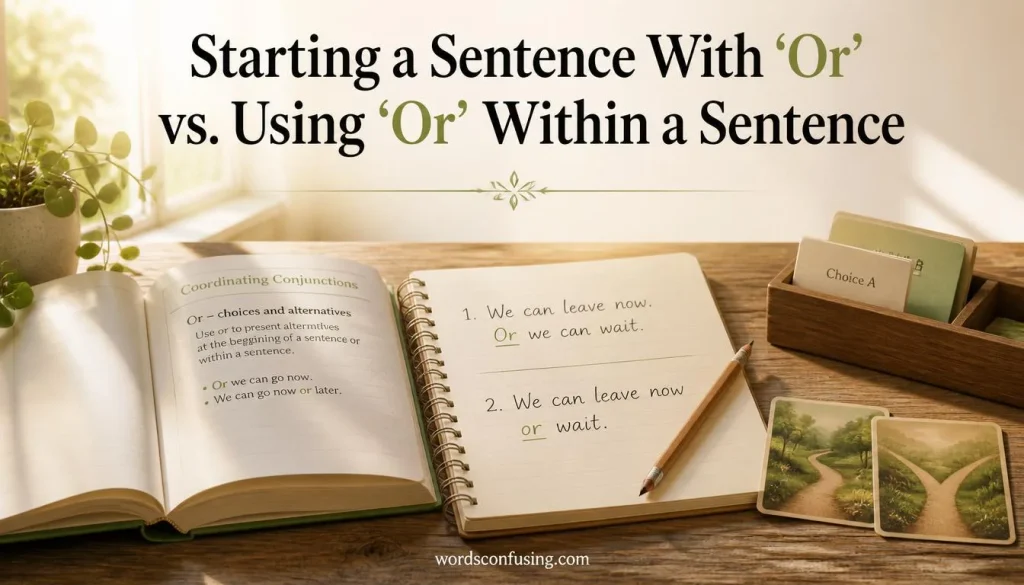
Starting a Sentence With “Or” vs. Using “Or” Within a Sentence
The difference between sentence-initial “or” and “or” within a sentence comes down to structure, emphasis, and flow. Both constructions can be correct, but each serves a slightly different purpose.
Consider the following comparison:
| Sentence structure | Example | Main purpose |
| “Or” at the beginning | We can leave now. Or we can wait until morning. | Emphasizes the second alternative |
| “Or” within a sentence | We can leave now or wait until morning. | Presents both alternatives together |
| “Or” introducing a question | Should we order pizza? Or would you prefer pasta? | Highlights a choice between questions |
| “Or” introducing a warning | Back up your files. Or you could lose important information. | Emphasizes a possible consequence |
When Is It Better to Start With “Or”?
Beginning a sentence with “or” works well when you want to separate alternatives for emphasis. It gives each possibility its own sentence and allows readers to consider the options individually.
For example:
“You can accept the offer today. Or you can take another day to think about it.”
The sentence break creates a slight pause before the second choice. That pause can be useful when the writer wants to emphasize that readers have another option.
When Is It Better to Keep “Or” in the Same Sentence?
Combining alternatives often produces more concise writing. This approach works particularly well when both options are short and closely related.
For example:
“You can accept the offer today or take another day to think about it.”
The sentence communicates the same basic information without the additional pause.
Neither structure is automatically superior. Choose the version that communicates your intended meaning most clearly.
Correct and Incorrect Examples of Starting a Sentence With “Or”
Examples make grammar rules easier to understand because they show how a construction works in real situations. The following sentences demonstrate appropriate usage, common problems, and practical corrections.
Correct Examples of Starting a Sentence With “Or”
Example 1: Presenting two choices
“We could visit the museum this afternoon. Or we could explore the historic district.”
This example works because the second sentence presents a clear alternative to the first. Both sentences contain complete thoughts.
Example 2: Offering another explanation
“The website may be experiencing technical difficulties. Or your internet connection might be unstable.”
The second sentence introduces another possible explanation. The reader understands that either problem could account for the situation.
Example 3: Suggesting another action
“You can send the document by email. Or you can upload it through the company’s website.”
Both options accomplish the same general purpose. Starting the second sentence with “or” makes the alternatives easy to distinguish.
Example 4: Introducing a warning
“Remember to charge your laptop before traveling. Or you might run out of battery during the meeting.”
The second sentence highlights a possible consequence. This structure works naturally in advice and instructions.
Example 5: Creating emphasis
“You can keep waiting for the right moment. Or you can take the first step today.”
The second sentence creates a stronger contrast. This technique can be effective in motivational or persuasive writing.
Example 6: Introducing a question
“Would you like to discuss the proposal now? Or should we schedule another meeting?”
Both questions are complete and closely related. The second question offers a reasonable alternative.
Incorrect or Awkward Examples of Starting a Sentence With “Or”
Not every sentence beginning with “or” works well. Sometimes the construction creates a fragment or leaves the connection between ideas unclear.
Example 1: An incomplete alternative
Incorrect or incomplete in formal prose:
“We can submit the report today. Or before Friday.”
The second part doesn’t clearly state what action should happen before Friday.
Corrected version:
“We can submit the report today. Or we can submit it before Friday.”
The revised version makes the alternative complete.
Example 2: An unclear connection
Awkward example:
“Mark bought a new laptop yesterday. Or the restaurant serves breakfast.”
The two statements have no apparent relationship. The word “or” suggests a connection that the reader cannot identify.
Corrected version:
“Mark bought a new laptop yesterday. The restaurant near his office also serves breakfast.”
If the writer intends to compare unrelated subjects, a new sentence without “or” is more appropriate.
Example 3: Unnecessary sentence separation
Awkward example:
“You can take the train. Or you can drive.”
Both sentences are grammatically acceptable, but the sentence break may be unnecessary in ordinary informational writing.
Smoother version:
“You can take the train or drive.”
However, keep the original construction if you deliberately want to emphasize each choice.
Example 4: Repetition that weakens readability
Awkward example:
“You can call customer service. Or you can send an email. Or you can visit the office.”
Corrected version:
“You can call customer service, send an email, or visit the office.”
The revised sentence presents three alternatives in a more compact form.
These examples reveal an important principle: the presence of “or” at the beginning of a sentence doesn’t determine correctness by itself. Sentence completeness, logical relationships, and readability matter more.
Read more: Yours Faithfully or Yours Sincerely: Which Should You Use?
Can You Start a Sentence With “Or” in Formal or Academic Writing?
Yes, you can start a sentence with “or” in formal or academic writing when the construction suits your argument. Academic writing requires precision and logical organization, but it doesn’t universally prohibit sentence-initial conjunctions.
The main consideration is whether the word accurately expresses the relationship between your ideas.
In Academic Essays
An essay might compare two interpretations of a historical event, literary passage, or scientific observation.
For example:
“The evidence supports the first interpretation of the passage. Or the author may have intended a more symbolic meaning.”
The second sentence offers an alternative interpretation. However, a formal essay might benefit from a more carefully qualified version:
“The evidence supports the first interpretation of the passage. Alternatively, the author may have intended a more symbolic meaning.”
The revised example retains the alternative while adopting a more formal tone.
In Research Papers
Researchers often consider competing explanations when interpreting results. Sentence-initial “or” can introduce another possibility, although technical writing may benefit from explicit transitions.
For example:
“The observed change may reflect differences in sample composition. Or it may result from an unmeasured environmental factor.”
This construction is understandable, but the writer should ensure that the evidence supports both possibilities.
A more formal version would be:
“The observed change may reflect differences in sample composition. Alternatively, it may result from an unmeasured environmental factor.”
Neither version proves that either explanation is correct. The writer must support the interpretation with appropriate evidence.
In Business Reports and Professional Emails
Professional writing should make alternatives easy to understand. Starting a sentence with “or” can work well when presenting options to colleagues or clients.
For example:
“We can schedule the training session for Thursday. Or we can move it to Friday if more employees are available.”
This message is clear and conversational. A more concise version might read:
“We can schedule the training session for Thursday or move it to Friday if more employees are available.”
Choose the version that fits the document’s purpose and the reader’s expectations.
Practical rule: Follow any specific style requirements provided by your instructor, editor, or employer. When no such restriction exists, prioritize grammatical accuracy and clarity over an outdated blanket prohibition.
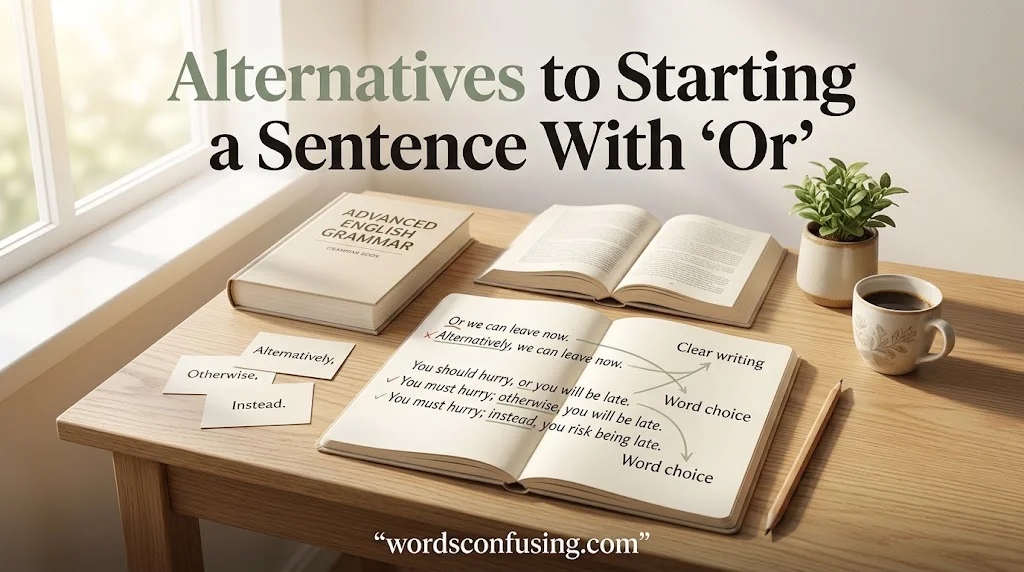
Alternatives to Starting a Sentence With “Or”
Sometimes another word or sentence structure communicates the intended relationship more precisely. Although “or” introduces alternatives, its possible replacements don’t all mean the same thing.
Choose the alternative that matches the relationship between your ideas.
Use “Alternatively” to Introduce Another Option
“Alternatively” is a useful transition in formal, academic, and professional writing. It introduces another possible choice or approach.
Original:
“We could hold the meeting in person. Or we could use a video conference.”
Revised:
“We could hold the meeting in person. Alternatively, we could use a video conference.”
The revised version sounds slightly more formal. Both versions clearly present two options.
Use “alternatively” when you want to emphasize another available approach without relying on a coordinating conjunction.
Use “Otherwise” to Express a Different Outcome
“Otherwise” often introduces what may happen if a particular action isn’t taken. It can communicate a consequence rather than simply present an alternative.
Original:
“Submit the application before the deadline. Or your request may be rejected.”
Revised:
“Submit the application before the deadline. Otherwise, your request may be rejected.”
The second version emphasizes the consequence of missing the deadline.
However, “otherwise” isn’t always interchangeable with “or.” If you’re presenting two equally valid choices, “alternatively” may be more accurate.
Combine the Alternatives Into One Sentence
Combining closely related alternatives is often the simplest solution. It reduces repetition and keeps the reader focused on the available choices.
Original:
“You can contact the support team. Or you can visit the help center.”
Revised:
“You can contact the support team or visit the help center.”
The combined version communicates the same information in fewer words. It works especially well when both options are straightforward.
Rewrite the Sentence for Better Flow
Sometimes the best solution involves restructuring the entire passage rather than replacing “or” with another word.
Original:
“The first product costs less. Or you could purchase the second product because it offers a longer warranty.”
Revised:
“The first product costs less, while the second offers a longer warranty.”
The revised sentence presents the contrast directly. It also helps readers compare the products without unnecessary repetition.
When editing, focus on the intended relationship between the ideas. A clear rewrite usually works better than a longer transition chosen simply to sound formal.
Common Mistakes When Starting a Sentence With “Or”
Even though starting a sentence with “or” is acceptable, writers sometimes misuse the construction. Recognizing these mistakes can help you edit more effectively.
Assuming It Is Always Grammatically Incorrect
The most common misconception is that “or” must never appear at the beginning of a sentence.
That rule is too broad. English allows sentence-initial conjunctions when they serve a clear grammatical and stylistic purpose.
Better approach: Evaluate the complete sentence and its relationship to the surrounding text instead of rejecting it automatically.
Beginning With “Or” Without a Clear Alternative
Readers expect “or” to introduce another possibility. If the previous sentence doesn’t establish an understandable choice, the connection may feel confusing.
Better approach: Make the alternatives explicit or remove “or” if the ideas aren’t related.
Creating Sentence Fragments
A short phrase following “or” may not express a complete thought when used as a standalone sentence.
For example:
“We can leave at noon. Or after dinner.”
Better approach: Add the missing information or combine the phrase with the preceding sentence.
“We can leave at noon or after dinner.”
Adding an Unnecessary Comma
Some writers automatically place a comma after “or” because it appears at the beginning of a sentence.
However, the opening word doesn’t normally require a comma by itself.
Better approach: Use commas according to the sentence’s structure. For example, “Or, if you prefer, we can meet tomorrow” uses commas to set off the interrupting phrase.
Repeating “Or” Too Often
Repeated sentence openings can make a paragraph sound mechanical. They can also weaken the emphasis that makes the construction useful.
Better approach: Combine short alternatives, vary your sentence structures, and reserve sentence-initial “or” for places where it adds clarity or emphasis.
Replacing “Or” With an Inappropriate Transition
Words such as “otherwise,” “alternatively,” and “instead” have different meanings. Substituting one without considering context can change the intended message.
Better approach: Identify whether you are presenting another choice, explaining a consequence, or contrasting two ideas. Then select the transition that expresses that relationship accurately.
FAQs
1. Can you start a sentence with “or” in formal writing?
Yes, you can start a sentence with “or” in formal writing. Use it when you want to introduce another option or connect your point clearly to the previous sentence.
2. Is starting a sentence with “or” grammatically incorrect?
No, starting a sentence with “or” is grammatically acceptable. The key is to make sure the sentence communicates a complete thought and fits naturally into the paragraph.
3. Why do writers begin sentences with “or”?
Writers use “or” at the beginning of a sentence to introduce an alternative, offer another possibility, or present a different outcome. It can also make explanations easier to follow.
4. Should you put a comma after “or” at the beginning of a sentence?
Usually, you don’t need a comma immediately after “or.” For example, “You can call me later. Or you can send me a message.” Add a comma only when the sentence’s structure or meaning requires one.
5. Can you start a question with “or”?
Yes, you can begin a question with “or” when presenting an alternative or asking someone to choose between possibilities. For example: “Or would you prefer to meet tomorrow?”
6. Is it better to start a sentence with “or” or use it in the middle?
Neither position is always better. Use “or” in the middle when connecting alternatives within one sentence. Start a new sentence with “or” when you want to emphasize a separate option or create a natural pause.
Conclusion
Starting a sentence with “or” is perfectly acceptable when it helps your writing sound clear and natural. Whether you’re writing an essay, explaining an idea, or having a casual conversation, this small word can introduce alternatives and connect related thoughts.
The key is to consider your sentence structure, punctuation, and overall flow rather than follow outdated grammar restrictions. Don’t avoid “or” simply because it appears at the beginning of a sentence. Instead, use it thoughtfully to make your writing easier to understand and more engaging for your readers.

Shafiq Ur Rehman is a writer and content contributor at WordsConfusing.com. He enjoys exploring the English language, common word confusions, vocabulary, and practical writing tips. His goal is to make English easier to understand through clear, simple, and useful articles.