
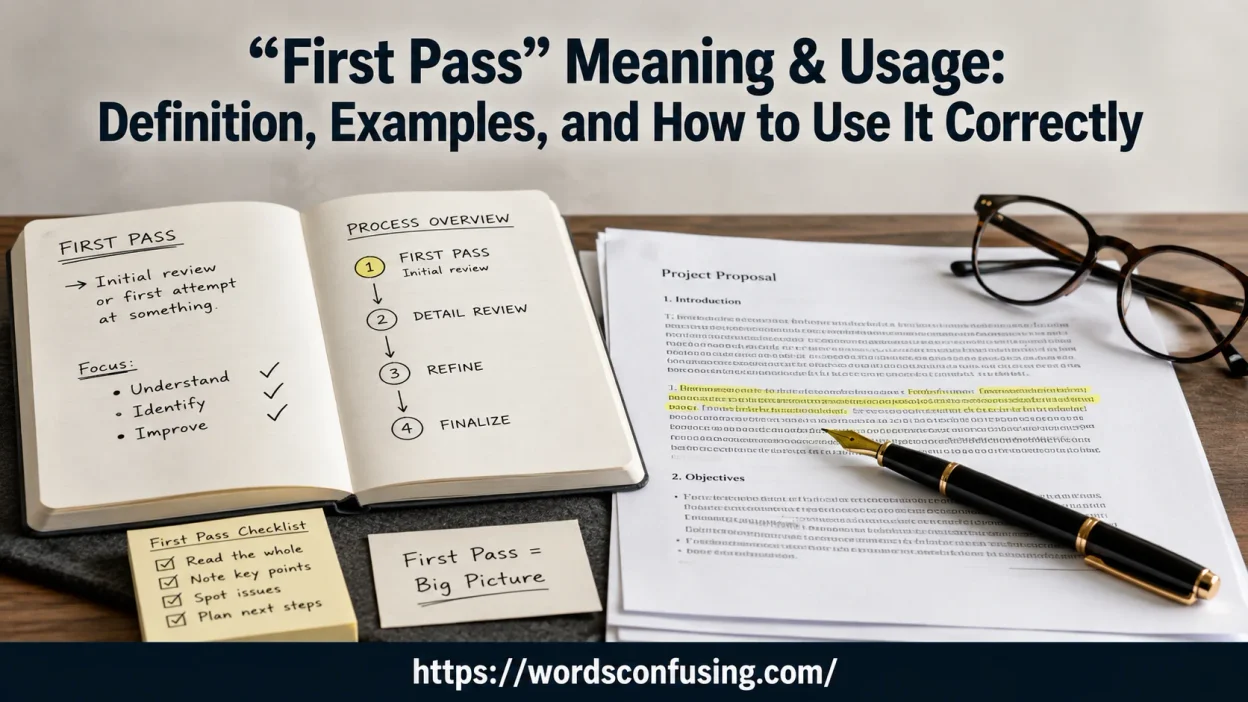
When you’ve heard the term First Pass, its basic meaning is fairly easy to work out from the context; this is the core of “First Pass” Meaning and Usage.
In different contexts, a first pass means an initial analysis or initial review of something before taking more time to examine every detail. Your first impression or first idea may be preliminary, giving you a primary view of the information instead of a complete understanding.
I find this early stage a useful starting point because it helps you understand the work without using too much time.
When you examine something more carefully, your impressions may change, and you can develop a full picture through further review and deeper examination. Your primary analysis isn’t final, so it’s appropriate to see a first pass as a designated stage for forming an early idea of what you need to know.
The meaning becomes clear when you see an initial view as a starting point rather than a complete judgment.
Quick Answer
“First pass” means the first attempt, review, or time you work through something. It usually suggests that you may revise, improve, or review it again later.
Examples:
- “I’ll take a first pass at the report.” → I’ll review or work on it initially.
- “She made a first pass through the document.” → She reviewed it for the first time.
- “This is my first pass at the design.” → This is the initial version or attempt.
In short: First pass means an initial attempt or review before further refinement.
What Does “First Pass” Mean?
The “first pass” meaning is the initial time someone works through, reviews, examines, processes, or attempts something.
The word pass can describe a stage or instance of going through something. When you add first, the phrase identifies the initial stage.
So, depending on context, first pass can mean:
- An initial attempt
- An initial review
- A first examination
- An early analysis
- The first stage of editing
- The first time data moves through a process
- An initial version of a design or plan
The phrase often suggests that more work may follow.
Imagine polishing a rough stone. The first pass removes the obvious rough edges. Later passes can refine the details. In much the same way, a first pass gets the process moving without necessarily representing the final result.
“First Pass” Definition in Simple English
A simple definition is:
First pass = the first time you work through, review, examine, or try something.
Consider these examples:
- “I made a first pass through the report.”
This means I reviewed the report initially. - “She took a first pass at the design.”
This means she made an initial attempt to create or improve the design. - “The first pass revealed several errors.”
This means the initial review found several problems. - “Let’s discuss the results after the first pass.”
This means the discussion will happen after the initial stage.
The phrase doesn’t automatically mean the work is bad. It simply tells you where the work stands in a sequence.
What Does “First Pass” Mean in Different Contexts?
Context gives first pass its precise meaning. The underlying idea stays similar, but the action changes.
“First Pass” as an Initial Attempt
In many situations, first pass means an initial effort to accomplish something.
You might use it when you’re solving a problem, creating a plan, developing a design, or working on a project.
For example:
- “I’ll take a first pass at the budget.”
- “She made a first pass at the presentation.”
- “Let’s take a first pass at solving the issue.”
- “He completed a first pass of the proposal.”
Here, first pass resembles first attempt. However, the two expressions aren’t always interchangeable.
First attempt focuses more strongly on trying to accomplish something. By contrast, a first pass often suggests working through something that may receive additional attention later.
“First Pass” as an Initial Review
Another common first pass meaning involves reviewing information for the first time.
For example:
“I gave the contract a first pass before sending it to the legal team.”
The speaker probably didn’t perform a final legal review. Instead, they examined the document initially and may have identified obvious issues.
You can use this meaning for:
- Contracts
- Reports
- Articles
- Applications
- Research papers
- Financial documents
- Presentations
- Proposals
- Business plans
The phrase works particularly well when multiple rounds of review are expected.
“First Pass” in Editing and Writing
Writers and editors frequently talk about an editing pass.
A first editing pass may focus on major issues such as:
- Organization
- Structure
- Missing information
- Repetition
- Clarity
- Awkward sections
- Logical gaps
- Inconsistent ideas
Later passes might focus on grammar, word choice, punctuation, formatting, and fine details.
For example:
“During my first pass through the article, I noticed that the introduction needed a stronger hook.”
The writer isn’t necessarily proofreading every comma. They’re looking at the article more broadly.
That’s an important distinction. A first pass can be broad rather than microscopic.
“First Pass” in Data and Technology
In technical contexts, first pass can describe the initial stage of processing information.
A system might process a dataset once, identify potential problems, and then process or inspect it again.
For example:
“The first pass through the dataset identified several unusual values.”
The phrase doesn’t necessarily mean someone manually read every row. It can describe a processing stage performed by software, an algorithm, or an analyst.
You might encounter the term in discussions involving:
- Data processing
- Algorithms
- Software development
- Compilers
- Image processing
- Quality control
- Automated analysis
- Information retrieval
In these contexts, pass often carries a more technical sense: one complete stage of processing.
“First Pass” in Business Communication
Workplace communication uses first pass heavily because many projects develop through several rounds.
Consider this email:
“Can you take a first pass at the proposal before Friday?”
The request usually means:
Please review or work on this initially so we have something to discuss or refine.
The expression can sound collaborative because it doesn’t necessarily demand a final product.
Common workplace examples include:
- “I’ll take a first pass at the presentation.”
- “Can you give the numbers a first pass?”
- “Here’s my first pass at the project timeline.”
- “I finished the first pass of the report.”
- “Let’s get a first pass ready for tomorrow.”
This usage is especially common when teams expect feedback and revisions.
What Does “Take a First Pass” Mean?
“Take a first pass” means to make an initial attempt at something or conduct an initial review.
It is one of the most common ways to use the phrase.
The basic pattern is:
take a first pass at + something
Examples:
- “I’ll take a first pass at the article.”
- “Can you take a first pass at these figures?”
- “She took a first pass at the presentation.”
- “We need someone to take a first pass at the proposal.”
The phrase often carries an unstated idea:
“I’ll work on this now, then we can refine it later.”
That’s why it fits naturally into collaborative environments.
What Does “Take a First Pass at” Mean?
“Take a first pass at” means to make an initial effort to work on, solve, review, or improve something.
For example:
“I’ll take a first pass at the introduction.”
This doesn’t necessarily mean:
“I’ll write the final introduction.”
Instead, it usually means:
“I’ll work on it initially and create a starting point.”
That distinction matters when interpreting workplace requests.
“First Pass” vs. “First Attempt”
Although these expressions overlap, they carry different shades of meaning.
| Expression | Main meaning | Typical emphasis |
| First pass | Initial stage of working through something | Review, processing, refinement |
| First attempt | First effort to accomplish something | Trying or succeeding |
| First try | First effort | Casual conversation |
Consider these examples:
“My first attempt to fix the printer failed.”
The sentence emphasizes whether the attempt succeeded.
Now compare:
“I took a first pass at fixing the printer.”
This sounds more like an initial effort that may lead to further troubleshooting.
First pass often fits iterative work better.
If you expect several rounds, the phrase feels especially natural.
“First Pass” vs. “First Draft”
These expressions sometimes overlap in writing, but they aren’t identical.
A first draft is an initial version of a written or creative work.
A first pass refers to an initial stage of work. That work might involve writing, reviewing, analyzing, designing, or processing.
| First pass | First draft |
| Broad initial stage | Initial version |
| Works in many fields | Mainly writing and creative work |
| Can describe reviewing | Represents created content |
| May involve analysis | Usually contains the first complete version |
| Doesn’t require writing | Normally involves writing or creative production |
For example:
“I finished the first draft of the article.”
This tells you that an initial version of the article exists.
Meanwhile:
“I took a first pass at the article.”
This could mean the writer drafted it, edited it, reorganized it, or reviewed it.
A first draft is more specific, while a first pass is broader.
“First Pass” vs. “First Look”
A first look usually means an initial examination.
A first pass can also mean an initial examination, but it often suggests more active engagement.
Compare:
“I took a first look at the report.”
This sounds like an initial inspection.
“I took a first pass at the report.”
This suggests that the person did something more substantial with it. They may have reviewed, edited, analyzed, or worked through the material.
Here’s the distinction in a nutshell:
| Phrase | What it emphasizes |
| First look | Initial viewing |
| First pass | Initial work or examination |
| First review | Initial evaluation |
| First attempt | Initial effort |
These distinctions aren’t absolute. Natural English depends heavily on context.
“First Pass” vs. “First Impression”
These expressions describe completely different things.
A first impression is the initial feeling, judgment, or opinion you form about someone or something.
A first pass is an initial stage of working through something.
Compare:
“My first impression of the company was positive.”
This describes an opinion.
“My first pass through the company’s annual report was positive.”
This describes an initial review.
The easiest rule is:
First impression = what you think initially.
First pass = what you do initially.
Read more: The Smiths or The Smiths’ or The Smiths’s: Which Is Correct?
Which Preposition Goes With “First Pass”?
Prepositions can change the structure and emphasis of the phrase. The most useful constructions are first pass at and first pass through.
“First Pass At”
First pass at commonly describes an initial attempt or effort.
Examples:
- “This is my first pass at the article.”
- “She took a first pass at the proposal.”
- “Let’s make a first pass at the problem.”
- “Here’s my first pass at the schedule.”
This construction works particularly well when you’re creating, solving, revising, or attempting something.
“First Pass Through”
First pass through emphasizes moving through material or reviewing it from beginning to end.
Examples:
- “I made a first pass through the manuscript.”
- “The first pass through the data revealed several errors.”
- “After my first pass through the report, I had a few questions.”
The word through creates a stronger sense of progression from one part of something to another.
“First Pass On”
You may also encounter first pass on in informal or professional communication.
For example:
“Can you give me your first pass on these numbers?”
However, first pass at is often clearer when describing an attempt.
The best choice depends on what you want to emphasize.
“First Pass Of”
You may encounter first pass of when first pass refers to a particular stage or instance of a process.
For example:
“The first pass of the inspection found several defects.”
Still, the most natural construction varies according to the noun and the surrounding sentence. Don’t force one preposition into every context.
Is “First Pass” Hyphenated?
Usually, first pass appears as two separate words when it functions as a noun phrase.
For example:
- “I finished the first pass.”
- “The first pass revealed three problems.”
- “She completed a first pass through the document.”
However, a hyphen can appear when the phrase works as a compound modifier before another noun.
For example:
- “a first-pass review”
- “a first-pass analysis”
- “a first-pass assessment”
The difference becomes easier to see in a sentence:
“We completed the first pass.”
Here, first pass functions as a noun phrase.
Now consider:
“We completed a first-pass analysis.”
Here, first-pass modifies analysis.
Quick Hyphenation Rule
| Use | Example |
| Noun phrase | “The first pass was helpful.” |
| Compound modifier | “The first-pass review found several issues.” |
Style guides can differ in how they handle compound modifiers. When the meaning remains clear, consistency matters most within the document.
Does “First Pass” Mean the Work Isn’t Finished?
Usually, yes in the sense that additional work may follow. However, it doesn’t necessarily mean the work is incomplete.
This subtle difference matters.
Suppose someone says:
“Here’s my first pass at the marketing plan.”
The person has probably completed an initial version. They may still expect feedback, revisions, or another review.
The phrase describes the stage, not the quality.
A first pass can be:
- Carefully researched
- Highly polished
- Rough
- Experimental
- Nearly complete
- Very preliminary
Nothing about the expression itself guarantees the quality.
Think of it like painting a wall. The first coat covers the surface. A second coat may improve the finish. Calling something a first pass simply tells you that the process may continue.
“First Pass” in a Sentence
Understanding the grammatical role makes the phrase easier to use naturally.
As the Subject
“The first pass revealed several inconsistencies.”
Here, first pass performs the grammatical role of subject.
As the Object
“I finished the first pass.”
Here, first pass receives the action of finished.
After a Preposition
“After the first pass, we revised the document.”
Here, the phrase follows after.
With “At First Pass”
You may also encounter:
“At first pass, the proposal seems reasonable.”
This means based on an initial examination.
It resembles phrases such as:
- At first glance
- On first review
- Initially
- At first examination
However, these alternatives don’t always carry exactly the same tone.
Common Verbs Used With “First Pass”
Several verbs pair naturally with first pass.
| Verb | Example |
| Take | “I’ll take a first pass at it.” |
| Make | “We made a first pass through the data.” |
| Give | “Give the document a first pass.” |
| Complete | “She completed the first pass.” |
| Finish | “I finished the first pass yesterday.” |
| Review | “Let’s review the first pass.” |
| Perform | “The system performs a first pass.” |
Among these, take a first pass is particularly common in workplace communication.
Real-World Examples of “First Pass”
Seeing the expression in different situations makes its meaning much easier to recognize.
Writing Example
“I’ll take a first pass at the introduction tonight.”
The writer plans to create or revise an initial version.
Editing Example
“My first pass through the manuscript revealed several weak transitions.”
The editor reviewed the manuscript initially and noticed structural problems.
Business Example
“Can you take a first pass at the proposal before our meeting?”
The speaker wants an initial review before the group discusses it.
Design Example
“This is our first pass at the new website layout.”
The design represents an early version that may receive further revisions.
Data Analysis Example
“The first pass through the dataset highlighted several unusual entries.”
The initial processing or examination produced useful findings.
Research Example
“My first pass through the sources suggests three major themes.”
The researcher reviewed the sources initially and identified recurring ideas.
Planning Example
“Here’s my first pass at next month’s schedule.”
The speaker has created an initial schedule that may change after feedback.
Problem-Solving Example
“Let’s take a first pass at the issue before we bring in the engineering team.”
The group wants to investigate the problem initially before escalating it.
A Practical Case Study: Using “First Pass” at Work
Imagine a marketing team preparing a campaign for a new product.
The team leader asks:
“Can you take a first pass at the campaign brief?”
A new employee might interpret that as a request for a final document. In many workplaces, that’s not what the phrase implies.
The team leader probably wants the employee to:
- Read the available information.
- Identify the main audience.
- Draft initial messaging.
- Organize the key campaign ideas.
- Flag obvious gaps.
- Create something the team can discuss.
After that first pass, the team may provide feedback.
The employee could then produce a second version.
Why the Phrase Works
The expression gives the task a defined but flexible scope.
Instead of saying:
“Finish the campaign brief.”
the manager says:
“Take a first pass at the campaign brief.”
The second version leaves room for collaboration.
That’s one reason the phrase appears so often in professional communication.
Another Case Study: Editing an Article
Suppose an editor receives a 3,000-word article.
During the first pass, the editor might look for:
- Weak organization
- Repeated ideas
- Missing explanations
- Unsupported claims
- Unclear transitions
- Sections that need expansion
- Information that doesn’t belong
The editor may not worry about every punctuation mark yet.
During a later pass, the focus could shift toward:
- Grammar
- Spelling
- Sentence rhythm
- Word choice
- Formatting
- Style consistency
This example demonstrates an important feature of the first pass meaning:
The first pass often handles the biggest issues before smaller details.
Common Mistakes With “First Pass”
The phrase is straightforward once you understand its core meaning. Still, several misunderstandings appear frequently.
Treating “First Pass” as “First Impression”
These aren’t interchangeable.
Incorrect interpretation:
“My first pass of the restaurant was excellent.”
If you mean your initial opinion, first impression would usually be more appropriate.
Better:
“My first impression of the restaurant was excellent.”
Use first pass when you’re describing an action, review, attempt, or process.
Assuming “First Pass” Always Means “First Attempt”
Sometimes it does. Sometimes it means an initial review.
For example:
“I made a first pass through the report.”
This usually means reviewed, not attempted to create the report.
Context determines the meaning.
Confusing “First Pass” With “First Draft”
A first draft must generally be a version of written or creative work.
A first pass can involve:
- Writing
- Reviewing
- Analyzing
- Designing
- Processing
- Planning
- Problem-solving
That’s why first pass has a wider meaning.
Assuming a First Pass Is Poor Quality
The phrase doesn’t mean bad, rough, or unfinished.
It simply identifies the first stage.
A first pass can be excellent. It may even require only minor changes afterward.
Using “At First Pass” Everywhere
Although at first pass is valid in certain contexts, don’t automatically replace more natural expressions such as at first glance or on first review.
For example:
“At first glance, the design looks clean.”
This sounds more natural when you’re describing an immediate visual impression.
Synonyms for “First Pass”
There isn’t one perfect synonym because first pass has several meanings.
Choose an alternative according to the context.
| Meaning | Useful alternative |
| Initial attempt | First attempt |
| Initial effort | First try |
| Initial examination | First review |
| Initial viewing | First look |
| Early written version | First draft |
| Initial analysis | Preliminary analysis |
| Early evaluation | Preliminary assessment |
| Initial stage | Starting stage |
| Quick examination | Initial review |
Be careful with direct substitution.
For instance, replacing first pass with first draft can change the meaning substantially.
How to Choose the Right Expression
When you’re unsure which phrase fits, ask yourself one simple question:
What exactly am I describing?
Are you describing an initial stage of work?
↓
Yes
↓
“First pass” may fit
↓
Are you describing a written version?
↙ ↘
Yes No
↓ ↓
“First draft” “First pass” may fit
↓
Are you describing an initial opinion?
↓
“First impression”
You can also use this quick guide:
- First pass → initial work, review, processing, or attempt
- First attempt → first effort to accomplish something
- First draft → first written version
- First look → initial examination
- First impression → initial opinion or feeling
- First review → initial evaluation
The right expression depends less on grammar than on what you actually want to communicate.
“First Pass” Meaning for English Learners
For English learners, the phrase can look confusing because pass has many meanings.
You might know pass as:
- Moving beyond something
- Giving something to another person
- Succeeding in an examination
- Traveling past a place
- A permit or ticket
- A stage of reviewing or processing
In first pass, the relevant meaning involves going through something once as part of a process.
That’s why these sentences make sense:
“I made a first pass through the document.”
“I’ll take a first pass at the problem.”
The person isn’t physically passing an object. They’re working through something during an initial stage.
A useful mental shortcut is:
First pass = first time through.
That simple idea will help you understand most uses of the phrase.
Is “First Pass” Formal or Informal?
First pass works in both professional and conversational settings.
It’s particularly common in workplace, technical, academic, and creative environments.
Professional Example
“I’ll take a first pass at the financial report.”
Casual Example
“Let me take a first pass at fixing this.”
Academic Example
“The first pass through the literature revealed several recurring themes.”
Technical Example
“The algorithm performs a first pass over the dataset.”
The phrase doesn’t sound excessively formal. It feels natural when the situation involves iteration or multiple stages.
Why “First Pass” Is Useful in Professional Writing
The phrase communicates something subtle that simpler alternatives sometimes miss.
Suppose you tell a colleague:
“I’ll review the proposal.”
That could mean you’ll perform a complete review.
Now say:
“I’ll take a first pass at the proposal.”
This signals that you’re doing an initial review, not necessarily the final one.
That distinction helps teams set expectations.
It can communicate:
- Progress
- Collaboration
- Flexibility
- An initial scope of work
- A willingness to refine the result
- The possibility of future feedback
In project-based work, those details matter.
“First Pass” Examples You Can Reuse
Here are natural examples across several contexts:
For writing:
“Here’s my first pass at the article introduction.”
For editing:
“I finished my first pass through the manuscript.”
For business:
“I’ll take a first pass at the proposal before lunch.”
For research:
“The first pass through the literature revealed several patterns.”
For design:
“This is our first pass at the new logo concept.”
For planning:
“I’ve created a first pass at the project timeline.”
For data:
“The first pass through the dataset exposed several anomalies.”
For troubleshooting:
“Let’s take a first pass at the problem before changing the system.”
For collaboration:
“Can you give this document a first pass?”
For evaluation:
“At first pass, the numbers appear consistent.”
FAQs
1. What does “First Pass” mean?
“First Pass” means an initial review, analysis, or attempt at something. It gives you a basic understanding before you look at every detail.
2. Is “First Pass” the same as a final review?
No. A first pass is usually preliminary. You may find errors, add information, or change your opinion during a deeper review.
3. How do you use “First Pass” in a sentence?
You can say, “I’ll give the report a first pass today.” This means you’ll review it quickly to understand the main points before examining it closely.
4. Is “First Pass” formal or informal?
“First Pass” is commonly used in professional and everyday contexts. You’ll often see it in writing, editing, research, software development, and workplace discussions.
5. Can “First Pass” refer to an attempt?
Yes. It can describe an initial attempt as well as an initial review. For example, a writer might create a first pass of an article before revising it.
6. What is the difference between a “First Pass” and a detailed review?
A first pass focuses on the overall picture, while a detailed review examines specific points, errors, and finer details.
Conclusion
A first pass is your first look, review, or attempt at something before you go deeper. It gives you a quick sense of the main idea without requiring you to understand every detail right away. Your first impression may change as you learn more, and that’s completely normal.
Whether you’re reviewing a document, checking your work, studying an idea, or examining information, a first pass gives you a useful starting point. Once you’ve made that initial review, you can return to the details, make changes, and develop a much clearer and more complete understanding.