What Are People From India Called? People from India are called Indians, a common demonym that reflects their nationality and place of origin.
The word Indians describes Indian people collectively, but using an individual name is often the most respectful address. India has diverse regional names that reflect geographic identity, cultural identity, and regional identity.
For example, people from Goa are called Goans, while people from Bangalore are often called Bangaloreans. These terms identify a specific region within the country and highlight its regional differences and cultural diversity.
Understanding these names helps you describe people from India accurately while respecting their identity and background.
Quick Answer
People from India are called Indians. However, India’s diverse population includes many regional and cultural identities, such as Punjabis, Tamils, Bengalis, and Gujaratis. The word Indian describes nationality or connection to India, while terms like Hindu refer to religion.
What Do You Call a Person From India?
The correct English word for a person from India is Indian. This word is known as a demonym, which means a name used for people who come from a particular place.
For example, people from Pakistan are called Pakistanis, people from Japan are called Japanese, and people from India are called Indians.
You can use Indian as both a noun and an adjective. The correct form depends on how you construct your sentence.
Examples of How to Use Indian
Here are some natural examples that show how the word works in everyday English.
- As a noun: She is an Indian.
- As an adjective: He is an Indian student.
- To describe nationality: My friend is Indian.
- To describe culture: We enjoyed Indian music.
- To describe citizenship: She holds Indian citizenship.
- To describe a group: The Indians arrived for the cultural event.
Notice that Indian doesn’t always describe a person’s nationality. In phrases such as Indian food or Indian literature, it describes a connection to the country’s culture or traditions.
The plural form is Indians. You can use it when talking about people from India as a group.
For instance, the sentence “Many Indians celebrate Diwali” refers to people from India who celebrate the festival. It doesn’t mean every Indian celebrates it.
Is Indian the Same as India?
No. India is the name of the country, while Indian describes a person or something associated with that country.
| Word | Meaning | Example |
| India | The country | India is in South Asia. |
| Indian | A person or something connected to India | My neighbor is Indian. |
| Indians | The plural form of Indian | Many Indians speak multiple languages. |
| Indian citizenship | Legal membership in the Indian state | He has Indian citizenship. |
Knowing the difference makes it easier to write clearly and speak naturally.

Is Indian a Nationality or an Ethnicity?
The word Indian can describe nationality, ancestry, or cultural identity. However, these meanings aren’t interchangeable in every situation.
Nationality usually refers to a person’s legal connection to a country, often through citizenship. Ethnicity, on the other hand, relates to shared cultural traditions, ancestry, language, history, or community identity.
A person can have Indian ancestry without being an Indian citizen. Similarly, someone who holds Indian citizenship may come from a community with its own distinct language and cultural traditions.
Indian Nationality Explained
Indian nationality generally refers to a person’s national connection to India. In legal contexts, citizenship determines whether someone is an Indian citizen.
For example, someone born and raised in Mumbai who holds Indian citizenship can accurately describe themselves as Indian.
However, a person born in Canada to Indian parents may be a Canadian citizen of Indian ancestry. Their family background is Indian, but their nationality may be Canadian.
The distinction matters because ancestry doesn’t automatically determine citizenship.
Indian Ethnicity and Cultural Identity
India is home to many ethnic, linguistic, and cultural communities. People may identify with their state, language, ancestral community, or regional traditions.
For example, a person may describe themselves as Tamil, Bengali, Punjabi, Gujarati, or Malayali. These identities can coexist with Indian nationality.
Consider a family whose grandparents moved from India to the United Kingdom several decades ago. Their descendants may identify as British, British Indian, Punjabi, or another community identity, depending on their citizenship and personal background.
There isn’t one identity label that fits every person of Indian ancestry. The most accurate description depends on the individual and the context.
Read more: Womans or Woman’s or Womens’: Which is Correct?
What Is the Difference Between Indian, Hindu, and Asian?
Indian, Hindu, and Asian are different terms. Although they sometimes overlap, each describes a different aspect of identity.
| Term | What It Means | Example |
| Indian | A person from India or someone of Indian origin, depending on context | An Indian citizen living in Delhi |
| Hindu | A person who follows Hinduism | A Hindu living in India or another country |
| Asian | A person associated with Asia through nationality, origin, or cultural background | A person from India, China, or South Korea |
The easiest way to remember the difference is to think about country, religion, and continent.
- Indian generally relates to a country or national identity.
- Hindu relates to a religion.
- Asian relates to a broad geographical region and its many populations.
These terms aren’t mutually exclusive. Someone can be Indian, Hindu, and Asian at the same time.
Are All Indians Hindu?
No. India has a diverse religious population that includes Hindus, Muslims, Christians, Sikhs, Buddhists, Jains, and people who follow other beliefs or identify with no religion.
Hinduism is the country’s largest religious tradition, but it doesn’t represent every Indian.
For example, an Indian Muslim is Indian by nationality and Muslim by religion. An Indian Sikh may identify with both Indian nationality and Sikh religious and cultural traditions.
The same principle applies to people living outside India. A Hindu person may hold British, Canadian, American, or another nationality.
Nationality doesn’t determine religion. These terms describe different aspects of a person’s identity.
Are All Indians Asian?
India is geographically located in South Asia, so Indians are generally considered South Asian.
The broader term Asian includes people from South Asia, East Asia, Southeast Asia, Central Asia, and other parts of the continent, depending on the geographical classification.
For instance, Indians, Chinese, Japanese, Pakistanis, and Indonesians can all be described as Asian, although their nationalities and cultural backgrounds differ.
In some countries, such as the United States and the United Kingdom, people may use regional labels differently in everyday conversation or official statistics. When precision matters, naming the person’s country or specific background can prevent confusion.
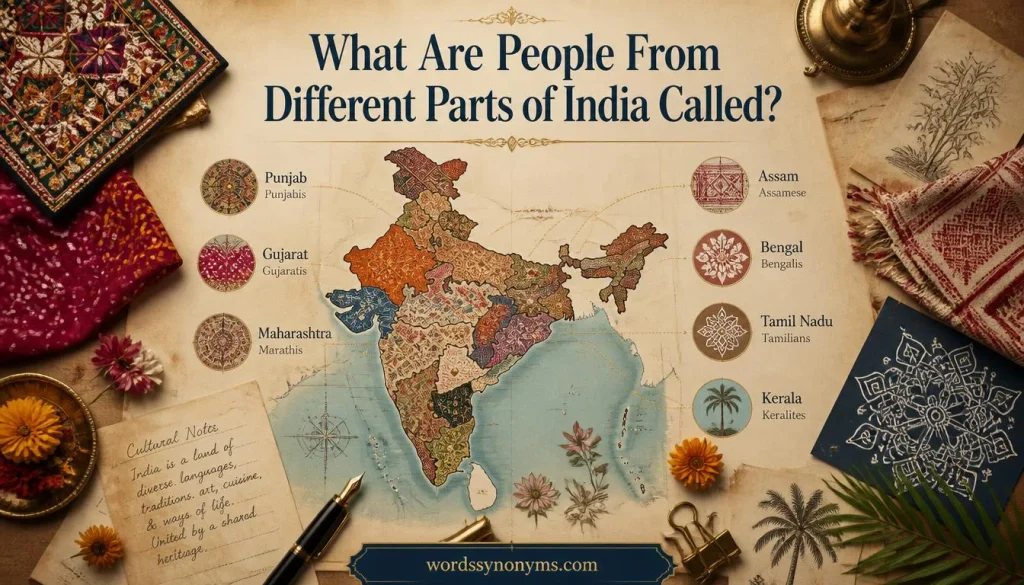
What Are People From Different Parts of India Called?
India has many states and regional communities, each with its own cultural history, languages, and traditions.
People often use regional identities alongside their Indian nationality. These terms can refer to a person’s place of origin, language, culture, or community.
Here are several common examples.
| State or Region | Common Regional Identity | Associated Language or Identity |
| Punjab | Punjabi | Punjabi |
| Gujarat | Gujarati | Gujarati |
| Maharashtra | Maharashtrian | Marathi |
| Kerala | Malayali | Malayalam |
| Tamil Nadu | Tamil | Tamil |
| West Bengal | Bengali | Bengali |
| Assam | Assamese | Assamese |
| Karnataka | Kannadiga | Kannada |
| Andhra Pradesh | Telugu or Andhra person, depending on context | Telugu |
| Odisha | Odia | Odia |
These terms aren’t all formed in the same way. Some refer to a language, while others describe a regional or cultural identity.
For example, Tamil can describe a language or a cultural identity. Maharashtrian generally describes someone connected to Maharashtra, while Marathi can refer to the language or its associated cultural community.
A person may also have family roots in one state while living in another. Therefore, you shouldn’t assume someone’s regional identity solely from their current address.
Why Do Regional Identities Matter?
Regional identities help explain India’s cultural diversity. Food, clothing, festivals, music, and everyday customs can vary considerably across the country.
For example, a Punjabi family may have traditions associated with Punjab, while a Tamil family may celebrate festivals and maintain customs connected to Tamil culture.
These differences don’t make either group less Indian. They show how a shared national identity can include many distinct communities.
Regional labels are most useful when the specific background is relevant and known. If you don’t know someone’s regional identity, Indian remains the appropriate general term for someone from India.
What Languages Do People in India Speak?
India is one of the world’s most linguistically diverse countries. People speak hundreds of languages and varieties, and many individuals use more than one language in daily life.
Hindi is widely spoken, but it isn’t everyone’s first language. Depending on where someone lives, they may speak Bengali, Tamil, Telugu, Marathi, Gujarati, Punjabi, Malayalam, Kannada, Urdu, or another language.
The Indian Constitution’s Eighth Schedule recognizes 22 languages. This constitutional list demonstrates India’s linguistic diversity, although it doesn’t include every language spoken throughout the country.
Major Languages Spoken in India
| Language | Common Regional Association |
| Hindi | Northern and central India, among other regions |
| Bengali | West Bengal and parts of eastern India |
| Telugu | Andhra Pradesh and Telangana |
| Marathi | Maharashtra |
| Tamil | Tamil Nadu and parts of southern India |
| Gujarati | Gujarat |
| Urdu | Communities across several Indian states |
| Kannada | Karnataka |
| Malayalam | Kerala |
| Punjabi | Punjab |
| Odia | Odisha |
| Assamese | Assam |
These associations are general rather than exclusive. Speakers of these languages also live in other Indian states and abroad.
Do All Indians Speak Hindi?
No. India’s linguistic landscape is far more complex than that.
A person from Chennai may speak Tamil as their first language, while someone from Kolkata may primarily speak Bengali. Someone from Hyderabad may speak Telugu, Urdu, Hindi, or several languages, depending on their family and community.
English also plays an important role in education, business, administration, and communication between people who speak different first languages.
For example, two Indian professionals from different states might use English to communicate at work even though each speaks a different language at home.
This diversity is one reason it’s inaccurate to assume that all Indians share one mother tongue.
Indian nationality doesn’t determine a person’s language. Regional background, family history, education, and personal circumstances all influence which languages someone speaks.
Interesting Facts About People From India
The word Indian has a straightforward meaning, but the people it describes come from a remarkably diverse country. These facts help explain the wider context behind the term.
Indian Is a Demonym
A demonym is a word that identifies people by their place of origin or association.
For example:
- India — Indian
- Pakistan — Pakistani
- Canada — Canadian
- Japan — Japanese
- Australia — Australian
- Brazil — Brazilian
- Egypt — Egyptian
Demonyms make it easier to discuss nationalities without repeating a country’s name in every sentence.
For example, instead of saying “people from India are attending the event,” you can say “Indians are attending the event.”
However, the appropriate word can depend on context. Some countries have more than one commonly used identity label, and individual preferences deserve consideration.
India Has Enormous Cultural Diversity
India includes communities with different languages, religious traditions, cuisines, art forms, and regional histories.
In northern India, some communities are known for food traditions featuring wheat-based breads and dishes such as chole bhature. In southern India, foods such as idli, dosa, and sambar are widely associated with regional cuisines.
Western India includes distinctive Gujarati and Maharashtrian food traditions, while eastern India has well-known Bengali and Odia culinary traditions.
These examples illustrate regional variety rather than fixed rules. People move between states, families adopt different customs, and individual preferences vary.
The same diversity appears in clothing, music, architecture, literature, and celebrations.
There is no single lifestyle that represents every Indian. National identity can connect people whose everyday experiences differ considerably.
Indian Communities Live Around the World
People of Indian origin live in countries across the globe. Some moved abroad themselves, while others belong to families whose migration began generations ago.
Large Indian-origin communities exist in countries such as the United States, Canada, the United Kingdom, the United Arab Emirates, Singapore, and Australia.
The term Indian diaspora generally describes people of Indian origin living outside India, along with the communities they form.
However, the term doesn’t automatically mean that everyone in the diaspora holds Indian citizenship.
For example, a person born in London to Indian-origin parents may be a British citizen. They might describe themselves as British Indian, British, Indian by heritage, or another identity that reflects their background.
Similarly, a person who moves from India to Canada may retain Indian citizenship or later acquire Canadian citizenship, depending on their circumstances and applicable laws.
When discussing people abroad, distinguish nationality, citizenship, ancestry, and cultural identity rather than treating them as identical.
India Is Also Known as Bharat
India’s constitutional naming tradition includes both India and Bharat.
Article 1 of the Constitution of India states, “India, that is Bharat, shall be a Union of States.”
The names reflect the country’s official constitutional wording and historical naming traditions. India is widely used in English, while Bharat is commonly used in several Indian languages and cultural contexts.
The name of the country doesn’t change the standard English demonym. People from India are still commonly called Indians in English.
Indian Identity Can Include Several Layers
A person’s identity isn’t always limited to one label. Someone may identify through nationality, religion, language, regional origin, ancestry, or family traditions.
For example, a person might be an Indian citizen, a Punjabi speaker, a Sikh, and a resident of Mumbai. Each description provides different information.
Another person might be a British citizen of Tamil ancestry who speaks English and Tamil. That person’s nationality and heritage can both matter, depending on the conversation.
These identities don’t have to compete with one another. They can describe different parts of the same person’s life.

What Is the Correct Way to Use the Word Indian?
Using Indian correctly is simple once you understand whether you’re discussing a person, a nationality, or something associated with India.
The word works naturally in many everyday situations.
Examples of Indian in Sentences
- Nationality: “My new classmate is Indian.”
- Citizenship: “She holds Indian citizenship.”
- Culture: “We watched an Indian classical dance performance.”
- Food: “They served Indian food at the festival.”
- Language: “He studies Indian languages.”
- History: “The museum features Indian history and art.”
- Travel: “We visited several cities in India.”
Each example uses the same word differently. In some sentences, it describes a person’s background. In others, it describes a cultural or geographical connection.
Should You Say Indian People or People From India?
Both expressions are correct.
Indian people is concise and natural in most conversations. People from India is equally clear and can be especially useful when explaining nationalities to English learners.
For example:
- “Indian people speak many different languages.”
- “People from India come from many regional and cultural backgrounds.”
Neither phrase suggests that everyone in India shares the same beliefs or customs.
When you know the person’s preferred identity, you can use a more specific term. Otherwise, the general term Indian is usually sufficient.
Is It Correct to Say an Indian Person?
Yes. An Indian person is grammatically correct and often sounds natural.
You can also say “an Indian student,” “an Indian citizen,” or “an Indian family.”
The choice depends on the sentence and the information you want to emphasize.
For example, “an Indian citizen” focuses on citizenship, while “a person of Indian descent” emphasizes ancestry. The expressions may describe the same person in some circumstances, but they don’t always mean the same thing.
A Note About Indigenous Peoples
The word Indian can have other meanings in different contexts, particularly when discussing Indigenous peoples of the Americas.
In the United States, some Indigenous people and communities use terms such as Indigenous peoples of America, while others prefer Native American, Indigenous, or their specific tribal or nation name.
These terms shouldn’t be confused with the demonym Indian for people from India. Context usually makes the intended meaning clear, but using a more specific term can prevent misunderstanding.
Read more: 5 Words for Someone Who Plays the Victim
Common Mistakes When Describing People From India
Although the basic answer is simple, a few common assumptions can lead to inaccurate descriptions.
Assuming Every Indian Speaks Hindi
Hindi is widely spoken, but India has many other major languages and numerous additional linguistic communities.
It’s better to ask which language someone speaks than to assume based on nationality.
Assuming Every Indian Follows Hinduism
India has several major religious communities and people with many different beliefs. Indian nationality doesn’t automatically tell you someone’s religion.
If religion is relevant, use the person’s stated identity rather than making assumptions.
Confusing Indian Ancestry With Indian Citizenship
A person may have Indian parents or grandparents while holding another country’s citizenship.
Use Indian citizen when referring specifically to citizenship. Use Indian origin or Indian descent when ancestry is the intended meaning.
Treating India as One Uniform Culture
India’s states and communities have distinct histories, languages, and customs. A tradition common in one region may be unfamiliar in another.
Avoid describing a regional practice as something every Indian follows.
Using Regional Labels Without Knowing the Person’s Background
Terms such as Punjabi, Bengali, Tamil, and Gujarati can communicate useful information, but you shouldn’t guess someone’s regional identity from their appearance or surname alone.
When the detail matters, asking respectfully is more accurate than making an assumption.
FAQs
1. What are people from India called?
People from India are called Indians. The term describes their nationality and is commonly used around the world.
2. Is Indian the correct term for someone from India?
Yes, Indian is the correct general term for someone from India. You can use it when talking about a person’s nationality or background.
3. What do you call someone from Goa, India?
Someone from Goa is commonly called a Goan. The term identifies a person from this coastal state in western India.
4. What are people from Bangalore called?
People from Bangalore are commonly called Bangaloreans. The term refers to people associated with the city, which is also known as Bengaluru.
5. Is Indian a nationality or an ethnicity?
Indian is primarily a nationality, meaning a person is from India or holds Indian citizenship. India also has many ethnic, linguistic, and cultural communities, so not every Indian shares the same ethnic background.
6. Should you call someone Indian or use their regional identity?
Indian is appropriate when referring to someone’s nationality. If you know their regional background, you can use a more specific term, such as Goan, when relevant. When addressing someone directly, using their name is often the most natural and respectful choice.
Conclusion
People from India are commonly called Indians, a term that reflects their nationality and connection to the country. However, India is home to many languages, traditions, and regional identities, so people may also use more specific names to describe where someone comes from. For example, people from Goa are called Goans, while people from Bangalore are often called Bangaloreans.
Knowing these differences helps you describe people accurately and respectfully. The word Indian works well when you’re talking about someone’s nationality, while a regional term can provide more detail about their background. Still, it’s important to remember that not every person from India shares the same culture, language, or traditions. When speaking to someone directly, using their name or asking how they prefer to be identified is always a thoughtful approach.

Franklin Hayes is a writer and editor at WordsConfusing.com, focused on making English vocabulary, grammar, and commonly confused words easy to understand. He writes clear, practical articles with simple explanations and useful examples to help readers improve their English with confidence.
His goal is simple: Making Confusing Words Simple.