

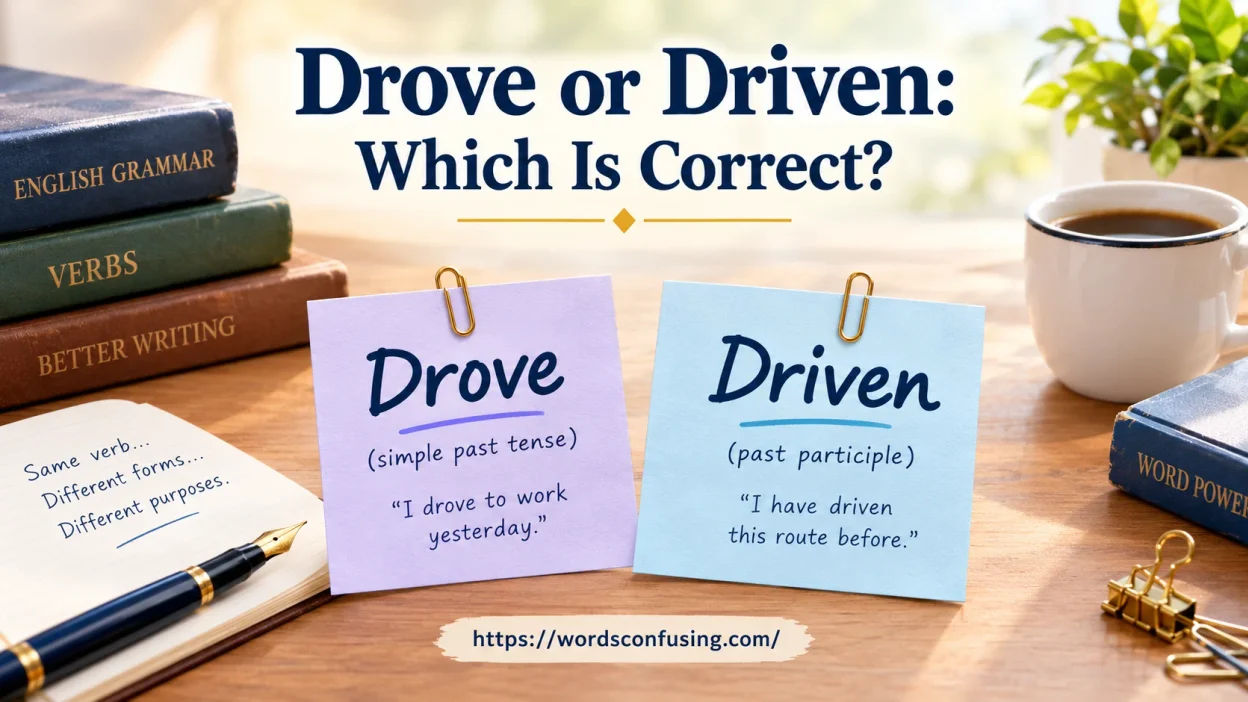
The difference between drove and driven becomes clear when you understand the verb forms of drive. In English grammar, drive is the base form, drove is the simple past, and driven is the past participle.
These principal parts, called V1, V2, and V3, belong to irregular verbs because they don’t follow the usual -ed pattern. Similar verb changes occur in ate and eaten or bit and bitten. Learning these forms through pattern recognition, memorization, and regular practice improves your language skills and grammar confidence.
The correct verb choice depends on context and grammatical tense. Use drove for completed past actions, such as “I drove yesterday.” Use driven with auxiliary verbs like have, has, and had, as in “I have driven before.” Expressions like “have drove” contain incorrect grammar and break standard grammar rules.
Understanding the simple past tense, present perfect tense, and past perfect tense helps you maintain tense consistency, improve sentence construction, and strengthen English communication. With practical usage examples, you can avoid common mistakes and use these verbs confidently in spoken English and written English.
Quick Answer
Drove is the simple past tense of drive, while driven is its past participle. Your sentence structure determines which form you need.
| Word | Grammatical form | Example |
| Drive | Base form | I drive to work every day. |
| Drove | Simple past tense | I drove to work yesterday. |
| Driven | Past participle | I have driven to work before. |
Remember this simple rule: use drove for a straightforward past action and driven when the sentence requires a past participle.
For instance, you can say, “She drove across town last night.” However, when you use has, the correct sentence becomes, “She has driven across town.”
What Does Drove Mean?
Drove is the simple past tense of the verb drive. It describes an action that happened in the past, whether the person operated a vehicle or caused something to happen.
You don’t need a helping verb such as have or has to use drove in an ordinary affirmative sentence.
Examples include:
- I drove my brother to college yesterday.
- She drove through the city during rush hour.
- We drove to the beach last weekend.
- He drove the company car to the meeting.
- Their determination drove them toward success.
Notice that drove doesn’t always refer to operating a vehicle. It can also describe something that motivated, pushed, or caused a person to act.
Examples of Drove in Sentences
The following examples show how drove works in different situations.
| Sentence | Meaning |
| I drove to work early. | The speaker traveled by car in the past. |
| She drove her parents to the airport. | She transported her parents by car. |
| They drove through the mountains. | They traveled along mountain roads. |
| The loud noise drove me to aggravate. | The noise caused frustration. |
| His ambition drove him to succeed. | His ambition motivated him. |
These examples share one important feature: drove describes a past action or cause.
When Should You Use Drove?
Use drove when you describe an action that occurred in the past and the sentence doesn’t require a past participle.
Common time expressions that accompany drove include:
- Yesterday
- Last night
- Last week
- Two hours ago
- In 2024
- When I was younger
For example, “We drove to Chicago last summer” clearly describes a completed past action.
However, remember that a time expression doesn’t determine the verb form by itself. The grammatical structure still matters.
You might say, “We had driven for three hours by noon.” Although by noon refers to the past, the sentence requires had driven because it uses the past perfect tense.
Important rule: After did or didn’t, use the base form drive, not drove.
- Correct: Did you drive home?
- Incorrect: Did you drove home?
- Correct: I didn’t drive yesterday.
- Incorrect: I didn’t drove yesterday.
This rule applies to regular and irregular verbs alike.
What Does Driven Mean?
Driven is the past participle of drive. It appears in perfect tenses, passive constructions, and certain adjective phrases.
Unlike drove, the word driven usually needs another verb to complete its grammatical role. For example, have driven forms a perfect tense, while was driven can form a passive construction.
Consider these examples:
- I have driven this route many times.
- She had driven for hours before taking a break.
- The truck was driven by an experienced operator.
- He is a driven student who works toward his goals.
First two examples, driven helps form perfect tenses.
Third, it appears in the passive voice.
Fourth, it describes someone’s determination.
Examples of Driven in Sentences
The meaning of driven depends partly on how you use it. These examples show its common grammatical roles.
| Sentence | How driven is used |
| I have driven this car before. | Present perfect tense |
| She has driven across the country. | Present perfect tense |
| They had driven all night. | Past perfect tense |
| The bus was driven by a trained driver. | Passive voice |
| The workers were driven to the hotel. | Passive voice |
| She is a driven entrepreneur. | Adjective describing ambition |
The word doesn’t always refer to a vehicle. For example, “He is driven by curiosity” means curiosity motivates him.
When Should You Use Driven?
Use driven when your sentence calls for the past participle of drive. Three common patterns can help you recognize it.
Use driven with have, has, or had.
These helping verbs form perfect tenses when combined with the past participle.
- I have driven this road before.
- She has driven to work every day this week.
- We had driven halfway before the storm began.
Use driven in passive constructions.
The passive voice emphasizes the person or thing receiving an action rather than the person performing it.
- The delivery van was driven by an employee.
- The passengers were driven to their hotel.
- The stolen vehicle had been driven across the state.
Use driven as an adjective.
When driven describes a person, it often means motivated, ambitious, or strongly determined.
- He is a driven athlete.
- She became a driven leader after college.
- Their driven approach helped the team meet its goals.
The key is to examine the entire sentence rather than choosing a word simply because the event happened in the past.
Drove vs. Driven: Key Differences
Although drove and driven come from the same verb, they perform different grammatical jobs. Understanding those jobs helps you avoid common mistakes in everyday conversation and formal writing.
Difference in Verb Tense
The most important difference is that drove is a finite past-tense form, while driven is a past participle.
A finite verb can express tense directly. For example, “I drove home” places the action in the past without requiring another verb to establish that tense.
A past participle works differently. It commonly combines with a helping verb to form a perfect tense or passive construction.
Compare these sentences:
- Simple past: I drove home after work.
- Present perfect: I have driven home after work.
- Past perfect: I had driven home before the rain started.
- Passive voice: The car was driven home by my brother.
Each sentence uses a form of drive, but the grammatical structure changes the correct choice.
Difference in Sentence Structure
Sentence structure provides one of the easiest ways to distinguish drove from driven.
| Structure | Correct example | Why it works |
| Subject + drove | She drove yesterday. | Drove expresses the past action. |
| Subject + have/has + driven | She has driven before. | Driven follows the helping verb. |
| Subject + had + driven | She had driven earlier. | Driven completes the past perfect construction. |
| Subject + was/were + driven | She was driven home. | Driven forms a passive construction. |
| Subject + did + drive | Did she drive yesterday? | Did takes the base verb. |
The incorrect forms have drove and had drove don’t follow standard English grammar when used to form perfect tenses.
For example:
- Incorrect: I have drove this car.
- Correct: I have driven this car.
- Incorrect: They had drove all night.
- Correct: They had driven all night.
Once you recognize the pattern, choosing between these words becomes much easier.
Drove vs. Driven Comparison Table
Use this table as a quick reference when you’re unsure which form belongs in your sentence.
| Feature | Drove | Driven |
| Verb form | Simple past | Past participle |
| Typical use | Completed past action | Perfect tenses and passive voice |
| Common pattern | I drove | I have driven |
| With had | I had drove — incorrect in standard English | I had driven — correct |
| With was | The car was drove — incorrect | The car was driven — correct |
| Figurative use | The pressure drove him to act. | He is driven by ambition. |
Quick memory tip: If you need the simple past tense, choose drove. If the sentence requires a past participle, choose driven.
Drove or Driven in Different Tenses
The verb drive appears in several tense patterns. Learning the most common ones will help you use both forms confidently.
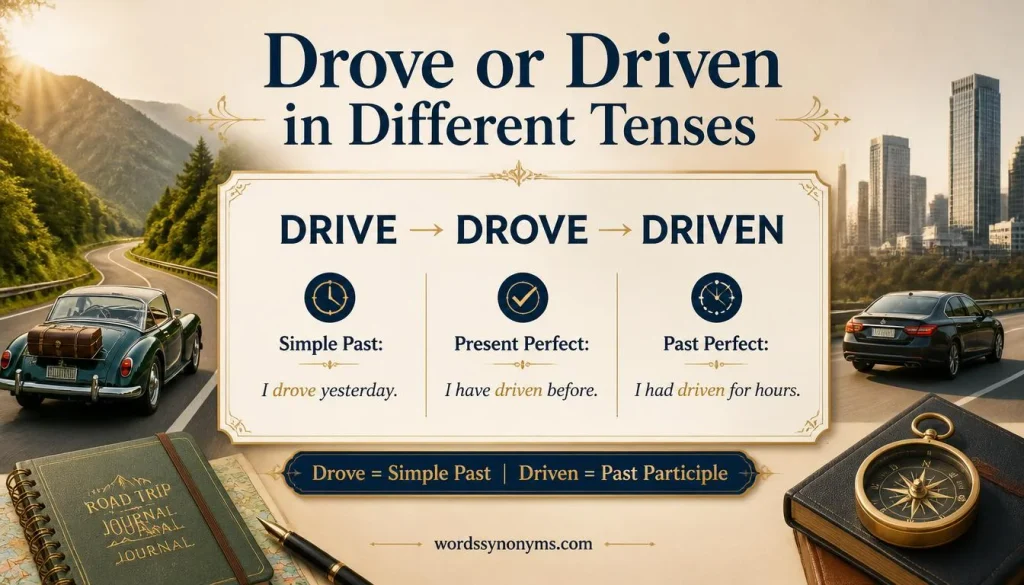
Simple Past Tense: Drove
Use drove to describe a past action, often with a clear time reference.
Examples:
- We drove to the airport yesterday.
- My father drove us to the beach last Sunday.
- The delivery driver drove through heavy traffic.
- She drove carefully because the roads were icy.
The simple past works well when you want to tell someone what happened.
For instance, imagine a friend asking about your weekend. You might answer, “We drove to the lake and spent the afternoon fishing.”
The word drove tells your friend that the trip happened in the past.
Present Perfect Tense: Have or Has Driven
The present perfect uses have or has followed by a past participle. With drive, the correct form is driven.
Examples:
- I have driven this route several times.
- She has driven a truck before.
- We have driven through that tunnel.
- He has never driven on the left side of the road.
The present perfect often connects a past experience or action to the present. It can describe experience without specifying exactly when something happened.
Compare:
- Simple past: I drove to Boston last year.
- Present perfect: I have driven to Boston before.
The first sentence identifies a specific past period. The second emphasizes the experience rather than the exact time.
However, the present perfect generally doesn’t pair with a finished past-time expression such as yesterday.
- Incorrect in standard usage: I have driven there yesterday.
- Correct: I drove there yesterday.
- Correct: I have driven there before.
Past Perfect Tense: Had Driven
The past perfect uses had followed by a past participle. Therefore, the correct form is had driven, not had drove.
Use the past perfect when one past action happened before another past event.
Examples:
- We had driven for two hours before we stopped.
- She had driven away when I reached the house.
- They had driven through the storm before the weather improved.
- He had never driven a truck before starting his new job.
Consider this example: “When the concert began, we had already driven three hours.”
The driving happened before the concert began. The past perfect makes that sequence clear.
You don’t need the past perfect in every sentence that describes two past events. However, it helps when you want to emphasize which event happened first.
Passive Voice: Was or Were Driven
Use driven after forms of be when forming the passive voice.
The passive construction often follows this pattern:
Subject + form of be + driven
Examples:
- The car was driven by a professional racer.
- The guests were driven to the hotel.
- The truck was driven through the narrow passage.
- The equipment had been driven to the site by a transport team.
Notice the difference between active and passive sentences:
- Active: The chauffeur drove the guests to the hotel.
- Passive: The guests were driven to the hotel by the chauffeur.
The active sentence emphasizes the chauffeur’s action. The passive sentence emphasizes the guests and their transportation.
Both are grammatically correct. Your choice depends on which part of the situation deserves attention.
Read more: “Special Thanks Go To” or “Special Thanks Goes To”
Common Mistakes to Avoid With Drove and Driven
Even fluent English speakers sometimes confuse irregular verb forms. Fortunately, a few simple corrections can help you avoid the most common errors.
Using Drove After Have or Has
One frequent mistake is using drove after have or has.
- Incorrect: I have drove to that office before.
- Correct: I have driven to that office before.
- Incorrect: She has drove this vehicle.
- Correct: She has driven this vehicle.
The reason is simple: perfect tenses require a past participle after the helping verb have.
Remember this pattern:
- I have driven.
- You have driven.
- He has driven.
- They have driven.
The subject changes the form of have, but the past participle remains driven.
Using Drove After Had
The past perfect follows the same principle.
- Incorrect: She had drove all night.
- Correct: She had driven all night.
- Incorrect: They had drove away before sunrise.
- Correct: They had driven away before sunrise.
Because had already establishes the past-perfect structure, you need the past participle that follows it.
A useful comparison is eat, ate, eaten. You would say, “I ate breakfast,” but “I had eaten breakfast.” The same principle applies to drive, drove, driven.
Using Driven Alone as the Simple Past Tense
Another mistake occurs when writers use driven without the grammatical structure it needs.
- Incorrect: Yesterday, I driven to work.
- Correct: Yesterday, I drove to work.
- Incorrect: She driven the car last night.
- Correct: She drove the car last night.
In ordinary standard English, driven doesn’t replace drove in a simple past sentence.
However, it can appear without have when a different construction supports it. For example, “The car, driven by a mechanic, arrived late” uses driven in a participial phrase.
Confusing Drove With Drive in Questions and Negatives
Questions and negative statements with did require the base form drive.
| Incorrect | Correct |
| Did you drove home? | Did you drive home? |
| Did she drove yesterday? | Did she drive yesterday? |
| I didn’t drove there. | I didn’t drive there. |
| He didn’t drove the truck. | He didn’t drive the truck. |
Why? The helping verb did already carries the past tense. The main verb therefore stays in its base form.
Think of did as the part of the sentence that handles the past tense. The main verb doesn’t need to do that job again.
Drove or Driven? Real-Life Examples
Grammar becomes easier when you see how people use these words in everyday situations. The following examples cover conversation, professional writing, and figurative expressions.
Drove vs. Driven in Everyday Conversation
Imagine you’re telling a friend about a family trip.
You might say:
We drove to the mountains last weekend. I’ve driven that road before, but the scenery still surprised me.
Both forms are correct because each sentence follows a different grammatical pattern.
Here are more everyday examples:
- “I drove my sister to school this morning.”
- “Have you ever driven through a snowstorm?”
- “Dad had driven for five hours before we stopped.”
- “The taxi driver drove us to the station.”
- “I’ve never driven such a large vehicle.”
When speaking casually, focus on the sentence structure rather than memorizing isolated examples.
Drove vs. Driven in Professional and Academic Writing
Choosing the correct verb form also matters in reports, workplace emails, and academic assignments.
For example:
- Project report: The team drove to the construction site on Monday.
- Travel record: The technician has driven more than 500 miles this week.
- Incident report: The vehicle was driven into the loading area.
- Research summary: Earlier trials had driven the need for additional testing.
The last example uses driven figuratively. The earlier trials created a need for further testing.
In formal writing, grammatical accuracy helps your ideas sound clear and credible. A sentence such as “The technician has drove 500 miles” can distract readers from the information you’re trying to communicate.
Figurative Uses of Drove and Driven
The verb drive can describe influence, pressure, motivation, or cause. These meanings don’t involve operating a vehicle.
Consider the following examples:
| Expression | Meaning |
| The deadline drove the team to work faster. | The deadline motivated the team. |
| Curiosity drove her research. | Curiosity motivated her investigation. |
| Stress drove him to seek help. | Stress contributed to his decision. |
| She is driven by a desire to learn. | A desire to learn motivates her. |
| He is a driven professional. | He is highly motivated. |
In the first three examples, drove describes a past cause or influence. In the last two, driven acts as an adjective or appears in a passive-style construction.
This distinction matters because drive has several meanings. The grammatical form still follows the same rules, whether you’re talking about a car or someone’s motivation.
A Practical Case Study: Choosing Drove or Driven
Suppose Alex is writing a short account of a business trip. He drafts three sentences:
- “Yesterday, I driven to the client’s office.”
- “I have drove that route several times.”
- “The company car was drove by my colleague.”
Each sentence contains a recognizable mistake, but each requires a different correction.
| Original sentence | Corrected sentence | Explanation |
| Yesterday, I driven to the client’s office. | Yesterday, I drove to the client’s office. | A simple past action requires drove. |
| I have drove that route several times. | I have driven that route several times. | The present perfect requires driven. |
| The company car was drove by my colleague. | The company car was driven by my colleague. | The passive construction requires driven. |
Alex can correct all three errors by identifying the sentence structure before choosing the verb.
This method works in emails, essays, conversations, and other forms of writing. Instead of asking whether drove or driven sounds better, ask what grammatical role the sentence requires.
Easy Ways to Remember Drove vs. Driven
You don’t need to memorize complicated grammar terminology to choose the correct word. A few reliable patterns will help you remember the difference.
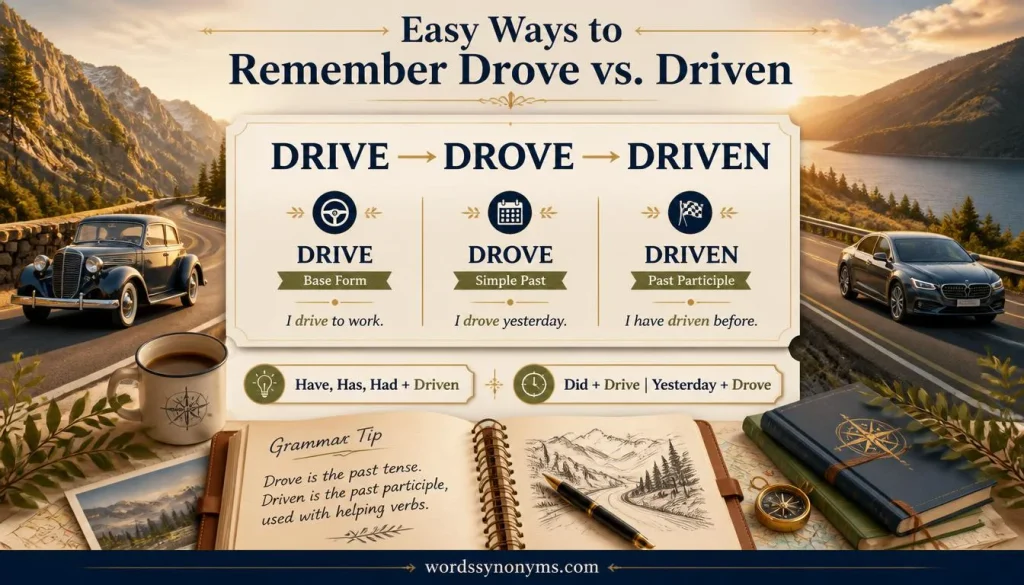
Remember the Three Forms of Drive
Start by learning these three principal verb forms.
| Form | Verb | Example |
| Base form | Drive | I drive to work. |
| Simple past | Drove | I drove to work yesterday. |
| Past participle | Driven | I have driven to work before. |
Unlike regular verbs such as walk, walked, walked, the verb drive changes its form irregularly.
The sequence is drive → drove → driven. Learning all three forms together makes it easier to recognize the correct choice when writing.
Look for Helping Verbs
Helping verbs provide useful clues about which form belongs in your sentence.
- Have, has, or had: Usually signals driven in perfect tenses.
- Was, were, or been: Can accompany driven in passive constructions.
- Did or didn’t: Requires the base form drive.
- No helping verb in a simple past statement: Usually calls for drove.
For example, “She drove home” uses the simple past. “She has driven home” uses the present perfect. “She was driven home” uses the passive voice.
These patterns offer a quick check when you’re editing your own writing.
Practice With Short Examples
Try completing each sentence with the correct form. Choose from drive, drove, and driven.
Read more: Your Fly Is Open: Usage and British vs. American English
Quick Grammar Quiz
Choose the correct verb form for each sentence.
1. I _____ to the store yesterday.
drive
drove
driven
2. She has _____ this road before.
drive
drove
driven
3. Did they _____ to the airport?
drive
drove
driven
4. The passengers were _____ to the hotel.
drive
drove
driven
5. He had _____ for three hours before stopping.
drive
drove
driven
0 of 5 answered
Try again
Practice helps turn these rules into habits. After a little repetition, you’ll begin to recognize the correct form naturally.
FAQs
Is it drove or driven?
Both words are correct, but they serve different purposes. Drove is the simple past tense of “drive,” while driven is its past participle. For example, “I drove to work yesterday” and “I have driven this road before.”
Can I say “I have drove”?
No. The correct phrase is “I have driven.” The verb “have” requires the past participle, so “drove” does not fit this sentence. Remember the pattern: drive, drove, driven.
When should I use drove in a sentence?
Use drove when describing a completed action in the past. For example, “She drove her brother to school yesterday.” You don’t need an auxiliary verb such as “have” in this simple past construction.
When should I use driven instead of drove?
Use driven with helping verbs such as “have,” “has,” or “had.” For example, “They have driven across the country.” You can also say, “He had driven for hours before stopping.”
Is driven the past tense of drive?
No. Drove is the simple past tense, while driven is the past participle. The three main forms are drive (base form), drove (simple past), and driven (past participle).
What is an easy way to remember drove vs. driven?
Connect drove with a finished past action and driven with a helping verb. Say, “I drove yesterday” and “I have driven before.” Practicing these two patterns can help you choose the correct form naturally.
Conclusion
Choosing between drove and driven becomes easier when you remember their different roles in English grammar. Drove describes a completed past action, as in “I drove to the store yesterday.” Driven is the past participle and usually appears with helping verbs such as have, has, or had. For example, “She has driven this car before.” Although both words come from the verb “drive,” you cannot use them interchangeably in every sentence.
The simplest way to remember the difference is to practice the pattern drive, drove, driven. Use drove for simple past sentences and driven when a helping verb requires the past participle. Reading examples aloud and writing your own sentences can help you avoid common mistakes, including “I have drove.” Once you recognize these patterns, you’ll feel more confident using the correct verb form in everyday conversations, school assignments, and professional writing.

Franklin Hayes is a writer and editor at WordsConfusing.com, focused on making English vocabulary, grammar, and commonly confused words easy to understand. He writes clear, practical articles with simple explanations and useful examples to help readers improve their English with confidence.
His goal is simple: Making Confusing Words Simple.


