


Your Fly Is Open: Usage and British vs. American English explains how this everyday phrase helps you give someone a quick, polite reminder.
“Your fly is open” is a common phrase in everyday English used when someone has forgotten to close their pants or trouser zipper after a toilet break, bathroom break, or visit to the restroom. This humorous phrase describes an open fly that might cause embarrassment or an awkward situation in public.
In spoken English, it works as an informal expression to remind someone discreetly. The phrase meaning is simple, but its phrase usage depends on your tone, relationship, and setting. A quiet voice can turn an embarrassing moment into a friendly joke. Good social etiquette means choosing a polite reminder or discreet warning that protects the other person’s feelings.
British vs. American English
British English and American English share this expression, but regional differences influence everyday wording. In British usage, people might say “Your fly is open” or “Your trousers are undone.” In American usage, “Your zipper is down” is another familiar option. The words trousers and pants highlight differences between British vs. American English because Americans commonly use pants for outer clothing, while British speakers often say trousers.
This comparison shows how language variation, dialect differences, cultural differences, and linguistic differences shape English expressions and restroom terminology. If you need alternative expressions or ways to say it, try “You might want to check your zipper” or “Just a heads-up, your fly is down.” These expressions use gentle humor and help someone avoid unnecessary embarrassment.
This article explores how tone and wording vary across English-speaking regions.
Quick Answer
“Your fly is open” means the front opening of your pants or trousers isn’t fastened properly. The phrase is understood in both British and American English. Americans also say “your fly is down,” while British speakers may say “your fly is undone” or “your flies are undone.”
What Does “Your Fly Is Open” Mean?
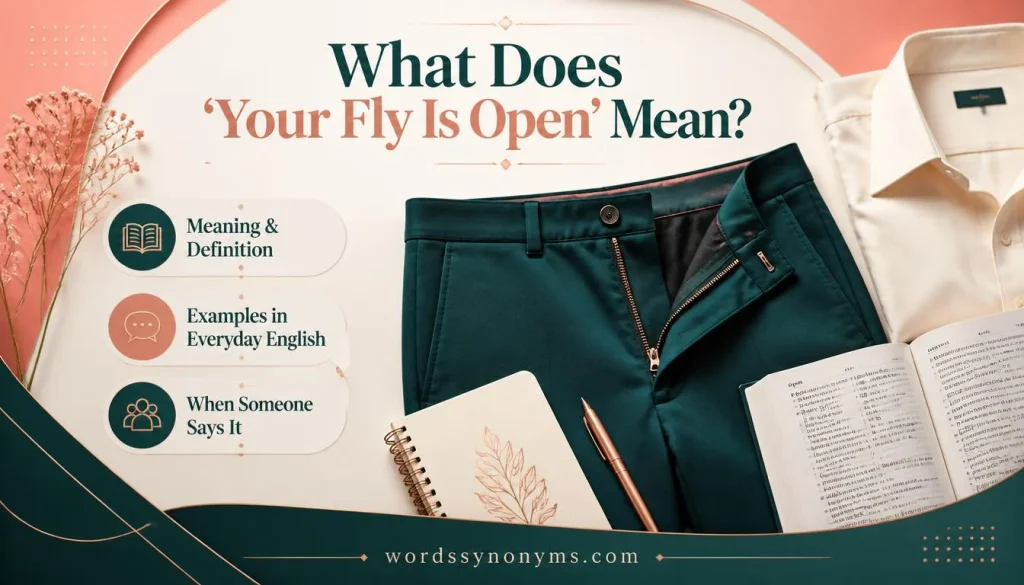
“Your fly is open” means that the front opening of someone’s pants or trousers is unfastened. The opening usually has a zipper or buttons and is often covered by a flap of fabric.
People use the phrase to alert someone to a small clothing problem. For example, if you notice that a coworker’s zipper is open, you might quietly say, “Excuse me, your fly is open.”
The expression isn’t normally meant as an insult. In most everyday situations, the speaker simply wants to help the other person avoid an awkward moment.
Consider this example:
Person A: “Hey, I think your fly is open.”
Person B: “Oh, thanks for telling me!”
Here, the first person points out the problem, and the second person acknowledges the reminder. The conversation is brief because the meaning is clear.
The expression can also appear in jokes, television shows, movies, and casual conversations. Its humor often comes from the embarrassment associated with an easily overlooked clothing mistake.
What Does “Fly” Mean in Clothing?
The word fly has several meanings in English. It can refer to an insect, the act of traveling through the air, or the front opening of a garment.
In clothing, a fly is the opening at the front of pants or trousers that fastens with a zipper or buttons. A fabric flap usually covers the fastening to create a neat appearance.
The fly and the zipper aren’t exactly the same thing. The fly refers to the opening and its construction, while the zipper is a fastening mechanism that may close it.
For example:
- “Your fly is open.” The front opening isn’t properly fastened.
- “Your zipper is broken.” The fastening mechanism doesn’t work correctly.
- “He buttoned his fly.” He fastened the front opening using buttons.
Not every fly uses a zipper. Some garments have button flies, so the expression remains useful even when no zipper is involved.
Why Do People Say “Your Fly Is Open”?
People use this expression because it communicates a specific problem quickly and clearly.
Clothing mistakes can happen when someone gets dressed in a hurry, uses the restroom, changes clothes, or simply forgets to check their zipper. A discreet reminder helps the person correct the problem before it attracts more attention.
The phrase also avoids unnecessary detail. Instead of explaining exactly what someone might be exposing, the speaker uses a familiar expression that most listeners understand immediately.
For example, imagine that you’re about to enter a meeting when a colleague quietly tells you, “Your fly is open.” You can fix the issue without interrupting the meeting or drawing attention to yourself.
That’s the practical purpose of the expression: it lets someone know about a small problem without making the situation more uncomfortable than necessary.
Is “Your Fly Is Open” British or American English?
“Your fly is open” is understood in both British and American English. The phrase isn’t exclusive to either variety, although speakers may prefer different alternatives.
American English commonly uses pants for the garment worn over underwear. British English usually uses trousers for the same item, although pants has a different everyday meaning in British usage.
The main difference lies in preferred wording rather than the basic meaning.
| Expression | General usage |
| Your fly is open. | Understood in American and British English |
| Your fly is down. | Common in American English |
| Your fly is undone. | Used in British English and understood elsewhere |
| Your flies are undone. | Recognized British English construction |
| Your zipper is open. | Clear, especially in American English |
| Your zip is undone. | Natural British English wording |
These distinctions describe common tendencies, not strict rules. Speakers in either country may use more than one expression.
“Your Fly Is Open” in American English
In American English, “your fly is open” is a direct and natural way to tell someone that their pants aren’t fastened properly.
Americans also commonly say “your fly is down.” Both expressions communicate the same general problem.
Here are some examples:
- “Hey, your fly is open.”
- “You might want to check your fly.”
- “Your fly is down. Just thought I’d let you know.”
- “Excuse me, but your zipper is open.”
- “I think you forgot to zip up your pants.”
The wording depends on the situation. Friends may use a casual expression, while coworkers or strangers may choose a more discreet reminder.
American English also commonly uses zipper to refer to the fastening mechanism. Therefore, “your zipper is open” can be particularly clear when speaking to someone who may not immediately recognize the word fly in this context.
One important point: Americans don’t always distinguish between a fly with a zipper and one with buttons when using the word fly. The term describes the opening, not just the mechanism.
“Your Fly Is Open” in British English
British English also uses fly to describe the front opening of trousers. However, British dictionaries recognize both the singular fly and the plural flies in this context.
As a result, you may hear expressions such as:
- “Your fly is undone.”
- “Your flies are undone.”
- “Your fly is open.”
- “Your zip is undone.”
- “Your trousers are unzipped.”
The expression “your flies are undone” may seem unusual to American readers because it uses a plural noun for one clothing opening. However, this construction is recognized in British English.
The singular form is also possible. You don’t need to assume that every British speaker uses the plural form.
British vocabulary differs in other ways, too. Someone in the United Kingdom is more likely to refer to trousers and a zip, while an American speaker may choose pants and zipper.
For example:
British English: “Excuse me, I think your zip is undone.”
American English: “Excuse me, I think your zipper is open.”
Both sentences are grammatically natural and communicate the same practical message.
Read more: 8 Words to Describe a Person Who Loves to Travel
“Your Fly Is Open” vs. “Your Fly Is Down” vs. “Your Fly Is Undone”
These expressions are closely related, but their wording emphasizes the condition of the clothing in slightly different ways.
Your Fly Is Open
This expression describes the fly as being open rather than closed.
It works well when you want to tell someone about the problem without using slang or making a joke. The wording is straightforward and easy to understand.
Example: “Excuse me, your fly is open.”
Your Fly Is Down
This expression is also widely understood and is common in American English.
The word down describes the fly’s unfastened state. It doesn’t necessarily mean that the person’s entire pants have moved downward.
Example: “Your fly is down. You might want to fix it.”
Although the wording can sound informal, it isn’t inherently rude.
Your Fly Is Undone
The word undone means that something previously fastened or completed isn’t fastened or complete anymore.
In this context, it indicates that the front opening hasn’t been secured properly. The expression is especially familiar in British English.
Example: “I think your fly is undone.”
Your Flies Are Undone
This version uses flies as a plural noun, following a recognized British English usage.
Even though the phrase refers to one opening, the plural form is established in this clothing-related meaning. It isn’t necessary to interpret it as referring to several separate openings.
Example: “Your flies are undone. You should check them.”
Your Zipper Is Open
This alternative focuses on the fastening mechanism rather than the clothing opening as a whole.
It’s useful when you want to avoid any possible confusion about the word fly. However, if the garment has a button fly, mentioning a zipper wouldn’t be accurate.
Example: “Your zipper is open. You may want to zip it up.”
Comparison Table
| Expression | Meaning | Tone | Typical use |
| Your fly is open. | The front opening isn’t fastened. | Neutral | General conversation |
| Your fly is down. | The front opening is unfastened. | Casual | Informal conversation |
| Your fly is undone. | The opening isn’t secured. | Neutral | British and international English |
| Your flies are undone. | The front opening isn’t secured. | Neutral | Recognized British usage |
| Your zipper is open. | The zipper isn’t closed. | Direct | Clear, practical reminders |
| Your zip is undone. | The zip isn’t fastened. | Neutral | Common British wording |
The simplest choice is the one your listener will understand immediately. You don’t need to memorize every regional variation to communicate the message correctly.
British vs. American English: Key Vocabulary Differences
The phrase “your fly is open” offers a useful example of how English varies across regions. Sometimes the underlying meaning stays the same while speakers choose different words.
The differences between British and American clothing vocabulary are particularly noticeable in everyday conversation.
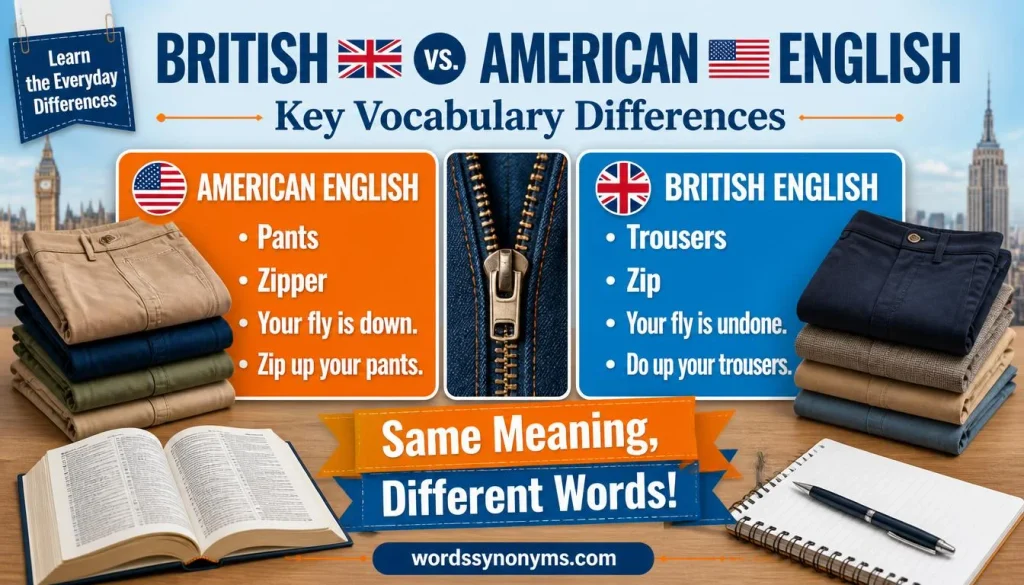
| American English | British English | Meaning |
| Pants | Trousers | Clothing worn over underwear |
| Zipper | Zip | A fastening mechanism |
| Your fly is down. | Your fly is undone. | The front opening isn’t fastened |
| Your zipper is open. | Your zip is undone. | The fastening isn’t secured |
| Zip up your pants. | Do up your trousers. | Fasten the front opening |
These are useful general comparisons, but they’re not absolute boundaries. British speakers understand zipper, and American speakers understand trousers. Exposure through travel, entertainment, and online communication makes many regional terms familiar internationally.
There’s also an important vocabulary trap.
In American English, pants usually means trousers. In British English, pants commonly means underwear, while trousers describes the outer garment.
That distinction can change the mental picture a listener forms. If you’re speaking to a British audience, trousers may be the clearest choice when discussing the clothing opening.
Nevertheless, the word fly itself is widely recognized. You can use “your fly is open” without needing to replace the word in every British English conversation.
Examples of “Your Fly Is Open” in Everyday Conversation
Examples make it easier to understand how the phrase works in real situations. The meaning stays consistent, but the tone changes according to the relationship between the speakers.
Casual Conversation
Friends usually don’t need formal language when pointing out a small clothing mistake.
Example one
Alex: “Hey, your fly is open.”
Jordan: “Seriously? Thanks for telling me.”
Alex: “No problem.”
Example two
Sam: “You might want to check your fly.”
Chris: “Oh, good catch!”
In both examples, the speakers communicate naturally without turning the moment into a big deal.
Polite or Professional Situations
When speaking to a coworker, customer, manager, or stranger, a discreet approach is usually best.
Example one
Coworker: “Excuse me, I think your zipper is open.”
Colleague: “Thank you. I’ll fix it.”
Example two
Customer: “Just a quick heads-up. Your fly might be undone.”
Shop assistant: “Thanks for letting me know.”
These examples show how a polite opening phrase can soften the message. Words such as excuse me, I think, and just a heads-up make the reminder sound considerate rather than critical.
Friendly or Humorous Situations
Humor can work when the speakers know each other well. However, the joke should never matter more than the person’s comfort.
Example one
Taylor: “Your fly is down, buddy.”
Morgan: “Thanks. Apparently, it wanted some fresh air.”
Example two
Riley: “Quick warning: your zipper needs attention.”
Casey: “Thanks for saving me from an embarrassing moment.”
These exchanges use light humor without insulting the person. Still, a joke that works among close friends may feel inappropriate in a workplace or unfamiliar group.
A Short Realistic Scenario
Imagine you’re attending a job interview. Just before entering the room, you notice another candidate has an unfastened zipper.
You could ignore the problem, but the person might feel embarrassed later. Instead, you quietly say, “Excuse me, I think your zipper is open.”
The candidate thanks you and fixes it before the interview begins.
This simple interaction demonstrates why the phrase can be helpful. A private reminder protects someone’s dignity while giving them a chance to correct the problem.
How to Tell Someone Their Fly Is Open Politely
Telling someone their fly is open can feel awkward, particularly if you don’t know them well. The best approach is usually brief, quiet, and respectful.
You don’t need a long explanation. In fact, a short sentence often works better because it gives the person the information they need without prolonging the moment.
Use a Quiet Voice
If possible, speak privately or move close enough that only the person can hear you.
Announcing the problem across a room can attract unwanted attention. A quiet reminder lets the person fix the issue without feeling exposed.
Choose Clear, Neutral Words
Avoid wording that sounds accusatory or mocking.
Instead of saying, “How did you not notice your fly?” try “Excuse me, your fly is open.”
The second sentence focuses on the problem rather than criticizing the person.
Consider Your Relationship
The wording you use with a friend may differ from what you’d say to a manager or stranger.
Here are some useful options:
| Situation | Suggested phrase |
| Speaking to a friend | “Hey, your fly is down.” |
| Speaking to a stranger | “Excuse me, I think your zipper is open.” |
| Speaking to a coworker | “Just a quick heads-up: your fly might be undone.” |
| Speaking to a manager | “Excuse me, you may want to check your zipper.” |
| Speaking to someone in British English | “Sorry, I think your trousers might be undone.” |
You can also use a discreet gesture if speaking isn’t practical. For example, you might quietly point toward your own waistband to suggest that the person should check theirs.
However, make sure the gesture is clear enough to prevent confusion. If necessary, a short verbal explanation is kinder than leaving the person guessing.
Give the Person Time to Respond
After delivering the reminder, let the conversation move on.
You don’t need to watch them fix the problem or ask whether they’ve corrected it. Unless there’s a practical reason to stay, simply return to what you were doing.
This small courtesy helps prevent an ordinary clothing mistake from becoming a prolonged embarrassment.
Is “Your Fly Is Open” Rude or Embarrassing?
The phrase itself is generally neutral, but the way you say it can make a difference.
A quiet reminder usually communicates helpfulness. A loud announcement, sarcastic comment, or public joke can make the same message feel insulting.
For example, consider these two situations.
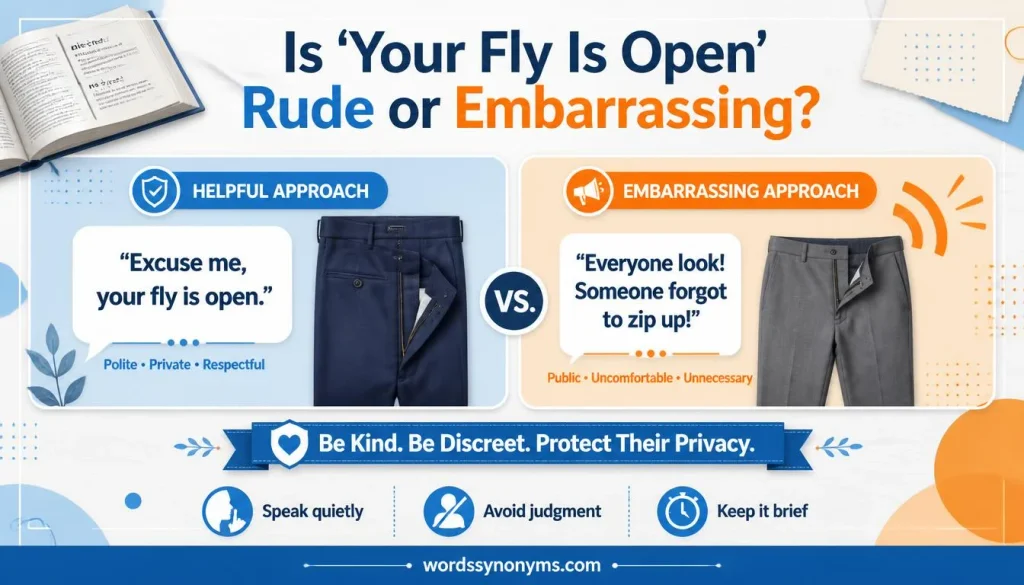
Helpful approach: “Excuse me, your fly is open.”
Embarrassing approach: “Everyone look! Someone forgot to zip up!”
Both draw attention to the same problem, but only the first respects the person’s privacy.
The relationship between the speakers also matters. Close friends may laugh about a small mistake, while a stranger might find the same joke uncomfortable.
Context plays a role, too. A discreet reminder during a private conversation may feel natural. Announcing the problem during a presentation or formal event could interrupt the situation and embarrass the person unnecessarily.
If you notice someone has an open fly, keep three principles in mind:
- Be discreet: Avoid drawing a crowd.
- Be neutral: State the problem without judgment.
- Be brief: Give the person time to fix it and move on.
The goal isn’t to highlight someone’s mistake. It’s to help them correct it comfortably.
Read more: Nice to Hear From You or Nice Hearing From You
Common Mistakes and Misunderstandings About “Your Fly Is Open”
Several misunderstandings can arise when people encounter this expression, particularly when learning British and American English.
Confusing the Clothing Meaning With an Insect
The word fly can refer to a small insect, but that’s not its meaning in this expression.
When someone says, “Your fly is open,” they’re referring to the front opening of the person’s pants or trousers.
The surrounding words provide the clue. In this sentence, open describes a clothing opening rather than an insect.
Assuming the Expression Is Exclusively American
Although the phrase is common in American English, British speakers also recognize the clothing-related meaning of fly.
British English has additional wording, including “your flies are undone,” but that doesn’t make the singular expression incorrect or incomprehensible.
Assuming Every British Speaker Says “Your Flies Are Undone”
The plural form is recognized in British English, but speakers don’t all use the same phrase.
Some may say “your fly is undone,” while others prefer “your zip is undone.” Regional habits and personal preferences influence everyday speech.
Confusing the Fly With the Zipper
The fly is the front opening of the garment. The zipper is one possible mechanism for fastening that opening.
This difference matters when discussing button-fly pants. If the garment uses buttons, the fly can still be open even though it has no zipper.
Assuming an Open Fly Always Has the Same Cause
An open fly doesn’t necessarily mean that someone forgot to zip up after using the restroom.
The person might have been changing clothes, adjusting their waistband, or simply overlooked the fastening. It’s better to point out the problem without guessing how it happened.
Treating Informal Expressions as Grammatically Incorrect
Phrases such as “your fly is down” may sound unusual if you translate them word for word. However, they are established expressions that people use to communicate a familiar situation.
English doesn’t always describe physical states in the most literal way. Understanding common usage is often more helpful than trying to interpret every phrase word by word.
FAQs
What does “Your fly is open” mean?
“Your fly is open” means the zipper on someone’s pants or trousers is unzipped. People usually say it to alert someone discreetly and help them avoid embarrassment.
Is “Your fly is open” a rude expression?
No, it isn’t usually rude. It depends on your tone and the situation. Saying it quietly and politely can make the moment less awkward, especially around friends or coworkers.
Do British and American speakers both say “Your fly is open”?
Yes, both British and American speakers use this expression. However, other wording may vary by region. British speakers might say “Your trousers are undone,” while Americans may say “Your zipper is down.”
What does “fly” mean in clothing?
In clothing, a fly is the part of pants or trousers that covers the zipper or button fastening at the front. When someone says your fly is open, they mean this area isn’t properly fastened.
What is a polite way to tell someone their fly is open?
You can say, “You might want to check your zipper,” or “Just a heads-up, your fly is down.” Both expressions sound friendly and help the person fix the problem without drawing attention.
Is “Your fly is open” formal or informal English?
It’s an informal English expression commonly used in everyday conversations. For a professional or unfamiliar setting, a discreet phrase such as “You might want to check your zipper” may sound more considerate.
Conclusion
“Your fly is open” is a simple, everyday expression that helps you alert someone to an unzipped zipper without making a big deal out of it. Although the phrase is common in both British English and American English, alternatives such as “Your trousers are undone” and “Your zipper is down” reflect regional differences in vocabulary. Understanding these expressions helps you communicate naturally and recognize how English changes across different places and situations.
The most important thing is how you deliver the message. A quiet voice, friendly tone, and discreet warning can save someone from an embarrassing moment. Whether you’re speaking with a friend, coworker, or stranger, choosing polite words shows good social etiquette. After all, a little kindness and gentle humor can turn an awkward situation into a brief, forgettable moment.

Shafiq Ur Rehman is a writer and content contributor at WordsConfusing.com. He enjoys exploring the English language, common word confusions, vocabulary, and practical writing tips. His goal is to make English easier to understand through clear, simple, and useful articles.


