


Choosing the right possessive form matters when writing about ownership. Lucas’ or Lucas’s? Here’s the Correct Possessive Form explains the rule clearly for everyday English and formal writing.
Both forms can be correct, depending on your chosen style guide. In standard English, adding apostrophe s to a singular noun usually creates a singular possessive noun. For example, “Lucas’s book” shows ownership, while some editorial styles prefer “Lucas’ book.”
These differences appear in journalistic formats, simplified formats, and other writing conventions. Understanding apostrophe placement, punctuation, and possessive spelling improves grammar accuracy and helps you follow consistent writing rules.
Lucas’s is often the safest form for essays, academic writing, business writing, and professional documents when no specific style guide applies. However, Lucas’ is also one of the accepted forms in certain editorial styles and British English conventions. For example, “Lucas’s calendar” identifies ownership in discussions about meetings, online booking, broadcasting, project management, scheduling, and time management.
The same principle applies to everyday emails, workplace communication, and business documents. A reliable grammar guide explains both forms through real-world examples and clarifies usage differences. Following your preferred style consistently improves clarity, credibility, and attention to detail across professional settings and academic settings.
Quick Answer
Both Lucas’ and Lucas’s are accepted possessive forms of the singular name Lucas. However, they follow different style conventions.
- Lucas’s: Adds an apostrophe and another s to the singular name.
- Lucas’: Adds only an apostrophe after the final s.
Consider these examples:
- Lucas’s backpack is beside the door.
- Lucas’ backpack is beside the door.
Both sentences mean that the backpack belongs to Lucas. The difference lies in the spelling convention, not the meaning.
Here’s a quick comparison:
| Form | Example | Explanation |
| Lucas’s | Lucas’s phone is missing. | Adds ’s to the singular name |
| Lucas’ | Lucas’ phone is missing. | Adds only an apostrophe |
| Lucas | Lucas arrived early. | Names one person without showing possession |
| Lucases | The Lucases arrived early. | Refers to multiple people named Lucas |
| Lucases’ | The Lucases’ house is nearby. | Shows possession by multiple people named Lucas |
The easiest rule to remember: Use Lucas’s when your chosen style guide adds ’s to singular proper names ending in s. Use Lucas’ when your style guide calls for an apostrophe alone.
If no style guide applies, either accepted convention can work. Choose one and use it consistently throughout your writing.
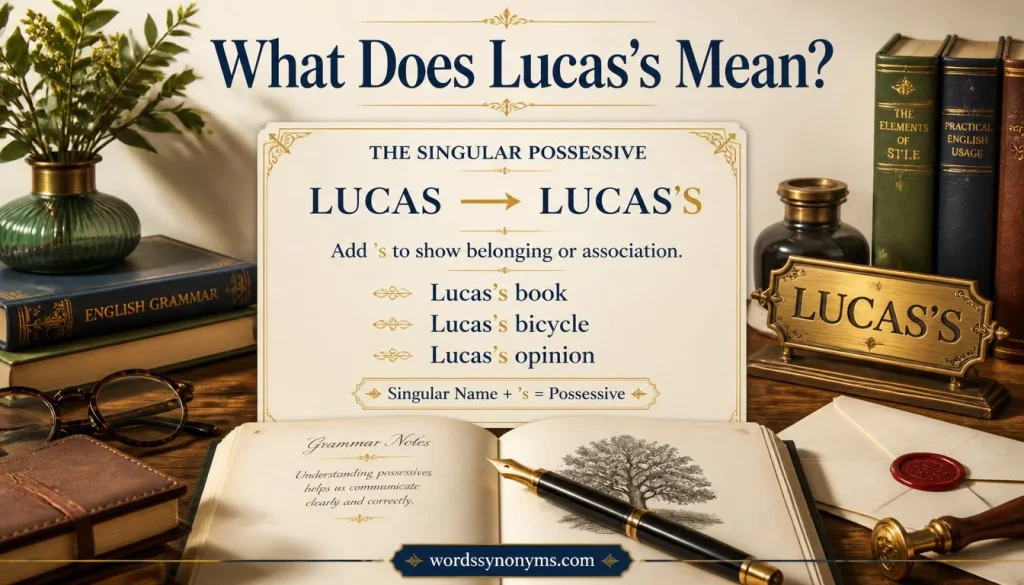
What Does Lucas’s Mean?
Lucas’s is the possessive form of the singular proper name Lucas. Writers use it to show that something belongs to, relates to, or is associated with a person named Lucas.
In this form, the apostrophe comes before the additional s. This follows the general rule for forming the possessive of most singular nouns, including singular proper names.
For example:
- Lucas’s bicycle is parked outside.
- I borrowed Lucas’s calculator for the exam.
- Lucas’s manager approved the proposal.
- We attended Lucas’s birthday party.
- Everyone admired Lucas’s painting.
In each sentence, Lucas’s connects the person to something associated with him. That connection might involve ownership, a relationship, work, or a personal achievement.
How the Possessive Apostrophe Works
The apostrophe helps readers recognize a possessive relationship. The additional s follows the spelling convention used for singular nouns.
Consider this simple progression:
| Word or phrase | Meaning |
| Lucas | A person’s name |
| Lucas’s book | A book associated with Lucas |
| Lucas’s opinion | An opinion expressed by Lucas |
| Lucas’s responsibility | A responsibility assigned to Lucas |
Notice that possession doesn’t always mean legal ownership. Lucas’s opinion isn’t a physical object, yet the possessive form still works because it identifies whose opinion you’re discussing.
The same principle applies to relationships and responsibilities. You can write Lucas’s sister, Lucas’s project, or Lucas’s decision without suggesting that Lucas owns a person, project, or decision in the literal sense.
Examples of Lucas’s in Everyday Writing
Here are several examples showing how the possessive form works in different situations.
Ownership: Lucas’s laptop needs a new battery.
The laptop belongs to Lucas or is the laptop associated with him.
Family relationships: Lucas’s brother works at a local hospital.
The possessive identifies the relationship between Lucas and his brother.
Education: Lucas’s assignment received an excellent grade.
The sentence connects the assignment to Lucas.
Professional writing: Lucas’s presentation covered the company’s annual results.
The possessive identifies the person responsible for the presentation.
Personal achievements: Lucas’s determination helped him finish the race.
Here, the possessive connects Lucas with an abstract quality.
These examples demonstrate why Lucas’s appears in many types of writing. It provides a clear, familiar way to express relationships and associations.
What Does Lucas’ Mean?
Lucas’ is another accepted possessive form of the singular name Lucas. Instead of adding another s, this convention places an apostrophe immediately after the existing final letter.
For example:
- Lucas’ bicycle is parked outside.
- I borrowed Lucas’ calculator for the exam.
- Lucas’ manager approved the proposal.
- We attended Lucas’ birthday party.
- Everyone admired Lucas’ painting.
Each sentence communicates the same basic meaning as its Lucas’s counterpart.
The difference is editorial style. Some style guides prefer adding ’s to singular names ending in s, while others recommend adding only an apostrophe in certain cases.
Why Do Writers Use Lucas’?
The apostrophe-only form has a long history in English writing. Some editorial traditions use it to avoid adding another s to names that already end with that letter.
For example, a publication following the relevant Associated Press convention generally writes Lucas’ book rather than Lucas’s book.
This choice doesn’t mean the possessive relationship is weaker or that the sentence follows a different grammatical rule. It reflects the publication’s preferred spelling convention.
Writers may encounter Lucas’ in:
- Newspaper articles and news reports.
- Publications following a particular editorial style.
- School assignments that require an apostrophe-only convention.
- Books or documents that consistently use this approach.
- Professional writing edited according to a specific house style.
However, you shouldn’t assume that every newspaper, academic institution, or publisher prefers Lucas’. Requirements vary, so check the applicable guidelines when accuracy matters.
Examples of Lucas’ in Sentences
The following examples illustrate how this spelling works naturally.
Ownership: Lucas’ keys are on the kitchen counter.
Family relationships: Lucas’ sister is studying engineering.
Education: Lucas’ final examination begins on Monday.
Professional writing: Lucas’ proposal includes three practical recommendations.
Personal qualities: Lucas’ patience helped resolve the disagreement.
In each case, Lucas’ identifies a relationship between Lucas and another person, object, activity, or quality.
One important point remains: Lucas’ and Lucas’s generally have the same meaning. The spelling changes because of style preferences, not because one form expresses more ownership than the other.
Lucas’ or Lucas’s: What Do Grammar Rules Say?
The main rule is straightforward: singular proper names generally form their possessive by adding ’s, even when the name already ends in s. However, some style guides make an exception for certain names ending in s.
This is why both Lucas’s and Lucas’ appear in standard English writing.
To understand the difference, it helps to separate general grammar rules from editorial preferences. Grammar explains how possessive relationships work, while style guides establish which spelling a publication or institution prefers.
The Rule for Adding ’s to Singular Names
The general possessive rule adds an apostrophe and s to most singular nouns.
For example:
- The student’s notebook.
- The teacher’s desk.
- The doctor’s appointment.
- James’s jacket.
- Lucas’s bicycle.
The first three examples involve singular common nouns. The final two involve singular proper names that already end in s.
Under this convention, the existing final s doesn’t prevent you from adding another one. You simply place the apostrophe before the additional s.
This gives you the following pattern:
| Singular name | Possessive form |
| Lucas | Lucas’s |
| James | James’s |
| Charles | Charles’s |
| Chris | Chris’s |
| Thomas | Thomas’s |
This approach is widely used in general writing and is recommended by The Chicago Manual of Style for singular proper names, including those ending in s.
For example, if you’re writing a story about Lucas and his bicycle, you can write:
Lucas’s bicycle leaned against the old wooden fence.
The spelling follows the general possessive rule and clearly connects the bicycle to Lucas.
The Rule for Adding Only an Apostrophe
Another established convention adds only an apostrophe after a singular proper name ending in s.
Under this approach, the possessive forms look like this:
| Singular name | Possessive form |
| Lucas | Lucas’ |
| James | James’ |
| Charles | Charles’ |
| Chris | Chris’ |
| Thomas | Thomas’ |
This convention appears in particular editorial styles, including the Associated Press approach for singular proper names ending in s.
For instance:
Lucas’ bicycle leaned against the old wooden fence.
The sentence communicates the same relationship as the version using Lucas’s. Only the written form changes.
Neither convention means that the name becomes plural. The apostrophe indicates possession, while the selected spelling reflects the style being followed.
Is One Form More Correct Than the Other?
Not in every context. Both forms are accepted, but the expected answer depends on the rules you’re using.
If your teacher requires Chicago style, Lucas’s is generally the appropriate choice. If you’re following AP style, Lucas’ is generally preferred.
When you’re writing without a prescribed style, you can choose either convention. The important thing is to avoid switching between them without a reason.
Lucas’ or Lucas’s: What Do Style Guides Recommend?
Style guides help writers make consistent decisions about punctuation, capitalization, spelling, and grammar. Their recommendations can differ even when both forms remain acceptable in broader English usage.
The distinction between Lucas’ and Lucas’s is a good example.
The Chicago Manual of Style: Lucas’s
The Chicago Manual of Style generally recommends adding ’s to singular nouns, including proper names ending in s.
Following this convention, you would write:
- Lucas’s car.
- James’s office.
- Charles’s book.
- Chris’s assignment.
Chicago’s approach follows the general singular possessive rule rather than dropping the additional s because of the name’s ending.
This convention is common in book publishing, long-form nonfiction, and other edited prose that follows Chicago style.
Example:
Lucas’s research helped the team understand the problem.
If you’re using Chicago style for a book, essay, or article, this is the spelling to follow.
Associated Press Style: Lucas’
The Associated Press uses a different convention for singular proper names ending in s. Its standard approach adds an apostrophe alone.
Under this convention, you would write:
- Lucas’ car.
- James’ office.
- Charles’ book.
- Chris’ assignment.
This spelling is associated with AP-style journalism and news writing.
Example:
Lucas’ research helped the team understand the problem.
The sentence carries the same meaning as the Chicago-style version. The difference is the editorial rule governing the possessive form.
What About Other Style Guides?
Not every style guide follows exactly the same rules. Academic institutions, publishers, and professional organizations may establish their own conventions.
For example, a university might require a particular academic style for essays. A newspaper may use its own house style based on an established editorial handbook.
Before deciding which form to use, consider these questions:
- Does your teacher specify a style guide?
- Does your employer have an editorial handbook?
- Are you writing for a publication with established spelling rules?
- Have you already used one possessive convention throughout your document?
If a specific style applies, follow it. Otherwise, choose a consistent convention that suits your writing.
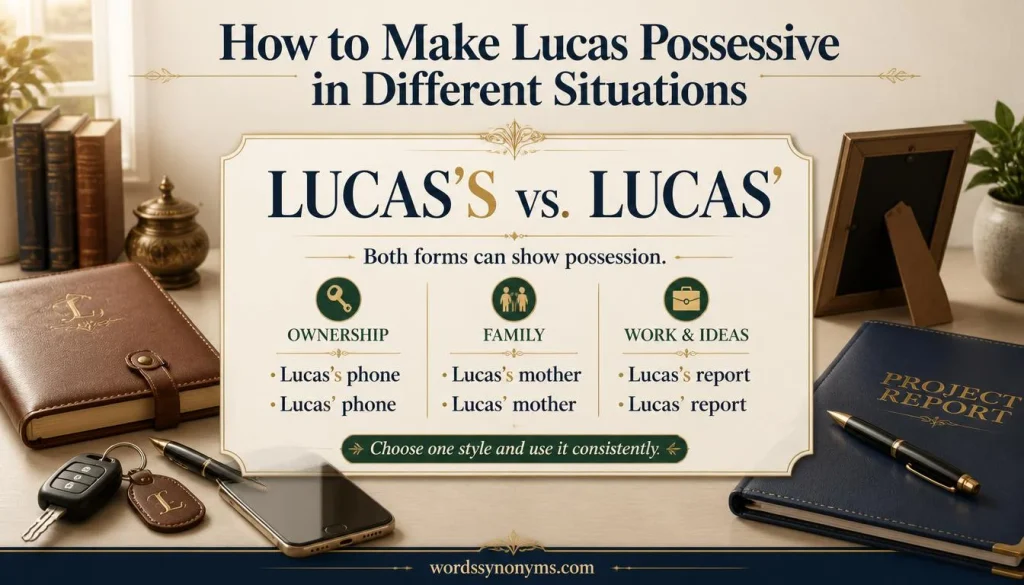
How to Make Lucas Possessive in Different Situations
Once you understand the two spellings, applying them becomes much easier. The same principle works for physical belongings, family relationships, professional responsibilities, and abstract qualities.
The following examples show how both possessive forms work in common situations.
Showing Ownership
Use a possessive form when you want to identify an object associated with Lucas.
| With Lucas’s | With Lucas’ |
| Lucas’s phone is ringing. | Lucas’ phone is ringing. |
| Lucas’s shoes are by the door. | Lucas’ shoes are by the door. |
| Lucas’s car needs repairs. | Lucas’ car needs repairs. |
| Lucas’s wallet fell from his pocket. | Lucas’ wallet fell from his pocket. |
Both columns express the same basic meaning. Choose the spelling that matches your selected style.
Describing Family Relationships
Possessive forms also identify family relationships. They don’t necessarily indicate literal ownership.
Examples include:
- Lucas’s mother teaches mathematics.
- Lucas’ mother teaches mathematics.
- Lucas’s cousin lives nearby.
- Lucas’ cousin lives nearby.
- Lucas’s grandfather tells wonderful stories.
- Lucas’ grandfather tells wonderful stories.
In each example, the possessive identifies the relationship between Lucas and another family member.
Talking About Work, Ideas, and Achievements
The possessive form also works with abstract concepts and professional activities.
Consider these examples:
- Lucas’s report explains the results.
- Lucas’ report explains the results.
- Lucas’s decision surprised his colleagues.
- Lucas’ decision surprised his colleagues.
- Lucas’s experience helped the new employees.
- Lucas’ experience helped the new employees.
Here, the possessive doesn’t refer to an object that Lucas physically owns. Instead, it connects him with a report, decision, or experience.
This distinction matters because possession in grammar includes more than ownership. It can also express relationships, responsibility, authorship, and association.
Lucas’ or Lucas’s: Common Mistakes to Avoid
Even when writers understand the basic rule, a few common mistakes can make possessive forms confusing. Fortunately, they’re easy to correct once you know what to look for.
Leaving Out the Apostrophe
If you want to show possession, writing Lucas book usually won’t work in standard English.
Incorrect: Lucas book is on the desk.
Correct: Lucas’s book is on the desk.
Also correct under an apostrophe-only convention: Lucas’ book is on the desk.
The apostrophe marks the possessive relationship. Without it, the sentence lacks the expected possessive form.
Confusing the Possessive With the Plural
Apostrophes don’t normally create plurals in English. Adding one to a name doesn’t mean you’re referring to multiple people.
Compare these sentences:
- Lucas arrived early. One person named Lucas arrived.
- Lucas’s bag is missing. The bag belongs to Lucas.
- The Lucases arrived early. Multiple people named Lucas arrived.
- The Lucases’ bags are missing. The bags belong to multiple people named Lucas.
The difference between these forms is important. Lucas’s and Lucas’ express singular possession, while Lucases’ expresses plural possession.
Mixing Styles in the Same Document
Imagine writing a report that uses Lucas’s office in one paragraph and Lucas’ desk in another. Both forms may be accepted individually, but the unexplained change can look inconsistent.
A better approach is to select one style and apply it throughout the document.
For example, if you choose the ’s convention, use:
- Lucas’s office.
- Lucas’s desk.
- Lucas’s computer.
If you follow the apostrophe-only convention, use:
- Lucas’ office.
- Lucas’ desk.
- Lucas’ computer.
Consistency makes your writing easier to edit and helps readers trust the quality of your work.
Assuming Every Name Ending in S Follows the Same Rule
Singular possessives are not always handled identically across style guides. That’s why it’s risky to assume that every name ending in s must use an apostrophe alone.
Under the general ’s convention, you can write Lucas’s, James’s, and Chris’s. Under the AP convention for singular proper names ending in s, the corresponding forms generally use an apostrophe alone.
The safest approach is to check the required style rather than rely on the final letter alone.
Lucas’s, Lucas’, or Lucases’? Understanding the Difference
One of the easiest ways to avoid apostrophe mistakes is to understand the difference between a singular name, a singular possessive, and a plural possessive.
Although these forms look similar, they serve different grammatical purposes.
| Form | Grammatical use | Example |
| Lucas | Singular name | Lucas plays tennis. |
| Lucas’s | Singular possessive | Lucas’s racket is new. |
| Lucas’ | Alternative singular possessive | Lucas’ racket is new. |
| Lucases | Plural form | The two Lucases play tennis. |
| Lucases’ | Plural possessive | The Lucases’ rackets are new. |
What Is the Plural of Lucas?
The standard plural form is Lucases when you’re referring to more than one person named Lucas.
For example:
Two students named Lucas joined the science club.
You could also write:
The two Lucases joined the science club.
The ending -es helps form the plural because the name already ends in s. You don’t add an apostrophe simply to make the name plural.
This distinction becomes especially useful when writing about families, groups, or multiple people who share the same name.
What Is the Plural Possessive of Lucas?
When multiple people named Lucas own or share something, the plural possessive is Lucases’.
For example:
The Lucases’ bicycles were parked outside the school.
The bicycles are associated with multiple people named Lucas. The plural noun comes first, followed by the apostrophe.
Compare the three forms:
- Lucas’s bicycle: A bicycle associated with one Lucas.
- Lucas’ bicycle: The same singular possessive under an alternative convention.
- The Lucases’ bicycles: Bicycles associated with multiple people named Lucas.
Remember that Lucas’s and Lucases’ aren’t interchangeable. One indicates singular possession, while the other indicates plural possession.
Lucas’ vs. Lucas’s: Are They Pronounced Differently?
In ordinary speech, Lucas’ and Lucas’s are generally pronounced the same way. The difference appears in writing rather than in the spoken possessive form.
The name Lucas is commonly pronounced LOO-kəs. When you say Lucas’s book, the possessive ending generally sounds like an additional iz sound after the name.
The written form Lucas’ book usually communicates the same possessive pronunciation, even though it doesn’t include the extra written s.
Consider these examples:
- Lucas’s phone.
- Lucas’ phone.
- Lucas’s brother.
- Lucas’ brother.
Both spellings generally sound alike when spoken naturally.
This is why the choice between them rarely depends on pronunciation. Instead, it depends on the spelling convention required by your style guide.
How to Choose Between Lucas’ and Lucas’s
Choosing the right form doesn’t need to be complicated. You can make the decision by following three practical steps.
Follow Your Required Style Guide
First, check whether your assignment, publication, or workplace specifies a particular style.
Use Lucas’s when following a convention that adds ’s to singular proper names ending in s. Use Lucas’ when following a convention that prescribes only an apostrophe for these names.
If you’re editing a document, check the relevant instructions before making changes.
Keep Your Writing Consistent
Next, look at how you’ve handled similar names elsewhere in the document.
If you use James’s book, you would generally use Lucas’s book under the same convention. If your chosen style uses James’ book, it would generally use Lucas’ book.
Consistency matters most when several examples appear together. It makes your work easier to read and prevents unnecessary editing problems.
Consider Your Audience
Finally, think about where your writing will appear.
A school assignment may follow a teacher’s preferred style. A newspaper article may need to follow AP conventions, while a book manuscript may use Chicago style.
If no specific requirement exists, choose one accepted form and stick with it.
Practical tip: When you’re unsure, Lucas’s is a useful general-writing choice. However, follow the required style whenever a specific convention applies.
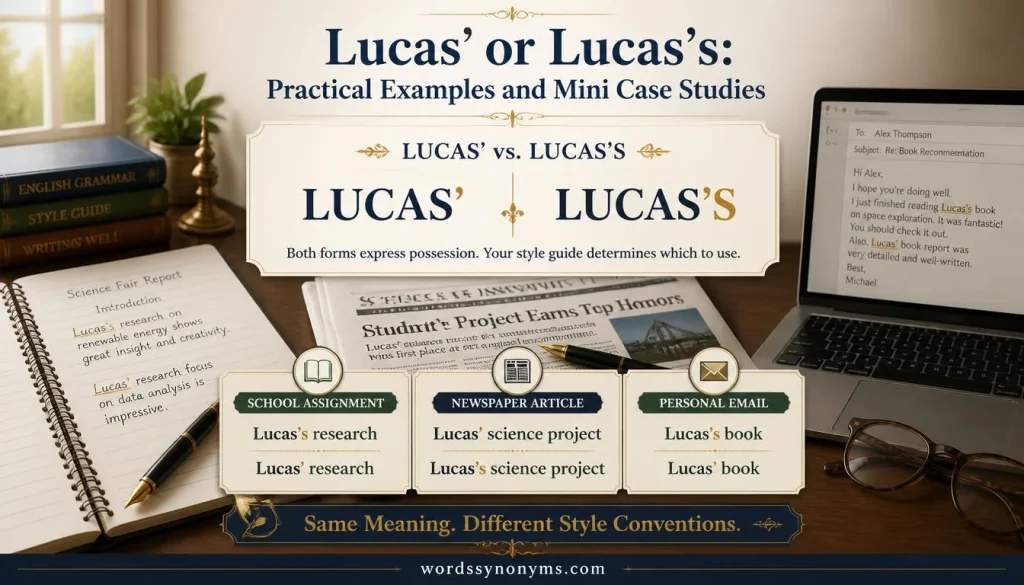
Lucas’ or Lucas’s: Practical Examples and Mini Case Studies
Sometimes, the easiest way to understand a grammar rule is to see it in context. The following examples show how the choice changes depending on the writing situation.
Case Study: A School Assignment
Suppose you’re writing an essay about a student named Lucas.
Your sentence reads:
Lucas’s research helped explain the causes of pollution.
If your teacher follows Chicago style or the general ’s convention, this spelling fits the expected rule.
However, if your teacher specifically requires AP style, you would generally write:
Lucas’ research helped explain the causes of pollution.
The meaning stays the same. Only the required editorial convention changes.
Case Study: A Newspaper Article
Imagine a news report describing a local student’s achievement.
An AP-style sentence might read:
Lucas’ science project earned first place in the regional competition.
A publication following a different style might instead use:
Lucas’s science project earned first place in the regional competition.
Both versions communicate the same information. The publication’s style guide determines which form its editors should use.
Case Study: A Personal Email
Suppose you’re emailing a friend about a book you borrowed.
You might write:
I found Lucas’s book on the kitchen table.
You could also write:
I found Lucas’ book on the kitchen table.
If nobody has specified a style guide, either spelling can work. Choose the version you prefer and keep it consistent with the rest of your message.
These examples illustrate a useful principle: the context determines which convention you should follow, but both forms can express the same possessive meaning.
Read more: Suits You Well – Meaning and Examples
FAQs
Is Lucas’s or Lucas’ correct?
Both Lucas’s and Lucas’ can be correct possessive forms. The choice depends on the style guide you follow. Many modern English style guides prefer Lucas’s, while some use Lucas’.
Is Lucas’s the safer choice in formal writing?
Yes, Lucas’s is often the safer choice for formal writing, academic essays, and professional documents. However, always follow your teacher’s, publisher’s, or organization’s preferred style guide.
Why does Lucas’s have an extra s?
Lucas’s uses an apostrophe followed by another s to show possession. Since Lucas is a singular name, this form follows the common rule for singular possessive nouns.
Should I write Lucas’ book or Lucas’s book?
Both forms are accepted in different style systems. For example, “Lucas’s book is on the desk” follows the widely used singular possessive pattern. Some publications prefer “Lucas’ book” for simplicity.
Does British English use Lucas’ or Lucas’s?
British English uses both forms, depending on the publication and style guide. Some British publications prefer Lucas’s, while others omit the additional s after the apostrophe.
How can I stay consistent when using Lucas’ or Lucas’s?
Choose one form based on your preferred style guide and use it throughout your writing. Consistency matters in essays, business emails, articles, and professional documents. Avoid switching between Lucas’ and Lucas’s without a specific reason.
Conclusion
Choosing between Lucas’ or Lucas’s becomes much easier when you understand the basic possessive rule. Both forms can show ownership, but Lucas’s is often the preferred choice in modern English writing. For example, “Lucas’s book” clearly shows that the book belongs to Lucas. Meanwhile, some style guides, including certain journalistic publications, accept “Lucas’ book.” The important thing is to understand the difference and follow the writing conventions required for your situation.
When writing essays, emails, academic assignments, or professional documents, check your preferred style guide before deciding which form to use. If no specific rule applies, Lucas’s is generally a reliable option. Once you learn how apostrophes work with names ending in s, similar grammar questions become easier to handle. A small punctuation choice might seem unimportant, but using it correctly helps make your writing clearer, more polished, and consistent.

Shafiq Ur Rehman is a writer and content contributor at WordsConfusing.com. He enjoys exploring the English language, common word confusions, vocabulary, and practical writing tips. His goal is to make English easier to understand through clear, simple, and useful articles.