Choosing between Teachers, Teacher’s, and Teachers’ becomes easier when you understand English grammar, plural nouns, and apostrophe placement. Teachers or Teacher’s or Teachers’? Correct Possessive Explained helps you identify the correct form for different writing situations.
Use Teachers when referring to multiple educators, Teacher’s to show singular ownership, and Teachers’ to indicate plural ownership. For example, “The teacher’s book” belongs to one teacher, while “The teachers’ room” belongs to several teachers.
These simple grammatical rules improve correct usage, writing accuracy, and language accuracy. Learning these possessive forms also strengthens your writing skills and helps you avoid common mistakes in everyday communication.
Correct apostrophe rules matter in formal writing, academic writing, business communication, and workplace documents. Whether you prepare emails, school documents, or reports, accurate sentence structure and clear communication help prevent misunderstandings.
Understanding singular nouns, plural forms, possessive grammar, and noun possession makes your writing clearer. With practical examples and consistent practice, you can improve grammatical accuracy, choose the right words confidently, and apply these language rules across educational and professional settings.
Quick answer
- Teachers refers to more than one teacher without showing possession.
- Teacher’s shows possession by one teacher. It can also represent teacher is or teacher has in certain sentences.
- Teachers’ shows possession by two or more teachers.
For example, you might write about several teachers, one teacher’s classroom, or a teachers’ meeting. Each expression is correct in its own context.
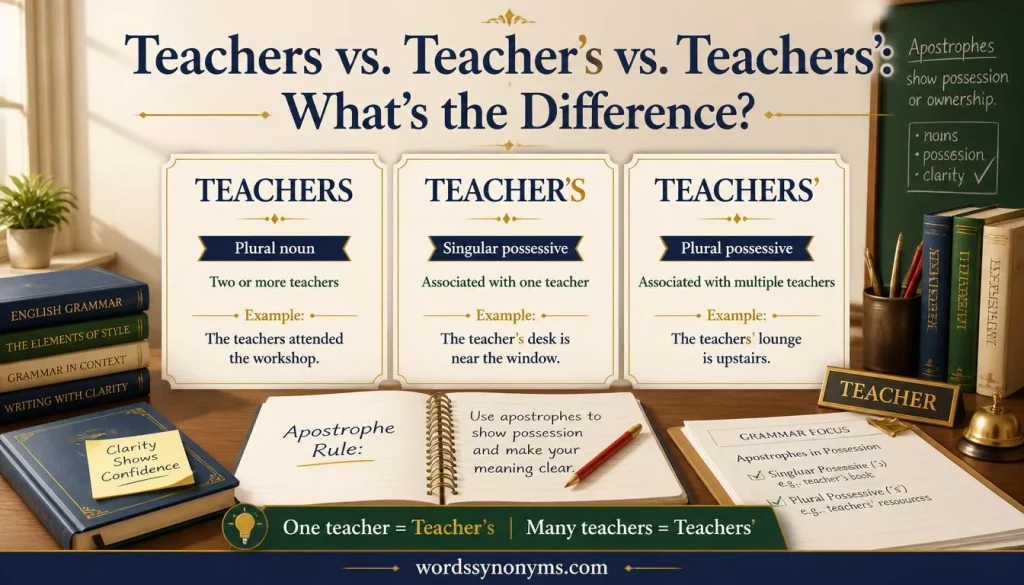
Teachers vs. Teacher’s vs. Teachers’: What’s the Difference?
The main difference between these three forms comes down to number and possession. Number tells you whether you’re referring to one teacher or several. Possession indicates that something belongs to, relates to, or is associated with someone.
Here’s a quick comparison.
| Word | Grammatical function | Meaning | Example |
| Teachers | Plural noun | Two or more teachers | The teachers attended the workshop. |
| Teacher’s | Singular possessive noun | Something belonging to or associated with one teacher | The teacher’s desk is near the window. |
| Teachers’ | Plural possessive noun | Something belonging to or associated with multiple teachers | The teachers’ lounge is upstairs. |
Notice how the apostrophe changes position depending on the grammatical form. The word teachers has no apostrophe when it simply refers to multiple educators. Add an apostrophe before the final s to show singular possession, or after the final s to show plural possession.
The Simple Apostrophe Rule
English uses a straightforward pattern for regular nouns such as teacher.
- One teacher: teacher
- More than one teacher: teachers
- Something associated with one teacher: teacher’s
- Something associated with multiple teachers: teachers’
For example:
- The teachers prepared their lessons.
- The teacher’s lesson included a quiz.
- The teachers’ lessons covered different topics.
These examples show why apostrophe placement matters. The first sentence refers to several teachers. The second connects a lesson with one teacher. The third connects lessons with multiple teachers.
Keep this pattern in mind as you explore each form in detail.
What Does Teachers Mean?
Teachers is the regular plural form of the noun teacher. You use it when referring to two or more people who teach, instruct, or help others learn.
The word doesn’t indicate ownership by itself. It simply identifies a group of educators.
For example, a school might employ twelve teachers across several subjects. You could discuss their schedules, classrooms, teaching methods, or professional responsibilities without using an apostrophe.
When to Use Teachers Without an Apostrophe
Use teachers whenever you mean more than one teacher and aren’t expressing possession through that noun.
Here are some examples:
- The teachers attended a professional development workshop.
- Many teachers use visual aids to explain difficult concepts.
- The teachers discussed the students’ progress after class.
- Several teachers volunteered to organize the school event.
- Experienced teachers often share useful classroom strategies.
- The teachers arrived early to prepare their materials.
In each sentence, teachers functions as a plural noun. None of these examples requires an apostrophe because the word doesn’t directly indicate possession.
Teachers in Different Sentence Structures
The plural noun teachers can perform different grammatical roles.
As the subject:
Teachers help students develop essential skills.
Here, teachers performs the action of helping.
As the object:
The principal thanked the teachers for their hard work.
In this sentence, teachers receives the action of the verb thanked.
After a preposition:
The school provides training opportunities for teachers.
The word teachers follows the preposition for and identifies the people receiving the opportunities.
These examples demonstrate that plural nouns can appear in several parts of a sentence without needing apostrophes.
Common Expressions Using Teachers
You’ll frequently encounter teachers in educational writing and everyday conversation.
| Expression | Example sentence |
| Teachers’ responsibilities? | Teachers’ responsibilities vary by school. |
| Teachers’ training? | Teachers’ training can include classroom management. |
| Experienced teachers | Experienced teachers often mentor new colleagues. |
| Substitute teachers | Substitute teachers cover classes when regular staff members are absent. |
| Teachers and students | Teachers and students worked together on the project. |
The first two expressions in this table use apostrophes because they express possession or association. The remaining expressions use teachers as a simple plural noun.
This distinction is important: the presence of another noun after teachers doesn’t automatically require an apostrophe. You need to determine whether the phrase expresses a possessive relationship.
For example, teachers and students simply names two groups. By contrast, teachers’ responsibilities refers to responsibilities associated with multiple teachers.
What Does Teacher’s Mean?
Teacher’s is the singular possessive form of teacher. You use it when something belongs to, relates to, or is associated with one teacher.
To form the singular possessive of most English nouns, add an apostrophe followed by s. Because teacher is singular, the correct form is teacher’s.
For example:
- The teacher’s desk is covered with books.
- I borrowed the teacher’s dictionary.
- The teacher’s explanation helped everyone understand the problem.
- The teacher’s schedule changed this semester.
- We followed the teacher’s instructions during the experiment.
Each sentence connects something with one teacher. The item doesn’t always need to be a physical possession.
A teacher’s instructions, opinion, experience, or schedule can all use the possessive form because each relates to that individual.
How to Form the Singular Possessive
The rule is simple:
Singular noun + ’s = singular possessive
Consider these examples:
| Singular noun | Singular possessive | Example |
| Teacher | Teacher’s | The teacher’s book is missing. |
| Student | Student’s | The student’s answer was correct. |
| Doctor | Doctor’s | The doctor’s appointment starts at noon. |
| Writer | Writer’s | The writer’s article received positive feedback. |
| Principal | Principal’s | The principal’s office is closed. |
The apostrophe comes before the s because you’re starting with a singular noun.
This pattern applies to many common English nouns. However, some style conventions handle certain proper names and special constructions differently. For ordinary nouns such as teacher, the rule is consistent.
Teacher’s Can Show More Than Ownership
Possession doesn’t always mean that someone physically owns an object. The possessive form can also express a connection, responsibility, source, or association.
For example:
- The teacher’s advice helped me prepare for the exam.
- The teacher’s experience made the lesson more engaging.
- The teacher’s decision surprised the class.
- The teacher’s responsibilities include grading assignments.
- The teacher’s feedback helped improve my writing.
A teacher doesn’t own advice in the same way someone owns a book. Instead, the possessive form identifies whose advice it is.
This broader meaning makes possessive nouns useful in academic and professional writing.
Teacher’s as a Contraction of Teacher Is or Teacher Has
There’s another important use of teacher’s: it can be a contraction of teacher is or teacher has.
The apostrophe marks omitted letters rather than possession.
For example:
- The teacher’s explaining the assignment now.
Meaning: The teacher is explaining the assignment now. - The teacher’s already left the classroom.
Meaning: The teacher has already left the classroom. - The teacher’s been working all morning.
Meaning: The teacher has been working all morning.
These contractions are grammatically acceptable, although they tend to sound more conversational than formal. In academic papers or formal reports, writing the teacher is or the teacher has may be clearer.
Context helps you distinguish the two meanings.
Consider these sentences:
- The teacher’s book is on the table.
- The teacher’s reading a book.
In the first sentence, teacher’s is possessive because it identifies whose book is on the table. In the second, it means teacher is because it describes an ongoing action.
A useful test: Try replacing teacher’s with teacher is or teacher has. If the sentence still makes sense, the word may be a contraction. If not, it may be possessive.
For instance, the teacher is book is on the table doesn’t work. Therefore, teacher’s is possessive in that sentence.
What Does Teachers’ Mean?
Teachers’ is the plural possessive form of teacher. Use it when something belongs to, relates to, or is associated with two or more teachers.
The important detail is that teachers is already plural. Because regular plural nouns ending in s form their possessive by adding an apostrophe after that letter, the correct spelling is teachers’.
For example:
- The teachers’ lounge is next to the library.
- The teachers’ meeting begins at 3 p.m.
- The teachers’ opinions differed on the new policy.
- The teachers’ schedules were posted online.
- The teachers’ shared resources are available in the staff room.
Each sentence refers to something connected with multiple teachers.
How to Form the Plural Possessive
The usual pattern for regular plural nouns is:
Plural noun ending in s + ’ = plural possessive
Compare these forms:
| Singular | Plural | Plural possessive |
| Teacher | Teachers | Teachers’ |
| Student | Students | Students’ |
| Doctor | Doctors | Doctors’ |
| Writer | Writers | Writers’ |
| Parent | Parents | Parents’ |
For example, one student’s notebook belongs to one student. Several students’ notebooks belong to multiple students.
The same principle applies to teachers. One teacher’s desk belongs to one teacher. The teachers’ desks belong to multiple teachers.
Teachers’ Can Describe Shared or Individual Possessions
A plural possessive can refer to something shared by a group or to separate things associated with individual group members.
Shared possession:
The teachers’ lounge has a coffee machine.
This sentence describes a lounge intended for teachers. It doesn’t necessarily establish legal ownership. The possessive form expresses the lounge’s association with the group.
Separate possessions:
The teachers’ lesson plans were collected before the meeting.
This sentence may refer to lesson plans prepared by several teachers, with each teacher contributing individual plans.
The plural possessive doesn’t require everyone to own or use the same object. It simply connects the noun with multiple people.
When Teachers’ Is Correct in School Writing
You’ll often see the plural possessive in school policies, staff communications, meeting notes, and educational reports.
Examples include:
- The teachers’ lounge will remain closed during renovations.
- The teachers’ union announced a scheduled meeting.
- The teachers’ feedback influenced the curriculum review.
- The teachers’ work received recognition at the ceremony.
- The teachers’ shared calendar includes upcoming school events.
In these examples, the possessive relationship connects the noun with a group of teachers.
However, be careful with phrases that simply identify a group rather than express possession.
For example, teachers meeting students describes an action. It doesn’t automatically require an apostrophe. The intended grammatical relationship determines the correct form.
Teachers vs. Teacher’s vs. Teachers’: Key Differences
The easiest way to understand these three forms is to compare them in similar sentences. When the surrounding words stay nearly the same, the difference becomes much clearer.
| Form | Example | What it means |
| Teachers | The teachers prepared the classroom. | Several teachers performed the action. |
| Teacher’s | The teacher’s classroom was clean. | One teacher is associated with the classroom. |
| Teachers’ | The teachers’ classrooms were clean. | Multiple teachers are associated with the classrooms. |
Notice that both possessive forms can indicate association rather than strict ownership.
Also, the nouns following teacher’s and teachers’ don’t have to be singular or plural in the same way as the possessive nouns themselves.
For example, the teacher’s books can refer to several books belonging to one teacher. Meanwhile, the teachers’ book can refer to one book shared by multiple teachers.
The number of the possessive noun tells you how many teachers are involved. The number of the following noun tells you how many items are being discussed.
Compare Teacher’s Books and Teachers’ Book
These two phrases often cause confusion because the words appear in a different order than learners expect.
The teacher’s books
This phrase means that one teacher has or is associated with multiple books.
Example:
The teacher’s books were stacked beside the computer.
The apostrophe appears before the s because the possessor is one teacher.
The teachers’ book
This phrase means that multiple teachers share or are associated with one book.
Example:
The teachers’ book contains activities for the new course.
The apostrophe follows the s because the possessive noun refers to multiple teachers.
The distinction becomes easier when you identify the possessor first and the possessed item second.
A Quick Decision Table
Use this table when you’re unsure which spelling belongs in your sentence.
| If you mean… | Write… | Example |
| More than one teacher | Teachers | Teachers attended the conference. |
| Something associated with one teacher | Teacher’s | The teacher’s classroom is large. |
| Something associated with several teachers | Teachers’ | The teachers’ conference starts tomorrow. |
| One teacher is doing something | Teacher’s, if contracting teacher is | The teacher’s speaking to the principal. |
| One teacher has done something | Teacher’s, if contracting teacher has | The teacher’s completed the report. |
Remember that the contraction examples are informal. In formal writing, the expanded forms often improve clarity.
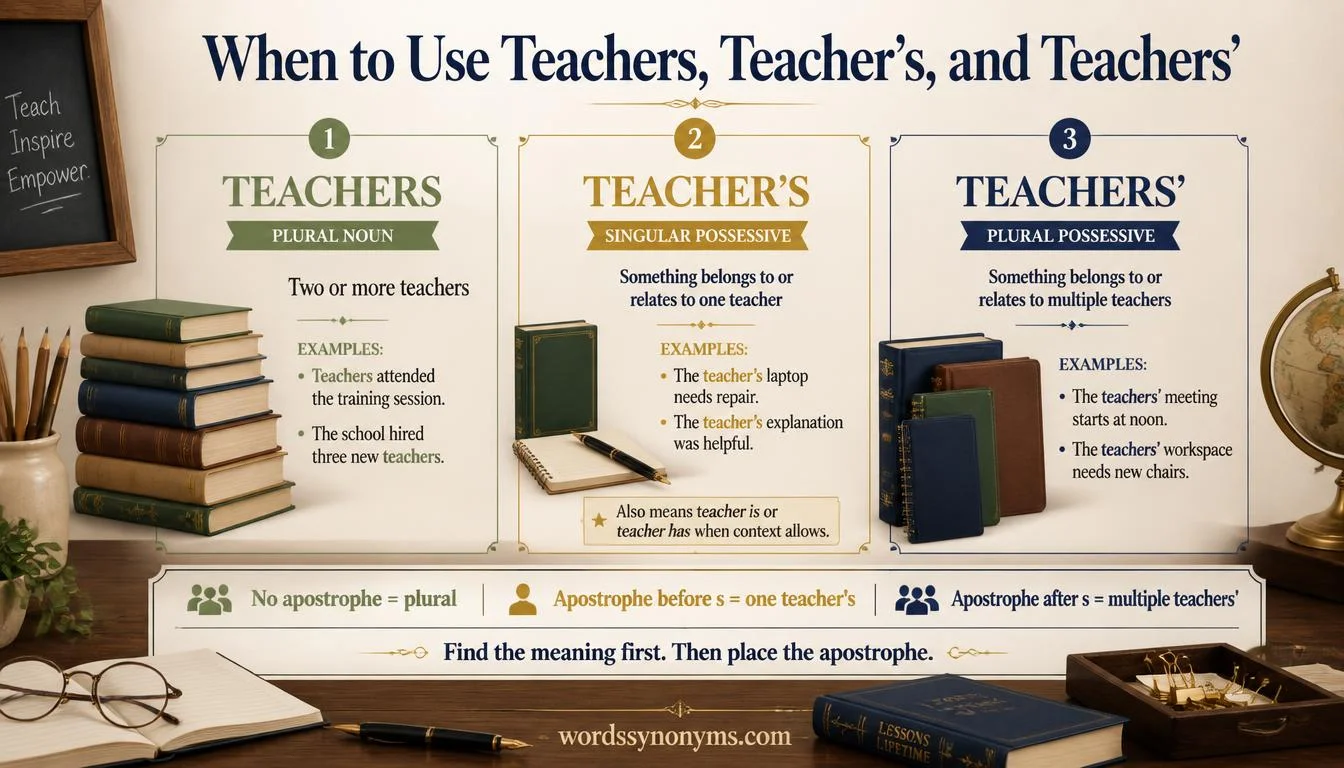
When to Use Teachers, Teacher’s, and Teachers’
Choosing the correct form becomes much easier when you focus on what the sentence actually means. Instead of memorizing isolated spellings, identify the number of teachers and the relationship between the nouns.
Use Teachers for Plural References
Choose teachers when discussing several educators without making the word possessive.
Examples:
- Teachers attended the annual training session.
- The school hired three new teachers.
- Many teachers use digital tools in their classrooms.
- Teachers often collaborate to support struggling students.
The form remains unchanged whether the sentence appears in a school newsletter, an essay, or an everyday conversation.
Use Teacher’s for One Teacher
Choose teacher’s when a single teacher owns, provides, creates, or is associated with something.
Examples:
- The teacher’s explanation clarified the difficult concept.
- I returned the teacher’s keys after class.
- The teacher’s report included student performance data.
- We discussed the teacher’s approach to classroom management.
You can also use teacher’s as a contraction when the context clearly means teacher is or teacher has.
Use Teachers’ for Multiple Teachers
Choose teachers’ when a possessive relationship involves several teachers.
Examples:
- The teachers’ meeting covered the revised school calendar.
- The teachers’ feedback helped improve the lesson materials.
- The teachers’ offices are located on the second floor.
- The teachers’ professional development program begins in June.
The apostrophe follows the plural s. That’s the key visual clue.
Practical Examples From School Life
Imagine a school preparing for a new academic year. The staff might discuss several different matters, and each situation calls for a particular form.
| Situation | Correct sentence | Why it’s correct |
| Several educators attend a meeting. | The teachers attended the meeting. | Teachers is plural. |
| One educator owns a laptop. | The teacher’s laptop needs repair. | Teacher’s is singular possessive. |
| Several educators share a workspace. | The teachers’ workspace needs new chairs. | Teachers’ is plural possessive. |
| One educator is preparing a lesson. | The teacher’s preparing a lesson. | Teacher’s means teacher is. |
| Several educators submit separate reports. | The teachers’ reports arrived today. | The reports are associated with multiple teachers. |
These examples reflect ordinary writing situations. They also demonstrate why context matters more than the appearance of the word alone.
Common Mistakes With Teachers, Teacher’s, and Teachers’
Even experienced writers sometimes misplace apostrophes. Fortunately, most errors involving these forms come from a few predictable misunderstandings.
Mistake: Writing Teacher’s When You Mean Several Teachers
Incorrect:
The teacher’s attended the training session.
Correct:
The teachers attended the training session.
The first sentence incorrectly uses a possessive-looking form before a verb. If you mean multiple teachers attended, use the plural noun without an apostrophe.
However, teacher’s could be correct in another sentence, such as the teacher’s attendance was recorded. There, the word expresses possession or association.
Mistake: Writing Teachers’ for One Teacher
Incorrect:
The teachers’ desk is near the window.
Correct, if one teacher is involved:
The teacher’s desk is near the window.
The original sentence suggests a relationship with multiple teachers. If the desk belongs to or is associated with one teacher, the singular possessive is appropriate.
The original sentence could be correct in a different context, such as a desk shared by several teachers.
Mistake: Leaving Out the Apostrophe in a Plural Possessive
Incorrect:
The teachers lounge is upstairs.
Correct:
The teachers’ lounge is upstairs.
If the phrase means a lounge associated with multiple teachers, the apostrophe belongs after the s.
This mistake is common because people sometimes treat teachers lounge as a compound noun. However, the conventional possessive form is teachers’ lounge when the meaning is a lounge for teachers.
Mistake: Adding an Apostrophe to Every Plural
Incorrect:
The school hired five teacher’s.
Correct:
The school hired five teachers.
Regular plural nouns don’t need apostrophes simply because they end in s. Apostrophes generally mark possession or certain contractions, not ordinary plural forms.
Compare:
- Three teachers joined the committee.
- One teacher’s presentation impressed the committee.
- Three teachers’ presentations impressed the committee.
Each spelling has a distinct grammatical purpose.
Mistake: Confusing Possession With a Contraction
Consider these examples:
- The teacher’s book is missing.
- The teacher’s finished the book.
The first sentence uses the singular possessive. The second uses teacher’s as a contraction of teacher has, meaning the teacher has finished the book.
Both forms can be correct, but they express different meanings.
When the sentence seems confusing, write out the contraction. If the expanded sentence makes sense, you’ve likely identified the intended meaning.
Mistake: Assuming the Possessed Item Must Be Singular
Incorrect reasoning often begins with this assumption: because teacher’s contains an s, the next noun must be singular.
That’s not how English possessives work.
Both of these sentences are correct:
- The teacher’s books are on the desk.
- The teachers’ book is on the desk.
In the first sentence, one teacher is associated with multiple books. In the second, several teachers are associated with one book.
The possessive noun identifies the possessor, not the number of items possessed.
How to Remember the Difference Between Teachers, Teacher’s, and Teachers’
You don’t need a complicated grammar formula to choose the right spelling. A simple two-step check usually solves the problem.
Step One: Identify the Number of Teachers
Ask yourself whether you’re referring to one teacher or more than one.
- One teacher: teacher
- Multiple teachers: teachers
This step establishes the basic noun form before you consider possession.
Step Two: Decide Whether You’re Showing Possession
Next, determine whether the sentence expresses ownership, association, or a relationship.
- Multiple teachers without possession: teachers
- One teacher with possession: teacher’s
- Multiple teachers with possession: teachers’
For example, suppose you want to describe a collection of classroom materials.
1. If several teachers use the materials, you might write the teachers’ materials.
2. If one teacher uses them, you might write the teacher’s materials.
3. If you’re simply discussing the educators, you could write the teachers organized the materials.
The intended meaning determines the correct form.
The One-Teacher and Many-Teachers Trick
A quick mental test can help you remember where the apostrophe belongs.
Imagine one teacher standing beside a desk. To show that the desk belongs to or is associated with that teacher, write:
The teacher’s desk.
Now imagine several teachers sharing a staff room. Write:
The teachers’ lounge.
The apostrophe moves because the noun changes from singular to regular plural.
This trick works well for other regular nouns, too:
- The student’s project.
- The students’ projects.
- The parent’s question.
- The parents’ questions.
Once you understand the pattern, you can apply it to many everyday writing situations.

Teachers, Teacher’s, and Teachers’ Examples in Sentences
The best way to reinforce a grammar rule is to see it used in context. The following examples cover common situations involving classrooms, staff members, school events, and educational materials.
Examples Using Teachers
Use teachers when the word simply refers to multiple educators.
- The teachers prepared their classrooms before the first day.
- Several teachers participated in the science fair.
- Teachers often exchange ideas during professional development sessions.
- The teachers discussed ways to improve student attendance.
- Many teachers use examples to explain abstract concepts.
- The school recognized its teachers during the annual ceremony.
In each example, teachers is a plural noun without a possessive apostrophe.
Examples Using Teacher’s
Use teacher’s to express possession or association with one teacher.
- The teacher’s desk was covered with notebooks.
- I followed the teacher’s advice when revising my essay.
- The teacher’s feedback helped me correct several mistakes.
- We waited outside the teacher’s office.
- The teacher’s explanation made the topic easier to understand.
- The teacher’s presentation included a helpful diagram.
You can also use it as a contraction:
- The teacher’s waiting outside. (The teacher is waiting outside.)
- The teacher’s finished grading the tests. (The teacher has finished grading the tests.)
The surrounding words make the intended meaning clear.
Examples Using Teachers’
Use teachers’ when the possessive relationship involves multiple teachers.
- The teachers’ lounge closes at 5 p.m.
- The teachers’ meeting focused on student progress.
- The teachers’ recommendations shaped the revised curriculum.
- We collected the teachers’ reports before the deadline.
- The teachers’ schedules are available in the staff office.
- The teachers’ shared resources helped the new employees.
These examples show the apostrophe after the final s in the plural noun.
Side-by-Side Sentence Comparisons
Compare these sentences to see how a small punctuation change affects meaning.
| Sentence | Meaning |
| The teachers are preparing the room. | Multiple teachers are doing the work. |
| The teacher’s room is ready. | One teacher is associated with the room. |
| The teachers’ room is ready. | Multiple teachers are associated with the room. |
| The teacher’s reviewing the plans. | The teacher is reviewing the plans. |
| The teachers reviewed the plans. | Multiple teachers reviewed the plans. |
| The teachers’ plans were approved. | Plans associated with multiple teachers were approved. |
These examples also highlight an important point: the possessive form doesn’t tell you whether an object is shared. It tells you who the object or idea is associated with.
A Short Classroom Case Study
Imagine that a school principal is preparing a newsletter about a new reading program. The principal needs to describe staff participation, a classroom resource, and a group meeting.
Here’s how the wording changes according to the intended meaning.
Situation one: Describing the staff
The teachers helped introduce the reading program.
The sentence refers to multiple teachers performing an action. No apostrophe is needed.
Situation two: Describing one educator’s resource
The teacher’s reading guide includes activities for beginners.
The guide is associated with one teacher. The singular possessive form is correct.
Situation three: Describing a group meeting
The teachers’ meeting focused on improving reading comprehension.
The meeting involves multiple teachers. The plural possessive form communicates that relationship.
The principal could use all three forms in the same newsletter. Each one serves a different grammatical purpose, and none is interchangeable with the others.
Read more: Can You Start a Sentence With “Yet”? Examples
FAQs
1. What is the difference between Teachers, Teacher’s, and Teachers’?
Teachers is the plural form of teacher. Teacher’s shows that something belongs to one teacher, while Teachers’ shows that something belongs to multiple teachers.
2. When should I use Teacher’s in a sentence?
Use Teacher’s when something belongs to one teacher. For example, “The teacher’s desk is near the window.”
3. When is Teachers’ the correct form?
Use Teachers’ when something belongs to two or more teachers. For example, “The teachers’ meeting starts at noon.”
4. Is Teachers correct without an apostrophe?
Yes. Teachers is correct when you mean more than one teacher without showing ownership. For example, “The teachers are preparing their lessons.”
5. How can I remember where to place the apostrophe?
First, decide whether you mean one teacher or several teachers. For one teacher, add ’s. For multiple teachers, add an apostrophe after the final s. Remember: Teacher’s means one owner, while Teachers’ means multiple owners.
6. What are common mistakes when using Teachers, Teacher’s, and Teachers’?
A common mistake is using Teacher’s to describe several teachers or writing Teachers’ when no ownership is involved. For example, “The teachers’ classroom” shows possession, but “The teachers are here” needs no apostrophe.
Conclusion
Understanding the difference between Teachers, Teacher’s, and Teachers’ doesn’t have to be complicated. The trick is to identify whether you mean several teachers or something that belongs to them. Use Teachers for more than one teacher, Teacher’s for something owned by one teacher, and Teachers’ for something shared by or belonging to multiple teachers. Once you recognize these patterns, choosing the correct form becomes much easier.
Whether you’re writing school notices, academic assignments, emails, or workplace documents, correct apostrophe placement makes your meaning clear. A tiny punctuation mark can change how readers understand a sentence, so it’s worth checking before you publish. Practice with everyday examples, remember the ownership rule, and you’ll feel more confident using these forms. With a little attention, you can avoid common grammar mistakes and make your English writing clearer and more professional.

Shafiq Ur Rehman is a writer and content contributor at WordsConfusing.com. He enjoys exploring the English language, common word confusions, vocabulary, and practical writing tips. His goal is to make English easier to understand through clear, simple, and useful articles.