

In “This People” or “These People”: Which Is Correct?, the answer depends on whether the noun refers to one person or a group in standard English.
The correct phrase is generally “these people” because people is a plural noun. In English grammar, these works as a demonstrative pronoun or determiner with plural nouns, while this accompanies a singular noun. Understanding this grammar distinction helps you avoid common mistakes and improve grammatical accuracy, writing accuracy, and sentence structure.
For example, “These people are friendly” follows standard English usage, but “This people are friendly” does not. Although native speakers often make these grammar choices naturally, learning the basic grammar rules, demonstrative words, and noun agreement can strengthen your word choice and writing confidence.
This distinction also matters in formal writing, business communication, emails, reports, presentations, and meetings, where professionalism, consistency, and language clarity are important.
Whether you’re updating a calendar, managing project management or time management tasks, using online booking systems, or sharing information through broadcasting platforms, correct usage helps deliver your message without confusion and communicates your intended meaning clearly to readers.
Practicing different usage patterns, studying practical examples and real-world examples, and applying them in everyday conversations can improve your communication skills, workplace communication, professional communication, writing skills, and communication effectiveness.
These habits also reinforce the difference between this and these, proper grammatical agreement, and overall grammatical correctness, helping you make the correct choice when referring to a group of people.
Quick Answer
“These people” is correct when referring to two or more individuals. The word these is plural, so it agrees with the plural noun people.
- Correct: These people are waiting outside.
- Correct: These people have different opinions.
- Usually incorrect: This people are waiting outside.
However, “this people” can be grammatically acceptable when people refers to one collective population, such as a nation or ethnic group.
For example:
– This people has preserved its traditions for centuries.
In ordinary American English, use “these people” whenever you mean multiple individuals.
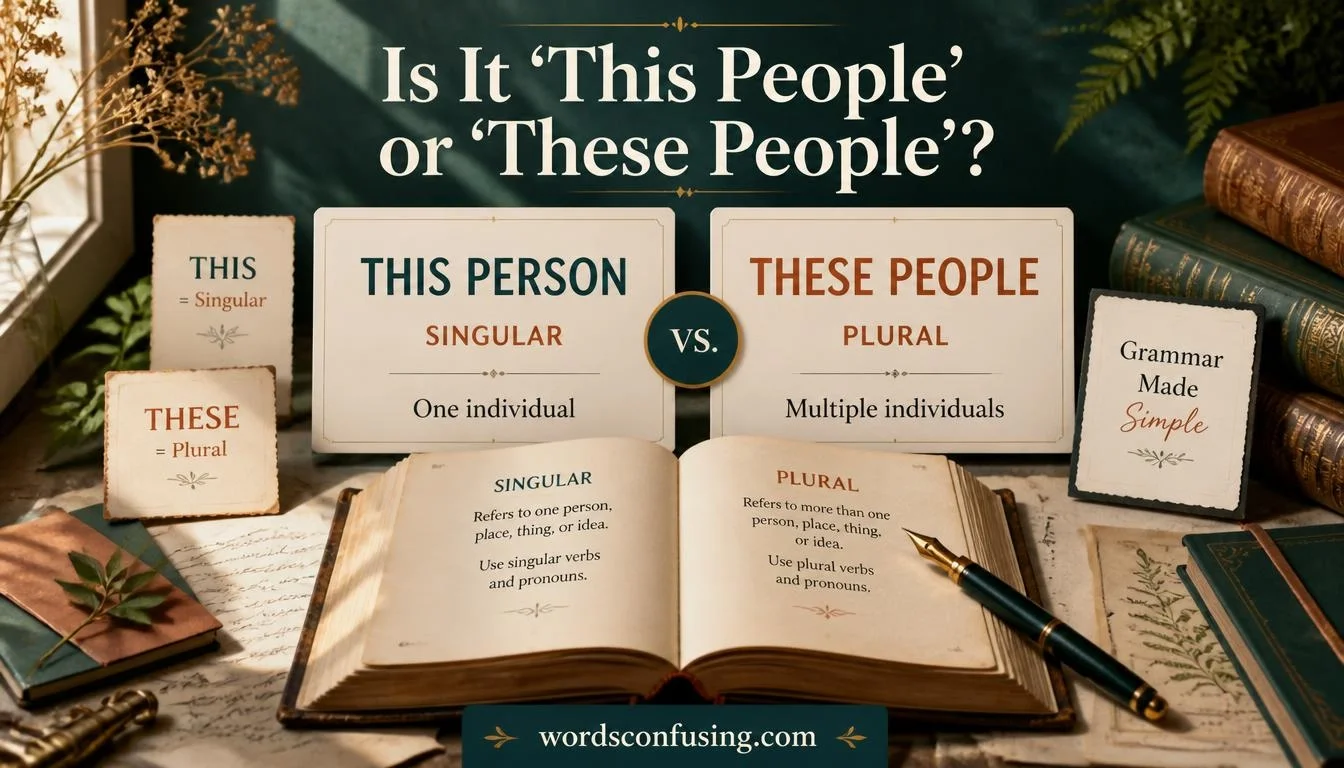
Is It “This People” or “These People”?
The correct expression depends on what you mean by people. When discussing several individuals, these people follows standard English grammar.
The reason is simple: demonstrative words must agree with the number of nouns they describe.
Consider these examples:
- This person is waiting outside.
- These people are waiting outside.
- This student needs assistance.
- These students need assistance.
Notice how the demonstrative changes when the noun becomes plural. The same principle applies to person and people.
Why “These People” Is Correct in Everyday English
The noun people usually functions as the plural form of person. Therefore, it normally takes plural demonstratives and plural verbs.
For example:
- These people are my neighbors.
- These people work in different departments.
- These people deserve equal opportunities.
- These people have helped our community.
- These people understand the situation.
Each sentence refers to multiple individuals. That’s why these works naturally.
When “This People” Can Be Correct
Although these people is the normal choice, this people isn’t automatically wrong in every context.
The noun people can also describe a distinct population united by shared culture, ancestry, nationality, or history. In this sense, a people refers to one collective community.
For example:
- This people has maintained its cultural identity.
- This people has a long and fascinating history.
Here, this people refers to one population rather than several unrelated individuals. The singular verb has treats that population as a collective unit.
However, this construction sounds formal or literary in modern American English. In everyday conversation, expressions such as this community, this nation, or this ethnic group often sound more natural.
Why Is “These People” Correct?
The word these is the plural form of this. It identifies specific people, objects, or things that are generally close to the speaker or connected to the current discussion.
Since people usually refers to multiple individuals, these two words naturally work together.
Think of it this way: one person becomes this person, while several people become these people.
Understanding Demonstrative Determiners
Demonstrative determiners help you identify particular people or things. English has four main demonstratives: this, that, these, and those.
Each word has a specific purpose.
| Demonstrative | Number | General Use | Example |
| This | Singular | Something nearby | This person is helpful. |
| That | Singular | Something farther away | That person is helpful. |
| These | Plural | Multiple things nearby | These people are helpful. |
| Those | Plural | Multiple things farther away | Those people are helpful. |
These words answer an important question: Which person or people are you talking about?
For example, imagine introducing your friends to someone. You might say, “These people are my college friends.”
However, if you point toward a group across the street, you might say, “Those people are waiting for the bus.”
The choice depends on number and context.
Why “People” Takes a Plural Verb
The noun people generally takes plural verbs because it refers to multiple individuals.
For example:
- These people are talented.
- These people have excellent communication skills.
- These people were invited to the event.
- These people work together.
Notice the verbs are, have, were, and work. Each agrees with the plural subject.
Using a singular verb in these sentences would create a subject-verb agreement problem.
- Incorrect: These people is talented.
- Correct: These people are talented.
Remember that changing the demonstrative doesn’t change the number of the noun. The entire subject must follow the same grammatical pattern.
Read more: Hands-On Experience: Meaning, Benefits and Examples
Why Is “This People” Usually Incorrect?
The confusion comes from treating this and these as interchangeable words. Although both identify particular things or people, they don’t serve the same grammatical purpose.
This normally describes one person or one thing. Meanwhile, these describes multiple people or things.
Therefore, using this directly before people usually creates a number disagreement.
Consider these examples:
| Incorrect Expression | Correct Expression |
| This people are friendly. | These people are friendly. |
| This people have arrived. | These people have arrived. |
| This people need help. | These people need help. |
| This people work here. | These people work here. |
| This people deserve respect. | These people deserve respect. |
Each corrected sentence refers to multiple individuals. Consequently, these is the appropriate demonstrative.
The Difference Between Singular and Plural Agreement
English grammar relies on number agreement between determiners and nouns. This means singular words generally accompany singular nouns, while plural words accompany plural nouns.
For example:
- This child is playing outside.
- These children are playing outside.
- This woman is a doctor.
- These women are doctors.
- This employee works remotely.
- These employees work remotely.
The same pattern explains why these people works in ordinary sentences.
However, remember that grammatical number depends on meaning. When people describes one distinct population, this people can function as a collective expression.
Common Mistakes With “This People”
Several common mistakes occur when writers overlook the difference between singular and plural demonstratives.
Here are some examples worth remembering:
1 Mistake: Using “this” with ordinary plural people
- Incorrect: This people are waiting for their turn.
- Correct: These people are waiting for their turn.
2 Mistake: Using a singular verb with “these people”
- Incorrect: These people is very helpful.
- Correct: These people are very helpful.
3 Mistake: Confusing “person” and “people”
- Incorrect: These person are my classmates.
- Correct: These people are my classmates.
4 Mistake: Using “this” when describing several individuals
- Incorrect: This people deserve an apology.
- Correct: These people deserve an apology.
The easiest solution is to identify whether you’re discussing one individual, several individuals, or one collective population.
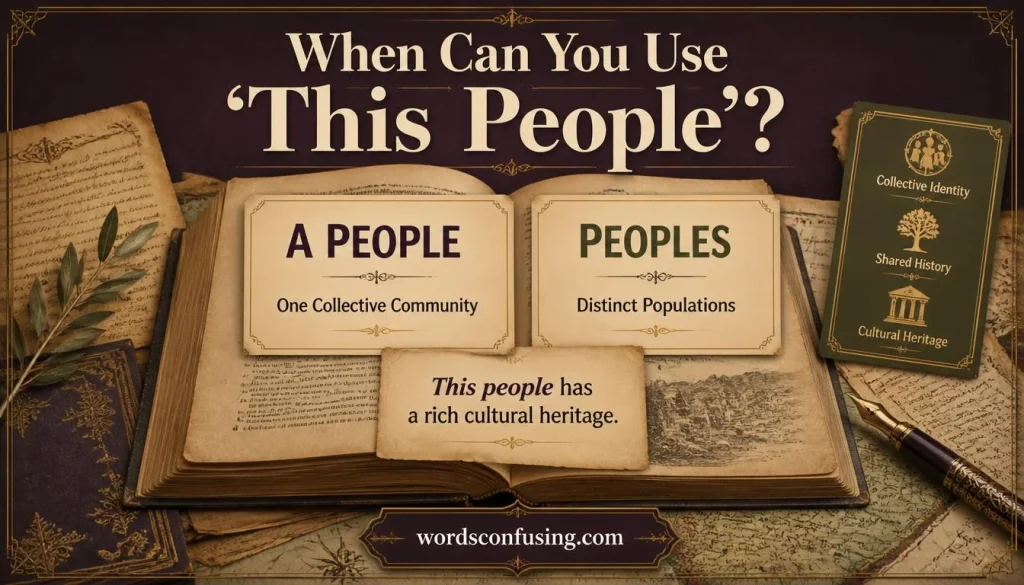
When Can You Use “This People”?
Here’s where the distinction becomes interesting. The word people doesn’t always refer to several unrelated individuals.
Sometimes, it describes an entire population connected through shared identity, culture, history, or ancestry.
In this collective sense, “this people” can be grammatically correct.
For example, consider this sentence:
“This people has preserved its traditions despite centuries of change.”
The expression refers to one distinct cultural population. The writer presents that population as a single collective entity.
This usage commonly appears in historical, religious, academic, and literary writing.
“People” as a Collective Noun
A collective noun describes a group considered as one unit. Words such as family, team, committee, and audience are familiar examples.
The word people can also function this way when it describes a particular nation or cultural population.
Consider these examples:
- This people has a rich cultural heritage.
- This people has preserved its ancestral language.
- This people has maintained its traditional customs.
- This people has a distinctive historical identity.
In these examples, the writer emphasizes the population as one collective community.
However, the construction is relatively formal. In everyday American English, you might find these alternatives more natural:
- This community has preserved its traditions.
- This nation has a rich cultural heritage.
- This ethnic group has maintained its identity.
- This population has a distinctive history.
The meaning remains similar, but the alternative expressions sound more familiar to modern readers.
The Difference Between “A People” and “People”
This distinction deserves special attention because it explains why both expressions can appear in correct English.
People usually serves as the plural of person. However, a people describes one distinct cultural, ethnic, or national community.
Compare these examples:
| Expression | Meaning | Example |
| People | Multiple individuals | These people are waiting. |
| A people | One distinct population | This people has a long history. |
| Peoples | Multiple distinct populations | These peoples have different traditions. |
For example, imagine a historian discussing an ancient civilization.
The historian might write:
“This people developed sophisticated agricultural practices.”
The sentence treats the civilization’s population as one historical community.
However, if the historian discusses several distinct communities, the sentence might become:
“These peoples developed different agricultural practices.”
Here, peoples refers to multiple distinct populations rather than individual people.
Does “This People” Always Take a Singular Verb?
Not necessarily. Verb agreement depends on whether the writer treats the group as one collective unit or emphasizes its individual members. Usage also varies across English dialects and writing traditions.
In standard American English, a collective population treated as one unit generally takes a singular verb.
For example:
- This people has a distinctive language.
- This people has preserved its traditions.
When discussing individual members, writers can restructure the sentence to make the plural meaning clear.
For example:
- The people of this community have preserved their traditions.
- The members of this population have maintained their cultural practices.
This distinction helps prevent awkward or confusing constructions.
For everyday writing, this community has or these people have will usually communicate your meaning more naturally.
Difference Between “This” and “These”
Although this and these look similar, they have different grammatical functions.
Both words are demonstratives. They help identify specific people, objects, places, or situations.
The main difference involves grammatical number.
When to Use “This”
Use this before a singular countable noun when identifying one person or thing.
Examples include:
- This person is my brother.
- This book belongs to Sarah.
- This house needs repairs.
- This student deserves recognition.
- This idea could solve the problem.
You can also use this as a pronoun without placing a noun immediately afterward.
For example:
- This is my favorite restaurant.
- This looks interesting.
- This belongs to my friend.
In each sentence, this identifies one particular thing or situation.
When to Use “These”
Use these before plural nouns when identifying multiple people or things.
Examples include:
- These people are my colleagues.
- These books belong to Sarah.
- These houses need repairs.
- These students deserve recognition.
- These ideas could solve the problem.
You can also use these independently as a pronoun.
For example:
- These are my favorite books.
- These look interesting.
- These belong to my friends.
The plural meaning remains the same whether these accompanies a noun or replaces one.
“This” vs. “These”: Quick Comparison
| Feature | This | These |
| Grammatical number | Singular | Plural |
| Noun type | Singular countable noun | Plural noun |
| General distance | Near | Near |
| Example with people | This person | These people |
| Example with books | This book | These books |
| Example with students | This student | These students |
| Example with ideas | This idea | These ideas |
Easy rule: Use this for one and these for more than one.

Difference Between “Person” and “People”
Another reason writers confuse these expressions involves the relationship between person and people.
Both words refer to human beings, but they serve different grammatical purposes.
Person is the singular noun. It identifies one individual.
People is the usual plural form. It identifies two or more individuals.
For example:
- One person is standing outside.
- Three people are standing outside.
This difference also affects which demonstrative you should choose.
Person vs. People: Examples
| Singular Form | Plural Form |
| This person | These people |
| That person | Those people |
| One person | Several people |
| A person | Many people |
| Every person | All people |
Notice how the demonstrative changes alongside the noun.
For instance, this person becomes these people. Similarly, that person becomes those people.
These combinations follow ordinary English number agreement.
Is “Persons” Also Correct?
Yes. Persons is a legitimate plural form of person, although people is much more common in everyday English.
The word persons frequently appears in legal, official, administrative, and formal contexts.
For example:
- Only authorized persons may enter this area.
- The building accommodates 200 persons.
- Several persons attended the official hearing.
However, most everyday conversations use people instead.
For example:
- Several people attended the meeting.
- Many people enjoy reading.
- These people live nearby.
Both people and persons can be correct. Your choice depends on context and tone.
What About “Peoples”?
The word peoples has a different meaning from ordinary plural people.
It generally refers to multiple distinct ethnic, cultural, national, or historical communities.
For example:
- The peoples of the region have different traditions.
- Indigenous peoples have diverse cultural identities.
- Ancient peoples developed different forms of government.
Compare the meanings:
- People: Several individuals.
- Peoples: Several distinct populations or cultural groups.
This distinction becomes especially useful when discussing history, anthropology, geography, and cultural identity.
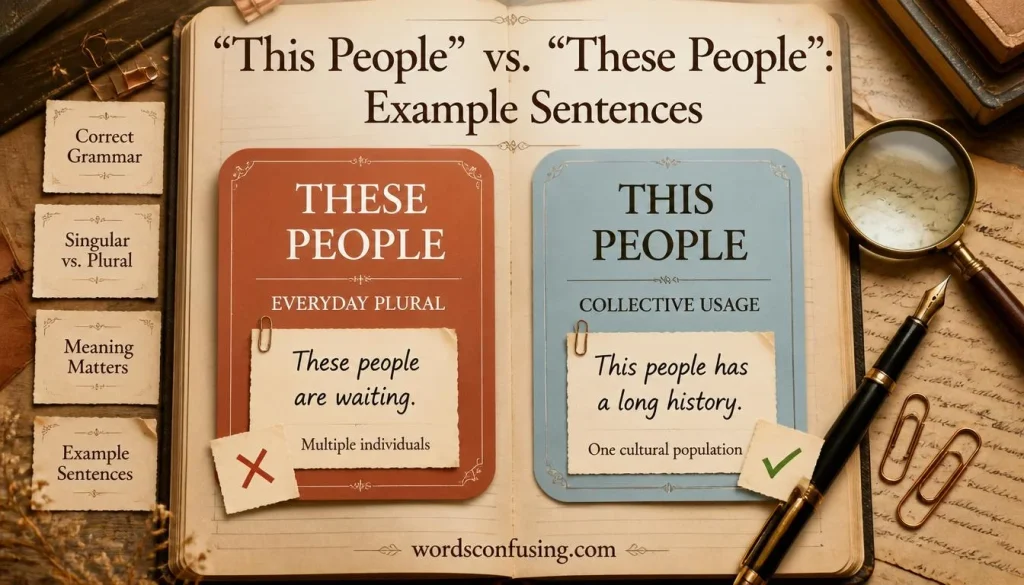
“This People” vs. “These People”: Example Sentences
Examples make grammatical rules easier to understand. The following sentences show how both expressions work in different situations.
Examples of “These People” in Everyday Conversations
Use these people when referring to multiple individuals in ordinary conversations, emails, articles, and other writing.
Here are some natural examples:
- These people are waiting for the bus.
- These people know how to solve difficult problems.
- These people have helped me tremendously.
- These people are new to our neighborhood.
- Why are these people making so much noise?
- These people work together every weekend.
- These people deserve better treatment.
- These people have different opinions about the issue.
- I invited these people to my birthday party.
- These people are responsible for organizing the event.
In every example, these identifies multiple individuals. The plural verb forms also agree with the subject.
Examples of “This People” in Collective or Historical Contexts
The expression this people can describe one distinct population or cultural community.
Here are some examples:
- This people has preserved its cultural traditions.
- This people has a remarkable historical background.
- This people has maintained its ancestral language.
- This people has a strong connection to its homeland.
- This people has developed unique artistic traditions.
- This people has passed its customs between generations.
- This people has a distinctive cultural identity.
These examples use this people as a singular collective expression.
However, this construction can sound unusual in everyday American English. If you’re writing for a general audience, consider using this community, this population, or this ethnic group instead.
Examples Comparing Both Expressions
The following comparisons show how meaning determines the correct expression.
| Sentence | Correct or Incorrect | Explanation |
| These people are kind. | Correct | Refers to multiple individuals. |
| This people are kind. | Usually incorrect | Uses a singular demonstrative with ordinary plural people. |
| This people has a long history. | Correct in collective usage | Refers to one distinct population. |
| These people have arrived. | Correct | Uses plural demonstrative and verb. |
| These people is helpful. | Incorrect | The plural subject requires a plural verb. |
| This person is helpful. | Correct | Refers to one individual. |
A Practical Case Study: Choosing the Right Expression
Imagine you’re writing an article about a group of volunteers who recently organized a community event.
You want to describe their hard work and dedication.
You might write:
“These people worked tirelessly to make the event successful.”
This sentence is correct because you’re discussing several individual volunteers.
Now imagine writing a historical article about one ancient civilization.
You might write:
“This people has preserved its cultural identity throughout history.”
Here, this people describes one distinct population rather than several unrelated individuals.
The difference isn’t simply about which expression sounds better. The intended meaning determines the grammatical construction.
Common Mistakes to Avoid
Even experienced English speakers sometimes confuse demonstrative words. Fortunately, a few simple distinctions can prevent most mistakes.
Here are common errors and their corrections.
Using “This” Before Ordinary Plural Nouns
The word this normally accompanies singular countable nouns.
- Incorrect: This students are preparing for exams.
- Correct: These students are preparing for exams.
The same rule applies to people.
- Incorrect: This people are waiting outside.
- Correct: These people are waiting outside.
Using “Is” With “These People”
The subject these people is plural in ordinary usage. Therefore, it requires a plural verb.
- Incorrect: These people is very generous.
- Correct: These people are very generous.
Remember this simple comparison:
- This person is generous.
- These people are generous.
Confusing “People” With “Person”
The words person and people aren’t interchangeable.
- Incorrect: These person are my friends.
- Correct: These people are my friends.
Likewise:
- Incorrect: This people is my neighbor.
- Correct: This person is my neighbor.
The correct noun depends on how many individuals you’re describing.
Using “These” With Singular Nouns
The opposite mistake happens when writers use these before a singular noun.
- Incorrect: These person needs assistance.
- Correct: This person needs assistance.
- Incorrect: These student is intelligent.
- Correct: This student is intelligent.
Always check whether the noun is singular or plural before choosing your demonstrative.
Confusing “People” With “Peoples”
These two words have different meanings.
- People generally refers to multiple individuals.
- Peoples refers to multiple distinct cultural, ethnic, or national populations.
For example:
- These people are attending the conference.
- The peoples of these regions have different traditions.
The second sentence discusses distinct populations rather than individual attendees.
Read more: 3 Words for a Person Who Takes a Survey: Meaning and Usage
FAQs
1. Is “this people” grammatically correct?
No, “this people” is generally incorrect in everyday English when referring to a group. Use “these people” because people is plural. For example, “These people work hard” is correct.
2. Why do we say “these people” instead of “this people”?
We use these with plural nouns and this with singular nouns. Since people refers to more than one person, these is the appropriate choice.
3. Can I use “this” when talking about a group of people?
Not directly with the plural noun people in standard English. However, you can say “this group of people” because group is a singular noun.
4. Is “these people” singular or plural?
“These people” is plural. These points to multiple individuals, while people identifies the group. You should also use a plural verb, such as are, were, or have.
5. Should I say “these people are” or “these people is”?
Always say “these people are” in standard English. People is plural, so it takes plural verbs. For example, “These people are waiting outside.”
6. What is the difference between “this person” and “these people”?
“This person” refers to one individual, while “these people” refers to multiple individuals. The difference comes from singular and plural noun agreement.
7. Can I say “these persons” instead of “these people”?
Yes, “these persons” is grammatically correct. However, it sounds more formal or legal. In everyday conversations, “these people” sounds more natural.
8. Is “these people” appropriate in formal writing?
Yes, “these people” works perfectly in formal writing. You can use it in professional emails, reports, presentations, and academic discussions when referring to a specific group.
9. What should I use instead of “this people”?
Use “these people” when referring to multiple individuals. If you’re referring to a particular collection, you can also say “this group,” “these individuals,” or “these members.”
10. Is “all these people” grammatically correct?
Yes, “all these people” is completely correct. All and these work naturally with the plural noun people. For example, “All these people attended the meeting.”
Conclusion
Choosing between “this people” or “these people” becomes easier once you understand singular and plural nouns. In standard English, “these people” is the correct expression because people refers to more than one individual. Remember that this goes with singular nouns, such as “this person,” while these goes with plural nouns, such as “these people.” Keeping this simple grammar rule in mind can help you avoid awkward sentences and communicate more clearly.
Whether you’re writing an email, preparing a report, or having an everyday conversation, using the right demonstrative word makes a difference. You don’t need to memorize complicated grammar explanations to get it right. Just check whether you’re referring to one person or several people. With regular practice, you’ll naturally choose between this and these and feel more confident about your English writing.