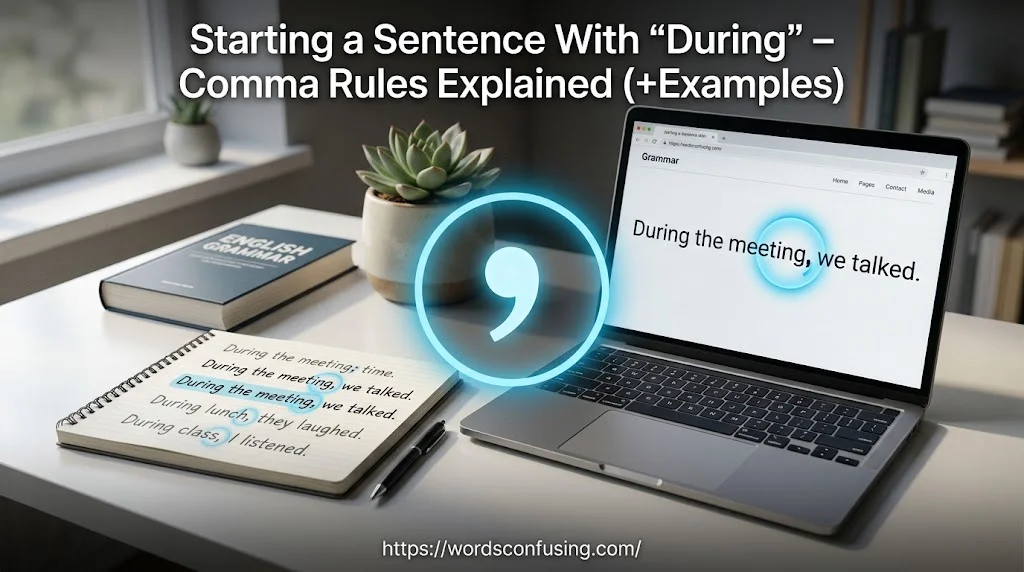
Starting a Sentence With “During” Comma Rules Explained shows how punctuation works when “during” opens a sentence with a time phrase.
Starting a sentence with during often introduces an introductory phrase that gives time or context before the main clause. For example, you might begin with an opening phrase that provides information before the main thought.
The interesting part is how style affects the choice. In my experience, checking how the opening phrase connects to the rest of the sentence makes the correct punctuation easier to identify.
This article helps explain how commas work after “during” and how grammar and usage can influence the choice. If you’re looking for clear answers, focus on whether the opening phrase forms a complete introductory unit and whether the pause improves readability.
“During” can establish a specific period or time before the sentence presents its main idea. Good writing supports the meaning instead of distracting the reader, helping you understand when a comma belongs after an opening “during” phrase.
Quick Answer
Yes, you can start a sentence with “during.” When during introduces a time phrase at the beginning, a comma usually follows the complete phrase, especially when it’s long or needs a clear pause.
Example: During the meeting, we discussed the new project.
Remember, during normally comes before a noun or noun phrase. If you want to introduce a subject and verb, use while instead: While we were meeting, we discussed the new project.
Is It Correct to Start a Sentence With “During”?
Yes. You can absolutely start a sentence with “during.”
There is no general grammar rule that says a sentence cannot begin with this preposition. In fact, starting with during often creates a natural way to establish when something happened.
Consider these examples:
- During the meeting, the manager explained the new policy.
- During the summer, the town becomes much busier.
- During the interview, the candidate discussed her experience.
- During the storm, several roads became flooded.
- During dinner, we talked about our travel plans.
In each sentence, during introduces a phrase that establishes a time or period.
The basic pattern looks like this:
During + noun/noun phrase + main clause
For example:
During the conference, researchers presented their findings.
Here, during the conference tells you when the researchers presented their findings.
The phrase doesn’t form the complete sentence by itself. It provides context for the independent clause that follows.
Why Start a Sentence With “During”?
Starting with a time phrase can make your writing more organized. Instead of dropping the time information into the middle of the sentence, you establish the setting first.
Compare:
The employees discussed the problem during the meeting.
With:
During the meeting, the employees discussed the problem.
The first version gives the action first. The second version establishes the timing before presenting the action.
Neither structure is inherently better. Your choice depends on what you want readers to notice first.
When the timing matters, beginning with during can create a smoother transition.
Do You Need a Comma After “During” at the Beginning of a Sentence?
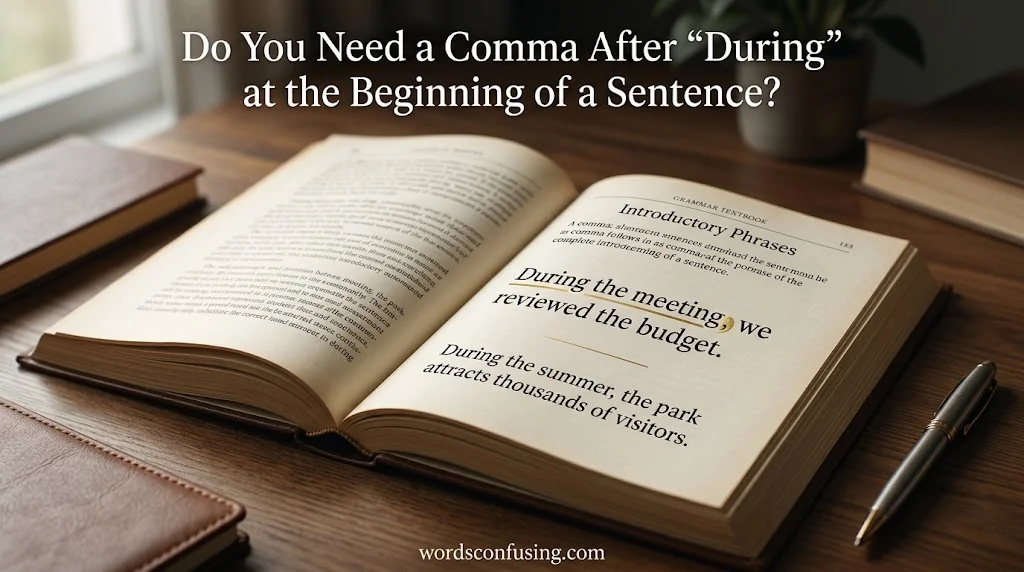
Usually, you should place a comma after the complete introductory “during” phrase, especially when that phrase is substantial or clearly introductory.
The important point is this:
The comma does not go immediately after “during.”
Incorrect:
During, the meeting became tense.
Correct:
During the meeting, the discussion became tense.
The phrase during the meeting works as a complete introductory prepositional phrase. The comma separates that introductory information from the main clause.
Here’s another example:
During the final week of the semester, students submitted their projects.
The comma comes after semester, not after during.
The same pattern appears in longer sentences:
During the first few months of the company’s expansion, the management team hired several new employees.
The entire phrase during the first few months of the company’s expansion functions as the introductory element. The comma follows the complete phrase.
The Basic Comma Pattern
You can remember the structure like this:
During + noun phrase, + main clause.
Examples:
- During the meeting, we reviewed the budget.
- During the summer, the park attracts thousands of visitors.
- During the ceremony, the graduates received their certificates.
- During the renovation, customers used another entrance.
The comma marks the boundary between the opening context and the main idea.
When to Use a Comma After an Introductory “During” Phrase
A comma is particularly useful when the opening during phrase is long, detailed, or clearly sets the scene.
Long or Detailed Introductory Phrases
Long opening phrases can become difficult to process without punctuation. A comma gives readers a small visual pause before the main clause begins.
For example:
During the final meeting before the company’s annual review, the directors discussed the financial results.
The opening phrase contains several pieces of information:
- the event: meeting
- the timing: final
- the relationship: before the company’s annual review
The comma makes the structure easier to recognize.
Another example:
During the first few weeks of the new training program, employees received daily feedback from their supervisors.
Without the comma, the sentence feels crowded:
During the first few weeks of the new training program employees received daily feedback from their supervisors.
The sentence isn’t difficult to understand, but the comma creates a cleaner boundary.
When the Phrase Clearly Sets the Time
A comma also works naturally when during introduces a phrase that establishes the time or circumstances for the main action.
For example:
During the winter months, electricity use often increases.
The reader immediately understands the time frame before reaching the main statement.
Similarly:
During the interview, the applicant explained how she solved the problem.
The opening phrase answers the question when?
That makes the comma useful because it separates the time-setting information from the central action.
When the Comma Improves Readability
Grammar isn’t only about rules. Good punctuation also helps readers process information quickly.
Imagine reading this:
During the long meeting about the company’s proposed changes to its employee benefits program the staff raised several concerns.
The opening phrase is lengthy. A comma provides a natural break:
During the long meeting about the company’s proposed changes to its employee benefits program, the staff raised several concerns.
The comma doesn’t change the basic meaning. It simply makes the sentence easier to navigate.
Think of the comma as a small road sign. It tells your reader, “The introductory information ends here. The main point starts now.”
When You May Omit the Comma After “During”
Not every short introductory phrase needs a comma in every writing style.
Short phrases can sometimes connect so closely to the main clause that writers omit the comma.
For example:
During winter many trees lose their leaves.
You may also see:
During winter, many trees lose their leaves.
The second version provides a clearer pause and is often preferred for readability. However, punctuation choices can vary with sentence rhythm, editorial style, and context.
Another example is:
During class students should keep their phones away.
Some writers may prefer:
During class, students should keep their phones away.
The comma makes the sentence immediately easier to scan.
Why Short Phrases Cause Confusion
Writers sometimes assume that every introductory phrase must receive a comma. Others make the opposite mistake and remove every comma after a short phrase.
Neither approach works perfectly.
Consider the difference:
During the meeting we reviewed the report.
During the meeting, we reviewed the report.
Both versions are easy to understand. The second gives the introductory phrase a clearer separation.
Now consider a longer example:
During the meeting held on Friday afternoon to discuss the proposed changes, we reviewed the report.
Here, the comma becomes much more useful because the opening phrase carries more information.
A practical approach is to ask:
Would the sentence become easier to read with a pause after the opening phrase?
If yes, a comma is often a sensible choice.
“During” vs. “While”: The Key Grammar Difference
One of the biggest mistakes involving during happens when writers treat it like while.
The two words can express overlapping time relationships, but their grammar differs.
“During” Takes a Noun or Noun Phrase
The standard pattern is:
during + noun/noun phrase
Examples:
- during the meeting
- during lunch
- during the summer
- during the concert
- during the interview
- during the holiday
- during the construction
- during my childhood
For example:
During lunch, we discussed the project.
Here, lunch is a noun.
“While” Introduces a Clause
The usual pattern is:
while + subject + verb
Examples:
- while we were eating
- while she was driving
- while they worked
- while I was studying
- while he waited
For example:
While we were eating, we discussed the project.
The phrase while we were eating contains a subject, we, and a verb phrase, were eating.
That’s why this sentence works.
Compare the Two Structures
| Using “During” | Using “While” |
| During dinner, we talked. | While we were eating dinner, we talked. |
| During the meeting, she took notes. | While we were in the meeting, she took notes. |
| During the trip, they took photographs. | While they were traveling, they took photographs. |
| During the storm, the lights went out. | While the storm was passing, the lights went out. |
| During the interview, he answered questions. | While he was being interviewed, he answered questions. |
The meaning can overlap, but the grammatical structure changes.
Can You Say “During I Was…”?
Generally, no.
This is one of the most common errors involving during.
For example:
❌ During I was working, she called me.
The problem is structural. During normally cannot introduce the full clause I was working.
Use while instead:
✅ While I was working, she called me.
Or restructure the sentence around a noun:
✅ During my workday, she called me.
The difference becomes clearer when you break down the grammar.
During works with a noun:
during my workday
While works with a clause:
while I was working
That distinction solves many punctuation and grammar problems at once.
Comma Rules for “During” + Noun Phrase
The word during can introduce several types of noun phrases. The grammatical structure stays basically the same.
During + Event
When during introduces an event, you can use a comma after the complete phrase.
Examples:
- During the meeting, we discussed the budget.
- During the ceremony, the students received their awards.
- During the interview, the manager asked several questions.
- During the concert, the audience remained remarkably quiet.
- During the conference, experts presented new research.
The noun following during identifies the event.
During + Period
You can also use during with a period.
Examples:
- During the summer, temperatures can rise quickly.
- During the winter, many roads become icy.
- During the 1990s, internet access expanded rapidly.
- During the holiday season, stores often extend their hours.
- During the first year, the company focused on customer growth.
Here, the phrase establishes a broader time frame.
During + Activity
During can introduce an activity or occasion.
Examples:
- During dinner, we discussed the trip.
- During class, students completed an exercise.
- During practice, the team worked on defensive drills.
- During lunch, the employees talked informally.
- During training, workers learned the new procedure.
These sentences all follow the same fundamental pattern.
During + Possessive or Modified Noun
You can also add possessives and modifiers.
Examples:
- During my first year, I learned several important lessons.
- During John’s presentation, the audience asked questions.
- During the company’s expansion, the staff doubled.
- During her childhood, she lived near the coast.
- During the final stage of the project, the team discovered an error.
The phrase can become quite detailed, but during still introduces a noun phrase.
Examples With and Without the Comma
Comma placement becomes easier when you compare examples side by side.
| Sentence | Comma Choice | Why |
| During the meeting, we discussed the budget. | Recommended | Clear introductory time phrase |
| During lunch we discussed the project. | Possible in some styles | Short and closely connected |
| During the final meeting of the year, we reviewed the results. | Recommended | Longer introductory phrase |
| During winter, temperatures often fall below freezing. | Recommended | Clear time-setting phrase |
| During class students should remain quiet. | Possible | Short opening phrase |
| During the ceremony, the award was presented. | Recommended | Natural introductory pause |
| During the first three weeks of training, employees received feedback. | Recommended | Long introductory phrase |
The safest practical habit is simple: when an opening “during” phrase clearly functions as an introductory element, use a comma after the complete phrase.
This especially helps in formal, academic, and professional writing.
When a Comma Changes the Reading Experience
Punctuation can affect how quickly a reader understands a sentence.
Consider:
During the company’s annual conference in Chicago last September employees discussed several changes to the benefits program.
The opening phrase contains several details. The reader must mentally identify where the introductory information ends.
Now add the comma:
During the company’s annual conference in Chicago last September, employees discussed several changes to the benefits program.
The structure becomes much clearer.
The comma tells the reader where the main clause begins.
Shorter Example
Compare:
During dinner we discussed the problem.
During dinner, we discussed the problem.
The second version creates a slight pause. That pause can make the sentence feel more polished.
Neither version creates a dramatic difference in meaning. The choice becomes more noticeable as the opening phrase grows.
A Useful Editing Test
Read the sentence aloud.
If you naturally pause after the introductory during phrase, a comma often makes sense.
However, don’t treat speech alone as an absolute grammar test. Formal punctuation follows established conventions rather than every tiny pause in conversation.
“During” at the Beginning vs. Middle of a Sentence
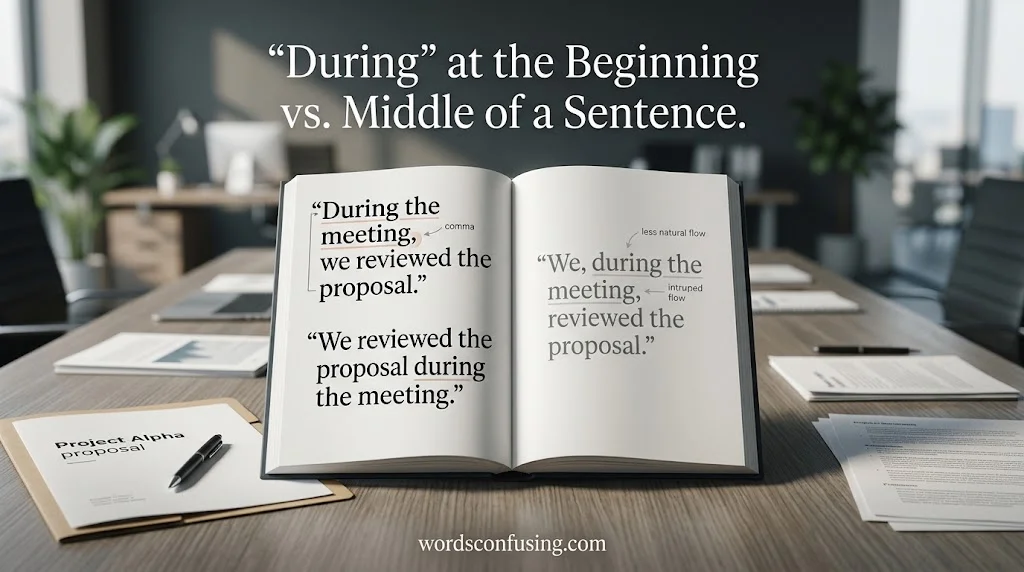
The position of during can change the punctuation pattern.
At the beginning:
During the meeting, we reviewed the proposal.
At the end:
We reviewed the proposal during the meeting.
The second version usually doesn’t need a comma before during because the phrase follows the main clause naturally.
You can also place the phrase in the middle:
We, during the meeting, reviewed the proposal.
Although grammatically possible in certain contexts, this construction sounds unnecessarily interrupted.
A smoother version is:
During the meeting, we reviewed the proposal.
Or:
We reviewed the proposal during the meeting.
Position matters because punctuation follows sentence structure.
Starting a Sentence With “During” in Formal Writing
Introductory during phrases work well in formal writing because they provide context without unnecessary wording.
Academic Writing
During the study period, researchers collected data from three groups.
This structure immediately establishes the relevant time frame.
Another example:
During the final phase of the experiment, researchers recorded temperature changes every five minutes.
The phrase prepares the reader for the main finding.
Business Writing
During the quarterly meeting, the management team reviewed sales figures.
This approach sounds direct and professional.
Professional Emails
During our call, you mentioned several concerns about the schedule.
This sentence works particularly well because it establishes context before referring to the previous conversation.
Reports
During the reporting period, customer complaints declined significantly.
The opening phrase quickly establishes the relevant time frame.
Everyday Writing
During dinner, my brother told us about his new job.
There’s nothing overly formal about the construction. It’s common in ordinary conversation and storytelling.
Common Mistakes When Starting a Sentence With “During”
Understanding what not to do can make the correct pattern much easier to remember.
Using “During” Before a Full Clause
Incorrect:
❌ During she was driving, her phone rang.
Correct:
✅ While she was driving, her phone rang.
Or:
✅ During her drive, her phone rang.
The first correction uses while + clause. The second changes the clause into a noun phrase.
Adding a Comma Immediately After “During”
Incorrect:
❌ During, the students completed their assignments.
Correct:
✅ During the class, the students completed their assignments.
The word during needs the noun or noun phrase that completes its meaning.
Adding an Unnecessary Comma Inside the Phrase
Incorrect:
❌ During the meeting, the manager, explained the new policy.
Correct:
✅ During the meeting, the manager explained the new policy.
The second comma incorrectly separates the subject from the verb.
Creating an Incomplete Sentence
Incorrect:
❌ During the conference.
That is a phrase, not a complete sentence.
You need an independent clause:
✅ During the conference, researchers presented their findings.
Or:
✅ Researchers presented their findings during the conference.
Making the Opening Phrase Too Long
Long introductory phrases aren’t automatically wrong. However, excessive detail can bury the main clause.
For example:
During the conference held in Boston during the final week of September after several months of planning by the organizing committee, researchers presented their findings.
The grammar works, but the sentence feels overloaded.
A cleaner version might be:
During the Boston conference in late September, researchers presented their findings.
Good writing doesn’t merely follow grammar rules. It also controls information density.
“During” Sentence Examples: Correct vs. Incorrect
Here are several practical examples that cover common patterns.
Correct Examples
During the meeting, everyone reviewed the new schedule.
During the summer, the park receives thousands of visitors.
During the interview, the candidate explained her previous experience.
During the storm, several neighborhoods lost power.
During lunch, we discussed the upcoming trip.
During the first month of training, employees received weekly evaluations.
During his childhood, he developed a strong interest in music.
During the construction, customers used the temporary entrance.
Each example uses during + noun phrase.
Incorrect Examples
❌ During she was studying, her friend called.
Better:
✅ While she was studying, her friend called.
Another example:
❌ During we traveled through Europe, we visited several museums.
Better:
✅ While we traveled through Europe, we visited several museums.
Or:
✅ During our trip through Europe, we visited several museums.
Now consider incorrect comma placement:
❌ During, the meeting became tense.
Better:
✅ During the meeting, the discussion became tense.
And:
❌ During the meeting, the manager, explained the changes.
Better:
✅ During the meeting, the manager explained the changes.
These mistakes become much easier to spot once you recognize the underlying structure.
A Simple Rule for Starting a Sentence With “During”
If you need a quick rule, remember this:
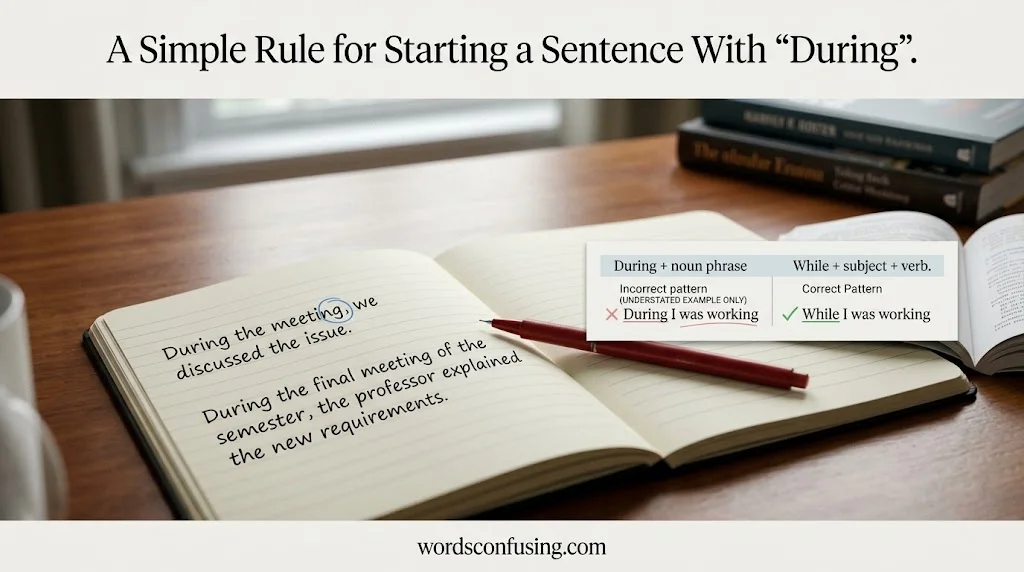
During normally comes before a noun or noun phrase. When that phrase opens the sentence, a comma often follows the complete phrase, especially when the phrase is long or clearly introductory.
For example:
During the meeting, we discussed the issue.
The structure is:
During + the meeting + comma + main clause
For a longer phrase:
During the final meeting of the semester, the professor explained the new requirements.
The structure remains the same.
A Four-Step Editing Method
When you’re unsure about a sentence, use these steps.
First, identify what follows “during.”
Is it a noun or noun phrase?
during the meeting
If yes, the construction is structurally sound.
Second, find the end of the introductory phrase.
Don’t put the comma immediately after during.
During the meeting, …
Third, check the length and clarity.
Longer phrases generally benefit from a comma.
Fourth, check whether “while” would work better.
If the phrase contains a subject and verb, while may be the correct choice.
For example:
During I was working ❌
While I was working ✅
Case Study: Fixing a Confusing Sentence
Consider this sentence:
During the final meeting with the department managers to discuss the upcoming changes employees raised several questions.
The grammar isn’t fundamentally broken, but the lack of punctuation makes the sentence harder to process.
A cleaner version is:
During the final meeting with the department managers to discuss the upcoming changes, employees raised several questions.
The comma separates the lengthy introductory phrase from the main clause.
Now consider another sentence:
During we discussed the upcoming changes employees raised several questions.
This one has two structural problems.
First, during incorrectly introduces the clause we discussed the upcoming changes.
Second, the sentence lacks punctuation between the introductory material and the main clause.
A better version is:
While we discussed the upcoming changes, employees raised several questions.
Or:
During the discussion about the upcoming changes, employees raised several questions.
The second version preserves during by changing the following clause into a noun phrase.
A Quick Comparison: During, While, and For
These three words can sometimes appear in similar contexts, but they don’t serve identical grammatical purposes.
| Word | Typical Structure | Example |
| During | during + noun phrase | During the meeting, we talked. |
| While | while + subject + verb | While we were meeting, we talked. |
| For | for + length of time | We talked for two hours. |
This distinction helps prevent awkward constructions.
You wouldn’t normally write:
❌ During we were meeting…
Instead, use:
✅ While we were meeting…
If you’re describing a duration, use for:
We talked for two hours.
If you’re identifying the event during which something happened, use during:
During the meeting, we talked.
Read more: What Does “Scrub” Mean in Slang? Meaning and Examples
Can “During” Start a Sentence Without a Comma?
Yes, particularly with short introductory phrases, depending on the style and context.
For example:
During winter many birds migrate south.
You may also write:
During winter, many birds migrate south.
The comma provides a stronger separation and may improve readability.
For polished professional or academic writing, adding the comma after a clearly introductory phrase is often the more reader-friendly choice.
Still, avoid turning this into a mechanical rule that says every sentence beginning with “during” must have a comma. English punctuation has context and style considerations.
The more useful principle is clarity first, consistency second.
Why “During” Doesn’t Take a Comma by Itself
A common misconception is that during somehow triggers a comma.
It doesn’t.
The word simply introduces a prepositional phrase.
For example:
During the meeting, we discussed the proposal.
The comma appears because during the meeting functions as an introductory phrase. It doesn’t appear because during requires punctuation immediately after it.
This distinction matters.
Compare:
During the meeting, we discussed the proposal.
with:
During, we discussed the proposal.
The second sentence removes the noun that completes the preposition. The problem isn’t merely punctuation. The phrase itself has become incomplete.
FAQs
1. Do you need a comma after “during” at the beginning of a sentence?
Not always. It depends on how the phrase is structured. A longer introductory phrase often benefits from a comma, while a short phrase may not need one.
2. Can I start a sentence with “during”?
Yes. During commonly begins a sentence when you want to mention when something happened. For example, “During the meeting, we discussed the new schedule.”
3. What is the comma rule for “during”?
The comma usually separates an introductory during phrase from the main clause when that separation improves clarity. The length and structure of the phrase matter.
4. Is “during” an introductory word?
During itself is a preposition, not an introductory word. However, a phrase beginning with during can function as an introductory phrase at the beginning of a sentence.
5. Is a comma required after every sentence that starts with “during”?
No. A comma isn’t automatically required simply because during appears first. Look at the complete introductory phrase and how naturally it connects to the main clause.
6. What is the easiest way to check the comma?
Read the sentence aloud and identify the opening time phrase. If the comma clearly separates that introductory information from the main thought, it can improve readability.
Conclusion
Starting a sentence with “during” isn’t difficult once you understand how the opening phrase functions. The comma usually helps separate the introductory time information from the main idea, making the sentence easier to read. However, style, sentence structure, and the length of the opening phrase can affect the final punctuation choice.
When you’re unsure, read the sentence aloud and look at where the introductory thought naturally ends. Then check whether the comma creates a useful pause without breaking the sentence unnecessarily. With a little practice, these grammar and punctuation decisions become much more natural.

Shafiq Ur Rehman is a writer and content contributor at WordsConfusing.com. He enjoys exploring the English language, common word confusions, vocabulary, and practical writing tips. His goal is to make English easier to understand through clear, simple, and useful articles.